South Yorkshire Police Have Another Coloured Horse
It wasn’t a bad day for a ride and as they did at Barnsley, the Police gave the horses some exercise.
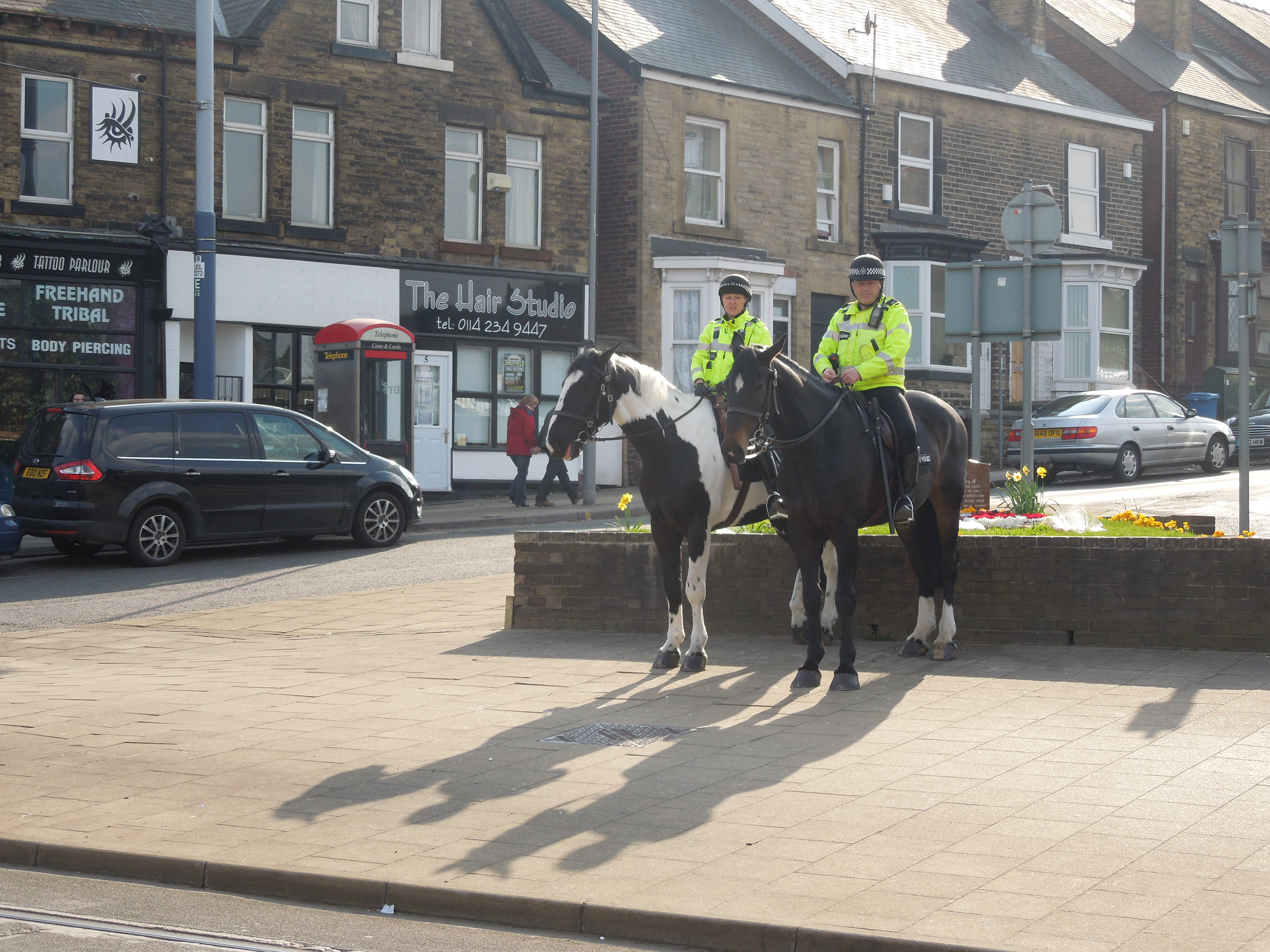
Police Horses At Hillsborough
it’s nice to see that the South Yorkshire Police doesn’t seem to mind what colours their horses are. This one doesn’t appear to be the one I saw earlier in the season. Incidentally, I can’t remember seeing a grey police horse for many years. But then to groom a grey so that it looks good, is a lot of hard work.
The Carriages Of Seville
Seville has some of the best carriages for tourists, that I’ve found, with the possible exception of Vienna.

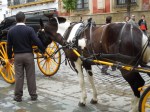
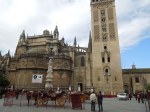
Seville incidentally was the only place that C and I ever had a ride in a horse-drawn carriage together. In fact, I think, it was the only place she ever rode in one.
Equine Research Day at Leahurst
The purpose of my trip to Leahurst was to go a series of presentations, about the work of the equine work of the School of Veterinary Science at Liverpool University.
It was a comprehensive series of talks, ranging across the whole field of equine welfare research.
One of the biggest areas talked about was colic and how to prevent it. I was quite surprised at how much of the research was done using computers to analyse databases of incidences of colic and other collected and observed data. I always believed that analysis of events is a very powerful tool to getting to the bottom of problems and my software; Daisy, has been used in numerous applications, although it’s all stagnated a bit, due to my illness.
There was also a presentation on obesity in horses, which is just as serious for them, as it is for humans.
But in some ways the biggest surprise was all the work done on arthitis in horses and humans, which is being funded in part by Arthritis Research UK. The aim is to learn more about this disease and be able to diagnose it earlier in all animals.
I believe they are putting the presentations on the Internet and I will link to them, when they are available.
Mother Knows Best
Yesterday, Slummy Mummy in The Times had two interesting thoughts courtesy of her mother.
The first was an absolute gem.
Since it’s people in towns who like badgers, we should exchange them for urban foxes.
Now that’s an idea! But it might get rid of the last few urban hedgehogs. The second was a sensible aside on the subject of horsemeat.
You’ll be glad to know that everything is shop-bought,” she says, opening the fridge door with a flourish. It is full of Findus lasagnes.
“They were on offer. I got them before they were withdrawn
I bet she’s not the only one who took advantage.
Germany’s Development Minister’s Marie Antoinette Moment
Marie Antoinette famously set that people could eat cake, but this story from Germany, is in a similar vein.
Germany’s development minister has suggested that horsemeat mislabelled as beef should be distributed to the poor.
Dirk Niebel said he supported the proposal by a member of the governing CDU party, and concluded: “We can’t just throw away good food.”
The opposition dismissed the idea, but a priest said it should be considered.
He does have a point, but surely the suspect beef could be used as dog or cat food, rather than given to those, who might not want it.
After all if it has horse in it, what other things are there. I bet there’s a load of gluten for a start.
It’s A Pig Of A Job, But Someone’s Got To Do It
I saw this story about a pig being used to train firefighters, in The Times, but it is also here in the Daily Mail.
I’m reminded of the time C and myself caught an escaped pony and Suffolk Police turned up as they had had reports of damage to flower beds being caused by the escapee. At the time, the police used Escort vans for local officers and we almost convinced him to put it in the back to take it to the station.
So perhaps, animal training is something that is now more common with the Fire and Police Services.
Saving Babies By Breastfeeding
I don’t know much about breastfeeding babies, but this report on Sky has a lot of sense to it. This is the first bit.
The lives of 95 babies could be saved every hour if mothers started breastfeeding their newborns in the hour after their birth, a charity has said.
Receiving a mother’s first milk within an hour will kickstart the child’s immune system, making a newborn three times more likely to survive, according to a report by Save the Children.
I should say, that as someone, who knows about breeding racehorses, that you always get the new born foal to have the first feed as it’s the best.
My stud groom would also milk the dead mare and give that to the foal in a bottle, if she had sadly died in the foaling.
When Did We First Test For Horse DNA In Beef?
This may seem to be an obvious question, but I can’t seem to be able to find the answer on the Internet.
There is also the related question of when were we able to test for equine DNA in beef?
After all, if we’ve been able to do this for some years, could we have detected the fact that crooks were putting horse in beef earlier? And then there’s how long has it all been going on?
Perhaps, we should ask people if they find a Findus beef lasagne or any of the other suspect products in the freezer with a date of last year, they should take it to get tested.
Apparently, It’s Romanian Horsemeat!
According to this report on the BBC, the horsemeat at the heart of your burgers and lasagne is of Romanian origin.
What the article doesn’t say is that the reason why horses are being killed in Romania because they are now no longer allowed on the road. This was said by an expert on the BBC News.
So these horses and our consciences are the victims of a Road Safety campaign in Romania.
At least the horses are dead before they are transported all the way across Europe. This couldn’t always be said for some of the meat we export, as it is exported live, so that the recipients can say it is locally killed.
It just shows how stupid everybody involved is, as to take a given number of animals to somewhere in Europe, takes three animal trucks or one refrigerated one. I’ve also taken a competition horse all the way from Suffolk to Scotland, and this needs stops on the way and a good rest in a field or large stable with lots of straw at the end, to make sure the animal is in the correct state to compete.
A farmer friend, who rears top quality meat for Waitrose and others, told me that, the law should be that all meat should be shown as EU-killed in the shop, so that the French, Greeks and Italians, couldn’t say it was locally-killed.
But then when did the EU do something sensible, where animal welfare is concerned.
The Other Side Of French Horsemeat
We may get worried about horsemeat appearing in burgers and lasagne, but I don’t think that those like me, who choose their food with care, have much to worry about, as I said here.
But one point about the French and horsemeat has been quietly forgotten. The French, like we do, love their heavy horses. And coming from Suffolk, you don’t forget that horses like the Suffolk Horse are on the endangered list. Quite frankly, they are just so expensive to keep!
The French have a pragmatic solution to keeping their heavy horses alive.
They eat them!
I remember an article in the equine press some years ago, which said that the French heavy horses, were in much better health than the British ones, precisely because of their role in the meat trade.
 The Anonymous Widower