Kent On The Cusp Of Change – Highspeed Routes
The Kent On The Cusp Of Change article in the July 2017 Edition of Modern Railways talks about the Southeastern Highspeed routes through Kent.
Some principles are laid down.
- All six-car services would be extended to twelve-car services.
- Trains could be divided at Ashford International station to serve multiple destinations.
- Maidstone West station would get an hourly Off Peak service.
The article gives an estimate that at least another twenty Class 395 trains are needed of which perhaps three would have batteries for operation along the Marshlink Line between Ashford International and Ore stations.
The new timetable proposed in the article is similar to that now, with the following changes in each hour.
- All Day – A St. Pancras – Ashford – Dover Priory service runs once per hour and splits at Ashford with one six-car train going to and from Hastings and the other six-car train going to and from Dover Priory.
- Off Peak – A new St. Pancras – Ashford – Canterbury West service runs once per hour.
- All Day – A new St. Pancras – Ebbsfleet service runs twice per hour.
- Off Peak – A new St. Pancras – Gravesend – Strood – Maidstone West service runs once per hour.
In addition all trains passing Thanet Parkway station will stop after it opens.
The Fawkham Junction Link
The article talks about reinstating this link , which connects the Chatham Main Line to Ebbsfleet International station and High Speed One.
I wrote about this link in a related post called Fawkham Junction Link, which shows how it can be used to create additional Highspeed services between London and Thanet.
- Victoria becomes a second terminal for Highspeed services.
- Victoria gets a Highspeed connection to Ebbsfleet International and Ashford International stations for Eurostar.
- Most if not all of the Thanet services become Highspeed services.
- Thanet services are faster with more capacity.
Obviously, Network Rail and the TOCs (train operating companies) have some cunning plan to use the Fawkham Junction Link.
Should All Victoria To Thanet Services Be Run By Highspeed Trains?
In my trip to Longfield Station, I came back iat a leisurely pace in a Class 465 train, that had started at Dover or Ramsgate.
As the routes to Thanet from Victoria can all be run by twelve-car trains and the platforms in East Kent are accessible to twelve-car Class 377, Class 395 and Class 465 trains, I wonder if Class 395 trains or a train with a similar performance, should run all these routes in an identical manner to the slower trains.
Consider.
- Calls at many stations would only be made by twelve-car Highspeed trains, which must make station design simpler and station stops easier and faster.
- Highspeed trains would be able to take advantage of any line speed improvements on the route.
- Highspeed trains are fitted with modern signalling systems including ERTMS, which would allow more capacity on busy sections of the routes. Between Victoria and Swanley could benefit.
- Crossrail and Thameslink trains already have ERTMS, so this must give advantages, on shared routes.
- A single unified fleet to Thanet must ease servicing and maintenance, which is done currently at Ashford and Ramsgate.
- High Speed One could be used as a diversion route if required.
- Victoria could be used as a diversion for Highspeed services, if there were problems on High Speed One to the West of Ebbsfleet station.
The outcome would surely be that even the Victoria to Thanet stoppers would be several minutes faster.
What would faster services be worth to the new train operating company?
Conclusion
Highspeed services could be increased in frequency and developed to a second terminal at Voctoria.
I wouldn’t be surprised to see all services to Thanet run by a single uinified fleet of Highspeed trains.
See Also
These are related posts.
- Abbey Wood Station
- Ashford Spurs
- Crossrail
- Elimination Of Slow Trains
- Fawkham Junction Link
- High Speed To Hastings
- Historic Routes
- Longfield Station
- Maidstone
- Reading To Tonbridge
- Thameslink
- Thanet Parkway Station
- Track Improvements
- Ultimate Class 395 Train
- Victoria As A Highspeed Terminal
To know more read Kent On The Cusp Of Change in the July 2017 Edition of Modern Railways.
Kent On The Cusp Of Change – Historic Routes
The Kent On The Cusp Of Change article in the July 2017 Edition of Modern Railways talks about the historic routes through Kent.
The existing fleet is being enlarged and updated.
- Class 375 trains are being refurbished.
- More Class 377 trains are arriving and will probably be refurbished.
- Class 465 trains will be transferred to Metro services.
- The Class 707 trains, unwanted by South Western Trains may arrive.
But there are problems, with issues like.
- Depot space,
- The lack of wi-fi.
- Crossrail’s Aventras have 4G and passengers will expect it.
- The Class 465 trains are only 75 mph units.
If we take a quick look at Greater Anglia, they are replacing all their fleet to increase capacity and they are having to build a new depot about half-way from London.
So expect to see a new depot, somewhere in Kent to accommodate the increased fleet.
More Highspeed Trains
I believe that for reasons of better services and efficiency, that a new batch of Class 395 trains or similar will take over some or all historic routes to Thanet.
If this happens, it could also mean, that because Highspeed trains are serviced at Ashford and Ramsgate, depot space was released at the London end of the routes.
A New Fleet Of Trains
I wouldn’t be surprised to see a new fleet of trains joining the fleet for the new South Eastern franchise.
If we look at the characteristics of Bombardier’s new Aventra we see the following.
- Up to 100 or even 125 mph capability.
- Superb interiors.
- Wi-fi and 4G capability.
- Wide doors and lobbies for fast entry and exit.
- Automatic coupling and uncoupling – Hitachi trains do it, so why not other manufacturers?
- Regenerative braking – Is it handled by on-board energy storage?
- Remote train warm-up!
- Improved automation for the driver.
- Less energy usage.
- Modern signalling systems including ERTMS, which is used by Thameslink and Crodssrail.
Judging by my journey on The 10:35 From Liverpool Street To Shenfield, the customer experience is Jaguar to the successful Electrostar’s Ford.
The fast station stops of these modern trains from the major manufacturers means the following.
- Less trains are needed for the same frequency of service.
- The frequency of services can be improved.
- Extra stops can be added with less of a time penalty.
In some cases semi-fast trains can be replaced by trains calling at all stations with no journey time penalty.
The Modern Railways article also hints that we’ll see more joining and splitting of trains to make sure capacity and frequency is tailored to the needs of a particular route.
Terminal Capacity In London
This could become a problem for Southeastern, but certain things can be done.
- Increasing Crossrail and Thameslink capacity.
- Extending Crossrail to Ebbsfleet and/or Gravesend.
- Splitting and joining services.
- Improve signalling to allow trains to run at higher frequencies.
- Cascade or scrap any train that can’t operate at 100 mph to create more paths.
In the long term, the solution is probably to rebuild Charing Cross station across the Thames, so that the platforms can accept three five-car trains working as one unit.
Higher Frequencies On Busy Routes
The North Kent Line from Abbey Wood station eastwards to Ramsgate will get increasingly busy through the Medway towns.
The East Kent Re-Signalling Project will help, but if all trains east of Abbey Wood were modern trains equipped with ERTMS, it would probably be easier to manage the trains, so that frequencies as high as ten trains per hour ran on a substantial part opf the route between Abbey Wood to Rainham stations.
There are probably several places where better signalling and modern trains can increase the frequency of trains.
Conclusion
The historic routes will be improved.
See Also
These are related posts.
- Abbey Wood Station
- Ashford Spurs
- Crossrail
- Elimination Of Slow Trains
- Fawkham Junction Link
- Highspeed Routes
- High Speed To Hastings
- Longfield Station
- Maidstone
- Reading To Tonbridge
- Thameslink
- Thanet Parkway Station
- Track Improvements
- Ultimate Class 395 Train
- Victoria As A Highspeed Terminal
To know more read Kent On The Cusp Of Change in the July 2017 Edition of Modern Railways.
Kent On The Cusp Of Change – Thameslink
The Kent On The Cusp Of Change article in the July 2017 Edition of Modern Railways talks about Kent and Thameslink.
This is said.
Under the Thameslink plans, due to come in next May, are two trains per hour (tph) Maidstone East to Cambridge and 2 tph Rainham to Luton, while the longstanding Sevenoaks via Bat & Ball to Blackfriars service will be extended to Welwyn Garden City in the peaks.
The Rainham to Luton service effectively creates a four tph service through the Medway towns to Abbey Wood, Greenwich, London Bridge and beyond.
The Maidstone East to Cambridge service, also creates four tph between London and Otford.
Onward From Maidstone East
I do wonder if the powers that be, looked at extending the service to Maidstone East station to the well-connected Ashford International station.
Consider.
- With the opening of the Ashford Spurs in Spring 2018, South East London and a lot more of Kent would have good access to Continental services.
- Thameslink would have a Southern access to Thanet to complement the Northern access at Rainham.
- Stations on the Maidstone Line could get four tph.
As Maidstone East to Ashford International takes thirty minutes, I suspect the extra time needed, makes scheduling trains difficult.
On the other hand, the Class 700 trains, probably execute stops faster than the current trains.
Could Thameslink Serve Ebbsfleet International Station?
If the Fawkham Junction Link is reinstated, this is a possibility.
Could A Catford Interchange Improve Thameslink?
The Maidstone East and Sevenoaks services both go through Catford station, which is close to Catford Bridge station.
Transport for London have said several times, that they would like to create a consolidated Catford Interchange station.
If one were to be created, could there be a bit of tidying up of services through the area, in much the same way as Gatwick Airport station acts as an important interchange on the Brighton Main Line?
Could Thameslink Capacity Be Increased?
I feel that Thameslink’s decision to serve Maidstone East and Rainham stations is a good one, but I suspect there are strips of paper on the Timetabling Room floor with other Kent and Sussex stations on them, like Ashford International, Canterbury, Dover, Hastings and Uckfield.
I also think too, that there may be stations, where additional trains could be desirable.
So could the current twenty-four trains through the central core of Thameslink be increased?
I think the answer is probably in the affirmative, as signalling, driver aids and the drivers themselves will get better, as the system develops.
In this article in Rail Engineer entitled Crossrail – approaching the final stages, this is said.
When the new Elizabeth line opens, 24 trains per hour will operate in each direction through the centre of London. The new signalling system will incorporate Automatic Train Operation to support this service, with the capacity for higher frequency of 30 trains per hour in the future. As a consequence, Siemens is installing the Communications-Based Train Control system (CBTC). It is similar to one already successfully installed in Copenhagen, so expectations are high.
So could similar techniques be used in Thameslink to create another six paths an hour.
That would still only be one train every two minutes.
I suspect too, capacity could be increased by lengthening some trains from eight to twelve cars.
Conclusion
Thameslink is very tied up with the Southeastern franchise.
See Also
These are related posts.
- Abbey Wood Station
- Ashford Spurs
- Crossrail
- Elimination Of Slow Trains
- Fawkham Junction Link
- Highspeed Routes
- High Speed To Hastings
- Historic Routes
- Longfield Station
- Maidstone
- Reading To Tonbridge
- Thanet Parkway Station
- Track Improvements
- Ultimate Class 395 Train
- Victoria As A Highspeed Terminal
To know more read Kent On The Cusp Of Change in the July 2017 Edition of Modern Railways.
Kent On The Cusp Of Change – Crossrail
The Kent On The Cusp Of Change article in the July 2017 Edition of Modern Railways talks about Kent and Crossrail.
This is said.
In December 2018, the Elizabeth Line is due to reach its south-eastern terminus at Abbey Wood, where there will be interchange with the North Kent line.
A wide range of new journey opportunities will open up, which over time will influence many choices over work and home locations. A train every five minutes from Abbey Wood to Canary Wharf and central London is expected to have a dramatic effect in North Kent.
The article goes on to say that a working group called Crossrail Gravesend is pushing to extend the Elizabeth Line to Ebbsfleet International station for High Speed One.
Current Services Between London, Abbey Wood And The Medway Towns
Adding together current services at Abbey Wood station as given in Wikipedia with the proposed Thameslink service between Rainham and Luton, which I wrote about in Thameslink To Rainham, gives the following service level at Abbey Wood station.
Westbound;
- 6 trains per hour (tph) to London Cannon Street via Greenwich
- 2 tph to London Charing Cross via Lewisham
- 2 tph to Luton via Greenwich.
All trains will call at London Bridge station, which after rebuilding for Thameslink is complete, will be a formidable interchange to other services, such as the Underground, buses and Shank’s pony.
Londoners tend to think of Crossrail, as London’s most important rail project, but I do think that the rebuilding of London Bridge station in a few years time will be considered the second most important.
In addition, as Abbey Wood will be connected to Crossrail, there must be few places in Central London, to which travel is difficult from Abbey Wood station.
Eastbound;
- 2 tph to Barnehurst via Slade Green returning to London via the Bexleyheath Line
- 2 tph to Dartford
- 2 tph to Gillingham (Kent)
- 2 tph to Rainham (Kent)
- 2 tph to Crayford via Slade Green returning to London via the Dartford Loop Line,
This map from carto.metro.free.fr shows the lines around Dartford station.

Note.
- Barnehurst is on the Bexleyheath Line.
- Cayford station is on the Dartford Loop Line.
- The North Kent Line goes East from Datford station to Gravesend , the Medway Towns and Thanet.
In addition at Abbey Wood station, using their separate platforms and separate tracks to the Crossrail tunnel, 12 tph will be providing the Crossrail service.
Future Services From London To The Medway Towns
Looking at the Southeastern services to Gillingham and the Thameslink services to Rainham, the following can be said
- These are the only services, that go more than a few miles past Abbey Wood station.
- The Gillingham service is a Southeastern Metro service, so probably needs to be run by faster modern trains, rather than the current Class 465 trains.
- The combination of the Gillingham and Rainham services will hopefully give a very passenger friendly train every fifteen minutes between Abbey Wood and Gillingham, via Dartford, Gravesend, Rochester and Chatham.
- The Gillingham service calls at Lewisham, Blackheath, Charlton and Woolwich Arsenal between London Bridge and Abbey Wood.
- The Rainham service calls at Greenwich between London Bridge and Abbey Wood.
I do wonder, if it would be better if the Southeastern service from Charing Cross to Gillingham were to be extended to Rainham and always run by a twelve-car train.
- Rainham is only four minutes further from London than Gillingham.
- Rainham has a twelve-car bay platform.
- Gillingham’s bay platform may not be able to take a twelve-car train.
- Four tph can be handled in a single bay platform.
This would give a high-capacity four tph service between Abbey Wood and the Medway Towns, with two tph from Thameslink and two tph from Southeastern.
But the major factor would be that passengers would surely find it a very easy service to use.
Service Frequencies East Of Dartford
Note that of the eastbound trains, only 6 tph go through Dartford, as the other 4 tph loop back to London.
Between Dartford and Rochester, there is only the 4 tph to Gillingham/Rainham, although they are joined by 2 tph Highspeed trains between Gravesend and Rochester.
It would thus appear that the maximum frequency between Abbey Wood and Rochester is probably 6 tph.
When you consider that the trains through the area, will all be modern trains fitted with the latest ERTMS signalling, handling these numbers of trains and perhaps 4-8 tph for Crossrail between Abbey Wood and Gravesend in the future, will be well below the 24 tph handled by Crossrail and Thameslink in their central tunnels.
The New Track Layout At Abbey Wood Station
Looking at the new track layout at Abbey Wood station, it appears to be very simple with just a reversing siding to the East of the two Crossrail platforms 3 and 4.
Cross-overs appear to be provided so that the following is possible.
- Trains from Crossrail can continue towards Dartford after calling at Platform 4.
- Trains from Dartford can continue towards Crossrail after calling at Platform 3.
It looks to me, that the track layout is designed, so that Crossrail trains can easily run to and from Dartford or any other station that the planners decide is the terminus.
Capacity Between Abbey Wood And Rochester
As the double-track line between Abbey Wood and Rochester with modern signalling can probably handle up to probably 24 tph, there is capacity for a lot of Crossrail trains to go past Abbey Wood.
Suppose Crossrail is extended to Gravesend with 4 tph extended to the new terminal and trains stabled at a new depot at Hoo Junction to the East of the town.
The following frequencies to and from London would apply at various stations.
- Abbey Wood – 10 tph + 12 tph Crossrail
- Belvedere – 10 tph + 4 tph Crossrail
- Erith – 10 tph + 4 tph Crossrail
- Slade Green – 10 tph + 4 tph Crossrail
- Dartford – 6 tph + 4 tph Crossrail
- Stone Crossing – 4 tph + 4 tph Crossrail
- Greenhithe – 4 tph + 4 tph Crossrail
- Swanscombe – 4 tph + 4 tph Crossrail
- Gravesend- 4 tph + 4 tph Crossrail + 2 tph Highspeed
North Kent is going to get a better train service.
Hoo Junction
Hoo Junction, which is a few miles to the East of Gravesend station, has been identified by Crossrail planners, as a suitable area for a depot to serve an extended South-Eastern branch of the line.
Chris Gibbs, in his extensive report on GTR’s performance, suggests that the Hoo Junction area , be used as a depot for Thameslink services to North Kent. I wrote about this in Gibbs Report – Hoo Junction Depot.
In addition, Southeastern are running short of space in Slade Green Depot.
But that’s just the railways.
This report on the BBC indicates that the new Lower Thames Crossing will cross North-South between Gravesend and Hoo Junction.
Should there be a Park-and-Ride station at Hoo Junction?
It would have a four tph service between London and the Medway Towns with a stop at Abbey Wood for Crossrail.
In Gibbs Report – Hoo Junction Depot, I came to the following conclusion.
Crossrail, the Department of Transport, Kent County Council, Network Rail, Southeastern, Thameslink and all other stakeholders and residents should sit round a large table and agree a common long-term philosophy that is in all their best interests for the future.
What happens at Hoo Junction, will be tremendously important to transport infrastructure in the South East of England in general and Kent in particular.
Crossrail To Ebbsfleet International Station
The article talks about extending Crossrail to Ebbsfleet International station, by adding two new tracks through Slade Green and Dartford stations, serving existing stations.
As I showed in the previous section, I think extra tracks are not necessary, as modern signalling can handle the required number of trains with ease. I suspect though, that the 75 mph Class 465 trains will need to be retired from the North Kent Line, as their performance is just not good enough.
The report says this about the connection at Ebbsfleet.
There would be a new station that would have pedestrian access with Ebbsfleet HS1 station and Northfleet on the historic line – this could be the terminus, or the new line might reach as far as Hoo Junction on the east side of Gravesend.
I’ve always felt that Ebbsfleet International station was a logical South-Eastern destination for Crossrail, mainly because of the space at the station for platforms, depots and car parking.
Consider.
- St. Pancras station may have too few platforms for Continental services in the future, so Ebbsfleet International may end up being a terminus for some of these services.
- Southeastern is developing the Highspeed commuter services to East Kent and East Sussex, which probably need a connection to Crossrail and/or Thameslink.
- The Fawkham Junction link connects Swanley and Ebbsfleet International stations, and it could be used by extra Highspeed services or Thameslink.
I’ve always felt that there’s a simple solution in there, but vested interests and politicians seem to stop railway planners from finding it.
So why not use upgrade Northfleet station with the following features?
- The ability to accept the services along the North Kent Line – 4 tph + 4 tph Crossrail
- The ability to accept twelve-car trains.
- A pedestrian link to Ebbsfleet International station based on something a bit sexy. Perhaps a fast travelator or some other form of people mover.
This Google Map shows that there is plenty of space between the stations.
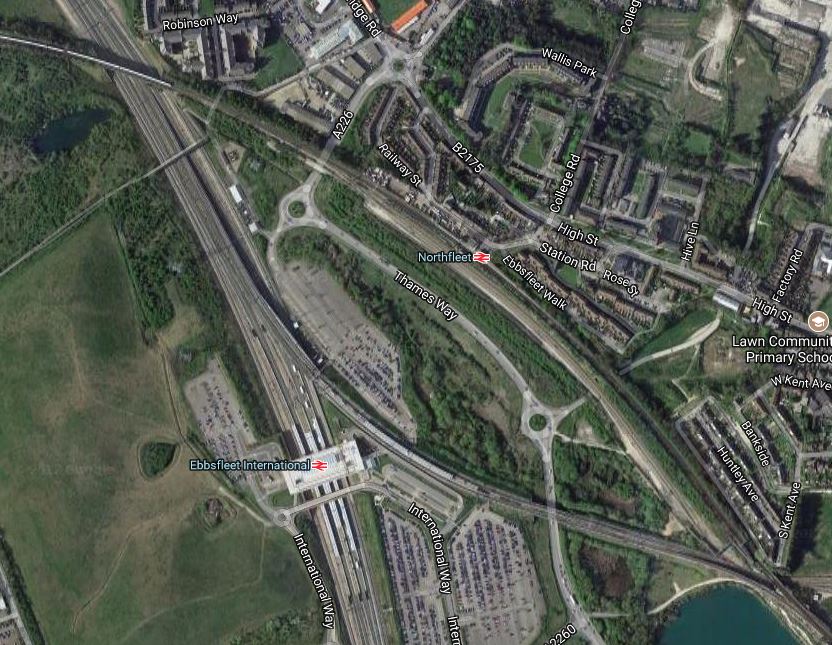
Northfleet station is to the North-East of Ebbsfleet International station.
Could it be that a simple solution would work?
- Belvedere, Erith, Slade Green, Dartford, Stone Crossing, Greenhithe and Swanscombe become Crossrail and North Kent stations.
- Northfleet station is connected to Ebbsfleet International station in a passenger-friendly way.
- The four tph service through the Medway towns to London Bridge continue and are better-integrated with Thameslink at London Bridge.
- The Swanley link to Ebbsfleet is reopened to allow more service opportunities.
But then what do I do know?
Is Abbey Wood Station A Cross-Platform Interchange?
One thing that the Modern Railways article says, is that Abbey Wood station has been designed with cross-platform interchange, in such a way that any delays to Kent services don’t have any knock-on effects on the new services.
The Modern Railways article says that Abbey Wood station is a cross-platform interchange, as do other articles.
This map from carto.metro.free.fr shows the layout of lines at Abbey Wood station.
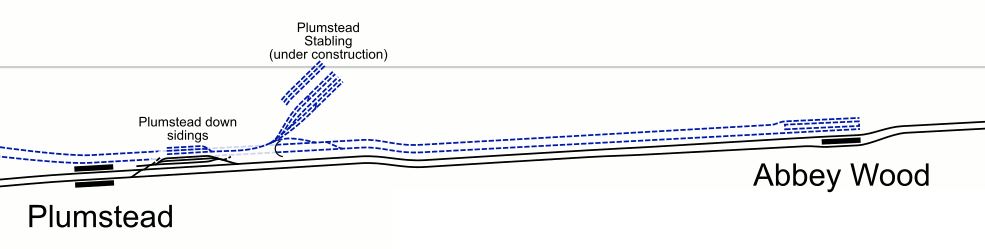
Compare this with this track layout, that I posted in Abbey Wood Station – 29th August 2016.
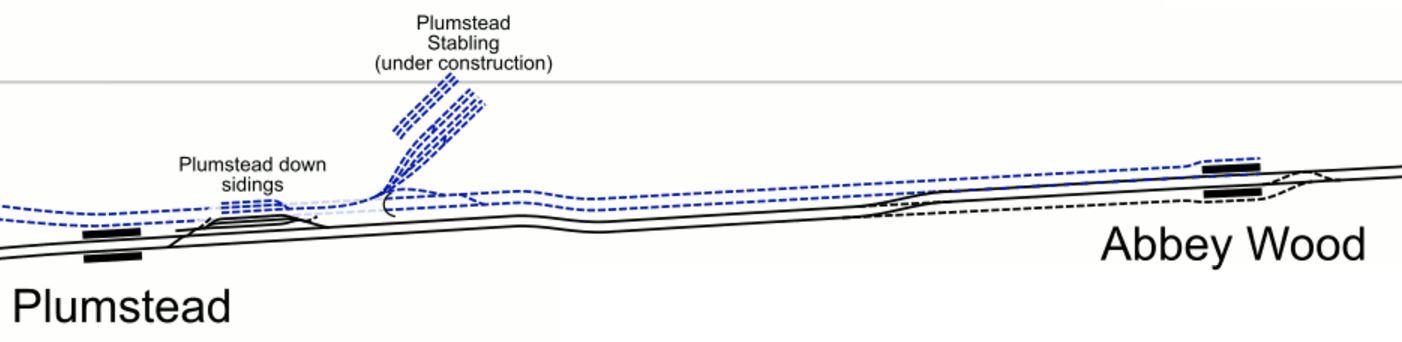
Note the following.
- The older layout shows cross-platform interchange.
- The current one has two pairs of platforms, with Platforms 3 and 4 for Crossrail and Platforms 1 and 2 for other services.
- The current layout probably connects better to the existing lines to Dartford.
These pictures were taken on the 28th June 2017.


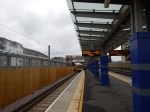


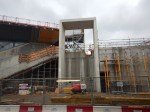
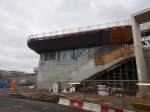

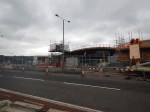




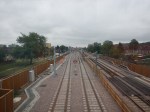


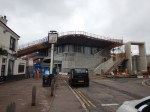
They show a similar layout, of two Northern platforms (3 & 4) for Crossrail and two Southern platforms (1 & 2) for all other services.
Note.
- The two cross-overs to the West of Abbey Wood station to get the Crossrail trains to and from the right platforms.
- The station building and the two footbridges over the lines.
- The solid wooden fence between the two pairs of lines.
- The robust nature of the overhead wiring.
I suspect, that if they had wanted to have Eastbound and Westbound lines each share an island platform, it would have required a flyover, which would have been a large expense.
But at least with this layout, Crossrail trains can have their own pair of lines to the East, running to the North of the current tracks. The Modern Railways article says this.
Mindful of this, the working group is proposing two new dedicated tracks for the extension, running alongside the line through Slade Green and Dartford, with platforms serving the existing stations.
This Google Map shows the route through Dartford.

In some places putting in two extra tracks would be very difficult and extremely expensive and very disruptive to local residents.
Given the capabilities of modern signalling, now being demonstrated on Thameslink in Central London, I believe that something practical for the train companies and friendly for the passengers will emerge.
But one thing is certain. There will not be cross-platform interchange between Crossrail and other services at Abbey Wood station.
Interchange Between North Kent Services And Crossrail
I have a feeling, that this will come down to personal preferences.
After the opening of Crossrail to Abbey Wood in 2018 and the opening of Thameslink to Rainham, passengers will probably have to use Abbey Wood, where it will be an up-and-over via escalators, lifts or stairs.
If and when Crossrail is extended to Gravesend, any of Abbey Wood, Dartford and Gravesend, could be used as a same-platform interchange.
It would also be possible to take a Highspeed service from Ramsgate and change to Crossrail at Gravesend. Would this avoid the extra charge for High Speed One?
I think that Gravesend could become the interchange of choice, as it could have the following London-bound trains, if Crossrail is extended.
- 2 tph – Thameslink to Luton
- 2 tph – Southeastern to Charing Cross
- 2 tph – Highspeed to Ebbsfleet International, Stratford international and St. Pancras.
- 4 tph – Crossrail
There could be a need to improve the platforms to cope with the increase of passenger numbers.
Conclusion
Crossrail will get very involved with the new Southeastern franchise.
See Also
These are related posts.
- Abbey Wood Station
- Ashford Spurs
- Elimination Of Slow Trains
- Fawkham Junction Link
- Highspeed Routes
- High Speed To Hastings
- Historic Routes
- Longfield Station
- Maidstone
- Reading To Tonbridge
- Thameslink
- Thanet Parkway Station
- Track Improvements
- Ultimate Class 395 Train
- Victoria As A Highspeed Terminal
To know more read Kent On The Cusp Of Change in the July 2017 Edition of Modern Railways.
Kent On The Cusp Of Change – Reading To Tonbridge
The Kent On The Cusp Of Change article in the July 2017 Edition of Modern Railways talks about reopening a service between Reading and Tonbridge stations.
This is said.
Kent County Council has recommended the restitution of through services to Reading, as existed many years ago when the route was operated by ‘Thumper’ stock. The council says that consideration should be given to a future option of providing a through Ashford – Tonbridge – Redhill – Gatwick – Redhill – Guildford – Reading service, potentially as a joint operation between the Great Western Railway (GWR) and South Eastern franchises.
This could build on the existing service level between Reading and Gatwick provided by GWR, and would link together several of the major towns of the south-east region with each other and with their local international airport.
The introduction of bi-mode rolling stock now being deployed across the railway network would resolve the problem of gaps in the electric power system on sections of this route.
In The East-Facing Bay Platforms At Reading Station, I talked about using trains with batteries to perform this service and considered it feasible.
I still do, but then bog-standard bi-mode trains might be a better option in terms of cost.
I also believe that a Reading to Ashford service via Gatwick Airport would be a very valuable route with the following connections.
- Wales and the West at Reading station.
- Gatwick Airport
- Hastings at Tonbridge station.
- Rail services to the Continent at Ashford station.
I also think, that once more Continental services stop at Ashford, as I indicated in Ashford Spurs, that this rail link could be one of those rail routes where usage is way about any forecast.
Conclusion
Given Gatwick Airport’s ambititious plans, I rate an Ashford to Reading service as a high possibility.
See Also
These are related posts.
- Abbey Wood Station
- Ashford Spurs
- Crossrail
- Elimination Of Slow Trains
- Fawkham Junction Link
- Highspeed Routes
- High Speed To Hastings
- Historic Routes
- Longfield Station
- Maidstone
- Thameslink
- Thanet Parkway Station
- Track Improvements
- Ultimate Class 395 Train
- Victoria As A Highspeed Terminal
To know more read Kent On The Cusp Of Change in the July 2017 Edition of Modern Railways.
Kent On The Cusp Of Change – Thanet Parkway Station
The Kent On The Cusp Of Change article in the July 2017 Edition of Modern Railways talks of the Thanet Parkway station.
The article says this about the station.
Thanet Parkway, a new station on the East side of Ramsgate, is one infrastructure investment that is steaming ahead. Due to open in 2020, the aim is that the new station will be launched with a reduced journey time from Thanet to London.
Currently, the fastest services between London and Ramsgate take seventy-five minutes.
As Ramsgate station, gets three Highspeed trains per hour to London, I could envisage a very passenger-friendly service of four trains per hour between St. Pancras and Thanet Parkway.
The only section of line between Thanet Parkway and London, that is not high speed line, would be the section East of Ashford station.
I wonder what times to Canterbury, Thanet Parkway, Ramsgate and Margate could be achieved if this section were to be improved.
I suspect somewhere between sixty and seventy minutes between St. Pancras and Thanet Parkway is possible.
Conclusion
Thanet Parkway seems to be a well-planned new station, as many new stations seem to be.
See Also
These are related posts.
- Abbey Wood Station
- Ashford Spurs
- Crossrail
- Elimination Of Slow Trains
- Fawkham Junction Link
- Highspeed Routes
- High Speed To Hastings
- Historic Routes
- Longfield Station
- Maidstone
- Reading To Tonbridge
- Thameslink
- Track Improvements
- Ultimate Class 395 Train
- Victoria As A Highspeed Terminal
To know more read Kent On The Cusp Of Change in the July 2017 Edition of Modern Railways.
Kent On The Cusp Of Change – Highspeed To Hastings
The Kent On The Cusp Of Change article in the July 2017 Edition of Modern Railways talks about running Southeastern Highspeed services to Hastings.
In Options For High Speed To Hastings, I laid out the four possibilities of giving Hastings station a fast service in around a projected seventy minutes to St. Pancras.
- Electrify Ashford To Hastings At 25 KVAC
- Electrify Ashford To Hastings At 750 VDC
- Use Class 802 electro-diesel trains
- Use Class 395 Or Class 801 trains with batteries
I discounted the first two and the current Modern Railways article discounts the third, as there might be problems with diesel tanks in the tunnels under London.
So it looks like, it will be up to the engineers at Hitachi to come up with a train with enough battery power to go between Ashford International and Ore stations.
The article also says that there will be one train per hour (tph) between London and Ashford, which will split and join automatically at Ashford, with one six-car section going to Hastings and the other reinforcing services to Dover.
I discuss the track layout changes needed at Ashford International in Track Improvements.
Onward To Eastbourne And Brighton
Some early reports about running Highspeed services to Hastings, also talked about running a better service along the South Coast to Eastbourne and possibly Brighton.
The Class 395 trains could turn-back further to the West, but this would require more expensive new Class 395 trains.
On the other hand, there are some 100 mph modern electric multiple units like the Class 377 trains, that could provide a quality service from Hastings to Brighton. I also think it would be possible to arrange a cross-platform interchange at Hastings.
This would also get round the problem of the relationship between the two franchises, who each run one service.
I estimate that based on the seventy minutes Hastings to London time, I’ve read in various sources, the following times would be possible.
- Eastbourne to St. Pancras – One hour and forty-one minutes.
- Brighton to St. Pancras – Two hours and twenty-eight minutes.
These compare with a current Eastbourne to Victoria time of one hour and twenty-seven minutes.
Conclusion
This will happen, otherwise Amber Rudd will have someone’s guts for garters.
See Also
These are related posts.
- Abbey Wood Station
- Ashford Spurs
- Crossrail
- Elimination Of Slow Trains
- Fawkham Junction Link
- Highspeed Routes
- Historic Routes
- Longfield Station
- Maidstone
- Reading To Tonbridge
- Thameslink
- Thanet Parkway Station
- Track Improvements
- Ultimate Class 395 Train
- Victoria As A Highspeed Terminal
To know more read Kent On The Cusp Of Change in the July 2017 Edition of Modern Railways.
Kent On The Cusp Of Change – Ashford Spurs
The Kent On The Cusp Of Change article in the July 2017 Edition of Modern Railways talks of the Ashford Spurs.
Not a new Kentish football team, but possibly one of the most important developments in Kentish railways in the last couple of years.
Eurostar’s Class 373 And Class 374 Trains
Eurostar are replacing their original fleet of Class 373 trains, with smart new Class 374 trains.
The Class 373 trains were built in the 1990s and were designed to run on both high speed and traditional lines and they had signalling systems to allow this.
Wikipedia says this about Class 373 Signalling Systems.
The class have multiple signalling systems, leading to a cluttered control desk. These include
-
Automatic Warning System, the British signalling system (induction-based), used in the Ashford area
-
Train Protection & Warning System, the warning system that supplements AWS, used in the Ashford area
-
Transmission Voie-Machine (TVM), used on lignes à grande vitesse, on Eurotunnel tracks, and on High Speed 1.
-
Contrôle de vitesse par balises, used between Paris Gare du Nord and the LGV Nord, on French lignes classiques and the HS1-connected throat around St Pancras. It is electro-mechanical with fixed radio beacons.
-
TBL, the Belgian signalling system (electro-mechanical), used between Brussels-South and HSL 1, Belgium.
Perhaps this is why multi-tasking is needed to be a train driver.
On the other hand, the Class 374 trains have just one signalling system, that can be used in the UK, France, Belgium, the Netherlands and Germany. And that is just for starters. Wikipedia says this about the operation of the two trains.
Eurostar International’s existing fleet of Class 373 “Eurostar e300” trains, which date from the opening of the Channel Tunnel in 1993, cannot operate under the 15 kV AC overhead line (OHLE) electrification system used in Germany, most cannot operate under the 1.5 kV DC overhead line (OHLE) electrification system used in the Netherlands and they do not have sufficient space to install ERTMS signalling. Therefore, Eurostar cannot use its Class 373 units on services to these countries and the Class 374 was designed and built to go where the Class 373 could never go. The Class 374 has replaced around half of the Class 373s, with some Class 373s being scrapped in the UK after the introduction of the new trains.
Class 374 Trains And Ashford International Station
The one place, where the Class 374 trains can’t go on the existing network is Ashford International station, as the platforms for high speed trains are on a loop from the high speed lines, which go over the station on a flyover.
Consequently, services from Ashford to the Continent have to use the older trains.
The Track Layout At Ashford International Station
This diagram from Wikipedia shows the lines through Ashford International station.

Note how the two main tracks of High Speed One use a flyover to get out of the way of Ashford International station. The Ashford Spurs connect the lines through the two platforms to High Speed One.
The Ashford Spurs Project
The Ashford Spurs resignalling project will allow the new Class 374 trains to call at Ashford International station, when it is completed in Spring 2018.
Eurostar trains will stop at Ashford, as required by the number of passengers who want to use the service at Ashford.
At present, three trains per day (tpd) to Paris and one tpd to Brussels call at Ashford, as against to five and four respectively at Ebbsfleet International station.
I suspect that the Class 374 trains can execute a stop faster than the older trains, so I think we’ll see Ashford getting a much improved service to the Continent.
The Modern Railways article also indicates that there will be a lot more connecting services to and from Ashford station, so passengers between Thanet and along the South Coast to Brighton and even Southampton, wanting to go to and from the Continent, will use Ashford for convenience.
There will be a lot of collateral benefits to things like house prices in the far South-East of England.
I would also feel that the area, would be an ideal business base for someone supporting an International business, that needs quick access to Amsterdam, Brussels, Cologne, London and Paris.
I believe that all the places I mentioned, will have fast direct trains to and from Ashford in a few years, with a customer-friendly frequency.
Conclusion
This project is reported to be costing less than five million pounds and it must be returning more than that to Kent.
See Also
These are related posts.
- Abbey Wood Station
- Crossrail
- Elimination Of Slow Trains
- Fawkham Junction Link
- Highspeed Routes
- High Speed To Hastings
- Historic Routes
- Longfield Station
- Maidstone
- Reading To Tonbridge
- Thameslink
- Thanet Parkway Station
- Track Improvements
- Ultimate Class 395 Train
- Victoria As A Highspeed Terminal
To know more read Kent On The Cusp Of Change in the July 2017 Edition of Modern Railways.
Kent On The Cusp Of Change
This is the title of an article in the July 2017 Edition of Modern Railways, which discusses the various issues that will be tackled by the new franchisee, who will take over from the current Southeastern.
Under Future Of The Franchise, Wikipedia says this.
In June 2017 the Department for Transport announced an Abellio/East Japan Railway Company/Mitsui consortium, incumbent Govia, Stagecoach and Trenitalia had been shortlisted to bid for the next South Eastern franchise.
The Invitation to Tender for the next franchise will be released in September 2017, the winning bidder will be announced in August 2018 and they will take over the franchise in December 2018.
So four big beasts will be fighting it out to run trains from London to Kent.
Over the last few years, new franchises; Greater Anglia, Northern, South Western Trains and TransPennine have all promised or arranged selections of the following.
- New fleets of trains.
- Refurbished trains.
- Lots of new seats.
- Increased frequencies.
- Better passenger facilities.
- Improved ticketing.
- Smart-card tuckering.
- Better repay systems for delays.
- Wi-fi.
I can’t believe that big promises will not be made in all the offers to take over the franchise.
So what will and what may happen?
The Modern Railways article discusses the following.
- Abbey Wood Station
- Ashford Spurs
- Crossrail
- Elimination Of Slow Trains
- Highspeed Routes
- High Speed To Hastings
- Historic Routes
- Longfield Station
- Maidstone
- Reading To Tonbridge
- Thameslink
- Thanet Parkway Station
- Track Improvements
- Ultimate Class 395 Train
- Victoria As A Highspeed Terminal
Each is discussed in separate posts.
A Spot Of Bother On The Rother
There is an article in the Sunday Times with the title of Residents Get Up Steam To Halt Eailway Extension.
It has a subtitle of.
A plan to link a heritage line to the national network is dividing a Sussex community.
It’s all about the Rother Valley Railway wanting to create a 2.5 mile link between Robertsbridge and Bodlam.
This section called Future Plans in the Wikipedia entry for the Rother Valley Eailway says a lot more.
There is also this article on Kent Online, which is entitled Rail groups get go-ahead to extend Tenterden-Bodiam line to Robertsbridge.
There are a lot of long comments, of which this from Zaphod is one.
Disgusting. The concoction of smoke billowing out of these things is horrendous. To inflict this on an already over polluted part of Britain is insane. Due ti the travelling nature of this loco it will make sure we all get a lung full. All those with long problems, asthma, bronchitis etc etc are going to suffer. They put grotesque pictures on cig packets to discourage us from smoking then inflict us with this … duh. But I do love these machines & their engineering but unfortunately firing one of these up & running it across the countryside is pure and simple LETHAL.
It doesn’t look to be full steam ahead just yet.
If I have a problem, it is that they propose to use a level crossing to cross the A21.
This Google Map shows the route of the line from Robertsbridge station to the A21.
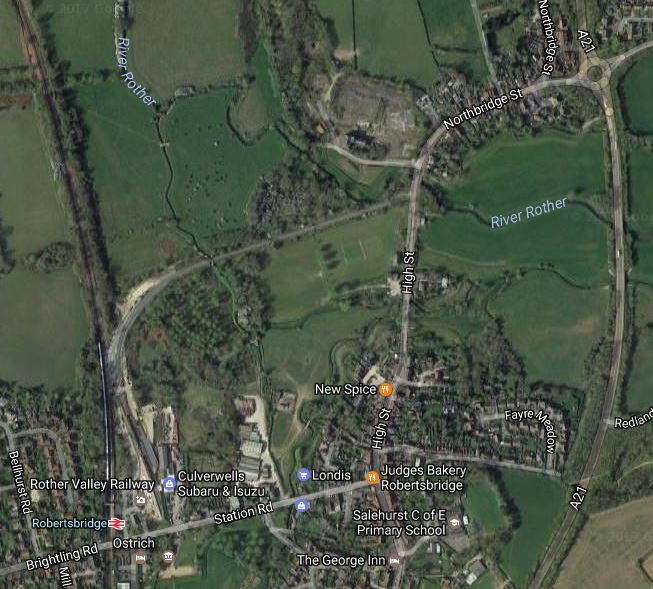
Note that the A21 leads down from the roundabout in the North-East corner of the map.
This map from Wikipedia shows the Western end of the Rother Valley Railway.
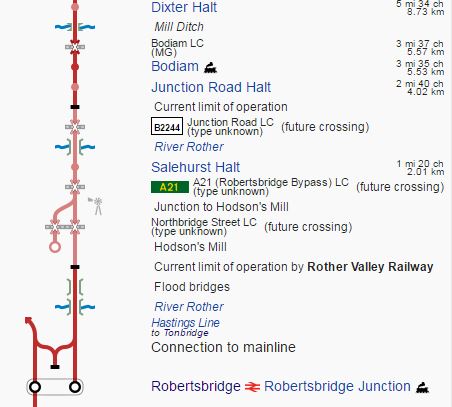
My question is the following.
Why would any sane Planning Authority allow the creation of three new level crossings, given the problems and the strong feelings they create?
Perhaps the economic benefits justify the disruption!
 The Anonymous Widower