Turning South London Orange
In the June 2016 Edition of Modern Railways in an article entitled Turning South London Orange.
It discusses a report by the Centre for London with the same name and a sub-title of Passenger Demand, Proposed Main Schemes And New Stations / Interchanges.
It is powerful stuff and these are posts I’ve written about their proposals.
An Improved South London Line Is Proposed
Proposed New Stations And Interchanges In South London
An Improved Station For Brixton
A New Station For Clapham East
Improvements To Clapham High Street And Wandsworth Road Stations
An Improved South London Line Is Proposed
In the June 2016 Edition of Modern Railways in an article entitled Turning South London Orange.
One of the proposals is to create an improved South London Line from Victoria and Clapham Junction via Brixton and Denmark Hill to Peckham Rye.
This map from carto.metro.free.fr shows the lines from Battersea to Peckham.
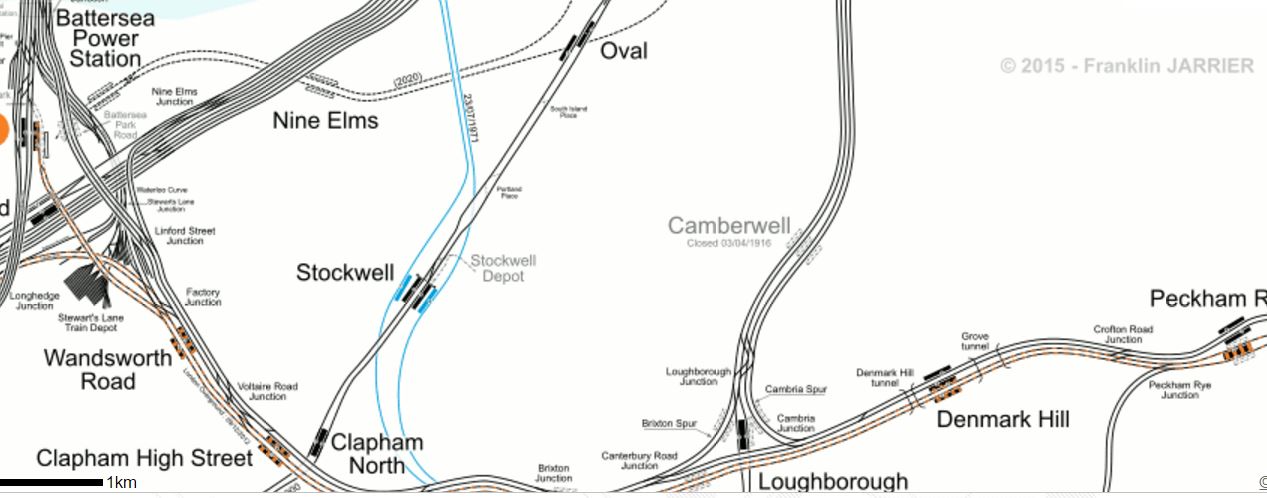
An Improved South London Line
You have to remember that when the current South London Line was created, there was criticism from various groups.
- Some objected to the loss of a direct service to Victoria.
- Some felt the line should call at Brixton.
- Some felt there should be an interchange at Loughborough Junction station.
Hopefully, the proposal for an improved South London Line will address some of these issues.
Between Wandsworth Road and Peckham Rye stations, the line is effectively two pairs of tracks, with the Overground using the Southern pair.
The Northern pair of tracks that are currently used by the Southeastern lines into Victoria only have platforms at Denmark Hill and Peckham Rye.
The Centre for London is proposing a redesign of the South London Line that could include.
- New Platforms at Wandsworth Road, Clapham High Street and Brixton.
- I would assume that the new Battersea station is part of the proposal, as this would connect the line to the Northern Line.
- Renaming of Clapham High Street to Clapham North to indicate its close relationship with the Underground station.
- Perhaps even putting the Overground on the Northern pair of tracks, as this would simplify the rebuild of Brixton station.
- An increase in frequency on both pairs of lines to six trains per hour.
I think as a start it is a good plan, but I do feel that something much better could emerge to improve the connectivity across South and South East London.
There are some questions that need to be answered.
- Where would the trains go past Peckham Rye?
- What would be the frequency of the Victoria to Orpington service?
- Would the restoration of a shuttle between London Bridge and v’ictoria be a good idea?
- Could Victoria be a terminus for the London Overground?
- Should the South London Line be connected to Thameslink at Loughborough Junction?
I suspect a lot of the answers are in the passenger statistics.
The London Overground Grows Without Fuss
I use the East london Line of the london Overground several times a week.
But this article in Rail Technology Magazine is entitled Extra evening services added on London Overground and I didn’t notice anything announcing the increase in services. This is said.
The East London line has been increased from two trains to four an hour between 10.00 and 11.30pm on the routes from Dalston Junction to New Cross and Clapham Junction and from Highbury & Islington to West Croydon and Crystal Palace.
It’s almost as if a Night Overground is being introduced in a Softly Softly way!
What’s gone wrong with the Unions?
They usually see an increase in levels of customer service, as a perceived threat to their jobs and working conditions and vote about whether to go on strike.
Will Old Oak Common Station And The Wimbledon To Sutton Tramlink Extension Get The Go-Ahead?
This article in Rail Engineer is entitled TfL Budget Confirms Rail Projects. This is said.
The GLA budget, announced in February 2016, included a £250 million fund for two new overground stations at Old Oak Common, linking with Crossrail, national rail and HS2, and £100 million towards a potential extension to the tram network to Sutton.
So will we be seeing a start to the planning for these two projects?
Obviously, nothing will be decided until the new Mayor is elected.
Will London Overground Fit On-board Energy Storage To Class 378 Trains?
This may seem to be a ridiculous idea, as why would the Class 378 trains on the London Overground need the ability to use battery power?
But I have just read this article in Rail Technology Magazine entitled Bombardier enters key analysis phase of IPEMU and it is a detailed article on everything Bombardier are doing to convert the prototype IPEMU into a real train, that can be sold to demanding customers.
- Four different types of battery are being evaluated in Mannheim.
- A simulated five-year test is being performed.
- Bombardier are taking a serious look at the branch-line market.
- Bombardier are evaluating the retrofit market with particular reference to the Class 387 and Class 378 trains.
This is all very sound stuff and in some ways it makes a change to fully-develop the product before launch rather than expect train operators and passengers to find the problems.
One thing that is surprising, is that Class 378 trains are being looked at for the retrofit of on-board energy storage. Marc Phillips of Bombardier is quoted as saying this in the article.
All Electrostars to some degree can be retrofitted with batteries. We are talking the newer generation EMU as well as the older generation. So, the 387s and 378s are the ones where we have re-gen braking where we can top-up the batteries and use the braking energy to charge the batteries. That gives us the best cost-benefit over operational life.
So it would seem that the Class 378 trains of the London Overground are candidates for fitting with batteries. As the trains handle their routes with ease and there doesn’t appear to be any lines without electrification, where anybody has speculated they might run, the only reason to fit them with batteries would be to capture and reuse all that braking energy.
It is an interesting proposition where the decision to fit batteries will depend totally on the accountants.
Obviously, there will be a cost to fit batteries, but as they wouldn’t need to propel the train for large distances, where there is no electrification, the specification could be quite relaxed.
- The capacity would have to be sufficient to hold the maximum braking energy of a full train.
- The battery technology would have to be able to handle the demanding stop/start regime of London Overground services.
- The system must be easy to fit to the existing trains.
- The battery capacity should probably be sufficient to move a stalled train into the nearest station.
A worst case scenario for moving a stalled train, would be hauling a train out of the Thames Tunnel after a failure of the power to the third-rail.
I have a feeling that traditional battery storage is not the best way to handle this application, as it is one that could be met by a larger version of the KERS system used in Formula One. KERS has already been applied successfully to buses, and I wrote about that in Could IPEMU Trains Use KERS?
You can do a simple calculation, which gives the kinetic energy of a hundred and sixty tonnes Class 378 moving at twenty metres per second, which is about two thirds of maximum speed and probably a typical service speed. The kinetic energy of such a train is 3.2 Mega Joules or 0.89 kWh. As an aside, I pay 10.73p for each kWh.
If a train has regenerative braking as Class 378 trains do, this energy can be returned through the overhead wires or third rail and used by other trains on the rail network, if the lines are setup to receive the energy. But it relies on another train being able to pick up the electricity and there are inevitable loses in the complicated transfer of the electricity.
On the other hand, if the train has on-board energy storage, it can store the energy and use it when it starts again at the station. This is a more efficient process.
It should also be noted that over the last year, all fifty-seven four car Class 378 trains have been upgraded to five cars. Does the fifth car have the wiring to incorporate an energy storage device? I would be surprised if it didn’t and that the train software is now capable of being upgraded to incorporate on-board energy storage.
I have no idea how much electricity would be saved by regenerative braking on the London Overground, but various applications of regenerative braking technology talk of electricity savings of between ten and twenty percent.
I think it is only a matter of time before the technology is proven to be sufficiently reliable and the numbers add up correctly for the Class 378 trains to be fitted with on-board energy storage.
The Last Class 378 Train Has Been Lengthened
The last Class 378 train to be lengthened to five cars has a special board on the front.
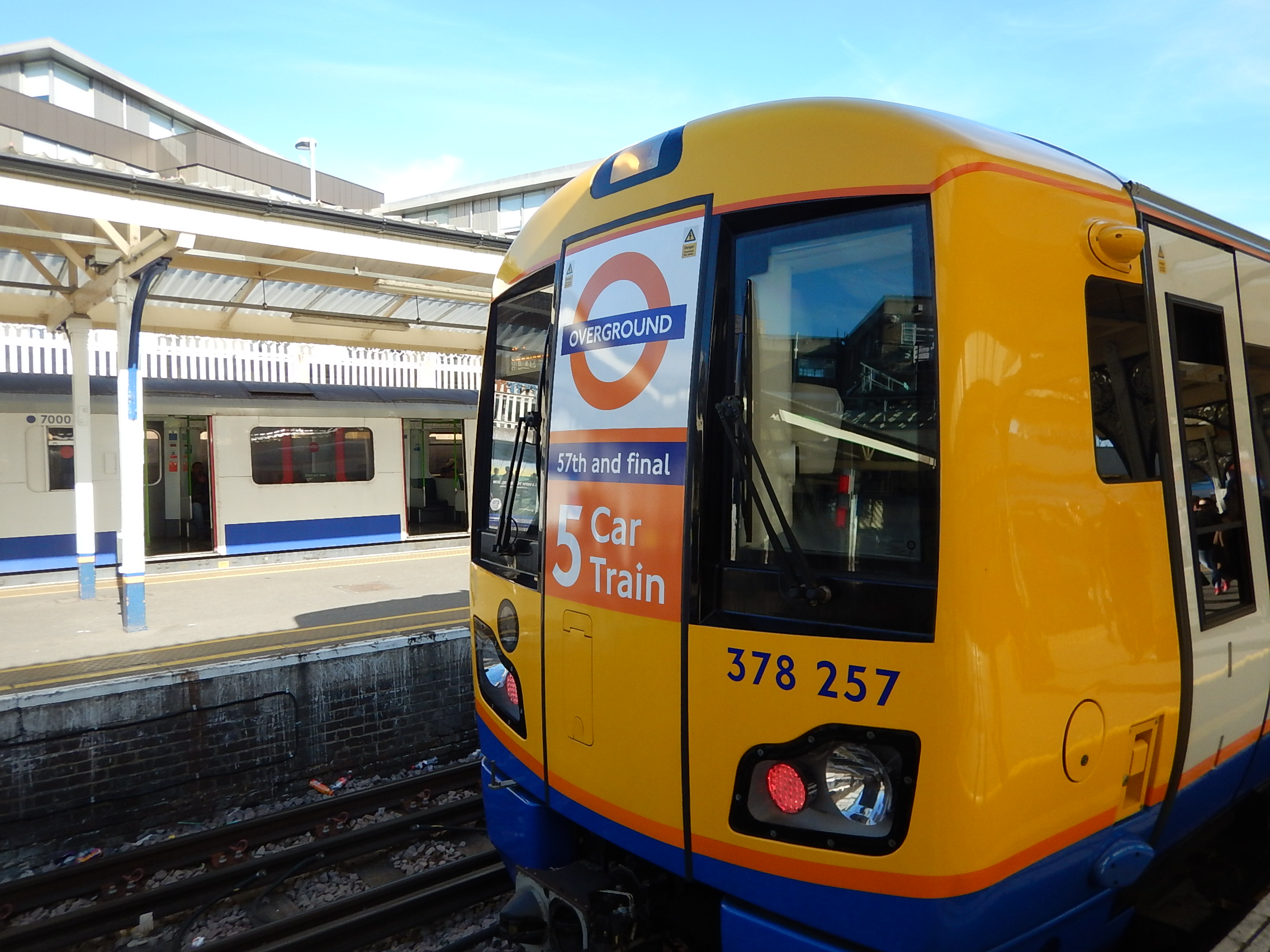
The Last Class 378 Train Has Been Lengthened
According to this article on RailStaff, the trains won’t be going to six cars. This is said.
Six car is not really an option on either the North London Line or particularly the East London Line because of the constraints of the tunnels.
If that is the case, then to get more capacity, they will need an increased frequency and probably more trains. The Wikipedia entry for the Class 710 trains that will be used on other Overground lines says this.
TfL invited expressions of interest for a total of 39 four-car EMUs in April 2014, with 30 required for the Cheshunt and Chingford routes, 8 for the Gospel Oak to Barking, and 1 for the Romford to Upminster. Since then the planned procurement has been increased to 45 four-car EMUs, with the additional 6 units intended for the Watford DC Line. The intention is that the five-car Class 378 trains used on the Watford route will be cascaded back to the North London and East London Lines to allow for strengthened services.
So it looks like the Watford DC Lines will be running different trains, although they will be the same as those on the Gospel Oak to Barking Line. So the GOBlin will be getting dual-voltage trains, so this means that in future an extension to invade South London via Acton and Hounslow is not compromised.
Painting London Orange
This article on BBC News is entitled Transport for London to take over suburban rail routes and it describes how TfL will have much more control over trains within and around London.
These are relevant points from the article.
- The new partnership between the Department for Transport and TfL says it aims to ensure there are more frequent trains and increased capacity.
- As franchises come up for renewal, they will come more under TfL’s control.
- The plan would mean more than 80% of stations would have a train at least every 15 minutes, up from 67%.
- Services running from London Bridge, Victoria, Charing Cross, Cannon Street and Moorgate would all be transformed under the scheme.
I think we’ll be seeing a lot more Overground orange on stations.
The Overground Philosophy
There are well-run railways all over the world, but somehow the Overground is different.
Whether it is because it is an offspring of the well-respected and much-loved Underground or whether because it reaches the parts the Underground doesn’t, it is difficult to explain, why in only a few years, the Overground has wormed its way into the hearts and minds of residents and visitors alike.
All lines adhere to the following principles.
- Trains at a frequency of at least four trains per hour.
- Staff on the station from the time the first train arrives to the time the last train leaves.
- Clean, modern trains and stations.
- Simple contactless ticketing.
- Increasing the proportion of step-free access.
- No pre-booking for passenger assistance for the disabled.
- All profits made, are invested back in the network.
- Continuous innovation and improvement
Some of these principles have come direct from the Underground.
The North London Line
Around the turn of the millennium the North London Line, had all the charm of a set of travelling urinals. Everything was tired and worn out, but within a few years of the start of the Overground, with new Class 378 trains, a couple of new stations and a deep clean of the others, ridership had soared and its major problem was increasing the size and number of the trains to cope with the growth in passenger numbers.
One of my local stations is Canonbury. The Overground has improved the station in the following ways.
- Six trains per hour on the North London Line and eight trains per hour on the East London Line.
- A new ticket office and two extra platforms.
- Full step-free access to all platforms.
- Large platform shelters.
- Cross platform interchange between Westbound NLL services and Southbound ELL services.
The only thing it lacks is a high quality artwork on the spacious island platform.
Canonbury even gets the occasional steam train, as I wrote about in Tornado at Canonbury Station.
I think it’s probably true to say, that Transport for London haven’t spent a fortune at Canonbury, but somehow they’ve created a quirky station that does its job with style.
London needs more Canonburys.
London Votes
London doesn’t vote red or blue any more. It now votes red, blue and orange!
In other words, if you stand as Mayor and don’t have a creditable policy for expanding London’s transport network, you won’t get elected. And one of the things you must do is support the Overground.
So now that Transport for London is going to get overall control of suburban services, it is perhaps worth looking at what lines out of London stack up against the principles of the Overground.
The Orange Standard
I’ll first look at various Overground routes to gauge their characteristics.
- Clapham Junction to Stratford – 2 trains per hour
- Clapham Junction to Willesden Junction – 2 trains per hour
- Dalston Junction to New Cross – 4 trains per hour
- Dalston Junction to West Croydon – 4 trains per hour
- Euston to Watford Junction – 3 trains per hour
- Gospel Oak to Barking – 4 trains per hour
- Highbury and Islington to Clapham Junction – 4 trains per hour
- Highbury and Islington to Crystal Palace – 4 trains per hour
- Liverpool Street to Cheshunt – 2-4 trains per hour
- Liverpool Street to Chingford – 4 trains per hour
- Liverpool Street to Enfield – 2-4 trains per hour
- Richmond to Stratford – 4 trains per hour
- Romford to Upminster – 2 trains per hour
All have or will have new trains by 2020.
Non-Train And Station Improvements
When you travel to a TfL-controlled station like say my local one of Dalston Junction and need to get a bus to your ultimate destination, there are lots of maps; geographic and spider and staff to ask as well.
This is not the same if you turn up at some stations controlled by South West Trains, Southeastern and other companies.
Transport for London should devise a standard for all stations connected to London.
London Lines To Paint Orange
The next few sections deal with London terminals.
Waterloo
These are the suburban lines out of Waterloo.
- Chessington South – 2 trains per hour – Must try harder
- Epsom – 4 trains per hour
- Hampton Court – 2 trains per hour – Must try harder
- Shepperton – 2 trains per hour – Must try harder
Quite frankly it’s a mess.
- There are not enough platforms at Waterloo.
- Some stations like Raynes Park come from the Topsy school of design.
- Some stations need lengthened platforms.
- There is a lack of turn-back platforms.
- Services tend to go a long way out of London, stopping in too many places, so you have overcapacity at the outer ends and overcrowding towards Waterloo.
- Connectivity meeds to be improved between the various lines.
- A lot of sacred cows need shooting.
- Action is needed now!
- South London can be very obstructive of changes!
Transport for London are promoting Crossrail 2 to sort out the mess, but I think there is a need to act immediately.
I think that these services need balancing, so that the outer overcapacity and inner overcrowding are reduced.
I have my ideas, which I’ll keep personal, but they involve rebuilding the truly awful Raynes Psrk station.
Whitechapel Station – 23rd January 2016
These pictures show the changes that have happened at Whitechapel station in the last week.


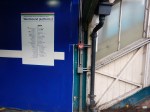
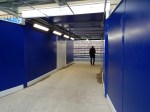

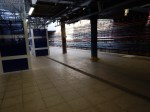

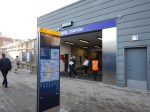
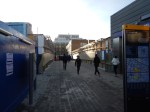

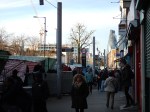
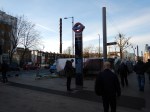


It is now possible to change direction on the wide platform between the Eastbound and Westbound lines of the District and Metropolitan Lines.
The escalators to the Crossrail lines will also be located in this wide platform. So changing between Crossrail and the \district and Metropolitan Lines will be very straightforward.
What surprised me was the quality of the temporary station. It’s actually a lot better and far more spscious than the one that was used previously, with several more gates.
A Journey Round The Clapham Stations
This morning, I took a train to Clapham High Street station, before visiting the three Clapham stations on the Northern Line.
- I walked to Clapham North station.
- I took the tube to Clapham South station.
- I walked to Clapham Common station.
I then took the Northern Line back to Central London.
These are some of the pictures I took on the way.
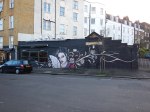
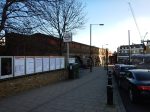
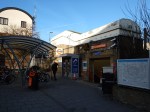




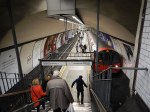





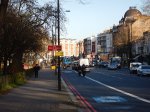



One of main reasons for going was to look at the deep level shelter at Clapham South station that is mentioned in this article in the Wandsworth Guardian entitled Clapham’s Second World War shelter to become cafe and exhibition, You can’t miss it, as it is right before you as you come out of Clapham South station.
In my view it is an ideal place for a cafe. If it had been built, when C and myself lived in the Barbican, I can envisage us taking the three boys to have lunch in a cafe like that! The elder two had to walk and George got a ride in one of the first McClaren buggies. The massive push chairs used today, wouldn’t have gone on a Routemaster of that era.
I also wanted to see the two dangerous island platforms at Clapham North and Clapham Common, which are the last two left on the Northern Line. I can remember the island platform at Angel station, which was removed, when the station was rebuilt in the early 1990s. Today, in an article on Global Rail News, which is entitled Green light for Bank station upgrade, the details are given of the plans to widen the cramped and dangerous platforms at Bank station.
Having seen Clapham North and Clapham Common stations today, I do wonder if a diversion could be dug as at Angel, Bank and London Bridge, to create safe new stations. This new tunnel could surely be part of the works to add step-free access to one or both stations and connect the tunnels to Clapham High Street station.
What with the Northern Line Extension to Battersea, the rebuilding of Bank and Camden Town stations and all the resignalling of the past few years, the Northern Line could at last be fulfilling its potential.
Overground Humour
This article in the Standard, shows the lengths to which London Overground are going to discourage fare dodgers. A sign was put up saying.
Attention. Anyone caught travelling without a valid ticker or Oyster will be told the ending to the new Star Wars. (and also get a Penalty Fare).
It may not work, but people have found it very funny.
Many stations in London put up something funny every day. Does this happen in other cities across the world with large transport networks?
 The Anonymous Widower