Crossrail’s Loops And Branches Across London
Most people think of Crossrail, as an East-West railway under London serving the following places on its pair of branches in the East and the West.
- Shenfield and Abbey Wood in the East.
- Heathrow and Reading in the West.
But it is more than that, as the East-West Crossrail can be considered to be part of a larger system that includes a number of North-South routes.
- Thameslink from St. Pancras to East Croydon via Farringdon on Crossrail.
- East Londson Line from Highbury and Islington to Canada Water via Whitechapel on Crossrail.
- West London Line from Willesden Junction to Clapham Junction via Old Oak Common on Crossrail.
- Bank Branch of the Northern Line from Camden Town to Kennington via Tottenham Court Road on Crossrail.
- Charing Cross Branch of the Northern Line from Camden Town to Battersea via Moorgate on Crossrail.
- Bakerloo Line from Willesden Junction to Elephant and Castle via Paddington on Crossrail.
Cross-London journeys will get interesting, as there will often be a dozen ways to go between A and B, when they are in different parts of London.
Kids will race each other across the City.
Crossrail will also grab a strong hold of other cross-London routes.
Central Line
Crossrail has interchanges with the Central Line at the following stations.
- Stratford
- Liverpool Street
- Tottenham Court Road
- Bond Street
- Ealing Broadway
The Central Line will add a loop to Crossrail from Stratford to Ealing Broadway.
People who live say near Queensway will use the Central Line to access the outer reaches of Crossrail., at Ealing Broadway and Stratford.
In Step-Free Interchanges In East London, I pointed out the excellent interchange between Crossrail and the Central Line at Stratford, which sadly is Crossrail’s only top quality interchange to other lines.
The interchanges with the Central Line in Central London would sappear to be very unadventurous. Only when the line is opened, will we know how well they work and the quality of the design.
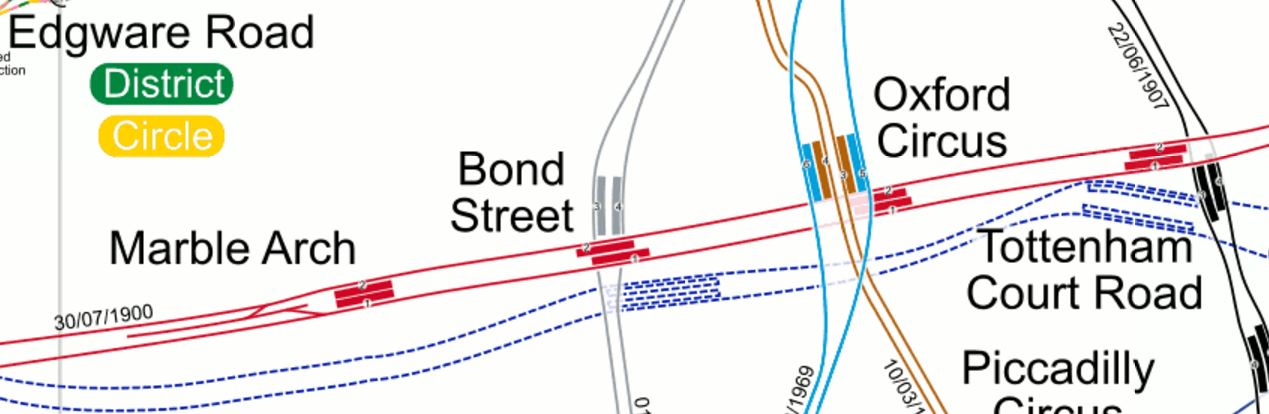
Perhaps the only way to have got better interchanges would have been for one track of Crossrail to be each side of the Central Line, through Central London.
This map from carto.metro.free.fr shows the section of Crossrail from Marble Arch to Tottenham Court Road.
Crossrail Through Central London
From this map it looks like it could be possible, but I know from this section in Wikipedia, that it was difficult squeezing the tunnels past the Northern Line at Tottenham Court Road, so perhaps the route that was chosen, was the best one from a construction and cost point of view. It could even have been the only one possible.
Metropolitan Line
Crossrail has interchanges with the Metropolitan Line at the following stations.
- Whitechapel
- Liverpool Street
- Moorgate
- Barbican
- Farringdon
- Paddington
The Metropolitan Line will add a loop to Crossrail from Whitechapel to Paddington. Although, due to the distance between the two lines at Paddington, this probably means the Metropolitan Line will serve as a North-Western branch of Crossrail, that serves Kings Cross, St. Pancras and Euston.
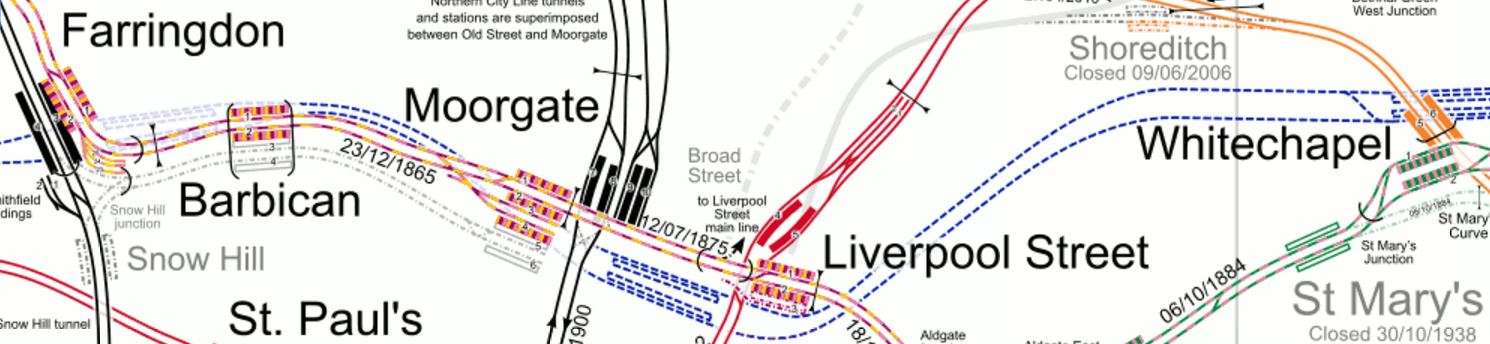
This map from carto.metro.free.fr shows the section of Crossrail from Whitechapel to Farringdon.
Crossrail Through The City
Note how two Crossrail stations; Liverpool Street-Moorgate and Barbican-Farringdon effectively each serve two Metropolitan stations.
Effectively, it gives a large choice of routes between North West London and East London and Essex.
Crossrail interchanges with the District Line at the following stations.
- Whitechapel
- Paddington
- Ealing Broadway
The District Line will add a loop to Crossrail from Whitechapel to Ealing Broadway, with a partial interchange at Paddington.
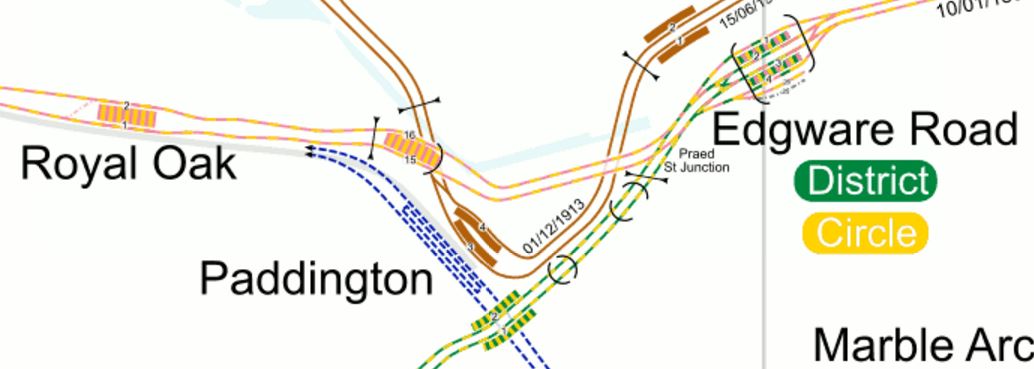
This map from carto.metro.free.fr shows the lines around Paddington.
Crossrail Through Paddington
Crossrail would appear to have a good right-angled connection with the District Line, between Edgware Road and Wimbledon.
So it could be argued that after Crossrail opens, the Edgware Road to Wimbledon service of the District Line is another North-South branch of Crossrail, just like with Thameslink and the East London Line.
North London Line
Crossrail interchanges with the following stations on the North London Line.
- Stratford
- Old Oak Common
The North London Line will add a loop to Crossrail from Stratford to Old Oak Common.
Jubilee Line
Crossrail interchanges with the following stations on the Jubilee Line.
- Stratford
- Bond Street
The Jubilee Line will add a loop to Crossrail from Stratford to Bond Street.
The Stations On The Loops
The effect of all these loops, mean that these stations will be on a line that connects to both ends of Crossrail.
- Acton Town
- Aldgate East
- Baker Street
- Bank
- Baron’s Court
- Bermondsey
- Bethnal Green
- Blackfriars
- Brondesbury
- Brondesbury Park
- Caledonian Road and Barnesbury
- Camden Road
- Canada Water
- Canning Town
- Cannon Street
- Canonbury
- Chancery Lane
- Chiswick Park
- Dalston Kinsland
- Ealing Common
- Earl’s Court
- East Acton
- Edgware Road
- Embankment
- Euston Square
- Finchley Road And Frognal
- Gospel Oak
- Gloucester Road
- Great Portland Street
- Hackney Central
- Hackney Wick
- Hammersmith
- Hampstead Heath
- Highbury and Islington
- Holborn
- Hommerton
- Kensal Rise
- Kentish Town West
- Kings Cross St. Pancras
- Lancaster Gate
- London Bridge
- Mansion House
- Marble Arch
- Mile End
- Monument
- North Greenwich
- Notting Hill Gate
- Oxford Circus
- Queensway
- Ravenscourt Park
- St. James’s Park
- St. Paul’s
- Shepherd’s Bush
- Sloane Square
- South Kensington
- Southwark
- Stamford Brook
- Temple
- Tower Hill
- Turnham Green
- Victoria
- Waterloo
- Westminster
- West Acton
- West Ham
- West Hampstead
- West Kensington
- White City
- Willesden Junction
The list may be impressive, even without stations on the North-South lines, but it has consequences.
- Ealing Broadway could see a lot of interchange traffic between Crossrail and the Central and |District Lines. Is it up to the task?
- Stratford and Whitechapel will see a lot of interchange traffic between Crossrail and other lines. These two stations have been designed for it.
- The Victoria Line is difficult to access. However, it is only a short walk from the Hanover Square entrance to Bond Street Crossrail station.
- The Piccadilly Line is difficult to access.
I suspect that as at Oxford Circus, there will be small schemes in several places to create connectivity.
Kings Cross St. Pancras is a big problem as it is a mass of long tunnels, but Crossrail and Thameslink will give passengers the chance to avoid it.
- If you’re on Crossrail and want to go North on the Victoria or Piccadilly Lines, I suspect that it would be easier to take Thameslink to Finsbury Park, where you can dive into the Underground.
- If you’re on Crossrail and want to go South on the Victoria Line, the quickest way might be change to the Bakerloo at Paddington and then walk across the platform to the Victoria Line at Oxford Circus.
But whatever route you take in a few years time, won’t be the obvious one today.
Extra Connectivity
There are various projects either under construction, planned or proposed, that would increase Crossrail’s reach.
- The Hall Farm Curve linking Walthamstow and Chingford to Stratford.
- The rebuilding of Bank, Camden Town, Highbury and Islington and other stations.
- The Northern Line Extension to Battersea.
- The Bakerloo Line Extension.
- The Greenford Branch is being improved.
- The re-signalling of London Underground’s sub-surface lines.
- The four-tracking of the West Anglia Main Line in preparation for Crossrail 2.
- The adding of a Central Line station at Shoreditch High Street.
- Extensions to the Docklands Light Railway.
- Old Oak Common will become more and more important with connections to the West Coast Main Line, HS2 and the Chiltern Main Line.
- Increases in frequency on the Victoria Line, Jubilee Line, Sub-Surface Lines, the Northern City Line and the Overground.
I do think though we could see a few surprises.
- There have been proposals to extend the Waterloo and City Line for years. Modern tunnelling and innovative train concepts might allow a shuttle between Waterloo and Crossrail at Liverpool Street.
- As the City of London wants to cut traffic in the Square Mile, what will they do?
- Will Oxford Street finally become traffic free?
- Will Manor House and Harringay Green Lanes be reorganised?
- Crossrail has seen some interesting concepts developed for building lift and escalator tunnels, which will be used again and again.
- Crossrail will be extended to somewhere not mentioned before.
I have a feeling that Crossrail 2 won’t be so urgent.
Step-Free Interchanges In East London
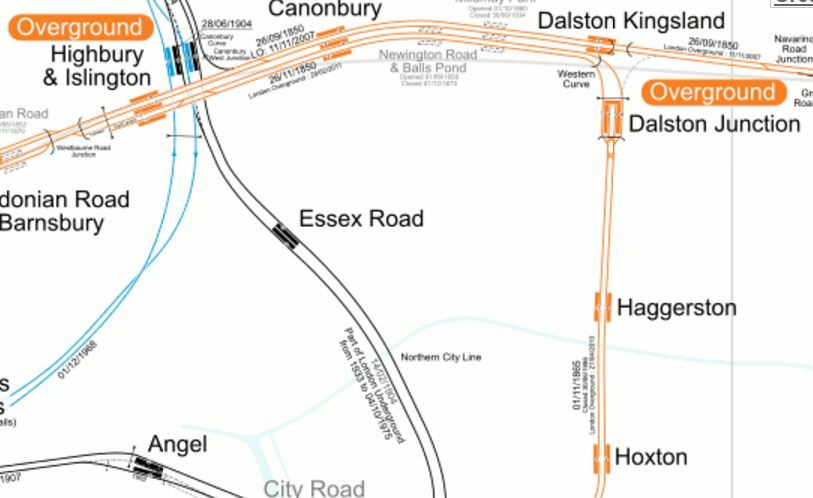
This map from carto.metro.free,fr shows the lines around where I live, which can be best described as a post code of N1.
Lines Around N1
I live halfway on the diagonal line between Dalston Kingsland and Essex Road stations. Years ago, there used to be a station at Mildmay Park, between Dalston Kingsland and Csnonbury, which if it still existed would be very useful for me, as it would be about a hundred and fifty metres away.
So my journeys often start from one of the half dozen bus routes, that have stops within fifty metres or so of where I live.
- I’ll take a 38, 30, 56 or 277 to Dalston Kingsland or Dalston Junction stations for the North London Line and East London Line respectively.
- I’ll take a 141 to Manor House station for the Piccadilly Line.
- I’ll take a 38 or 56 bus to Essex Road station for the Northern City Line
- I’ll take a 38 or 56 bus to Angel station for the Northern Line.
- I’ll take a 21 or 141 bus to Moorgate for the Metropolitan and Circle Lines
- I’ll take a 21 or 141 bus to London Bridge for main line trains.
- I’ll take a 21 or 141 bus to Bank for the Central and Waterloo and City Lines
- I’ll take a 56 bus to St. Paul’s for the Central Line
- I’ll take 30 bus to Kings Cross, St. Pancras and Euston for main line trains.
Who said the three most important things when buying a house, are location, location and location?
Strangely, I rarely go directly to Highbury and Islington station, as the station is one of the worst in London for passenger convenience, with long and crowded tunnels and no step-free access to the deep tunnels.
If I need to go North on the Victoria Line, I will sometimes go to Essex Road and then take the Northern City Line for one stop to Highbury and Islington station, where there is a step-free level interchange to the Victoria Line.
There are several of these interchanges in East London, making train and tube travel easier.
Northern City And Victoria Lines At Highbury And Islington Station
This map from carto.metro.free.fr, shows the layout of lines at the station.
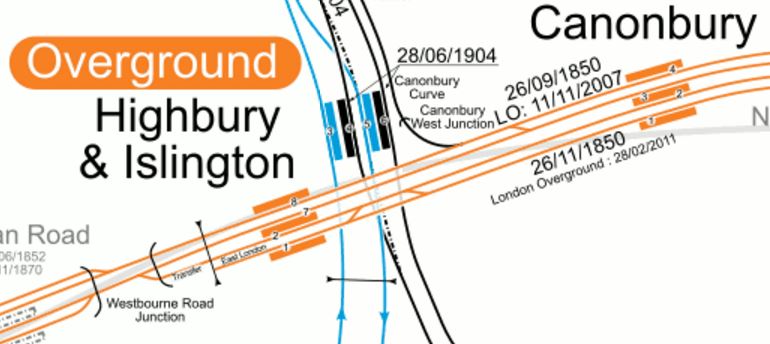
Note how the two Northbound lines and the two Southbound lines of the Victoria and Northern City Lines are paired, so that passengers can just walk through one of several short tunnels that connect the two platforms.
This connection will get more important in the future, as improvements will bring more passengers through the interchange.
- Highbuty and Islington station will be rebuilt, with access to the deep level platforms much improved.
- If traffic said it was needed, the Southbound and Northbound deep-level platforms, which are not far apart might even be connected together and to a second entrance on the other side of Holloway Road.
- The Northern City Line is getting new Class 717 trains, which will give an increase in capacity and I believe that the frequency on the Northern City Line will improve to 6, 8 or even 10 trains per hour (tph), thus making my ducking and diving easier.
- The Northern City Line will connect to Crossrail and for the first time N1 to lots of places, will be one change at Moorgate from the Northern City Line to Crossrail.
- The Victoria Line will increase in frequency to possibly 40 tph and benefit from station improvements at stations like Tottenham Hale, Blackhorse Road and Walthamstow Central.
It should also be noted how the Crossrail connection at Moorgate will help me.
When going to football at Ipswich, I may walk to Essex Road and then get a train to Moorgate, where I will take Crossrail to perhaps Shenfield for a fast train to Ipswich.
But who knows what I’ll do, as there will be several different routes, all of which will have their advantages?
East London Line To North London Line At Highbury And Islington Station
This is only from the East London Line trains arriving from West Croydon in Platform 2 at Highbury and Islington station to Westbound trains on the North London Line in Platform 7.
Although not as powerful as the double interchange at Highbury and Islington station between the Victoria and Northern City Lines, it is typical of well-thought out connections all over the Overground.
Piccadilly And Victoria Lines At Finsbury Park Station
This is a cross-platform interchange, that is heavily used as effectively it gives a simple choice of route through Central London for passengers from the Northern ends of the Piccadilly and Northern Lines. It’s a pity that the interchange between the two lines at Kings Cross St Pancras and Green Park aren’t as simple.
Metropolitan/District And Central Lines At Mile End Station
This picture gives a flavour of the interchange at Mile End station.
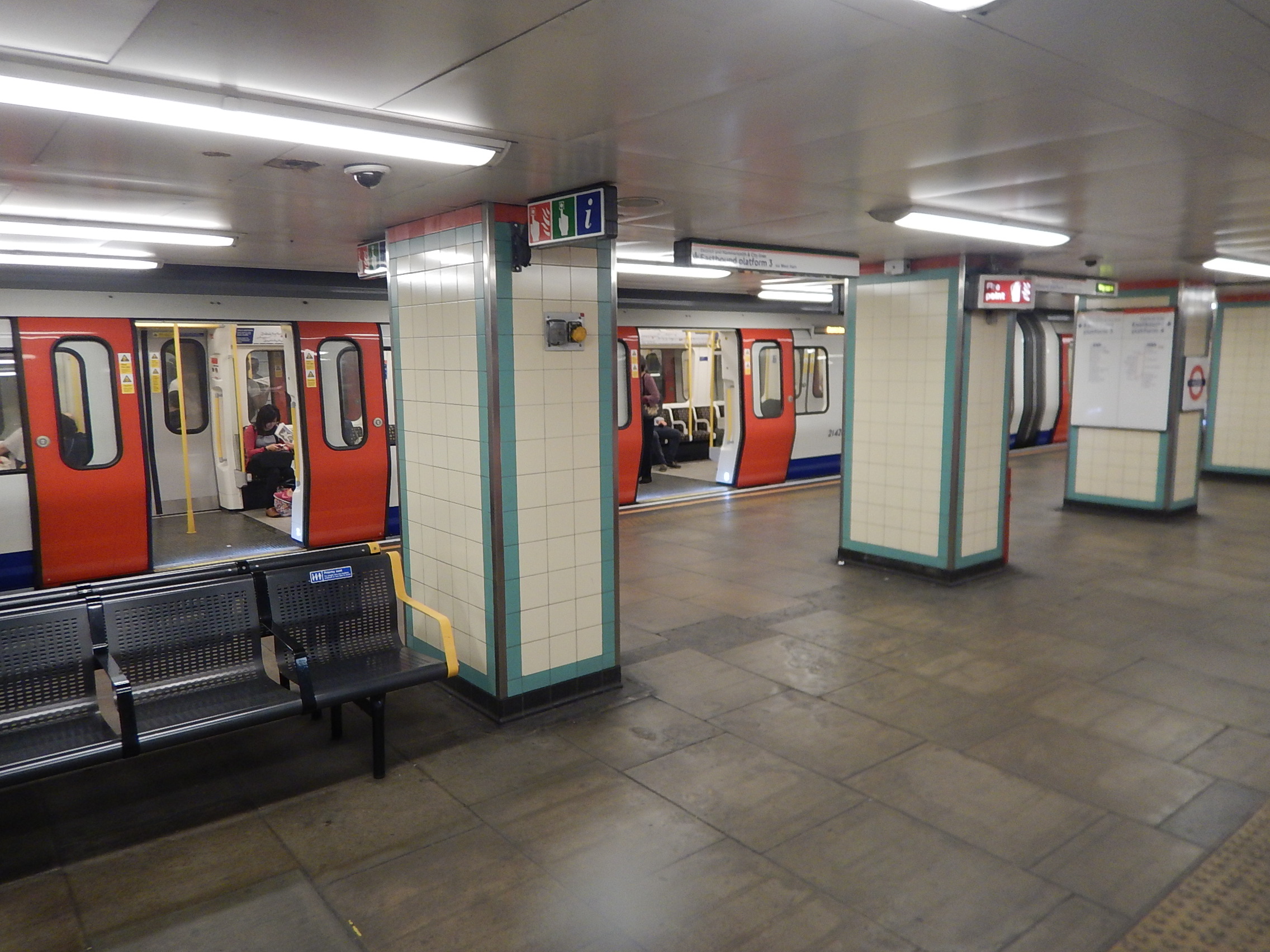
Cross-Platform Interchange At Mile End Station
It is a cross-platform interchange, that I use more and more, to go to the East on the Central Line. I usually arrive on a Metropolitan/District Line train from Whitechapel station, which is just a few stops down the East London Line.
Central Line And Shenfield Metro/Crossrail At Stratford Station
This interchange at Stratford station is going to be an integral part of Crossrail, as it will firmly connect the new line to the Central Line, with advantages to both.
This picture shows the interchange on the Eastbound platform.
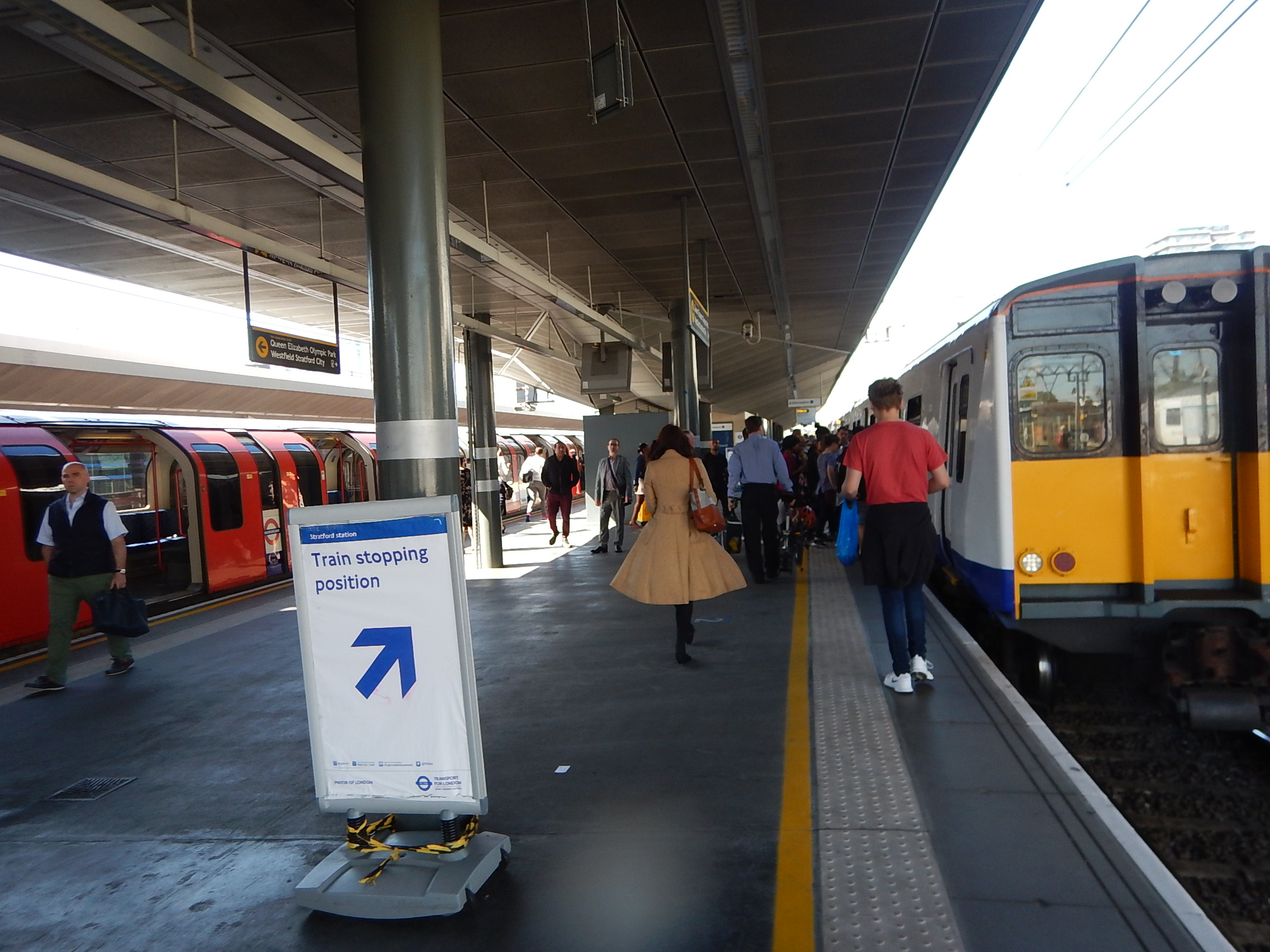
Central Line To Shenfield Metro/Crossrail Interchange
This interchange is certainly well-used and Crossrail will only increase that use.
Why Is This Not Done More Often?
These interchanges seem to work well!
But what always puzzles me, is why this layout is not used more often. And I don’t just mean in London. In all my travels, I can’t remember getting off a train in Europe and just walking across the platform to get a metro or a tram.
I suspect it could be because to get this type of interchange, you need to build some expensive railway infrastructure.
All of the examples I have given concern where a new line is being added to an existing network.
I am surprised that Crossrail doesn’t use a similar interchange anywhere else on its route.
Look at the Crossrail stations I documented in How Are Crossrail’s Eastern Stations Progressing?
In all stations, the Crossrail and fast lines are in pairs, whereas to get Cross-platform interchange between fast and stopping services, probably needs a different layout. That is not the fault of Crossrail, but the way the Great Eastern Main Line was built decades ago.
At the London end of the East Coast Main Line, the two slow lines are on either side of the two fast lines. At Stevenage, they have put two island platforms between the slow and fast lines, so that passengers have a cross-platform interchange between trains.

Stevenage Station
The Google Map clearly shows the layout.
Will Shoreditch High Street Be Connected To The Central Line?
Every Londoner has their own personal pet hates about the Underground.
One of mine is the lack of an interchange between the East London Line and the Central line at Shoreditch High Street station. The Central line passes under the East London Line and some web sites say that provision was left in the new station for the connection.
This map from carto.metro.free.fr shows the lines around Shoreditch High Street station.
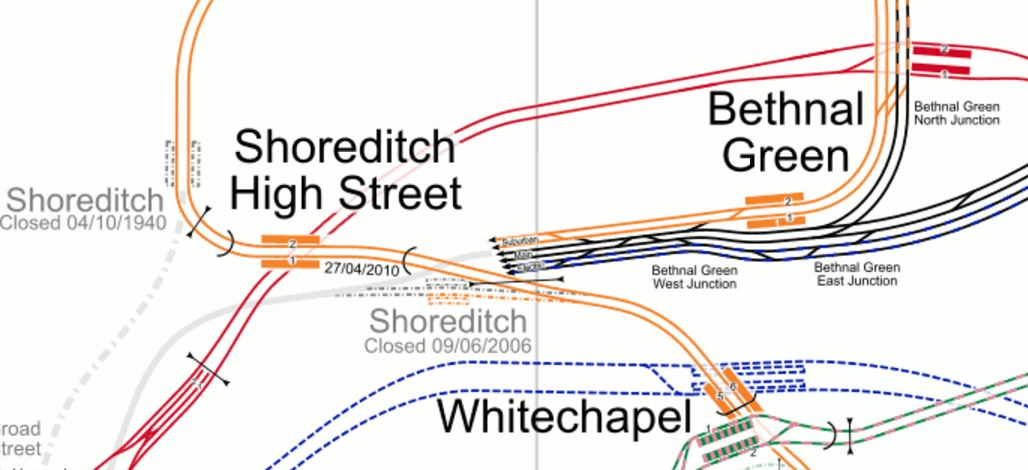
Shoreditch High Street Station
Note how the Central Line platforms at Liverpool Street are in the South West corner of the map.
Some sites also say that the reason for not building the connection, is that the Central line is too crowded and a decision will not be taken until after Crosrail opens. This is the comment on an article about the connection in London Connections.
Don’t expect an interchange with the Central Line until Crossrail 1 is fully operational. The Central Line in its present, heavily overcrowded, state could not possible cope with even more stations.
Perhaps in about 10 years…
It does sound sensible.
Getting West on the Central Line can be difficult from where I live.
I can take a bus to either Bank or St. Paul’s stations, but coming back is a problem, as the bus stops aren’t well placed.
After Crossrail opens, I might take the same bus to Moorgate for the new line or I could get to Crossrail using the East London Line connection at Whitechapel.
It shows how Crossrail is going to add masses of possible new routes to everybody’s travel in London.
Crossrail links with the Central line at Stratford with a cross-platform interchange and more conventionally at Liverpool Street, Tottenham Court Road, Bond Street and Ealing Broadway.
As the East London Line links to Crossrail at Whitechapel, will passengers going from say Anerley to Epping, be happy with a double change at Whitechapel and Stratford? Especially, as the second one would be just a walk across the platform.
I think they will.
But obviously Transport for London will have all the traffic statistics and would know when creating the Interchange at Shoreditch High Street will be worthwhile.
But looking at the map of the lines at Shoreditch High Street station, leads me to wonder if it would be possible to put in an escalator connection to the Eastern end of the Central Line platforms at Liverpool Street station. This map from carto.metro.free.fr shows the Central Line through both stations in detail.

Liverpool Street And Shoreditch High Street Stations
As all of the office blocks on both sides of Bishopsgate, were planned and designed before Crossrail and the London Overground, I do wonder that if they were being designed now, they would build a travelator connection between Shoreditch High Street and Liverpool Street stations, which incorporated another set of escalators to the Central Line.
Is A Big Row Developing Over The Northern Line Extension?
I have just read this article in the Evening Standard, which is entitled Northern line extension: Battersea Power Station’s Tube bill ‘to rise by £240m’. This is said.
The Standard understands that the changes relate to a section of the 39-acre site known as Prospect Place, a dramatic cluster of apartment buildings designed by the Californian “starchitect” Frank Gehry.
The new plans envisage more ambitious “over station development” (OSD) than in the original Battersea Power Station masterplan from Uruguayan architect Rafael Viñoly.
Obviously, the more you put on top of a station, the stronger the box that encloses the station needs to be.
Hence the redesign of the box and the greater cost.
I do think that some architects are a bit precious and over-ambitious, whereas others create spectacular buildings, that seem to cost a fraction of those by the so-called architectural superstars.
Some schemes only seem to be capable of being built at enormous cost.
Architects never learnt from the fiasco of building the Sydney Opera House.
And it’s usually the poor taxpayer who picks up the bill for bad design.
A Good Information Board
I saw this information board at Kings Cross station.


I think the seat on the right, should be by the Tube Map.
But it’s a good attempt!
Piccadilly Line Drivers Give Heathrow Express A Helping Hand
Yesterday, as the BBC reports, the drivers on the Piccadilly Line went on strike.
My view on the tube drivers and their constant strikes, is that it is not about safety, Night Tube or whatever, but a power struggle between the drivers union and Transport for London.
At least it’ll all stop if Sadiq Khan becomes Mayor as the unions will calm things down in the hope, that they’ve got a more union-friendly Mayor.
The only winners yesterday were Heathrow and their overpriced Heathrow Express, which as most Londoner’s wouldn’t use it, except as a last resort, probably got some strong language going in the pubs and on social media.
The Shape Of Stations To Come
Oakwood, Southgate or Arnos Grove it isn’t but this image from Transport for London is the new Nine Elms station on the Northern Line Extension.
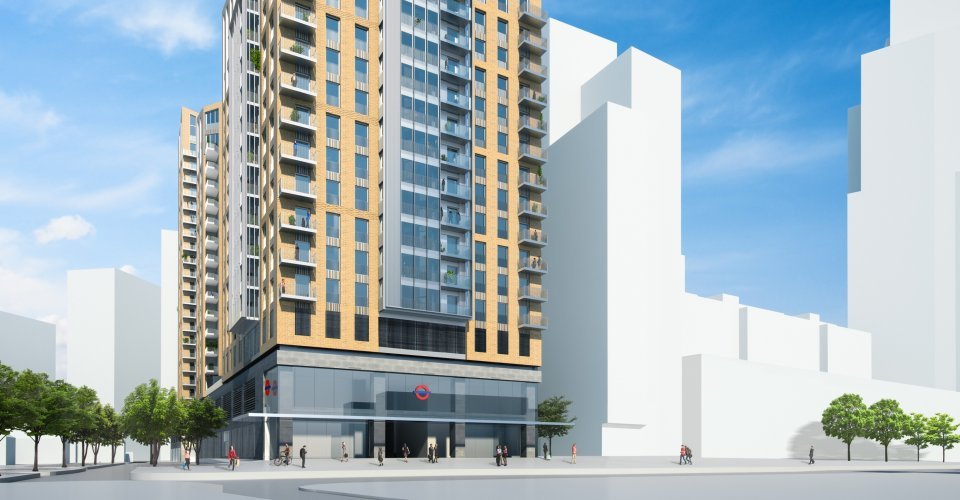
Nine Elms Station
But is it so different to Clapham South station?
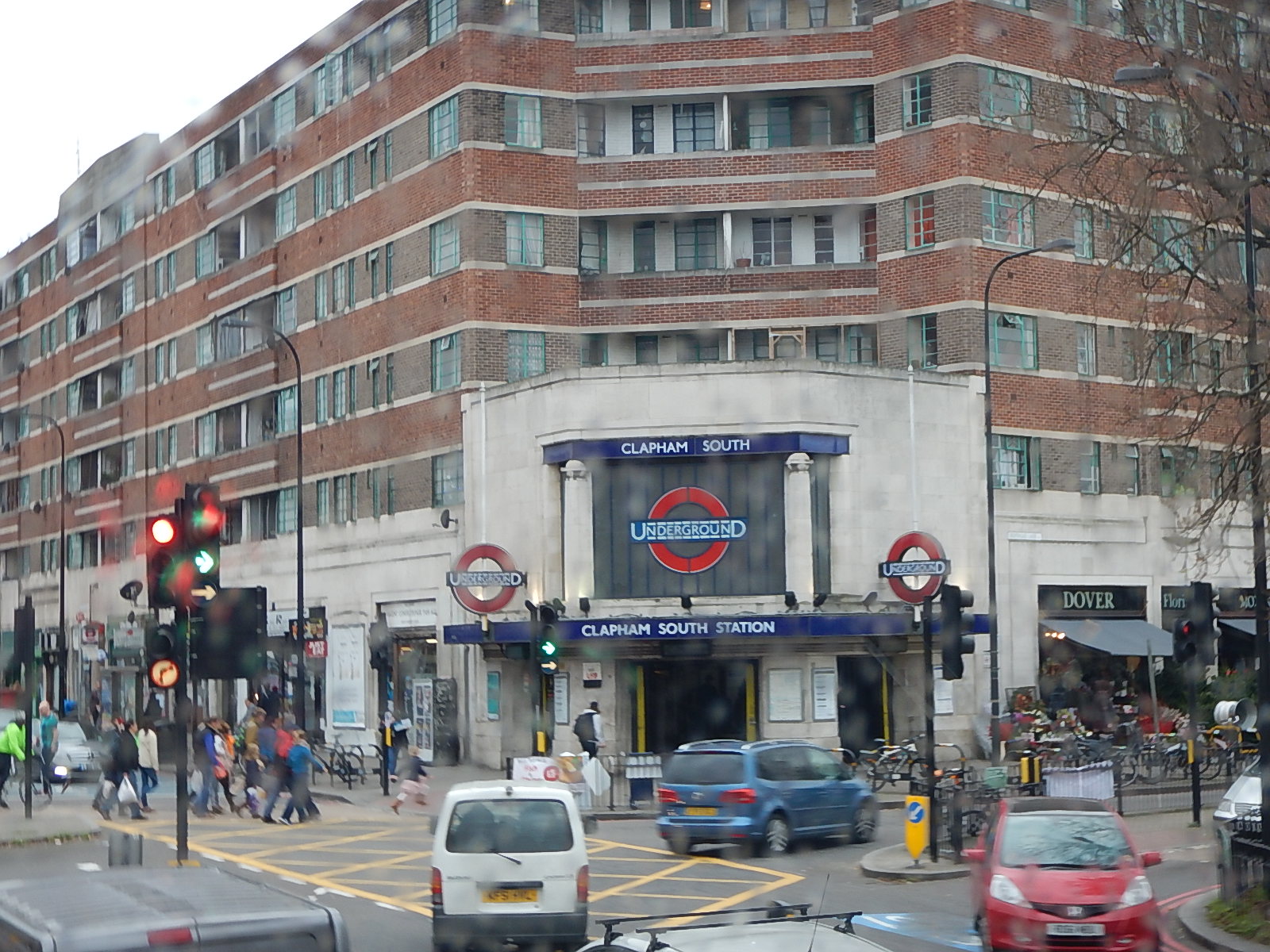
Clapham South Station
Except that the architecture is from a different era and the over-site development is higher.
We will be seeing a lot more stations like Nine Elms.
Some have already seen that type of development or developments are in progress.
- Angel
- Archway
- Baker Street
- Canary Wharf – Crossrail
- Elephant and Castle
- St. James’s Park
- Wembley Central
There should be more.
I think we’ll see different types of station design. Some with developments and others without.
The Station With Appropriate Towers On Top
These will be interpretations of the Nine Elms or Clapham South principles.
There certainly should be more stations with housing, offices, schools, universities or hospitals on the top.
A property developer told me, that he was developing schemes for housing on or close to stations in London, with little or no car parking. They are popular, sell like hot cakes and are very profitable.
The Station Under A Landscaped Area With Clusters Of Towers Around
This design is emerging and I suspect that the definitive prototype could be built at Old Street station. This is a visualisation from Transport for London.
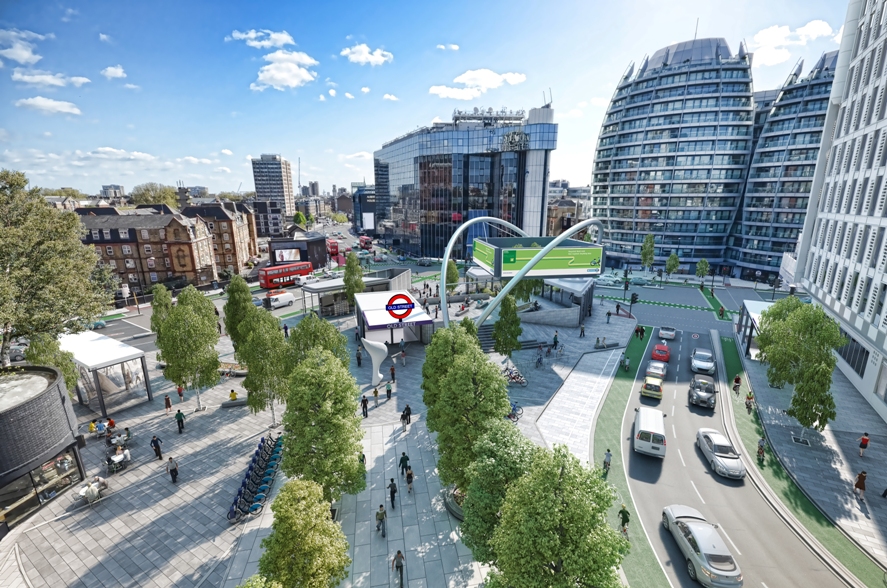
The Future Old Street Station
I suspect we’ll see similar approaches at Elephant and Castle, Highbury and Islington and other stations on a roundabout, square or park.
I like this approach for various reasons.
- The design improves the passenger experience.
- It is very cycling- and walking-friendly.
- TfL seem to have taxi-ranks in their thinking.
- It gives the opportunity to make the train-bus interface an easy one.
- Cafes and kiosks are easily incorporated.
- As development around the station is spread around, it is probably easier to bring together and finance, than a tower-on-top solution.
- It doesn’t require much modification or demolition of existing buildings.
But there are disadvantages.
- Badly done, it can be a nightmare on a wet or windy day.
- The approach can also have negative effects on other road users.
Although there doesn’t seem to be too many complaints about the half-finished scheme at the Elephant, which will enable the new station, in the media.
My taxi-driver was complaining about Highbury Corner last night, but then that scheme hasn’t even started and the extensive works to replace the bridge and sewers are ongoing.
The Roofed Station
We have a tradition in this country of giving rail stations spectacular roofs.
Surely the latest and one of the best is the new roof over Manchester Victoria station, which I wrote about in Victoria Gets A Posh Umbrella. Here’s one of my pictures.

If you think it was all amazing expensive read this article from the Manchester Evening News entitled Stunning pictures show latest progress of £44m Victoria Station refurbishment.
Good design is often much more affordable than crap design.
Imagine electric trains, trams and possibly electric buses and taxis under an umbrella, with developments all around. Someone will and it will be the most spectacular and passenger-friendly station in the world.
The Innovative Solution
I don’t discount totally innovative solutions like the new Blackfriars station, although that station is more of a spectacular architectural set-piece, than a practical station.
- I’ve had complaints from staff, saying it is a cold and draughty place to work at times.
- Changing between Southbound Thameslink services and the bay platforms is not easy.
- There should be a walking route across the Thames incorporated in the station.
- I’ve never seen a train in the bay platforms.
But to be fair, I think that the Blackfriars station, we see now, is not the one that was envisaged by Thameslink. Original plans called for all Sutton Loop services to terminate at Blackfriars. But this was overturned, by those knowledgeable enthusiasts for good design, the elected members of the House of Commons.
Conclusion
Innovate and go forward, rather than cast the past in stone.
Crossrail 2 Will Be Threaded Through This
The map from carto.metro.free.fr, shows all the lines around Kings Cross station.

Lines Around Kings Cross
It certainly isn’t the easiest place to connect Crossrail 2, which will call at Angel, King’s Cross St. Pancras and Euston stations into the system. From a map in this document, it would appear that Crossrail 2 runs across to the north of the Victoria and Northern Lines.
Thank Heaven for 3-D computer design systems!
The New Cannon Street Entrance To Bank Station
This entrance will help to solve Bank station’s chronic problems. It will go on the corner of Nicholas Lane and Cannon Street.
These pictures were taken on a walk from King William Street to Cannon Street station.





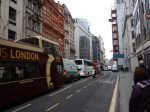

I would assume, it will replace the McDonald’s, with a new office block on top.
This Google Map shows King William Street, Nicholas Lane, Cannon Street and the various stations.
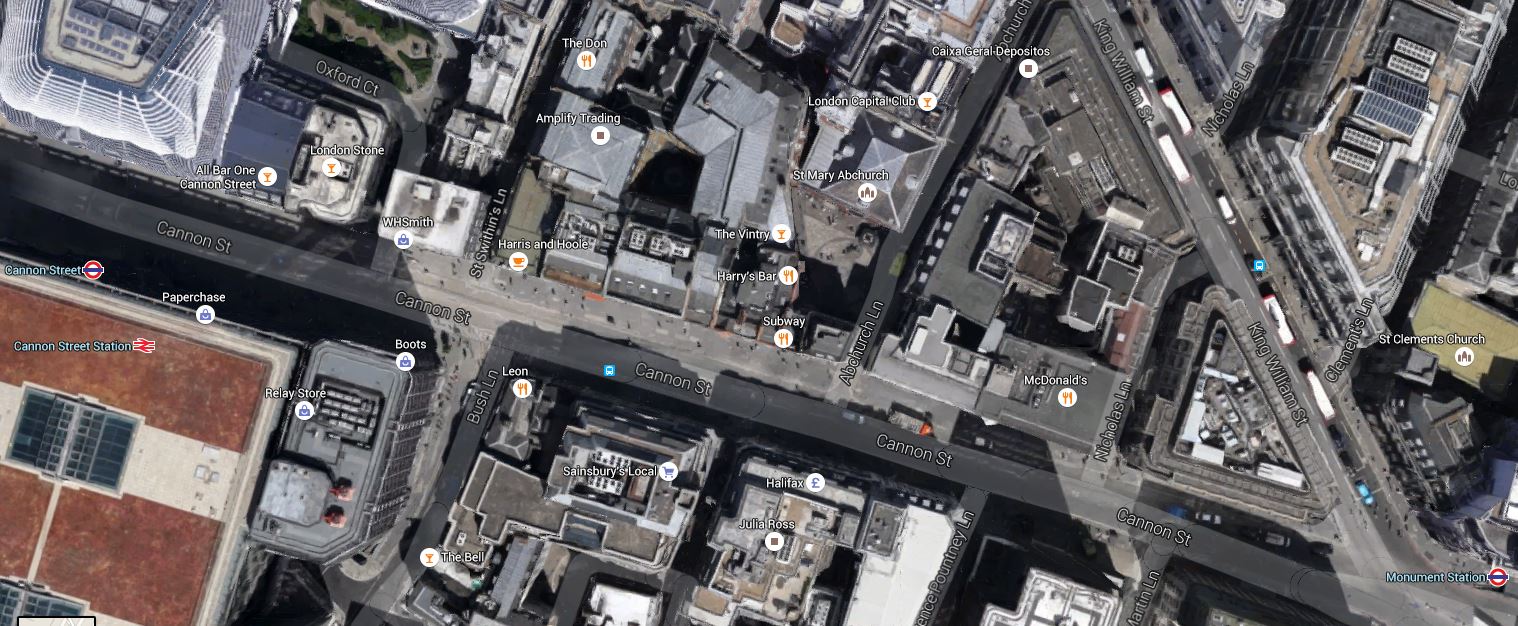
New Cannon Street Entrance At Bank Station
Note the McDonald’s. I had an excellent lunch in the Leon.
If you want to read more about the proposed station, you start by looking at this page on the TfL web site, which is entitled.
I found these two documents answered a lot of the questions, I had about the design of the station.
Design and Access Statement – Part 1 – Opens with a detailed drawing of the whole new entrance project.
Design and Access Statement – Part 2 – Opens with a detailed summary of the proposal.
They also have a lot of good images, visualisations and diagrams.
Summarising what I learned, I will make the following points.
- The new entrance will be a wide one where the current McDonald’s is situated.
- Passengers will go through the wide gate line and banks of escalators will take them down to the Northern Line.
- Passengers requiring step-free access will have a dedicated route to the lifts from two wide gates on the left of the entrance.
- The Northern Line is deep and because of the constricted nature of the site, the escalators will be vertically split into two banks with a landing, as some at London Bridge station are.
- At the bottom of the escalator will be a large circulation area, with cross passages accessing the rebuilt and wider Northern Line platforms.
- Moving walkways from the circulation area, will take you to the Central Line.
- The rise between the Northern and Central Line levels will be handled by escalators between the Central Line platforms.
- Access to the DLR platforms, which are several metres below and parallel to the Northern Line platforms, will be via escalators in the middle.
- The District and Circle Lines will be accessed from the Southern end of the circulation space by means of an improved passage to existing escalators.
- I suspect that the access to the Central Line and DLR platforms, can be built without any lengthy closures.
- Don’t forget that there is a new entrance at Walbrook Square being built to give lift and escalator access to the Waterloo and City Line, that will open in 2017.
- All existing links between lines and the existing entrances will be preserved and upgraded.
- Two seventeen passenger lifts will descend from the new entrance to both the Northern Line and the DLR.
- The station is to be completed by 2021.
I think it is true to say, that the new Cannon Street entrance is effectively a second station that is connected to all the existing lines.
In the latter part of the project, the Bank branch of the Northern Line will be closed, so that the new running tunnel can be dug. I don’t think it will be possible to turn trains at say Moorgate and London Bridge, so the branch will cease to be any use.
Could this blockade, be planned to happen after Crossrail opens, so that passengers can walk to Liverpool Street/Moorgate to access other North-South routes?
- Crossrail to Farringdon station for Thameslink
- Crossrail to Tottenham Court Road station for the Charing Cross Branch of the Northern Line.
- Crossrail to Whitechapel for the East London Line.
- The Northern City Line at Moorgate station.
The Central, District and Circle Lines had better behave too!
So how would the new station at Bank change my transport habits?
- Journeys between my house and Bank station are often done on a 21 or 141 bus, where the stops are within a hundred metres of my house. I would hope for better access between buses and the new complex at Bank.
- The new Wallbrook entrance and the improved access to the Waterloo and City Line, will greatly improve one of my routes to Waterloo,
- I often go south on the Northern Line, as it is easy to get a 38 or 56 bus around the corner from my house and dive straight into the Northern Line at Angel station. From Bank I will use the easy access to the DLR and the District and Circle Lines.
- I suspect that when I need the DLR, I will go to Bank, rather my route now via Shadwell on the East London Line.
- If I’m coming North on the Northern Line, I get out at either Bank, Moorgate or Old Street and take the 21 or 141 bus.
I shall certainly have a lot of interesting transport routes.
The expansion of the station, in addition to sorting the connection between the various lines at the station, will after the Wallbrook entrance is complete, create two new terminii for the two smaller lines at the station.
Waterloo And City Line
The new Wallbrook entrance will create a step-free entrance into an upgraded Waterloo and City Line.
This will generate a few questions.
- How long will it be before demand is such, that the Waterloo and City Line opens on a seven-day-a-week basis?
- Will the passageways still connect the Waterloo and City Line platforms to the to the DLR and the Northern Line?
- Will the connections to other lines at Bank station be good enough?
- As the Bank end of the line will be step-free, what will happen at the Waterloo end?
- Could access to the line be improved from Waterloo East station?
I think that the Waterloo and City Line will get a few more small upgrades. Especially, as during the blockade of the Northern Line to build the new spouthbound tunnel, it will be used to bring travellers to and from Bank station.
Docklands Light Railway
The two DLR platforms and their connections to the other lines will be transformed by the station expansion.
- Many of the walking routes to other lines and the exits will be step-free, and all will be an improvement on the present routes.
- The important connection to the Northern Line will be by escalator or lift.
- There will be a lot more space around the two DLR platforms.
I think this ease-of-use of the DLR part of the station, will increase passenger numbers dramatically.
It appears to me that the new design will future-proof the DLR terminus, as the new layout of the DLR platforms and their connections seems to have been designed, so that the DLR can be extended to the West.
According to Wikipedia, two possible westward extensions have been proposed.
I think that the former which would take the DLR to Charing Cross and possibly Victoria via City Thameslink and Aldwych would be the most promising.
This would give me a route to Charing Cross station, which is probably the most difficult station to get to from Dalston.
But will it ever happen?
Bank station will certainly ready for a DLR extension in 2021.
Connectivity Around Clapham
I’ve talked a lot lately about improving the rail lines and especially their connectivity in South London in quite a few posts lately.
So I extracted this map from carto.metro.free.fr
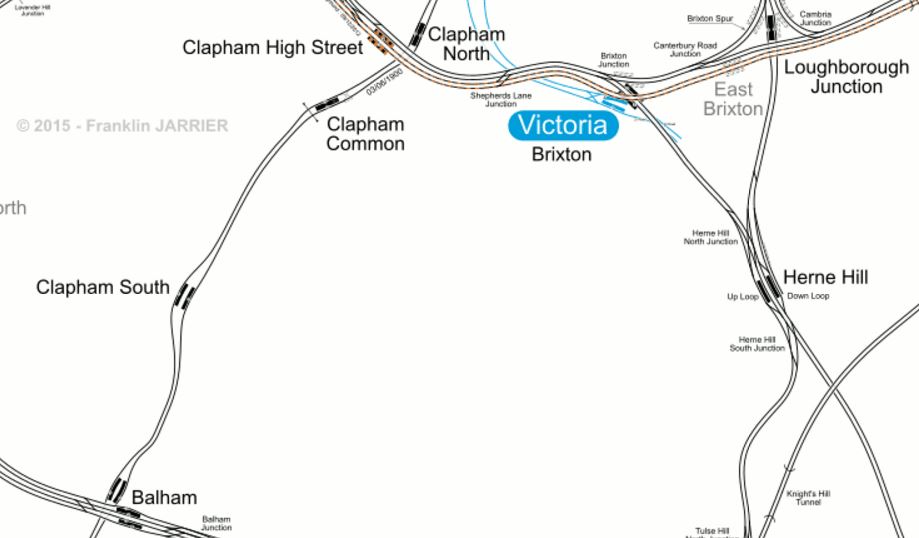
Clapham Lines
I think we have to congratulate the French behind these accurate metro maps.
Note the following.
- In a few years time, there will be two high-capacity North-South routes through the area; Thameslink and the Northern Line, which meet with the Bakerloo Line at Elephant and Castle station.
- Thameslink at Farringdon station and the Northern Line at Moorgate and Tottenham Court Road will have excellent connections to Crossrail.
- Thameslink goes through Herne Hill and Loughborough Junction and will have at least six eight-car trains all day, with extra services in the peak.
- Herne Hill is a big railway bottleneck, with as yet no sensible proposal to solve it.
- The Northern Line will have at least twenty trains per hour all day, between Morden and Kennington stations.
- The Victoria Line is also important to the area, as it will provide a thirty trains per hour service to from Brixton to Walthamstow Central via Stockwell on the Northern Line.
- The East London Line connects Clapham Junction in the west via Clapham High Street and Surrey Quays to Highbury and Islington in the north-east.
- The East London Line is getting crowded and increased frequencies will happen in 2019.
- The Law of New Routes, Stations and Trains will mean that Thameslink will attract traffic and the trains will quickly get busy.
- In the future Balham station could be served by Crossrail 2.
I believe that expecting Crossrail 2 to solve South London’s transport problems, is a bit like waiting for the United States to help the beleaguered good guys out in the First and Second World Wars.
Like the Americans, Crossrail 2 will arrive, but we have to make the best of what we’ve got in the meantime.
Perhaps these projects will help.
More And Better Designed Stations
Transport for London (TfL) have very sophisticated train and passenger modelling systems, which enable them to propose where improvements to stations should be made.
Sometimes this type of analysis, gives surprising results, that are counter-intuitive.
For example, I pointed out in Faster London Trains Could Make Your Commute Even Longer, how French research had shown this premise, to sometimes be true.
But the research also showed that in certain cases, extra stations could make journeys faster.
From my personal observations at Angel station, I sometimes think that trains arrive and depart faster on the wider southbound platform, rather than the narrow northbound one.
Camberwell Station On Thameslink
A couple of miles north of Loughborough Junction station is the disused Camberwell station, which Transport for London are proposing to reopen.
In their report on the Bakerloo Line Extension, TfL give this concise summary on reopening Camberwell station.
A new station at Camberwell would be a significantly lower cost option to a Tube extension, whilst serving the same catchment area. Investigations show significant journey time improvements could accrue to Camberwell passengers and that operationally there may be scope to integrate re-opening of the station into the launch of the completed Thameslink programme.
We will therefore undertake further planning work with Network Rail and the London Borough of Southwark to assess the proposal.
From their statement, it would appear that TfL have done an extensive analysis.
I would not be surprised, if this enthusiastic statement wasn’t followed through.
Northern Line Stations
Several of the Northern Line stations are relics of the line’s Victorian past and stations are slated for major improvements over the next few years.
- Bank – A big development has just been announced.
- Camden Town – I wrote about the proposed development of Camden Town station in The Camden Town Upgrade Exhibition.
- Elephant and Castle – A big property development is planned, which incorporates a new Northern Line station.
- Moorgate – Crossrail will improve the station.
- Old Street – Developments are planned in the area, which could result in an improved station.
These developments will probably mean that after the Northern Line Extension to Battersea is completed, most major stations between Camden Town and Kennington will have been upgraded.
Only the two Northern branches and the Morden branch will have not received a substantial number of upgraded stations with complete step-free access, wide safe platforms and escalators.
I think we’ll see other improvements to stations, especially an upgrading of the two island platform stations at Clapham North and Clapham Common.
The Herne Hill Loop On The Victoria Line
One constraint on the efficiency of the Victoria Line, is reversing the trains at Brixton station. There have been proposals in the past to crete a reversing loop with another station on the loop at Herne Hill station. I wrote about it in detail in Will The Victoria Line Go To Herne Hill?
This extension will only be built, if it is value-for-money in improving the Victoria line, despite the positive secondary effects it might have in the Herne Hill area!
An Interchange Hub At Streatham Common Station
Transport for London has recently proposed a interchange hub at Streatham Common, which I wrote about in Puzzled Over Streatham Common Station.
In my article, I showed that a well-designed hub could connect the following lines.
- The Sutton Loop Line Of Thameslink – Linking To Wimbledon and Sutton
- The Brighton Main Line
- Tramlink – With the possible use of tram-trains.
- East London Line – Linking to East London, Kent and Essex
- West London Line – Linking to Old Oak Common for HS2 and the West Coast Main Line
I very much think that the idea of an interchange hub at Streatham Common is a masterstroke.
Especially, as it will take the pressure off Wimbledon and East Croydon!
Another Branch Of The East London Line
The East London Line currently has four trains per hour in both directions across South London to and from Clapham Junction station.
This branch is getting very busy and from 2019, an extra two trains per hour will use this route.
But will Clapham Junction be able to cope with the extra services?
If it can’t, a possible alternative would be to run some trains from Peckham Rye via Tulse Hill to a terminus at Streatham Common.
Clapham High Street, Brixton And Brockley Interchanges
These are three possible interchanges with the Easst London Line in South London.
- Clapham High Street and Clapham North stations could be connected, if it was decided to improve the Northern Line through Clapham.
- Interchange between all the lines at Brixton station has been mentioned by TfL and I wrote about it in Could The Various Lines At Brixton Be Connected?
- TfL have also suggested that Brockley station could be a potential interchange hub and I wrote about it in A Report On The Bakerloo Line Extension
Each will have advantages and disadvantages.
Conclusion
There are a lot of possible projecs to improve the train services in the Clapham area.
What TfL have in their traffic database will decide the pattern of trains the area.
 The Anonymous Widower