It’s Gibbon Time
I took a New Bus for London up to Piccadilly Circus this afternoon and it was surprisingly busy for a Sunday afternoon.
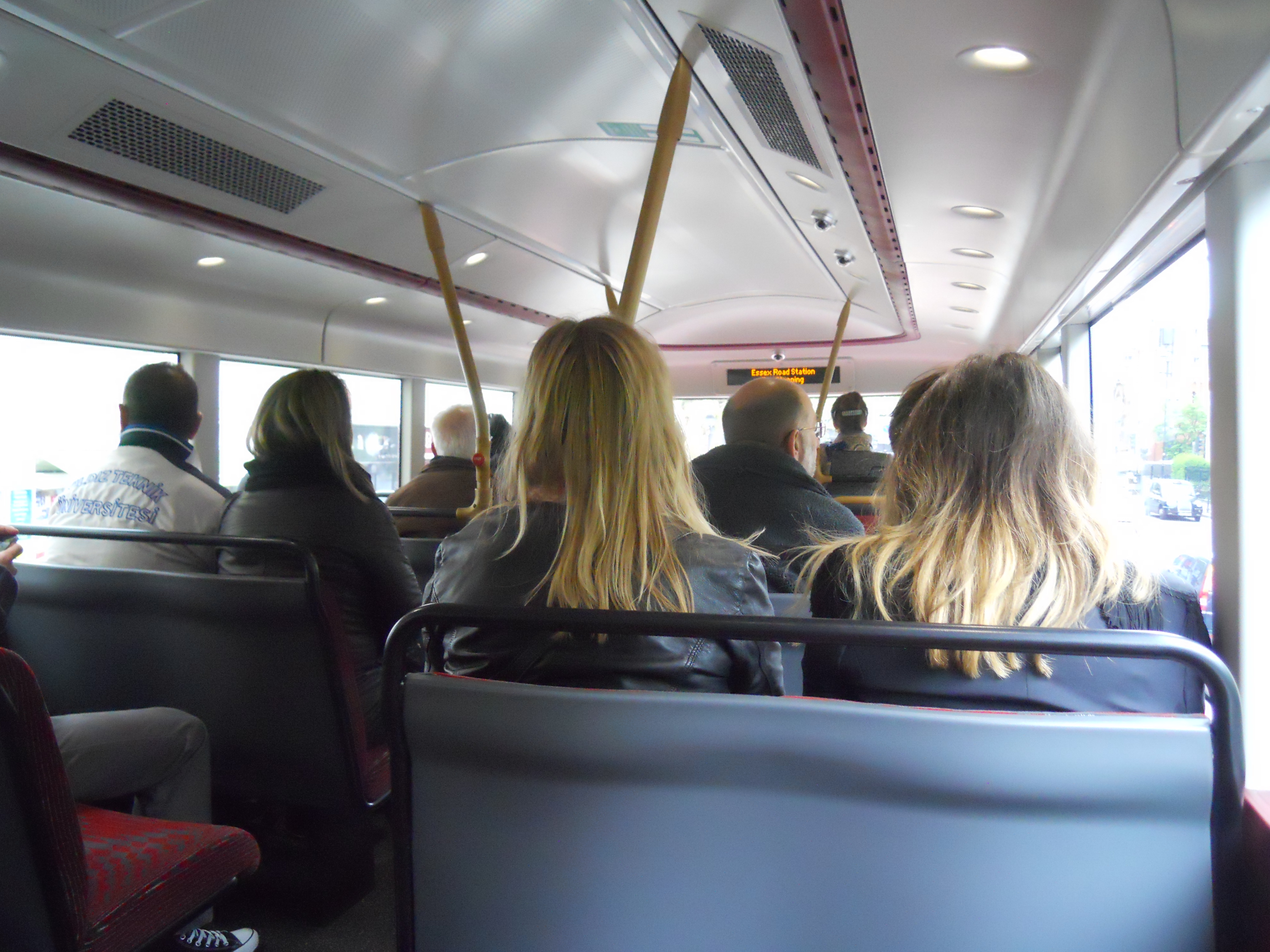
A Busy New Bus for London
When I got off, I used the rear staircase and I found that the vertical hand holds were alternated for my left and right hands. So I swung down the bus like a gibbon. I’m not sure, whether all buses are like that on the top deck. But if they are not, they should be! The slightly rough texture of the hand holds also gives a good grip for my gammy left hand.
Incidentally, note in the picture, how the handholds slant outwards. Does this effectively make the gangway wider? Or just appear so? I must take my tape measure with me to check!
After all, when you are rehabilitating from a stroke, like I am, isn’t it a bit cheaper to get free exercise in everything you do?
Hail the Granny Bus!
The term may be a bit over the top and sexist, as why should it just be grannies and not granpas as well.
But it does seem the elderly like travelling on the New Bus for London. This picture of an elderly couple getting on at traffic lights, sums up the elderly’s attitude to the bus and is one of many I could have taken in a similar vein.
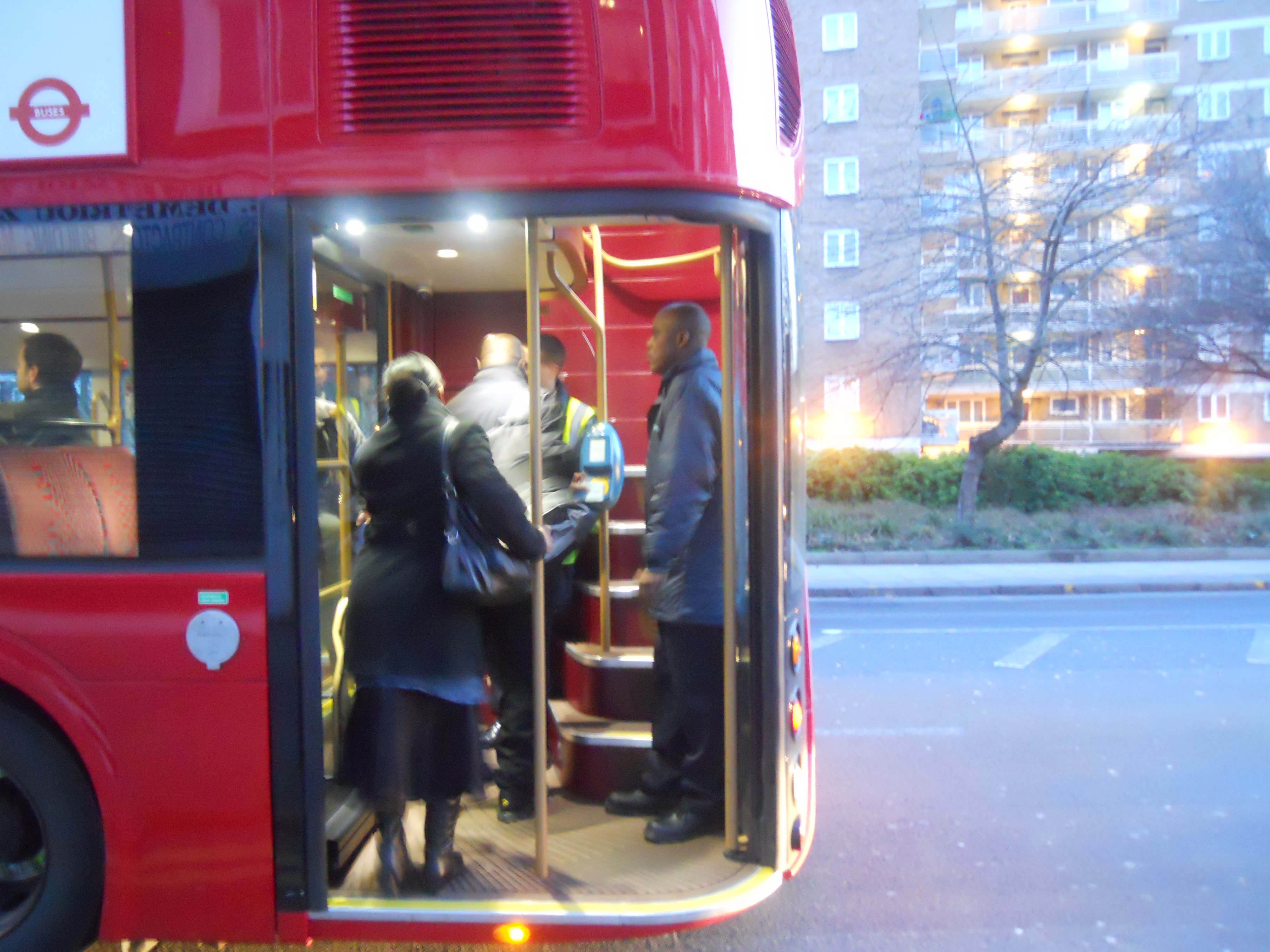
Hopping On a New Bus for London
I also encountered two ladies on the bus, who had deliberately waited for a ride on a New Bus for London. They were impressed.
I think it must bring back memories of years ago, when you could get on and off when you wanted and got service from a friendly conductor.
The Bus Games People Play
The behaviour of most people on London’s buses is generally immaculate, but it is sometimes treated like a serious game.
Obviously, kids like to travel in the front seats on the top. But so do adults and people generally move about to get the best seats as they become available. Perhaps, we all never grow up. Unless of course, we’re someone like Gordon Brown or Angela Merkel.
And then there’s how you choose, who you sit next to! It’s not just men, who like to sit next to nice-looking ladies and I can’t deny it doesn’t happen. But today, an elderly lady deliberately moved over so that I sat next to her, so she could have a chat. Most of the other passengers at the time were in their twenties at their eldest. In some ways, it’s only being friendly and no-one bothers.
And then there’s the game of judging what is the best time to descend from the top deck, just before you get off, as obviously walking down into an empty lobby is easiest. This game will get even more fun on a New Bus for London, as you have two staircases.
The New Bus for London also allows you to get on and off at convenient places, so this is yet another game, which at some time will come under the realm of the Health and Safety Police. But until then, let’s enjoy it.
A Plague of 38 Buses
Perhaps plague is the wrong word, but they were swarming round the Angel, when I came home. I was part of a convoy of six, led by a New Bus for London. Does the fact that it was in front, show that they are faster at both loading and unloading and between the stops? I also saw all three of the new buses today, so they are getting more common, with a fourth example expected for next week.
A New Bus for Hong Kong?
I was chatting with the conductor on a New Bus for London and he said that he’d seen officials from bus companies in Hong Kong on the bus.
This is not unexpected as Hong Kong has quite a few Wright buses, as this article indicates.
So is the New Bus for London going to be the New Bus for Hong Kong? I would suspect that the new London design, has the ability to be stretched to a double rear axle design, like that used in Hong Kong.
Update on May 25th, 2012 – In his talk last night, David Barnett indicated that the current New Bus for London is a stretch of the original design, so a stretched bus with an extra axle, is probably not the most difficult pieces of engineering, especially given the computing employed to transfer designs to a real bus. The power-train layout would still allow a totally flat floor, which the New Buses for London have and is one of the best passenger features.
Voting for the Bus
I was at the Angel yesterday afternoon, waiting for a 38 or 56 to take me home, when a New Bus for London passed the other way going towards Victoria.
The guy standing next to me, asked if I’d ridden the bus and I said several times. We then both agreed that we liked them and I said that as an engineer and a designer, it had a lot of good ideas that would find their way into new buses, making them all better.
He then made the statement, that although he was a lifelong Labour voter, he would be voting for the one candidate, who won’t be scrapping the bus; Boris.
Is this the first time that the man on the Dalston omnibus, has been swayed in his voting preference, by that bus?
A Second New Bus for London is Spotted
Tonight I spotted a second New Bus for London in the Balls Pond Road.
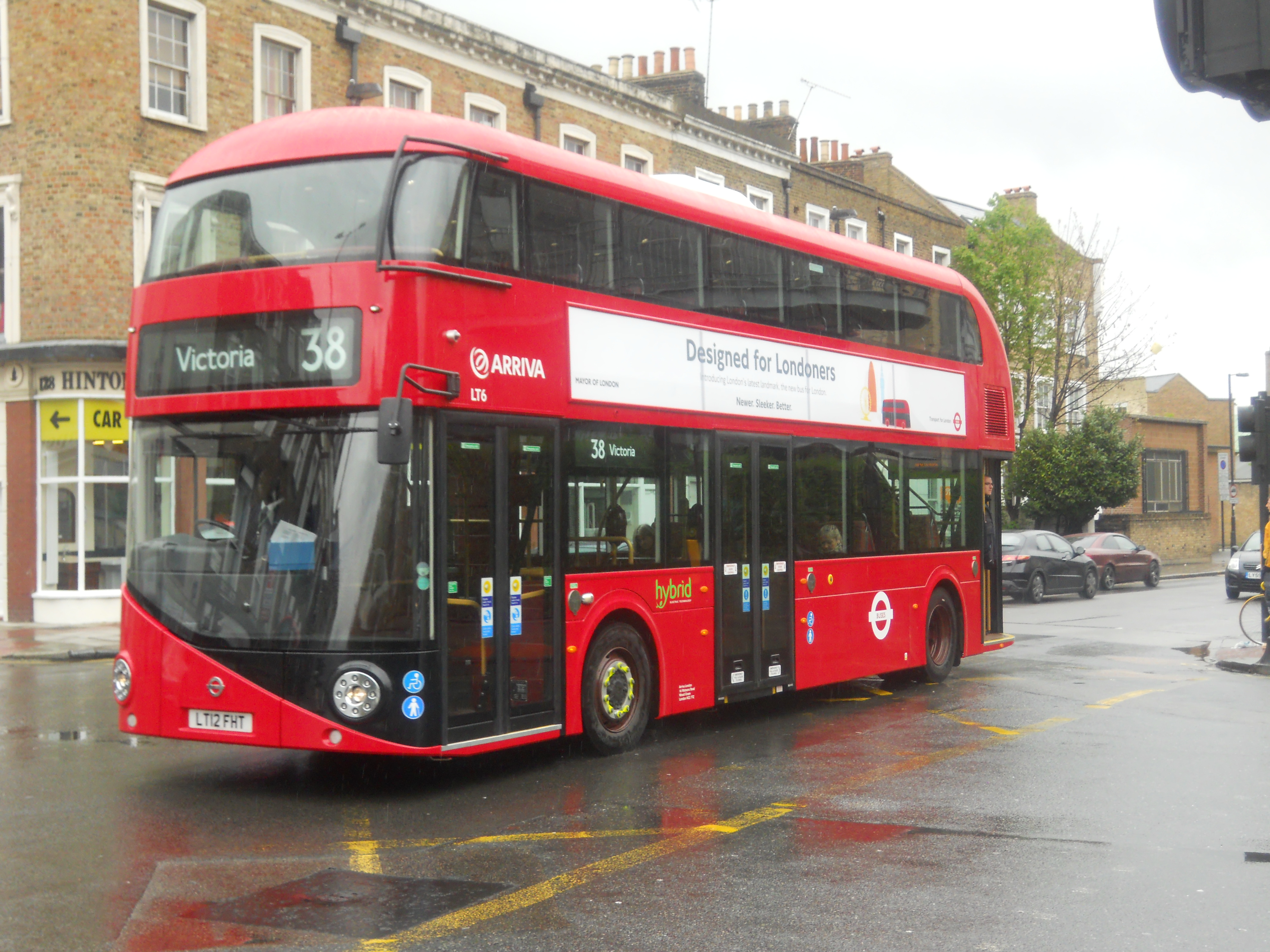
A Second New Bus for London
It appears to be numbered as LT6.
They all appear to have registration numbers starting with LT
The Capacity of a Bus Route
As I said in a previous post, I’ve travelled on a New Bus for London five or six times, and only once was the bus full to capacity. That was around six in the evening, when I took it home from the Angel and it was standing room only, as it would have been on every bus from there at that time.
I find this strange as the 38 is a very busy route and obviously the bus has a curiosity value. I too, would always choose it because it is more comfortable and getting on and off is easier. So perhaps we have other factors at work. Could it be that because of its flexibility the New Bus for London is faster at stops and people use it in a different way? Perhaps they tend to get off a stop or two earlier and walk. I have no idea and only a detailed analysis will give the answer.
But it all goes to show that when calculating the capacity of a bus route, it is not a simple process.
The capacity probably depends on three main parameters.
- Obviously the capacity of the bus is important. Doubling the carrying capacity of a bus though may not double the capacity of the route as you’ve still got to get passengers off and on the bus.
- The average journey time it takes to get from one end of the route to the other is also important, as the more trips you can do, the higher the capacity of the route.
- But probably the most important factor is the sum of the dwell times at each of the intermediate stops.
For years London has always had two door buses, with the front one for entry and payment and the middle for exit. I can’t understand, why this isn’t the norm around the country as it cuts the all-important dwell time at stops dramatically. It also makes the entry and exit of wheelchairs and buggies so much easier and fully complies with proposed disability regulations.
The New Bus for London, with its three exits and two staircases, adds another variable to the calculation of route capacity, as it undoubtedly cuts the dwell time at stops.
There are other factors which will effect the dwell time at stops.
- Well-designed wheelchair ramps, that don’t block the entrance or exit.
- Better design and location of bus-stops.
- Hybrid buses, which can accelerate away quicker.
- Electronic ticketing, that is no worse than London’s Oyster.
- Announcement of stops on the bus, so people know where to get off.
- Bus and walking maps at all stops, so passengers know the best bus to take.
- Having a conductor, may make a substantial difference on a busy route.
A lot of the country has a long way to go.
But buses are expensive at between £100,000 and £200,000 a time and it is criminal to spend that on a bus and then not use it to its maximum capacity. If you do use buses to their maximum capacity, you might need a couple of buses fewer to provide the same service.
When London learns more about the New Bus for London, they may find that because of the way people use them, that the number of buses required for a route may be slightly less than those they need now. As I said before, only a detailed analysis will give the answer!
A Bus With Added Service
I have travelled on a New Bus for London about five or six times now and like all things, be they cars or corkscrews, that have been properly designed, you see more and more good features, the more you use them.
Today, I picked up a New Bus for London at the Angel to go back home. The downstairs wasn’t full, but there was a lady in a wheelchair in the wheelchair space, sitting opposite her two friends.
I was sitting at the back, as given luck, I might have been able to get off a few metres or so before the stop and save myself some walking. Just after the stop before mine, the conductor walks past me to the lady in the wheelchair and has a short chat. At the stop, I jump on to the rear platform and step off, but without saving any walking, although I did save a half-minute or so. As I walked to the lights to cross the road, I saw the reason for the conductor’s chat. The lady and her friends had exited smoothly from the middle door. Wheelchair entrance and exit on a standard London bus is not difficult, but it sometimes does result in a time delay. On the New Bus, not only does the design minimise loading and unloading delays by allowing three routes for the able-bodied, but a conductor with a bit of forethought, like today, can minimise any problems before they happen. I think the lady was impressed with the service she received.
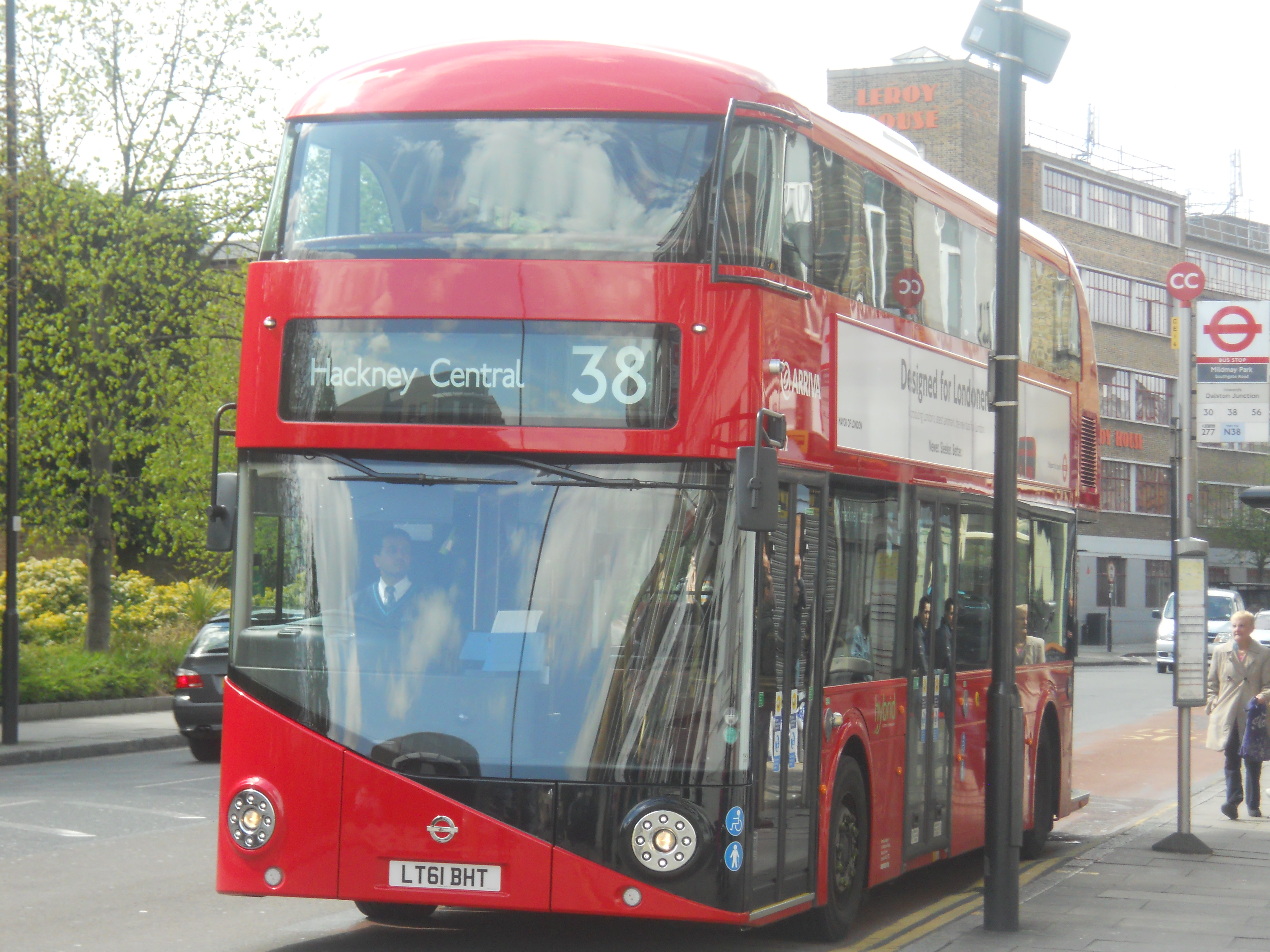
A New Bus for London on the Balls Pond Road
Incidentally, it was originally stated that New Buses for London would run with the rear platform closed and no conductor at weekends. According, to the conductor, this policy has been reversed. Read into that what you will! I just think that passengers like the extra service and security. Several users have also told me how much they like the ability to get on and off at convenient places using the rear platform.
The stop I used on the Balls Pond Road illustrates how by being clever Transport for London can use the new buses to advantage. The stop shown in the picture is perhaps thirty metres before a set of traffic lights, where most of the buses get caught for a couple of minutes. The conductor can use this time to allow late-arriving passengers to get on the bus. And they already do! So I think we’ll see a lot of bus stops moved to create and then take advantage of an increased loading window, if the stop is just before traffic lights.
Two Pleased Ladies and a Happy Driver
Yesterday afternoon, I took a New Bus for London from Islington Green to the Balls Pond Road. Because of the time of day and the weather, there were only about six people on the lower deck of the bus.
In front of me, were two ladies of a certain age and I asked them what they thought of the new bus. They said, that they had so much space and seemed very pleased with it.
I then moved to the back and asked the driver/conductor, what the bus was like to drive. He said he was happy with it, although the acceleration was a bit lively.
So perhaps they should be called Halley’s Comets after Edmond Halley, one of Hackney’s most famous citizens.
 The Anonymous Widower