No Panic At The Pumps … South Koreans Just Stop Driving On Wednesdays
The title of this post, is the same as that of this article on The Times.
This is the sub-heading.
President Lee Jae-myung has urged the public to ‘save every drop of fuel’ and introduced a number-plate rotation to keep drivers off the road
These first three paragraphs deeply illustrate the differences between the energy situation in North and South Korea.
From the lookout point atop Mount Dora, in the heart of the demilitarised zone that has separated the peninsula since 1953, you can clearly see where South Korea ends and North Korea begins.
The trees that proliferate across Korea’s undulating topography come to an abrupt halt. On the land that sits beyond, a farmer can be seen guiding an ox pulling a plough.
Sealed off from the world economy for 73 years, communist North Korea has resorted to cutting down much of its vegetation to burn for fuel. Democratic South Korea, by contrast, has established deep global trading ties that allow the country to import vital natural resources it cannot produce domestically.
North Korean communism certainly can’t be considered green.
I find these two paragraphs extremely significant.
South Korea may have to import almost all of its crude oil, but the country plays a huge role in refining it into petrol, diesel and jet fuel before shipping it around the world. This means that demand from overseas for Korea’s refined products is greater than ever, which has forced the government to step in. The country’s Ministry of Trade, Industry and Energy has implemented mandatory caps on refined petroleum products.
Of all South Korea’s refined products, kerosene, or jet fuel, is the most in demand. The country is one of the biggest exporters of jet fuel in the world. The US, for instance, relies on it for 70 per cent of its total jet fuel imports.
They could also be problematical for the country, as they will surely need to replace these jet fuel exports with exports of sustainable aviation fuel (SAF).
Most viable processes, that I’ve seen need the following ingredients.
- Lots of hydrogen or masses of GWhs of electricity to make it.
- Some carbon atoms, which can even be captured from the air or a gas-fired power station.
- Some form of Fischer-Tropsch process to force the atoms to make sustainable aviation fuel.
There are several companies that can do this, with British ones seeming to often to be connected to Oxford University.
There is also this Anglo-Korean connection over hydrogen.
I asked Google AI, who are investors in innovative hydrogen production company; HiiROC, which is a spin-out of the University of Hull, and received this answer.
HiiROC, a UK-based developer of “turquoise” hydrogen technology, is backed by a consortium of major industrial and financial players, including Centrica, Melrose Industries, HydrogenOne Capital Growth, Hyundai, Kia, Wintershall Dea, VNG, and Cemex Ventures. The company has raised over £40 million to develop its thermal plasma electrolysis technology.
Note the presence of two of the biggest Korean companies ; Hyundai and Kia.
HiiROC is also five times more efficient than traditional electrolysis.
Google AI says this about South Korean offshore wind.
South Korea is aggressively developing its offshore wind sector, targeting 14.3 GW to 15 GW of installed capacity by 2030, with over 116 projects and 44 GW of capacity under development. The country aims for a 2030 renewable energy share of 20-30%, leveraging floating technology for massive projects like the 3.2 GW Jindo project.
It appears to me, that South Korea will replace their market share of the jet fuel market with sustainable aviation fuel (SAF).
I’m also sure, that if the Koreans need to produce more hydrogen to make more SAF to power the world’s aircraft, Centrica will help them to rent some of our empty seas.
I can see the Koreans, with a little help from their friends, including the UK, dominating the SAF market.
CO2 to SAF: A One-Step Solution
The title of this post is the same as that of this article on the Chemical Engineer.
This is the sub-heading,
Oxford spinout OXCCU has launched a demonstration plant at London Oxford Airport to trial its one-step process of turning CO2 into sustainable aviation fuel (SAF). Aniqah Majid visited the plant to investigate the benefits of its “novel” catalyst
One word in this sub-heading caught my eye.
When I was a young engineer in the Computer Techniques section in the Engineering Department at ICI Plastics Division, I did a small mathematical modelling project for this chemical engineer, using the section’s PACE 231-R analogue computer.

He was impressed and gave the 23-year-old self some advice. “You should apply that beast to catalysts.”
I have never had the chance to do any mathematically modelling of catalysts either at ICI Plastics or since, but I have invested small amounts of my own money in companies working with advanced catalysts.
So when OXCCU was picked up by one of my Google Alerts, I investigated.
I like what I found.
The three raw ingredients are.
- Green Hydrogen
- Carbon dioxide perhaps captured from a large gas-fired powerstation like those in the cluster at Keadby.
- OXCCU’s ‘novel’ catalyst, which appears to be an iron-based catalyst containing manganese, potassium, and organic fuel compounds.
I also suspect, that the process needs a fair bit of energy. These processes always seem to, in my experience.
This paragraph outlines how sustainable aviation fuel or (SAF) is created directly.
This catalyst reduces CO2 and H2 into CO and H2 via a reverse water gas shift (RWGS) process, and then subsequently turns it into jet fuel and water via Fischer-Tropsch (FT).
The Wikipedia entry for Fischer-Tropsch process has this first paragraph.
The Fischer–Tropsch process (FT) is a collection of chemical reactions that converts a mixture of carbon monoxide and hydrogen, known as syngas, into liquid hydrocarbons. These reactions occur in the presence of metal catalysts, typically at temperatures of 150–300 °C (302–572 °F) and pressures of one to several tens of atmospheres. The Fischer–Tropsch process is an important reaction in both coal liquefaction and gas to liquids technology for producing liquid hydrocarbons.
Note.
- I wouldn’t be surprised that to obtain the carbon monoxide and hydrogen or syngas for the Fischer-Tropsch process, excess hydrogen is used, so the OXCCU process may need a lot of affordable hydrogen, some of which will be converted to water in the RWGS process.
- The high temperatures and pressures for the Fischer-Tropsch process will need a lot of energy, as I predicted earlier.
But I don’t see why it won’t work with the right catalyst.
The Wikipedia entry for the Fischer-Tropsch process also says this.
Fischer–Tropsch process is discussed as a step of producing carbon-neutral liquid hydrocarbon fuels from CO2 and hydrogen.
Three references are given, but none seem to relate to OXCCU.
OXCCU have a web site, with this title.
Jet Fuel From Waste Carbon
And this mission statement underneath.
OXCCU’s mission is to develop the world’s lowest cost, lowest emission pathways to make SAF from waste carbon, enabling people to continue to fly and use hydrocarbon products but with a reduced climate impact.
It looks like they intend to boldly go.
Conclusion
My 23-year-old self may have been given some good advice.
Freightliner Partners With Zero To Decarbonise Critical Transport Operations
The title of this post, is the same as that of this news item from Freightliner.
This is the sub-heading.
Today, Freightliner and Zero, a breakthrough energy company that develops and manufactures whole-blend synthetic, non-biological fuels, announced a partnership to achieve a fossil-free locomotive operation by 2040 and overall Net Zero by 2050, representing a major evolution for one of the world’s oldest, safest and most reliable forms of freight transport. To successfully meet these ambitious emissions targets, Freightliner is exploring alternatives to diesel, such as Zero’s carbon-neutral synthetic diesel, which will eliminate fossil-carbon emissions and improve air quality and environmental wellbeing.
These are my thoughts.
Freightliner
Freightliner is a rail-freight company, that you see regularly hauling freight trains all over the UK.

The picture shows two of their Class 90 electric locomotives in their latest livery.
These posts talk about the company and lower or zero carbon operation.
- Clean Air Power Adds Hydrogen To Class 66 Fuel Mix
- Freightliner Continue Trials On New Low Carbon Fuel
- Freightliner Secures Government Funding For Dual-Fuel Project
- The Ultimate Bi-Mode
The current post fits that pattern.
Zero Petroleum
Zero Petroleum is one of those companies that gives Elon Musk nightmares.
But when you have backers like Babcock, Boeing, Intertek, Rolls-Royce and the Royal Air Force, you must be doing something right.
The Wikipedia entry for the company has this first paragraph.
Zero is a manufacturer of non-biological carbon-neutral synthetic fuel (also known as e-fuel) co-founded by former Formula One engineer Paddy Lowe. Its product has been developed as an alternative to fossil-based fuels and a more scalable sustainable alternative to waste and bio-fuels. The Royal Air Force used its fuel in November 2021 to achieve a World Record first flight powered by synthetic fuel. In July 2022, Zero entered a new partnership with the Royal Air Force to move towards mass production of sustainable aviation fuel.
The company is often known as just Zero.
These two and a half paragraphs from the Wikipedia entry describe the technology.
Zero uses Direct FT (a proprietary and specialised version of Fischer-Tropsch) to directly manufacture target fuels (gasoline, kerosene and diesel) at high yield and with no need for refinery upgrading.
When manufactured using renewable energy, synthetic fuel can be used as a carbon neutral or carbon negative direct drop-in replacement for fossil fuels, particularly for operations that require high energy densities – such as air travel, shipping and farming – and to ensure the continued use of legacy vehicles. It can also be used as a raw material to produce various forms of plastic.
It is manufactured using a process known as petrosynthesis, in which carbon dioxide and hydrogen are combined to create hydrocarbons. The process involves direct air capture of carbon dioxide from the atmosphere and the electrolysis of water to obtain hydrogen.
The Fischer-Tropsch process, despite its association in the past with dodgy regimes, seems to be at the heart of things, as it is with Velocys.
I describe the Velocys process and its link to Fischer-Tropsch in Grant Shapps Announcement On Friday.
Surely, the carbon-neutral fuel produced by Zero, are the ideal stop-gap fuel until true full zero-carbon fuels are available.
But Zero’s fuels will always be available for heritage and legacy trains, planes and automobiles and for applications, where older technology must be used.
As an example of older technology still being used on UK’s railways, Network Rail operate, the New Measurement Train to check all tracks in Great Britain.

The train may have been manufactured in the 1970s, but it has modern engines and is the ideal train to carry the wide variety of sophisticated equipment to ensure the safety of Britain’s railways.
Synthetic diesel like that produced by Zero could keep the New Measurement Train running for some years yet.
Freightliner Have Made A Pragmatic Decision
I believe that Freightliner have made a pragmatic decision, that allows them to go carbon neutral without without taking risks or spending millions on new equipment, that is not fully-developed.
As new zero-carbon technology is developed, like say hydrogen-electric hybrid locomotives, these may take over certain tasks, which will reduce some of the need for synthetic diesel.
But synthetic diesel from Zero will always be there as a fuel of last resort.
Fresh Air Fuels Global
Because of its history, South Africa has developed technology to create biofuels, as alternatives to diesel.
If you read the Wikipedia entry for South African chemical company; SASOL, you’ll see the things that South African chemists did, to get round the sanctions imposed because of apartheid.
SASOL has advanced the Fischer–Tropsch process and uses it to produce diesel and other fossil fuels.
Note that Velocys have also developed this process to make sustainable aviation fuel in the UK.
Fresh Air Fuels Global have a page on the G-volution web site.
The page is dominated by an infographic, which shows organic waste (animals and plants) going into an anaerobic digester, which produces.
- Biogas, which is used to create heat, electricity, CO2, biomethane, fuel and gas for the grid.
- Digestate, which is used for fertiliser and livestock bedding.
It almost sounds too good to be true.
This is the mission statement below the graphic.
Our mission: To be the most reliable producer of energy secure low carbon fuels.
There is then these paragraphs, which explain the relationship between G-volution and Fresh Air Fuels Global.
Global energy security concerns and climate targets necessitate countries and businesses to transition away from high-cost fossil fuels towards low-carbon alternatives.
Over more than a decade, Cape Advance Engineering South Africa (CAE) have been developing an incredibly cost-effective Anaerobic Digestion (AD) technology, which has proven to generate renewable energy from organic waste in the form of gas, heat and electricity that is cost competitive with fossil fuels.
G-Volution has partnered with CAE to form Fresh Air Fuels Global (FAFG), with aim of introducing the CAE technology to international markets that the G-Volution already have a foothold, constructing AD plants and creating carbon neutral biofuel from waste that can be used in dual fuel engines.
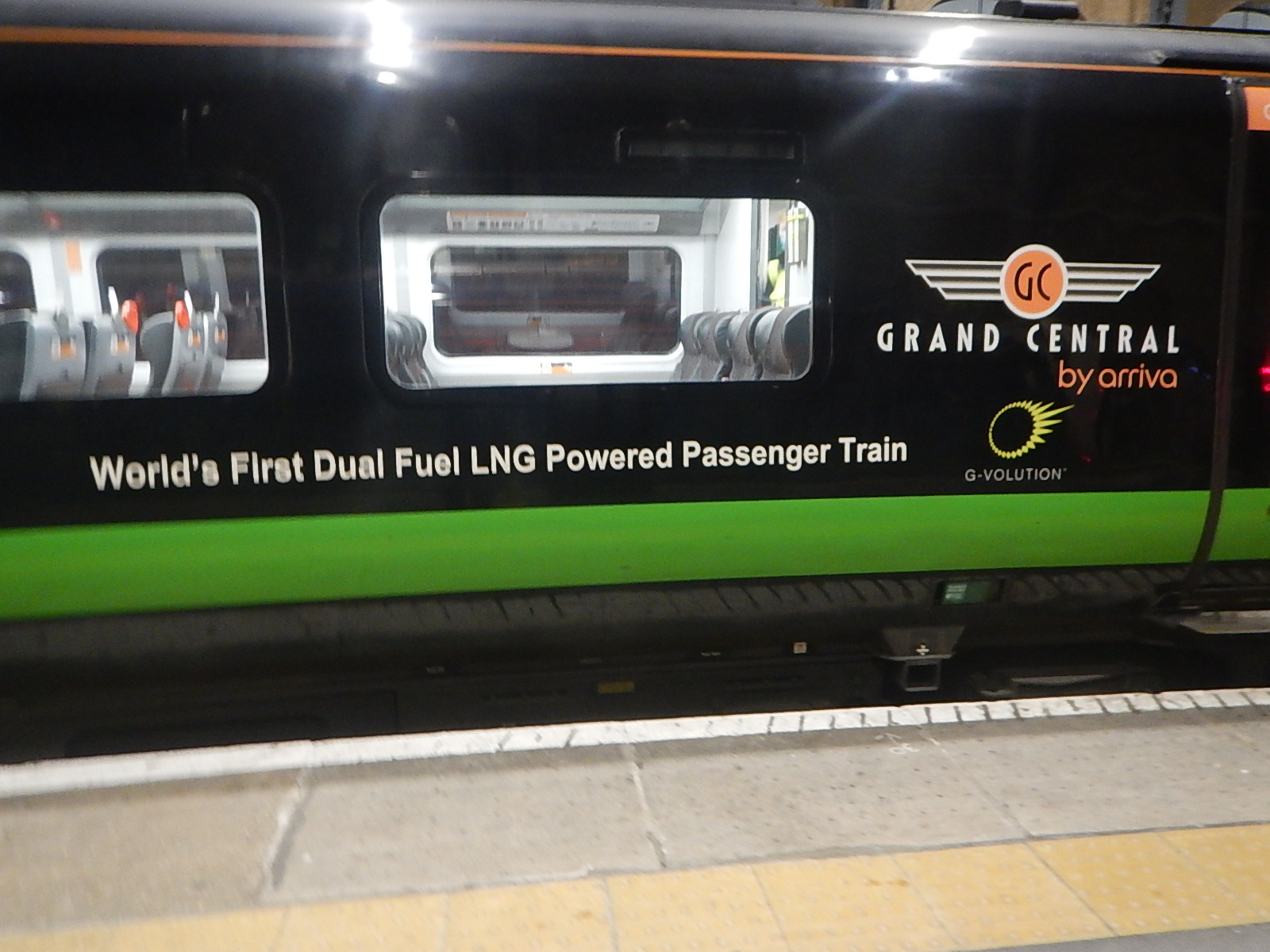
In Grand Central DMU To Be Used For Dual-Fuel Trial, I describe how G-volution’s dual fuel technology has been applied to one of Grand Central’s Class 180 train.
This picture I took after travelling in a Grand Central Class 180 train, shows that G-volution don’t hide their light under a bushel.
Note.
- This train appears to run on diesel and liquified natural gas.
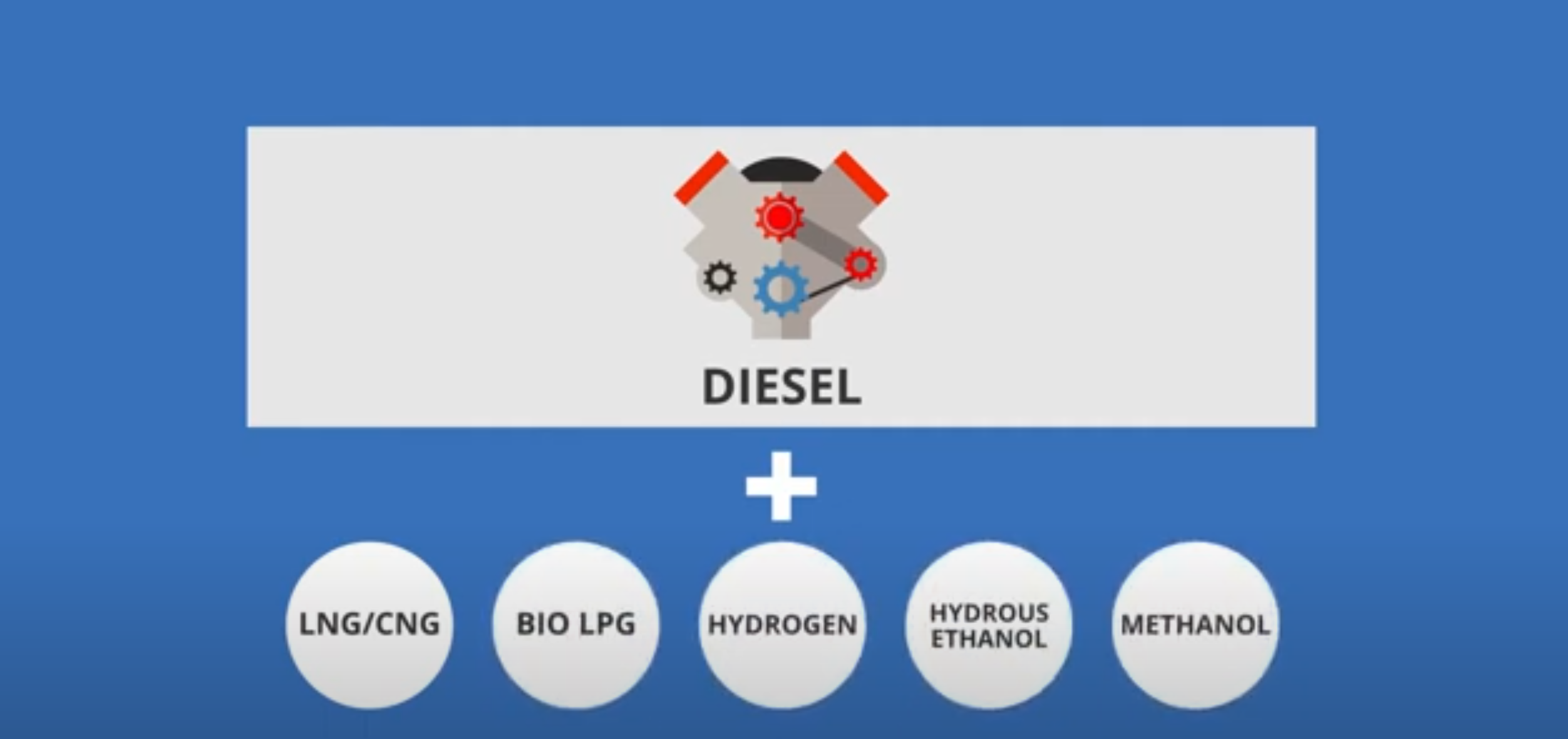
- This G-volution video gives more details.
This clip from the video, shows the possible fuels.
Note.
- Can the dual fuel engine use biodiesel or HVO instead of diesel?
- It looks like the Fresh Air Fuels Global process can produce biomethane, which could be liquified as LNG.
- Hydrogen is the only true zero-carbon secondary fuel.
- There is a Wikipedia entry for ethanol fuel.
- Hydrous ethanol is about 95% ethanol and 5% water and is used as a fuel in Brazil in petrol cars.
- There is a Wikipedia entry for the use of methanol as fuel.
Have G-volution got access to the technology to both reduce the fuel consumption of diesel engines and run them on zero-carbon fuel?
UK Trains That Have Cummins QSK-19 R Diesel Engines
Grand Central’s Class 180 trains have a Cummins QSK-19 R diesel engine.
All these trains have the same engine.
- 14 – Class 180 trains
- 51 – Class 185 trains
- 34 – Class 220 trains
- 44 – Class 221 trains
- 27 – Class 222 trains
In addition, Class 175 trains have a different engine made by Cummins.
Conclusion
If G-volution’s technology can be made to work successfully, it could play a large part in the decarbonisation of UK passenger trains.
With Southwest Airlines Deal, Velocys Presells 100% Of The Output From Its US Biobased Jet Fuel Project
The title of this post, is the same as that of this article on the American Chemical Society.
This is the first paragraph.
The biofuel maker Velocys has signed jet fuel purchase agreements with Southwest Airlines and International Airlines Group. Velocys says it now has agreements for the entire output of the facility it plans to open in Mississippi in 2026. The plant, known as Bayou Fuels, will use gasification and Fischer-Tropsch chemistry to make the fuel from wood waste. It will be fitted with carbon-capture equipment from Oxy Low Carbon Ventures, making its fuel net-negative in CO2 emissions. The two airlines have also agreed to buy the resulting greenhouse gas.
Note that the technology is net-negative in carbon dioxide emissions.
This must be a short-term route to decarbonise existing aviation.
Velocys’ Fischer–Tropsch Tech Picked For E-fuels Project In Japan
The title of this post is the same as that of this article on Renewables Now.
Fischer–Tropsch technology has a chequered history, as it has been used by regimes like Nazi Germany and South Africa under apartheid to create the fuel they need.
But now Oxford University spin-out company; Velocys have improved the process, so that it can turn rubbish destined for landfill into sustainable aviation fuel.
This is the last paragraph from the article.
The developer says its FT reactor can enable the production of SAF from household waste and woody biomass. The end product is a high-quality version of existing fuels, requiring no changes to engines or infrastructure, Velocys says on its website.
This is surely a viable alternative to keep airlines flying, until hydrogen-powered planes are developed.

