Ocean Winds Enters Lease Agreement With Crown Estate For 1.5 GW Celtic Sea Floating Wind Project
The title of this post, is the same as that of this article on offshoreWIND.biz.
This is the sub-heading.
Ocean Winds has entered into an agreement for lease with the Crown Estate for a 1.5 GW floating offshore wind project, for which the developer secured a site in the Round 5 seabed auction last year.
These two paragraphs add detail to the story.
Offshore Wind Leasing Round 5, the UK’s first dedicated floating wind seabed leasing round, was launched in February 2024, offering three areas. In June 2025, the Crown Estate announced Equinor and Gwynt Glas, a joint venture between EDF and ESB, as preferred developers for two project sites and said it was working to ensure the delivery of the full potential capacity of Round 5, which is up to 4.5 GW.
Equinor and Gwynt Glas entered into lease agreements for their floating wind projects in October 2025 and, the following month, the Crown Estate said Ocean Winds had secured the third floating offshore wind site in the Celtic Sea.
This map shows the three wind farms, that make up the Glynt Glas wind farm.
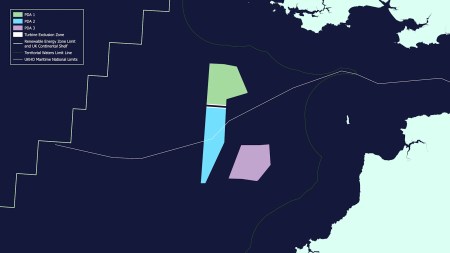
Note.
- It is expected to be built from and connect to the grid at Port Talbot in South Wales.
- The three sites are expected to be commissioned by the early-to-mid 2030s.
- The elongated white dot to the East of the wind farms would appear to be Lundy Island.
- The large bay to the North of Lundy is Carmarthen Bay with Caldey Island at its West end and Llanelli on its East.
- The Gower separates Swansea Bay from Carmarthen Bay.
This Google Map shows the Bristol Channel from the wind farms in the West to Cardiff and Hinkley Point.
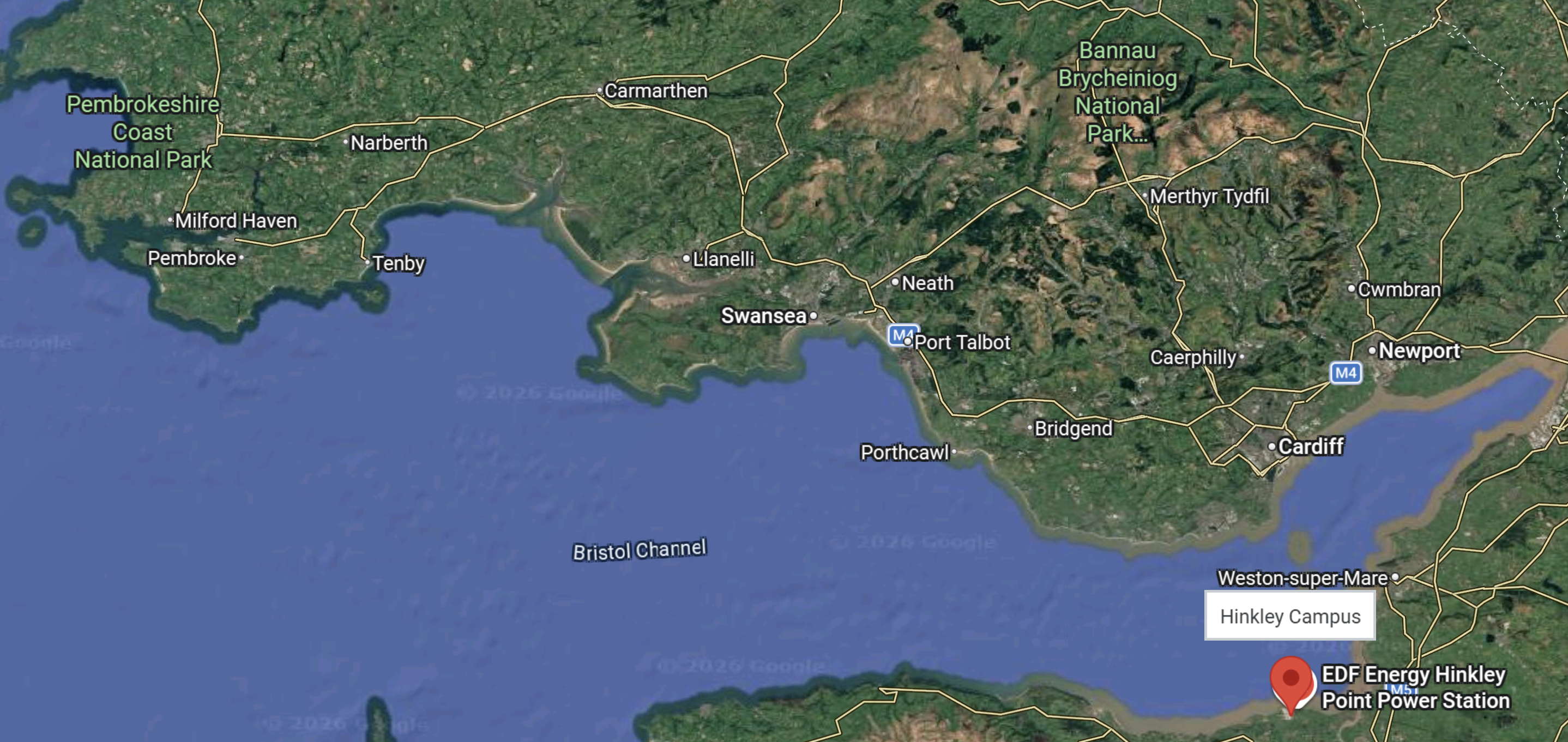
Note.
- Along the North coast of the Bristol Channel, working from West to East, my 78-year-old eyes can pick out Milford Haven, Pembroke, Caldey Island, Tenby, Llanelli, Swansea, Port Talbot, Porthcawl, BridgendCaerphilly, Cardiff and Newport.
- Coming back along the South Coast, I can see Weston-super-Mare, Hinkley Point C and the tip of Lundy Island in line with Tenby.
- The three sections of Glynt Glas will each generate 1.5 GW, making a total of 4.5 GW.
- Hinkley Point C when completed, will be a 3.26 GW nuclear power station.
- There is also a 2.2 GW gas-fired power station at Pembroke.
Nearly 8 GW of renewable electricity should be enough to convert Port Talbot steelworks to the manufacture of green steel.
How Much Wind Power Is Planned For The Western Approaches?
I asked Google AI, the title of this section and received this answer.
The UK has a target of 50 GW of offshore wind by 2030, with significant projects planned for the Celtic Sea (part of the Western Approaches), which is a key area for 5 GW of floating wind. Total UK offshore wind pipeline capacity exceeds 93 GW, with major developments in this region focusing on floating technology.
Key details regarding wind power in the Western Approaches (specifically the Celtic Sea) include:
Celtic Sea Developments: The area is a primary focus for floating wind projects, designed to capitalize on deep-water potential, with 5 GW of floating wind expected to be deployed across the UK by 2030.
Pipeline and Capacity: The total UK pipeline for offshore wind, which includes the Western Approaches, is 93 GW, and the government is aiming for 43-50 GW of installed offshore capacity by 2030.
Project Status: The region is expected to benefit from the Crown Estate’s leasing rounds aimed at accelerating floating wind, with 15.4 GW of new projects submitted across the UK in 2024.
Wales/South West England Context: Wales has 1.4 GW of projects in the pre-application stage, with some potential for developments off the South West coast.
For more detailed information on specific projects and their development status, you can visit the RenewableUK website and RenewableUK website.
It looks like about 20 GW of offshore wind could be installed in the Western Approaches.
Do British And German Offshore Wind Farm Generate Maximum Power At Different Times
In National Grid, TenneT Germany Launch GriffinLink, A First Of A Find Project To Maximise Offshore Wind, I discussed GriffinLink, which will be an offshore link between British and German offshore wind farms.
Somebody has asked me if wind farms are in phase with each other, as obviously this would effect how they perform and are are controlled.
So I asked Google AI, the question in the title of this post and received this reply.
Yes, British and German offshore wind farms often generate their maximum power at different times, although they are both located in the North Sea and share similar peak seasons. The variations in generation are driven by localized weather patterns, specifically the movement of low-pressure systems.
Key Differences in Generation Times:
Regional Weather Patterns: While North Sea wind farms are often closely correlated, significant differences arise when weather systems move from west to east. Wind often hits the UK’s North Sea sites first, meaning they may hit maximum generation capacity hours before German or Danish sites, which are further east.
Time of Day (Diurnal Differences): Because UK wind farms are located in the Irish Sea, the Scottish coast, and the North Sea, they can exhibit different diurnal (daily) peak times compared to German sites in the North Sea and Baltic Sea.
Seasonal Peaks: Both countries experience the highest output during winter months (e.g., December). However, during specific, localized, long-lasting high-pressure systems (“Dunkelflaute”), one country might experience a complete drop in wind while the other continues to produce, or vice versa.
Why They Differ:
Geography: The UK’s extensive, spread-out coastline (Irish Sea, Atlantic coast, North Sea) offers a different wind profile than the more concentrated German offshore projects in the North Sea and Baltic Sea.
Correlation Challenges: Research shows that while North Sea countries have similar wind profiles, there is not 100% correlation. Meteorological differences in how wind speeds behave across the North Sea allow for complementary production.
This difference is highly advantageous for European energy security, as it allows for the balancing of intermittent wind power across the region.
The conclusion from Google AI, is almost predicting that GriffinLink will be developed. From my experience of mathematical modelling the cost and financial benefits should be fairly easy to predict.
Will The UK And The Republic Of Ireland Link Their Offshore Wind Farms To Improve Efficiency?
This may seem an obvious idea, especially as UK and Republic of Ireland are heavily interconnected.
So I asked Google AI, the question in the title of this section and received this reply.
Yes, the United Kingdom and the Republic of Ireland are taking significant, active steps to link their offshore wind farms and electricity grids to improve efficiency, increase renewable energy production, and enhance energy security. Following a Memorandum of Understanding (MoU) signed in September 2023, the two countries are collaborating on developing subsea energy infrastructure in the Irish and Celtic Seas.
Here are the key details regarding this cooperation:
Deepened Collaboration: As of March 2025, the UK and Ireland are working on a new data-sharing arrangement to lay the groundwork for directly connecting offshore wind farms to each other’s national energy networks.
Offshore Hybrid Assets (OHAs): The plans include developing offshore hybrid assets, which are subsea cables that directly link offshore wind farms to both countries’ grids, reducing infrastructure costs and maximizing efficiency.
Subsea Mapping & Interconnection: Both nations are mapping the Celtic Sea to identify optimal locations for interconnectors and to improve the interoperability of their grids.
Existing & New Projects: While Ireland’s current interconnection to the UK is limited (approx. 500MW), capacity is planned to increase significantly. Specific projects like Mares Connect (linking North Wales and Ireland) are being developed to provide750MW of additional capacity.
Regional Cooperation: Ireland is also participating in the “Hamburg Declaration” (signed Jan 2026), joining the UK and other North Sea countries to commit to 300GW of offshore wind by 2050 through shared, regional infrastructure.
This cooperation aims to allow Ireland to export its surplus renewable energy during high generation, while benefiting from the UK’s robust grid during lower wind conditions.
Will The UK AndNorway Link Their Offshore Wind Farms To Improve Efficiency?
As we have interconnectors with Norway, I asked Google AI, the question in the title of this section and received this reply.
Yes, the UK and Norway are actively planning and implementing initiatives to link their offshore wind farms and electricity grids to improve efficiency, energy security, and grid balancing. Following a series of agreements, including a major pact in January 2026, the two countries are collaborating on “hybrid” projects that connect offshore wind sites directly to multiple countries.
It does look like that the co-operations between the UK and Germany, Norway and the Republic of Ireland are setting examples that should be copied all over the world.
But then, you should always follow the mathematics.
But somehow, I can’t see President Trump signing any windmill co-operation with his neighbours.
National Grid, TenneT Germany Launch GriffinLink, A First Of A Find Project To Maximise Offshore Wind
The title of this post is the sane as that of this press release from National Grid.
These three bullet points serve as sub headings.
-
National Grid and TenneT Germany announce our cooperation on GriffinLink, a planned GB-Germany multi-purpose interconnector (MPI).
-
GriffinLink would support energy security, accelerate the connection of offshore wind and mark a coordinated approach on supply chains and infrastructure.
-
Announced at the North Sea Summit in Hamburg, the project could maximise shared offshore wind resources in the most efficient way.
These two paragraphs add more detail.
National Grid will partner with TenneT Germany to develop GriffinLink, a new multi-purpose interconnector (MPI) project, which could connect British and German offshore wind to both countries. It marks a step towards a more integrated, flexible, and efficient energy system for both Great Britain and Germany which delivers secure, affordable energy for consumers.
GriffinLink could make an important contribution to security of supply and market integration in northwestern Europe. Cross-border hybrid energy systems such as GriffinLink make it possible to feed cleaner electricity into the grid where it can be generated and transport it exactly where it is needed.
Note this integrated approach means.
- Better utilisation of the grids and is a more efficient use of renewable energy across national borders;
- Lowering the costs involved, and the supply chain materials required and;
- A reduced impact on coastal communities and the environment.
As a ‘multi-purpose’ interconnector connecting wind in two countries, GriffinLink would be the first project of its kind in Europe and a milestone for cross-border energy security and stability.
It will also connect the UK’s offshore wind power to someone someone who needs it and will pay good money for it.
I asked Google AI, “How much energy we will be exporting to Europe in 2030” and received this reply.
By 2030, the UK is expected to be exporting significant amounts of electricity to Germany, largely enabled by the NeuConnect interconnector, which is set to become operational around 2028 and will have a capacity of 1.4 GW. While precise, definitive figures for 2030 are subject to market conditions, key data suggests:
NeuConnect Capacity: The 725km subsea link between Kent (UK) and Wilhelmshaven (Germany) will allow 1.4 GW of electricity to flow in either direction.
Net Export Position: The UK is positioned to become a net exporter of electricity to Europe by the 2030s, fueled by a massive expansion in offshore wind capacity, aiming for up to 50GW by 2030.
Grid Interconnection: By 2030, the UK’s total interconnection capacity to Europe is planned to increase to 18GW, up from 8GW.
Hydrogen Focus: In addition to electricity, the UK is exploring the potential to export up to 35 TWh of hydrogen to Germany by 2030.
That will do nicely!
All Five Halted US Offshore Wind Farms Resume Construction
The title of this post, is the same as that of this article on offshoreWIND.biz.
This is the sub-heading.
All five US offshore wind farms under construction that received stop-work orders from the US government have been cleared to continue building, with Ørsted’s Sunrise Wind project the fifth project to be granted a preliminary injunction as part of a lawsuit challenging the order issued by the Director of the Department of the Interior’s Bureau of Ocean Energy Management (BOEM) on 22 December 2025.
I would have loved to have been a fly on the wall of the Oval Office in the White House, as what words could the dumbest United States President of my lifetime possibly use to put any positive spin on such an overwhelming five-round defeat, where he was screwed, glued and tattooed to borrow an expression from Brian, who was one of my favourite accountants.
This table summarises the five wind farms.
- Coastal Virginia Offshore Wind-Commercial – 2600 MW – Operation in 2027.
- Empire Wind 1 – 816 MW – Operation in 2026.
- Revolution Wind – 704 MW – Operation in 2026.
- Sunrise Wind – 924 MW – Operation in 2027.
- Vineyard Wind 1 – 804 MW – Operation in late 2026.
The five farms total nearly 6 GW.
This is what Google AI says about the usefulness of 6 GW to power typical United States houses.
6 gigawatts (GW) of power can supply approximately 5 million US homes, based on recent large-scale energy capacity deals. Depending on energy efficiency and regional usage, this capacity typically translates to around 750,000 homes per 1 GW, meaning 6 GW can cover a range of roughly 4.5 million to 5 million households.
I doubt Trump will give up gracefully.
Offshore Wind Farms Owned By CIP, JERA Nex BP Enter Lease With Crown Estate
The title of this post, is the same as that of this article on offshoreWIND.biz.
This is the sub-heading.
The 1.5 GW Mona offshore wind farm, owned by JERA Nex BP, and the 480 MW Morecambe, owned by Copehnagen Infrastructure Partners (CIP), have entered into lease with the Crown Estate.
It looks like the 1.5 GW Mona and the 480 MW Morecambe wind farms, which were both given development consent in 2025, will be going ahead, but the 1.5 GW Morgan wind farm is to be discontinued, despite having development consent.
Mona and Morecambe would appear to be planned to be commissioned around 2030.
So if all goes well, that would appear to be 2 GW in the oven.
In CIP’s UK Offshore Wind Project Granted Development Consent, there is a comprehensive map of all the wind farms in Morecambe Bay.
‘Mobilising EUR 1 Trillion in Investments’ | North Sea Countries, Industry, TSOs to Ink Offshore Wind Pact
The title of this post, is the same as that of this article on offshoreWIND.biz.
This is the sub-heading.
Government officials from Belgium, Denmark, France, Germany, Ireland, Luxembourg, the Netherlands, Norway and the UK are set to sign a declaration confirming the ambition to build 300 GW of offshore wind in the North Seas by 2050, and an investment pact with the offshore wind industry and transmission system operators (TSOs) that is said to mobilise EUR 1 trillion in economic activity.
These three paragraphs add a lot of powerful detail.
Under the Offshore Wind Investment Pact for the North Seas, to be signed today (26 January) at the North Sea Summit in Hamburg, governments of the nine North Sea countries will commit to building 15 GW of offshore wind per year from 2031 to 2040.
The heads of state and energy ministers will also vow to de-risk offshore wind investments through a commitment to provide two-sided Contracts for Difference (CfDs) as the standard for offshore wind auction design. The pact also commits governments to remove any regulatory obstacles to power purchase agreements (PPAs), according to WindEurope, which will sign the pact on behalf of the industry.
On the industry’s side, the commitment is to drive down the costs of offshore wind by 30 per cent towards 2040, mobilise EUR 1 trillion of economic activity for Europe, create 91,000 additional jobs and invest EUR 9.5 billion in manufacturing, port infrastructure and vessels.
These two paragraphs say something about cost reductions.
The cost reduction of offshore wind is planned to be achieved through scale effects, lower costs of capital and further industrialisation supported by clarity and visibility on the project pipeline.
The transmission system operators (TSOs) will identify cost-effective cooperation projects in the North Sea, including 20 GW of promising cross-border projects by 2027 for deployment in the 2030s.
I hope there is a project management system, that can step into this frenzy, just as Artemis did in the 1970s with North Sea Oil and Gas.
The BBC has reported the story under a title of UK To Join Major Wind Farm Project With Nine European Countries.
this is the sub-title.
The UK is set to back a vast new fleet of offshore wind projects in the North Sea alongside nine other European countries including Norway, Germany and the Netherlands.
These six paragraphs add more detail.
The government says the deal will strengthen energy security by offering an escape from what it calls the “fossil fuel rollercoaster”.
For the first time, some of the new wind farms will be linked to multiple countries through undersea cables known as interconnectors, which supporters say should lower prices across the region.
But it could prove controversial as wind farm operators would be able to shop around between countries to sell power to the highest bidder – potentially driving up electricity prices when supply is tight.
Energy Secretary Ed Miliband will sign a declaration on Monday at a meeting on the future of the North Sea in the German city of Hamburg, committing to complete the scheme by 2050.
Jane Cooper, deputy CEO of industry body RenewableUK, said the deal would “drive down costs for billpayers” as well as increasing “the energy security of the UK and the whole of the North Sea region significantly”.
But Claire Countinho, shadow energy secretary, warned “we cannot escape the fact that the rush to build wind farms at breakneck speed is pushing up everybody’s energy bills.”
Claire Coutinho, as an outsider at present and a member of a party out of Government had to say something negative, but her negotiations when she was UK Energy Minister with her German opposite number, which I wrote about in UK And Germany Boost Offshore Renewables Ties, seem very much a precursor to today’s agreement.
‘Drone Boats Will Be The New Normal’
The title of this post is the same as this article on the BBC.
This is the sub-heading.
A remotely operated boat will survey an area hundreds of miles offshore – while being controlled from an inland airport.
These two paragraphs add more details to the story.
The Orsted Examiner is being launched this week from Grimsby by the renewable energy company, which is currently building the Hornsea 3 windfarm in the North Sea.
The vessel contains enough fuel to be at sea for several months, and an internet connection means it can be remotely controlled from anywhere.
Note.
- This would appear to be an elegant way to improve both productivity and safety.
- In RWE Opens ‘Grimsby Hub’ For Offshore Wind Operations And Maintenance, I indicated that RWE will have a Grimsby hub.
- Will the two companies have similar drone boats?
I certainly agree with the title of the post.
Trump Administration’s Legal Setbacks Are Good News For Offshore Wind — And The Grid
The title of this post is the same as that of this article on Tech Crunch.
These two paragraphs give more details.
The Trump administration suffered a series of legal setbacks this week after judges allowed work to restart on several offshore wind farms under construction on the East Coast.
The Department of the Interior had ordered a stop to five projects totaling 6 gigawatts of generating capacity in December, citing national security concerns. The judicial orders will allow three projects to resume construction: Revolution Wind off Rhode Island, Empire Wind off New York, and Coastal Virginia Offshore Wind off — you guessed it — Virginia.
The developers each filed lawsuits shortly after the Trump administration issued the stop work order, which had been effective for 90 days.
Trump is now learning you don’t win them all.
I would suggest that you read the full article, as there is a lot of good stuff there.
This is the concluding paragraph.
he potential is even bigger when viewed on a national scale. Offshore wind could generate 13,500 terawatt-hours of electricity per year, which is three times more than the U.S. currently consumes.
If the US, were to use all the fossil fuels, that Trump would like, there would be no point in buying Greenland as the Trump proportion of the resulting Global Warming would probably melt the country.
US Federal Court Clears Revolution Wind To Resume Construction As Ørsted, Skyborn’s Lawsuit Against Stop-Work Orders Progresses
The title of this post, is the same as that of this article on offshoreWIND.biz.
This is the sub-heading.
The US District Court for the District of Columbia has granted the preliminary injunction sought by the joint venture between Ørsted and Skyborn Renewables for the Revolution Wind project, which was ordered to pause construction by the US government. When the stop-work order was issued on 22 December 2025, the 704 MW project had seven wind turbines left to install.
This paragraph adds more detail.
The underlying lawsuit that the Revolution Wind joint venture filed against the first stop-work order issued for the offshore wind farm on 22 August 2025, which was supplemented to also challenge the 22 December 2025 order, continues to progress in the court, while the preliminary injunction will allow the construction activities to restart immediately.
Note.
- Ørsted said on the 12th January 2026, that they would resume work as soon as practically possible.
- Ørsted have also said that the project is approximately 87 per cent complete and was expected to begin generating power this month.
- In New York Attorney General Files Lawsuits Against Trump Admin’s Stop-Work Orders For Empire Wind, Sunrise Wind, Trump is also facing a second legal action over offshore wind.
It does seem that we are seeing what happens, when the irresistible force that is Trump meets the immovable force, that is United States law.
New York Attorney General Files Lawsuits Against Trump Admin’s Stop-Work Orders For Empire Wind, Sunrise Wind
The title of this post, is the same as that of this article on offshoreWIND.biz.
This is the sub-heading.
New York Attorney General (AG) Letitia James has filed two lawsuits against what the AG says is “the Trump administration’s unlawful attempt to halt construction” on Empire Wind 1 and Sunrise Wind, two large-scale offshore wind projects being built in the US federal waters off New York.
These three paragraphs add more detail.
In the lawsuits, filed simultaneously for the two projects in the US District Court for the District of Columbia on 9 January, Attorney General James argues that the stop-work orders fail to explain the federal government’s change in position and to provide a genuine justification for the suspension. This makes the orders “arbitrary and capricious, in violation of the Administrative Procedure Act”, says the New York AG, whose lawsuit is asking the court to declare the stop-work orders unlawful and block their enforcement.
Pointing out that the two offshore wind farms are expected to power more than one million New York homes, the Attorney General says pausing them could threaten the state’s economy and energy grid, as well as the jobs created by the projects, which currently employ thousands of workers and have already invested billions of US dollars.
Furthermore, the New York AG emphasised that both Empire Wind 1 and Sunrise Wind had undergone more than a decade of extensive review by federal, state, and local authorities, including environmental impact analysis, public comment periods, and coordination with numerous federal agencies, including the US Department of Defense.
I’m no lawyer, but I do think that the New York Attorney General has a good case.
 The Anonymous Widower