Able Seaton Port
Able Seaton Port has been in the news several time recently. So I looked it up on Google Maps.
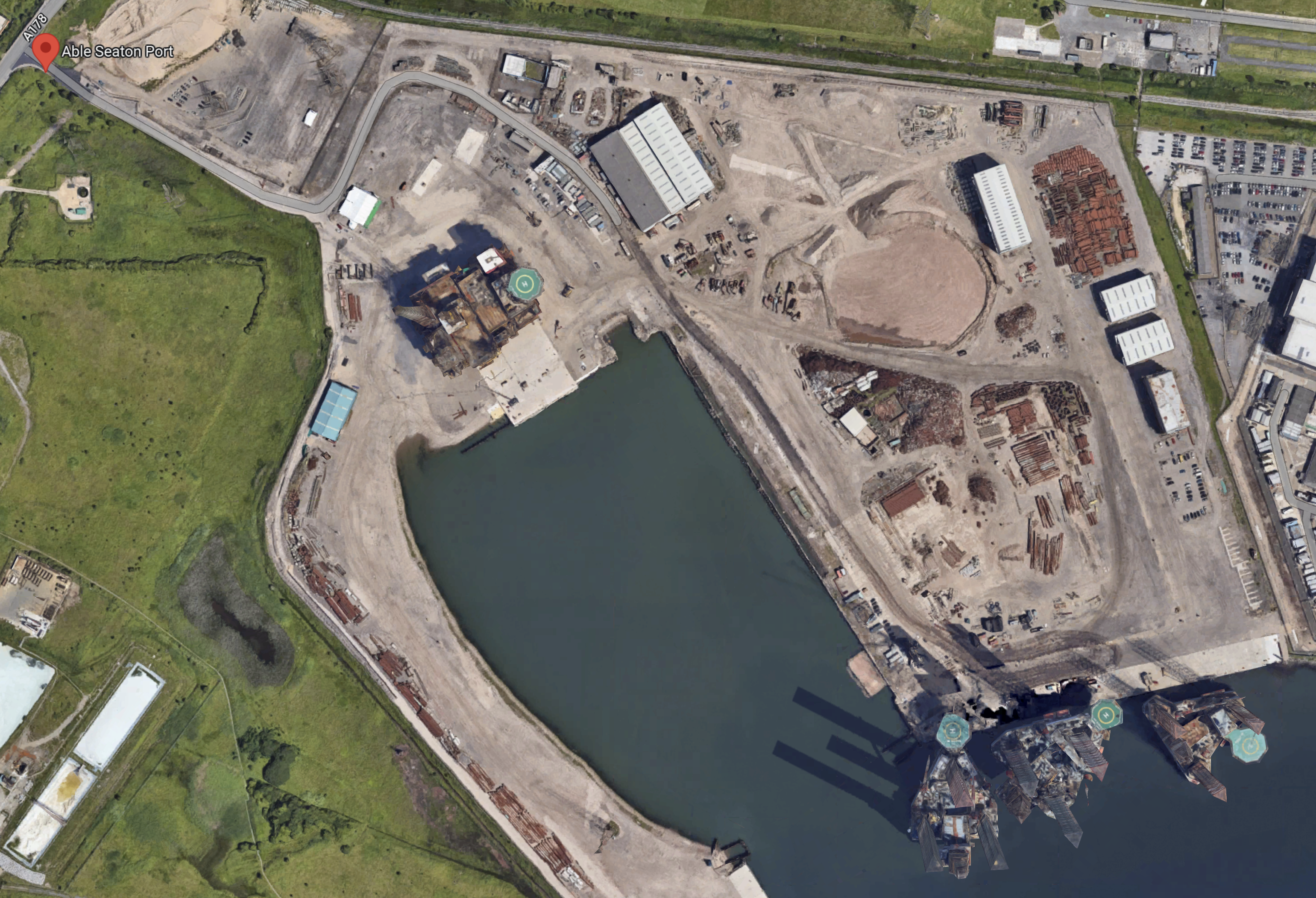
These four paragraphs on the Able Seaton Port website outline the capabilities of the port.
ABLE Seaton Port (ASP) is located in the centre of the UK on the North East Coast close to the mouth of the River Tees and covers 51 hectares (126 acres) including a 10 hectare (25 acre) dry dock (currently wet) – one of the world’s largest.
It is capable of handling all types of offshore construction vessels, has significant crane capacity and quays, which have been constructed particularly to suit the requirements of the heavy fabrication industry.
Quays 10 & 11 are some of the strongest in Europe at 306m long. They are dredged to -15m chart datum and are designed with a quay loading capacity of 40T/m² with a heavy load-out pad area capable of 60T/m².
Quay 6 is a new heavy-lift quay at the northern end of the wet dock. At 60T/m² this is one of the heaviest load out quays in Europe. It’s function is to service the Brent field decommissioning project which ABLE is undertaking with partners Shell and Allseas.
Note.
The four platforms with their helipads.
Is the platform at the Northern end of the dock concerned with the Brent field decommissioning project?
There seems to be lots of components around the dock ready to be assembled into assemblies like wind turbine foundations.
As Able say this is certainly a large facility.
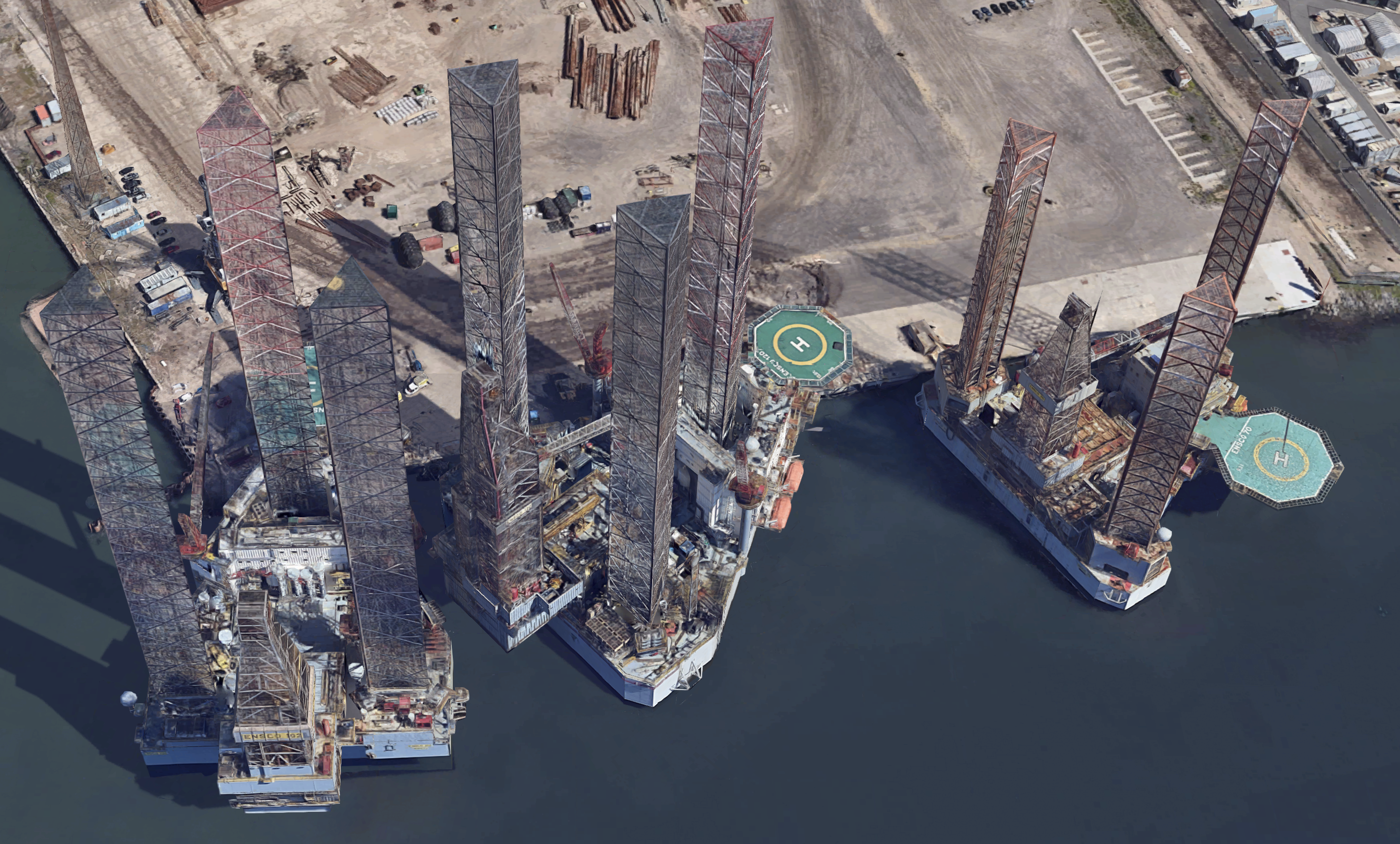
This second Google Map is a 3D-visualisation of the Southern three platforms.
The view has all changed now according to this news item on the Able Seaton Port, which is entitled First Campaign To Install Turbines At World’s Largest Offshore Wind Farm Is Underway.
A new vessel called Voltaire will be used to install the turbines.
This page on the Dogger Bank Wind Farm web site, is entitled Largest Jack-Up Vessel Voltaire Arrives In The UK To Build Largest Wind Farm In The World.
These are the bullet points.
- Largest offshore jack-up vessel and first seaworthy ultra-low emission installation vessel Voltaire arrives in the UK for her very first assignment on Dogger Bank Wind Farm.
- The vessel will install turbines for all three Dogger Bank Wind Farm phases, a total of 277 units of GE Renewable Energy Haliade-X offshore wind turbines.
These three paragraphs describe the assembly of the wind farm.
The largest offshore jack-up installation vessel ever built, Voltaire, has just arrived in the UK port of Able Seaton ahead of its first campaign on Dogger Bank Wind Farm.
Voltaire of Jan De Nul Group was delivered in late 2022. Since then she has been undertaking final preparations for her very first assignment, the construction of the Dogger Bank Wind Farm phases A, B and C.
In total, the vessel will be responsible for installing 277 GE Renewable Energy Haliade-X turbines. Voltaire will sail out in early July to begin installation
As in an earlier life I was writing project management software for North Sea oil and gas, I can obviously say history is repeating itself. In the 1970s offshore work got easier as cranes got bigger and now fifty years later, it looks like larger lifting capacity, is enabling the installation of larger turbines.
Iberdrola Secures EUR 500 Million Loan For East Anglia Three
The title of this post, is the same as that of this article on offshoreWIND.biz.
This is the sub-heading.
Spain-headquartered Iberdrola has secured a EUR 500 million loan from Citi, partly guaranteed by the Norwegian Export Credit Agency (Eksfin), to support the development of the 1.4 GW East Anglia Three offshore wind farm in the UK.
It certainly doesn’t seem that raising the money to build this wind farm has been difficult.
Octopus Energy To Pour Billions In Offshore Wind Globally By 2030
The title of this post, is the same as that of this article on offshoreWIND.biz.
This is the sub-heading.
UK green energy supplier Octopus Energy Group has announced that it will invest, through its generation arm, USD 20 billion (about GBP 15 billion) into offshore wind by 2030.
These three paragraphs outline the investment.
The company said that this will go towards the generation of 12 GW of renewable electricity a year, enough to power 10 million homes.
Octopus is targeting projects across the globe, with a focus on Europe, and already has several deals in the pipeline.
It will back developers of new offshore wind farms as well as projects that are under construction operational, according to the press release.
Note.
- This is the original press release from Octopus Energy, which is entitled Making Waves: Octopus Energy To Unleash $20bn Of Investment In Offshore Wind By 2030.
- According to the press release, Octopus Energy also backs Simply Blue, a developer of innovative floating offshore wind projects, a type of offshore wind technology that taps into strong winds deeper out at sea.
- I will be interested to see how much capacity, Octopus Energy builds in the UK and how the capacity relates to their electricity sales in the UK.
Octopus Energy seem to have their tentacles into several worthwhile projects.
They will certainly need a lot of finance.
In World’s Largest Wind Farm Attracts Huge Backing From Insurance Giant, I describe Aviva’s philosophy about investing in renewable electricity infrastructure, based on an article in The Times.
I suspect other reputable companies and funds will follow Aviva’s lead. Provided, that the infrastructure is top-notch and well-managed.
Ørsted Divests Remaining Stake In London Array For EUR 829 Million
The title of this post, is the same as that of this article on offshoreWIND.biz.
This is the sub-heading.
Ørsted has signed an agreement with funds managed by Schroders Greencoat to divest its remaining 25 per cent minority interest in the London Array offshore wind farm in the UK.
These first three paragraphs outline the deal and give Ørsted reasons.
The total value of the transaction is GBP 717 million (approximately EUR 829 million).
Ørsted originally owned 50 per cent of the project and divested an initial 25 per cent of London Array to Caisse de dépôt et placement du Québec (CDPQ) in 2014.
The company does not have operations and maintenance (O&M) responsibility at the 630 MW London Array, and as the firm only holds a minority interest, Ørsted said it considers the asset non-strategic.
Note.
- Ørsted is the world’s largest developer of offshore wind power by number of built offshore wind farms.
- Schroders Greencoat LLP is a specialist manager dedicated to the renewable energy infrastructure sector.
This is a typical transaction, which is enabled between companies in the world’s financial centres all the time.
- Company A has an asset, which generates a predictable cash flow and needs money to invest in similar assets.
- Fund B has lots of money, but needs a predictable cash flow to pay interest to its investors.
So it is not surprising, that Fund B buys the asset from Company A.
I should say that the project management computer system, that I designed; Artemis was leased to the end users.
This eased the process of funding the sales.
In later years, I seem to remember, that we took bundles of leases with companies like BAe, BP, Shell, Texaco and sold them to banks, who needed a safe investment.
Vattenfall Stops Developing Major Wind Farm Offshore UK, Will Review Entire 4.2 GW Zone
The title of this post, is the same as that of this article on offshoreWIND.biz.
This is the sub-heading.
Vattenfall has stopped the development of the Norfolk Boreas offshore wind power project in the UK and will review the way forward for the entire 4.2 GW Norfolk Zone, the Swedish energy company revealed in its interim report.
This is the first paragraph.
The developer said that the decision to stop the project was made due to ”challenging market conditions”, adding that ”financial frameworks have not adapted to reflect the current market conditions” so far.
Vattenfall are also complaining about inflation and cost increases if up to 40 %.
I have my thoughts.
Great Yarmouth Support Base
In some ways, I find this decision to pull out strange, as it was only in March this year that Vattenfall signed a contract with Peel Ports to build a support base for their Norfolk wind farms at Great Yarmouth.
I don’t think that Peel Ports will be too bothered, as they are a well-funded company and there are plenty of wind farm proposals in the sea around Norfolk, who could use a base at Great Yarmuth.
Cable Routes And Nimbys
These Norfolk wind farms have suffered opposition from Nimbys to the cable route, that will be taking the electricity away from the coast. This may have increased the cost of delivery of the electricity to market.
An Offshore Cable Route
In January 2022, I wrote Is There A Need For A Norfolk-Suffolk Interconnector?, where I analysed the amount of energy, that will be produce in Norfolk and Suffolk.
This was my conclusion.
I believe there are a lot of possibilities, that would meet the three objectives, I stated earlier.
-
- Avoid as much disruption on the land as possible.
- Create the capacity to deliver all the energy generated to customers, either as electricity or hydrogen.
- Create an expandable framework, that would support all the wind farms that could be built in the future.
In addition, simple mathematics says to me, that either there will need to be extra capacity at both Bicker Fen and Bullen Lane substations and onward to the rest of the country, or a large electrolyser to convert several gigawatts of electricity into hydrogen for distribution, through the gas network.
Note.
- An offshore Multiple Purpose Interconnector (MPI) could be built between Bicker Fen in Lincolnshire and the Isle of Grain.
- An electrolyser could be built offshore, joined to the MPI and connected to the Bacton gas terminal.
- There could be local offshore hydrogen storage.
- Bicker Fen is connected to the Viking Link to Denmark.
- An offshore link could have its Southern end at the Isle of Grain, from where the electricity can be exported to Germany, by the NeuConnect interconnector, that is under construction.
There must be sufficient capacity, so that all energy is delivered to customers, as either electricity or hydrogen.
I’ve always favoured delivering electricity from these and other East Anglian wind farms with an offshore cable route away from the coast between perhaps Bicker Fen in Lincolnshire and the the Isle of Grain, from where the electricity can be exported to Germany, by an interconnector, that is being built.
Competition From Scotland
National Grid are improving the offshore grid between Scotland and Humberside, so perhaps Vattenfall might have a competition problem, when it comes to selling their electricity.
If you have no market for a product, then the price drops.
Is East Anglia A Bad Place To Have Surplus Electricity?
Consider.
- It should also be remembered that East Anglia has no heavy electricity users.
- There are also no substantial mountains for building large pumped-storage hydro schemes, as Scotland is proposing to do.
- The construction of Sizewell C will add more electricity to the area.
In my view the best thing to do would be to build a giant electrolyser near the Bacton gas terminal.
Was It A Mistake For Vattenfall To Make A Bid?
Looking at the delivery problems for the Norfolk wind farms, I think that Vattenfall made a bad decision to bid for them.
- The wind farms are too far North to serve London and the South-East and to export the electricity to the Continent.
- They are also too far South to serve the industry in the North around the Humber and the Tees.
It looks an obvious case of wrong Location, Location and Location.
Could Norfolk Boreas And Norfolk Viking Work Economically?
I suspect these ideas could help.
- A Multiple Purpose Interconnector (MPI) would be built between Bicker Fen in Lincolnshire and the Isle of Grain.
- The MPI would connect to any wind farms on the route.
- An offshore electrolyser opposite Bacton would be connected to the MPI to use surplus electricity to generate hydrogen, which would be distributed through the gas grid.
The whole network of wind farms, interconnectors, electrolysers and storage needs to be comprehensively designed, so that it provides the South-East corner of England, with enough reliable electricity and hydrogen.
Ørsted Receives Development Consent For 2.6 GW Hornsea Four Offshore Wind Farm
The title of this post, is the same as that of this article on offshoreWIND.biz.
This is the sub-heading.
The UK Secretary of State for Energy Security and Net Zero has granted development consent to Hornsea Project Four, a 2.6 GW offshore wind farm Ørsted plans to build some 69 kilometres off the Yorkshire Coast.
This is the first paragraph.
The UK government, in a press release issued on 12 July, stated that Hornsea Four was the 126th Nationally Significant Infrastructure Project and 73rd energy application to have been examined by The Planning Inspectorate within the timescales laid down in the Planning Act 2008.
It certainly looks like The Planning Inspectorate has been working overtime.
Note that the four Hornsea wind farms are planned to have at least the following sizes.
- Hornsea 1 – 1218 MW
- Hornsea 2 – 1386 MW
- Hornsea 3 – 2852 MW
- Hornsea 4 – 2600 MW
These four wind farms give the Hornsea complex, a total capacity of at least 8056 MW.
When I worked at ICI in Runcorn in the late 1960s, I used to cross the Runcorn Bridge twice every day and would see Fiddlers Ferry power station, with its eight cooling towers, on the North Bank of the River Mersey to the East. It was generally thought of as a large coal-fired power station.


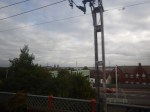

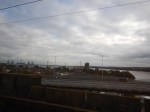
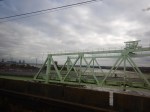
These pictures of Fiddlers Ferry power station were taken in 2021, from a Liverpool-bound train on the railway bridge.
This Google Map shows the power station.

Note.
- Fiddlers Ferry may have been large for its time at 1989 MW, but it is still less than a quarter of the size of the Hornsea wind farm!
- Drax power station in 1986 at 3960 MW, was larger than Fiddlers Ferry, but was still less than half of the size of Hornsea!
Hornsea wind farm is a true green giant!
This paragraph is from the Hornsea Project 4 section of the Wikipedia entry for the Hornsea wind farms.
Construction of the wind farm was provisionally expected to start in 2023, and be operational by 2027, at the earliest. The project’s capacity is unknown by Ørsted due to the ever increasing size of available wind turbines for the project.
When completed, it could be even bigger.
Germany Rakes In EUR 12.6 Billion Through ‘Dynamic Bidding’ Offshore Wind Auction
The title of this post, is the same as that of this article on offshoreWIND.biz.
This is the sub-heading.
Germany’s first dynamic bidding process, covering four offshore wind zones with a combined capacity of 7 GW, has generated EUR 12.6 billion in proceeds, according to the Federal Network Agency.
This dynamic bidding process seems to have brought in the euros.
I hope the Crown Estate is going to look at this bidding, to see if it would be good for the UK.
CIP’s Flagship Fund On Track To Become World’s Largest Dedicated To Greenfield Renewable Energy Investments
The title of this post, is the same as that of this article on offshoreWIND.biz.
This is the sub-heading.
Copenhagen Infrastructure Partners (CIP) has reached the first close on its fifth flagship fund, Copenhagen Infrastructure V (CI V), at EUR 5.6 billion in capital commitments received. This puts the fund on track to reach its target size of EUR 12 billion, which would make this the world’s largest dedicated greenfield renewable energy fund, according to CIP
These three paragraphs give more details on the size and investments of the latest fund, which is named CI V.
The first close of the flagship fund saw a large group of leading institutional investors across continental Europe, the Nordics, the UK, North America, and the Asia-Pacific region.
CIP noted that there is a strong interest from additional investors already in process, so CI V is on the way to reaching its target fund size of EUR 12 billion.
The fund now has ownership of more than 40 renewable energy infrastructure projects with a total potential CI V commitment of approximately EUR 20 billion, corresponding to more than 150 per cent of the target fund size.
The CIP web site gives more details on the company, including this summary on the front page.
Founded in 2012, Copenhagen Infrastructure Partners P/S (CIP) today is the world’s largest dedicated fund manager within greenfield renewable energy investments and a global leader in offshore wind. The funds managed by CIP focuses on investments in offshore and onshore wind, solar PV, biomass and energy-from-waste, transmission and distribution, reserve capacity, storage, advanced bioenergy, and Power-to-X.
CIP manages 11 funds and has to date raised approximately EUR 25 billion for investments in energy and associated infrastructure from more than 150 international institutional investors.
In the UK, CIP are currently involved in the Ossian and Pentland floating wind farms.
Centrica To Build Largest Battery Storage Project To Date
The title of this post, is the same as that of this news item from Centrica.
These three paragraphs outline the news.
Centrica Business Solutions has secured the development rights to a 65MW two-hour battery storage plant in Perthshire, Scotland, its largest battery storage acquisition to date.
The site in Abernethy is located near a connection for North Sea offshore wind farms and will help manage grid capacity by charging when demand for power is low, and discharging when demand is at its highest.
Once connected to the grid in 2028, the 65MW two-hour battery will be able to store enough electricity to power 130,000 homes for an hour – the equivalent to a town the size of Aberdeen. The discharge could happen up to four times a day.
This map shows the site of the substation at Abernethy.
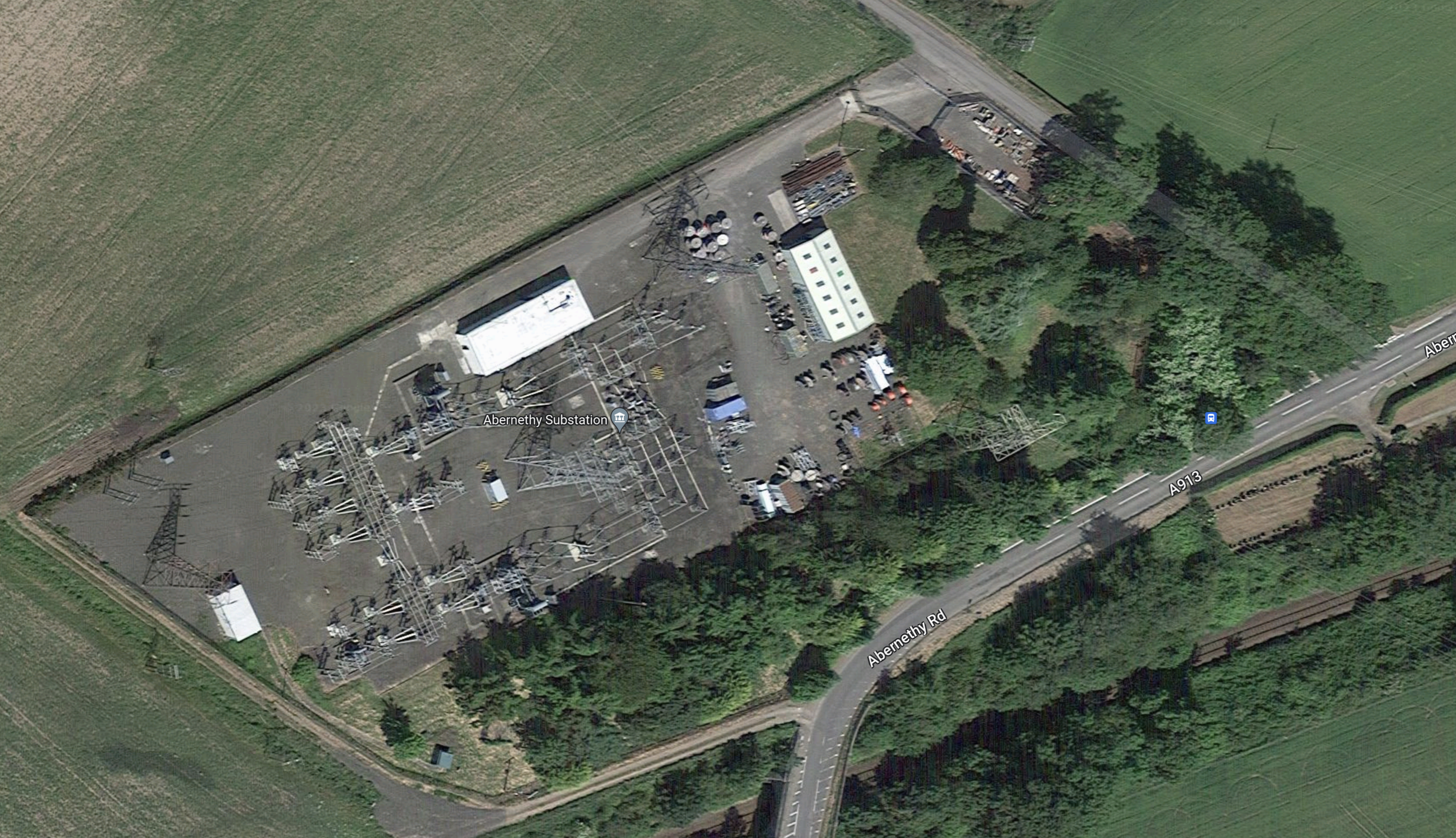
It seems a site with enough space for a 65 MW/130 MWh battery.
But is that a railway running past the site in the South-East corner of the map?
Yes! It is the single-track unelectrified railway that is used by trains to go between Edinburgh and Perth.
- There are stations at both ends of the single-track section at Ladybank and Perth.
- Abernethy substation looks like it is about halfway between the two end stations.
This page on Scotland’s Railway is entitled Fife Electrification and lists these four phases.
- Haymarket and Dalmeny
- Kinghorn and Thornton North
- Thornton and Lochgelly
- Thorton and Ladybank
The page also says that the electrification will support BEMUs (Battery Electric Multiple Units)
I feel that the electrification to Ladybank and Centrica’s battery could be linked.
- If the electrification was extended a few miles to Abernethy substation, this would surely be a reliable way to power the electrification.
- It would also be ideally placed, if Perth and Ladybank were to be electrified.
- The new battery would surely smooth out any deviations in the power supply.
I certainly don’t expect that Centrica will object to a new customer.
Electrification Between Edinburgh And Ladybank
Consider.
- Edinburgh and Ladybank is 39 miles and takes a couple of minutes over an hour.
- Once, the four phases of the electrification are complete, only the 13.6 miles between Dalmeny and Kinghorn, will be without electrification.
- I doubt that Dalmeny and Kinghorn will ever be electrified, as it includes the Forth Rail Bridge.
- Dalmeny and Kinghorn is 13.6 miles and takes around twenty-four minutes.
It looks like the BEMUs will be under wires for 25.4 miles and nearly forty minutes, which will be more than enough to charge the trains.
Edinburgh And Aberdeen
In Thoughts On Batteries On A Hitachi Intercity Tri-Mode Battery Train, I said this about services between Edinburgh and Aberdeen.
Consider.
-
- The gap in the electrification is 130 miles between Edinburgh Haymarket and Aberdeen.
- There could be an intermediate charging station at Dundee.
- Charging would be needed at Aberdeen.
I think Hitachi could design a train for this route.
The 25.4 miles of new Fife electrification between Haymarket and Ladybank will reduce gap in the electrification to 105 miles and ensure trains leaving Ladybank for Aberdeen had a full battery.
Denmark Exploring Multiple Platforms As Alternative To Building Artificial Island
The title of this post, is the same as that of this article on offshoreWIND.biz.
This is the sub-heading.
After concluding that the current concept of its North Sea Energy Island would be too expensive for the State, the Danish government, the transmission system operator (TSO) Energinet, and other relevant agencies are now looking into the concept for the island to be established on several large platforms.
I feel this could be a sensible decision, as it would fit well with a modular approach to the building of offshore wind farms.
Suppose, the floating turbines used by a company like Ørsted were all similar. This would surely simplify management of their portfolio of wind farms.
If it works for floating wind turbines, surely, it would work for substations, electrolysers and other offshore hardware.
Conclusion
Artificial energy islands may seem an impressive way to go, but I suspect that the modular approach using standard components, that either sit on the sea bed or float may be a more affordable and faster way to build offshore wind farms.
 The Anonymous Widower