There Are Lies, Damned Lies And Trumpkopf’s Medical Statistics
With apologies to Benjamin Disraeli and/or Mark Twain
Last Night, I Had A Very Bad Night’s Sleep
I usually sleep very well. In fact like my father, if I need a nap, I can even take it on a hard upright chair.
He would have a nap like this every day in his printworks. It also looks like my 53 year old middle son has this ability to take a quick nap.
Last night, I slept very badly and woke about two, with a pain in my hip.
I nearly phoned 111, as I felt so rough. Luckily I didn’t!
I didn’t get much more sleep and eventually had perhaps a nap of an hour or so, before I gave up and got out of bed to do a few puzzles on the Internet.
After a large mug of tea, the pain in my hip receded.
My now-retired GP, reckoned I suffered when the atmospheric pressure was low.
So, did an area of low pressure pass through last night and suck water out of my body?
After a good bath, I certainly feel better now, with no pain in my hip.
In My Strange Skin, I describe an incident, where weather sucked water out of my body!
It’s Now Ten O’Clock
I’ve survived the day and managed to take a train to Reading and back.
I had intended to take pictures in Oxford, but when I got to Reading, it was raining hard and I turned back.
Application Of Control Engineering Principles To The Calculation Of Pharmaceutical Drug Doses
Today, I was asked by an eminent cardiologist to give my opinion on this scientific paper in the Journal of the American Heart Association, which was entitled Personalized Antihypertensive Treatment Optimization With Smartphone‐Enabled Remote Precision Dosing of Amlodipine During the COVID‐19 Pandemic (PERSONAL‐CovidBP Trial).
This was the background to the study.
The objective of the PERSONAL‐CovidBP (Personalised Electronic Record Supported Optimisation When Alone for Patients With Hypertension: Pilot Study for Remote Medical Management of Hypertension During the COVID‐19 Pandemic) trial was to assess the efficacy and safety of smartphone‐enabled remote precision dosing of amlodipine to control blood pressure (BP) in participants with primary hypertension during the COVID‐19 pandemic.
These were the methods and the results.
This was an open‐label, remote, dose titration trial using daily home self‐monitoring of BP, drug dose, and side effects with linked smartphone app and telemonitoring. Participants aged ≥18 years with uncontrolled hypertension (5–7 day baseline mean ≥135 mm Hg systolic BP or ≥85 mm Hg diastolic BP) received personalized amlodipine dose titration using novel (1, 2, 3, 4, 6, 7, 8, 9 mg) and standard (5 and 10 mg) doses daily over 14 weeks. The primary outcome of the trial was mean change in systolic BP from baseline to end of treatment. A total of 205 participants were enrolled and mean BP fell from 142/87 (systolic BP/diastolic BP) to 131/81 mm Hg (a reduction of 11 (95% CI, 10–12)/7 (95% CI, 6–7) mm Hg, P<0.001). The majority of participants achieved BP control on novel doses (84%); of those participants, 35% were controlled by 1 mg daily. The majority (88%) controlled on novel doses had no peripheral edema. Adherence to BP recording and reported adherence to medication was 84% and 94%, respectively. Patient retention was 96% (196/205). Treatment was well tolerated with no withdrawals from adverse events.
These were the conclusions.
Personalized dose titration with amlodipine was safe, well tolerated, and efficacious in treating primary hypertension. The majority of participants achieved BP control on novel doses, and with personalization of dose there were no trial discontinuations due to drug intolerance. App‐assisted remote clinician dose titration may better balance BP control and adverse effects and help optimize long‐term care.
About Myself
I am a Graduate Control Engineer, who graduated from the University of Liverpool in 1968.
I then worked at ICI in Runcorn for eighteen months, before moving to ICI Plastics Division, because of the untimely death of my father-in-law.
One of my tasks at Welwyn, was to look at control algorithms for chemical plants. For this I often used a PACE 231-R analogue computer.

Note.
- These computers could solve up to a hundred simultaneous differential equations at one time.
- They were programmed by wiring the various amplifiers and potentiometers together to simulate the equations.
- There were only a few transistors in these powerful machines, as all electronics were thermionic valves.
- Two of these machines wired together, were used to calculate the trajectories of the Apollo missions.
They were the unsung heroes of bringing Jim Lovell and Apollo 13 home safely.
Determining Control Algorithms
In a typical problem, I would model the a section of a chemical plant and the control system around it.
This would then lead to recommendations, as to the design and operation of the plant, so that it performed as required.
It could be argued that the body of an animal, is a very complicated integrated chemical plant, with a sophisticated control system.
For instance, if sensors around the body, say you are slightly low on fluids, your brain determines you should have a drink.
Many control loops on a chemical plant are controlled by proportional–integral–derivative controllers, which are commonly known as three-term controllers.
This is the first two paragraphs of the Wikipedia entry for three-term controllers.
A proportional–integral–derivative controller (PID controller or three-term controller) is a control loop mechanism employing feedback that is widely used in industrial control systems and a variety of other applications requiring continuously modulated control. A PID controller continuously calculates an error value
PID systems automatically apply accurate and responsive correction to a control function. An everyday example is the cruise control on a car, where ascending a hill would lower speed if constant engine power were applied. The controller’s PID algorithm restores the measured speed to the desired speed with minimal delay and overshoot by increasing the power output of the engine in a controlled manner.
I wouldn’t be surprised that the app in the smartphone used in the PERSONAL‐CovidBP Trial contained a form of three-term controller.
These are some points about three-term control algorithms.
Changing Of External Factors
One that was the villain in a problem, I dealt with, also affects my body – the weather.
I was asked to look at the problem of a chemical reaction, that overheated in hot weather. But the plant operators solved it by better insulation and ventilation of the plant and the standard three-term controller adjusted itself automatically to the new conditions.
After my stroke, I am on Warfarin for life. I test my own INR with a Roche meter and I have noticed that atmospheric pressure affects my INR. I change my deose accordingly, using a simple algorithm, of my own design.
The More You Test The More Precise The Control
If you take the cruise control example used by Wikipedia, speed is monitored continuously, as I hope, it would be if you were driving yourself.
But obviously, in many systems, where you are using an input with discrete values to control a system, you can’t be as precise as the data you collect.
When my son was dying from pancreatic cancer, he was fitted with a morphine pump, that he could adjust himself to dull the immense pain he was enduring.
- His nerves and his brain ascertained the pain level.
- He then adjusted the morphine level.
- He could get very precise control of his pain, because he was measuring it continuously.
But he was only using simple one-term control (proportional).
Derivative Control Can Be Difficult To Get Right And Can Even Go Unstable
Derivative control is mainly to stop overshoot, but sometimes you will find that it can go unstable, so two-term(proportional+integral) controllers will be used.
How I Control My INR
As I said earlier, I am on Warfarin for life and test my INR with a Roche meter.
The NHS typically tests patients about once every six weeks, which in my opinion as a Control Engineer is too infrequent.
I usually test myself a couple of times a week.
But every so often, I evaluate what daily dose gives me an equilibrium INR level of 2.5.
For the last three years, I have found a dose of 3.75 mg keeps me more or less on 2.5.
- As Warfarin comes in 1, 3, 5 and 10 mg. tablets, I alternate 3.5 and 4 mg.
- Warfarin tablets are easily cut in half using a sharp knife.
- I record INR and dose in a spreadsheet.
I have been doing this now for over ten years.
Is This A Unique Property Of Warfarin?
In this time, I have had five medical procedures, where surgeons were worried, that as I was on Warfarin, I might bleed too much.
For the first, which was to remove a lump from my mouth, the private surgeon wanted to charge extra for an anaesthetist. In the end, I asked what INR he wanted and he said 2.1 should be OK!
- So I reduced the Warfarin level and tested every day.
- I judged it correctly and had an INR of 2.1 on the day of the operation.
- The operation went incredibly well and I went home on public transport.
- The lump turned out to be benign.
- I’ve not had another lump.
After the operation, I increased the Warfarin level and tested every day, until it regained a level of 2.5.
On analysing my doses through the date of the operation, I found that the total amount of Warfarin, I didn’t take to reduce my INR to 2.1, was the same as I took to bring it back up again to 2.5.
Is this a unique property of Warfarin?
Since then I’ve had two cataract operations performed in a private hospital, where the NHS paid. Interestingly, they wouldn’t trust my own INR readings, so I had to get my GP to take the measurement.
I’ve also had gallstones removed by endoscopy at the local Homerton NHS hospital.
- For cases like mine, the hospital hire in a surgeon from the posh Wellington private hospital for one day a week, who brings the specialist tools needed.
- I wrote about this in Goodbye To My Gallstones.
- As it was a more serious procedure, I reduced my INR to a requested 1.0.
Interestingly, I still have my gall bladder, but the surgeon put it on notice to behave.
Conclusion
I would totally agree with the conclusion given in the PERSONAL‐CovidBP Trial.
Personalized dose titration with amlodipine was safe, well tolerated, and efficacious in treating primary hypertension. The majority of participants achieved BP control on novel doses, and with personalization of dose there were no trial discontinuations due to drug intolerance. App‐assisted remote clinician dose titration may better balance BP control and adverse effects and help optimize long‐term care.
I would add some conclusions of my own.
- The app used in the PERSONAL‐CovidBP Trial, seems to have had a good algorithm.
- I suspect the app could also be Internet-based.
These are some general conclusions.
- If you are on Warfarin and have access to a Roche meter, it is possible to lower your INR to the value required by a surgeon for an operation or a procedure.
- Since starting to take Warfarin, I have had four operations or procedures, where others would have had anaesthetic or a sedative.
- In those four operations, I was able to go home on public transport. If I still drove a car, I could have driven home afterwards.
- Private hospitals like to use an anesthetist, as it pumps up the bill.
- Avoiding anaesthesia must save hospitals money.
Well designed apps, based on Control Engineering principles, that help the patient take the best dose of a drug will become more common.
A Tale Of Two Cataract Operations
I have now had two cataract operations.
There was a few weeks between the operations and in the interval they changed the machines.
- The first was a Leica and the second was a Zeiss.
There were no problems with either operation, but there were differences, particular in how I felt afterwards.
- With the first, I was slightly more uncomfortable and had a slight amount of pain in my left eye. But the pain was nothing that a few ginger biscuits couldn’t cure.
- With the second, I’ve had no pain at all and the eye looks less red. I was able to take the dressing off in the evening and go out the next day, which I couldn’t do after the first.
Now fifty-four hours after the operation, my eyes are back to normal. I can even type this without putting on my glasses.
Conclusion
I would suggest that before you have a cataract operation, you make sure the surgeon will be using the latest machines.
I Don’t Generally Take Pain Killers
I have taken pain killers rarely in my life, but only when I get serious pain.
But since the cataract operation, I have felt a bit of light pain in my left eye.
So I’ve resorted to taking three of these large pain-killers.

Usually, I dunk them in a cup of tea.
I’ve always liked ginger and they have been my favourite biscuits since I was about six.
I also used to see a Jamaican nurse in a former GP practice for my B12 injections and she was fulsome in her praise for the spice and what it can do.
Dr. Google also finds evidence that they help.
However, who cares, so long as I think they work.
My Cataract Operation
It was all very simple and painless.
After the procedures, where they checked that they had the right patient and that everything else was in order, after some local anaesthetic was put in my left eye, I just laid on my back with my head in a rest.
A cloth shield was put over my face and my right eye and my left eye, from which the cataract would be removed was left looking through a hole in the shield.
I was asked to focus on a bright light and I held it there for what must have been about ten minutes.
I held my head and eye still and I felt nothing.
Then the shield was removed, I was told it was all over and I was led out of the operating theatre.
I was in no pain and the only difference in my appearance was the shield taped over my left eye.
How many people hold off their cataract operation because they think it will be painful?
I left the hospital within two-and-a-half hours of my arrival at nine o’clock this morning.
It is now over twelve hours since the operation and I can honestly say, I have had no serious pain. Although for some reason my right eye has developed an itch in sympathy.
Conclusion
If you are told you need a cataract operation, get it done sooner rather than later.
Prioritising Patients
Homerton hospital is hoping to remove my gallstones on Thursday by endoscopy, so it’s just a fairly small procedure.
I do wonder if there is a shortage of nurses, doctors and other staff at the hospital caused by either the Covids or the fuel crisis, if some operations will be cancelled.
At no time, in the diagnostic process was I asked if I was in pain. Which I am not!
Surely, in the Age of Covid-19, where there is great uncertainty about predicting hospital capacity just a few weeks in the future, I should have been asked a few questions, so that urgent cases could be given priority if necessary.
As they must have been there for a few months causing me no trouble, surely a few extra weeks won’t make much difference to me.
The Only Pain Killer I Ever Use
My teeth and mouth are a bit painful tonight, so I’ve resorted to the only pain killer, I’ve ever found effective.
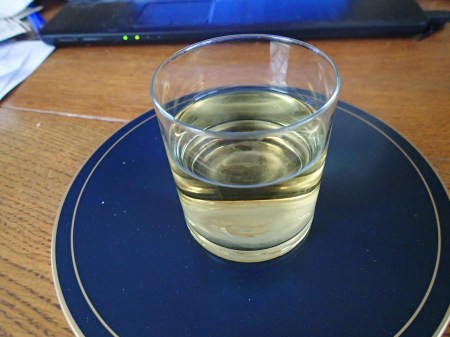
The Only Pain Killer I Ever Use
I’ve always found it so and I suspect, it is able to deal very well with the muck that seems to run into my mouth.
But after all, so many million Scots can’t be wrong! Can they? Although they probably think my habit of diluting it with London tapwater, is a bit Philistine!
On the other hand there’s a serious article from Time magazine here. This is the first paragraph.
Whiskey is one of the cheapest and best painkillers known to man.” So reported Dr. Harold George Wolff of Cornell last week to the Association of American Physicians meeting at Atlantic City. Earlier doctors, he said, prescribed whiskey freely but were finally forced to discard it for “moral and ethical considerations.
The report is dated May 19th, 1941. The only problem is that they weren’t talking about Scotch whisky, but bourbon.
Got A Migraine, Have Sex!
Research from the the University of Munster in Germany has shown that sex may be a better cure for migraine than painkillers. It’s all here in Her Majesty’s Daily Telegraph.
I wonder what Disgusted of Tunbridge Wells thinks of this?
Incidentally, I used to get the odd migraine, until I was diagnosed as a coeliac and went gluten-free.
 The Anonymous Widower