Race For Clean Power Surges Ahead As New Electricity Superhighway Greenlit
The title of this post, is the same as that of this press release from Ofgem.
These three paragraphs, explain the infrastructure.
Flagged by the National Energy System Operator (NESO) as an essential element in achieving the Government’s Clean Power 2030 ambition, Eastern Green Link 1 (EGL1As part of its mission to rapidly upgrade the energy system with a minimum cost to customers, Ofgem has identified over £43m of savings which have been cut from the project costs without impacting delivery or quality. Communities that host the infrastructure in Scotland and North-East England are also set to benefit from a £7.9m social value and community benefit fund.) is a high voltage electricity superhighway able to transport 2 gigawatts of homegrown wind generated electricity between Torness, East Lothian and Hawthorn Pit, County Durham. A gigawatt (GW) is equivalent to one billion watts, and one gigawatt hour (GWh) of electricity is enough to power one million homes for one hour. Most of the 196km cable will be under the North Sea, with the remaining 20km of cables underground linking the cable to substations and converter stations in Scotland and England.
The project will reduce Great Britain’s reliance on volatile international gas markets by further harnessing the power of homegrown North Sea wind. NESO’s recent Clean Power 2030 Report has also shown that the project will deliver annual saving of over £870m by reducing the need to compensate British wind generators who are currently asked to turn off production during times of high wind due to lack of grid capacity. This in turn will help drive down consumer bills.
Note.
- Eastern Green Link 1 (EGL1) is a high voltage electricity superhighway able to transport 2 gigawatts of homegrown wind generated electricity between Torness, East Lothian and Hawthorn Pit, County Durham.
- This is the second down the eastern side of the UK.
- In Contracts Signed For Eastern Green Link 2 Cable And Converter Stations, I described how contracts were signed for EGL2 from Peterhead in Scotland to Drax in England .
- Most of the 196km cable will be under the North Sea, with the remaining 20km of cables underground linking the cable to substations and converter stations in Scotland and England.
There are another two 2 GW cables to follow in the current plan!
UK Energy Grid Needs £60bn Upgrade To Hit Green Target, Plan Says
The title of this post, is the same as that of this article on the BBC.
This is the sub-heading.
The UK’s electricity network needs almost a further £60bn of upgrades to hit government decarbonisation targets by 2035, according to a new plan.
These five paragraphs explain the plan.
About 4,000 miles of undersea cables and 1,000 miles of onshore power lines are needed, said the National Grid’s Electricity Systems Operator (ESO).
The investment would add between £20 to £30 a year to customer bills, it said.
The government said the ESO’s plans were preliminary and yet to pass a “robust planning process”.
The plans were written up by the ESO, the organisation which runs the electricity network and would run the updated system it is calling for too. It is currently owned by National Grid but will transfer into government ownership later this year.
Its latest £58bn estimate is for work needed between 2030 and 2035 and comes on top of a previous £54bn estimate for work taking place between now and 2030.
These are my thoughts.
The Amount Of Undersea Cable
Edinburgh and London are roughly 400 miles apart as the train runs, so it looks like there could be the equivalent of ten underwater cables between the North of Scotland and England.
In Contracts Signed For Eastern Green Link 2 Cable And Converter Stations, I talked about the proposed 2 GW link between Peterhead in Scotland and Drax in England, which will be a double cable. So there’s the first two of these long cables.
It looks to me, that National Grid are proposing to use underwater cables wherever they can, so they avoid large expensive planning rows stirred up by Nimbies.
Monitoring The Undersea Cables
Last week Ofgem gave National Grid a £400,000 grant to develop new innovative technologies, which I wrote about in £400k For National Grid Innovation Projects As Part Of Ofgem Fund To Help Shape Britain’s Net Zero Transition.
One of the project is called HIRE – Hybrid-Network Improvement & Reliability Enhancement and will be used to check all these cables are performing as they should.
My electrical engineering experience tells me, that there must be some cunning way, that will detect that something is happening to the cable. The involvement of a technology company called Monitra in the project is a bit of a giveaway.
How Much Will It Cost Me?
Currently, UK consumers pay about £30 per year to have electricity delivered, so this will rise to between £50 and £60 per year.
That is just over a pound a week. I would pay about the same for a resident’s parking permit outside my house for an electric car and probably three times more for a petrol or diesel car.
Do We Have Enough Cable?
Two undersea cable factories are under development in Scotland and I suspect the 4,000 miles of undersea cables will be delivered on schedule and covered in saltires.
What About T-Pylons?
The latest onshore electricity transmission line between Hinckley Point C and Bristol, doesn’t use traditional pylons.
It uses T-pylons like these to connect the 3.26 GW nuclear power station.
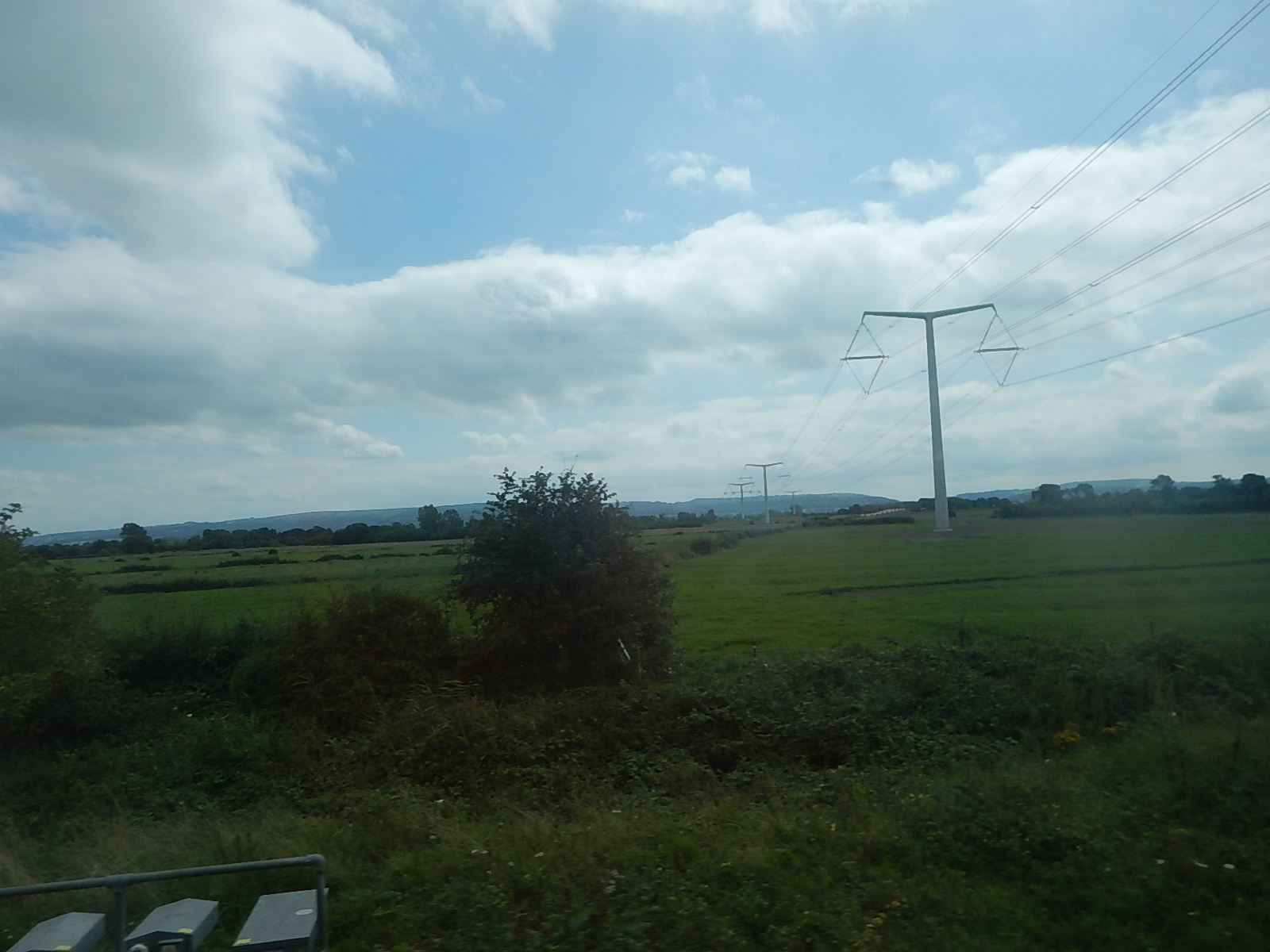
Note that they are shorter, designed to be less intrusive, have a smaller footprint and are made from only ten parts.
I suspect they will cost less to install and maintain.
There is more on T-pylons in National Grid Energise World’s First T-Pylons.
I wouldn’t be surprised that some of the oldest traditional pylons will be replaced by T-pylons.
I am surprised that T-pylons are not mentioned in the BBC article.
I like T-pylons. How do you feel about them?
Eastern Green Link 2
This press release from National Grid, describes Eastern Green Link 2 like this.
Eastern Green Link 2 (EGL2) is a 525kV, 2GW high voltage direct current (HVDC) subsea transmission cable from Peterhead in Scotland to Drax in England delivered as a joint venture by National Grid and SSEN Transmission.
This map from National Grid, shows the route of the Eastern Green Link 2.

The Northern landfall is at Sandford Bay and the Southern landfall is at Wilsthorpe Beach.
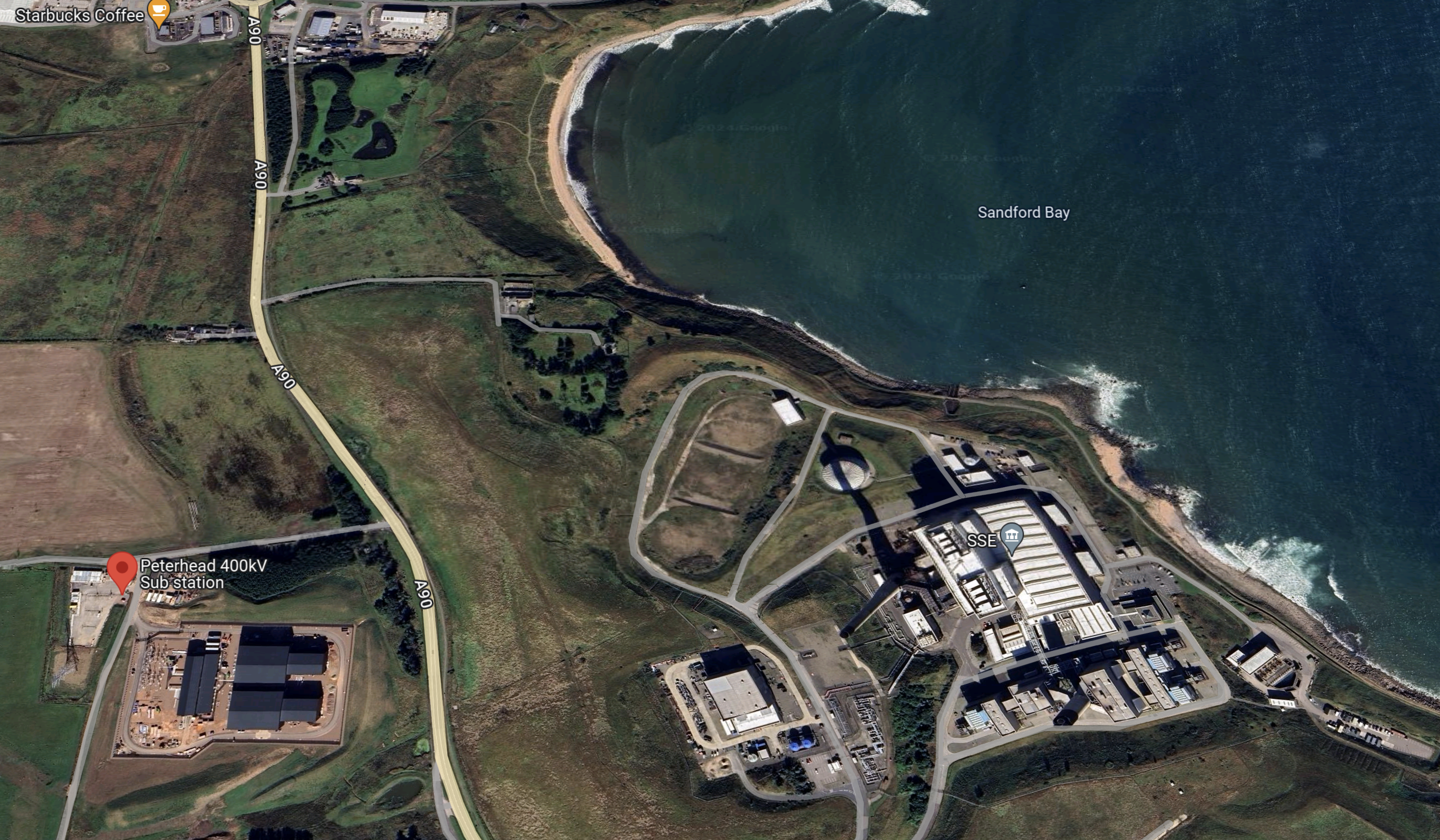
This Google Map shows Sandford Bay and Peterhead power station.
Note.
- Sandford Bay occupies the North-East corner of the map.
- The red arrow indicates the main 400kV sub-station at Peterhead.
- The 2177 MW gas-fired Peterhead power station is to the East of the sub-station marked as SSE.
This second Google Map shows the onshore route of the cable from Wilsthorpe to Drax.

Note.
- Flamborough Head is in the North-East corner of the map.
- Wilsthorpe Beach is at Bridlington a couple of miles South of Flamborough Head.
- The red arrow indicates Drax Power station.
- An onshore underground cable will be installed from landfall in Wilsthorpe to a new onshore converter station built in Drax.
The EGL2 HVDC cable connection from Scotland to England consists of 436km of submarine cable and 69km of onshore cable.
Both converter stations will be on existing power station sites and the major onshore works will be the underground cable between Wilsthorpe and Drax.
Where Does Drax Go From Here?
Currently, Drax power station is a 2595 MW biomass-fired power station.
There are now other large power sources that could replace some or all of the output of Drax power station.
- 2GW of Scottish wind power coming to Drax on Eastern Green Link 2.
- 6 GW of offshore wind is being developed at the Hornsea wind farms.
- 8 GW of offshore wind is being developed at the Dogger Bank wind farms.
- 2.5 GW from the three gas-fired power stations at Keadby, two of which are likely to be fitted with carbon capture.
- 1.8 GW from the proposed hydrogen-fired Keadby Hydrogen power station.
Given the bad feelings many have about Drax burning biomass, with 20.3 GW of electricity, you might think that shutting down Drax would be a simple solution.
But, according to Drax’s Wikipedia entry, it has a unique property.
Despite this intent for baseload operation, it was designed with a reasonable ability for load-following, being able to ramp up or down by 5% of full power per minute within the range of 50–100% of full power.
So Drax could be very useful in balancing the grid, by ramping up and down to fill the gap between production and need.
In addition, there is good biomass. This is from the Wikipedia entry.
A 100,000 tonne pa capacity straw pelletization facility was constructed at Capitol Park, Goole in 2008.
Drax are also promoting BECCS or Bioenergy carbon-capture and storage.
There is a Wikipedia entry for Bioenergy With Carbon Capture And Storage, of which this is the first couple of sentences.
Bioenergy with carbon capture and storage (BECCS) is the process of extracting bioenergy from biomass and capturing and storing the carbon, thereby removing it from the atmosphere. BECCS can theoretically be a “negative emissions technology” (NET).
I do feel that carbon capture and storage is a bit like sweeping the dust under the carpet, when you sweep the floor around it.
But carbon capture and use could be another matter.
This Google Map shows the Drax site.

Note how it is surrounded by agricultural land.
Could the power station be the source of pure carbon dioxide to be fed in greenhouses to flowers, herbs, salad vegetables, tomatoes and other plants?
I suspect there’s productive life left in Drax power station yet!
LionLink
LionLink, that is being developed by National Grid is a new type of interconnector, called a multi-purpose interconnector, that will connect Suffolk and The Netherlands via any convenient wind farms on the way. This means that the electricity generated can go where it is needed most.
I wrote about LionLink in World’s Largest-Of-Its-Kind Power Line To Deliver Clean Power To 1.8m UK Homes And Boost Energy Security.
Other Multi-Purpose Interconnectors
I can see other multi-purpose interconnectors like LionLink being built around the UK.
- There could be one across the Dogger Bank to link out 8 GW of Dogger Bank wind farms with those of the Dutch, Danes and Germans on their section of the bank.
- NorthConnect could be built between Scotland and Norway via some of the wind farms being developed to the North-East of Scotland.
- Could wind farms to the North of Ireland use a multi-purpose interconnector between Scotland and Northern Ireland.
- I can also see one or possibly two, being built across the Celtic Sea to link Devon, South Wales and Southern Ireland via the wind farms being developed in the area.
- Will we also see a Channel multi-purpose interconnector to transfer electricity along the South Coast of England?
Some of these multi-purpose interconnectors could be key to creating a revenue stream, by exporting electricity, to countries in Europe, that have a pressing need for it.
Conclusion
National Grid’s excellent plan will lead to the end of the practice of shutting down wind turbines. The spare electricity will be exported to Europe, which will surely create a good cash-flow for the UK. This in turn will encourage developers to create more wind farms in the seas around the UK’s coasts.
Contracts Signed For Eastern Green Link 2 Cable And Converter Stations
The title of this post, is the same as that of this press release from National Grid.
These four bullet points, act as sub-headings.
- Eastern Green Link 2 (EGL2) is a 525kV, 2GW high voltage direct current (HVDC) subsea transmission cable from Peterhead in Scotland to Drax in England delivered as a joint venture by National Grid and SSEN Transmission
- The joint venture has signed a contract with the Prysmian Group to supply around 1,000km of cable for the project and a contract with Hitachi Energy and BAM for the supply of converter stations at either end of the subsea cable
- Contract signing is a significant milestone for the project as it progresses towards the delivery phase
- EGL2 will be the longest HVDC cable in the UK and the UK’s single largest electricity transmission project ever, providing enough electricity to power two million UK homes
This paragraph outlines the project.
EGL2, a joint venture between SSEN Transmission and National Grid Electricity Transmission (NGET), has reached another milestone in the development of a new subsea electricity superhighway after sealing contracts this week with specialist HVDC cable supplier, Prysmian, and with Hitachi Energy and BAM for the supply of converter stations at either end of the project.
These four paragraphs add more detail.
EGL2 will see the creation of a 525kV, 2GW HVDC subsea transmission cable from Peterhead in Scotland to Drax in England. The longest HVDC cable in the UK and the UK’s single largest electricity transmission project ever, it will provide enough electricity to power two million UK homes.
Prysmian has confirmed it has the capability to deliver the project with its manufacturing facilities for the production of the HVDC cable and its cable laying vessels for the installation in the timescale required for EGL2 to meet its targeted energisation date in 2029, supporting the timely delivery of this project and mitigating risks associated with global constraints in the HVDC supply chain.
Hitachi Energy is partnering with BAM to provide the engineering works and technology for the HVDC converter stations which form the terminals for the HVDC cable and convert direct current to the alternating current used in the onshore transmission network. This latest milestone is another significant step as the project moves towards delivery and, following final approval from Ofgem, work is expected to commence later this year, with a targeted operational date of 2029.
The subsea HVDC cable system is approximately 436km in length with new converter stations at either end to connect it into the existing transmission network infrastructure. HVDC technology provides the most efficient and reliable means of transmitting large amounts of power over long distances subsea.
Note.
- EGL2 can handle 2 GW.
- There is a targeted operational date of 2029.
- Eastern Green Link 2 now has its own web site.
- Most of these links now seem to be HVDC.
A map in the press release, shows the undersea route may be shorter.
It also appears to me, that moving electricity around the UK under the sea, is possibly the most environmentally-friendly and least intrusive way to do it.
We already have four HVDC interconnectors.
There will be many more,
Neptune Energy, Ørsted And Goal7 Explore Powering Integrated Energy Hubs With Offshore Wind
The title of this post, is the same as that of this press release from Neptune Energy.
These four paragraphs outline the agreement.
Neptune Energy today announced it has signed a Memorandum of Understanding with Ørsted and Goal7 to explore powering new integrated energy hubs in the UK North Sea with offshore wind-generated electricity.
Integrated energy hubs have the potential to combine multiple energy systems, including existing oil and gas production assets, carbon storage and hydrogen production facilities. They could extend the life of producing fields and support the economic case for electrification with renewable energy, to keep carbon emissions low.
The agreement will see the companies examine the potential to supply renewable electricity from Ørsted’s Hornsea offshore windfarm projects to power future Neptune-operated hubs in the UK North Sea.
Goal7 will provide project management support and technical input.
Note.
- Neptune Energy has three oil and gas fields in the UK North Sea; Cygnus (operational), Isabella (exploration) and Seagull (development)
- Gas from Cygnus comes ashore at the Bacton Gas Terminal.
- Ørsted owns the Hornsea wind farm, which when fully developed will have a capacity of around 6.5 GW.
- Cygnus and Hornsea could be not much further than 50 km apart.
- Seagull and Isabella are further to the North and East of Aberdeen.
- Ørsted has an interest in the Broadshore wind farm, which was numbered 8 in the ScotWind Leasing round.
These are my thoughts.
The Cygnus Gas Field And The Hornsea Wind Farm
This could be like one of those stories where boy meets the girl next door and they hit it off from the first day.
This page on the Neptune web site says this about the Cygnus gas field.
The biggest natural gas discovery in the southern North Sea in over 30 years is now the largest single producing gas field in the UK, typically exporting over 250 million standard cubic feet of gas daily. Cygnus contributes six per cent of UK gas demand, supplying energy to the equivalent of 1.5 million UK homes. It has a field life of over 20 years.
Two drilling centres target ten wells. Cygnus Alpha consists of three bridge-linked platforms: a wellhead drilling centre, a processing/utilities unit and living quarters/central control room. Cygnus Bravo, an unmanned satellite platform, is approximately seven kilometres northwest of Cygnus Alpha.
In 2022, we plan to drill two new production wells at Cygnus, with the first of these expected to come onstream in 4Q. The second well is due to be drilled in the fourth quarter and is expected onstream in the first quarter of 2023, with both wells helping to maintain production from the field and offset natural decline.
Gas is exported via a 55 km pipeline. Cygnus connects via the Esmond Transmission System (ETS) pipeline to the gas-treatment terminal at Bacton, Norfolk. Neptune Energy has a 25% minority interest in ETS.
Note.
- Cygnus with a twenty year life could be one of the ways that we bridge the gap until we have the two Cs (Hinckley Point and Sizewell) and a few tens of offshore wind gigawatts online.
- The two extra wells at Cygnus will help bridge the gap.
- The gas field has a pipeline to Bacton.
So what can the gas field and the wind farm, do for each other?
Hornsea Can Supply The Power Needs Of Cygnus
Typically, ten percent of the gas extracted from the wells connected to a gas platform, will be converted into electricity using one or more gas-turbine engines; which will then be used to power the platform.
So, if electricity from the Hornsea wind farm, is used to power the platform, there are two benefits.
- More gas will be sent through the pipeline to Bacton.
- Less carbon dioxide will be emitted in recovering the gas.
Effectively, electricity has been turned into gas.
Electricity Can Be Stored On The Sea-Bed
The Hornsea One wind farm has an area in the order of 150 square miles and it is only one wind farm of four, that make up the Hornsea wind farm.
I would argue that there is plenty of space between the turbines and the wells of the Cygnus gas field to install some form of zero-carbon underwater battery to store electricity.
But does this technology exist?
Not yet! But in UK Cleantech Consortium Awarded Funding For Energy Storage Technology Integrated With Floating Wind, I described a technique called Marine Pumped Hydro, which is being developed by the STORE Consortium.
- Energy is stored as pressurised water in 3D-printed hollow concrete spheres fitted with a hydraulic turbine and pump.
- The spheres sit on the sea-bed.
- This page on the STORE Consortium web site, describes the technology in detail.
- The technology is has all been used before, but not together.
I think it is excellent technology and the UK government has backed it with £150,000 of taxpayers’ money.
I also believe that Marine Pumped Hydro or something like it, could be the solution to the intermittency of wind farms.
Excess Electricity Can Be Converted Into Hydrogen
Any spare electricity from the wind farm can drive an electrolyser to convert it into hydrogen.
The electrolyser could be mounted on one of the Cygnus platforms, or it could even float.
The hydrogen produced would be blended with the gas and sent to Bacton.
Carbon Dioxide Can Be Stored In The Depleted Cygnus Gas Field
As the gas field empties of natural gas, the gas pipes to the Cygnus gas field can be reversed and used to bring carbon dioxide to the gas field to be stored.
The Cygnus gas field has gone full circle from providing gas to storing the same amount of carbon that the gas has produced in its use.
These are two paragraphs from the press release.
Neptune Energy’s Director of New Energy, Pierre Girard, said: “The development of integrated energy hubs is an important part of Neptune’s strategy to store more carbon than is emitted from our operations and the use of our sold products by 2030.
“Neptune has submitted three applications under the recent Carbon Dioxide Appraisal and Storage Licensing Round, and securing the licences would enable us to develop future proposals for integrated energy hubs in the UK North Sea.
I can envisage a large gas-fired power-station with carbon capture being built in Norfolk, which will do the following.
- Take a supply of natural gas from the Cygnus gas field via the Bacton gas terminal.
- Convert the hydrogen in the gas into electricity.
- Convert the carbon in the gas into carbon dioxide.
- Store the carbon dioxide in the Cygnus gas field via Bacton.
- I also suspect, that if a Norfolk farmer, manufacturer or entrepreneur has a use for thousands of tonnes of carbon dioxide, they would be welcomed with open arms.
Would the ultra-greens of this world, accept this power station as zero-carbon?
The Isabella And Seagull Gas Fields And The Broadshore Wind Farm
Could a similar set of projects be applied to the Isabella and Seagull gas fields, using the Broadshore wind farm?
I don’t see why not and they could work with the Peterhead power stations.
Landmark CCS Project In Humber Becomes UK’s First To Gain Planning Consent
The title of this post, is the same as that of this news item on the SSE web site.
This is the first paragraph.
SSE Thermal and Equinor’s Keadby 3 Carbon Capture Power Station in the Humber has become the first power CCS project in the UK to receive planning permission.
Note.
- This will be one of four power stations at Keadby with Keadby 1, Keadby 2 and Keadby Hydrogen Power Station.
- Keadby 3 will have a capacity of 910 MW.
- It will capture up to 1,500,000 tonnes of carbon per year.
- It could be operational as early as 2027.
The news item, also says this about SSE’s other power stations and hydrogen storage.
SSE Thermal and Equinor are also collaborating on Peterhead Carbon Capture Power Station in the north-east of Scotland. In addition, they are developing Keadby Hydrogen Power Station, which could be the world’s first large-scale 100% hydrogen-fuelled power stations, and Aldbrough Hydrogen Storage, which could provide vital storage to balance intermittent supply and demand.
This all fits nicely with the proposed strategy I wrote about in Increased CCS Can Decarbonise GB Electricity Faster On Route To Net Zero.
I think we can expect more new gas-fired power stations with carbon capture to be built by SSE.
 The Anonymous Widower