DeepForm
On Wednesday I went to the TDAP Wave 8 Demo Day, which was organised by the Advanced Propulsion Centre.
One of the cohort of companies there was DeepForm, who were described like this.
DeepForm is transforming sheet metal pressing with its patented cold-shear press design, which reduces blank sizes by up to 45 % and trimming waste by up to 85%. This drop-in technology lowers material costs and embodied CO2 in existing press lines without compromising performance, quality or speed. Spun out of the University of Cambridge in 2022, DeepForm enables OEMs and Tier 1 suppliers to adopt the breakthrough through IP licensing, simulation and design support.
The company have an impressive web site, which deserves a very full read.
In their presentation, they showed two products, that could benefit from their innovation; a large steel component for Jaguar Land Rover and a humble aluminium drink can.
As I walked home ntoday, I saw this advert displayed on a bus stop.
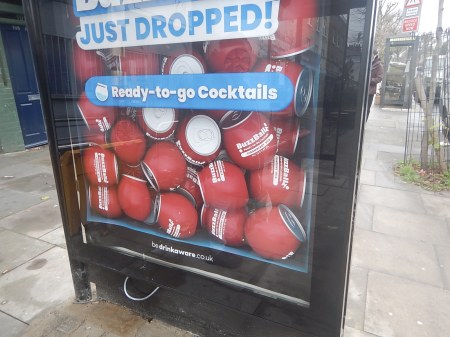
The cans for BuzzBallz are also shown on the company’s web site.
But these products are are only the start.
For instance, I can see lots of small plastic items and components, that can’t be recycled, could be made from aluminium, which is easy to be recycle.
I also think companies like IKEA will love the design freedom, the technology will give.
Surgeon Invents Plastic-Reducing Urine Collection Pot
The title of this post, is the same as that of this article on the BBC.
This is the sub-heading.
A hospital specialist has invented a new product that manages to reduce plastic and simplify the process of testing urine.
These three introductory paragraphs, add more detail.
Consultant urologist Dr Nick Burns-Cox has been working on his own innovation, the Pee-In-Pot (PiP) for 10 years.
Made from bamboo and sugar cane, it removes four items from the current urine collection process, three of them plastic.
Mr Burns-Cox, who works at Musgrove Park Hospital in Taunton, said he hoped it would cut down the use of single-use plastic in the NHS and reduce the chance of errors.
I like the design of this simple device.
But, personally, I hope it becomes universal, as I have trouble giving urine samples.
I had my stroke in Hong Kong and the Chinese nurses, were so aggressive, when it came to taking urine samples, they have given me an aversion to them.
In my view the device could help the patient psychologically, at what could be a difficult time.
Berkeley Scientists Finally Solve 10-Year Puzzle Enabling Efficient CO2-to-Fuel Conversion With Major Climate Impact Potential
The title of this post, is the same as that of this article on Sustainability Times.
This is the sub-heading.
In a groundbreaking advancement, scientists at Lawrence Berkeley National Laboratory and SLAC National Accelerator Laboratory have unveiled the critical mechanisms behind the degradation of copper catalysts, a revelation that promises to revolutionize the production of sustainable fuels by enhancing the efficiency and stability of CO2 conversion processes.
This paragraph gives more details.
Scientists from the Lawrence Berkeley National Laboratory and SLAC National Accelerator Laboratory have made a groundbreaking discovery in the field of artificial photosynthesis. By utilizing advanced X-ray techniques, they have uncovered the critical factors that limit the performance of copper catalysts in converting carbon dioxide and water into useful fuels. This revolutionary insight could significantly enhance the stability and efficiency of catalysts in CO2 conversion processes, potentially accelerating the production of ethanol and ethylene. The research, which tackles a decades-old puzzle, offers promising avenues for the development of more durable catalyst systems, paving the way for future advancements in sustainable energy solutions.
I first came across catalysts in my working life, when I was working at ICI. I was modelling a chemical process called sulphonation for a guy who was trying to find an efficient way to create the monomer of building block for a new engineering plastic.
Some feel that all plastics are bad for the environment, but I think that, if the plastic is designed to replace another material in a long-lasting application, then plastic is good for the environment.
This picture shows my wonderful Sheba cutlery.

Note.
- C and I bought it in the 1960s, when we got married.
- Some have been used every day for over fifty years.
- The important bits are Sheffield stainless steel, with the handles formed of black Delrin plastic.
- Some of the handles have been in the dishwasher too many times and have faded.
- From what I have seen on the Internet, the average worth of pieces could be as much as a tenner.
Perhaps, when I pass on, all the pieces should be divided between my grandchildren.
I have digressed and I will return to my modelling project with one of ICI’s catalyst experts.
I remember him telling me, that if you could improve the way catalysts worked, you would open up whole new areas of chemistry.
It looks to me, that the scientists at Berkeley may have opened up a route to turn carbon dioxide into fuel.
Whether that is a good route to decarbonisation is another long discussion.
The Problem Of Waste Plastic And Why Pyrolysis Oil Might Just Contain The Answer
The title of this post, is the same as that of this article on the Chemical Engineer.
These three paragraphs introduce the article.
One of the few technologies that can break down unrecyclable post-consumer waste plastic, pyrolysis is fast becoming a potential recycling route for companies trying to reduce their waste output.
The world produces around 450m t/y of plastic, but only 9% is recycled, with most waste ending up in landfill. Pyrolysis, which involves heating the plastic at extremely high temperatures in the absence of oxygen, breaks down the molecules to produce pyrolysis oil or gas. The oil can then be used to develop new products.
George Huber, a professor of chemical engineering at the University of Wisconsin-Madison, is leading a research team that is investigating the chemistry of pyrolysis oil and its use in polyolefin recycling.
This is a quote from George Huber
Waste plastic should be viewed as a resource we can use to make plastics and other chemicals. We should not be landfilling or burning it, we should be reusing the carbon in waste plastics.
I very much agree with what he said.
These are my thoughts.
Pyrolysis
The Wikipedia entry for pyrolysis starts with this paragraph.
The pyrolysis (or devolatilization) process is the thermal decomposition of materials at elevated temperatures, often in an inert atmosphere.
This paragraph describes the technique’s use in the chemical industry.
The process is used heavily in the chemical industry, for example, to produce ethylene, many forms of carbon, and other chemicals from petroleum, coal, and even wood, or to produce coke from coal. It is used also in the conversion of natural gas (primarily methane) into hydrogen gas and solid carbon char, recently introduced on an industrial scale. Aspirational applications of pyrolysis would convert biomass into syngas and biochar, waste plastics back into usable oil, or waste into safely disposable substances.
I came across pyrolysis in my first job after graduating, when I worked at ICI Runcorn.
ICI were trying to make acetylene in a process plant they had bought from BASF. Ethylene was burned in an atmosphere, that didn’t have much oxygen and then quenched in naphtha. This should have produced acetylene , but all it produced was tonnes of black soot, that it spread all over Runcorn.
I shared an office with a guy, who was using a purpose-built instrument to measure acetylene in the off-gas from the burners.
When he discovered that the gas could be in explosive limits, ICI shut the plant down. The Germans didn’t believe this and said, that anyway it was impossible to do the measurement.
ICI gave up on the process and demolished their plant, but sadly the German plant blew up.
I would assume we have progressed with pyrolysis in the intervening fifty years.
University of Wisconsin-Madison
The University of Wisconsin-Madison is a top-ranked American University and is part of my daily life, as the Warfarin, that stops me having another stroke was developed at the University in the 1940s.
Conclusion
The article is a must-read and I feel that my past experience says, that George Huber and his team could be on to something.
I wish them the best of luck.
A Design Crime – Marks And Spencer’s New Paper Carrier Bag
This article on the BBC is entitled Marks & Spencer Scraps Plastic For Paper Bags.
This is the sub-heading.
Marks & Spencer is swapping plastic carrier bags for paper ones in all stores, in an expansion of a trial that began in 10 branches in January.
These two paragraphs give a few reasons.
It follows other High Street stores in swapping plastic bags to paper in a bid to cut plastics use.
Supermarkets Morrisons, Waitrose and Aldi all use paper bags for customers, though some stores offer plastic bags as an option.
But the proof of the bag is in the using.
This picture shows the new bag.

It’s main problem is unlike the plastic bags, it is a nightmare to fold.
I could also fold the plastic bags, so they went in the pocket of my Barbour jacket.
I have searched my house for some of the green plastic bags to use in the future.
Conclusion
Three out of ten!
The Diamond Light Source And PETase
When I was writing Diamond Synchrotron Sparkles And Shows Its Value To UK Economy, I came across a reference to PETase, in an article in Chemistry World, where this was said about the Diamond Light Source.
‘It is the facilities in the UK that really make the difference and make us a world leader,’ comments John McGeehan, professor of structural biology at the University of Portsmouth.
His team has used Diamond to study the bacterial enzyme PETase, which digests plastic. ‘Diamond’s I23 [long-wave macromolecular crystallography] beamline is unique in the world. It allowed us to solve the 3D structure of the PET-degrading enzyme, first found in plastic dumps in Japan in 2016. Three years ago it was the highest resolution image of the enzyme measured and remains so today. Having this information allows us to understand how the enzyme works, and how to make it work faster and better.’
As a result, the team has been able to visualise the active site of the enzyme and how it consumes plastic. The researchers discovered that the active site was slightly wider than cutinase, a similar enzyme that bacteria use to break down natural plant polyesters. ‘The technology leading from this research means plastic waste can be broken down and put back together into bottles (infinite recycling), or can be made into higher value products such as resins for wind turbine blades,’ says McGeehan. Patents are pending.
Note, that PET is polyethylene terephthalate, which is a very common plastic used to make fabric (Terylene/Dacron) and packaging.
Now that is what I call recycling!
How To Build A Liverpool-Style Optical Bench
When I worked at ICI in Runcorn, one of the guys had developed a very accurate instrument for measuring trace chemicals in a dirty process stream. I remember one of these instruments was used to measure water in parts per million in methyl methaculate, which is the misnomer or base chemical for Perspex.
All the optical components needed to be mounted on a firm base, so a metre length of nine-inch C-section steel beam was chosen. The surface was then machined flat to a high accuracy.
In the end they found that instead of using new beams, old ones decades-old from the depths of a scrap yard gave better accuracy as the steel had all crystallised out. Machined and spray-painted no-one knew their history.
But they were superb instruments and ICI even sold them abroad.
Wiltshire’s Recycled Railway Sleepers A UK First
The title of this post, is the same as that of this article on the BBC.
This is the first paragraph.
Railway sleepers made of recycled bottles, food packaging and unwanted plastics have been installed on a mainline railway for the first time.
This paragraph describes their durability.
The new railway sleepers are designed to be used for 50 years as they do not split, rot or degrade, and can resist water, oil, chemicals and fungi.
The new sleepers would appear to be an advance on wood and concrete in certain applications.
Conclusion
This seems to be a good example of creative recycling.
Turning Waste Plastic Into Hydrogen – Is This The Future?
The title of this post, is the same as that of this article on H2 View.
This paragraph is a description of the process from Myles Kitcher of Peel L&P Environmental.
At Peel L&P Environmental we’ve been working with PowerHouse Energy who have developed a world first plastic to hydrogen technology. The first plant at Protos, our strategic energy and resource hub in Cheshire, is due to start construction later this year. It will take unrecyclable waste plastic – destined for landfill, or worse export overseas – and use it to create a local source of clean hydrogen to fuel buses, Heavy Goods Vehicles (HGVs) and cars. Not only will this help reduce air pollution and improve air quality on local roads, it’s helping us deal with the pressing problem of plastic waste.
This sounds like an eminently sensible way of dealing with unrecyclable waste plastic.
 The Anonymous Widower