Poland Receives Its First Electricity from Offshore Wind As Baltic Power Starts Delivering
The title of this post, is the same as that of this article on offshoreWIND.biz.
This is the sub-heading.
Electricity generated by the Baltic Power offshore wind farm has entered Poland’s national power grid, marking the first time the electricity generated by offshore wind turbines is added to the country’s energy mix.
This first paragraph gives more details of the project.
54 of 76 turbines have already been installed at Poland’s first offshore wind farm, with the first now generating electricity. Construction is scheduled for completion this autumn, ORLEN and Northland Power, the owners of the project, said.
When complete, the Baltic Power wind farm will generate up to 1.2 GW.
How Much Offshore Wind Does Poland Have Planned?
I asked Google AI, the question in the title of this section and received this reply.
Poland has massive offshore wind plans in the Baltic Sea.
The country targets 5.9 GW by 2030 and 18 GW by 2040. To meet these goals, the government is pursuing two primary development phases to transition the national grid away from coal.
A breakdown of Poland’s offshore wind rollout includes:
Phase I (Advanced Projects): Includes 5.9 GW of capacity.
Baltic Power: Poland’s first offshore wind farm (1.2 GW), developed by Orlen and Northland Power, officially connected to the national grid in July 2026.
Bałtyk 2 & 3: Equinor and Polenergia have finalized financing for an additional 1.4 GW, slated for commercial operation around 2028.
Phase II (Auction-Backed): Poland recently allocated over 3.4 GW in new capacity through competitive offshore wind auctions, pushing development well into the next decade.
Long-Term Outlook: Industry groups estimate the total technical potential in Poland’s portion of the Baltic Sea could reach up to 33 GW.
Will Poland Be Welcoming Any Invading Germany Wind Farms?
In New Study Shows How North Sea Offshore Wind Can Yield More While Costing Less, I talked about how Germany doesn’t have enough sea in which to place the wind farms it needs to generate the green electricity and hydrogen it needs.
This map from Wikipedia shows Exclusive Economic Zones in the North Sea, but it also shows who has control of the sea in the Baltic.
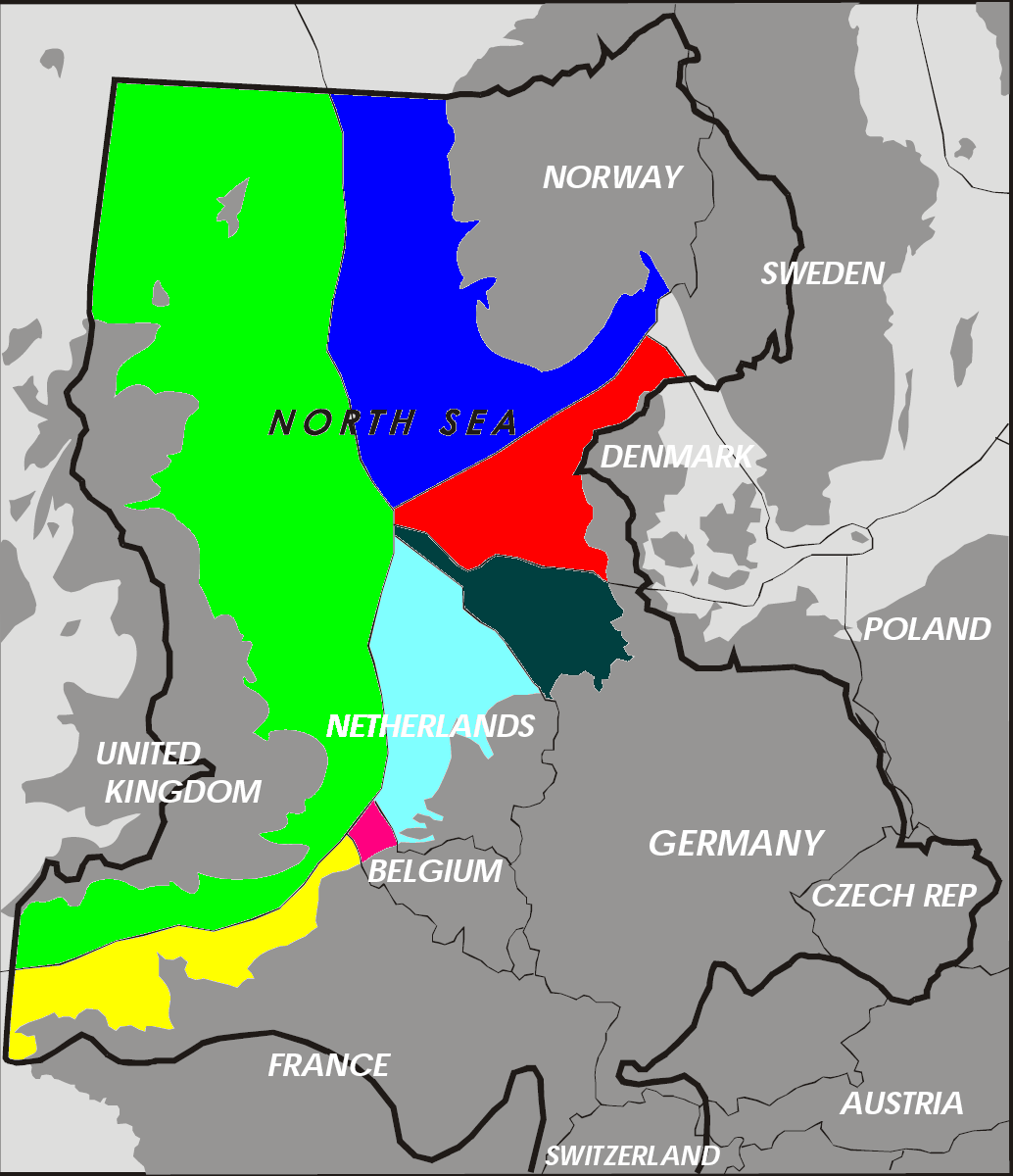
Note.
- Yellow is France.
- Mauve is Belgium, who drew the short straw.
- Light Blue is The Netherlands.
- Black is Germany, who despite their large land area, don’t have as much sea as the UK.
- Red is Denmark.
- Dark Blue is Norway.
- Green is The UK.
- Germany and Poland seen to share the Southern Baltic.
I wouldn’t be surprised to see Germany and Poland co-operating to maximize the wind power capacity of the Southern Baltic.
A Visit To Poland’s Coal Capital
On one of my trips to Poland, I went to Katowice, which is in Poland’s coal-mining region. I wrote about it in An Excursion In Katowice.
Google AI produced this snapshot of Katowice.
Katowice is historically known as the “Polish Coal Capital” and served as the absolute backbone of the region’s heavy industry. First transforming into an industrial powerhouse in the mid-19th century due to rich local coal and metal reserves, the city’s economy and rapid growth were entirely reliant on coal mining and steel.
While coal and heavy industry historically anchored its identity, the city of Katowice has aggressively transformed into a modern cultural, technological, and business hub. The wider Silesia region remains heavily tied to coal mining, but the municipality itself has shifted its focus to avoid reliance on it.
My visit to Katowice was an excellent pit-stop on a train ride between Krakow and Prague, when I did my Home Run From Krakow.
If you like your food and like me, you’re coeliac, I would certainly recommend Poland for a few days away.
Strangely, the language is not a problem, as if you get three Poles together, one will speak English better than what you do.
‘Sleeper Trains’ London To Berlin And Prague A New Possibility
The title of this post, is the same as the title of this article on Rail Technology Magazine.
This is the introductory paragraph.
For those who have grown a travel bug during lockdown, the truth is that flying looks like it won’t be a viable option as a global pandemic persists. However, for those who dream to travel again, there might be some hope. With growing new interest, there are ambitious plans to take overnight ‘Sleeper trains’ services through the channel tunnel from London to cities around Europe .
I regularly use sleeper trains to Scotland, as they deliver me North of the Border for an early start or are ideal for coming back ;ate after a busy day.
As I can sleep with no trouble on a train and generally book a few days in advance, it generally works out that the cost of the sleeper one way is good value, as it avoids paying for a hotel.
Certainly, in the UK, if you use sleeper trains properly and have a rail-card, I find them convenient and good value. A couple of times, there’s also been a party in the lounge car.
It appears that the first sleeper trains will start from Brussels.
- NightJet already run a service between Brussels and Vienna.
- A route of Brussels and Prague via Amsterdam, Berlin and Dresden is suggested.
- These routes could be extended to London, at some time in the future.
But if they were timed appropriately, you could take an afternoon or evening Eurostar to Brussels and have supper before you get the sleeper, either on Eurostar or in Brussels.
With sleeper trains popping up in several places in Europe and becoming more fashionable with better rolling stock, I’m sure that this sleeper train would work.
Brussels and Berlin is currently seven hours with a change, so a sleeper train without a change could probably take you to Berlin for eight in the morning, if it left Brussels at about yen at night.
BBC Weather Gets It Right
The BBC weather forecast yesterday was saying today that Prague would have a wet and thundery afternoon.
So I booked myself out of Prague on the 14:30.
And guess what? It’s raining!
From Prague To Dresden
I went First Class between Prague and Dresden, as it only cost an extra fifty percent and a total of 43€. I also had a compartment to myself, all the way.







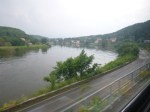

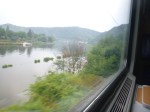
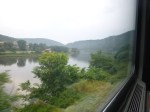
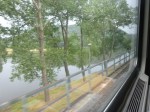

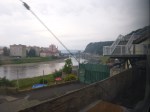

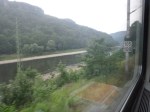


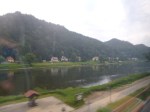




The journey is mainly along the River Elbe and its tributary, the Vitava river.
I suspect that you can use a ferry part or all of the way according to this review in Trip Advisor.
From The Charles Bridge To The Station
To get out of Prague, I needed to catch the 14:30 train to Dresden. I left it a bit tight and in the end I had to walk across a lot of the city, whilst trying to find a Metro station. I took these pictures as I walked.

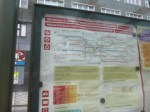
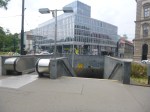
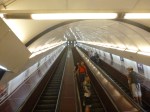
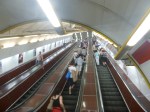
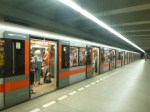
What complicated matters was that when I changed from Line B to Line C at Florenc, there was a power cut. Luckily, I used another escalator to get to the surface and then entered gain through another entrance direct to the other line.
Add to this these features of Prague’s transport system.
1. There are no maps of either the trams or the metro on the surface that are readable.
2. Each separate Metro line has a different colour of signs and not all entrances to the Metro are signed.
3. There are no walking maps, even at important places, unlike in Krakow, Dresden and Leipzig
4.Prague is not in Poland, where the locals have good English and don’t have to be asked before they offer help.
5. Prague has too many visitors for its transport system.
I also had to get to the station in good time, as I’d left my bag in the Left Luggage Office and as it was lunch time, it might be closed whilst the guys had their lunch. But once I got to the main station all went well. Even if I was a bit early!
After I’d left Prague, it all reminded me of Vaclav Havel‘s play; The Memorandum, which I heard on Radio 4, probably over thirty years ago.
The Charles Bridge
The Charles Bridge across the Vitava River is rightly famous.
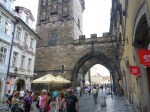


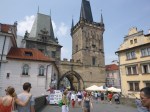

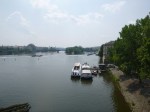
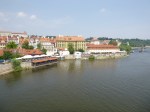




It was extremely busy, as the pictures show.
From Prague Castle To Charles Bridge
I decided that if I took a tram down from the castle, it would probably take me somewhere I recognised.




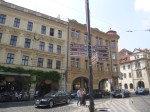
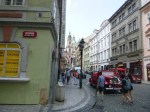
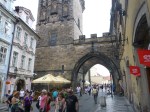
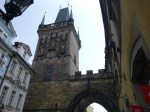
In the end, I recognised the Hoffmeister Hotel, where C and myself stayed on our weekend in Prague, that I described in Getting Emotional. So I got off a few stops later, where it looked like an area with plenty of cafes, that I remembered.
After that the Mark 1 Navigation System kickred in and it led me to the Charles Bridge.
Exploring Prague Castle
After getting up to Prague Castle, I bought a ticket that gave me universal access and spent an house or so exploring.
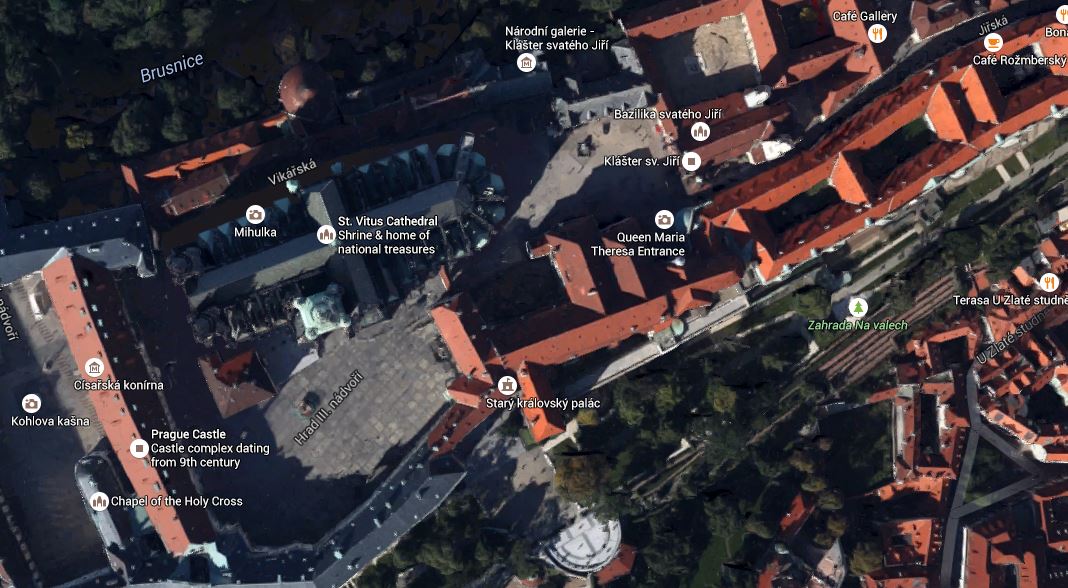
This Google Map shows the extend of the site. which the Guinness Book of Records lists as the largest ancient castle in the world.
Prague Castle
These are some of the pictures I took.
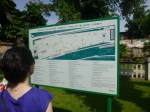
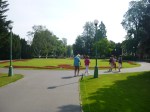




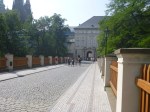


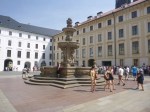



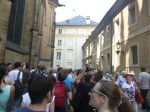






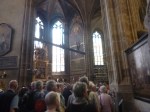












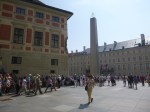






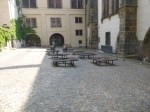








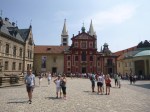

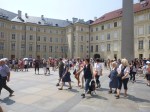
As the pictures show it was extremely hot and very busy, with queues to get into many of the buildings.
Climbing To Prague Castle
These pictures document my journey from the station, where I dropped my bag, up to Prague Castle.


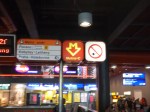

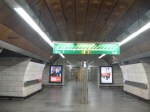
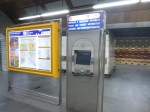

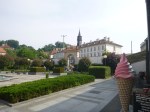
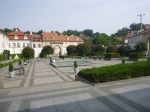
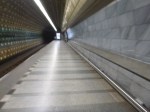
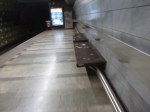

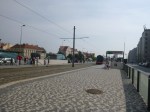

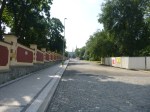
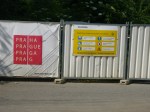
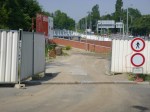
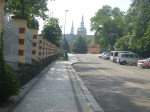
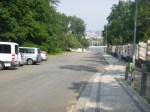
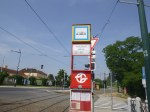
I had hoped to avoid walking up too many hills, but I did have to climb the last bit, only to find, that a 22 or 91 tram could have taken me right up the hill.
The Czech Republic has a real problem with its language, with lots of characters unfamiliar to visitors. But I didn’t have the same problems in Budapest, where the language is equally indecipherable.
In my view Prague could solve a lot of their transport problems, by adding some simple signs, which as I found a couple of years ago in Munich could be picture-based.
The Blanka tunnel being built appeared to be a road tunnel. And it is, if you look at Blanka Tunnel Complex in Wikipedia! Which says this.
The complex will connect the area west of Prague Castle with Trója district in the northeast. Its length is about 6.4 km and consists of three tunnels: Bubenečský, Dejvický and Brusnický. The tunnel complex was designed to relieve the historic centre of Prague from heavy traffic.
It’s just a pity, that some small change from the project, wasn’t used to improve the current system, with good maps and decipheral information.
My Hotel Ibis In Prague
I stayed at a Hotel Ibis in Prague.





The value was OK, but the hotel doesn’t compare in value to the average Premier Inn in the UK.

