Centrica Business Solutions And Highview Power
Centrica Business Solutions is one of Centrica’s business units.
It has its own web page, with this sub heading.
Helping Organisations Balance Planet And Profit
This is followed by this mission statement.
Centrica Business Solutions helps organisations to balance the demands of planet and profit, by delivering integrated energy solutions that help you save money and become a sustainable business.
Several pictures show some of the solutions, that Centrica Business Solutions can provide.
Centrica Business Solutions In Numbers
These numbers are given about the customers of Centrica Business Solutions.
- Customer Sites Globally – 7000
- Solar PV Installations Delivered Worldwide – 16,380+
- Solar PV Installations Delivered Power – 240 MW
- CHP Units Operated And Maintained Globally – 700 MW+
- Energy Data Points Collected Each Month Globally – 29 billion
Theses are large numbers.
How Would Centrica Business Solutions Use Highview Power’s Batteries?
The obvious use of Highview Power’s batteries is to connect them between a solar or wind farm and the grid, for when the sun isn’t shining or when the wind isn’t blowing.
Currently, there are three sizes of Highview Power batteries, either working on under development.
5MW/15 MWh
This is the demonstration system, which is described on this page of the Highview web site.
Surely, if a system of this size is very useful for Viridor, there may be other applications and customers out there.
This system will provide 5 MW for three hours.
50MW/300MWh
This is the Carrington system, which is described on this page of the Highview web site.
The Highview web site says this about output potential and connectivity.
The facility will store enough clean, renewable energy to serve the needs of 480,000 homes, as well as providing essential grid stabilisation services. The site will use existing substation and transmission infrastructure.
This system will provide 50 MW for six hours.
200MW/2.5GWh
This is the larger system for Scotland and the North East, which is under development and described on this page of the Highview web site.
The Highview web site says this about output their use.
These will be located on the national transmission network where the wind is being generated and therefore will enable these regions to unleash their untapped renewable energy potential and store excess wind power at scale.
This system will provide 200 MW for 12.5 hours.
In Rio Tinto Punts On British Start-Up To Plug Renewables Gap, I said this.
In Britain, Highview hopes to be putting four 2.5-gigawatt assets into planning this year – one in Scotland, three with Orsted in England.
This sentence was originally published in this article on the Australian Financial Review.
I believe that Centrica could find applications for all three sizes of Highview’s batteries.
Suppose, though Centrica find that an application needs say a 100 MW/1 GWh battery.
From the mathematics, I did at ICI in the 1970s, when looking at the scaling of chemical plants, I believe that Highview’s battery design could be scalable, by just using appropriately-sized turbomachinery, matched to the right number of tanks.
So the customer would get the battery size they needed!
How Much Electricity Could One Of Highview’s Batteries Store?
This image shows large LNG tanks at Milford Haven.
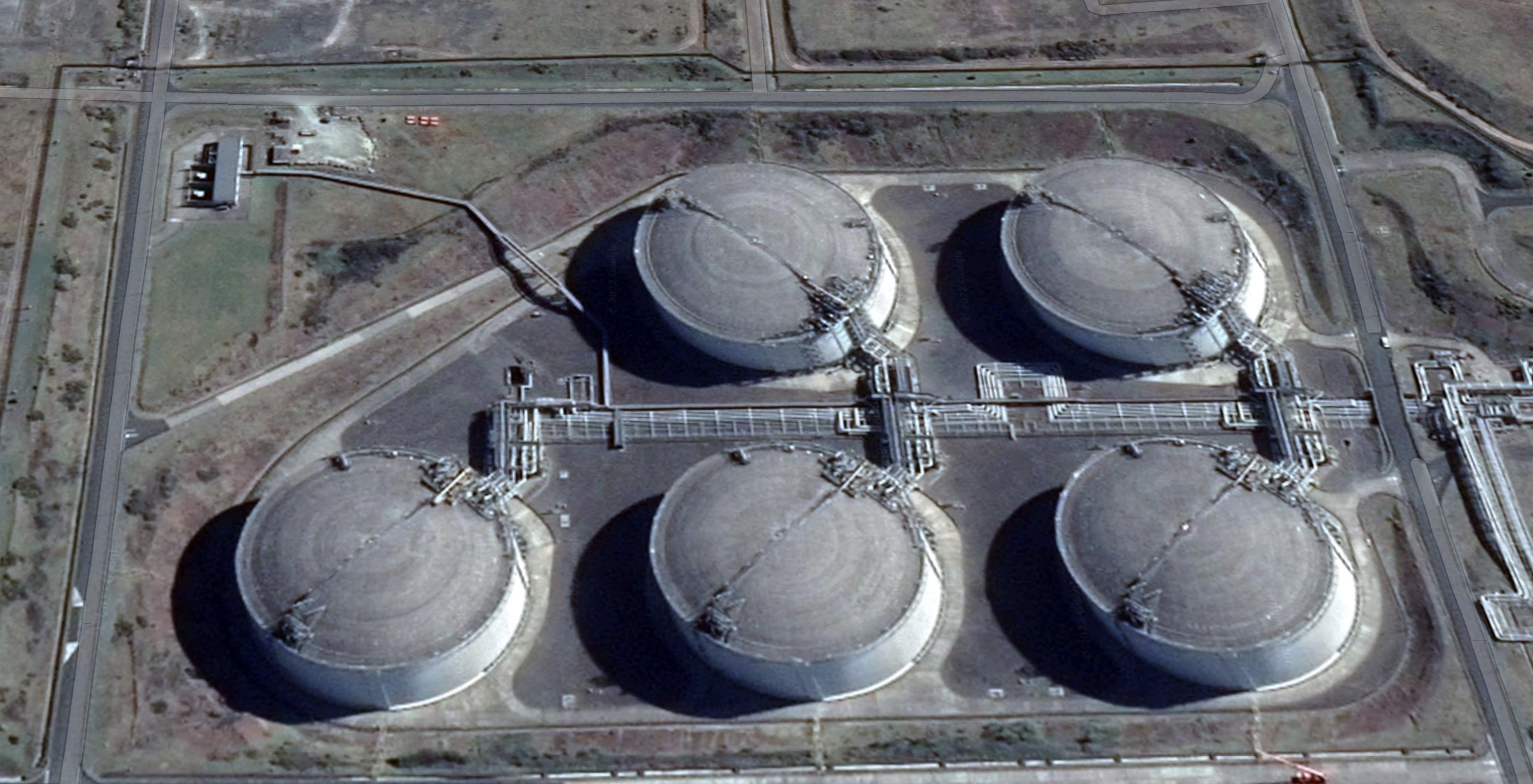
In Could A Highview Power CRYOBattery Use A LNG Tank For Liquid Air Storage?, I did a rough calculation and found that the largest LNG tanks could hold enough liquid air, that would be the equivalent of around one GWh.
So the image above could be a 5 GWh battery.
This image clipped from Highview’s web site, shows large tanks for liquified gas storage.
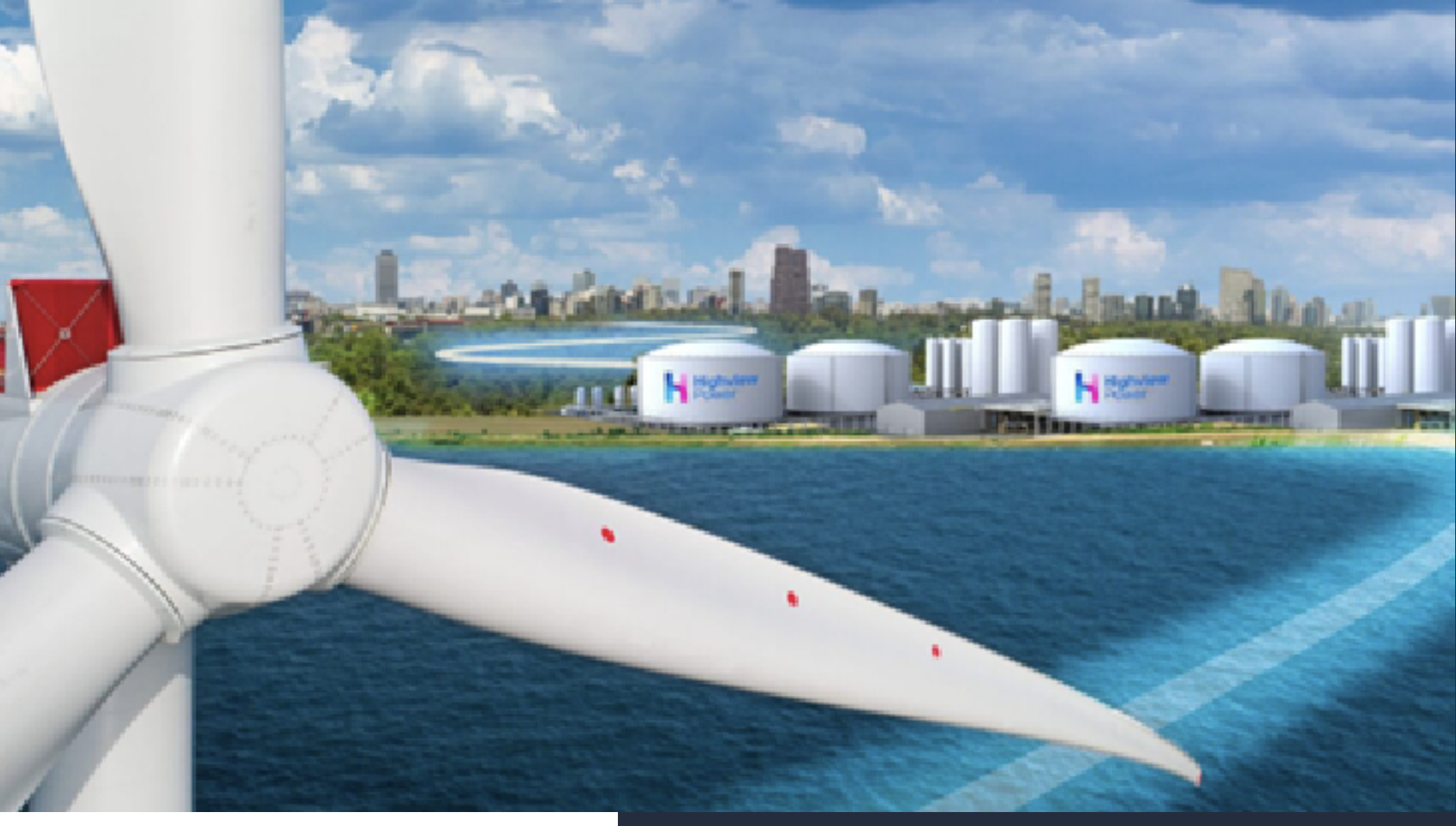
With tanks like these, Highview could be building batteries with storage to rival the smaller pumped storage hydroelectric power stations.
In Grid Powers Up With One Of Europe’s Biggest Battery Storage Sites, I talked about how Ørsted were planning the Swardeston BESS, where the 2852 MW Hornsea Three wind farm connects to the grid.
The chosen battery will be from Tessla with an output of 300 MW and a capacity of 600 MWh.
I suspect Ørsted couldn’t wait for Highview, but circumstances might have changed now, with the financing deal for the Carrington battery!
Are Combined Heat And Power Units And Highview’s Batteries Interchangeable And Complementary Technologies?
According to the Centrica Business Systems web site, they have deployed over 700 MW of CHP systems globally.
I wonder how many of these systems could have used a standard Highview battery?
Perhaps, Centrica Business Systems have done a survey and found that it could be quite a few.
So, perhaps if Centrica Business Systems had access to Highview’s technology, it would increase their sales.
In addition how many of Centrica Business Systems existing CHP systems, would be improved with the addition of a Highview battery?
It appears to me, that if Centrica Business Systems were to develop a series of standard solutions based on Highview’s technology, they could substantially increase their sales.
What Could Centrica Business Systems Do For Highview Power?
Centrica Business Systems could probably develop several standard applications with Hoghview’s technology, which would be to the benefit of both companies.
But, I believe that as Centrica Business Systems are supporting large number of systems globally, that they are in a good place to help develop and possibly run Highview Power’s support network.
Conclusion
I can see Centrica Business Systems and Highview Power having a long and profitable relationship.
Fifth Hydro Project Proposed At Loch Ness
The title of this post. is the same as that of this article on the BBC.
This is the sub-heading.
The local community is to be asked for its views next week on plans for a new hydro-electric scheme at Loch Ness.
These three paragraphs introduce the new scheme.
Glen Earrach Energy’s, external (GEE) pumped storage hydro project is the fifth hydro scheme proposed for the Loch Ness area.
The company said its project on Balmacaan Estate would create clean energy while protecting the environment, and create 600 on-site jobs.
But concerns have been raised about the number of planned schemes, with Ness District Salmon Fishery Board worried about the effect on wild fish.
The project has a web site, which has a section entitled About The Project, where this is said.
Glen Earrach Energy, which means “Valley of Spring” in Gaelic, stands at the forefront of energy innovation. The Pumped Storage Hydro (PSH) project, located at Balmacaan Estate, Scotland, is a critical component for achieving a net-zero grid by 2030.
The project prioritises environmental preservation and biodiversity enhancement while achieving outstanding efficiency in energy storage and generation.
This ensures a healthier and more sustainable balance between harnessing natural energy resources and the maintenance and reinforcement of the surrounding ecosystem.
Note.
- It doesn’t say, but it looks like Glen Earrach Energy aim to complete the project by 2030.
- Glen Earrach Energy also seem to be playing a strong environmental card.
But nothing is said about the size of the project.
This article on Business Insider, which is entitled £3 billion Loch Ness Hydro Project Plans Unveiled, does give some details.
- Potential Investment – More than £2 billion
- Output – 2 GW
- Storage Capacity – 30 GWh
- The project could create at least 600 on-site construction jobs in Scotland over a six-year period, plus many thousands more locally in the supply chain.
It is larger, than SSE’s flagship Coire Glas pumped storage hydroelectric power station, which is planned to be a 1.5 GW/30 GWh station, at the other end of the Great Glen.
I have some thoughts.
The Existing Hydro Schemes On Loch Ness
According to the BBC article, there are two existing hydro schemes on Loch Ness.
- Foyers is described on this web site and is a reasonably modern 305 MW/6.3 GWh pumped storage hydroelectric power station, that was built by SSE Renewables in the last fifty years.
- Glendoe is described on this web site and is a modern 106.5 MW conventional hydroelectric power station, that was built by SSE Renewables in the last twenty years.
Foyers and Glendoe may not be the biggest hydroelectric power stations, but they’re up there in size with most solar and onshore wind farms. Perhaps we should look for sites to develop 100 MW hydroelectric power stations?
The Proposed Hydro Schemes On Loch Ness
According to the BBC article, there are four proposed hydro schemes on Loch Ness.
- Coire Glas is described on this web site and will be a 1.5GW/30 GWh pumped storage hydroelectric power station, that is being developed by SSE Renewables.
- Fearna is described on this web site and will be a 1.8GW/37 GWh pumped storage hydroelectric power station, that is being developed by Gilkes Energy.
- Loch Kemp is described on this web site and will be a 600MW/9 GWh pumped storage hydroelectric power station, that is being developed by Statera.
- Loch Na Cathrach is described on this web site and will be a 450MW/2.8 GWh pumped storage hydroelectric power station, that is being developed by Statktaft.
In addition there is, there is the recently announced Glen Earrach.
- Glen Earrach is described on this web site and will be a 2GW/30 GWh pumped storage hydroelectric power station, that is being developed by Glen Earrach Energy.
Note.
- The total power of the seven pumped storage hydroelectric power stations is 4.76 GW.
- The total storage capacity is 85.1 GWh.
The storage capacity is enough to run all turbines flat out for nearly five hours.
Could Glendoe Be Updated To Pumped Storage?
The Wikipedia entry for the Glendoe Hydro Scheme mentions pumped storage several times.
In Glendoe Hydro Power Station, I estimate that a Glendoe pumped storage scheme could be perhaps 50 % bigger than the system at Foyers.
I feel that if more storage capacity is needed in the Highlands, then Glendoe could be converted to pumped storage.
Gresham House BESS Fund Energises 50MWh Asset
The title of this post, is the same as that of this article on Solar Power Portal.
These three paragraphs detail the project.
Gresham House Energy Storage Fund has energised a 50MW/50MWh battery energy storage system (BESS) in Lancashire.
Situated in Penwortham, south-west of the county capital Preston, the 1-hour duration BESS is set to be expanded to 2-hours in the summer, meaning its capacity would be 50MW/100MWh.
With the commencement of this new BESS, Gresham House Energy Storage Fund’s operational capacity has now reached 790MW/926MWh. The project is the fund’s 25th operational asset since IPO.
Note.
- The battery will be upgraded to a two-hour battery in the summer.
- The average battery would appear to be 32 MW/37 MWh.
- The average full-power duration for all Gresham House’s batteries appears to be around 70 minutes.
This Google Map shows the battery, which is located next to National Grid’s Penwortham substation.
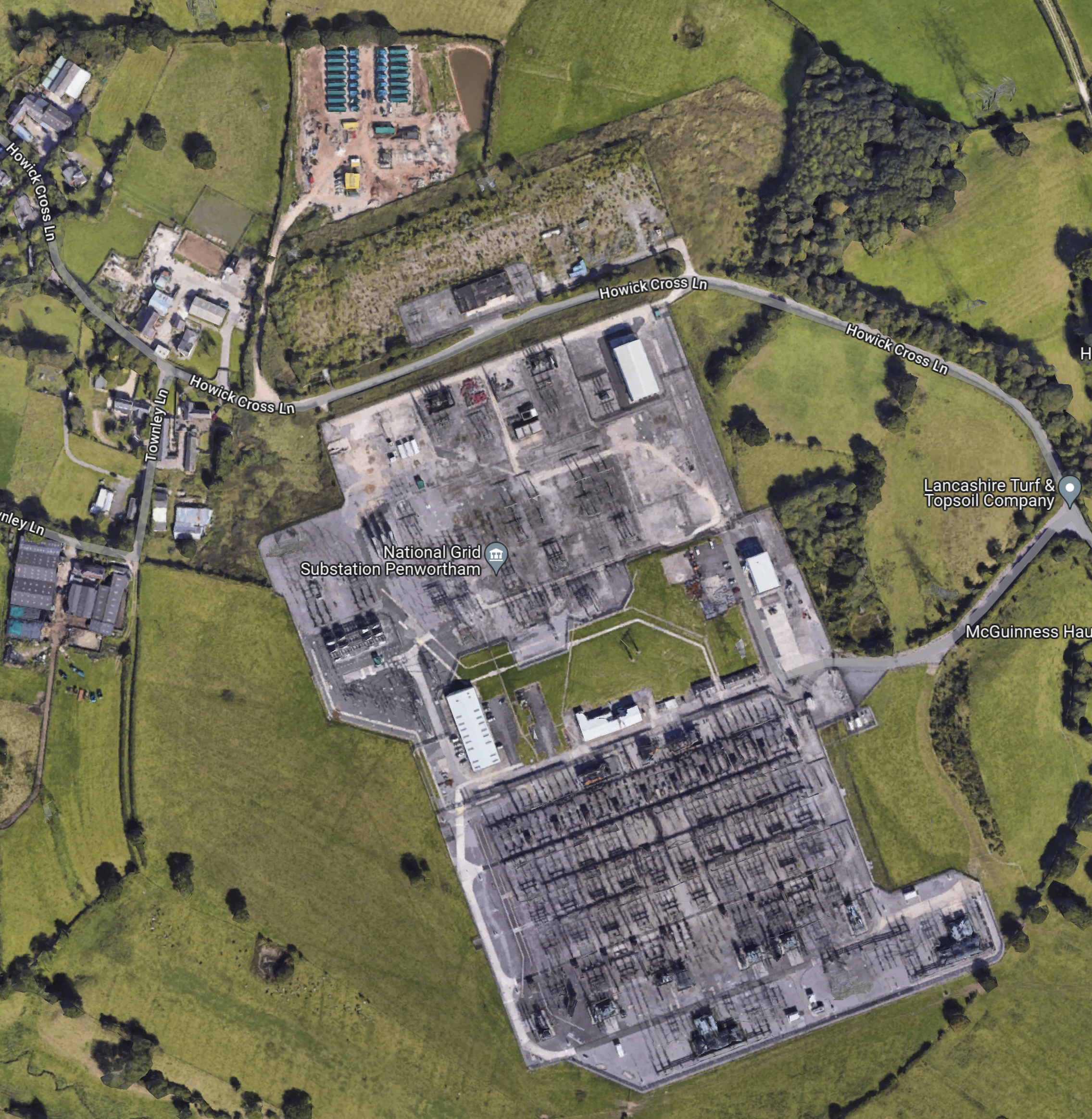
Note.
- The battery is the two rows of green containers at the top of the map.
- The substation appears to be large.
Co-location like this, must surely bring design, construction and operational advantages.
This page on the National Grid web site is entitled Network And Infrastructure, where this is said.
We own the national electricity transmission system in England and Wales. The system consists of approximately 4,500 miles of overhead line, over 900 miles of underground cable and over 300 substations.
If every substation in the UK were to be fitted with a 32 MW/64 MWh two hour battery, these would have a total capacity of 9.6 GW/19.2 GWh.
Compare that with these operational batteries and pumped-storage systems in the UK.
- Cruachan – 1000 MW/7.1 GWh – Pumped Storage
- Dinorwig – 1800 MW/9.1 GWh – Pumped Storage
- Ffestiniog – 360 MW/1.44 GWh – Pumped Storage
- Minety -150 MW/266 MWh – BESS
- Pillswood – 98 MW/196 MWh – BESS
And these systems are under development
- Coire Glas – 1.5GW/30 GWh – Pumped Storage
- Loch Na Cathrach/Red John – 450 MW/2.8 GWh – Pumped Storage
- London Gateway – 320 MW/640 MWh – BESS
There are at least another four substantial pumped storage systems under development.
Conclusion
A twin-track approach of grid-batteries at sub-stations and a few larger grid batteries and pumped storage hydroelectric schemes should be able to provide enough storage.
Ørsted, Simply Blue, Subsea7 Submit Application For 100 MW Scottish Floating Wind Farm
The title of this post, is the same as that of this article on offshoreWIND.biz.
This is the sub-heading.
Ørsted, Simply Blue Group and Subsea7, through their joint venture partnership in Scotland, have submitted an offshore consent application for the proposed 100 MW Salamander floating offshore wind farm, one of the 13 projects selected in Scotland’s Innovation and Targeted Oil and Gas (INTOG) leasing round.
The article starts with a map that shows the location of the Salamander floating offshore wind farm and it shows how the sea is getting very crowded 35 kilometres off Peterhead.
This map shows the various ScotWind leases, around the North of Scotland.

The numbers are Scotwind’s lease number in their documents.
These are the Scotwind wind farms to the North-East of Scotland.
- 1 – BP Alternative Energy Investments – 859 km² – 2.9 GW – Fixed
- 2 – SSE Renewables – 859 km² – 2.6 GW – Floating
- 3 – Falck Renewables Wind – 280 km² – 1.2 GW – Floating
- 4 – Shell – 860 km² – 2.0 GW – Floating
- 5 – Vattenfall – 200 km² – 0.8 GW – Floating
- 6 – DEME – 187 km² – 1.0 GW – Fixed
- 9 – Ocean Winds – 429 km² – 1.0 GW – Fixed
- 10 – Falck Renewables Wind – 134 km² – 0.5 GW – Floating
- 11 – Scottish Power Renewables – 684 km² – 3.0 GW – Floating
- 12 – BayWa r.e. UK – 330 km² – 1.0 GW – Floating
Note.
- Salamander is located to the South of wind farms 10, 11 and 12 and to the North-West of wind farm 5.
- These windfarms total up to 16 GW.
- 4.9 GW are fixed foundation wind farms.
- 11.1 GW are floating wind farms.
These are my thoughts.
The Salamander Project
In the big scheme of things, the 100 MW Salamander wind farm, is rather a tiddler of a wind farm.
On the Salamander wind farm web site, a section gives the Project Goals.
- Our innovative pre-commercial stepping-stone concept will use novel floating foundations to (i) maximise Scottish content, (ii) enable the Scottish supply chain to gear up for the future floating offshore wind commercial opportunities in ScotWind and (iii) reduce the financial, environmental and technology risks of floating offshore wind.
- The Salamander project will contribute to the Scottish Government and UK Government net-zero targets. The project can contribute to the Scottish government’s target of 11 GW of installed offshore wind by 2030, as well as the UK government’s target of 5 GW of operational floating offshore wind by the same date.
- We are dedicated to developing a sustainable and transformative project, working with the oceans, and enabling communities to benefit from Project Salamander. Therefore, we commit to having a continuous and strong stakeholder and community engagement.
It appears to me, that the Salamander project will be a pathfinder for the 11.1 GW of floating wind farms to be built off Peterhead.
Bringing The Electricity South
National Grid are building four interconnectors between Eastern Scotland and Eastern England.
- Eastern Green Link 1 – Torness and Hawthorn Pit
- Eastern Green Link 2 – Peterhead and Drax
- Eastern Green Link 3 – Westfield and Lincolnshire
- Eastern Green Link 4 – Peterhead and Lincolnshire
Note.
- All interconnectors are 2 GW.
- All interconnectors are offshore for a long part of their route.
- It also appears that National Grid are burying much of the onshore sections.
But the 4 GW of interconnectors will only be able to bring a quarter of the offshore electricity generated in the Peterhead area to the South.
What Will Happen To The Excess Electricity?
Consider.
- There could be 16 GW of planned offshore wind power around Peterhead and North-East Scotland.
- There is only 4 GW of interconnector capacity between Peterhead and Eastern England.
- There is another 6.8 GW of electricity around North-West Scotland.
- There is 2.8 GW of electricity being developed to the East of Shetland.
- The Crown Estate is thinking of increasing the size of some offshore wind farms.
It is likely, that other wind farms will be built in the seas around the North of Scotland.
It appears that the North of Scotland could have at least 20 GW of excess electricity.
Possible solutions would include.
- Developing energy intensive industries like metal refining.
- More interconnectors to Denmark, England, Ireland and Norway.
- Storage of the electricity in giant pumped storage hydroelectric power stations.
- Creation of green hydrogen for export.
Note.
- Aluminium refining has been developed in the North of Scotland before.
- More interconnectors are a possibility, especially as Scotland is developing cable manufacturing capacity.
- Some maps show extra interconnectors between West Scotland and Merseyside.
- At least 70 GWh of pumped storage hydroelectric power stations are being developed along the Great Glen.
- I suspect that the pumped storage hydroelectric power stations could be connected to the wind farms, by cables under the waters of Loch Ness.
But surely, production of green hydrogen for export would be a very good way to go.
- Extra electrolysers could be added as required.
- Because of the interconnectors down both East and West Coasts, electrolysers could be built in England, where there is a large need for hydrogen.
- Hydrogen would be exported initially by tanker ships.
- At some point in the future, it might be viable to build a hydrogen pipeline to connect to the growing European hydrogen network.
The giant pumped storage hydroelectric power stations and the hydrogen electrolysers would be sized to make sure, that no wind power is never wasted.
Conclusion
The 100 MW Salamander floating wind farm may only be small, but it will prove the technology, the manufacturing and the supply chains, so that Scotland can have a second energy boom from the North Sea.
But this boom will certainly last longer than a hundred years.
RheEnergise To Build First-Of-A-Kind Hydro Storage System
The title of this post, is the same as that of this article on Power Technology.
This is the sub-heading.
A demonstrator of the company’s long-duration hydro-energy storage system will be constructed at Sibelco’s Devon mine.
These are the first two paragraphs.
UK hydro-energy storage company RheEnergise is to build a first-of-a-kind demonstrator of its long-duration hydro-energy storage system at Sibelco’s mining operations at Cornwood, near Plymouth, Devon. The construction of the demonstrator will start soon, with commissioning scheduled in September.
The power generated by RheEnergise’s HD Hydro demonstrator, which has a peak power production of 500kW, will support Sibelco’s mining operations at times of high energy demand and help the company decarbonise its operations. The Cornwood site produces kaolin, mainly for sanitary ware, ceramics, tiles and industrial applications.
I have some thoughts.
A Short Construction Time
If RheEnergise’s timescale is correct and it is the same in RheEnergise’s original press release, then I can draw the following conclusions.
- Five months is a short construction time.
- I would suspect that the system can be built from readily available components.
- RheEnergise’s HD Hydro system, which uses a fluid with a specific gravity of 2.5 can work with standard pipes and turbines.
I wouldn’t be surprised, that the only difference between RheEnergise’s system and a standard water-based hydro system is the fluid and a few settings on the control system.
It might even be possible to check that the system works by using water as the storage fluid.
But that would of course shorten the testing time.
Could An Existing Pumped Storage System Be Uprated With RheEnergise’s Fluid?
Consider
- There are only a few small pumped hydro systems.
- The RheEnergise system needs to be sealed.
- The storage capacity would be raised by 2.5 times.
It is an interesting idea, but could be possible in some cases.
What Will Be The Storage Capacity Of The Sibelco System?
This is not stated, but typically a battery system has a duration of two hours.
So that would give a capacity of 1 MWh.
Could RheEnergise’s HD Hydro System Back Up A Wind Or Solar Farm?
Consider.
- Batteries are always a good addition to a wind or solar farm, as they stabilise the output.
- A lot would depend on the possible size of the RheEnergise system battery.
- The location of the wind farm is probably important.
An onshore wind farm on top of a hill might be an ideal candidate.
Conclusion
RheEnergise could be installed in a lot of sites.
Coire Glas Exploratory Tunnel 70% Complete
The title of this post, is the same as that of this article in Ground Engineering.
This is the sub-heading.
A tunnel to investigate ground conditions at SSE Renewables’ Coire Glas project to build a pumped hydro scheme in the Scottish Highlands is 70% complete, as wider ground investigations come to an end.
These are the first three paragraphs.
Coire Glas on the shores of Loch Lochy in Great Glen is the first large scale pumped hydro storage scheme to be developed in the UK for more than 40 years.
It would take excess energy from the grid and use it to pump water 500m up a hill from Loch Lochy to a vast reservoir where it would be stored. This will be done through a tailrace tunnel, underground cavern power station, high pressure tunnel and low-pressure headrace tunnel.
SSE Renewables has started exploratory works on the scheme. This has involved building an up to 1km long and 4m wide tunnel to investigate the ground conditions in which the powerhouse will be built.
All the information gathered will be used in the detailed design of the 1,5GW/30 GWh pumped storage system, which is expected to be a £1.5 billion capital investment.
The Wikipedia entry for Coire Glas power station, says this about the current status and completion.
In December 2023, the exploratory tunnel had reached 720m in length.
A final investment decision will depend on UK government assurances about how the regulated electricity market would reward storage schemes. SSE hope to make that £1.5Bn decision in 2024, in which case the scheme could be completed in 2031.
I suspect that as this is one of the largest green energy projects in the UK, that there’ll be a lot of media coverage of the construction of this power station.
UK Has Almost 7GW Of Shovel-Ready Pumped Hydro, Says IHA
The title of this post, is the same as that of this article on Solar Power Portal.
This paragraph fills out the headline.
Former Australian Prime Minister and current president of the International Hydropower Association (IHA) Malcolm Turnbull has penned an open letter to Rishi Sunak stating that the UK has “almost 7GW of shovel-ready pumped storage hydropower projects with over 135GWh storage capacity”.
Note.
- At 7 GW, it would take 19.2 hours to run out of water.
- Currently, we have about 3GW/24GWh of pumped storage hydro.
- At the end of 2022, we had just 2.4GW/2.6GWh of connected battery storage sites.
It looks like we should start digging.
The UK’s Pumped Storage Hydroelectricity
This post is a simple list of the UK’s pumped storage hydroelectricity.
- Balliemeanoch – 1500 MW/45 GWh – In Development
- Coire Glas – 1500 MW/30 GWh – Under Construction
- Corrievarkie – 600 MW/14.5 GWh – In Development
- Cruachan – 1000 MW/7.1 GWh – In Operation
- Fearn – 1800 MW/37 GWh – In Development
- Dinorwig – 1800 MW/9.1 GWh – In Operation
- Earba – 900 MW/33 GWh – In Development
- Foyers – 305 MW/10 GWh – In Operation
- Ffestiniog – 360 MW/1.44 GWh – In Operation
- Loch Kemp – 600 MW/9 GWh – In Development
- Loch Sloy – 152.5 MW/25 GWh – In Operation
- Red John – 450 MW/2.8 GWh – Under Construction
Note.
- Cruachan is only 440 MW and is being upgraded.
- The storage capacity at Foyers may be wrong, as I can’t find my original source.
When fully developed the total will be 10969.3 MW/223.94 GWh.
The Economic Case For Hydrogen In Domestic Heating
The title of this post, is the same as that of this article on The Chemical Engineer.
The Wikipedia entry for The Chemical Engineer has this introductory paragraph.
The Chemical Engineer is a monthly chemical engineering technical and news magazine published by the Institution of Chemical Engineers (IChemE). It has technical articles of interest to practitioners and educators, and also addresses current events in world of chemical engineering including research, international business news and government policy as it affects the chemical engineering community. The magazine is sent to all members of the IChemE and is included in the cost of membership. Some parts of the magazine are available free online, including recent news and a series of biographies “Chemical Engineers who Changed the World”, although the core and the archive magazine is available only with a subscription. The online magazine also has freely available podcasts.
It is a source on the Internet, where anything non-scientifically correct will be unlikely to appear.
The article has two introductory sub-headings.
Despite its thermodynamic disadvantages, global energy technology specialist Thomas Brewer believes hydrogen has an economic and efficient role in domestic heating. It forced him to deviate from his usual mantra of ‘efficiency above all else’ to get there, though
The work of decarbonisation by chemical engineers is about how we can cost effectively enable our organisations’ transition away from fossil fuels. This requires foresight. A decision chemical engineers make on a project with a 20-year lifespan will still be operational in 2045, when in most global locations, internal combustion engine (ICE) vehicles will probably be in the minority and grid electricity will be mostly renewable.
This is the first actual paragraph.
It is unsurprising, therefore, that chemical engineers are researching and debating the prospects of the future of energy availability from renewables, and the likely role and cost of hydrogen. There is much public noise surrounding the conversation about heat pumps vs hydrogen for domestic heating. I have noticed how few articles are written from an unbiased perspective, how very few reports talk about the whole solution, and authors avoid quantifying the financial impact of their proposed solution. I couldn’t find an unbiased study with any financial logic, so, I built a model to assess the options, for my own interests. I found the results so intriguing that I wanted to share them.
In other words, let the data do the talking and accept what it tells you.
These are some extracts from the article.
On Curtailment
The article says this on curtailment of wind energy, because you are generating too much.
Efficient electrical energy storage is expensive, which has traditionally led renewable system designers to include curtailment as a part of their design. Curtailment involves oversizing the wind supply to be higher than the grid connection to reduce the need for as much energy storage, and deliberately wasting the occasional electrical excess. The system design becomes an economical balance between oversizing the renewable generation and paying for additional electrical storage. Within the UK grid in 2023, curtailment is a small factor. As electrification and wind power become more mainstream, the financial decision between investing in excess wind vs electrical storage will lead curtailment to become a more significant factor.
Curtailment is to me a practice, that should be consigned to the dustbin of history.
To eliminate it, as much storage as is needed storage must be provided.
Eliminate Naked Flames In The Kitchen
The article says this about eliminating naked gas flames (natural gas or hydrogen) in the kitchen.
Figure 1 shows that the recommended standard of hydrogen gas installation if removing kitchen gas cooking would result in less injuries than the existing natural gas installation if cooking were converted to induction heating. Kitchen leaks are more likely than boiler leaks due to the number of valves and connections, regardless of the gas type. NOx emissions in the home because of naked flames in the kitchen are also of concern to the health of the occupants and hydrogen naked flames have a higher NOx emission than natural gas; another reason to eliminate naked flame cooking.
When I was financing the development of what became the Respimat inhaler, I did my due scientific diligence and found research from a Russell Group University, that naked flames (including smoking) were a cause of asthma, especially in children.
My recommendation is that, at an appropriate time in the near future, you replace your gas cooker with an electric one. My ginger-haired Glaswegian friend, who is a chef, who’s had Michelin stars would recommend an electric induction cooker.
Pumped Storage
The article says this about building more pumped storage.
The pumped storage assumption is based on the SSE proposal for Coire Glas, a 30 GWh £1.5bn storage system in Scotland which will more than double the UK’s current pumped storage capacity. The capital cost of this pumped storage system is about £50/kWh which will be delivered at about 80% efficiency. Pumped storage is a good balance between low cost and high efficiency. However, it requires natural resources. The Mott MacDonald report, Storage cost and technical assumptions for BEIS (Department for Business, Energy and Industrial Strategy) suggests the equivalent of four Coire Glas-scale installations in the UK by 2050. The model optimistically assumes that ten more similar additional Coire Glas-size pumped storage schemes could be installed.
This page on the Strathclyde University web site, gives these GWh figures for the possible amounts of pumped-storage that can be added to existing hydroelectric schemes.
Strathclyde’s total for extra storage is over 500 GWh.
Distributed Batteries
The article says this about distributed batteries.
A distributed battery assumption could be configured with multiple 10 kWh batteries which typically cost about £3,000 installed, near or in homes with a heat pump. This could be coupled with larger battery storage systems like the £30m Chapel Farm 99 MWh battery installation near Luton, commissioned in 2023. The small battery systems at each home are similar to the proposed virtual power plants using electric vehicle battery capacity to help balance the grid. Placing these batteries at locations with grid limitations could reduce the costs of upgrading the grid system. This is a more expensive energy storage scheme than pump storage and for the purposes of the model it is assumed that battery storage schemes are limitless. In both cases cited, the cost is £300/kWh. Battery efficiency varies significantly with temperature, and typically ranges from about 90% to 97%. As the system design needs to be focused on the coldest periods, the model is optimistically assuming 93% efficiency, which would require many of the batteries to be in a heated environment.
New lower-cost alternative batteries are also being developed.
Hydrogen Generation
The article says this about hydrogen generation.
Alternatively, the electricity generated from wind energy could be used in the electrolysis of water to produce hydrogen. While the fully installed electrolysis equipment costs about £2,100/kW, hydrogen storage in specially built cylinders is relatively cheap at about £23/kWh. The model, however, assumes salt mine storage which the US DoE in their report, Grid Energy Storage Technology Cost, calculate at a total system cost for hydrogen of $2/kWh. Electrolysis is the least efficient energy storage option, with a conversion efficiency of 75%, including compression. The waste heat from this conversion loss is useful for industrial heating, or in a district heating system. This has been ignored for simplicity.
Pumped storage, distributed batteries and hydrogen electrolysers distributed all over the UK, will mop up all the spare electricity and release it to heat pumps and for charging cars as necessary.
The hydrogen will be used for heating, to decarbonise difficult-to-decarbonise industries and provide fuel for hydrogen-powered vehicles, railways and shipping.
Curtailment will be a thing of the past.
The UK Offshore Wind Potential
The article says this about the UK offshore wind potential.
The UK government target for wind generation by 2030 is 50 GW. The UK offshore wind potential is reliable and available and has been estimated to be as high as 2,200 GW. There are, however, a few low wind periods that can last for several days.
I am not going to argue with 2,200 GW, but I will say that a lot of that will be used to generate hydrogen offshore.
Conclusions
This is the article’s main conclusion.
A wind-based supply for heating will mean that large quantities of potentially unused electricity will be available for more than 90% of the year, for potentially very low cost. While this could appear wasteful, it provides further synergistical opportunities for the decarbonisation of other interruptible energy duties, such as production of hydrogen for road transport or supplying heat via heat pumps for interruptible industries.
The sensitivity analysis shows that these conclusions are robust even with significant variation in the assumptions on equipment cost, efficiency, and other electricity source options.
This is also said about the most cost-effective solution.
A cost-effective national heat pump-only solution is about £500bn (50%) more expensive than a hydrogen-only boiler solution. The most cost-effective system is a combination of the two, £100bn cheaper than the hydrogen-only solution, and £600bn cheaper than the heat pump-only solution.
A cost-effective national heat pump-only solution has a system efficiency 40% lower than the hydrogen-only solution, requiring more than 750 GW of installed wind capacity. A hydrogen boiler solution requires less than 500 GW but the most efficient system, however, is a combination of the two.
The conclusions mean that everybody will be able to use the most appropriate solution for their circumstances for both heating their housing or powering their vehicles, as there will be massive supplies of affordable electricity and hydrogen.
How Will Everything Be Paid For?
Just as Germany and others built its industry on cheap Russian gas, it will now choose to use the plentiful and reliable UK electricity and hydrogen to rebuild its industry.

