UK Offshore Wind Farm Now Equipped With Scour Protection Doubling As Marine Life Habitat
The title of this post, is the same as that of this article on offshoreWIND.biz.
This is the sub-heading.
RWE has installed around 75,000 reef cubes developed by the nature-inclusive technology designer ARC marine at the Rampion offshore wind farm in the UK, in what the Rampion owner says is a “global first”. The cubes are a specially eco-engineered scour protection solution for wind turbine foundations, and this represents their first full-scale deployment at an offshore wind farm.
These four paragraphs add more details.
The solution is designed to protect the energy infrastructure from strong currents in the subsea environment, while creating new and extending existing living marine habitats, RWE says.
The reef cubes, ranging in size from 15 to 35 centimetres, were installed over the last few days at the base of one of the Rampion turbines by the project’s contractor Rohde Nielsen. It is the first real-world deployment of ARC marine’s patented Reef cubes as scour protection at an operational wind farm, according to RWE.
The developer says that at just one of the Rampion turbines, the reef cubes are providing a habitat surface area of 25,000 square metres.
The deployment is part of the Reef Enhancement for Scour Protection (RESP) pilot that RWE and ARC marine announced in July this year.
ARC marine’s reef cubes have their own comprehensive web site, which show all aspects of this fascinating technology.
1.2 GW Rampion 2 Offshore Wind Farm Granted Development Consent
The title of this post, is the same as that of this article on offshoreWIND.biz.
This is the sub-heading.
The UK has granted development consent to Rampion 2, the proposed 1.2 GW extension to the 400 MW Rampion offshore wind farm in Sussex. The Development Consent Order (DCO), issued by the Secretary of State for Energy Security and Net Zero on 4 April, will come into force on 28 April.
Rampion 2 is one of a number of extension wind farms that are listed in this list on Wikipedia.
They include.
- Awel y Môr which is a 500 MW wind farm, that is adjacent to the 576 MW Gwynt y Môr wind farm
- Five Estuaries, which is a 353 MW wind farm, that is adjacent to the 353 MW Galloper wind farm
- North Falls, which is a 504 MW wind farm, that is adjacent to the 504 MW Greater Gabbard wind farm
- Outer Dowsing is a 1500 MW extension to the 194 MW Lynn and Inner Dowsing wind farm.
- Rampion 2 is a 1200 MW extension to the 400 MW Rampion wind farm.
- Seagreen 1A is a 500 MW extension to the 1400 MW Seagreen 1 wind farm.
- Sheringham Shoal and Dudgeon Extensions, which is a 353 MW wind farm, that is adjacent to the 575 MW Sheringham Shoal and Dudgeon wind farms
In total 3780 MW of wind farms are being increased in size by 4406 MW.
A parcel of seven web sites have been more than doubled in size. Is this more efficient to do them this way, as some resources from the previous wind farms can be shared and better use can be made of resources like ships and cranes?
I feel that some serious project management may have been done.
Gatwick’s Hydrogen Advantage Over Heathrow
The Future Of Hydrogen In Aviation
I believe that hydrogen will have a big future in aviation.
Powering Aircraft
It will be some years, but not as many as some people think, before we see hydrogen-powered aircraft in the air.
Airbus have produced this infographic of three possible hydrogen-powered aircraft.
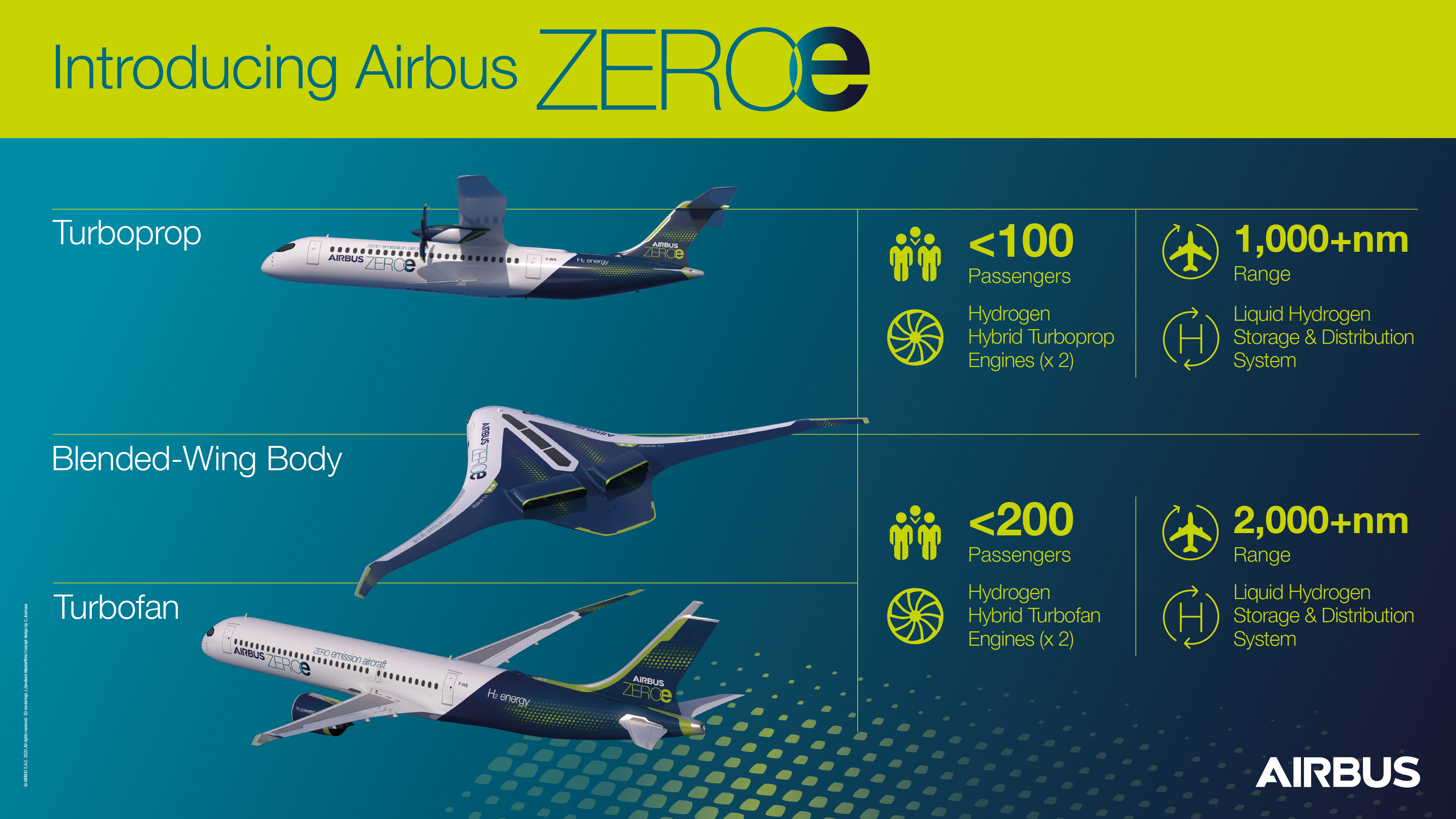
Discover the three zero-emission concept aircraft known as ZEROe in this infographic. These turbofan, turboprop, and blended-wing-body configurations are all hydrogen hybrid aircraft.
I wrote a bit more about these three hydrogen-powered concepts in ZEROe – Towards The World’s First Zero-Emission Commercial Aircraft.
My best estimate is that we’ll see hydrogen-powered aircraft in the air by 2035.
Towing Aircraft Around
Most aircraft are very heavy and towing them around needs a lot of zero-carbon energy.
So I think it is likely, that at some time in the near future,tugs to tow large aircraft around an airport will be hydrogen powered.
If you type “hydrogen-powered aircraft tug” into Google, you get several sensible product developments, including ones from.
- Exeter Airport
- Teesside Airport
- The Royal Air Force.
- The US Air Force
Note.
- The involvement of the military.
- At least two of the tugs are conversions of existing equipment.
- The extra weight of the battery in an electric-powered tug, may make the realisation of a viable electric aircraft-tug difficult.
I suspect we’ll see hydrogen-powered aircraft tugs in use on airports around the world in the near future.
Long-Term Car-Park Buses
I would have thought that using hydrogen-powered or battery-electric buses to serve long-term car-parks at an airport would be an obvious application. But it does appear that airports using zero-carbon buses to serve long-term car-parks are not very common.
- Gatwick uses a large fleet of hydrogen buses to bring passengers and staff to the airport, but these don’t appear to be linked to car parking.
- Incheon Airport in Korea does appear to use hydrogen-powered buses.
Please let me know, if you know of any other uses of hydrogen-powered vehicles at airports.
Hydrogen For Heathrow
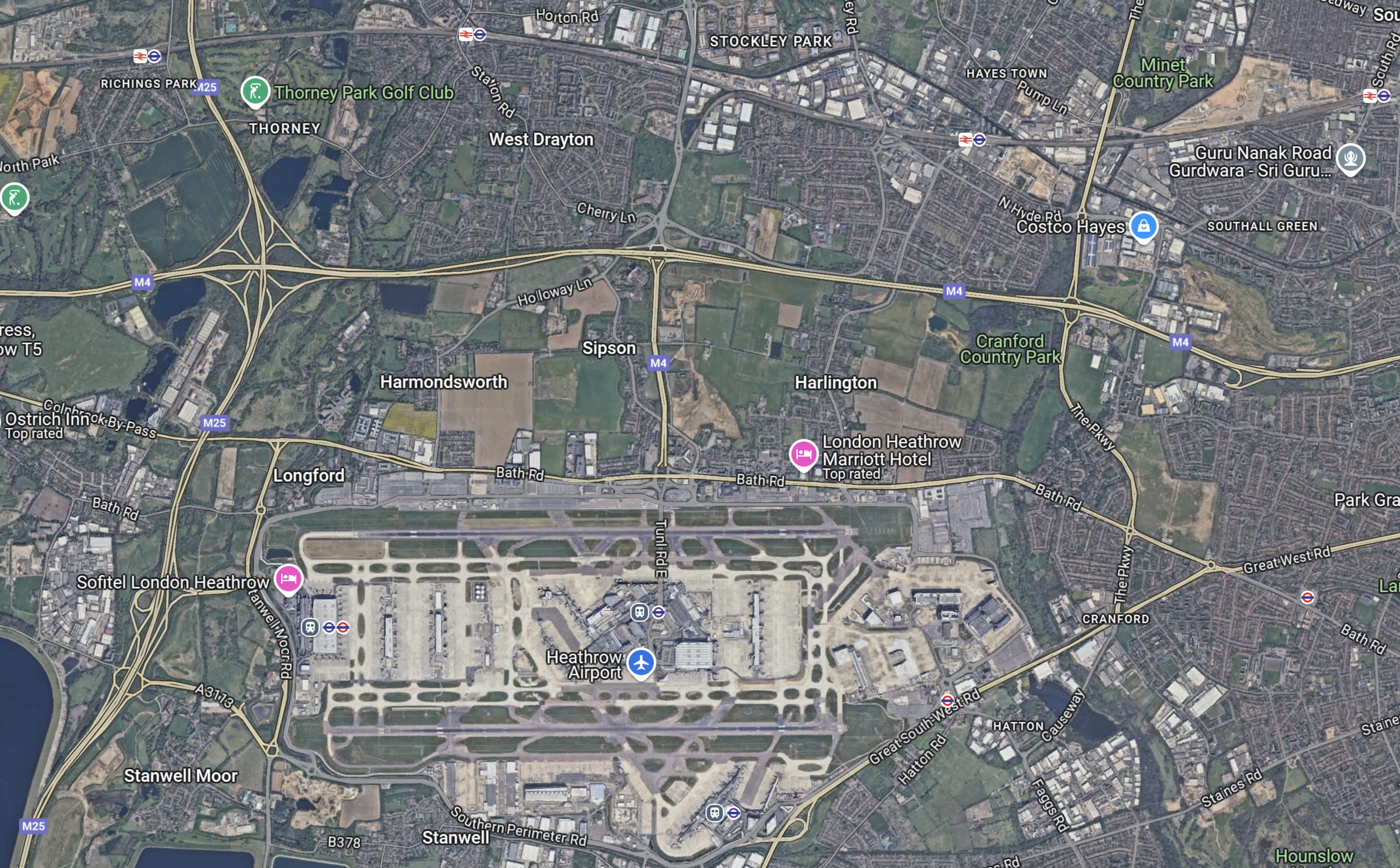
This Google Map shows Heathrow Airport.
Note.
- The M4 going across the map.
- The two main runways.
- A new third runway would go between the M4 and the Northern runway.
It is likely if the third runway goes ahead, the village of Harmondsworth will be flattened.
It is likely that supplying hydrogen to Heathrow will mean a hydrogen terminal somewhere South of the M4, which could be supplied by rail tankers.
Hydrogen For Gatwick
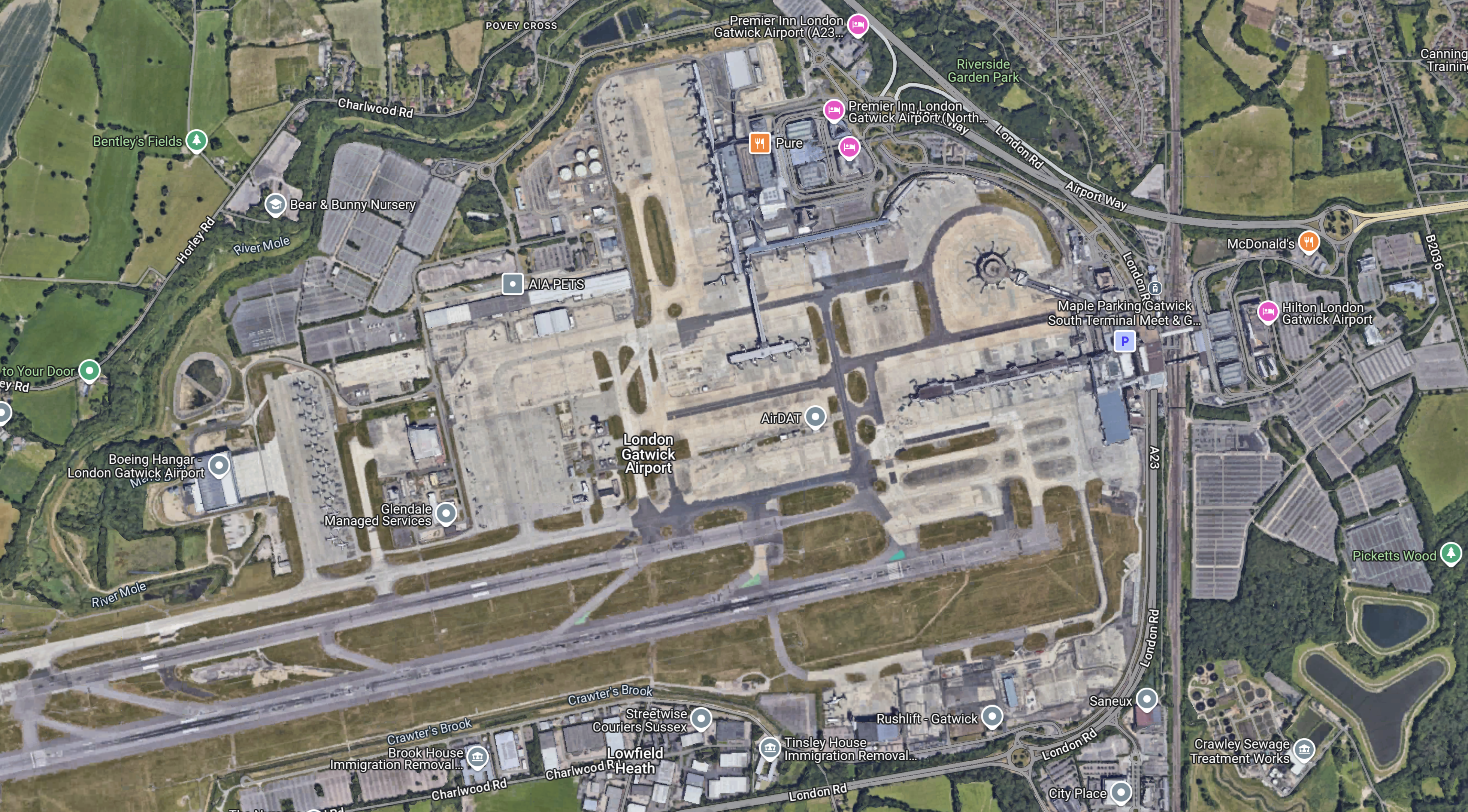
This Google Map shows Gatwick Airport.
Note.
- The current main runway with the emergency runway to its North.
- Because the runways are too close together they cannot be used simultaneously.
- To create a second runway, the two runways would be moved further apart and the current emergency runway would be enlarged.
- The Brighton Main Line runs North-South past the Eastern end of the main runway.
Gatwick’s expansion plan doesn’t appear to require any properties outside the airport boundaries to be demolished.
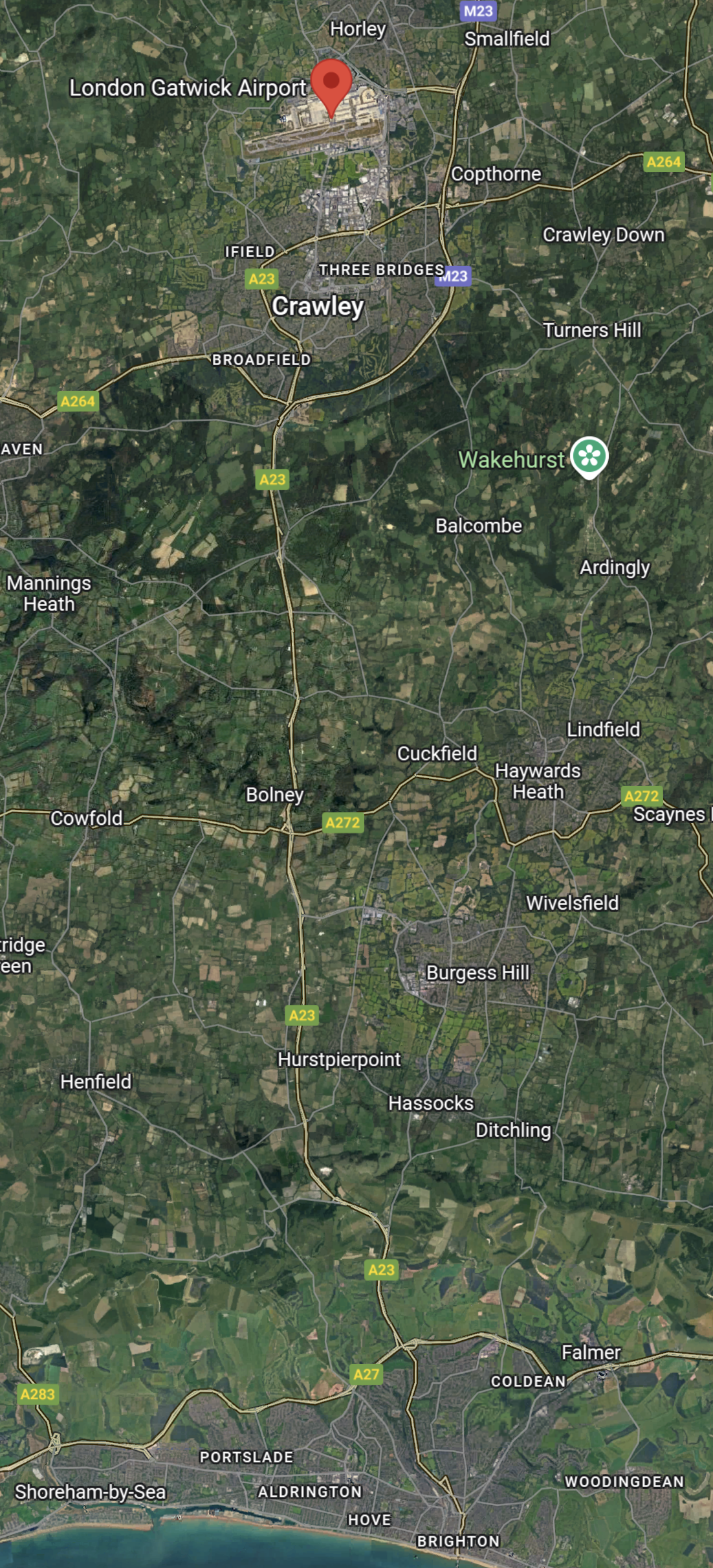
This Google Map shows Sussex between Gatwick Airport and Brighton.
Note.
- Gatwick Airport is indicated by the red arrow at the top of the map.
- Gatwick’s runways can be picked out under the red arrow.
- The South Coast is at the bottom of the map.
- The M23 and the Brighton Main Line connect Gatwick Airport and Brighton.
- Shoreham and Brighton are on the South Coast.
- Click the map to show on a larger scale.
Under current plans, the Ramplion offshore wind farm off the South Coast is going to be increased in size to 1.6 GW.
The simplest plan to provide large amounts of green hydrogen to Gatwick would be to build a large electrolyser in the Port of Shoreham and pipe it along the railway to Gatwick Airport. Hydrogen could also be shipped at night into the Airport using rail tankers.
There’s no doubt in my mind, that it will be much easier to supply large quantities of hydrogen to Gatwick, rather than Heathrow.
In 2023, I wrote Discover How Greater Brighton Is Championing The Transition To Hydrogen, which probably indicates that the locals and their politicians, would welcome the investment in hydrogen in their city.
It should also be noted that world class consultants Ricardo, who are very much involved in the development and promotion of hydrogen technology are based in Shoreham.
Liquid hydrogen could also be imported and distributed from the Port of Shoreham.
Brighton could end up as the South of England’s Hydrogen City.
Never Mind Heathrow: Gatwick Airport Is Close To Getting A New Runway
The title of this post, is the same as that of this article on The Times.
A friend passed through at Gatwick Airport yesterday, so I went to wish him well. For a change , I took a Metrobus from Sutton station to the South terminal – This route is free and doesn’t need a ticket with a Freedom Pass!
The bus was no ordinary bus, but a brand new Wrightbus hydrogen double decker from Ballymena.
It took a round-about route, as its main function is to bring local workers and passengers into the airport and handle traffic to Redhilll, Reigate and East Surrey Hospital.
But if this is the shape of buses to come, then I’m for it. Quality was more coach than bus and performance was sparkling with little or no noise and vibration.
Gatwick and Metrobus are building a network of local hydrogen buses to bring workers and passengers into the airport and I suspect, if the Airport has the fuel, they’ll use it for other purposes, like air-side vehicles, aircraft tow-trucks and car park buses.
Gatwick unlike Heathrow has a close-by source of electricity to produce hydrogen in the soon-to-be-extended 1.6 GW Ramplion offshore wind farm, just off Brighton.
Airbus are talking about bringing hydrogen aircraft into service by 2035 and I believe that by this date we’ll be regularly seeing hydrogen-turboprops on short routes.
As someone, whose software planned the Channel Tunnel, I think it reasonable by 2035, the following projects will be completed.
- Zeroavia are talking of converting aircraft to hydrogen in the next few years.
- A number of short-haul hydrogen aircraft are in service.
- Gatwick’s new runway and terminals are built.
- Ramplion is pumping hydrogen to the airport.
- The station has been updated.
- The Thameslink frequency of trains will have been increased.
Gatwick could be the first major airport to use large amounts of hydrogen, to cut emissions.
 The Anonymous Widower