Would You Buy A Battery Energy Storage System From Rolls-Royce?
I don’t often click on adverts that appear in web pages.
But I had to click on one from Rolls-Royce mtu, which advertised Battery Energy Storage Systems.
I wonder what the Honourable Charles Rolls would have thought of adverts on the Internet for the company he jointly founded?
I suspect he would have liked the idea, as Rolls was very much a promoter of motoring and aviation and opened one of the first car dealerships in the UK, according to his Wikipedia entry.
The Wikipedia entry for his business partner; Sir Henry Royce starts with this sentence.
Sir Frederick Henry Royce, 1st Baronet, OBE (27 March 1863 – 22 April 1933) was an English engineer famous for his designs of car and aeroplane engines with a reputation for reliability and longevity.
He is also described as a perfectionist.
This sentence from the Wikipedia entry, describes how he started the design of the legendary “R” engine.
In October 1928, he began design of the “R” engine while walking with some of his leading engineers on the beach at West Wittering, sketching ideas in the sand. Less than a year later, the “R” engine, designed in his studio in the village, set a new world air speed record of 357.7 miles per hour and won the Schneider Trophy of 1929.
Later with help from the maddest person my father ever met (his words, not mine!) ; Lady Houston, the Supermarine S.6B won the trophy in 1931 and then broke the world speed record at over 400 mph. Not bad for a seaplane. Take the floats off an S.6B and you almost have a Spitfire.
The Wikipedia entry also describes how the “R” engine was developed into what many engineers believe was the finest internal combustion engine of all time; the Rolls-Royce Merlin.
Following the success of the “R” engine, it was clear that they had an engine that would be of use to the Royal Air Force. As no Government assistance was forthcoming at first, in the national interest they went ahead with development of what was called the “PV-12” engine (standing for Private Venture, 12-cylinder). The idea was to produce an engine of about the same performance as the “R”, albeit with a much longer life. Rolls-Royce launched the PV-12 in October 1933 and the engine completed its first test in 1934, the year after Royce died. The PV-12 became the Rolls-Royce Merlin engine.
Where would we have been in the Battle of Britain without the Merlin engine?
Since 1969, the engineers at Rolls-Royce have followed Sir Henry’s example of perfection and developed the revolutionary RB-211 into the modern day Trent, which is now about to take a big leap into a low-carbon future with the UltraFan.
If the quality of Rolls-Royce mtu’s Battery Energy Storage System matches the levels of perfection Rolls-Royce achieved with the Merlin and the Trent, then I suspect that Sir Henry would have given his approval.
This picture is shown on the web page for the Battery Energy Storage System.

These two paragraphs introduce, what Rolls-Royce mtu are calling the mtuEnergyPack.
In today’s world of economic growth and increasing populations, the demand for electricity is soaring. Governments and industries globally shift to distributed renewable energy, challenging centralized grids. To adapt to this changing energy landscape, the mtuEnergyPack offers an ideal solution.
It integrates renewable sources like solar and wind power, paving the way for future-ready sustainable power systems. The mtu EnergyPack is a scalable, all-in-one solution for autonomous off-grid facilities. It ensures reliable power through peak shaving, load-shifting, and grid stabilization, making it suitable for various applications.
These are my thoughts.
What Is The Output And The Storage Capacity?
This paragraph on this page gives this answer.
It efficiently stores electricity from distributed sources and delivers on demand. The mtu EnergyPack is available in different sizes: The QS and the QL, ranging from 200 kVA to 2,000 kVA, and from 312 kWh to 2,084 kWh, and the QG for grid scale storage needs, ranging from 4,400 kVA and 4,470 kWh to virtually any size.
It seems that you specify your requirements and Rolls-Royce mtu should be able to satisfy it.
What Devices Can Be Connected?
This paragraph on this page gives this answer.
The mtu EnergyPack serves as a key component in enhancing the reliability and profitability of microgrids and energy systems. It stores electricity generated by distributed power sources, including gensets, wind turbines, or solar panels, and delivers it when needed.
In the 1970s, when I was working at ICI, others in the section were working on a system called MEDIA, where every sensor on a chemical plant was connected to the central computer, through its own analog-to-digital computer. It would now be called plug-and-play by some.
I believe that Rolls-Royce mtu are using similar ideas to connect equipment to the control computer.
These are my thoughts about connecting various equipment.
- Hydrogen-powered generators and electrolysers as Rolls-Royce mtu are using at Duisburg, which I wrote about in Rolls-Royce Makes Duisburg Container Terminal Climate Neutral With MTU Hydrogen Technology.
- Could Rolls-Royce’s beer keg-sized 2.5 MW electrical generator based on a Super Hercules engine, be connected?
- Could a Rolls-Royce Trent be connected?
- Could one of Rolls-Royce’s small modular nuclear reactors be connected?
- In Rolls-Royce To Play Key Role In US Department Of Defense Nuclear Microreactor Program, I talk about developing a 1-5 MW nuclear reactor for US Department of Defense. Could these be connected?
I don’t see why every device can’t work to the same protocol.
What Is The Power Density Like?
This paragraph on this page gives this answer.
The mtu EnergyPack’s compact battery system designs suit projects with limited space and logistical restrictions.
In ‘Spirit of Innovation’ Stakes Claim To Be The World’s Fastest All-Electric Vehicle, I talked about Rolls-Royce’s record-breaking electric plane called Spirit of Innovation.
Has what has been learned about energy storage in the confined spaces of an aeroplane been applied to a Battery Energy Storage System?
What Do Rolls-Royce mtu Consider To Be Important Features?
On this page, they list these features.
- Power Density
- Digitally Connected
- Multilevel Safety
- Black Start Capability
- Scalability
- Ultra-Fast Response
- Flexible Use
- Plug-And-Play Installation
The design seems to have everything covered.
Can Similar Systems Be Designed By Others?
I would expect that similar systems can be designed, as technology like batteries is available to all and the operation is only as good as the software controlling the various components of the system.
But similar systems will be without the famous Rolls-Royce logo.
Could One Of These Systems Decarbonise A Village?
I once lived in a village with about fifty houses and perhaps a hundred inhabitants.
- There was an old World War Two airfield, that could probably accommodate a small wind farm of perhaps 20 MW.
- There were a couple of barns and large sheds, that could have solar panels similar to those I described in Bedford Depot’s Massive Solar Roof Helps Thameslink On Way To Net Zero.
I suspect an mtuEnergyPack could control all these inputs and provide the village with the following.
- Enough electricity to power all the needs of the inhabitants, businesses and their vehicles.
- If an electrolyser were to be provided, it could probably produce enough hydrogen to power every boiler and hydrogen-powered vehicle.
Note.
- Farmers would like the local availability of hydrogen, as it will be ideal for tractors and agricultural machinery.
- I actually believe that if a village had a reliable and affordable hydrogen supply, that a large proportion of the inhabitants would switch to hydrogen-powered vehicles.
There would still be the National Grid there for backup.
Conclusion
If I needed an mtuEnergyPack, I’d certainly give one a close look.
The Power Behind Rolls-Royce
My post entitled ‘Spirit of Innovation’ Stakes Claim To Be The World’s Fastest All-Electric Vehicle, was based on this press release from Rolls-Royce, which has the same title.
In the post I talk about Rolls-Royce’s experimental electric aircraft; Sprit of Innovation.
- The aircraft set a world record for electric-aircraft of 345.4 mph.
- the aircraft clocked up a maximum speed of 387.4 mph.
- The aircraft was propelled on its record breaking runs by a 400kW electric powertrain.
- Rolls-Royce worked in partnership with aviation energy storage specialist; Electroflight and automotive powertrain supplier; YASA.
For comparison, my Cessna 340A had two 230 kW engines and a maximum speed of 281 mph.
Electroflight, Evolito And YASA
YASA has this description of the company on their home page.
YASA is at the forefront of eMotor innovation and development. Our axial flux technology motors are up to 4x more powerful than those used in nearly all Electric Vehicles on the road today, whilst being around 50% smaller & lighter.
We already feature in some of the best eMotor applications across multiple sectors, and now as part of Mercedes-Benz, with sites in Oxfordshire and Welshpool, we are accelerating development of axial flux eMotors and Control Systems for of the next generation of Electric Vehicles.
Evolito has this description of the company on their About page.
Evolito was spun out in 2021 by YASA, the world-leading pioneer of automotive axial-flux electric motors acquired by Mercedes-Benz in July 2021, to exclusively commercialise YASA’s next-generation electric motor technology and IP for the rapidly-growing aerospace market. Evolito is funded by a portfolio of private investors including B-FLEXION and Oxford Science Enterprises (OSE).
Electroflight has this company story on their About page.
Founded in 2011 to address battery-electric issues in the aerospace market, we are a UK-based innovation engineering company, taking expertise from across the automotive and aerospace sectors, working with leading airframers to develop and supply next-generation battery technology.
In 2019, Electroflight, Rolls-Royce and YASA partnered to design and build the worlds fastest all-electric vehicle – The Spirit of Innovation. 3 years of dedication from the team involved integrating the full powertrain into a NXT aircraft, optimising the system to peak performance and following rigorous testing processes in an emerging market with new regulations; in 2021 the record breaking flight reached a staggering 345.5 mph!
Following the successful spinout of Evolito (YASA’s Aerospace Division) in 2021, Evolito acquired Electroflight in July 2022 to offer a fully optimised powertrain solution for the electric aerospace industry.
It appears that Mercedes-Benz now own YASA’s technology for the the automotive industry and Evolito have the aerospace technology.
Evolito’s Technology
The Evolito web site has a Technology page, which is entitled The World’s Most Advanced Electric Propulsion Solution.
- Their Axial Flux Motors are certainly a revolutionary approach.
- It looks like one of their motors has a peak power of 280 kW, a continuous power of 100 kW and weighs just 35 Kg.
There is also this page, which gives more details about the creation of the Spirit of Innovation, which has this video.
Evolito And Project Fresson
This press release from Cranfield Aerospace Solutions is entitled Cranfield Aerospace Welcomes Ground-Breaking UK Technology Innovator Onboard Project Fresson.
These paragraphs explain the link-up.
Cranfield Aerospace Solutions (CAeS) welcomes Evolito, a ground-breaking UK technology innovator onboard as the motor & inverter supplier for its hydrogen-powered aircraft demonstrator – Project Fresson.
Evolito join Reaction Engines and Ricardo as technology collaborators on Project Fresson, showcasing the UK innovation that is redefining the aviation industry.
Based in Oxfordshire, Evolito is the aerospace spin out of YASA – the world-leading pioneer of automotive axial-flux electric motors.
Producing the world’s most advanced electric propulsion system, Evolito’s motors are smaller, lighter, and typically 4 times more power dense than radial flux solutions, making them ideally suited to the emerging zero-emissions aviation markets.
Evolito’s axial-flux technology requires up to 75% less iron, less copper and fewer permanent magnets than competing radial solutions, making it lighter and more environmentally friendly.
Note.
- Project Fresson is a project to develop an electric propulsion system for Britten-Norman Islanders.
- There are 700 Islander aircraft in service.
A hydrogen propulsion system, would be useful for new aircraft and conversions.
‘Spirit of Innovation’ Stakes Claim To Be The World’s Fastest All-Electric Vehicle
The title of this post is the same as that of this press release on the Rolls-Royce web site.
This is the first paragraph.
We believe our all-electric ‘Spirit of Innovation’ aircraft is the world’s fastest all-electric aircraft, setting three new world records. We have submitted data to the Fédération Aéronautique Internationale (FAI) – the World Air Sports Federation who control and certify world aeronautical and astronautical records – that at 15:45 (GMT) on 16 November 2021, the aircraft reached a top speed of 555.9 km/h (345.4 mph) over 3 kilometres, smashing the existing record by 213.04 km/h (132mph). In further runs at the UK Ministry of Defence’s Boscombe Down experimental aircraft testing site, the aircraft achieved 532.1km/h (330 mph) over 15 kilometres – 292.8km/h (182mph) faster than the previous record – and broke the fastest time to climb to 3000 metres by 60 seconds with a time of 202 seconds, according to our data. We hope that the FAI will certify and officially confirm the achievements of the team in the near future.
Rolls-Royce also claim that the maximum speed achieved of 387.4 mph make it the world’s fastest all-electric vehicle.
To put that speed into perspective, it is faster than a Mark V Spitfire, which was powered by a legendary Rolls-Royce Merlin engine. These aircraft were powered by a Merlin 45 engine that generated 1074kW.
By comparison the Spirit of Innovation has a maximum power of just 400 kW.
Why Do It?
This paragraph from the press release gives an explanation.
As well as a stunning technical achievement, the project and world record runs provided important data for our future electric power and propulsion systems for all-electric urban air mobility and hybrid-electric commuter aircraft. The characteristics that ‘air-taxis’ require from batteries, for instance, are very similar to what was developed for the ‘Spirit of Innovation’.
I’ll go with that, as Rolls-Royce seem to be associated with several electric aviation projects.
But I can’t help feeling that there are parallels with the 1930s, when Supermarine and Rolls-Royce teamed up to produce the Supermarine S 6B, that won the Schneider Trophy outright in 1931. It is generally accepted that the knowledge gained at the time helped to design the Spitfire and the Merlin engine.
Rolls-Royce’s All-Electric ‘Spirit of Innovation’ Takes To The Skies For The First Time
The title of this post, is the same as that of this press release from Rolls-Royce.
This is the first paragraph.
We are pleased to announce the completion of the first flight of our all-electric ‘Spirit of Innovation’ aircraft. At 14:56 (BST) the plane took to the skies propelled by its powerful 400kW (500+hp) electric powertrain with the most power-dense battery pack ever assembled for an aircraft. This is another step towards the plane’s world-record attempt and another milestone on the aviation industry’s journey towards decarbonisation.
Rolls-Royce also published an album of photographs, of which this is one.
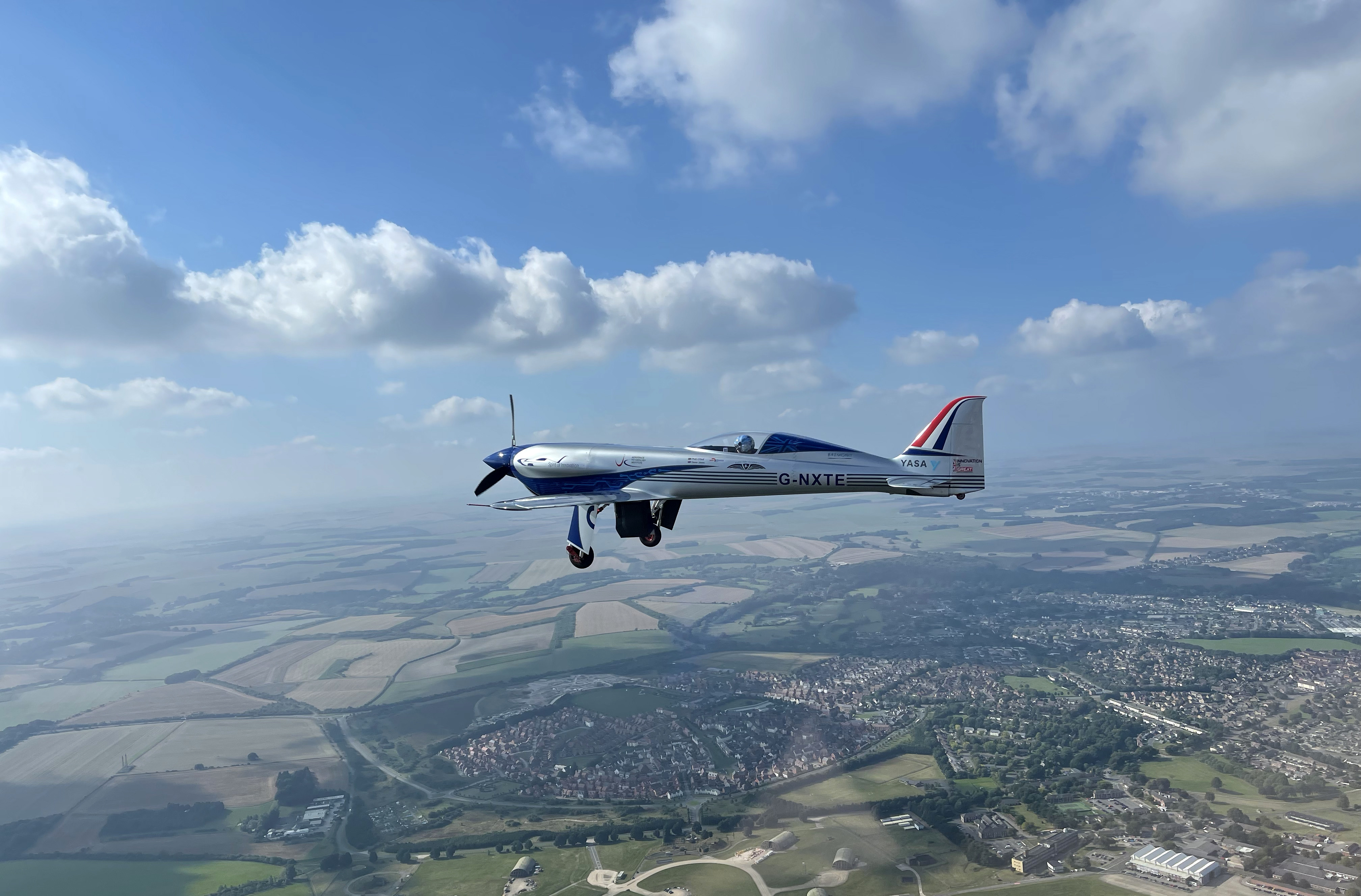
Note that the motor was designed and made by Yasa.
 The Anonymous Widower