Battery EMUs For Merseyrail
The title of this post is the same as an article in the August 2017 Edition of Modern Railways.
This is the first paragraph.
Two of the new EMUs Stadler will build for the Merseyrail network will be fitted with batteries.
This is also said.
The initial benefits of the trial will be the energy recycling properties of the batteries, but with a larger battery the option could be to run the units away from the electrified Merseyrail network using battery power.
Other reports suggest that battery power could move the trains in depots.
Another report in the same edition of Modern Railways is entitled Class 769s For Wales.
It discusses the use of Class 769 trains on the Borderlands Line.
This is said.
Would safety regulations permit Class 769s, or other third-rail EMUs retrofitted with diesel engines, to operate the Wrexhm-Bidston Line and continue in the Mersey tunnels to Liverpool? No definite answer was available as Modern Railways went to press. Each bi-mode unit would displace pnly one two-car Class 150/2 unit from the line, but studies have predicted large growth in passenger numbers if the change of trains at Bidston were eliminated.
It is an interesting concept.
- Porterbrook have already talked about converting Class 455 trains into bi-modes.
- These third-rail units don’t have pantographs to snag in the tunnels.
- They have been refurbished to a high standard in recent years.
- The fuel safety problem in the tunnel, is something for which Formula One engineers may have a ready-made solution.
I’m sure if it does happen, Scouse humour will go into overdrive, about London cast-offs and old trains. But Class 455 bi-mode trains would have the last laugh.
Conclusion
It is encouraging to see in these two articles signs of radical but in my view totally sound thinking.
New Merseyrail Fleet A Platform For Future Innovations
The title of this post, is the title of this article on the Rail Technology Magazine web site.
The article mainly consists an interview with David Powell, who is programme director of rolling stock at Merseytravel.
It is very much an article worth reading, as it describes the process of choosing trains and how Merseyrail and Stadler will develop the trains during their relationship.
This is a direct quote from the article.
We will be exploring, with Stadler, what the options are for having the trains becoming self-powered. This isn’t the bi-modes that lots of other people are talking about in the industry; this is on-board electrical storage.
I am a great believer in on-board energy storage and I believe its deployment in the UK, is closer than most people think.
N
Stadler To Build Another Special
Stadlet seem to be getting a reputation for building trains for niche markets.
This article on Global Rail News is entitled Stadler to build narrow-gauge EMUs for Stockholm’s Roslagsbanan.
Wikipedia has an entry for the Roslagsbanan.
After trains for the Glasgow Subway and Merseyrail, the Class 88 locomotives and Class 399 tram-trains, they must be one of the companies in prime position for the new Docklands Light Railway trains.
Stadler On A Swiss Roll
Over the past couple of years, I have written about several orders for new trains or deliveries, where the manufacturer is Stadler Rail or a company controlled by the Swiss group.
- More Class 68 Locomotives On The Way
- The Class 88s are Coming
- Enthusiasm For Class 68 And Class 88
- Glasgow Subway Orders New Trains From Stadler
- Vossloh’s Product Sheet For The Class 399 Tram-Train
- Thoughts On Merseyrail’s New Trains
- Making Sense Of The New East Anglia Franchise
- The Glasgow Airport Rail Link Will Be A Tram-Train
If there is one theme that goes through these articles, it is that a lot of the products involved are innovative., whether they were designed by Stadler or other companies the group now owns.
Locomotives
The Class 68 locomotive has proven itself, as a capable locomotive for hauling express passenger trains with Chiltern Railways and will be doing a similar task for TransPennine. A total of 32 have been delivered or are on order.
The Class 88 locomotive is an electro-diesel version of the Class 68 and is just starting to be delivered. Will it find its home on the front of passenger or freight trains? A total of ten is planned for this go-anywhere locomotive.
Sheffield’s Tram-Train
The Class 399 tram/train has rather stalled in the sidings at Sheffield, probably more to do with Network Rail’s inability to get a job done on time, than anything to do with the tram/train, which runs successfully in Germany and Spain.
Greater Anglia’s Flirts
Electric and bi-mode versions of the Stadler Flirt will make an appearance in East Anglia in the next few years. Very little is known about the trains, except for visualisations for the press like this.

Stadler Flirt
This press release on the Stadler web site says little of substance. This is a typical paragraph.
The trains are designed to provide a significantly enhanced passenger experience that will transform rail travel for the people of Norfolk and Suffolk. The FLIRT trains to be used on the East Anglia franchise will be equipped with air-conditioning; ‘2×2’ seating; Wi-Fi and power points throughout the train; a low floor design, allowing easier access to platform from the train; passenger information systems with real-time information; and have regenerative braking.
But then it’s not for serious consumption and could be said by any manufacturer about their trains.
This is a section from the Specification section in the Wikipedia entry.
The FLIRT is a new generation of multiple units, even though it has a striking resemblance with GTW vehicles. The trains can have two to six sections and electric variants are available for all commonly used power supply systems (AC and DC) as well as standard and broad gauge. It has jacobs bogies between the individual sections, with wide walk-through gangways. The floor height at the entrances can be chosen by the operator, providing level boarding at most stations. Automatic couplers of either Schwab type (on all Swiss units) or Scharfenberg type at both ends of the train allow up to four trains to be connected.
Look closely at the press picture and you can see, that there are two cars either side of a smaller power section. In A Train With The Engine In The Middle, I described a Stadler GTW, that I saw in Kassel.
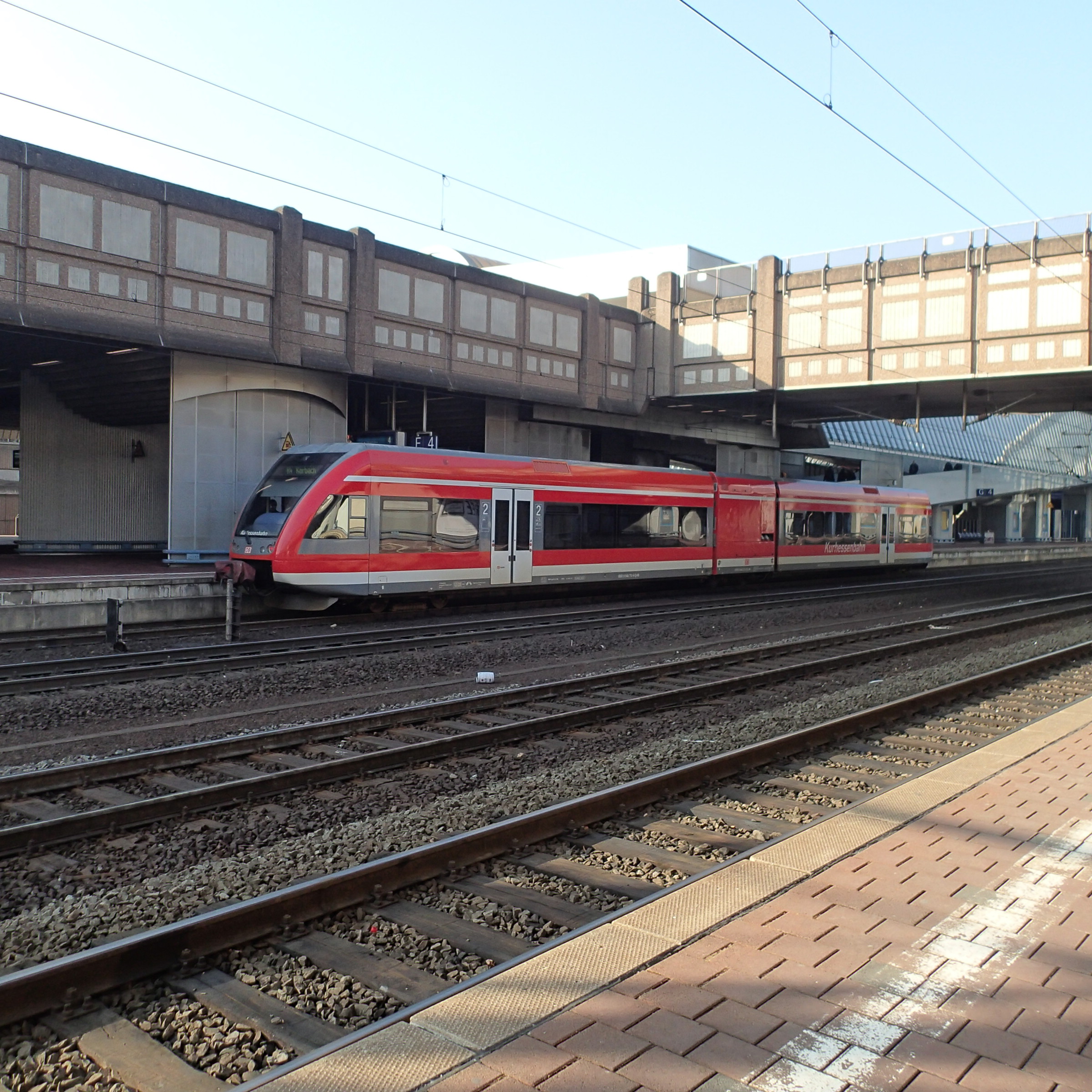
So it looks like East Anglia’s bi-mode Flirts could have a power car in the middle. Stadler says this about the power car in the product specification for the GTW.
The GTW is a low-floor single-decker regional train. The drive unit is arranged between the carriages, but the train can still be accessed throughout.
Is the train in my picture considered to be a two-car or three-car train?
I obviously haven’t ridden one of Stadler’s trains with a power unit in the middle, but is the full-accessible toilet in the power car? It would seem logical that it could be!
Glasgow And Merseyrail
This visualisation shows Glasgow’s proposed tram-train link to the Airport.

Glasgow Airport Tram-Train
And this visualisation shows Merseyrail’s new train.
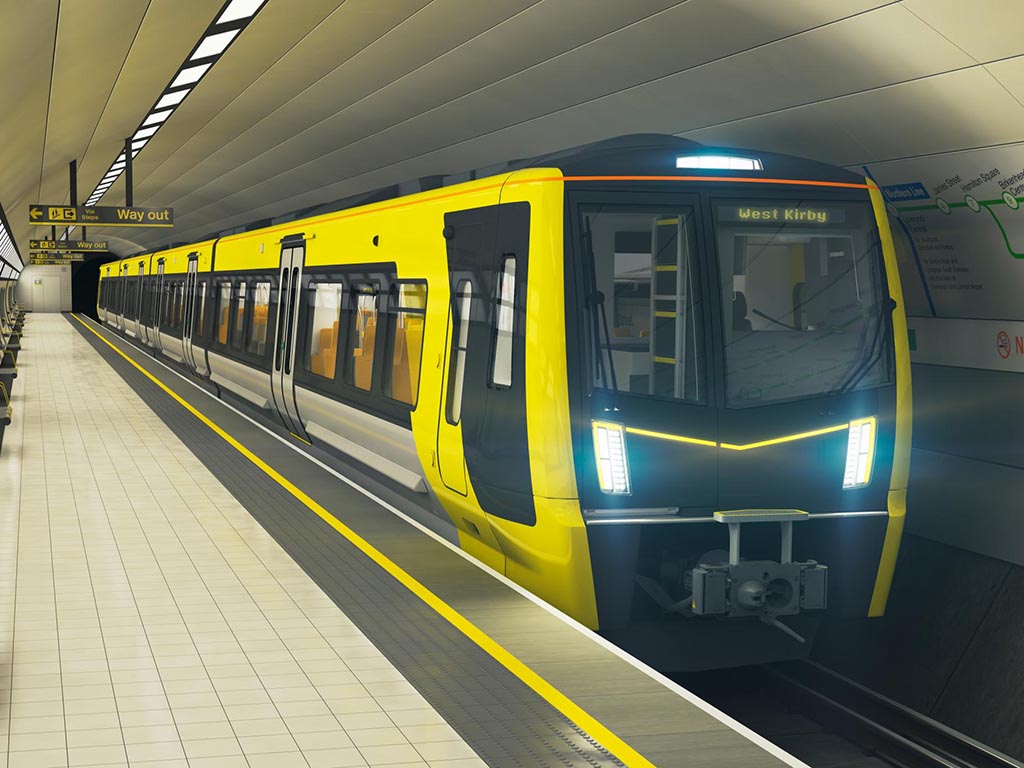
Merseyrail’s New Train
Could they be related?
- The Merseyrail train is definitely to be built by Stadler
- Stadler are building the new vehicles for the Glasgow Subway.
- The rail routes to Liverpool and Glasgow Airports are very similar in nature.
- Both vehicles are reported to possibly use onboard energy storage.
- Stadler have all the tram-train technology.
- Supporting a small number of vehicles in Glasgow could be expensive, but having similar vehicles in Liverpool must make it easier.
I said that the two routes to the airports are similar in nature.
- In Glasgow, the train starts at Glasgow Central station and goes to Paisley St. James station using the Inverclyde Line’s 25 KVAC overhead electrification and then could use onboard stored energy to run as a tram on a dedicated track without electrification to Glasgow Airport.
- In Liverpool, the train starts to the North of the City, calls at Moorfields and Liverpool Central stations in the City Centre and then goes to Liverpool South Parkway station using the third-rail electrification and then could use onboard stored energy to run as a tram on a dedicated track without electrification to Liverpool Airport.
I don’t know, but it would surely mean that the vehicles needed for the Glasgow Airport tram-train, would be substantially cheaper, if they were one of Merseyrail’s vehicles with a modified exterior and interior.
Conclusion
Stadler seem to be picking up all of the small and tricky rail vehicle projects, by applying large dollops of innovation and a fair helping of common sense.
I wouldn’t give odds, that Stadler will land the contract to build new trains for the Docklands Light Railway!
Thoughts On Merseyrail’s New Trains
Merseyrail have ordered 52 new Stadler trains to replace, the 59 geriatric Class 507 and Class 508 trains on the Northern and Wirral Lines.
In some ways I was surprised, as with the possible takeover of tye Borderlands Line to Wrexham in Wales, I thought that Bombardier, may have had a good chance with Aventras with an onboard energy storage or IPEMU-capability.
Reports On The Internet
These are some useful articles that give more details.
- Article in the Liverpool Echo, entitled Merseytravel reveals new £460m train fleet plans – with no train guards
- Article in Railway Gazette, entitled Stadler selected to supply bespoke Merseyrail train fleet
- Article in Rail News entitled Stadler wins contract to build new Merseyrail trains
- Article in Focus Transport entitled New Stadler Trains Announced for Merseyrail
These are my thoughts on the new trains.
The Loop
The Wirral Line trains run in a single-track circular loop tunnel under Liverpool (The Loop), which is a fairly unusual railway formation. But it works well and means that the three stations on The Loop can be single-platform.
The track in the Loop is being relaid in the first half of 2017 and this article on the Merseyrail web site describes the work.
This is a video of the rebuilding.
Note.
- The tunnel has a diameter of 4.7 metres.
- By comparison, the Crossrail tunnels have a diameter of 6.2 metres.
- If you are relaying the track, you will make sure, that the track and platforms fit your current trains, which could run for another five years or more.
- The tunnels and platforms will probably be sized, so that there is only a small gap between the train and platform.
- The slab track chosen looks to be of the highest quality and similar to that which Transport for London are using on the Sub Surface lines, as described in this article in Rail Engineer.
So Liverpool is getting a world-class railway track on The Loop, which will fit its current rolling stock, like a glove.
It will also be very safe, as the gap between the trains and the platform could be very narrow.
They don’t say in the video, but will the tracks be arranged so that the trains align for step-across at the stations on The Loop?
The Tunnel Size Issue
If you have just rebuilt the track in the Loop, then this will have implications for the new trains needed for the lines.
The small size of the tunnel and the precision fit, mean that any new trains must be a similar height and width, as the current Class 507/508 trains.
The height of the Class 508 train is 3.58 metres and for comparison the height of a Class 378 train is 3.78 metres.
I don’t have a figure for a Bombardier Aventra, but I suspect that they are just too fat.
So it looks like that a small number of non-standard size trains need to be built to fit the slightly smaller size tunnels under Liverpool.
The Railway Gazette article says this about the trains ordered from Stadler.
There will be a mix of airline and facing seats, with more space for bicycles, pushchairs and persons with reduced mobility. The train body will be designed specifically for the Merseyrail network, with lower floors and a sliding step to provide near-level access.
It is interesting to note, that Stadler also won the order for the smaller trains on the Glasgow Subway, which I wrote about in Glasgow Subway Orders New Trains From Stadler.
As it looks like they will be specially built to fit the tunnels and the platforms, this has various implications.
- Passengers in wheelchairs, pushing buggies or dragging large suitcases should be able to just wheel themselves into the train, which is described as lower floor.
- All platforms, that the trains call at, must have the same critical dimensions.
- Safety could be increased as the gap between train and platform could be very narrow.
- Incidentally, the trains are reported to be fitted with automatic gap fillers, to make sure nothing drops through the gap.
- Will the tracks in the Northern Line tunnel through Liverpool be renewed?
The trains had better be well-built as they’re going to have to last a long time. But if say extra trains were to be needed to increase frequency, capacity or routes, Merseyrail would probably just send an e-mail to Switzerland.
Platforms And Stations
Most new trains need modifications to platforms, to match the trains.
As it appears that the new trains are designed to fit the current platforms, I suspect that very little will need to be done before they arrive.
On my travels, I did notice on-going work at some stations, but this would fit either fleet of trains.
From the specification of the trains, it would appear that all of the driver-only-operation equipment is on the trains, rather than the platform, so station improvement money can be spent on passenger facilities like lifts and weather protection.
Any new stations that may be required could possibly be built to an affordable but very passenger-focused design.
Cost
Special trains don’t come cheap and these 52 trains roll in at a total of £450million or about nine millions a train.
Compare this with the price of £260million, that Transport for London paid for 45 similar-capacity Class 710 trains for the London Overground, which works out at just under six million a train.
The trains are apparently not leased, but paid for directly. The Rail News article, says this.
The 52 four-car trains will be publicly owned rather than leased from a ROSCo, and the finance needed will be raised in various ways, including by using a rail reserve that has already been established for this purpose, plus loans at ‘favourable interest rates’. Merseytravel said ‘such opportunities are currently being explored, such as a loan from the European Investment Bank’.
London financed the first London Overground trains in a similar way.
Capacity
The Railway Gazette article, says this on capacity.
The 65 m long four-car EMUs will have the same number of seats as the existing three-car sets, but will be 4 m longer with wide through gangways to provide an increase in standing space. This will increase total capacity per EMU from 303 to 486 passengers.
Some of my observations.
- It looks like each train is 64 metres long, with a car length of 16 metres, as opposed to 60 and 20 for the current trains.
- I suspect that there is some interesting behavioural software out there, that is used to design people systems. So the interiors will work!
- The current trains pack in five passengers in every metre of length, whereas the new trains pack in 7.6
- Will it be a lot more packed in there? I don’t know, but the space between carriages is now available for passengers.
- The same trains will be able to run on both the Northern and Wirral Lines.
- Will the extra capacity in a single train, mean that most services will be run by a single four-car unit?
In the Peak, I suspect two trains could be coupled together, as they are now. However, they will couple together and uncouple much quicker and probably automatically.
On the other hand the trains themselves could increase capacity.
I’ll look at the Northern Line first.
In London, Thameslink, Crossrail and the East London Line, run similar services to those on Liverpool’s Northern Line, where services fan out from a central core.
I believe that if the Northern Line ran twelve trains per hour (tph) between Sandhills and Hunts Cross stations, that this would increase the capacity on that route. Twelve tph running all day, would need just 24 trains.
If in the Peak more trains were needed, extra services would be added to an appropriate route.
The Wirral Line is unique, in that trains from four destinations slot together to go under the Mersey, go round The Loop, before going back to Birkenhead and fanning out to where they started.
Currently, twelve tph run in The Loop and I suspect to provide this service all day needs just 24 trains.
Merseyrail have ordered 52 trains, which means there are just four trains to cover maintenance issues and increase services in the Peak.
London Overground Syndrome
All new and upgraded lines seem to suffer from London Overground Syndrome, where passengers see what they like and the original passenger forecasts prove to have been pessimistic.
On the East London Line, three-car trains were forecast to be the right size, but they had been designed to be lengthened and now after two upgrades, the trains are now five-cars long.
As this syndrome has been seen on the Borders Railway, the Nottingham Express Transit and other places, I would not be surprised to see it on Merseyrail’s Northern and Wirral Lines.
But the design of the trains, future-proofs the lines, should there need to be more capacity.
Provided, the signalling can accept the increased frequencies, more identical trains would be added to the fleet.
Or trains could be lengthened, by adding another car, so that the busiest routes perhaps ran five-car trains.
As it would only be a problem of success, I suspect, that the financing wouldn’t be a problem.
Extras In The Contract
The Railway Gazette article, says this on extra items included in the contract.
This headline figure also covers upgrades to the power supply, platforms and track, as well as refurbishment of the depots at Kirkdale and Birkenhead North and future maintenance of the new trains.
I’ve heard that Merseyrail’s power supply is a bit dodgy and probably needs updating. I’ve always wondered, if the trains would handle regenerative braking by the use of onboard energy storage.
Nothing is said except this in the Railway Gazette article.
At 99 tonnes, the EMUs will be lighter than the current 105 tonne trains, and energy consumption is expected to be 20% lower, including regenerative braking; options for energy storage are to be studied.
It will be interesting to see the specification of the new train.
Performance
The Railway Gazette article, says this on performance.
A new timetable will be introduced in 2021 once the existing Class 507 and 508 units dating from the 1970s have been withdrawn; the new trains’ better acceleration and braking is expected to enable Hunt’s Cross – Southport journey times to be reduced by 9 min.
The interesting thing, is that being nine minutes quicker between Southport and Hunts Cross, will bring the journey under the hour and mean that the service can be achieved using less trains.
It would also mean that all trains could go through the core to Hunts Cross, without having to turn trains at Liverpool Central.
Energy Storage
The trains will be fitted with regenerative braking, where the traction motors, act as generators to slow the train, turning the train’s energy into electricity.
There are three common ways of handling the electricity generated.
- Feed it back into the power network for other trains to use, as is done on the London Underground and on the extensive third-rail network in the South East.
- Store the energy on the train and reuse it, as has been demonstrated by Bombardier and is common in vehicles as diverse as high-performance cars, hybrid buses and trams in Seville.
- Feed the electricity into resistors on the roof of the train and turn it into heat.
I believe that option 3 is totally unacceptable and is akin to burning money.
Option 1 will probably require extensive modification to the power supply of the Merseyrail network, as the supply is not known to be of the best and there is no need to handle regenerative braking with the current Class 507/508 trains.
So will we see some form of energy storage on the trains? Birmingham’s trams will have on board energy storage in a few years, so the technology is on its way.
The Railway Gazette article, says that options for energy storage are to be studied.
As an Electrical and Control Engineer, I strongly believe that the cost cost-effective way to handle the regenerative braking energy is to store the energy on the trains.
On European gauge trains, equipment is often mounted on the roof, where there is plenty of space in the generous loading gauge.
But Merseyrail has the problem of the small tunnels.
Look at this picture of a Class 507/508 train entering a tunnel at James Street station.
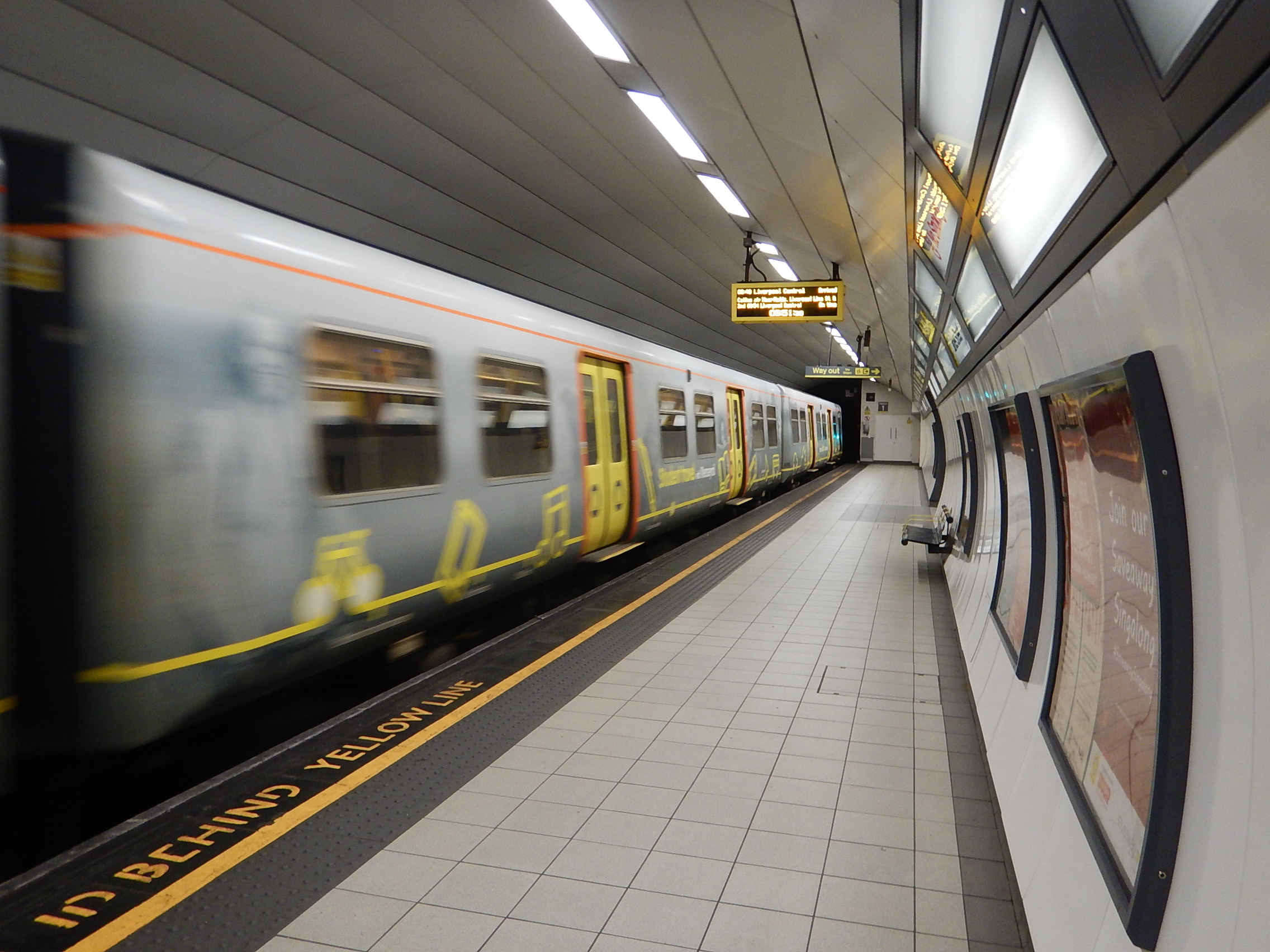
Note how there is some space above the train in the tunnel entrance.
Imagine a train specifically-designed for these tracks, platforms and tunnels, with the bottom of the doors level with the platforms. Would this release more space for putting energy storage on the roof, as has been done with Seville’s trams?
If I am right with this speculation, onboard energy storage also enables the following.
- Regenerative braking on the whole of the Merseyrail third-rail network.
- Next station recovery of the trains, in case of power failure.
- The ability to extend routes using stored energy.
In addition, trains with onboard energy storage have other maintenance and operational advantages.
More Destinations
The Railway Gazette article, says this on more destinations.
The 750 V DC third-rail EMUs will be capable of conversion to dual-voltage operation for use on 25 kV 50 Hz lines with a view to serving Skelmersdale, Warrington and Wrexham in the longer term.
If onboard energy storage is fitted with sufficient range, this would open up other possibilities and also make destinations like Preston much more affordable to implement.
Train-Tram Operation
Note that I said train-tram and not tram-train.
In Riding The Vogtlandbahn, I talked about riding a unique German railway in Zwickau, where the trains go walkabout from the main line station and travel through the city just like trams to a stop in the centre. This picture shows a train-tram at that stop.
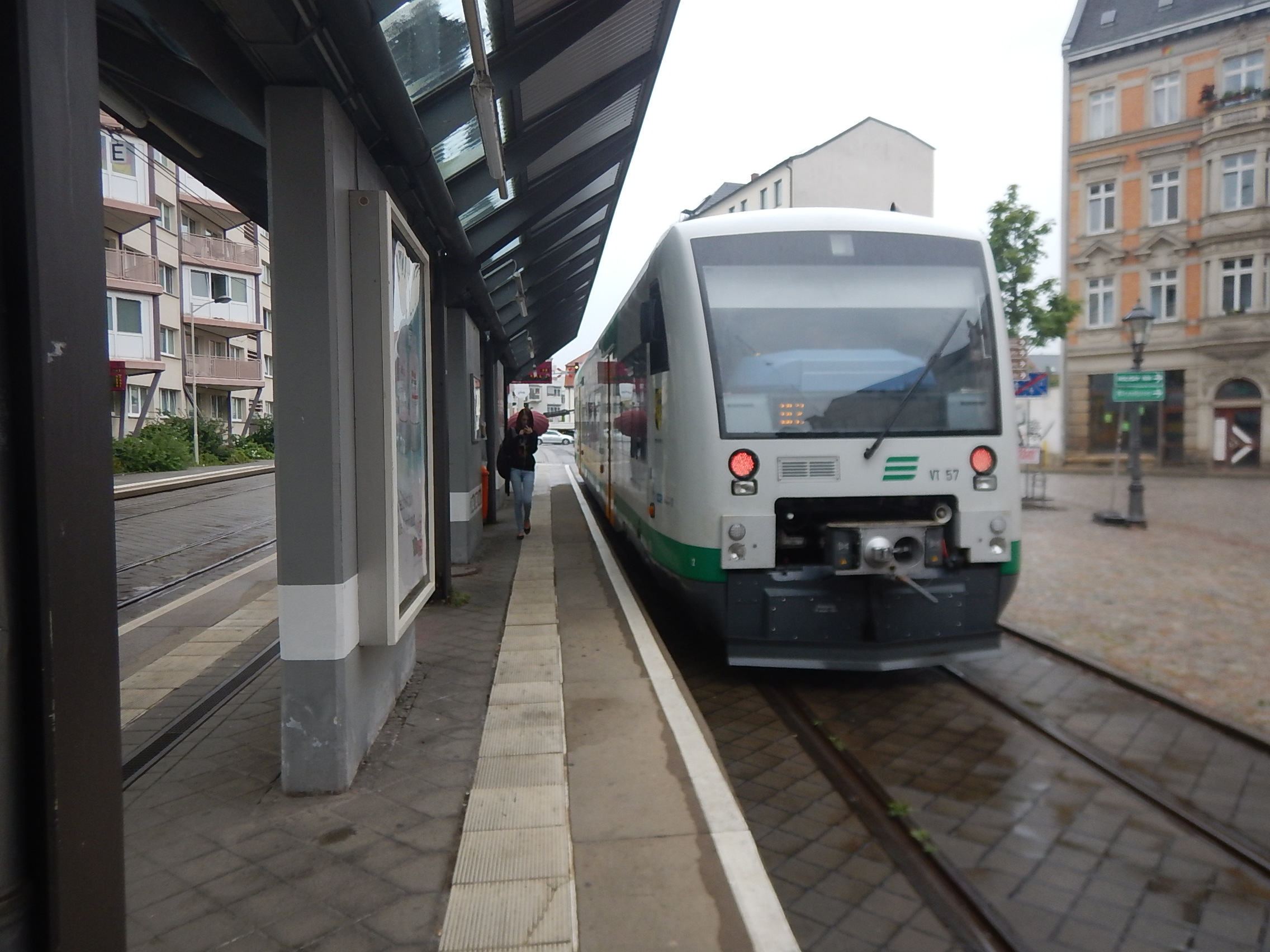
At Zwickau Zentrum Train/Tram Stop
You don’t need to guess, who made the train! It was of course Stadler and is not electric, but a diesel-multiple unit.
It is worth comparing weight and capacity of Liverpool’s new trains with Manchester’s trams.
The Railway Gazette article, says that the trains will weigh 99 tonnes and have a capacity of 486 passengers. This compares with the M5000 on the Manchester Metrolink, which weighs in at 80 tonnes for a double unit and carries 400 passengers.
So weight and capacity is not out of line with a typical large tram.
Trams need to have a door sill height, that gives level access between the tram and platform.

Level Access On The London Tramlink
Not all trams and trains match the platform, as well as this example on the London Tramlink.
But, Liverpool’s new trains will be built to fit the current track and platforms, which after updating, will all be to the same height and designed to give step-free access..
Without doubt, the new trains could call at correctly-dimensioned tram-style stops, just as the train-trams do in Zwickau.
Tram-style sections of the route could be designed to the following principles.
- Tram-style flush slab track, so passengers can just walk across the track.
- Segregated tracks.
- No electrification
- Trains would run using onboard energy storage.
- Low speed limit.
- Rail-style signalling, whether trackside or in-cab.
- Charging station, like a Railbaar if required.
Lines could be single-tracked with single-platform stops to make everything more affordable.
Train-Tram To Liverpool Airport
Could we see Merseyrail’s new trains leaving the rail lines at Liverpool South Parkway station, switch to onboard energy storage and continue to the Airport on a dedicated track without electrification?
This Google Map shows the station and the Airport.
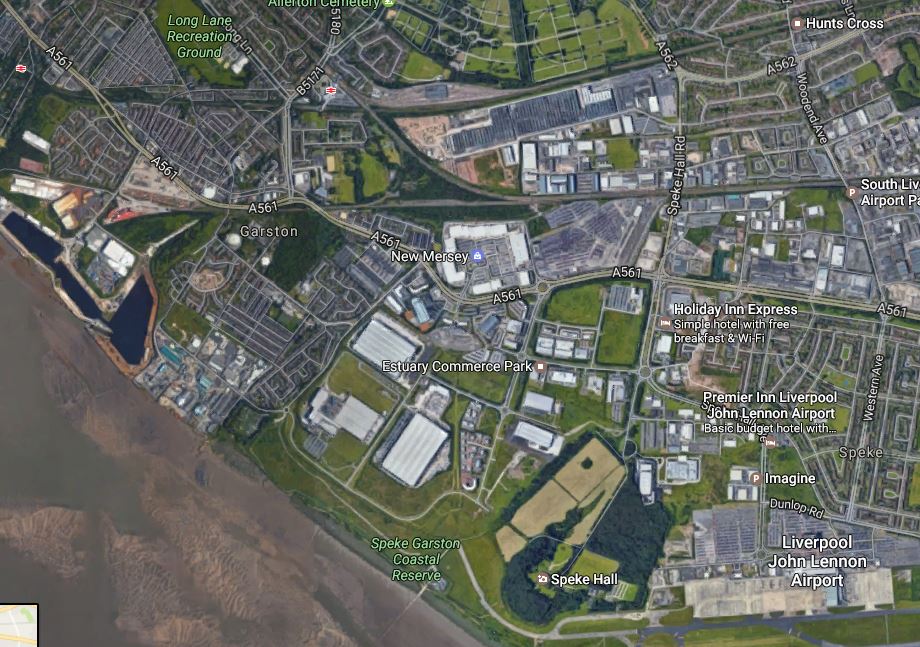
Liverpool Airport And Liverpool South Parkway Station
Note.
- The station is at the top of the map in a triangle of lines.
- There must be various possibilities for a route between the station and the airport.
- The train could call at the New Mersey Shopping Park.
From my knowledge of both areas, the Liverpool Airport route is no more difficult, than what was done in Zwickau.
Journey times to and from Liverpool Airport would be something like.
- Liverpool South Parkway station – 5 minutes
- Liverpool Central station – 18 minutes
- Southport station – 54 minutes
If they followed Northern Line principles, the frequency would be four tph.
I may be wrong, but it looks like Merseyrail have acquired trains, that running as train-trams can fulfil the link to Liverpool Airport.
More Train-Tram Routes
The proposed Liverpool Airport link is a classic route extension using onboard energy storage, which is very similar to the extension of the Midland Metro through Birmingham City Centre.
So could any of the routes to current terminals, be extended using onboard energy storage and running as a tram.
Ellesmere Port, New Brighton, Southport and West Kirby stations all serve coastal towns, but despite this, they don’t seem the sort of places that cry out for a tram along the promenade.
Chester could possibly benefit, but I suspect this could be one very much for the future.
Skelmersdale could be a distinct possibility, as the scars of the rail routes to the old Skelmersdale station, from the two Northern Line termini of Ormskirk and Kirkby, which are still visible on Google maps. This map from Wikipedia shows the old Skelmersdale Branch.
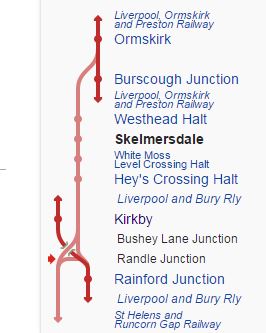
Skelmersdale Branch
A new railway could be built simply, as it was in Zwickau.
- Single-track
- No electrification
- Trains would run using onboard energy storage.
- Tram-style stops.
The train could even go walkabout in Skelmersdale to serve important places.
As Kirkby station needs demolition and rebuilding, unless it gets Listed status, as a monument to the British Rail School Of Crap Design, there must be opportunities to give Kirkby and Skelmersdale a modern transport system to be envied.
If you think all of this speculation is outrageous fantasy, I suggest you visit Zwickau and ride the Vogtlandbahn.
The Ultimate Train-Tram Route
A lot of people, that I’ve met from Liverpool, mourn the passing of the Liverpool Overhead Railway or the Docker’s Umbrella.
Because of this, it has been suggested that a tram should run along the Mersey, past the main attractions of the Waterfront, connecting to the Northern Line at perhaps Sandhills and Brunswick stations.
This is one of those projects thast gets speculated about for years and then it gets implemented because it is integral to another project, like a massive development or a City getting the Olympic Games. Or in Liverpool’s case the Commonwealth Games, which is a distinct possibility in either 2022 or 2026!
As it runs through a World Heritage Site, it will have to be built without overhead wires and run on stored energy.
Canada Dock Branch
The Canada Dock Branch runs in an arc to the North and East of Liverpool city centre.
- It is a freight route linking Liverpool Docks to routes out of the city.
- The capacity of the route is being upgraded to 48 freight trains per day.
- It is not electrified.
- There are no passenger services.
- The line runs close to both Liverpool’s main football grounds.
- Are there any large developments, that would benefit from a train service along the route of the line?
With the development of the massive new dock at Liverpool2 and the pressure for more electrified freight trains, I think it is likely that the Canada Dock Branch will be electrified.
So could passenger services be reinstated on the line?
This Google Map shows the section of the Canada Dock Branch, where it curves round the two football grounds.
The station at the bottom left is Sandhills station, with Merseyrail’s Kirkdale depot to the North.
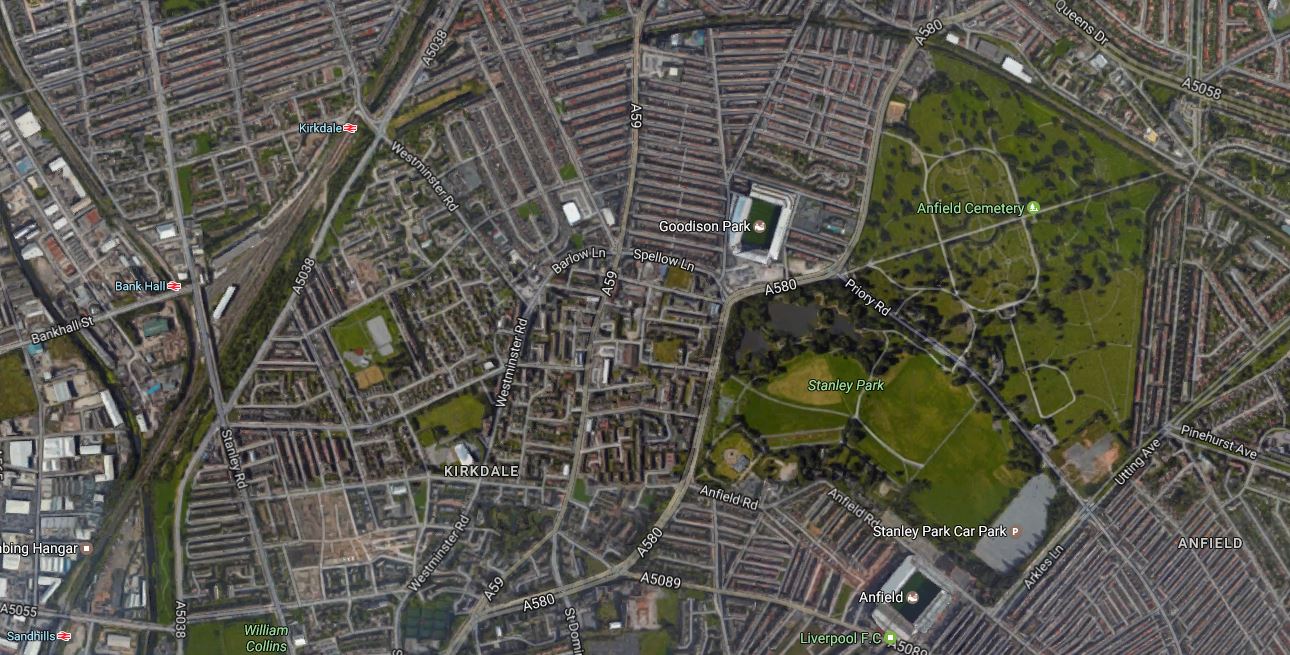
I don’t know whether there is a connection, but the lines cross in the region of the depot and if required one could probably be built.
I think it is likely, that if the Canada Dock Branch is electrified for freight reasons, then Merseyrail will look at running a service along the line.
- It might terminate at Sandhills in the North.
- It might terminate at Broad Green, Edge Hill or even Lime Street in the South.
- Stations could be simple affairs, much like the one in the picture at Zwickau.
Whether they did propose a service would depend on traffic forecasts and possible costs.
The Commonwealth Games Line
Liverpool do spectaculars well and if they get the Commonwealth Games in either 2022 or 2026, I can see that the city could use the new Stadler trains to create a line for the Games, thaqt would be a legacy, that the city needs and wants.
Starting in the South by the Albert Dock and the Echo Arena, the line would go past the Three Graces at the Pierhead and then North to Everton’s new stadium at Bramley-Moore Dock, which is being proposed as the main venue of the Games. From there it could continue to Liverpool’s Anfield Stadium, which will probably play some part in the Games.
The line would also connect or go close to the following.
- Mersey Ferry
- The Wirral Line at James Street station.
- The Northern Line at the new Vauxhall station.
- The museums and galleries at the Albert Dock.
- Liverpool Cruise Terminal
- Liverpool One
- The Liverpool Waters development
I’m sure Liverpudlians will give it a suitable nickname.
Consider.
- Much of the Southern part of the route is within the Liverpool Maritime Mercantile City World Heritage Site.
- I think it would be possible to run the route using onboard storage.
- Charging would be at each end of the route.
- Catenary running could be used between the two football grounds, some of which could be on an electrified Cansada Dock Branch.
- The Southern end could use on-street running with catenary to go up the hill to Hope Street , to serve both cathedrals.
- After the Games, both Liverpool football grounds would have a tram connection to the Pierhead.
Designed properly, it could become one of the world’s most iconic tram lines.
Conclusions
Merseyside will be getting one of the best commuter railways in the world!
I also think, that these innovative trains will make other cities and train operators, think hard about the design of their railways and the trains.
An Article On Driverless Trains That Hardly Mentions Unions
This article on Rail Engineer is entitled Subway Revival – Glasgow to introduce UTO.
In this instance UTO stands for Unattended Train Operation.
In the article, there is only one mention of a trade union. This is said.
Getting the workforce’s commitment to new working practices was an essential first step of the modernisation programme. SPT achieved this in 2012 with an agreement between UNITE and SPT for more flexible working and establishment reduction with no compulsory redundancies.
The dreaded word RMT does not appear.
Having read the whole article, it does look like, when the new trains start running in a few years time, Glasgow will have one of the best Underground lines in the world.
I particularly liked this paragraph on the procurement of the new trains.
Charlie Hoskins explained that SPT did not procure its trains on the basis of a prescriptive technical specification as this might rule out a worthwhile technology. Instead, prospective suppliers were given a concept of operation that covered general requirements such as the number of people to be carried and how SPT wished to operate the trains. A competitive dialogue then followed to develop the technical solution that offered best value. This approach was supported by Glasgow-based consultant Racon and by Systra which, with SPT key staff, formed the client’s technical, commercial and procurement team.
It looks like Glasgow said they wanted to move so many passengers and the consortium came up with a solution.
How practical! And the dreaded word Treasury wasn’t mentioned.
Also just as they are involved in East Anglia, the Swiss company; Stadler is very much involved here. They seem to be s[specialising in niches.
 The Anonymous Widower