High Speed Two To The North West Of England
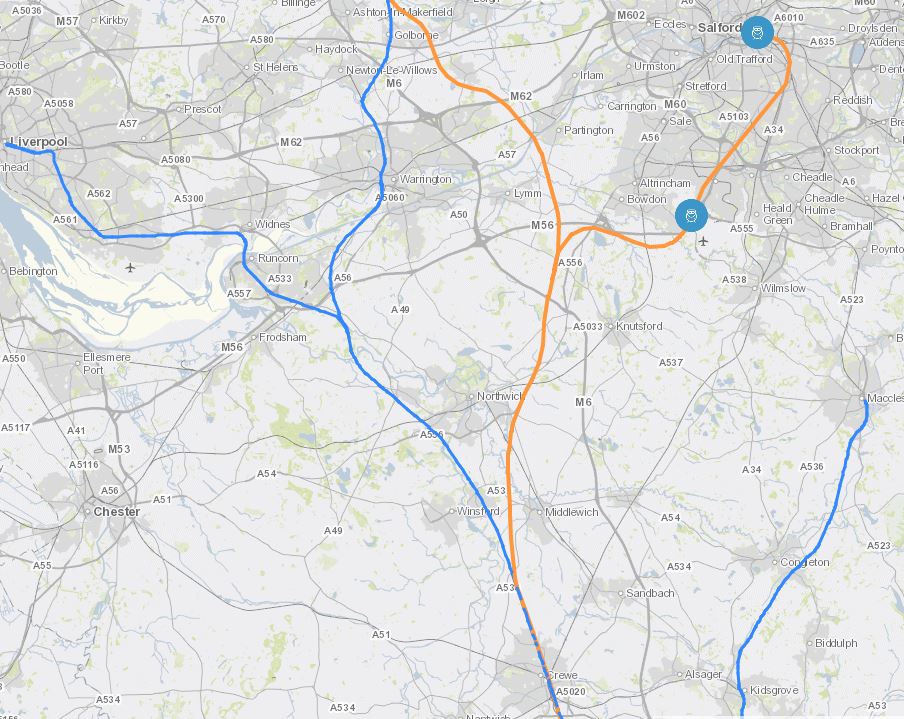
This map clipped from the High Speed Two web site, shows High Speed Two routes in the North West of England.
Note.
- When shown in orange, High Speed Two will use new tracks.
- When shown in blue, High Speed Two will use existing tracks.
- New stations are shown as large blue dots.
- High Speed Two and the West Coast Main Line appear to share a corridor through Crewe, before dividing near Walley’s Green.
- High Speed Two loops to the East of the West Coast Main Line and rejoins it South of Wigan between Bryn Gates and Abram Brow.
The route will or might serve the following stations in North West England.
Blackpool North
Blackpool North station is not planned to be served by High Speed Two.
But the station has been recently rebuilt.
- It has a number of platforms, that are capable of handling 200 metre long classic-compatible High Speed Two trains.
- The route to High Speed Two at Preston is fully electrified.
- In a couple of years, it will be connected to Blackpool’s expanding tramway.
- Blackpool would welcome High Speed Two with open arms.
Blackpool North would be an ideal extra destination, if more trains were to be split and joined at Crewe.
But whatever happens, I believe that high speed commuter trains will run from Blackpool North.
- Blackpool and Manchester Piccadilly via Preston, Wigan North Western, Warrington Bank Quay and Manchester Airport.
- Blackpool and Derby via Preston, Wigan North Western, Warrington Bank Quay, Crewe and Stoke-on-Trent.
Blackpool North has the platforms and electrification and it will be used.
Carlisle
Carlisle station is a through station on the current Glasgow service and can handle a nine-car Class 390 train which is over 210 metres long, which means they can handle a 200 metre long, classic-compatible High Speed Two train.
But two tph will be 400 metre London Euston and Edinburgh/Glasgow trains, so platform lengthening will probably be required.
There will be the following trains.
- Birmingham Curzon Street and Carlisle – I tph – 118 minutes
- London Euston and Carlisle – 2 tph – 154 minutes.
After any necessary platform lengthening, Carlisle will be ready and waiting for High Speed Two and will be reached in Phase 1 of the project.
The High Speed Two web site, says Carlisle will be reached in Phase 2b, but as Edinburgh and Glasgow are part of Phase 1, this must be a mistake.
Crewe
Crewe station is at the bottom of the map, just to the right of centre.
The station gets this introduction on this page of the High Speed Two web site.
HS2 services will call at Crewe, where passengers will be able to access the high speed network heading south. Journey times to London will be cut to under an hour. Macclesfield, Stafford and Stoke-on-Trent will also receive HS2 services, spreading the benefits of better connectivity.
The page also says that between five and seven trains per hour (tph) will call at Crewe.
Lancaster
Lancaster station is a through station on the current Glasgow service and can handle a nine-car Class 390 train which is over 210 metres long, which means they can handle a 200 metre long, classic-compatible High Speed Two train.
Lancaster will also be a terminus of 200 metre long classic-compatible High peed Two train from London Euston, so there may need to be refurbishment to handle the larger, if not longer train.
The use of Lancaster as a terminus, would appear to have the following advantages.
- The platform is already there.
- Using Lancaster as a terminal, may reduce the scope of works at Carlisle and Preston.
- The one tph service from London Euston is effectively a High Speed Northern stopper between Lancaster and Crewe, with calls at Warrington Bank Quay, Wigan North Western and Preston stations.
- Lancaster has connections to Barrow-in-Furness, Heysham Port and Morecambe and the scenic Cumbrian Coast and Settle-Carlisle Lines.
- Paces like Barrow-in-Furness. Morecambe and a host of other stations, should save forty-three minutes on journeys to and from London.
I think that Lancaster, is a good place to terminate a service in the North-West of England.
There will be the following trains.
- Birmingham Curzon Street and Lancaster – I tph – 65 minutes
- London Euston and Lancaster – 1 tph – 101 minutes.
After the necessary refurbishment, Lancaster will be ready and waiting for High Speed Two and will be reached in Phase 2b of the project.
But I do feel that Lancaster could be reached in Phase 1 of the project, if necessary works North of Preston and at Lancaster station were planned as an independent project.
Liverpool Lime Street
Liverpool Lime Street station is at the Western edge of the map, at the end of the Liverpool Branch of the West Coast Main Line.
Liverpool gets this headline and brief description on this page of the High Speed Two web site.
The City Region Wants To Deliver a World Class Transport Network
Its ambitious plans would integrate the existing HS2 route and builds on the Northern Powerhouse Rail proposals for high speed, east-west links directly into Liverpool City Centre.
Liverpool has made a good start to prepare for High Speed Two.
- The Grade II Listed; Lime Street station now has lengthened platforms and an improved layout so that it can handle two 200 metre long High Speed Two trains per hour.
- Merseyrail is taking delivery of a fleet of new Class 777 trains to update their suburban network.
- By the time High Speed Two arrives in the city, the suburban network will be larger.
Liverpool is ready and waiting for High Speed Two and will be reached in Phase 1 of the project.
Macclesfield
Macclesfield station is at the Eastern edge of the map, at the end of its own leg of High Speed Two.
The station was the surprise destination added, during the last iteration of High Speed Two.
- The late, great Brian Redhead, who lived in the town would be very pleased.
- The station was rebuilt in 1960 and has three platforms.
- It is planned to have one tph to London Euston via Stoke-on-Trent, Stafford and Old Oak Common.
- The visualisation on this page of the High Speed Two web site, also shows three platforms, but I wouldn’t be surprised to see a fourth added, as the extra platform would add flexibility.
The second surprise for Macclesfield, is that like Liverpool, it will be reached in Phase 1 of the project.
Manchester Airport
Manchester Airport station is the Southern large blue dot at the top of the map.
This page on the High Speed Two web site is rather sparse on information about Manchester Airport station.
I have combined train times given on the web page, with frequencies from an article in the June 2020 Edition of Modern Railways to create this table, which should be valid after the completion of High Speed Two.
- Birmingham Curzon Street and Manchester Airport – 2 tph – 32 minutes
- Birmingham Interchange and Manchester Airport – 1 tph – 29 minutes
- London Euston and Manchester Airport – 3 tph – 63 minutes
- London Old Oak Common and Manchester Airport – 3 tph – 56 minutes
- Manchester Piccadilly and Manchester Airport – 5 tph – 6 minutes
In Changes Signalled For HS2 Route In North, I stated that Northern Powerhouse Rail were proposing the following Liverpool and Manchester service.
Manchester Airport station will be reached in Phase 2b of the project.
- Six tph
- Stops at Manchester Airport and Warrington.
- An end-to-end journey time of 26 minutes.
This would do the following.
- Add a Liverpool and Manchester Airport service with a frequency of 6 tph, that will take 20 minutes.
- Add a Warrington Parkway and Manchester Airport service with a frequency of 6 tph that will take around 10 minutes.
- Increase the frequency between Manchester Piccadilly and Manchester Airport to 11 tph. Or more likely 12 tph.
How many cities have an airport connection running every five minutes using trains running at 125 mph?
As these Liverpool and Manchester services would probably start in places like Hull and Newcastle and come via varied routes that included a selection of Bradford, Doncaster Huddersfield, Leeds and Sheffield, all of the North, that lies to the East of the Pennines will be connected to Manchester Piccadilly, Manchester Airport and Liverpool by high speed trains.
Manchester Piccadilly
Manchester Piccadilly station is the Northern large blue dot at the top of the map.
This page on the High Speed Two web site is rather sparse on information about Manchester Piccadilly station.
Using the same data as before I can create a table of services from Manchester Piccadilly station, where I have included Liverpool and Manchester services, that will be run by Northern Powerhouse Rail.
- Birmingham Curzon Street – 2 tph – 40 minutes
- Birmingham Interchange – 1 tph – 37 minutes
- London Euston – 3 tph – 67 minutes
- London Old Oak Common – 3 tph – 60 minutes
- Manchester Airport – 12 tph – 6 minutes
- Liverpool – 6 tph – 26 minutes
Manchester Piccadilly station will be reached in Phase 2b of the project.
Oxenholme Lake District
Oxenholme Lake District station is a through station on the current Glasgow service and can handle a nine-car Class 390 train which is over 210 metres long, which means they can handle a 200 metre long, classic-compatible High Speed Two train.
There will be the following trains.
- Birmingham Curzon Street and Oxenholm Lake District – I tph – 79 minutes
- London Euston and Oxenholme Lake District – 115 minutes – Change at Preston
Oxenholme Lake District is ready and waiting for High Speed Two and will be reached in Phase 2b of the project.
But I do feel that Oxenholme Lake Districtcould be reached in Phase 1 of the project, if necessary works North of Preston and at Lancaster station were planned as an independent project
Penrith North Lakes
Penrith North Lakes station is a through station on the current Glasgow service and can handle a nine-car Class 390 train which is over 210 metres long, which means they can handle a 200 metre long, classic-compatible High Speed Two train.
There will be the following trains.
- Birmingham Curzon Street and Penrith North Lakes – I tph – 102 minutes
- London Euston and Penrith North Lakes – 138 minutes – Change at Preston
Penrith North Lakes is ready and waiting for High Speed Two and will be reached in Phase 2b of the project.
But I do feel that Penrith North Lakes could be reached in Phase 1 of the project, if necessary works North of Preston and at Lancaster station were planned as an independent project
Preston
Preston station is a through station on the current Glasgow service and can handle a nine-car Class 390 train which is over 210 metres long, which means they can handle a 200 metre long, classic-compatible High Speed Two train.
But two tph will be 400 metre London Euston and Edinburgh/Glasgow trains, so platform lengthening will probably be required.
There will be the following trains.
- Birmingham Curzon Street and Preston – I tph – 50 minutes
- London Euston and Preston – 3 tph – 78 minutes.
After any necessary platform lengthening, Preston will be ready and waiting for High Speed Two and will be reached in Phase 1 of the project.
Runcorn
Runcorn station is a through station on the Liverpool service and can handle a nine-car Class 390 train which is over 210 metres long, which means they can handle a 200 metre long, classic-compatible High Speed Two train.
There will be two tph between London Euston and Runcorn and trains will take 74 minutes.
Runcorn is ready and waiting for High Speed Two and will be reached in Phase 1 of the project.
Stafford
Stafford station is a through station on the Macclesfield service and can handle a nine-car Class 390 train which is over 210 metres long, which means they can handle a 200 metre long, classic-compatible High Speed Two train.
There will be one tph between London Euston and Stafford and trains will take 54 minutes.
Sfafford is ready and waiting for High Speed Two and will be reached in Phase 1 of the project.
Stoke
Stoke station is a through station on the Macclesfield service and can handle a nine-car Class 390 train which is over 210 metres long, which means they can handle a 200 metre long, classic-compatible High Speed Two train.
There will be one tph between London Euston and Stoke and trains will take 71 minutes.
Stoke is ready and waiting for High Speed Two and will be reached in Phase 1 of the project.
Warrington
Warrington Bank Quay station is a through station on the current Glasgow service and can handle a nine-car Class 390 train which is over 210 metres long, which means they can handle a 200 metre long, classic-compatible High Speed Two train.
There will be the following trains.
- Birmingham Curzon Street and Warrington Bank Quay – I tph – 25 minutes
- London Euston and Warrington Bank Quay – 1 tph – 73 minutes.
Warrington Bank Quay is ready and waiting for High Speed Two and will be reached in Phase 1 of the project.
Wigan
Wigan North Western station is a through station on the current Glasgow service and can handle a nine-car Class 390 train which is over 210 metres long, which means they can handle a 200 metre long, classic-compatible High Speed Two train.
There will be the following trains.
- Birmingham Curzon Street and Wigan North Western – I tph – 36 minutes
- London Euston and Wigan North Western – 1 tph – 84 minutes.
Wigan North Western is ready and waiting for High Speed Two and will be reached in Phase 1 of the project.
Reopening Meir Railway Station Between Stoke-On-Trent And North Staffordshire
This is one of the successful bids in the First Round of the Restoring Your Railway Fund.
Meir station was on the Crewe-Derby Line in the area of Meir.
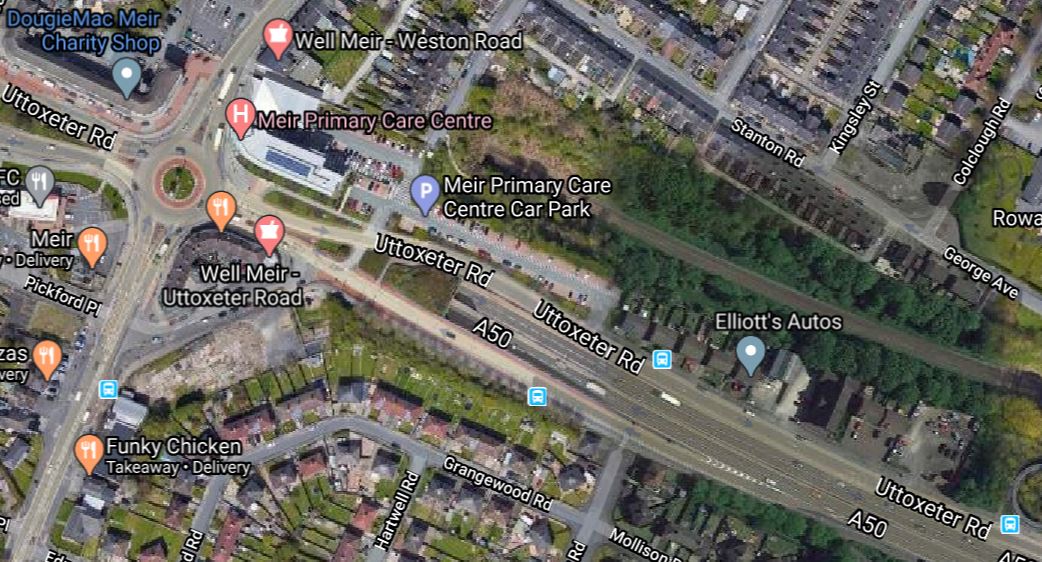
This Google Map shows the railway line running through the area.
Note.
- The railway is double track and looks to be in a cutting.
- The railway runs in a 744 metre long tunnel under Meir.
- The Eastern portal of the rail tunnel is just above the label indicating the Meir Primary Care Centre Car Park.
- There is also a road tunnel taking the A50 under the roundabout.
The original station was to the East of the tunnel portal.
If you look at this area in higher definition on Google Maps, it looks like space is at a premium and the Primary Care Centre has a parking problem.
I wonder, if the tentative plans for reopening, incorporate innovative ideas to improve the car parking and extend the Primary Care Centre.
The Train Service
These are my thoughts on the train service.
- Currently, the service is an hourly train in both directions and it is run by elderly diesel multiple units.
- The trains will be replaced by more modern Class 170 trains in the near future.
- These faster trains may be able to double the service frequency.
I estimate, the service will take about nine minutes to and from Stoke.
Link To High Speed Two
Stoke will have an hourly high speed service between London and Manchester, when High Speed Two opens. If the high speed and local services connected ay Stoke-on-Trent station, that could be very convenient.
Electric Trains Between Derby And Crewe
The Crewe-Derby Line is not fully-electrified, but the Northern section between Crewe and Stoke is electrified to give more flexibility to trains on the West Coast Main Line, when there is engineering work or other problems.
If a new station is being built at Meir, it would be likely that, the following works will be done at the same time.
- Meir station will be made electrification ready.
- The nearby Meir tunnel will be given a full service and made electrification ready.
Could the electrification be extended to Meir or even Blythe Bridge stations?
Consider.
- The distance between Crewe and Derby is fifty miles.
- Between Crewe and Stoke is fully-electrified and the two stations are fifteen miles apart.
- Extending the electrification to Blythe Bridge station would increase the electrified part of the line to twenty miles.
- Derby station was recently upgraded with extra platforms and other goodies.
- Was Derby station prepared for electrification? If so, charging for battery trains could be installed!
- Hitachi have stated that battery-electric versions of their AT-300 trains will have a range of 55-65 miles on battery power and can be charged in ten minutes.
- Both Avanti West Coast and East Midlands Railway will have trains that could be fitted with batteries
There must come a point, where a battery-electric train could work these services on the Crewe-Derby Line.
- Manchester Piccadilly and Derby via Uttoxeter, Stoke, Crewe and Manchester Airport.
- London St. Pancras and Stoke via Derby and Uttoxeter.
It would also open up valuable diversion routes.
Conclusion
I think this station reopening, has the potential to be very worthwhile.
It does appear to me, that this could be a very convenient project for Network Rail to do some other projects, whilst the new station is built.
Could High Speed Two Trains Serve Stoke-on-Trent?
The city of Stoke-on-Trent lobbied hard for High Speed Two to call, but it is going through closer to the West Coast Main Line, which is a few miles to the West.
Current Services
Stoke-on-Trent station is on the Stafford to Manchester branch of the West Coast Main Line.
It is served by two trains per hour (tph) between Euston and Manchester Piccadilly via Milton Keynes Central (1tph), Stoke-on-Trent, Macclesfield (1tph) and Stockport. The fastest journey time is one hour and 24 minutes.
Possible Routes Using High Speed Two
It should be noted that to serve Stafford on the West Coast Main Line, High Speed Two trains will use the West Coast Main Line, rather than High Speed Two between Lichfield and Crewe.
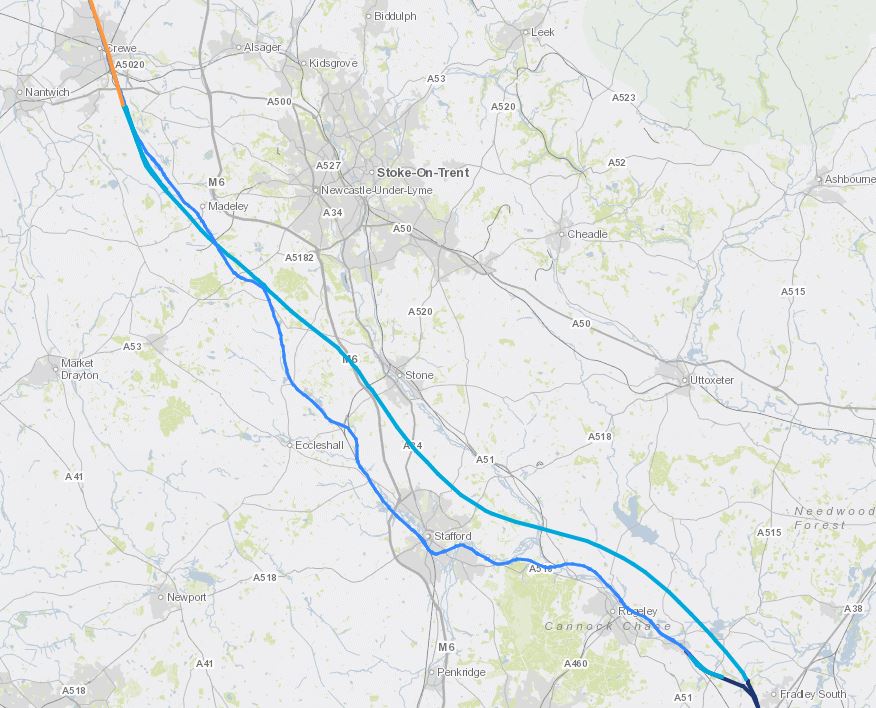
This map clipped from the High Speed Two web site, shows the two routes between Lichfield and Crewe.
Note.
- The straighter route is the new High Speed Two route.
- The bendy route is the West Coast Main Line.
- The two routes split to the North of the city of Lichfield in the South-East corner of the map.
- Stafford can be seen between the two routes.
- Stoke-on-Trent can be seen to the North-East of the routes.
- The new route through Crewe station is shown in orange.
To give an idea of scale, the West Coast Main Line is about forty miles long between the two junctions at Lichfield and Crewe.
Possible Ways High Speed Two Could Serve Stoke-on-Trent Station
There are several ways that High Speed Two trains can serve Stoke-on-Trent station.
London Euston And Stoke-on-Trent Direct
The simplest way is to run a direct service between London Euston and Stoke-on-Trent
- It would use High Speed Two from Euston to Lichfield, where it would take the Trent Valley Line.
- It would proceed to Stoke-on-Trent via Rugeley Trent Valley and Stone.
I estimate that the service would take one hour and two minutes.
The service could either turnback at Stoke-on-Trent or go on to Crewe, Manchester or some other convenient terminus.
Manchester services might even call at Macclesfield and Stockport, as the current services do now!
Times between London and Manchester by various routes could be.
- Current via Stoke-on-Trent, Macclesfield and Stockport – Two hours and seven minutes.
- Planned using High Speed Two – One hour and seven minutes.
- High Speed Two and current route to Manchester – One hour and forty-one minutes
Manchester will get three tph from London and one from Birmingham, so perhaps one of the four services should go via Stoke-in-Trent.

