Success For Ovako In Green Steel Hydrogen Trial
The title of this post, is the same as that of this article in The Engineer.
Steel usually has to be heated to a high temperature before it can be rolled.
Normally, LPG is used, but Swedish steel company; Ovako, have conducted a full-scale trial using hydrogen, which seems to have proved it doesn’t result in lower quality.
Will COVID-19 Create A Boom In Sleeper Train Services?
I have regularly used the Caledonian Sleeper to go to Scotland, as it gets you there at an early hour in the morning and if you book the train, at the right time, the cost of a single First Class cabin can be about the same cost as a day First Class ticket and a night in a Premier Inn.
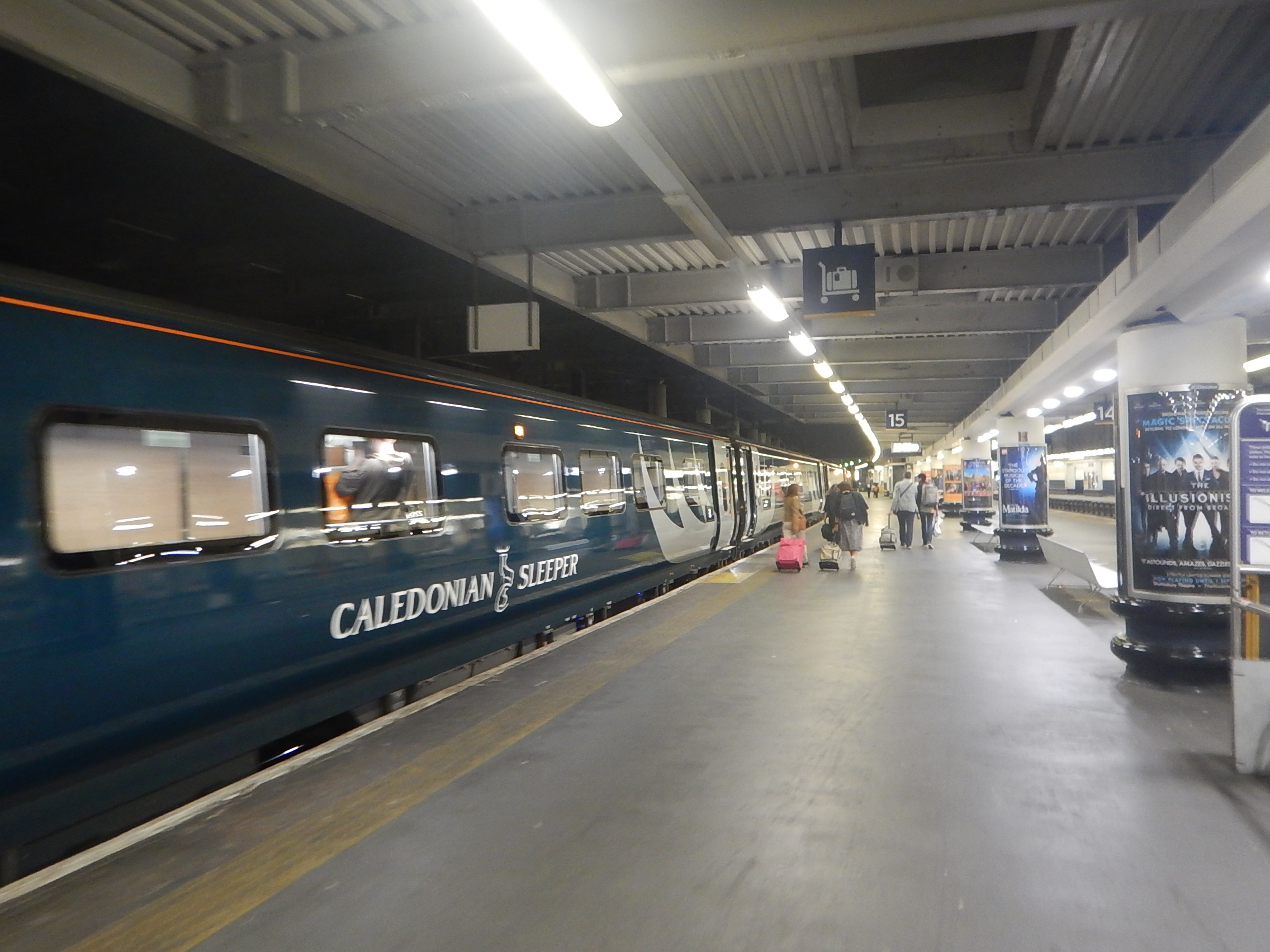
Look at this picture, that taken a few months ago, as I was leaving Euston on a Caledonian Sleeper to Edinburgh. It would be very easy to board the train without breaking the two-metre rule.
I believe sleeper trains will see an increase in passengers.
We may also see in increase in services. These posts detail various planned or possible services.
- Caledonian Sleeper Considers Seven-Day Running
- Rail Sleeper Plan Between Caithness And Edinburgh
- Lying Not Flying, As Nightjet Sleeper Train Reaches Brussels
- SJ Invests In Thriving Sleeper Trains
- Austrian Railways To Run More Sleeper Trains
Note that the Caledonian Sleeper, the Swedes and the Austrians are investing in new rolling stock, so that won’t be a problem.
But perhaps the most interesting story, is described in Nightjet Plans Mini-Capsules For Private Travellers.
I can see a series of sleeper trains criss-crossing Europe, where everybody has their own mini-capsule. Perhaps, it will be called Ryantrain or easyTrain.
Coronavirus Lockdown In Sweden: a New Take On Safe Shopping — No Assistants
The title of this post is the same as that of this article on The Sunday Times.
It could be the way, that convenience stores will be going! Even my local Marks and Spencer in Dalston, allows you to scan using an app, put the goods in your bag and just walk out!
I must try it, as it would mean that I would have to touch less equipment and won’t have to stand there like a wally, whilst the assistant verifies my age, after I have purchased low alcohol beer.
There could also be little robots like Daleks or R2-D2 wandering around, who you could ask questions, like “Where is the Adnams 0.5% low-alcohol beer?”. They would reply “Follow me!” and lead you to your next purchase.
SJ Invests In Thriving Sleeper Trains
The title of this post is the same as that on this article on Global Rail News.
This is said.
Over the last five years, passenger numbers on its Malmö to Stockholm services have increased by 100 per cent.
There has also been growth on the Gothenburg-Stockholm-Umeå-Luleå-Kiruna-Narvi route, where passenger numbers have risen by 25 per cent.
That sounds like thriving to me!
So why is it that sleeper trains are thriving in the UK and Sweden, but countries like Germany have given up?
Malmö to Stockholm
These factors probably help this service
- Malmö is Sweden’s third-largest city.
- The frequent trains between Malmö and Stockholm take four and a half hours.
- Stockholm and Malmö are a very similar distance apart as London and Glasgow or Edinburgh.
- Malmö is only thirty-five minutes from Copenhagen by train.
As the Caledonian Sleeper works between London and Edinburgh/Glasgow, why shouldn’t a quality service work on a similar distance in Sweden?
Gothenburg-Stockholm-Umeå-Luleå-Kiruna-Narvi
These factors probably help this service
- The service effectively goes from the South-West of Sweden right up to the North.
- The distance as 1,600 kilometres
- I have been recommended to take this train to go to see the Northern Lights. So perhaps, it is useful for tourists.
- The service probably appeals to train enthusiasts.
- It is probably a reasonably civilised way to go to the North of Sweden.
I would certainly use it in winter to get to see the Northern Lights at Abrisko.
Stadler To Build Another Special
Stadlet seem to be getting a reputation for building trains for niche markets.
This article on Global Rail News is entitled Stadler to build narrow-gauge EMUs for Stockholm’s Roslagsbanan.
Wikipedia has an entry for the Roslagsbanan.
After trains for the Glasgow Subway and Merseyrail, the Class 88 locomotives and Class 399 tram-trains, they must be one of the companies in prime position for the new Docklands Light Railway trains.
If You Think Network Rail Have Got Problems
I found this article on Global Rail News entitled Sweden’s longest rail tunnel finally opens.
The article is about the nine kilometre long, Hallandsås Tunnel. This is said.
The €1.2 billion Hallandsås Tunnel was finally opened by Sweden’s Minister for Enterprise and Innovation, Mikael Damberg, and Trafikverket director general Lena Erixon on December 8.
Construction had started in 1992.
So I looked up the Wikipedia entry for Hallandsås Tunnel. It is certainly an epic saga of biblical proportions.
This is a section entitled 1990s: Problems, scandal, and stoppage.
Construction began in 1992, and the traffic opening was originally planned for 1995. However, construction was plagued by major difficulties concerning large amounts of water seeping in from surrounding rock, only a small fraction of which had been foreseen. Additionally, the original drill, which was said to drill 100 meters per week, broke down after drilling only 18 m (59 ft). The rock was too soft, so the machine could not use it to pull itself forward. The contractor tried to drill traditionally, but had to spend a lot of effort on sealing the water leaks. The contractor went bankrupt and a new contractor, Skanska, was contracted. The new contractor had similar trouble but a better contract that gave compensation for troublesome rock conditions.
A scandal broke out when it was learned that a poisonous sealing compound Rhoca-Gil was used during construction. This substance was linked to the death of nearby livestock. Rhoca-Gil contains acrylamide, a toxic chemical that is mutagenic and possibly carcinogenic. The main contractor, Skanska, took no special precautions for the sealant, nor did it tell its own workers or the local population of the risks. By October 1997, local cattle and fish started dying and workers were becoming ill. The local press started an investigation. After tests were done showing high levels of acrylamide contamination, the site was declared a high risk zone and the sale of agricultural products from the region was banned. Skanska, along with Rhone-Poulenc and Swedish Railways all had criminal charges brought against them; some senior executives resigned as a result.
Construction was halted in late 1997. By this time, nearly 3 km (1.9 mi) had been bored in each tunnel: 1,200 m (3,937 ft) at the north end, 1,700 m (5,577 ft) at the south end, and 40 m (131 ft) at the central adit).
Wikipedia also says this about the cost of the tunnel.
Cost overrun has been large. The cost was expected in 1992 to be 1 billion Swedish krona (SEK). The cost from 1992 to 1997 was in reality more than SEK 2 billion, for less than half the tunnel length. Since the remaining cost at the beginning of 2005 was calculated to be more than SEK 4 billion, there was initially much debate and hesitation as to whether to halt or resume work. The total cost is likely to reach over SEK 10.5 billion (approximately 1.25 billion USD as calculated in 2015), before the project is finished.
Network Rail’s problems at Farnworth tunnel were tiny by comparison.
A Comeback for Europe’s Wildlife
This report on the BBC is to be welcomed.
As I found in Sweden, bears, wolves, beavers and moose are all thriving.
The trouble comes, when animals like urban foxes and badgers become a menace because they are too numerous.
We need to make sure we manage the consequences properly.
Sweden’s Mammals – Would I Go Again?
It is now a few days since I returned from my trip to see Sweden’s mammals, and it is time to pause for reflection.
Although, I ask the question of whether I would go again in this post, I actually don’t think, I would do the exact same trip again, as I’ve done it once and the only disappointment was that the bears and the wolves were on holiday too.
So I might go just to see bears or wolves and Sweden would be one of the places I would look at. After all, it’s a country, where things are done correctly, the food and accommodation, I had on the trip was very good and overall, it was all well organised.
Overall, I enjoyed it immensely and don’t regret going one bit in any way.
I said on the first night on the boat looking for beavers, that we would get some surprises and things wouldn’t turn out as expected.
Obviously, the problems with the bears and the wolves was one surprise, but as someone who lived in the countryside for forty years, I know how unpredictable animals and birds can be.
But we also had two very positive surprises; the ants and the magnificent skies.
If I was organising the tours, I would make sure that these were explained better.
But then as in all things, it is attention to detail that counts.
I have a feeling that this tour and others like it will get more popular, as surely Norway and Sweden, are the one place close to the UK, where you can see large wild animals. It’s also an ideal short break.
I think coupled with visits to Stockholm and Oslo at either end, it could be part of a fuller exploration of Scandinavia for everybody.
THe tour I took was organised by Marcus Eldh of Wild Sweden and I booked it through Naturetrek in the UK.
All of the posts can be accessed by clicking this link.
Why Do Trains Travel On The Left?
Next time you board a train on a double-track railway, notice which side of the tracks the train runs.
In the UK, the trains are virtually all driven from the left-hand seat and the trains go on the left. A lot of this is tradition, as early trains had to be compatible with existing traffic in the early days of trains. As the British helped built French railways, they followed our lead, as did many countries under British influence. Metro systems, which tend to run on streets at times, have to be compatible with road traffic, so they could be on the right. There’s a detailed explanation in Wikipedia here. This paragraph sums up a lot.
In France, for instance, cars keep to the right, but the first train lines were built by British engineers, so kept to the left. The Paris RER trains keep left, but the Paris Metro was designed to run on the right. Another anomaly occurs in the Alsace-Moselle region, where trains keep to the right because the lines were built in the late 19th century when Alsace-Moselle was part of Germany. Bridges at the former border allow the trains to swap sides. High-speed TGV trains, however, operate on dedicated lines which were built more recently, but they keep left because they interface with older lines.
The question was asked by our guide in Sweden. He had noticed that main line trains in Sweden run on the left and that most Metro systems run on the right, except for Stockholm, which runs on the left.
Wikipedia says that in Sweden trains generally run on the left except for Malmo and further south.
I uspect that the Stockholm Metro is on the left, as it was built in the 1940s when Sweden drove on the left and thus was following the more or less universal Metro compatibility rule. The first line was also converted from a underground tramway, which would of course be compatible with road traffic.
So we’re still left with the Malmo anomaly in Sweden.
Endless Bits Of Paper
Queue in Norway and Sweden and you always seem to have to get a ticket with a number on it.
but I suppose, they have plenty enough trees to make the paper for the tickets.
 The Anonymous Widower