German Trains Don’t Have A Coach 13
German stations like a lot of continental ones, have a poster showing where your coach will be on the platform.
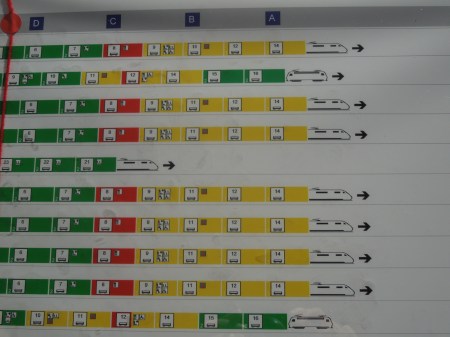
German Trains Don’t Have A Coach 13
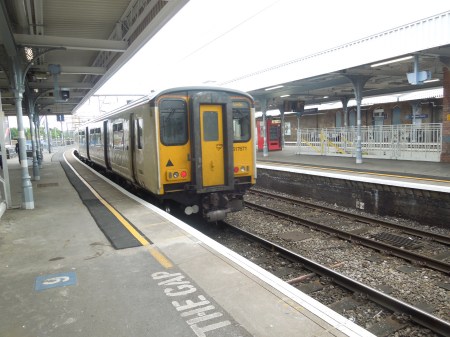
It looks to be a good idea, but just imagine the system at somewhere like Clapham Junction or Crewe, where we seem to run many more trains than our European cousins.
Incidentally, I don’t think we have a coach 13, as we give coaches on long trains, like those out of Kings Cross and Euston, letters rather than numbers. Several times though, I’ve travelled in coach M. Is that unlucky?
From Copenhagen To Hamburg By Train
This is one of the more unusual journeys you can do in a high speed train. Usually, high speed trains, are defined as ones, that are capable of travelling at 200 kph or 125 mph. thus, the UK’s InterCity 125 train, built over forty years ago, are high speed trains, despite being diesel-powered. I thought that the train I was on, was a standard DeutscheBahn ICE. But it wasn’t, as it was an ICE-TD, which is diesel-powered.
You don’t notice the diesel engine in each car, and the comfort is similar to an electrically-powered train.
But the big difference on this route, which is called the Bird Flight Line, is that the train is carried part of the way in a ferry from Rødby to Puttgarden. Here are a few pictures.




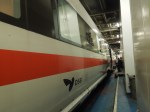



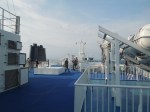


I nearly delayed everything by falling asleep and was quickly roused by the guard and told to get off the train at Rødby.
The train arrived in Hamburg a few minutes late. It certainly had been an unusual trip in a train. It was also noteworthy as I saw a hare in the station at Puttgarden. But then a few years ago, I saw one on the dock at the Hook of Holland.
From Stockholm To Copenhagen By Train
I left Stockholm for Copenhagen late in the morning.





The journey should have taken just over five hours but the train was half-an-hour late into the Danish capital. A hotel manager I spoke to, said that the trains are always late. But I couldn’t find any published statistics, like you see on British stations.
The Stockholm to Copenhagen line is not very spectacular, except for the amazing crossing between Malmo and Copenhagen on the double-deck Øresund Bridge.
The Øresund Line, which is the high-speed rail line between Malmo and Copenhagen, illustrates some of the problems of running trains between different countries. This section called Border Technicalities in the Wikipedia article on the line, illustrates the problem. The electrification, signalling and train running systems are all different.
At least England and Scotland have the same systems and we’re vaguely the same as the French, Belgians and Germans, with respect to high-speed rail.
But then Ireland, including the North, use a different gauge.
The Swedish high speed train, called the SJ 2000, that I used on the journey has the luxury of running on 19th Century lines between Stockholm and Malmo, that were built relatively straight. But it is not particularly fast, going at speeds comparable with our Inter City 125s from London to the West Country. Our trains are thirty years older and diesel powered, but comparisons like this illustrate how good was the design of the Inter City 125s.
Buying My Ticket To Copenhagen
The Swedish ticket machines appeared to be very comprehensive, but trying to buy the ticket to Copenhagen was very difficult, so in the end I queued up and bought it from a person, who was very helpful and spoke English better than myself.

Swedish Ticket Machines
My first problem, was that like the touch screens in IKEA at Edmonton, my fingers had the wrong dampness to make them work. But by changing to another machine, I was able to work the system.
Then I found the problem, that turned me towards buying a ticket from a person. Although, I was using the machine in English, the place names were still in Swedish. How many of those who speak English as a first language, know how to spell Copenhagen in Swedish.
I’ve always felt that every town or city, should only have one name and those that live there should choose it. That way, we would probably all know the town names that didn’t confuse.
Home Run From Stockholm
I’ve just returned from Stockholm, after flying there and taking various trains all the way home.
All of the posts concerning this trip will be tagged Home Run From Stockholm. Clicking the tag below will give them all. Hopefully, in the chronological order if the trip. Although to start with they’ll probably be backwards.
I sarted at Heathrow on Sunday, June the 16th, I flew to Stockholm by British Airways.
Wetherspoons To Open A Pub On The M40
It looks like Wetherspoons will be opening a pub on the M40 according to reports like this one from the BBC.
I have no view on whether it would increase drink-driving, but surely it would be just as easy to drink in a pub just off the motorway, than one in a service area.
But what I would like to see is better rail interchanges on motorways! Very few railway stations are close to motorways with large amounts of parking. Personally, I’m not too badly affected, as I don’t drive, but sometimes when I want to meet someone driving along the motorway, finding a suitable station is difficult.
Summer Over Haggeston
The blue sky just asked to be photographed.
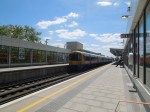
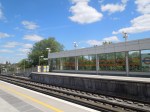
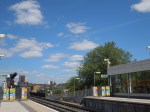
I wish I’d taken a few more. But then, if I had, the summer will end before it starts.
Still I did buy a raincoat yesterday and that will put the mockers on it.
The Hackney Downs Information Board
I’ve used Hackney Downs station twice in the last few days, and on Friday, I noticed this information board for the first time.
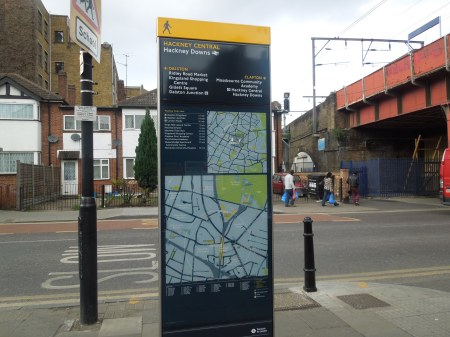
The Hackney Downs Information Board
There doesn’t seem to be any information on the buses on it, but the stops are obvious and as is typical with Transport for London, they have all the bus information you need. There was also at least one bus spider map inside the station.
This board is also placed in such an obvious place, that you can’t miss it.
I wonder how many stations would score less than Hackney Downs on their information?
Merrily We Roll Along
I came back from Walthamstow on Friday on one of Greater Anglia‘s ubiquitous Class 317 trains.
A Greater Anglia Class 317 Train
They may look to be scrapheap-ready trains from the 1980s, ripe for replacement with shiny new expensive trains. Incidentally, the train in the picture is one of the last ones built in 1987, so it’s a comparative youngster compared to some.
But underneath the tired paintwork and uncomfortable seating, there is a legendary Mark 3 coach struggling to get out. These coaches used in the InterCity 125 and in many other trains, were made as early as the 1970s and most are still running in 2013.
The Class 317 is closely related to the Class 455, some of which have been refurbished by South West Trains to a very high standard. I talked about them here.
It looks like these 317s are going to get their own version of the Class 455 refurbishment. it is reported here in Wikipedia. Work is ongoing to create a prototype with new and more efficient traction equipment and a new interior to test passenger reaction.
So yet again, it looks like more Mark 3 coaches will be emerging from their chrysalis. The Wikipedia article talks of increasing the life of the trains by twenty years. Not bad considering that many of them are over thirty years old now!
The InterCity 125 is well-known as a design classic of Kenneth Grange. But who’d have thought that the humble coaches in the middle, would still be having a laugh at everybody’s expense nearly fifty years after they were designed.
Belgians Give Up On Fyra
The Belgian government has pulled out of the Fyra project to run high speed trains between Brussels and Amsterdam. It’s reported here.
This sorry story has a lot of lessons for governments, who try to implement large projects.
Building railway lines and in particular high-speed lines is not difficult, except for the odd local political and environmental problems, as HS1 found in Kent and HS2 is now finding. But the actual line generally works well from an engineering perspective, with the possible exception of the Wenzhou crash in China, where signalling may have been at fault. None of the high speed train crashes in this country, were caused by engineering problems on new lines.
The main problems with Fyra are all about using new unproven trains. No sensible project manager would ever use unproven technology at the heart of a new project. You could argue, that Boeing used an unproven battery system on the Dreamliner. But look what happened there!
The other major problem with Fyra is that they discontinued the traditional services between towns like The Hague and Brussels, thus alienating a lot of their target market.
So when you do a large project, make sure that it fits the aspirations of your customers.
If we look at HS2 to Birmingham, the technology to be used to build the line will be very much proven, as hopefully will be the trains, which will probably be derived from something that is working well in the UK or Europe.
The line too, will be an addition to the current services between the two cities. This in itself removes a lot of risk from this line, as say there is a problem that cuts capacity on HS2, you don’t have only one basket for your eggs. I also believe the competition from such as Chiltern and Virgin trains and their successors, will make sure that HS2 is competitive and reliable. Those two services, will also act as valuable feeder services to HS2, as say you live in Banbury and want to go to Leeds, you’d hop to Moor Street station in Birmingham and then take HS2 to Leeds, when that section of the line is completed.
 The Anonymous Widower