A Rebuilt Station For Guildford
It is has just been posted on Modern Railways, that Guildford station is to be redeveloped. The report is subtitled.
£150m investment at no cost to tax or fare payer
I think we’ll see a lot more developments like this, where everybody wins. In Guildford’s case, this means a new station building, a transport hub, 445 new homes and 1,600 sq. metres of office space. It also claims 300 jobs will be created.
Look at this aerial view of the station.
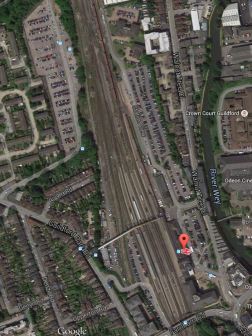
Guildford Station
The development is to use surplus land around the station. There seems to be a lot of that and a lot of space devoted to car parking.
So an imaginative development would be an improvement. I would like to see homes and offices developed over the station.
Underneath The Shard
The space between Thameslink and the Shard has been tidied up a lot, as the pictures show.


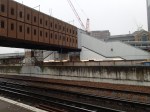

All is now ready for a start to be made on the next phase of the rebuilding of London Bridge station.
Wikipedia has a section on rebuilding the station.
This link shows the final platform layout. It’s very different to what platforms were used in the past and are now.
But hopefully, it’ll be all right on the night!
Walking Between Rochester And Strood Stations
I took the South Eastern Class 395 and explored Rochester.
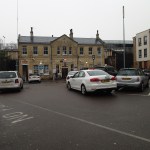












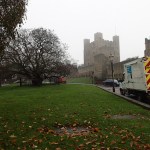
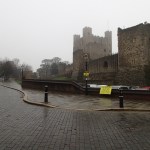


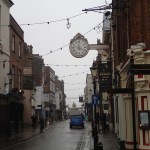

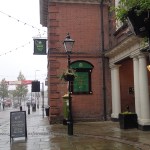
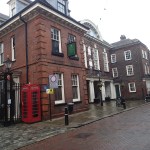
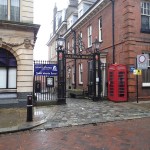

I walked along the High Street, visited the cathedral, castle and the museum before crossing the Rochester Bridge to get the train home from Strood.
Solihull Station
To get to Stratford, I changed at Solihull station.
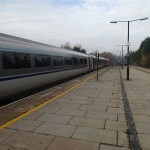
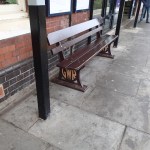



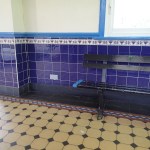
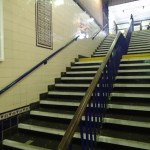
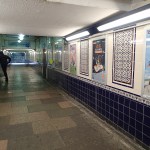
The pictures show what an excellent job has been done in creating a modern station, with nice details and what looked like a proper buffet.
The Bicester Chord Takes Shape
I took the Chiltern Line to Stratford upon Avon today and I was able to get these pictures of the building of the Bicester chord.
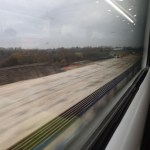
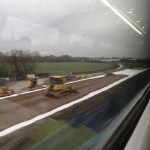
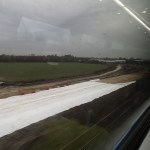



This will allow Chiltern Trains to start services between Oxford and Marylebone sometime in 2015.
The Bicester Chord is the first idea of several to come to fruition and transform railways in the area between Oxford, Banbury and Milton Keynes.
The East West Rail Link will be built and electrified, to link Oxford, Bicester, Milton Keynes, Bedford, Cambridge, Ipswich and Norwich.
The Cowley Branch at Oxford will be opened to passenger traffic.
Marylebone to Birmingham will drop to ninety minutes.
Chiltern Trains will probably want to expand. This is probably just as well, as if HS2 is to be built and Euston rebuilt, someone will have to get the passengers between London and Birmingham.
Waxing Lyrical About The Overground
My Internet trawler found this article on a web site called The Quietus. It’s an interview with veteran writer and filmmaker; Iain Sinclair.
He says this about the London Overgroiund, when asked about the effect of the lines on his life.
It’s changed mine enormously, in a sense. It’s so convenient that I tend to make journeys that reflect on the railway rather than journeys that I need to make. I wouldn’t have thought of going to Clapham Junction if I couldn’t just jump on this train and get to Clapham Junction. I wouldn’t have gone to Willesden Junction, which proved to be very useful, because I got a better sense of Leon Kossoff as a painter. He’d done some fantastic paintings of Willesden Junction but I didn’t really know Willesden Junction.
I think the Overground railway is a bit like the cinema project in that it curates. It curates a London of disparate elements. What relates Denmark Hill to Finchley and Frognal or Camden Town to Shadwell? They are now an organic identity. And sitting on this train is like sitting in a cinema. You’ve got this screen, and the landscape changes. Patrick Keiller writes that as being the view from the train; that is, really, a form of cinema. I really believe that walking is a form of cinema, and being on a train is a form of cinema, and having the excuse to stop and go to these venues and see some wonderful movie enhances that experience.
Read the full article.
I can see my own behaviour in what he says.
Every city deserves its own Overground network, designed and run to the same principles.
In the UK, Birmingham, Bristol, Cardiff, Glasgow, Leeds and Liverpool seem to be going or starting to go in this direction. Manchester is going a slightly different direction by integrating its trams and trains in the Northern Hub.
As somebody once said in the past – “The Future’s Bright – The Future’s Orange!”
South West Trains Messy Tea
The picture says it all.

South West Trains Messy Tea
If I was the boss of ATOC, I’d offer a prize for the design of a tea system that was simple for the staff and customers alike, but didn’t leave any mess.
Could Parry People Movers Replace The Class 153s?
On the Stourbridge Town Branch Line, Parry People Movers or Class 139 trains, have replaced a Class 153 train on the short route.
As there are seventy of the Class 153s, how many of these could be replaced by the smaller Class 139s.
I feel that a line like the Felixstowe branch could probably just be covered adequately, by two Class 139s working together. They would start simultaneously at Ipswich and Felixstowe, every thirty minutes. The current Class 153 is scheduled to take twenty-six minutes, which means it would be tight and would probably need a train with a bit higher performance than the current Class 139.
But if you look at this line in a few years, it is likely that it will be electrified for freight reasons and I suspect that passenger trains on the branch will be reorganised and run by a suitable electric train. I do wonder if the Ipswich Cambridge line were to be electrified and given an increased service frequency, that some of these trains should be extended to Felixstowe or Harwich. Extra stations might also be added on the Felixstowe line to both serve the port and new housing developments. The area has lived on scraps and hand-me-down trains for years, but now that the Beccles Loop and the Bacon Factory Curve have been built, the trains are at last generating traffic and running more frequently and reliably.
Looking at where the seventy single coach Class 153 trains are used, quite a few are used on lines a lot longer than the Felixstowe branch. When I took a trip around Wiltshire, a lot of the journey was in a Class 153, but probably the route is too long, fast and busy for the smaller Class 139.
So I would think that some Class 153s and possibly some Class 150s or 156s might be able to be replaced on services by Class 139s or a bigger version, but not many. A specialist version with lots of space for bicycles, wheelchairs and luggage might also have applications in tourist areas like the St. Ives branch.
Another likely source of replacement is some new Class 172s. This has been hinted at by a rail minister and we do have a General Election coming up. If money was no object, all of those rural lines that will probably never be electrified like those in the North of Scotland, Lincolnshire, East Anglia, Wales and the West Country, would be equipped with a new standard train like a Class 172, built to last for the next forty years. Class 172s also have the advantage that they can be lengthened by adding extra coaches in the middle and coupled together to make longer sets. I suspect too, they could also be updated in a decade or so, with an energy-efficient, quieter hybrid power train.
In my view an order for some Class 172s would solve a lot of problems for a long time.
A start has also been made on refurbishing some of the Class 156s and these will probably all be retained for many years. As some of these Class 156s are used on lines that will be electrified, they could be a replacement for Class 153s and 150s, where something better and/or bigger is needed.
The Class 15x trains may all be getting on for thirty years old, but many could linger a good few years. Especially, if engineers keep finding ways of updating them, like these new toilets.
So to answer my original question. Parry People Movers or their larger successors might have a place in some places in the UK, but I can’t see too many running in say ten years time, except under special circumstances like Stourbridge, where a high frequency service is needed over a short distance.
Perhaps some might be used on new services, where a small town or attraction needs to be connected to a main line. One place for example might be to link Yeovil Junction to Yeovil Pen Mill and then possibly to the town centre. The track exists between the two stations, which don’t have any connections and are served by totally different companies and services
Projects Are On The Way – W/E 22nd November
This week there have been several projects or investment in UK railways announced.
21st November – Crossrail Work At Shenfield Starts Early – Are they wanting to build Crossrail faster?
21st November – Welsh Valley Lines Go-Ahead Given – This is very much needed.
20th November – Wisbech Reopening Proposed – Nothing concrete yet, but needed if Wisbech is going to develop as a satellite of Silicon Fen
19th November – Electrostars For Gatwick Express – Something like this was expected and Derby will be pleased.
18th November – Crossrail Accessibility Boost – Probably best done before opening
It will be interesting to see how many get announced each week, as we build up to the General Election.
To Stourbridge And Back
I went to Stourbridge today essentially to see the town and the Parry People Mover, but I took these pictures on my way up by Chiltern from Marylebone and back on Virgin to Euston.
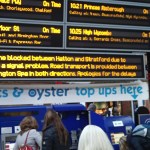
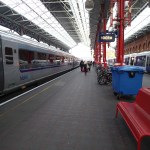
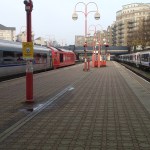
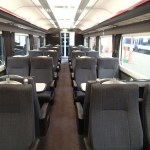
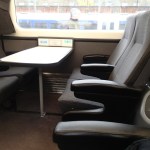
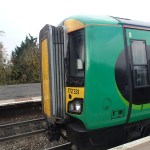
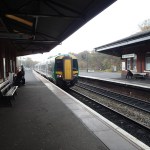
The trips illustrated the best and worst points of the two companies and their trains.
Chiltern has the more comfortable trains, with big windows and free wi-fi, but the journey takes longer.
One small thing that surprised me was the quality of both the Class 172 trains and the stations it passed through, on the way from Birmingham Moor Street to Stourbridge Junction. In some ways though it is a reasonably modern line, as it was only reopened in 1995 as the Jewellery Line Project, which created Birmingham’s cross-city passenger route between Moor Street and Snow Hill. Wikipedia says this about the Birmingham to Worcester via Kiderminster Line, on which Stourbridge Junction is located.
It is a future aspiration of Chiltern Railways and Network Rail to electrify the entire line, including the Chiltern Main Line to London Marylebone.
I’ve always thought that electrification of the Chiltern Line should be done before HS2, so that there is adequate capacity between London and Birmingham, whilst Euston is rebuilt.
Another reason to electrify the Snow Hill Lines sooner rather than later would be so that some of these Class 172 trains could be released for other routes.


