James Cook Station – The Reinvention Of The Halt
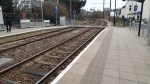
Simple stations or halts, were once very common on UK railways. These pictures show James Cook station in Middlesbrough, which is a new small station, that opened in May 2014.
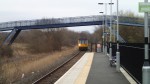
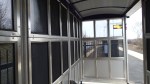


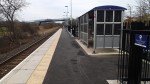

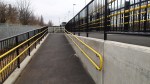
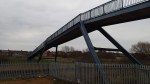




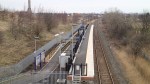


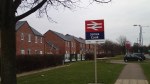
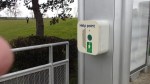
As the trains stopping at the station have conductors to sell tickets, there is no ticket machine, but there is a smart shelter, a help point, a destination board, a step-free bridge and ramps to the single platform.
James Cook station is the first construction in the possible creation of a Tees Valley Metro, which may see other new stations created or old ones reopened.
Surely, some of the ideas used in the design of the single platform James Cook station could be used at several places on the Tees Valley Metro and the wider UK rail network.
Incidentally, is there another station named solely after a person?
The Design Of Tram Or Tram-Train Stations
When I wrote the article about using tram-trains in Blackpool, I wanted to include a picture from an existing UK tramway to show what a stop might look like on the Colne Line after conversion to tram-train operation, if that should be decided. The only tramway near me is the Croydon Tramlink, for which my Freedom Pass is valid, so I went to take some pictures.
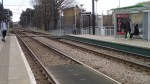
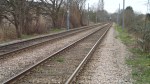



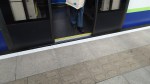

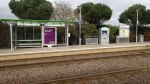
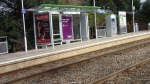

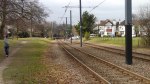
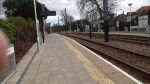
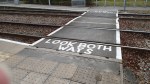





Some more are shown in this article about Birkbeck Tramlink stop.
I believe that the pictures show the sort of stations you would get on a line like the Colne Line, if you used Class 399 tram-trains instead of Class 142 trains. As Birkbeck shows you can have single-track bi-directional stations in addition to the more normal ones with two platforms, either on the outside of the tracks or as an island between them.
If I’d gone to any other UK tramway and a good few on the continent like Strasbourg, I’d have found similar good design. Although some don’t quite get the step-free access quite as good as Croydon and Strasbourg do.
But next time you get into a Class 142 or some of their dreadful cousins to go to work or for a bit of pleasure in Liverpool, Manchester, Leeds or Sheffield, think what train travel could be like in a brand new tram-train that sped you to your destination in complete comfort, in a faster time, than your current scrapyard special.
The experience will be even better, if the stations you use have all of the superb step-free access that you get in Croydon, Strasbourg and Edinburgh.
To sum up my ideal tramway must have.
1. Low floor trams or tram-trains with level access from the platform, with no gap between.
2. Gentle slopes up from street level to the platforms if possible.
3. As few lifts and escalators as possible to break down.
4. Crossing the tracks should be a simple walk across.
5. A shelter on every platform.
6. Good information on use and ticketing, with maps of the network and the local area at every stop and on every vehicle.
7. Multiple next stop displays with a clock on the vehicle. Trains and trams, are well behind London’s buses in this area.
8. Contactless bank card and cashless ticketing. Anything else is so last millennium! If one of the biggest cities in the world; London can do it across all their modes of transport and well upwards of a dozen transport operators, surely all smaller ones can!
9. Free wi-fi!
10. An on-board Train Captain like the Docklands Light Railway!
I’ve never used a tram network that scores ten! Croydon Tramlink scores about eight.
Birkbeck Tramlink Stop
Birkbeck is a stop on the Croydon Tramlink and I took these pictures this morning.

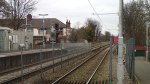

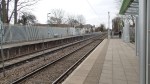
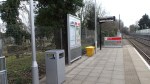
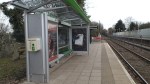
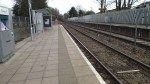
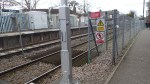
It is a rather unusual stop in that a double-track Crystal Palace Line has been turned into a bi-directional single track railway and a bi-directional tram line. Both lines have stops on the outside.
Note the wire fences to stop people and animals straying onto the electrified railway line.
The tram stop is very much a typical tram stop for Tramlink, with a platform the right height for entry to and exit from the low-floor trams that run on the line, a rudimentary shelter, information and maps and a well-presented ticket machine.
Because of the bi-directional nature of the line, passengers use it to go to either Croydon or Beckenham Junction. Provided they know where they intend to go, I suspect passengers don’t have too much trouble getting on the right tram.
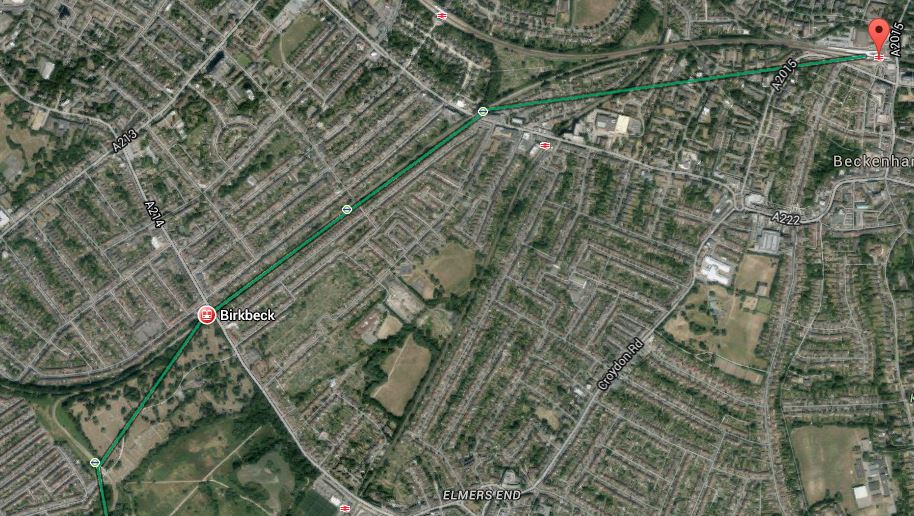
This Google Earth image shows the layout of the lines between the junction where the lines join and Beckenham Junction station.
Birkbeck To Beckenham Junction
Beckenham Junction is shown by the red arrow and the green line is the rough direction of Tramlink Line 2. Note the sharp cyrve at the far left of the image, where Tramlink joins the Crystal Palace Line.
This second Google Earth image shows an enlarged view of the rail station and tram stop.
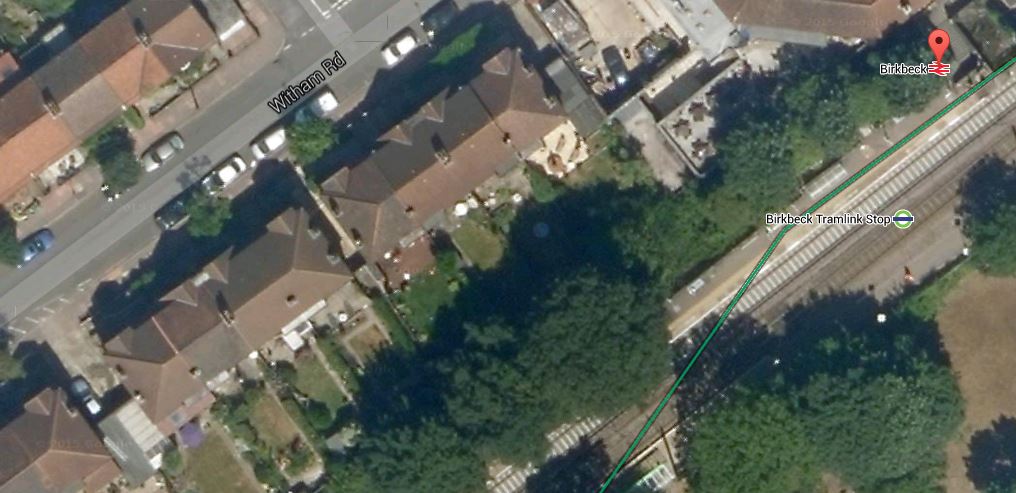
Birkbeck Station
Note the two platforms and two single-track lines with a fence between them.
I think it is true to say, that if the Tramlink was being designed today, they would seriously look at using tram-trains on this branch, as these could just join the main lines at the junction and then proceed to the station at Beckenham Junction, where there is even a bay platform, that could be used to turn the trams back to Croydon,
But the system they use at Beckenham has been proved to be very safe.
Could Tram-Trains Be Used To Advantage In Blackpool?
Blackpool tramway is unique in the United Kingdom in that it runs a mixture of modern and heritage trams, which I’ve only seen done on a big scale in Lisbon, where like Blackpool, the heritage trams are a tourist attraction.
It may also be unique in that it is already tram-train ready in terms of dimensions, power supply and other details according to this report on the Sintropher web site.
Blackpool’s trams have two major problems.
The obvious one is that the trams do not serve the main railway station at Blackpool North.
The second is that the trams don’t connect well to any of the stations served by the Blackpool South to Colne service. The best connection is a two hundred metre walk between Squires Gate station and Starr Gate tram stop.
The branch to Blackpool North is being electrified and this should be completed in 2017. The final report of the North of England Electrification Task Force has also recommended that the lines from Burnley to Colne and Kirkham to Blackpool South be electrified in the Tier Two group of lines to be wired.
So it would be reasonable to assume that in a few years Blackpool will have two stations with electric trains to Preston, Liverpool and beyond.
This is a Google Earth image of the area between the two stations.
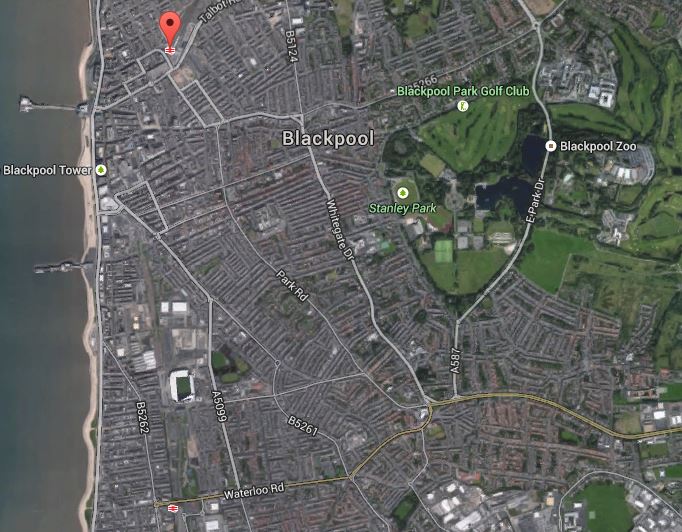
Blackpool North and South Stations
Blackpool North is indicated by the red arrow and Blackpool South at the bottom of the image, about five hundred metres or so from the sea front and a short walk south of the football ground and extensive car parking for visitors. Neither the football ground or the car parking are well served by the current tramway.
Blackpool South
This Google Earth image shows the area north of Blackpool South to the football ground to a larger scale.
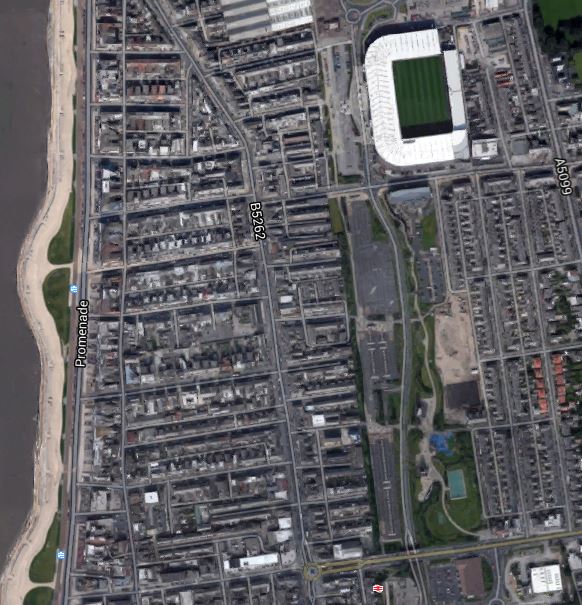
North of Blackpool South Station
I feel that it should be possible for a tram to start northwards from Blackpool South station, go past the car parks and the football ground and then thread its way through to the main tramway route along the sea front.
To the south of the station the rail line is single track all the way to Kirkham and Wesham station, where it joins the main Blackpool branch to Blackpool North.
As this line is now slated for electrification, there are probably cases to electrify it to either main line standard or make the line an extension of the tramway.
If tram-trains successfully pass their trial between Sheffield and Rotherham, then surely using tram-trains to work the services between Blackpool South and Colne, will be looked at seriously.
One factor that could come into the discussion about upgrading of the Blackpool South branch is the important golf course at Royal Lytham and St. Annes, as Ansdell and Fairhaven station is adjacent to the course and is used to transport spectators for important tournaments.
So when will the next Open Championship be staged at Royal Lytham?
Blackpool North
At Blackpool North station, the tram extension is now funded and is being planned.
But will the announcement of electrification to Blackpool South and hopefully successful trialling of tram-trains in Rotherham, add extra possibilities to how the extension to Blackpool North station is implemented?
This is the Google Earth image of Blackpool North station, which is indicated by a red arrow, to the sea front.
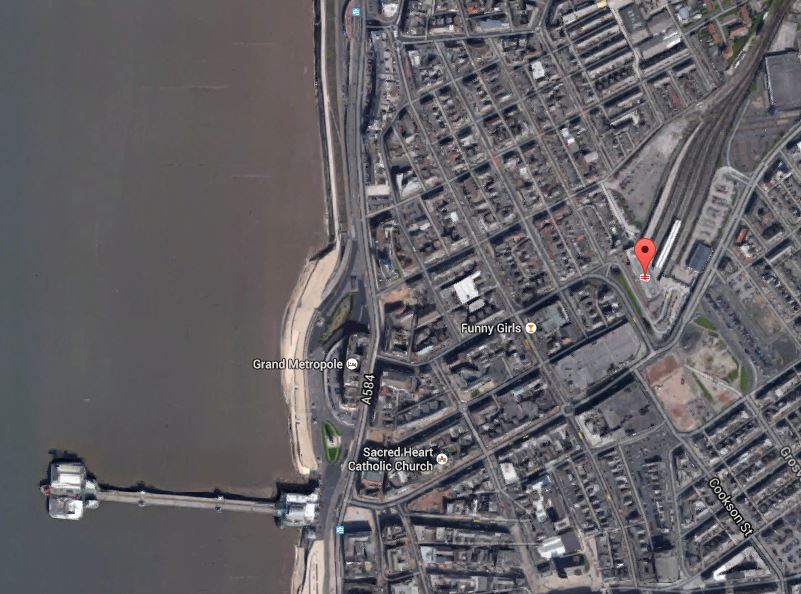
Blackpool North Station
Wikipedia also indicates that the spur to the station will join the main tramway north of the North Pier, which is the pier shown in the image.
One possible way of building the spur, would be to make it compatible with tram-trains so that some trains arriving at Blackpool North could transfer to the tramway.
The Karlsruhe Model
If both Blockpool stations were to be served by tram-trains that then ran between the two two stations, then would be an example of the classic Karlsruhe model that has been successfully working in the city since 1992.
Between the two stations, they would work as trams and once clear of the tramway, they would work as normal trains.
Advantages Of Using Tram-Trains Between The Two Blackpool Stations
The tram-train services would probably be on a simple loop between the two stations, with tram-trains turning back at either Kirkham and Wesham or Preston stations. Alternatively, services could be something more substantial serving the wider area. Certainly some tram-trains would go all the way to Colne to replace the current service.
But whatever is done, if tram-trains are used to link the two stations, various advantages will be seen.
1. Long distance services into Blackpool North would have easier access to the tram network, which would probably be step free.
2.As Preston would probably have more trains to Blackpool, this would give Blackpool better access to other long distance services to say Glasgow, Edinburgh, London and Birmingham.
3. Local services running tram-trains from perhaps Preston and Colne would have immediate access to some of the central tram stops in Blackpool, as these stops would be on the link between the two stations.
4. Blackpool South station would become a simple tram stop.
5. Space might also be released at Blackpool North station, depending on how much space was needed for the tram-train stop.
6. Extra trams would be running on the busiest central section of the tramway.
7.If the football ground and the main car parks were on the central loop, this would improve transport links to the town.
Probably the most difficult thing to get right would be the ticketing method, which London has shown must be based on a contactless bank card.
Implications Of Tram-Trains On Services To Colne
With the announcement that the East Lancashire Line is to be electrified to Colne, there would be no problem running tram-trains through both Blackpool stations and then through Preston and on to Colne.
The line from Rose Grove to Colne appears to be mainly single track, with some stations looking like tram stops, with a pile of bricks at the track-side.
If tram-trains were to run on the Colne Line as trams, this would actually be a service upgrade, despite the apparent downgrading of the line from trains to trams. If the powers-that-be thought that more stops were needed, these would be simple affairs, with a low platform on one or both sides of the track, with perhaps a simple shelter and a ticket machine. As on other tram lines in the UK, passengers would walk across the line rather than use an expensive footbridge. To see what is possible on a good tramway, look at this post about good stop design for trams and tram-trains.
But the two biggest improvements would be a much more frequent service, that probably ran at least twice an hour on weekdays and hourly on Sundays, that used new comfortable electric low-floor tram-trains something like the Class 399, being used for trials in Sheffield.
As to speed, the increased acceleration of the tram-trains would mean that stopping wasn’t as time-consuming as on say a Class 142 train. also outside of urban areas and some way from stops, they would be able to run at a more appropriate speed using the railway rules currently in force on the line. Incidentally, some UK trams like Croydon and Edinburgh go faster than you think when the track allows.
Tram-trains would appear at a cursory glance, to be a simple and affordable way to improve services in this neglected part of Lancashire.
Improving Transport In Burnley
Burnley is one of those places most famous outside the local area for football, but it is a market town of over seventy thousand people. The town probably needs improved transport connections, despite having four railway stations, the most important of which; Burnley Manchester Road has recently been rebuilt.
A big improvement will come by electrifying all of the lines, which will mean that Rose Grove and Manchester Road, will be on an important electrified artery between Leeds and Preston. The other line is the Colne Branch of the East Lancashire Line and this has three stations in the town; Rose Grove, Burnley Barracks and Burnley Central.
This Google Earth image shows the four stations as they relate to Burnley.
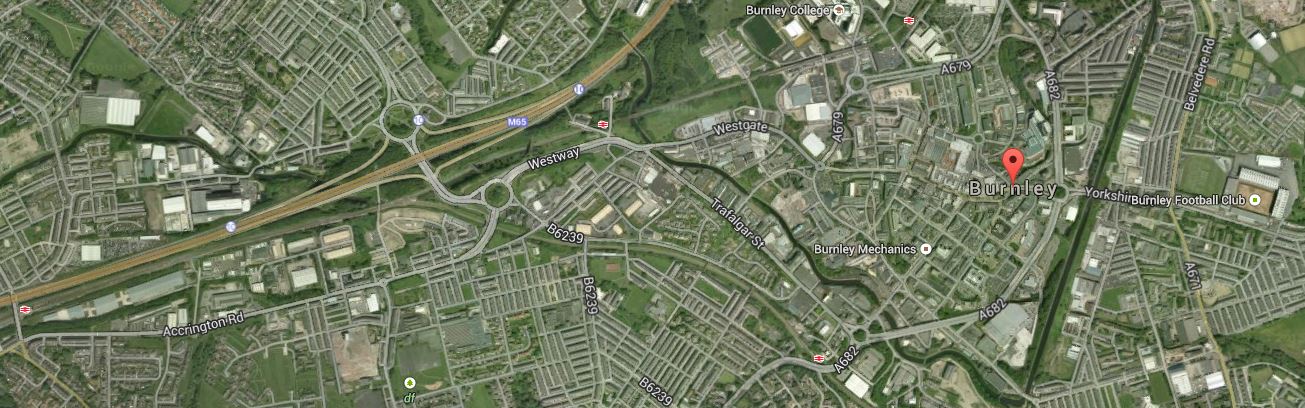
Burnley And Its Stations
Rose Grove is at the West, just to the south of the M65 motorway and is served by both lines. The Colne Line curves to the north with the two stations at Barracks and Central to the western end of the town centre, which is indicated by the red arrow. Manchester Road station is at the southern edge of the image, a steep walk up the hill from the town centre.
If the Colne Line were to be run by tram-trains, would this create a better and more accessible railway for Burnley.
As an example of what could happen, north from Burnley Central , the Colne Line follows the Leeds and Liverpool Canal, so are there possibilities to use a tram-train to give better access to the countryside above the town?
Using tram-trains on the Colne Line could improve public transport in Burnley and the other towns like Nelson and Colne, without laying a metre of new expensive railway.
But why stop the trains at Colne?
The final report of the North of England Electrification Task Force has also recommended that the lines from Skipton to Carlisle via Settle be electrified in the Tier Three group of lines to be wired.
The Skipton – East Lancashire Rail Action Partnership is also campaigning for the line between Colne and Skipton to be reinstated. This map of the missing part of the line is taken from the Wikipedia entry.
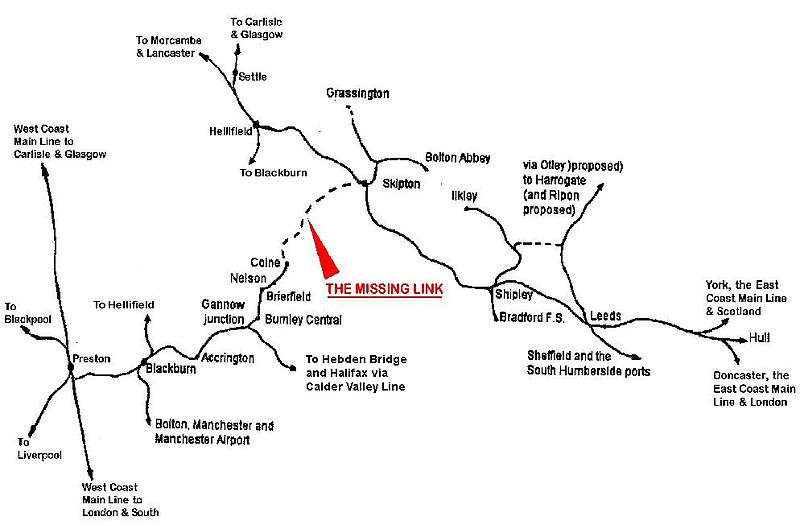
Skipton To Colne
Would the missing link be easier and more affordable to build, if it continued as a modern, single-track tramway?
This type of line would also be less visually intrusive, if it used 750 V DC overhead wires, which are all that would be needed for the Class 399 tram-train.
Building this link between Skipton and Colne would further connect the electrified lines in the Leeds area, with the soon to be electrified ones of North Lancashire. As the map shows, Skipton is on the iconic route through Settle between Leeds and Carlisle, which is also in the queue for electrification.
Skipton is the key to the success of any scheme to improve the Colne Line and link it to the town. The town is known as the Gateway to the Dales and already has direct services to London. This section in Wikipedia shows that there are impressive plans for services in the future.
But that was written before the North of England Electrification Task Force reported that Skipton to Carlisle through Settle was an electrification scheme for Tier Three. This was probably included more for freight reasons, as it creates a new route for electrified freight trains from Yorkshire, the East Midlands and the Electric Spine from Southampton to Scotland.
And to think that the line was nearly closed, but a certain Michael Portillo didn’t sign it off!
So will we see electrified passenger services from the South coming up via Leeds and Skipton to Carlisle? I think we will and if the Borders Railway is a success, then I think in perhaps 2040, these trains will reach Edinburgh.
So I think this all means that the tram-trains to Colne, should be used to create a link to Skipton.
Services Between Blackpool And Liverpool
Currently there is just a measly single train each hour between Blackpool and Liverpool.
Ormskirk to Preston is another line that could be chosen for electrification and it is likely that under the Liverpool rules it will be served by four trains per hour.
So I think it is reasonable to assume that when electrification to Blackpool North is complete, that the frequency of Liverpool-Blackpool services will be increased. After all when electrification is complete various routes via Ormskirk, Wigan, Newton-Le-Willows and St. Helens will all be possible.
But the possibility also exists for the use of tram-trains on this route, which will then go round the loop in Blackpool.
Obviously, passenger numbers will determine what services are worth trialling.
There is also the possibility of linking Royal Lytham and St. Annes with the other high-quality golf courses south of Southport.
Conclusion
The Blackpool tramway could use tram-trains to connect the electrified stations at Blackpool North and South, and over a wider network, especially over the Colne Line and its possible extension to Skipton.
Could Tram-Trains Jump The Gap In Hertford?
One of the problems in the UK’s network is towns with two stations, that are badly connected. Often this is because two companies built competing rail lines to the town.
I went to Hertford to see how the town was laid out with respect to the stations.








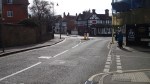








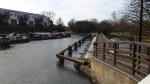




These pictures were taken as I arrived in Hertford North station and walked through the town centre to Hertford East station.
Apart from a nice walk, there was a serious point to my visit in that as part of the East-West Rail Link, the two stations could be connected. This section on the Hertford East station Wikipedia entry explains.
Some options of the proposed East West Rail Link involve reopening a route between Hertford East railway station and Hertford North railway station; however a 2009 discussion paper noted that while “the new connection appears technically feasible, doubts must be cast over its public acceptability and deliverability.
I don’t think it will happen, as it will stop all the development of expensive flats and houses at Hertford East station.
It is worthwhile looking at the Google Earth image of the town.
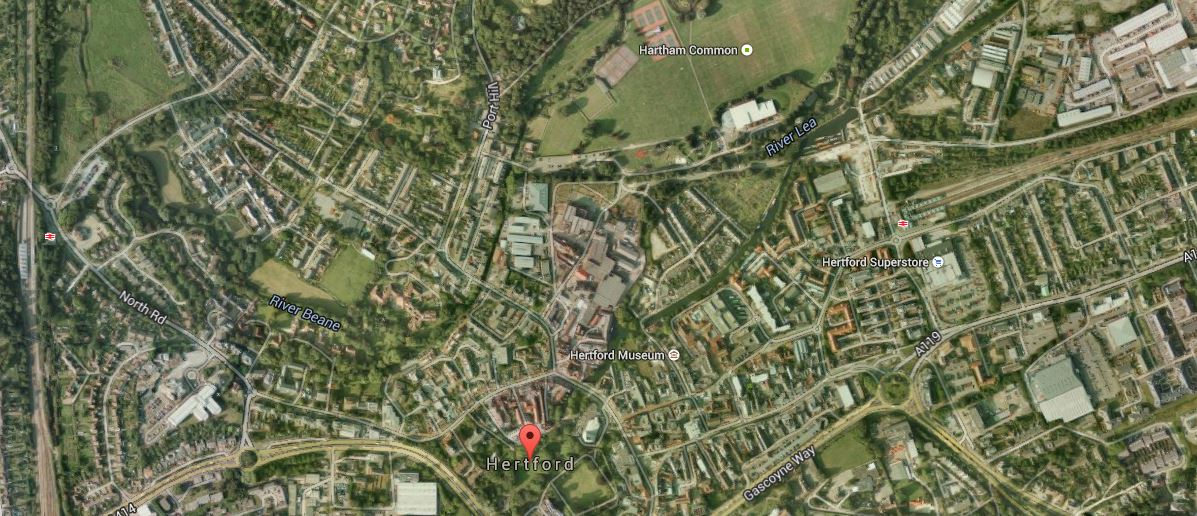
Hertford And Its Two Stations
The town centre is indicated by the red arrow and the rail icons can be seen at Hertford North on the Hertford Loop Line going north-south at the left of the image, and Hertford East at the right.
To answer my original question, I can’t imagine tram-trains ever be given permission to either run through the town-centre or across Hartham Common, but surely creating a connection to go north at Hertford North station, would need a rail engineer, with all the skills of Harry Potter, to lift the trains onto the viaduct.
At the east of the town, the train travelled under the A10 road as it crossed the Lea Valley on the Kingsmead Viaduct, which had to be built due to the nature of the terrain in the area. Any new rail line would have the same problem of both turning north and getting up the escarpment, which is heavily populated.
There used to be an extension of the Hertford East Branch, that appears to have left the branch before Hertford East station and then went across country to join the Hertford Loop Line north of Hertford. The line has been so built on, that Google Earth shows no trace. This is the Google Earth image of the land to the north of Hertford.
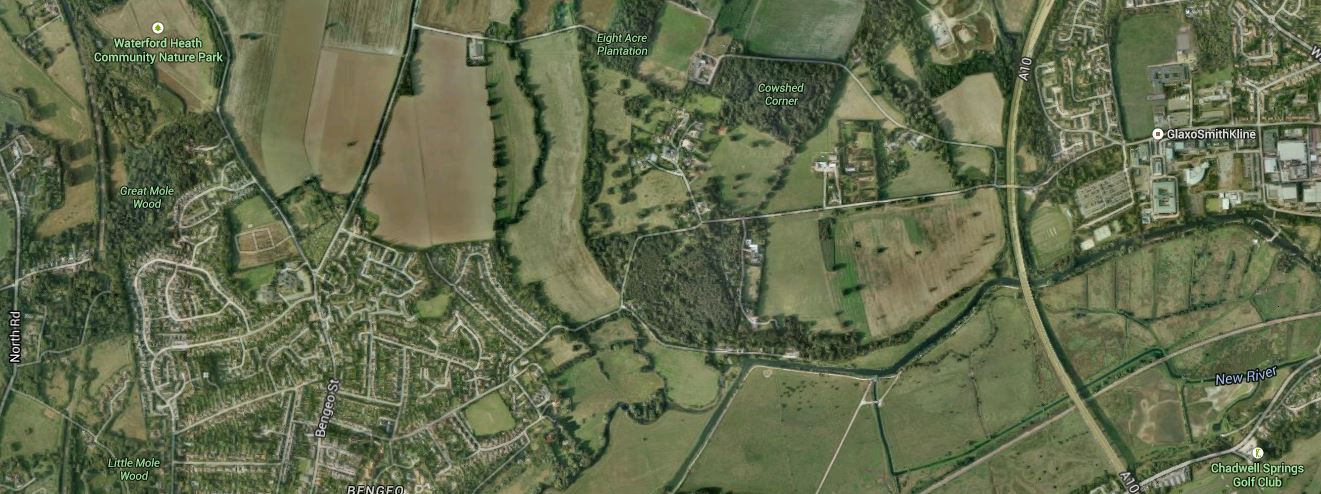
Across Hertford
You can see the Hertford Loop at the left of the image and you can also see the Hertford East Branch crossing under the A10 road at the right.
As the report says it would appear to be technically feasible to thread a railway between the two railways, but you can see why doubts on public acceptibility and deliverability have been raised. The only thing in the enginers’ favour is that you already have the ugly Kingsmead Viaduct across the Lea Valley, so perhaps you might be able to create a better solution.
Probably the only other way a connection could be made, would be to have a tunnel under Hartham Common, which then turned north underground before surfacing along the Hertford Loop Line north of the town. Even with advances in tunnelling technology and affordability, it would still be a very expensive project.
Investigating Warrington
Warrington with its two stations at Warrington Bank Quay and Warrington Central was flagged up as possible place for turning back Merseyrail trains on the Northern Line.
So on my way back from Leeds via Liverpool, I decided to visit for the first time.











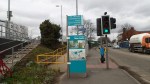





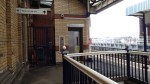

If you trace these images on a map you’ll see that I walked from Central to Bank Quay and back again.
I was very pleasantly surprised.
Instead of the rather second-rate Lancashire town I’d expected, I found a town that had been enlivened by lots of shops and quite a few restaurants including an Ask and a Nando’s.
It’s also a good idea to look at the two stations with Google Earth images, to see what possibilities exist for turning trains back to Liverpool.
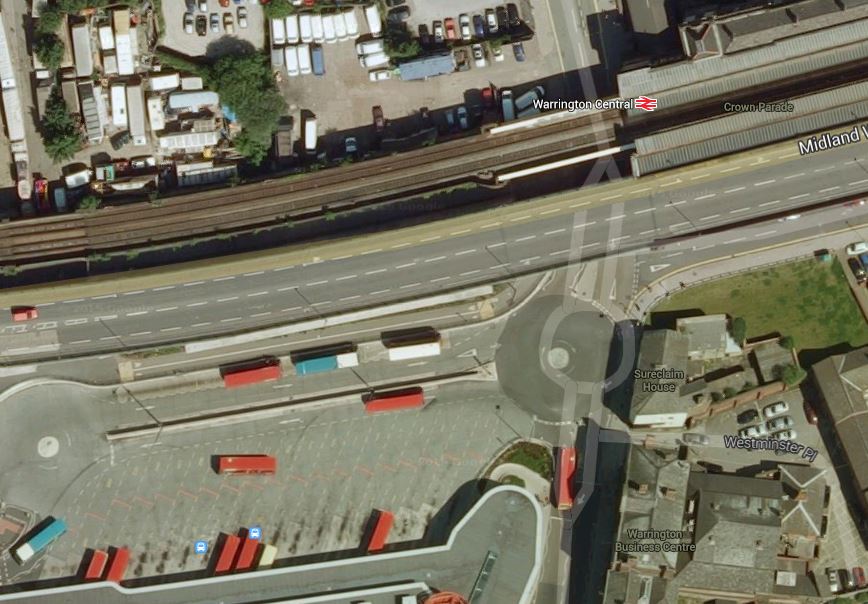
Warrington Central And Bus Stations
This image shows how the bus station is close to Warrington Central station, but as the station is close to the A57,which crosses the town, I doubt there’s any way a tram-train could access the Liverpool to Manchester Line on the viaduct.
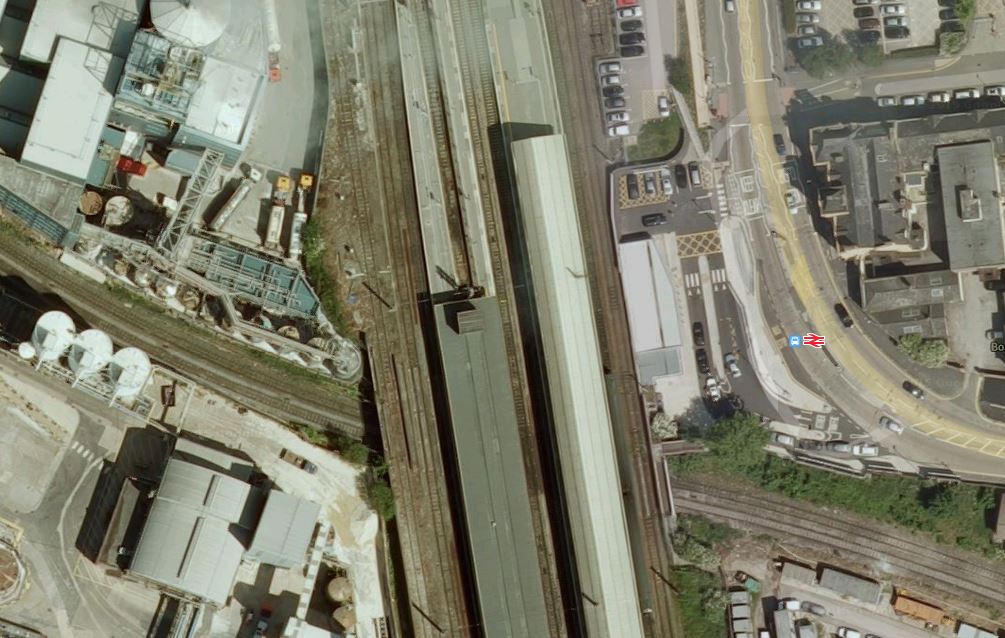
Warrington Bank Quay Station
You can clearly see the freight line passing under the West Coast Main Line in this image of Warrington Bank Quay station. A tram stop or low-level station on the freight line could easily be connected into the current high-level station and with lifts it could easily be a step-free interchange.
As I walked through Warrington town centre, I thought that an innovative tramway engineer could probably find a way to turn the tramway northward after Bank Quay station to perhaps finish its journey by Warrington Central station and the bus station. The route would probably be not more complicated than some of those in Manchester that I saw today.
But you could also go for a simple solution. There is probably space at the low-level Bank Quay station for a bay platform, where trains from Liverpool would turn back. That would not solve the problem of transfer passengers between the two rail stations and the bus station. They use a shuttle bus at present, so why not increase the frequency, perhaps power it by batteries and make it more visible!
Warrington got a boost today in that in this report on the Modern Railways web site, it was said that Liverpool to Manchester via Warrington is in the top group of lines that will be electrified.
That will also add to the possibilities of railway and tram-train layout in the Warrington area.
Could Tram-Trains Be Used To Advantage In Liverpool?
This document discusses the various issues concerning tram, tram-trains and conventional rail in the wider Liverpool area.
It is divided into the following sections.
1. Liverpool Trams And The Merseytram Proposal
2. A Tram-Train To The Airport
3. The Future Of Public Transport In The Wider Liverpool Area
4. Further Electrification In The Merseyrail Network
5. Extensions To The Merseyrail Network
7. Increasing Capacity On The Northern Line Through The City Centre
8. Connecting To Football At Anfield And Goodison Park
9. Capacity Problems At Lime Street
10. There Is A Need For Extra Southern Terminals
11. Upgrading The Halton Curve
12. Expansion Of South Parkway Station
13. The Canada Dock Branch And The Edge Hill Spur
14. The North Mersey Branch To Aintree
16. Electrified and Extended Lines In The North
18. Electrification Between Liverpool to Manchester via Warrington Central
22. Conclusions
Note that all of this post was produced using WordPress with most of the maps from Google Earth.
1. Liverpool Trams And The Merseytram Proposals
Liverpool doesn’t have trams any more, although it does have a legacy of wide dual-carriageways with a wide grass area in the middle, which was where the trams used to run. These would help with on-street running of a modern tram system.
Plans for a system called Merseytram are hanging around.
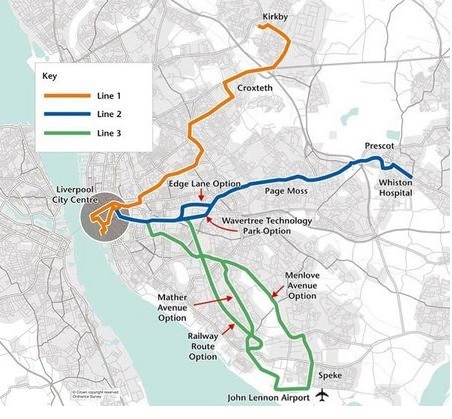
Merseytram Map
This map shows the comprehensive nature of the proposal.
In some ways, I’m surprised that Liverpool hasn’t done something to implement a modern system.
Liverpool too, doesn’t have much traffic congestion outside of the city centre and as they’ve just abolished bus lanes without too many protests, it might be assumed, that there is not the need for any more public transport, other than the current extensive buses and trains.
The latter are undergoing more electrification.
2. A Tram-Train To The Airport
However, there is one place, where a tram-train is being proposed in the area. Look at this Google Earth image, showing the area between Liverpool South Parkway station and John Lennon Airport.
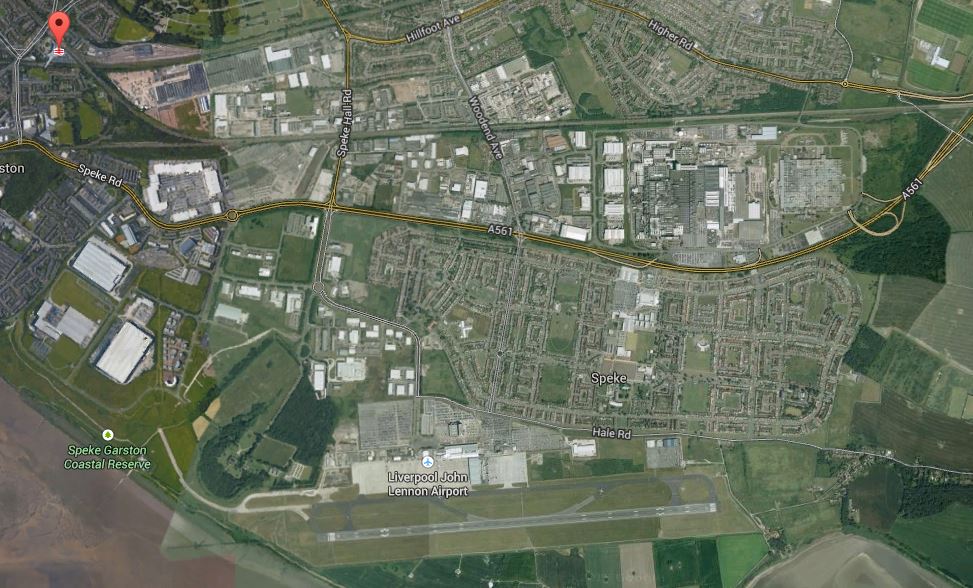
Liverpool South Parkway To John Lennon Airport
I’m not sure of the route and I can’t find anything on the Internet, but an airport to a nearby station is a classic tram-train application, as effectively you’re extending a rail line, by using much more affordable tramway infrastructure. In this type of application, you often have lots of airport infrastructure like secondary terminals and car parks, that need to be connected to both ends of the link. In Liverpool’s case you might even put a stop at Speke Hall. I know the area fairly well and those wide dual-carriageways and spare land alongside the railways will mean that putting in the tracks and stops will not be the most challenging of engineering. It would appear that compared to other schemes proposed for tram-trains it is very affordable, with the major cost being procuring the new tram-trains, which would also be used to run to the city centre and beyond on the existing train lines, giving passengers a one vehicle journey to a large number of places in Liverpool city centre.
What makes this proposal even more sensible in my view, is that Liverpool South Parkway, is served by both the City Line and the Northern Line that go to the city centre. Within a few years both lines will be electrified and would be a route for tram-trains.
This proposal is surely one of several around the country, that will be looked at in great detail, if the Sheffield-Rotherham tram-train trial is a success.
After my experiences in Kassel and Karlruhe, I’m sure that trial will be an outstanding success. If only, because we’ve got all the accumulated knowledge from design and operations of several tram-train systems all round the world.
3. The Future Of Public Transport In The Wider Liverpool Area
Liverpool and Merseyside in general have various plans, problems and decisions to take or solve in the next few years.
4. Further Electrification In The Merseyrail Area
On March the fifth, 2015 the North of England Electrification Task Force published its final report of which lines should be electrified.
The lines are grouped into three tiers and those in the Merseyrail area are.
Tier 1
- Liverpool to Manchester via Warrington Central
- Southport/Kirkby to Salford Crescent
- Chester to Stockport
- Warrington to Chester
Tier 2
- Chester to Crewe
Tier 3
- Ormskirk to Preston
These and other schemes may or may not effect this discussion.
5. Extensions To The Merseyrail Network
This map from Wikipedia shows the current network.
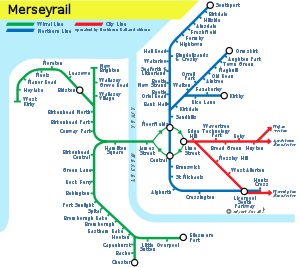
Merseyrail Network
A lot of the lines out of the centre end in areas in need of development, at all places on the price scale. Some of these and other places might be better served by using tram-trains, which run on from the current network and then perhaps could even go on a loop at the end of the line before returning to the city centre.
- The Skelmersdale branch could be reopened from Ormskirk.
- Could tram-trains run along the coast from Ainsdale, to the north of Southport, to create a tram line serving all of the golf courses and other leisure facilities?
- Could tram-trains help sort out the problems at Kirkby station, by going in a worthwhile loop around the town?
- Edge Hill to Bootle is an important freight line, that runs close to Goodison and Anfield football grounds, Network Rail have stated that this line may be electrified. Would using tram-trains with their simpler infrastructure needs make adding passenger services on this line easier?
- The North Mersey Branch from Bootle to Aintree is another freight line, that also runs close to Aintree racecourse. Like Edge Hill to Bootle, could tram-trains be a more affordable solution to adding passenger services to the line?
- Liverpool have long had aspirations to build an Outer Rail Loop. The route is safeguarded and could tram-trains enable an affordable passenger service?
I suspect that other lines and branches will be added to this list.
It is worth noting that all the tram-trains I’ve seen in Kassel, Karksruhe and Mulhouse, start on one line coming into the city as a train, go through the city centre as a tram and then take another line out of the city as a train. The Sheffield to Rotherham trial will use a version of this model. However in Liverpool, it would appear more likely, that tram-trains will be used to extend the existing rail network.
I don’t think anybody in their right mind, would expect Liverpool to follow convention.
6. Train Replacement
Merseyrail has a current fleet of just under 60, Class 507 and Class 508 three-car electric trains, that work the DC lines and these will need replacement in a few years. At nearly thirty-five years old, they are older than a lot of the dreaded Pacers. But they have certainly worn better.
With all the 25kV AC electrification that is planned for the area, any new trains would have to be dual-voltage, so they wouldn’t be limited in where they ran on the Merseyrail network.
Should some of the replacement trains, be something like Class 399 tram-trains? Some of these may be purchased anyway, if the tram link between Liverpool South Parkway and John Lennon Airport goes ahead.
They also tick all of the boxes of being dual-voltage, low-floor and with main-line performance and crash protection, so they could work the City, Wirral and Northern Lines, without causing problems with faster traffic.
They could probably be easily certified for working in tunnels.
It is worth stating some of the sdvantages I perceived when I saw tram-trains in action, in Kassel, Karlsruhe and Mulhouse.
1. When running as trains on a normal rail line, they fit in with the other traffic just like an electric multiple unit of the same length, taking their power from either overhead line or third-rail at the line’s voltage. Except for testing, you could run a compatible tram-train on many rail lines tomorrow.
2. When running as trams, they trundle around slowly in very much the same manner as trams do in Manchester, Sheffield and Croydon. Stops just need to be shelters with information and possibly a ticket machine. Power would usually come from a simple 750V DC overhead line, like most tramways in the UK and Europe.
3. Tram-trains can also run as trams on say a freight line, which has been electrified with either 25kV AC or 750V DC overhead line. This type of operation is being trialled on a Sheffield to Rotherham freight line to test the applicability of tram-trains to the UK. If the stops are simple affairs and not complete stations, the cost is kept low.
4.One problem that tram-trains might have is the difficulty of maintaining level access to the different platform heights. The new tram-trains in Mulhouse used clever steps to make sure it is easy to get on and off for all passengers.
5. Early tram-trains used to have separate control systems for when they were running as trams and as trains. But I suspect now, that UK trains are being equipped to run under ERTMS, which does away with line-side signals and relys on radio and screens, that this system can be used in tram-mode. This would certainly simplify operation.
In some ways because we are late to look at tram-trains we get the benefit of everybody else’s design and operational mistakes.
We might even be lucky in that a tram-train can be designed and built, that could run on any tram or train line in the country.
7. Increasing Capacity On The Northern Line Through The City Centre
This is mentioned as a problem in the Wikipedia entry for Merseyrail under tram-trains. This is said.
Tram-trains would allow street running, providing an alternative route through Liverpool city centre. It could potentially relieve pressure on the busy underground section of the network.
I don’t think you’d take a route in front of Lime Street station, but you could run along the historic water-front, to much the same route as the iconic Liverpool Overhead Railway. Although, you’d probably run at street level, rather than on a viaduct.
The line could run up the Mersey starting from Garston, Liverpool South Parkway or even the Airport in the South, going through the gardens along the river at Otterspool and then move away from the river to go on the landward side of the Albert Dock, the Liverpool Arena and the Three Graces. It would go close to the shops at Liverpool One, James Street station, the Mersey Ferries, the Cruise Ship Terminal and the development at Liverpool Waters, before possibly rejoining the Northern Line.
Liverpool are thinking of creating a new station at Vauxhall between Moorfields and Sandhills stations, which could be a good place for the rejoining. Incidentally, the developers are proposing a monorail link to the city centre for this development, so at least transport is being thought about.
This would be World-class transportation for a city making a reputation for itself as a World-class destination.
8. Connecting To Football At Anfield And Goodison Park
When people think about Liverpool, many think about football. I also think there is an increasing trend for football grounds at the top level to be well-served by trains or trams.
Following on from the previous section about increasing capacity on the Northern Line through the city centre, look at this Google Earth image of the area between Sandhills station and Anfield and Goodison Park.
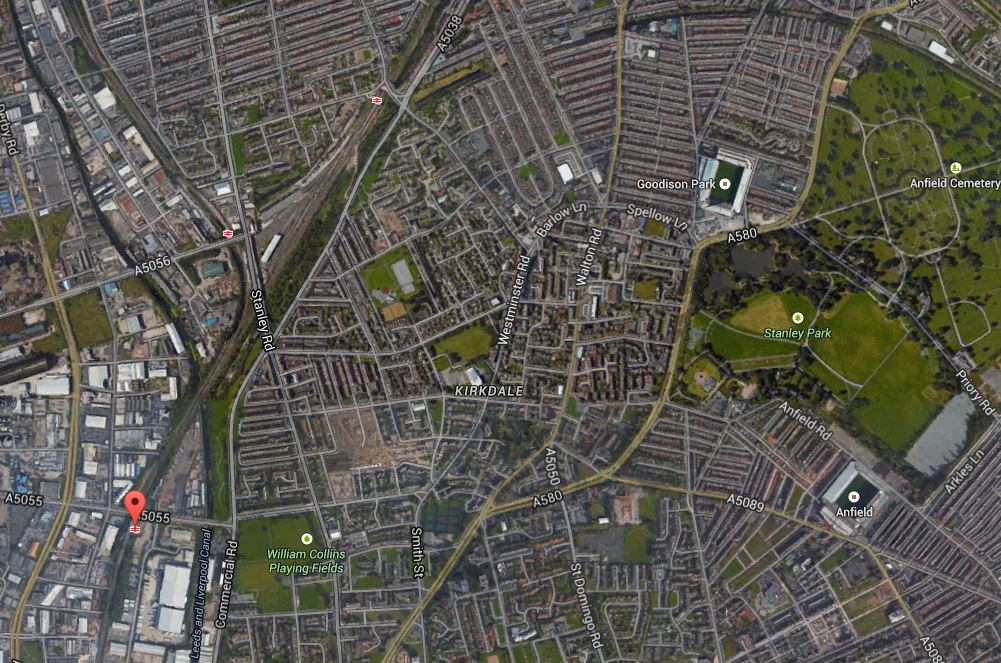
Sandhills Station, Anfield and Goodison Park
Sandhills is the station, from where connecting buses leave for football and it is indicated by a red arrow. North of Sandhills you can see Bank Hall station on the Southport branch of the Northern Line and Kirkdale station on the Kirkby branch.
Crossing under the two branches of the Northern Line, just south of Bank Hall and Kirkdale, and then curving away initially in a north-easterly direction before turning south-easterly around the Anfield Cemetery is the Edge Hill to Bootle Line or the Canada Dock branch, which is an important route for freight trains in and out of the docks. Merseyrail would like to use this line as a passenger line possibly with a station at Walton and Anfield, which would be about four hundred metres from Goodison Park and another at Breck Road, which would be a little bit further from Anfield. This modified Google Earth image, shows the two football grounds and the stations.
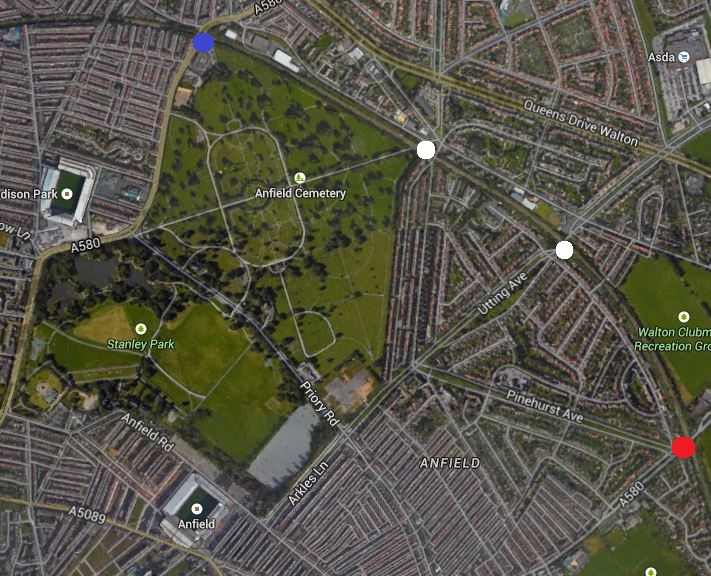
Anfield, Goodison Park and Stations
Obviously, Walton and Anfield is shown with a blue circle and Breck Road with a red one. I don’t know the area very well, as I have only been to Anfield once in the last forty years or so, so it might be that there is a possibility of putting a station at Utting Avenue or the north-east corner of the cemetery to serve both grounds. Both possibilities are shown with white circles.
If tram-trains were to be used on this line running as trams, then it might be possible to use a simple standard station design, as all stations are on bridges over roads. The Disused Stations web site has some more information and pictures, about the former Walton and Anfield and Breck Road stations.
As the line curves round to Edge Hill, supporters coming from the South and East could avoid the City Centre.
9. Capacity Problems At Lime Street
Liverpool Lime Street is a station, where capacity is a problem and I’ve read somewhere that Virgin can’t run their longest Pendolinos to the city. Wikipedia says this about work being done to create an extra platform.
The old platform 6A which is located next to platform 7 and is only used as a siding will become the new platform 7 in 2014. Existing platforms 7/8/9 will become new platforms 8/9/10, this will allow new long distance services to start and terminate at Lime Street to Scotland and London starting in 2015 from the new platform 8 & 9 (Virgin Trains).
There is also an idea called the Edge Hill Spur, that has been in the pipeline since the 1970s. This extract from Wikipedia sums it up.
The construction of the Spur would have connected the City Line branches to the east of Liverpool into the electrified Merseyrail network and importantly the underground section in Liverpool’s city centre. An increase in integration and connectivity of the system would be achieved. An additional and substantial benefit was releasing platform space at Lime Street mainline terminus station from urban to mid and long haul mainline routes, as the Spur would divert local urban routes entering the city underground in the city centre.
So everybody would seem to win. Even I would, as one of the proposals now is to have an underground station at my old University of Liverpool.
The accountants certainly win too, as much of the tunnelling required was dug by the Victorians or was enabled when Liverpool sorted out the underground railway in the 1980s.
One of the things that you have to remember as a visitor to Liverpool, is that the city centre slopes down to the Mersey, so it is an easy walk. I can walk up, but those with a lot of purchases in Liverpool One or various movement problems can get a train up from James Street station, a bus or a taxi.
There may be a case for running tram-trains as trams past Lime Street station, but I think if the connection at the station to the underground lines is improved and the train frequency around the loop is increased, then there is a lot less need. As it is frequencies to all destinations on the Wirral Line at Lime Street are four trains per hour, so to get to Central or James Street usually means a wait of no more than four minutes.
Once at Central to go North it’s the same fifteen minute frequency to go all destinations, with a train every five minutes. Going south to Hunts Cross there’s a train every fifteen minutes.
New trains with perhaps four cars and ERTMS, drawing on the experience of Crossrail and Thameslink in London, may be able to increase the capacity through the core.
10. There Is A Need For Extra Southern Terminals
If you look at the East London Line in London, which is of a similar layout of a central core with north and south branches, that runs modern trains, this handles sixteen trains per hour through its core section.
I think it is reasonable to expect that the Northern Line should be able to take a similar number of trains. But as the planned frequency in London is twenty-four and ERTMS is coming to both lines, does sixteen trains per hour on the Northern Line look very conservative? .
My scheduling gut-feelings also say that if the number of destinations south of the city centre were increased and this meant that fewer trains were turned back at Liverpool Central, then capacity and frequency would be raised. This section on services at Liverpool Central says that twelve services an hour go north to the various destinations of Southport, Ormskirk and Kirkby and only four go south to Hunts Cross and Liverpool South Parkway. So that means eight per hour have to wait. It’s a similar problem to what used to happen in London at Edgware Road on the Circle Line, except there it was an easy solution. They turned the circle into a spiral.
Trains and drivers seem to be wasting their time sitting in the turn back platform at Liverpool Central, when they could be doing something useful, like perhaps running to Runcorn or Warrington.
The Edge Hill Spur won’t help, as because it joins to the north of Liverpool Central station, if another terminus is not added in the south, this will just add to the problems.
Resources must be balanced, so if from Sandhills to Liverpool Central the frequency is twelve trains per hour, the frequency should be planned to be the same from Liverpool Central to Brunswick.
If the traffic isn’t balanced you get trains in the centre waiting to go back north.
If Merseyrail wants to run traffic to three northern destinations at a frequency of four trains per hour, it would seem that one of the best solutions would be to run trains to three southern destinations at the same frequency. On the East London Line, there are four Southern destinations and two in the north, but each with two platforms.
In Liverpool they’ve already got Hunts Cross and they’re planning to add the Airport as another. I think they need another to balance the line and improve frequency and punctuality.
11. Upgrading The Halton Curve
Funds have been made available to upgrade the Halton Curve, so that trains can reach Chester from Liverpool South Parkway via Runcorn.
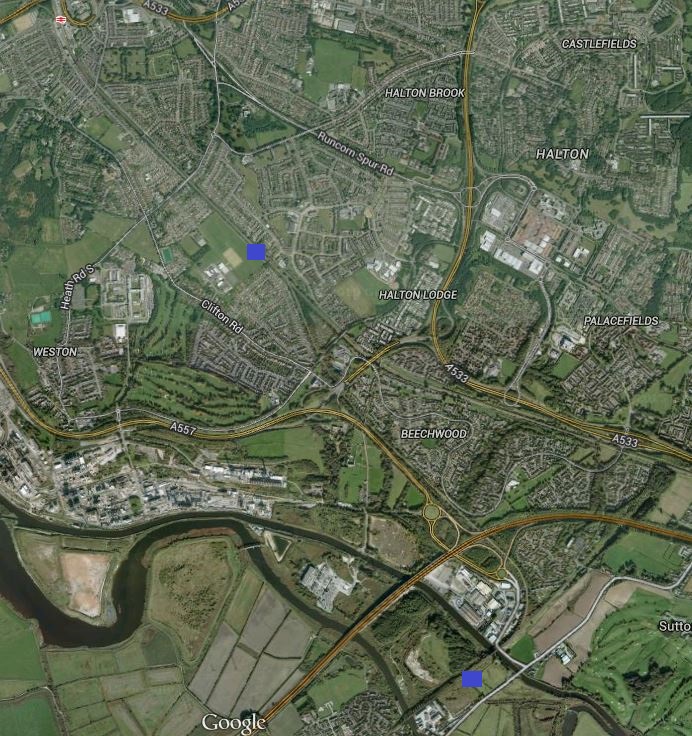
The Halton Curve
The two blue squares indicate the two ends of the current single-track curve. The top one is where the curve leaves the Liverpool branch of the West Coast Main Line south of Runcorn station and the bottom one is where it joins the Chester to Manchester Line east of Frodsham.
The main reason for doing this would be to allow trains from Chester and North Wales better access to Liverpool Lime Street and South Parkway stations, and the John Lennon Airport.
As the Tier Two and Three electrification plans for the North as they effect Merseyside, include full electrification of the lines around Chester, this would mean that an upgraded curve would be electrified.
There are probably good reasons to add an extra track to the curve, which would make it possible for Chester to be a new southern destination of the Northern Line.
12. Expansion Of South Parkway Station
Liverpool South Parkway was built as a transport hub so that travellers to the city,could use the local electric trains to get to all parts of the area, without going into the city centre. This Google Earth image shows how the station is built between the Northern Line and the Liverpool branch of the West Coast Main Line.

Liverpool South Parkway Station
The Northern Line platforms are at the bottom, with the ones to the right serving the other lines, so it is effectively two stations and a transport hub.
Liverpool want to get more services running from Liverpool South Parkway station and would like to see some Virgin Trains services stop there, but the platforms are too shirt for Pendelinos.
Tram-trains might help grow traffic, as with the airport connection and perhaps other services using the technology, the station could become a hub from where you could get all over Merseyside.
Other factors will also help.
1. As time progresses, quite a high proportion of services from to and from Liverpool Lime Street will stop at the station, so it could become an alternative station from where to catch long distance trains.
2. Merseyrail wants to fully develop the Halton curve, which will give alternative routes to Chester and North Wales. Due to its proximity to the John Lennon Airport, Liverpool South Parkway can only benefit.
3. Merseyrail also have a desire to create an Outer Rail Loop that encircles the city. Nothing has happened much in recent years, but if the North Liverpool Extension Line should be reopened, I’ll ride it, as it goes through places dear to my memory of the wonderful four years I spent in Liverpool. C and myself at one time lived in a rented flat near Gateacre station on the line and regularly drunk in the Black Bull pub in Gateacre. If the line should be reopened and a circular railway is formed around Liverpool, Soputh Parkway station will only gain more traffic.
4. HS2 and HS3, if they reach Liverpool will surely stop at Liverpool South Parkway.
Most Parkway stations in this country are isolated and you need a car to get to them, but Liverpool South Parkway is unique in that it is a transport hub outside of the city centre close to an airport.
I believe that in time South Parkway will become an alternative station to Lime Street. After all, it only takes twenty minutes on a train between South Parkway and Central or Moorfields in the city centre.
Improved trains and a few tram-trains can only hasten the rise of this station’s importance.
13. The Canada Dock Branch and the Edge Hill Spur
I talked in Section 7 about how the Canada Dock Branch between Bootle and Edge Hill could improve passenger services in an arc in the north-eastern part of the city and in Section 8 about how capacity problems at Lime Street might be improved by the Edge Hill Spur.
Edge Hill station is one of the oldest stations in the country and will only grow in importance, when it receives the new electrified services from Manchester in a few months. At present the Canada Dock Branch is not electrified, but with the large number of freight trains going into and out of the docks, it can’t be long before this line gets wired.
This Google Earth image shows where the southern end of the Canada Dock branch splits to allow trains to go east to Broad Green station or west to Edge Hill station.
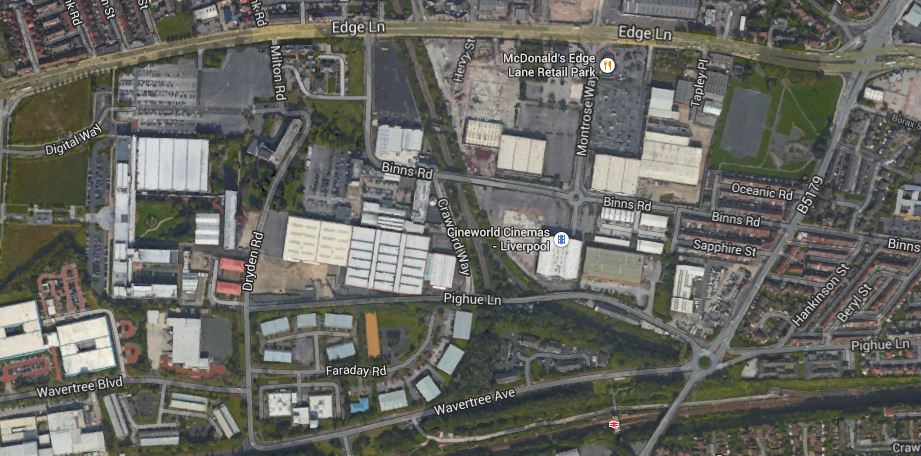
The Southern End Of The Canada Dock Branch
The chord going east is the Olive Mount Chord, which was only reopened in 2009 to create an easier route for freight trains between Seaforth Dock and the West Coast Main Line. Read this section in the Wikipedia entry for Seaforth Dock, which describes how one three hundred metre rail line made everything easier and increased capacity of the rail line by 100%. It also freed up capacity so that a passenger service could be created.
The station south of the junction is Wavertree Technology Park on the main Liverpool to Manchester Line, between Edge Hill and Broad Green. It should also be noted that there used to be a station at Edge Lane, where the branch crosses the road of that name.
Obviously, if the Canada Dock Branch were to be run using tram-trains, there are possibilities of extra stops in the area.
Merseyrail originally planned to put a transport hub at Broad Green and you can see why, as trains on both the Canada Dock Branch and the Edge Hill spur could pass to or through the station. As this Google Earth image shows, the station is shoe-horned into a forest of motorways and dual-carriageway roads.
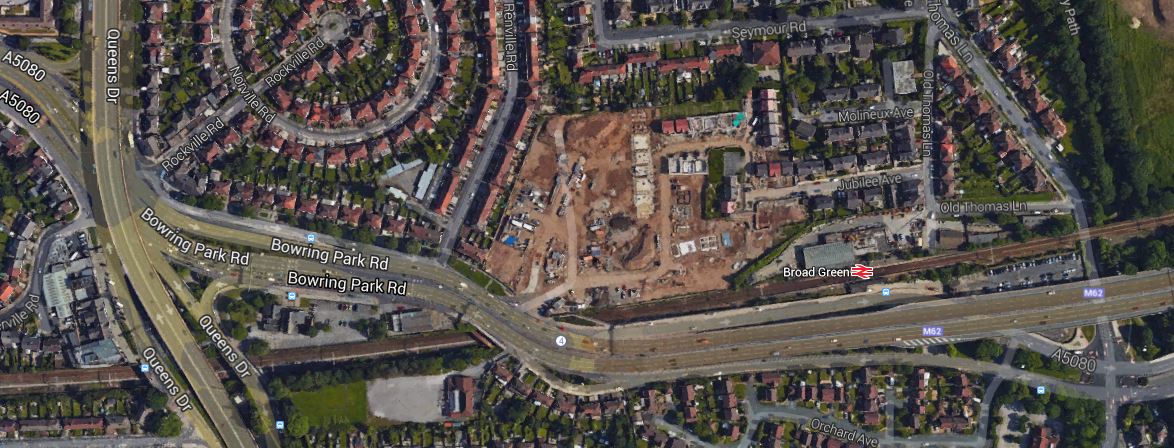
Broad Green Station
, A good creative architect could make something of this transport hub and give Broad Green a bay platforms for the extra trains.
14. The North Mersey Branch To Aintree
The North Mersey Branch is a railway to the north of Liverpool, that is really only used for engineering purposes. It originally linked Gladstone Dock and Bootle with Aintree and the racecourse.
This Google Earth image shows the line of the Aintree end of the branch.
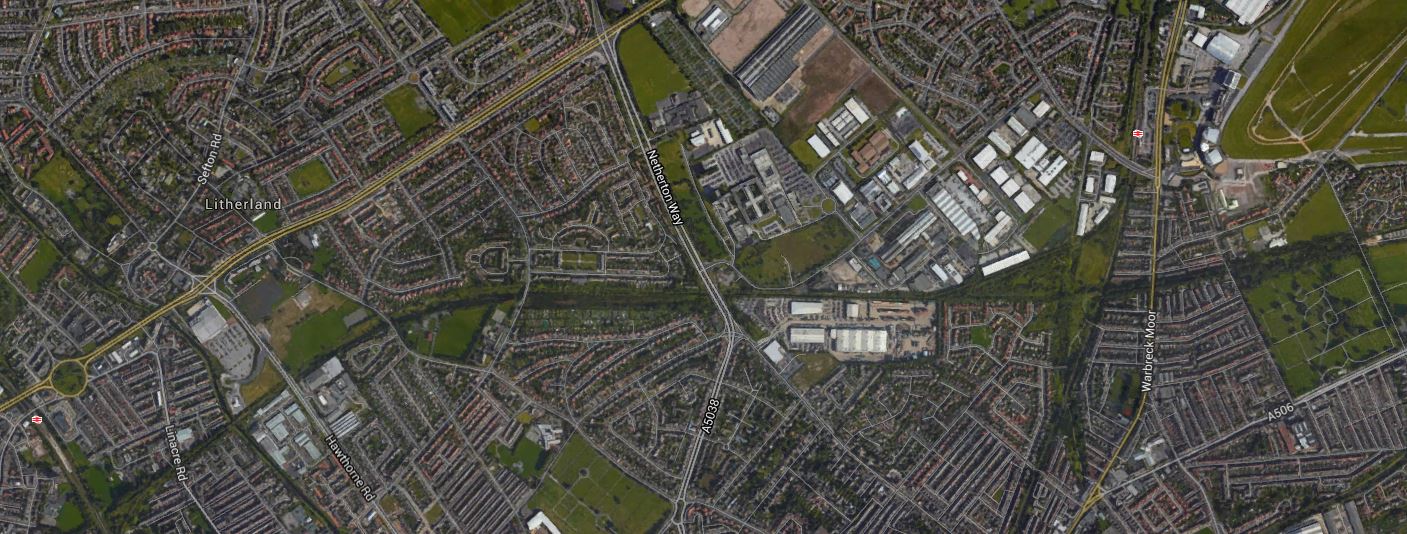
The North Mersey Branch
The station on the left of the image is Seaforth and Litherland and Aintree station and the racecourse can be seen in the east.
The line could also be extended to the west into the docks and at the east to Kirkby, which is an area that in the 1960s needed a good sort-out of public transport and probably still does.
Could this be a line that would benefit the area, by being turned into a tram-train route across the north of the city?
15. The Skelmersdale Branch
Skelmersdale is the second largest town in North West England without a railway service. Merseyrail’s entry on Wikipedia, has a section about the reopening of the Skelmersdale Branch to the town centre, which includes this.
The reopening of a section of the Skelmersdale Branch from Upholland to Skelmersdale town centre has been proposed.[42] The line was completely closed in 1963. This would give Skelmersdale, the second largest town in North West England without a railway service, direct access to Liverpool city centre. Network Rail has recommended that a further feasibility study be carried out.
One proposal is to extend the line from Ormskirk station by laying 3 miles of new single track along the previous route towards Rainford Junction station.
This single track proposal could be one to be built in an affordable way for a tram-train.
16. Electrified and Extended Lines In The North
Under the electrification plans for the North, some of the lines fanning out in the north of Liverpool and Southport will be electrified.
In Tier One, the Southport to Manchester Line and the Kirkby Branch would be joined to the electrification in Manchester at Salford Crescent station, which is being improved and expanded.
This electrification is essentially separate from the third-rail Northern Line, so it does mean that Southport and Kirkby stations will be on both electrification systems.
Where they do interact more directly is when under Tier Three of the electrification, the Ormskirk to Preston Line is electrified.
This line crosses the Southport to Manchester Line at the Burscough Curves. Merseyrail have wanted to reinstate this full junction for some time and this is said about the curves on the Wikipedia entry for Merseyrail.
The Burscough Curves were short chords linking the Ormskirk to Preston Line with the Manchester to Southport Line. The last regular passenger trains ran over the curves in 1962; the tracks were subsequently lifted. The reinstatement of the Burscough Curves would allow direct Preston-Southport and Ormskirk-Southport services and provide an alternative Liverpool-Southport route. Network Rail has recommended that a strategy for the Burscough Curves be developed further.
This Google Earth image shows the curves.
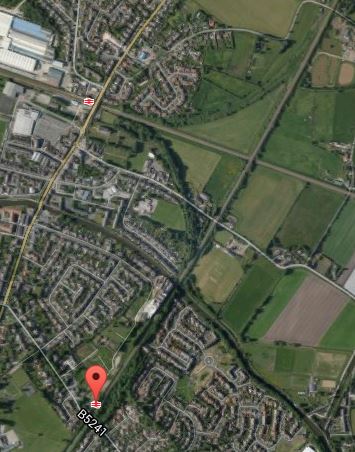
Burscough Curves
The two stations are Burscough Junction indicated by the red arrow on the Ormskirk to Preston Line and Burscough Bridge on the Southport to Manchester Line. The crossing of the two lines can be clearly seen and the two curves can also be made out, although the track was lifted decades ago.
Although, a reinstated junction would undoubtedly be good for the area, this link doesn’t really have any ramifications for the rail system in Liverpool, as both lines will have 25kV AC overhead electrification.
If trains on the Northern Line are to run past Ormskirk and Kirkby, they would have to be dual-voltage.
17. The Outer Rail Loop
Wikipedia explains the Outer Rail Loop in a section of the entry for Merseyrail, This is said.
The Orbital Outer Rail Loop was a part of the initial Merseyrail plans of the 1970s. The route circled the outer fringes of the city of Liverpool using primarily existing rail lines merged to create the loop. With Liverpool city having a semi-circular footprint with the city centre at the western fringe against the River Mersey, the western section of the loop would run through the city centre. The scheme was started along with the creation of Merseyrail however postponed due to cost cutting.
As Liverpool has been a major port since we started building railways in this country, as in London and Glasgow, they go hither and thither linking the docks to the lines in and out of the city.
The railways that may go to create the Outer Rail Loop, like the North Liverpool Extension Line, North Mersey Branch Line and some of the electified lines in the city, are either fully operational or safeguarded.
It’s a real pity that all those railways closed after the Beeching Report, were not protected from building over, as we’d have saved millions in creating some of the new railways.
But then design by hindsight is easy.
As finally planned the Outer Rail Loop was a northern loop and a southern one. Each probably has their own very good reasons why they should be built and the large economic forces at work in Liverpool will decide what actually gets built.
Most of the North Liverpool Extension Line now is a walk called the Mersey Path. This Google Earth image shows the green way, where the track used to be.
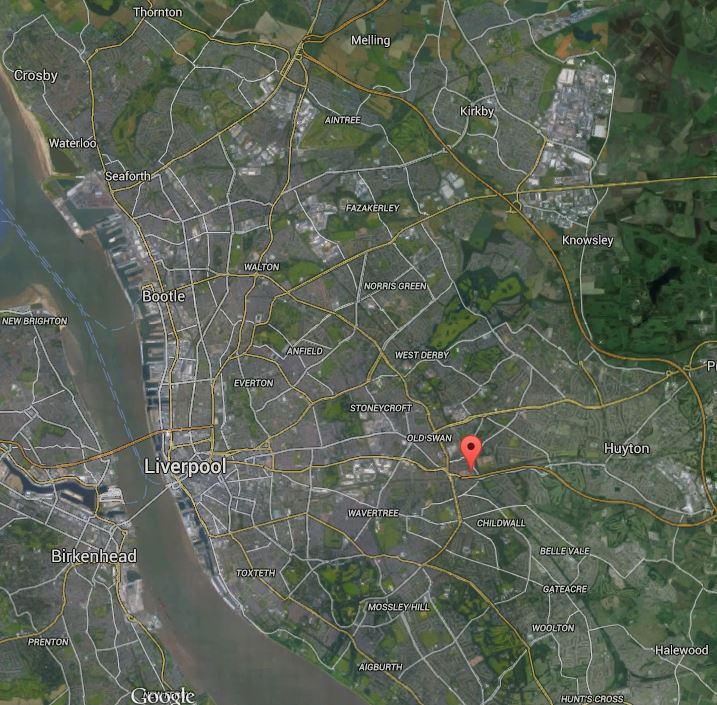
North Liverpool Extension Line
The red arrow picks out Broad Green station and you can see the green line of the Mersey Path or Liverpool Loop Line passing to its right in a northerly direction. At the southern end it splits with one branch going east to Halewood and the other west to Hunts Cross.
I never rode the original trains, but the place names as you go north bring back lots of memories; Gateacre, Childwall, Broad Green, Knotty Ash, West Derby, Fazakerley, Walton, Aintree and Huskisson. Pronunciation of most has to be learned by foreigners!
In writing this, I think those planners in the 1960s got their ideas right. An Outer Rail Loop might just be a good idea for which the technology has finally arrived.The Liverpool Loop Line has certainly been well-laid out as a cycle and walking route.
Imagine a tram-train using the path in tram mode running on mainly a single track with passing places, which it shares with the cycle and walking route of the Mersey Path. I don’t know of this being done in the UK, but I’ve certainly seen it in The Netherlands. But something similar has been done to provide a walking and cycling route alongside the Cambridge Guided Busway and Wilford Toll Bridge is being widened to take Line 2 of the Nottingham tram and cyclists and pedestrians.
Starting at Hunts Cross, it would go up the line to Broad Green, where it would have an interchange with the Liverpool to Manchester and Wigan services, and then it would loop across the north of the city to the Mersey and the Docks. Interchanges could be made with the Northern Line there and the tram-trains could even go back down the riverside to Hunts Cross.
18. Electrification Between Liverpool and Manchester via Warrington Central
This electrification has been proposed in the Tier One electrification plans for the North.
This is the busiest passenger route between the two cities will start from Hunts Cross at the Liverpool end and continue through Warrington to Manchester Piccadilly.
This electrification has been mooted before and the Wikipedia section for the line says this.
The Liverpool to Warrington section of this line was initially scheduled to be on the Merseyrail electric urban network. The Strategic Plan for the North West, the SPNW, in 1973 envisaged that the Outer Loop which was to be an orbital line circling the city of Liverpool, the Edge Hill Spur which is a tunnel connecting the east of Liverpool to the central underground sections, and the lines to St. Helens, Wigan and Warrington would be electrified and all integrated into Merseyrail by 1991. This meant that trains from Warrington would access Liverpool city centre’s underground stations via the Northern Line and Liverpool Central underground station, giving access to Liverpool’s shopping and business quarters. This never transpired, however is a long term aspiration of Merseytravel.
It truly has taken a long time to be planned, let alone delivered.
If Northern Line trains do eventually run to Warrington, then like the trains used to extend to the north, they will have to be specified as dual-voltage, to run in the third-rail electrified tunnel and on the sections of the line with 25kV AC overhead electrification.
19. A Coastal Tramway
Liverpool Airport is on the bank of the Mersey and the current Northern Line goes all the way up the coast to Southport. The West Lancashire Railway used to continue the line to Preston but was closed in the 1960s. This Google Earth image shows the coasts and major towns around Liverpool.
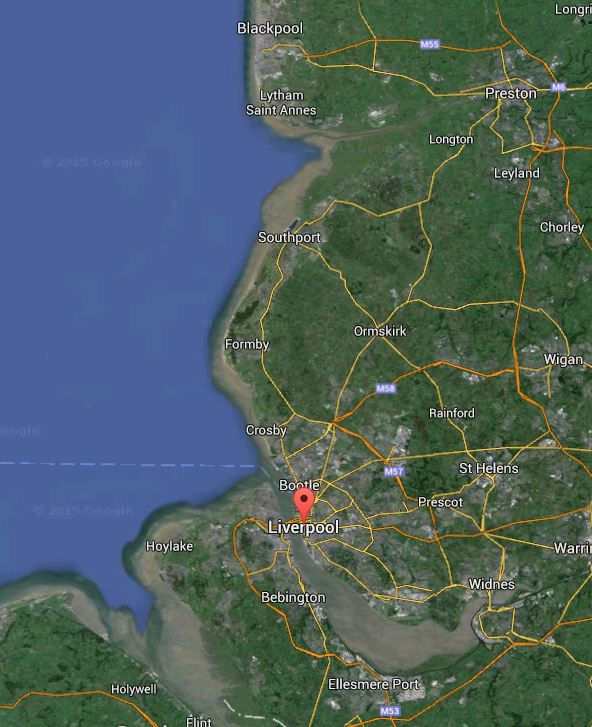
The Liverpool Coastline
This image shows there is a possibility to extend the tramway in the north. If the Blackpool trams and the Northern Line were both extended almost as far as Preston, they could be connected across the River Ribble and you would have a scenic way of getting between Blackpool and Liverpool on a coastal tramway, that took in all range of sites from world class architecture to some of the best links golf courses.
Going west the Wirral Line at West Kirby could be extended down the coast of the River Dee. I don’t think you’d make a direct route, but passengers could change lines at an upgraded James Street station. Its design doesn’t really reflect its importance as a station, but says more about being an economy station station created in the 1970s.
Going south towards Widnes and Runcorn would never have been a possibility, when I lived in Liverpool and worked in Runcorn in the late 1960s, but now all is changing. I believe that it is so significant that it deserves its own section.
If Northern Line trains do eventually run to Warrington, then they will have to be specified as dual-voltage.
20. The Mersey Gateway
The Mersey Gateway is a new bridge being built over the river to the east of the existing Silver Jubilee Runcorn-Widnes Bridge. This Google Earth image shows the Mersey from Liverpool South Parkway station to the massive Fiddlers Ferry Power Station.
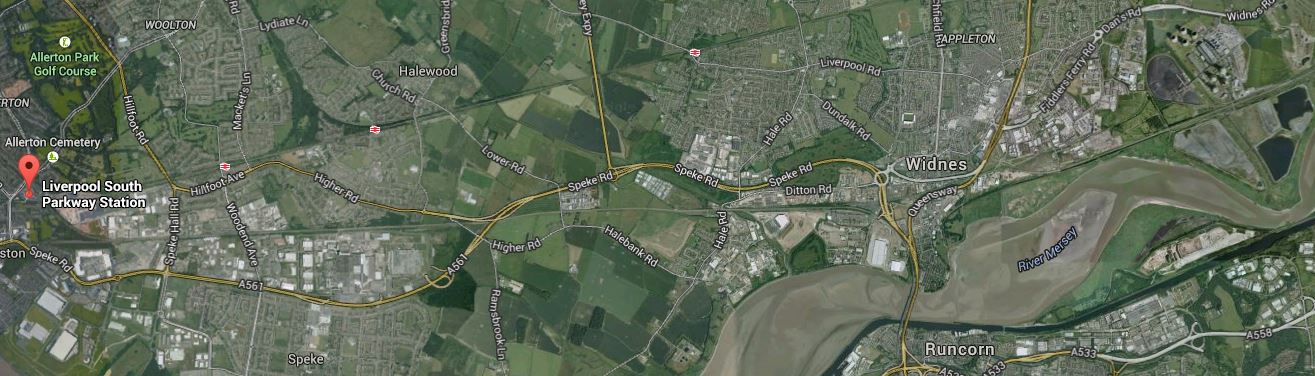
Along The Mersey
The station is indicated by a red arrow and you can clearly see the existing bridge across the Mersey, next to the Britannia Bridge carrying the Liverpool Branch of the West Coast Main Line. The power station is at the top right or north-east corner of the image.
This is said by Wikipedia about the charging arrangements for the new bridge.
It is envisaged that the new bridge will be a toll bridge, with three lanes in each direction. The Halton Borough Council has also stated that the current bridge will also become a toll bridge, making Halton the only borough in England separated by only toll bridges. It was also put forward that the current bridge may be reduced to one lane in each direction for vehicles, with the other two lanes being converted into cycle lanes and/or pedestrian lanes.
As the current bridge is toll free, it will go down like a lead balloon. Especially with those, who commute across the river to and from Liverpool every day. There is this report on the BBC, saying that Halton residents will be able to use the bridge for free. It would appear there is a strong campaign against the tolls from the report.
One good alternative would be to extend the Northern Line from Hunts Cross to Runcorn, but Runcorn station would not have the capacity in its present form. Look at this Google Earth image of the area from the station to the bridges.
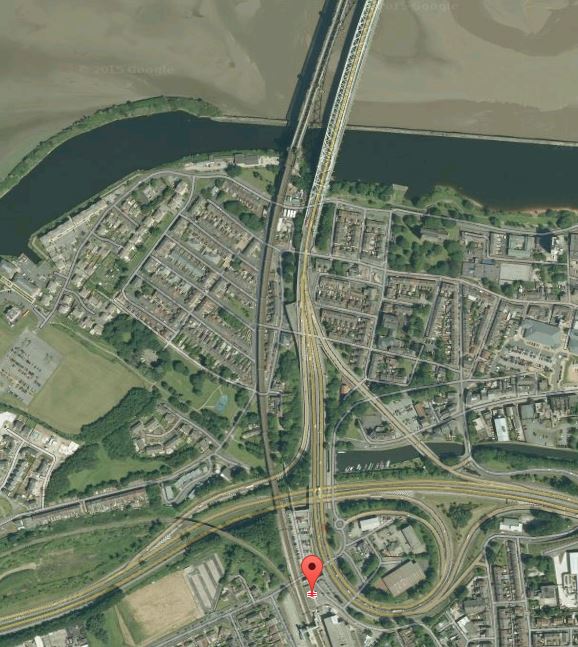
Runcorn Station And The Bridges
It might be possible to squeeze in the extra platform and junctions that would be needed, or more probably the trains could go on via the Halton Curve to Chester via Frodsham and Helsby. Obviously, following practice on the Northern Line, there would be an objective of providing four trains per hour to and from Hunts Cross and the centre of Liverpool. Look at this Google Earth image of the northern end of the Halton Curve.
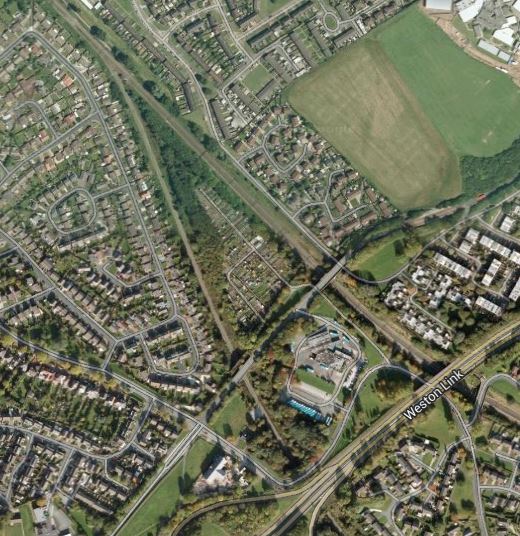
Northern End Of The Halton Curve
Surely a station could be built in this area, which could also be used to turnback trains for Liverpool. Tram-trains might be able to take a circular on-street route around the town, if that was thought to be what was needed.
Returning to the North Bank of the river, the first image in this section shows a rail freight line that runs from Liverpool docks to the power station for the transport of biomass via Liverpool South Parkway. This Google Earth image shows the area north of the Mersey around Widnes.
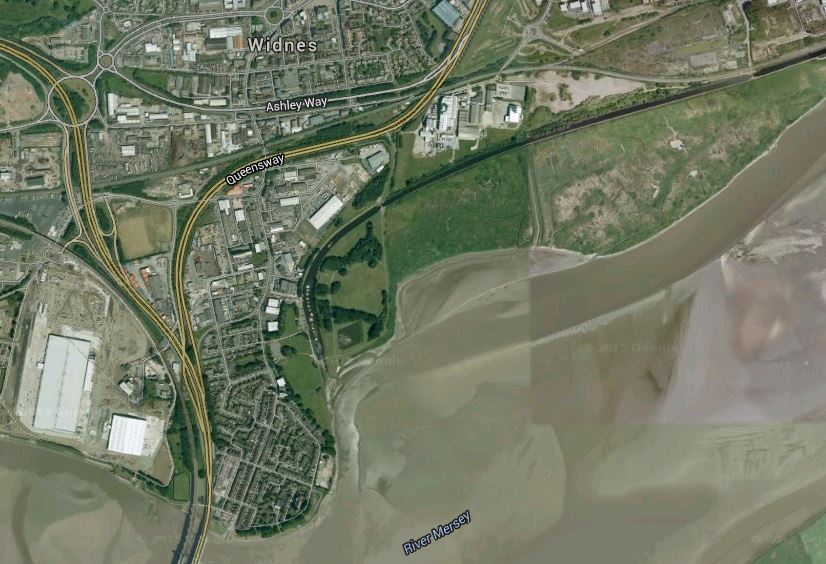
Widnes
The freight line can be seen going across the image from west to east, passing under the railway and roads linking to the existing bridges, then following on the north side of the dual-carriageway before going southwards to follow the St. Helens Canal.
So could this line be used by extended Northern Line services in the future? I suspect that within a few years, plans will be published for the decommissioning of the power station, as it is now over forty years old, so who knows what will be done with the site. But surely, a good train or tram-train service to the centre of Liverpool in the west and Warrington and Manchester in the east will be essential, whatever is developed on the site.
The train line could also have stations or even simple tram stops in the region of both bridges. Unfortunately, due to the design and height of the approaches to the Britannia and Silver Jubilee Bridges, a simple interchange might not be possible, but you could rebuild the station at Ditton, where the two lines meet.
The biggest problem for Widnes and Runcorn, is that the borough is effectively in two parts on either side of the River Mersey.
The availability of tram-trains may give advantages to sorting this out, but overall the Mersey Gateway, looks like a project,that has been designed in isolation for road users.
21. Onward To Warrington
Currently, Widnes is served by trains on the Liverpool to Manchester Line that go via Warrington Central station.This Google Earth image shows the Warrington area.
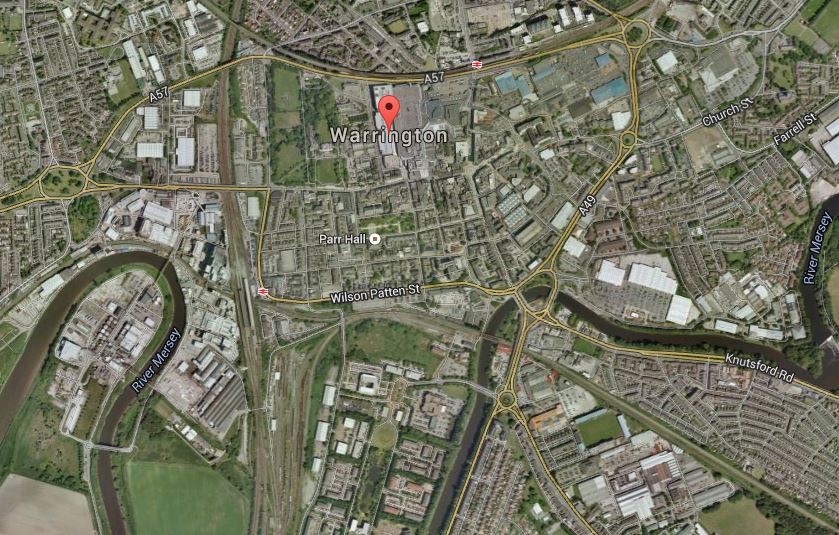
Warrington
Warrington Central station is to the right of the red arrow indicating Warrington and Warrington Bank Quay station is below the arrow to the left on the West Coast Main Line. One of the problems of the trains in the town, is that you have to get a shuttle bus, a taxi or walk between the two stations.
Note how the freight line along the Mersey goes around the bend of the Mersey on the left, under Warrington Bank Quay station in the disused Low Level station and then crosses the Mersey before going off in a south-easterly direction. To the West of Warrington, this railway is the St. Helens and Runcorn Gap Railway and to the East it is the Warrington and Altrincham Junction Railway. It effectively was another route between Liverpool and Manchester, although it is closed in places and just runs freight services over parts of the line.
As both these southern Liverpool-Manchester routes go through Warrington, it could be a reasonable assumption, that some of the trains on the Northern Line could turnback in the town, as was originally envisaged in 1973.
There is a lot of scope to provide an intelligent solution to turning trains round, which would at worst add another four trains an hour to and from Liverpool.
I’ve just looked at how you get from Widnes to London or Carlisle by train on the National Rail Journey Finder. It is not an easy journey and at best involves a change at Liverpool or Manchester and at worst a transfer across Warrington.
A few days after I wrote this article, I visited Warrington. I found a modern town with a good shopping centre and wrote this.
As I walked through Warrington town centre, I thought that an innovative tramway engineer could probably find a way to turn the tramway northward after Bank Quay station to perhaps finish its journey by Warrington Central station and the bus station. The route would probably be not more complicated than some of those in Manchester that I saw today.
But you could also go for a simple solution. There is probably space at the low-level Bank Quay station for a bay platform, where trains from Liverpool would turn back. That would not solve the problem of transfer passengers between the two rail stations and the bus station. They use a shuttle bus at present, so why not increase the frequency, perhaps power it by batteries and make it more visible!
It is not an easy problem to solve, but I do believe that Warrington would make an ideal additional destination for Northern Line trains.
Unless they revert to street running, the trains coming to Warrington would be normal trains without any tram capability, thus simplifying the needs even more.
And after Warrington, should the Northern Line trains go all the way to Manchester? Or could the line through Warrington Central go to Manchester and the southern line underneath Bank Quay go to Stockport? The possibilities are endless.
If Liverpool’s tram-trains are certified for Manchester and vice-versa, you probably get some innovative joint services but you stir up an awful lot of political hornets’ nests.
22. Conclusions
Liverpool still has a lot of connecting railways and as it is acquiring a new fleet of electric trains and has aspirations to link the airport to the Merseyside electric rail network using a tram-train. There are also other places where a tram-train could be sensibly used to create new services, perhaps including these lines and applications.
1. The Airport Connection From South Parkway.
2. The Canada Dock Branch serving the football grounds.
3. Furthe Extensions to the Northern Line in both the North and South.
4. An iconic tram running up the river from Garston to Bootle and possibly further.
5. The Liverpool Loop Line from Hunts Cross to Aintree and Litherland.
I would think it would be prudent if the new train order included a number of tram-trains.
Liverpool though, does show that you don’t need to have trams to run tram-trains. You just need freight lines where adding passenger services is a necessary and plausible idea. You add the simpler stations using well-proven tramway technology, to make the whole project affordable.
The Northern Line could grow from a well-used, but limited line, which predominately serves the northern side of Liverpool, to one that goes along the bank of the Mersey and through Liverpool City Centre from Runcorn, Widnes, Warrington and Liverpool Airport in the South, to Southport, Ormskirk, Kirkby and Preston in the North. In the future, It might even link Chester and Stockport to Wigan, Preston and Blackpool.
If you look at the East London Line in London, which is of a similar layout, with modern trains, this now handles sixteen trains per hour through its core section. I think it is reasonable to expect that the Northern Line should be able to take a similar number of trains with just the investment of creating extra Southern terminals.
The line is but a sapling just about to grow into a tree, with a full size collection of branches.
If you look at the Future section in the Wikipedia entry for Merseyrail, you realise the potential that there is in Liverpool’s railways.
Tram-trains could help the dreams become realities.
Could Tram-Trains Be Used To Advantage In Croydon?
The Croydon Tramlink has been around since 2000 and doesn’t get mentioned very often with respect to either expansion or tram-trains.
Tramlink Route 1
The Tramlink Route 1 to Elmers End, does not give much scope for tram-trains as Elmers End is the only station with a rail connection, other than East and West Croydon.
That is unless you wanted to run tram-trains up the Hayes Line to perhaps Lewisham or even Cannon Street.
These pictures show how the tram interfaces to the rail line at Elmers End.


It would appear to my untutored eye, that trams might be able to connect northwards, but southwards looks difficult. This is probably confirmed by this Google Earth image of the station.
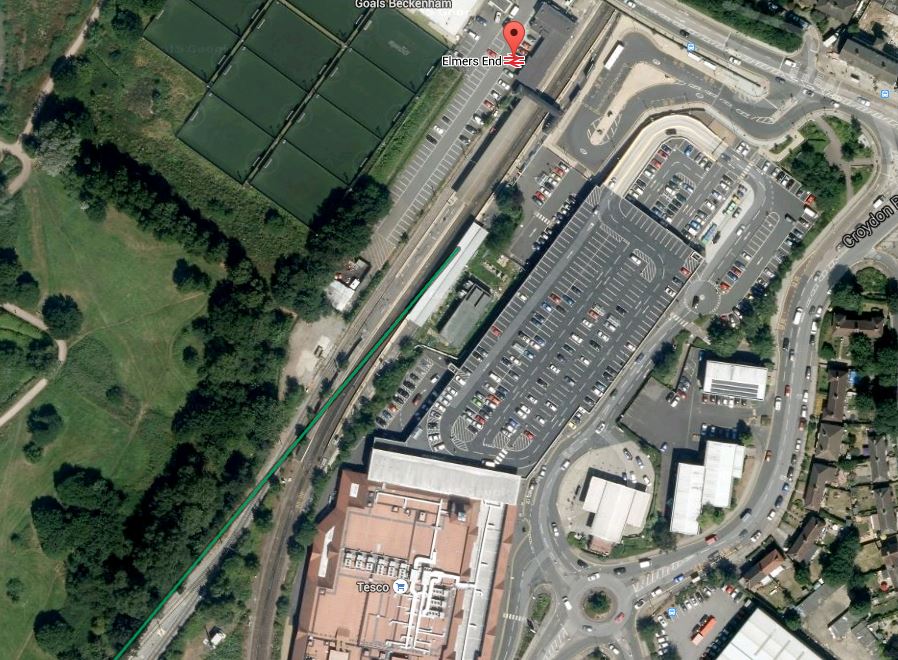
Elmers End Station
If Route 1 was run by tram-trains, that continued after Elmers End, this would not cause any problem at the Croydon end, as they’d just go round the loop and back to the east.
So it looks like there is little scope to put tram-trains on Route 1 and then run them up and down the Hayes branch.
Tramlink Route 2
The Tramlink Route 2 to Beckenham Junction actually runs alongside the electrified railway between that station and Birkbeck. If that line had been built in France or Germany in the last few years, I think they would have used tram-trains to provide the service.
It is in the area of Birkbeck station, shown here in a Google Earth image that tram-trains could be used to advantage.
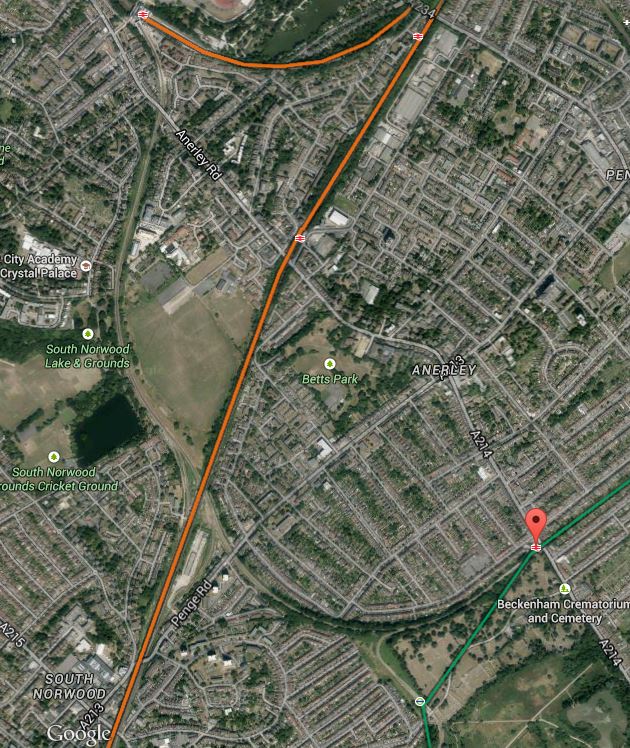
Birkbeck To Crystal Palace
Note the red arrow pointing out Birkbeck station, the orange lines denoting the East London Line and the green line denoting Tramlink Route 2.
The Crystal Palace Line and Tramlink Route 2 are both single-track lines from west of Birkbeck most of the way to Beckenham Junction, with the railway carrying just two trains an hour each way.
It has been a long-term ambition of Tramlink to run the trams on-street to Crystal Palace, but with tram trains you only need a small piece of infrastructure.
At the bottom of the image, there is a blue roundel at a kink on the green line denoting Harrington Road tram stop. From here, the line goes northwards and turns to run alongside the railway to Birkbeck station.
The line goes to Crystal Palace station if you could turn left. That station is at the end of the topmost orange line on the map.
Here’s a large scale Google Earth image of the area, where Route 2 joins the main line railway.
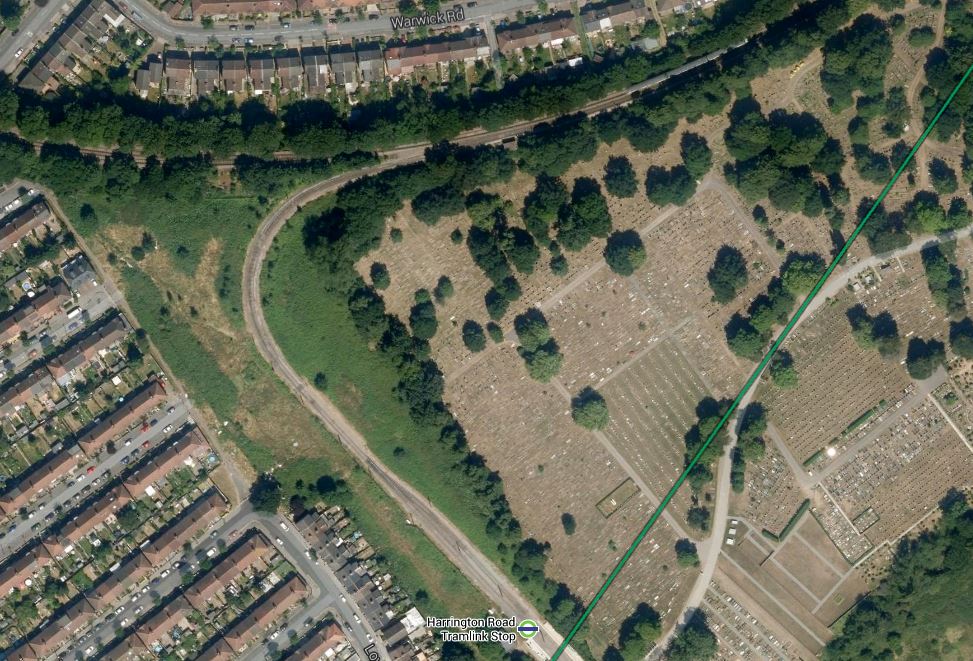
Tramlink Route 2 To Crystal Palace
There is probably enough railway land where the lines meet to create a simple triangular junction that would allow tram-trains to go from Harrington Road to Crystal Palace. As tram-trains are in effect normal trains on the main line, they would use the normal platforms.
The only problem is to decide where they reverse and go back to Croydon.
Looking at the Crystal Palace Line, the tram-trains could even be run all the way to and from Victoria or London Briodge, but that probably wouldn’t give enough capacity. So a bay platform will have to be brought into use somewhere. This is Platform 1 at Crystal Palace station, where it might be possible.
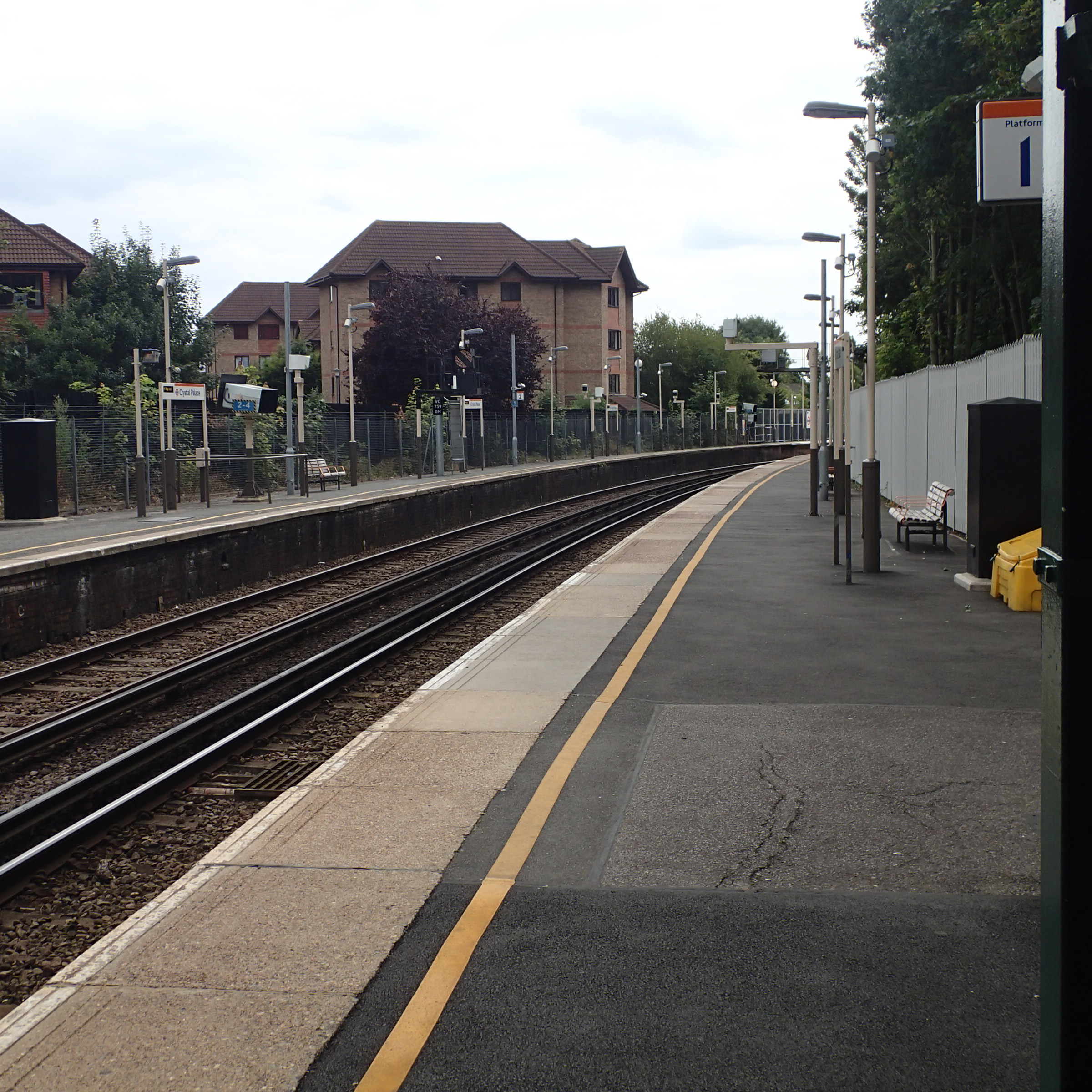
But it would need some good architecture and clever engineering.
Incidentally, the line has an operating speed of sixty miles an hour, so the Class 399 tram-trains would not interrupt any traffic, if they went all the way.
Where the tram-trains terminate will also be determined by passenger statistics.
If a variant of Route 2 was run by tram-trains, that continued to Crystal Palace, this would not cause any problem at the Croydon end, as they’d just go round the loop and back to the east.
The Hayes Line
Closely related to Tramlink Routes 1 and 2 is the Hayes Line.
I get the impression that it is a bit of a nuisance to train operating companies, as it’s always being talked about as a possible new terminus for the Bakerloo Line. Withdrawal of passenger services from the line have also been proposed and rejected in the recent past.
This Google Earth image shows how it crosses the Crystal Palace Line to the west of Beckenham Junction.

Hayes Line Crossing The Crystal Palace Line
The Hayes Line crosses from north to south, but it is not a complete junction, where tram-trains coming from Crystal Palace could access the line. But there would appear to be the space for the necessary infrastructure.
As I said in the section on Tramlink Route 1 it could also be linked to that route at Elmers End.
There may also be advantages in running tram-trains as trams on the Hayes Line.
Remember that if you ran tram-trains from Victoria to Beckenham Junction and/or from Cannon Street to Hayes, you don’t necessarily have to stop running the current trains.
But overall, I have my doubts about tram-trains on the Hayes branch, without some radical thinking.
Perhaps it is extended to the south past Hayes station as a tram route or Elmers End could be developed as a full interchange for trams and tram-trains, working the two routes.
But as there are more urgent proble,s and proposals on Tramlink, I think nothing much will happen on the Hayes branch.
Tramlink Route 3
The Tramlink Route 3 to Wmbledon has two connections with the rail network; Mitcham Junction and Wimbledon.
I am not knowledgeable about routes and traffic levels in that part of London, to postulate if tram-trains would be any advantage and give better connectivity for rail passengers.
However one of the proposed extensions of Tramlink is to Sutton station. Look at the layout at Mitcham Junction in this Google Earth image.
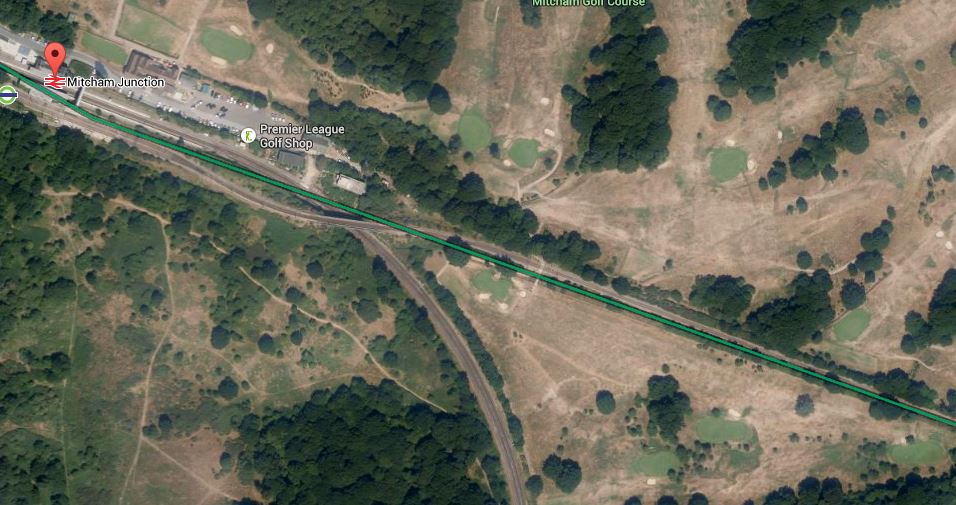
Mitcham Junction
It might be possible to put a curve between Tramlink Route 3 and the Sutton and Mole Valley Lines that go south to Sutton and Epsom. According to Wikipedia Sutton station used to have a bay platform for local services from Mitcham. Could it be reinstated?
Tramlink Route 4
The Tramlink Route 4 to Elmers End is a partial dupication of other routes.
Proposed Routes
There are several proposed routes for the Tramlink.
I have already dealt with the extensions to Crystal Palace and Sutton and how tram-trains might help.
But could tram-trains help with other extensions. I also think that if anybody suggests more street running of trams, this might get short-shrift from car drivers, so a lot of the proposed extensions might be difficult to get planned.
As to getting to Mitcham Town Centre from Mitcham Junction, they probably won’t help unless another station is added to the line between Mitcham Junction and Mitcham Eastfields. But as the latter station was only opened in 2008, I can’t see that happening.
The route south to Purley would probably be liked by passengers, but it would probably be difficult to fit into Croydon’s crowded town centre.
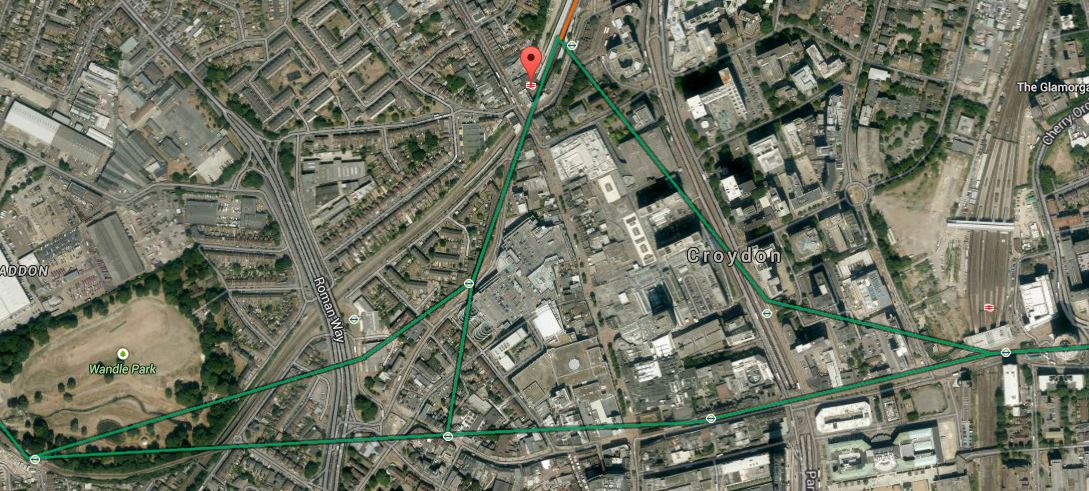
Croydon Town Centre
The red arrow points to West Croydon station, with East Croydon station at the right, with the green lines showing the current tram routes.
The only way to go south would probably be with a lot of unpopular street running.
However, a route to Brixton could be fairly easy for a tram-train, by going via either Mitcham Junction or Crystal Palace.
The Tram-Trains Go Anywhere Capability
I am assuming that the tram-trains chosen are something like the Class 399, with the following characteristics.
1. Ability to use third rail or overhead 750 V DC.
2.Double-ended and able to use both tram and train platforms.
3. 110 kph and main line crash protection.
4.ERTMS
A tram-train with this level of capability could go virtually anywhere in South London, provided the track layout allowed it to get on the full-size railway.
So where could a tram-train go from Croydon?
Brixton – Via Crystal Palace, Gypsy Hill, West Norwood, Tulse Hill and Herne Hill
If the Victoria Line was extended to Herne Hill, this would give South London a very useful tube connection. You could also build a decent station at Brixton to link all the lines together.
Bromley South – Via Beckenham Junction
Epsom – Via Mitcham Junction and Sutton
Clapham Junction – Via Mitcham Junction, Balham and Wandsworth Common
Lewisham – Via New Beckenham, and Catford Bridge
This would link the Tramlink to the DLR
Orpington – Via Beckenham Junction and Bromley South
New Cross – Via New Beckenham, Catford Bridge and Lewisham.
This route actually extends the New Cross branch of the East London Line to Hayes.
Whatever happens in Croydon, I think it would be a good idea if perhaps four trains per hour of the eight extra that could be sent down the East London Line were to be sent to the Hayes Branch or Orpington via Lewisham. It would connect that part of South London to Crossrail at Whitechapel.
Could Tram-Trains Be Used To Advantage In Edinburgh?
This might be design by hindsight but after viewing the tram-trains of Kassel, Karlsruhe and Mulhouse, I do wonder if tram-trains could be used to advantage in Edinburgh, alongside the new tram system.
To the west of Haymarket station, the trams and rail lines share a corridor, with the tram tracks to the north. So as the Edinburgh trams run on standard gauge tracks, any tram-trains coming or going to the west could just cross over between the two sets of tracks. This Google Earth image shows the tram stop and the train station at Haymarket.
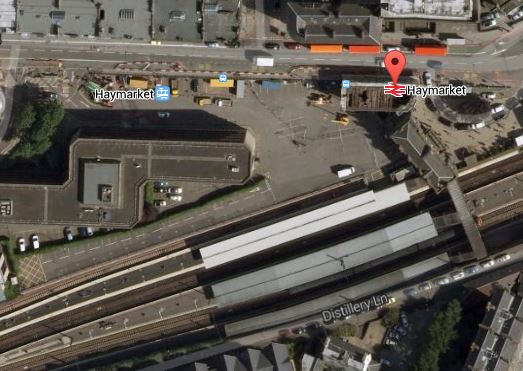
Trams And Trains At Haymarket
Unfortunately, I think the image pre-dates the operation of the trams, but compared to some of the complicated layouts and tunnels in Germany, it should be very simple. As was shown in Paris, tram-trains can be built that run on both the 750 V DC used by Edinburgh trams and the 25 kV AC used on the electrified main line to both Glasgow and London from Edinburgh.
The Edinburgh trams run every 8-10 minutes during the week, so there should be capacity to run some train-trains through the city centre section, without much modification.
But where would they go at the eastern end?
The obvious place would be to go straight on past Waverley station and the Balmoral Hotel and then return to the rail lines to the east of the station, if that was possible. This is a Google Earth image of the area.

Edinburgh Waverley
If they ever extend the tram to Leith and Newhaven, that may or may not be a possibility. The Edinburgh trams are built to a very tight specification, which is designed to go round sharp corners and not make too much noise. Running straight between Haymarket and Waverley may be an easier task, than turning sharply on and off Princes Street.
As with Crossrail and Thameslink in London, where tunnels link two railways lines together, thus saving terminal platforms in the city centre, an east-west tram-train across Edinburgh, would reduce the needed platform capacity in both Waverley and Haymarket stations.
I have been looking at Google Earth images of Edinburgh and there are more railways than those that run passenger trains. I would assume they take freight from up the East Coast Main Line through the city. So could some of these lines be used by tram-trains to create much needed public transport routes in the city?
There is one interesting possibility. The Edinburgh Suburban and Southside Junction Railway, runs across the south of the city and is used by freight trains, but no passenger services. According to Wikipedia there is a campaign to reopen the line to Passenger services and also a proposal by Network Rail to electrify the line. Tram-trains could be a possibility for providing the service, as the line links to the main railway across Edinburgh at both ends.
It would probably be more affordable to provide the passenger services using tram-train technology, as the stops would be simpler and you could use an off-the-shelf Class 399 tram-train, if they have been proven to work in Sheffield.
In the Wikipedia for Edinburgh trams, they also talk about a new stop called Edinburgh Gateway, which would link to trains on the Fife Circle Line.
It has been proposed that the Fife Circle Line be extended to Leven by creating the Levenmouth Rail Link.
I’m pretty certain that in Karlsruhe or Kassel, the Germans, would run tram-trains on the Fife Circle and the extension to Leven, probably using 750 DC electrification all the way.
1. The station at Edinburgh Gateway could be a simpler affair, which would only need to accommodate compatible tram-trains and trams which could share platforms. Obviously, if longer distance trains to Glasgow or Aberdeen were stopping at the station, these would probably need their own platforms.
2. Creating a 750 DC tram line between Thornton and Leven, even if parts of the line carried freight trains, must be more affordable, than heavy rail.
3. Edinburgh would have the iconic images of tram-trains going over the Forth Rail bridge, which could be electrified to either system, as the tram-trains won’t care.
4. Operation of the tram-train would be a bit like the proposed tram-train test in Sheffield, where both ends of the line operate as trams, with a section of heavy rail in the middle.
5. Battery technology could also be used between Edinburgh Gateway and Thornton.
I’ve seen everything, I’m proposing here, in the last few weeks.
This musing of a Saasenach, does illustrate the importance of the tram-train trial between Sheffield and Rotherham.
Are Tram-Trains A Good Idea?
After my trip around Germany and France, have I come to any conclusions about the concept of tram-trains?
I must admit, I was sceptical when I set out, as some of the claims about the advantages of tram-trains seemed too good to be true!
So what are their strengths? And how would they fit the planned test route to Rotherham that will extend the Sheffield Supertram?
Dual Voltage
In both Mulhouse and Paris, the tram-trains are dual voltage and can run on both 750 V DC and 25kV AC. This type of tram-train will become the standard as main lines are increasingly electrified with the higher AC voltage.
In the case of Sheffield, which will be electrified to London, Doncaster and other places in the next decade or so, dual voltage Class 399 tram-trains will be essential to future proof the system.
Standard Gauge
All except one of the tram and tram-train systems I used or saw were standard gauge systems. The exception was Darmstadt, where trams were of a narrow gauge. Any standard gauge system could be used by tram-trains of the same gauge. In the UK, France and Germany that means to incorporate tram-trains on a tram network, that the tram network must be standard gauge.
There are no tram systems in the UK, that are not standard gauge.
Tram-Trains Can Be Low Floor
Buses and trains are moving towards totally flat and low floors, where to enter you just step or wheel yourself across.
The Mulhouse and Paris Siemens Avanto tram-trains achieve this and it has been stated that the Class 399 tram-trains for Sheffield will be low-floor.
Tram-Trains Are Larger Than Trams
Generally tram-trains are larger than trams. I don’t know for sure, but this could be for crash-worthiness reasons when running as trains.
With Sheffield this is an advantage as the Sheffield trams are bigger than most of those in other systems.
Tram-Trains Are Faster Than Trams
I don’t know at what speed the tram-trains that I rode ran, but it was certainly faster than the average tram.
Tram-Trains Are Almost As Fast As Pacers
A Class 142 Pacer has a top speed of 120 km/hr, whereas the Siemens Avanto used in Mulhouse and Paris has a top speed of a hundred and the Class 399 tram-trains for Sheffield have a top speed of 110 km/hr.
I suspect though that the electric vehicles have better acceleration and braking, so they might even be quicker over a route like the Hope Valley Line. I won’t comment on the passenger experience, but I will say that they probably have a slightly higher capacity of over two hundred, if you count standing passengers.
Tram-Trains Release Platforms In City Centres
This was well-illustrated in Kassel, where the Hauptbahnhof has been effectively released for other uses after the building of two underground island platforms.
By joining services together it might also be possible to release platform needs, just as Thameslink and Crossrail will do in London.
I’ve spent a lot of time waiting for local train services in Sheffield, so is there any scope for joining more services together.
Acting Like Trams In A City Centre
This was impressively shown in Kassel, where except for the colour and size, you couldn’t tell which vehicles were trams and which were tram-trains.
Sheffield’s tram line layout is very like Kassel with a shared centre section.
Acting Like Trains On Train Lines
Once on a railway line, the trams must be able to use the voltage of that line, have the same crash protection and signalling of a train and have the performance not to interfere with all other traffic.
Tram-Trains Can Have Alternative Power Sources
Around the world, there are several examples of tram-trains that have on-board diesel engines as well. Kassel has ten for a start.
And there are of course the battery trams in Nice and Seville.
Tram-Trains Don’t Need Lines To Be Converted
If tram-trains need to use a line they don’t stop other traffic like freight trains and express passenger services using that line. In some places in the UK, tram lines have been created by ripping up heavy rail tracks, which might need to be used again.
Tram-Trains Can Create An Extensive Network
The Manchester Metrolink has a network of around ninety kilometres, whilst Sheffield’s Supertram has a length of around thirty.
Compare this to Kassel at over a hundred and eighty kilometres and Karlsruhe at over two hundred and sixty.
The two German cities are substantially smaller than the two major English ones.
Tram-Trains And Sheffield
Tram-trains are not some difficult concept, but any competent group of railway, tram, electrical and control engineers should be able to create a system that works pretty well.
At least in choosing the line to Rotherham, they haven’t set themselves too difficult a task. Sheffield also has a very good layout in the area to the east and north of the main line station.
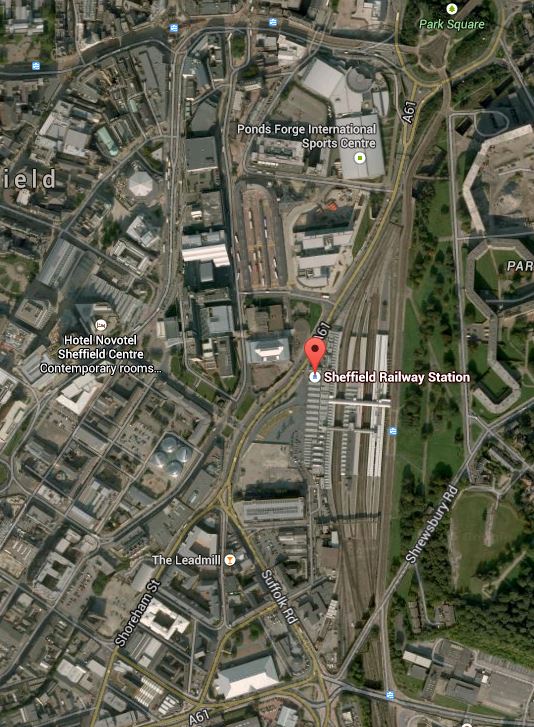
The Trams Around Sheffield Station
There are some things to note in this Google Earth map.
1. At the top right of the map, the three branches of the system meet in a triangular junction. The northern branch goes to Meadowhall and in the future Rotherham, the southern branch goes past the rail station and the western branch goes through the city centre. I don’t think that services use this junction in every posible direction, but it appears to have been future-proofed to cater for all eventualities.
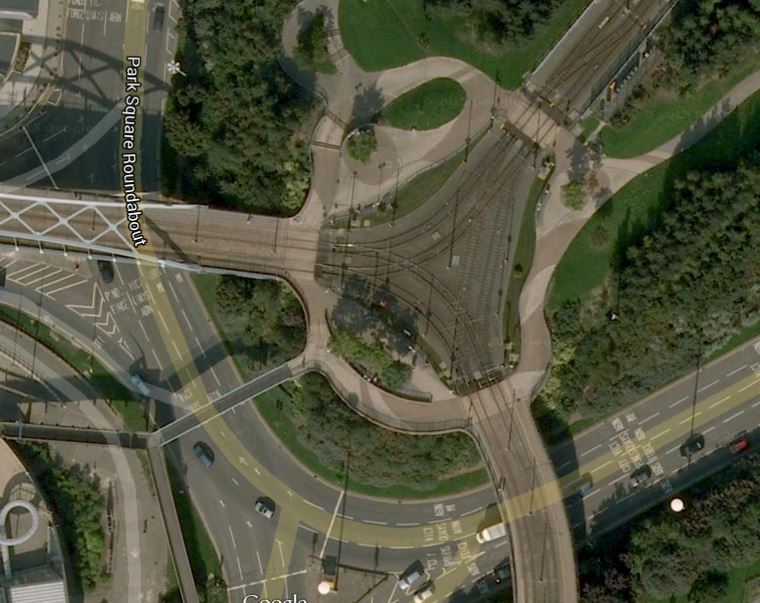
In this enlargement, the tracks and wires are clearly shown.
2. The southern branch past the station runs parallel to the rail lines.
3. There is quite a bit of space to put in extra tracks.
I also think, that after seeing the systems in Kassel and Karlsruhe, Sheffield could incorporate tram-trains fairly easily. Not being the first is a definite advantage, as ideas, designs and technology have moved on, as the Mulhouse system showed.
At some point in the future a lot of rail lines in the Sheffield area are going to be electrified to the main line standard of 25 kV AC and this might mean that the line used by the tram-trains to get to Rotherham in future may have this voltage. The Class 399 tram-trains themselves will be bought with a dual voltage capability, so they won’t care, but it seems a pity to put up one set of wires and then rip them down for another. Perhaps, you put up main line catenary initially and use it to provide a 750 DC supply! I’ll leave that one to the engineers.
An Extension To Dore
Plans have existed in the past to extend the Sheffield Supertram to Dore and some reports state that Dore will be linked to Meadowhall to improve HS2 connectivity. This Google Earth map shows Sheffield and Dore and Totley stations.
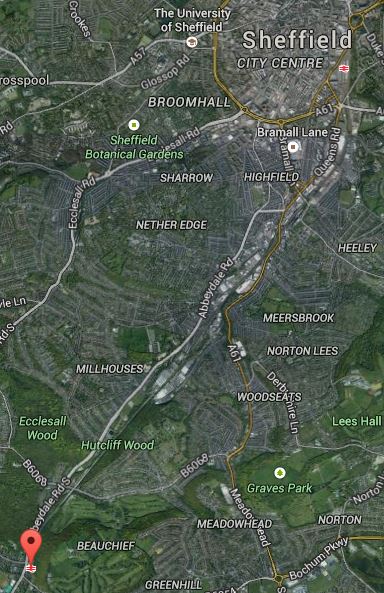
Sheffield To Dore
Dore and Totley station is on the Hope Valley Line, which will probably be electrified in the next ten years or so.
So could tram-trains come past Sheffield station and then go down an electrified Hope Valley Line?
I know little of the area, but because plans have been drawn up in the past, others must have a good idea. This document from Sheffield University written in 2003, gives a summary of what might happen.
But it predates any thought of tram-trains in Sheffield.
Could The Hope Valley Line Run Tram-Trains To Both Sheffield And Manchester?
This section in Wikipedia’s article about the Hope Valley Line, talks about proposals to to extend the Manchester Metrolink to Rose Hill Marple station on a spur off the line. Tram-trains could be used.
As Dore and Totley station is at the Sheffield end of the Hope Valley Line, could we see tram-trains going to both Manchester and Sheffield?
And What About Manchester And Sheffield?
I can remember reading in my Meccano Magazine in the 1950s about the ground-breaking electric-hauled Woodhead Line between the two cities.
This is said about tram-trains in the Wikipedia section for extensions to the Manchester Metrolink.
Metrolink and the TfGM Committee have prepared five costed proposals for extending Metrolink using tram-train technology over the existing heavy rail network in the region; along the Mid-Cheshire Line (between Stockport and Hale), the Hope Valley Line (between Manchester and Marple), the Glossop Line (between Manchester and the dual termini at Hadfield and Glossop), the Manchester to Sheffield Line (between Manchester and Hazel Grove), and along the Manchester to Southport Line (between Manchester and Wigan via Atherton), with an estimated total funding requirement of £870 million as of 2013.[197] TfGM intend to proceed to the identification of potential rail industry funding options, subject to a review of lessons from a tram-train pilot scheme in Sheffield.
So could we see the opening up of routes between the two cities using tram-trains, if the trial in Sheffield to Rotherham is successful.
The old Woodhead Line is just over sixty kilometres long, which means that from what I saw in Karlsruhe and Kassel, tram-trains could easily handle the distance between Manchester and Sheffield.
An interesting possibility for which the technology exists is a dual voltage tram-train leaving Manchester and taking the Hope Valley Line, which is electrified at its western end, which then travels over the Pennines to Dore, using either diesel or battery power, from where it becomes a tram on Sheffield’s network.
It won’t happen soon, but it is no fantasy, as I’ve seen all the technology needed in Kassel, Karlsruhe and Essex.
So will we see, heresy-of-heresies, an operational merging of the tram systems across the Pennines?
But imagine two, three or even four new tram-trains an hour on each of the routes between Manchester and Sheffield, that would extend their journeys into the city-centres, rather than need valuable platform space at Sheffield or Manchester Piccadilly stations.
I don’t know the lines well, so this might be pure speculation, but as the systems in Germany showed, if you get the track, power and signalling working, then good tram-trains can go virtually anywhere they’re needed.
A Vision For The North?
Let’s assume that the tram-train experiment from Sheffield to Rotherham is a success, which after my German and French experiences, I wouldn’t bet against.
So what happens next?
That is very much in the hands of the politicians, at both a national and local level, but from Sheffield and Manchester I could see tram-trains getting used on the numerous local lines that fan out from Manchester and Sheffield.
1. At present many of these lines are served by dreaded diesel Pacers, so the new tram-trains would be very welcome.
2. Some lines like the Hallam Line between Sheffield and Leeds via Barnsley could probably be just electrified with 750 V DC, to allow tram-trains to run.
3. As at Kassel not all lines would need to be electrified, as other technologies exist.
Everybody needs to have a bit of vision and if the Class 399 tram-trains, do what it says in the specification, we could be seeing them all over a dense network of lines in the north.
If all of these lines were upgraded, there is one thing that will happen for certain. The areas will improve in all ways, with better housing, more jobs and business and leisure opportunities.
Conclusion
To answer my original question, tram-trains are not a good idea, but a brilliant affordable solution to the big problem of urban transport all over the world.
In the UK, we must prove that the technology will work in a UK environment and I suspect there are many councils, tram and train operators eagerly awaiting the outcome.
 The Anonymous Widower