Were The New Merseyrail Trains Designed In A South London Pub?
In Thoughts On Merseyrail’s New Trains, I postulated that the new Stadler trains could work as trams on appropriate infrastructure.
I looked at the pictures in The Design Of Tram Or Tram-Train Stations, which I wrote in March 2015 and came to the conclusion, that Merseyrail’s new trains might be able to run on the London Tramlink with some modifications.
- The ability to run on 750 V DC overhead electrification.
- Precise adjustment to the platform height.
- Tram lights and signalling to make the vehicles comply with regulations.
So why do I say that the new Merseyrail trains were designed in a London Pub?
- Both Merseyrail and South London have networks with third-rail electrification.
- Merseyrail need a train to match their tunnels and platform heights, which are sized to the current Class 508 trains.
- South London has the London Tramlink, which runs Stadler Variobahn trams.
- The London Tramlink has strange infrastructure between Birkbeck and Beckham Junction stops, which could be improved if trams and trains could share lines and platforms.
- The London Tramlink would like to extend to Bromley South station.
- Merseyrail have been talking about running a tram-train to Liverpool Airport.
- Stadler have experience of trams, trains and the very special experience of Zwickau, where Stadler DMUs share tracks with electric trams.
- Stadler builds the tram-trains for Karlsruhe, Chemnitz and Sheffield.
- Karlsruhe has a problem of two different sized tram-trains, which has been solved, by clever design of the vehicles and the platforms.
- Every Stadler train seems to be different, with different car dimensions to fit the customers tracks and different power systems to give them the required performance.
I think that a Stadler engineer or perhaps more came over to look at both London and Liverpool’s problems and after riding round South London, they ended up in a local hostelry and lots of alcohol was added to the mix to see what would happen.
The result was a concept, which I think of as a train-tram with the following features.
- The ability to run as a speedy commuter EMU train on either 750 VDC third-rail, 750 VDC overhead or 25 kVAC overhead electrification.
- The ability to run as a tram on 750 VDC overhead electrification.
- The ability to run on energy stored in an onboard energy storage device.
- It could be built to fit any of the tram gauges and platform sizes in the UK and quite a few around the world.
- Level access to the vehicle from platforms of the correct height at all times.
- Signalling would either be using traditional signals or in-cab displays. The second would be preferable, as it could display the same format at all times.
- The ability to run the Glasgow Airport Rail Link, in a city where Stadler are providing trains for the Subway.
- The ability to run on the other tram lines in the UK, if the vehicle were to be built to the correct size.
- The ability to run on standard heavy rail infrastructure.
If you see the Zwickau DMU in a train station, you think it’s a train, if you see it at the stops in the centre of Zwickau, you think it’s a tram.
Get the dimensions and the look of the vehicle right and no passengers will bother that it’s a train, when running in tram mode.
The big advantages come with certification.
- As it’s a train, certification for heavy rail and lines without electrification is the same for any new train.
- Adding the vehicles to a tram network, would be like adding any new tram type to any existing tram network.
Merseyrail have got in first with an order, but I wouldn’t rule out something similar used to extend the London Tramlink or vehicles for the Glasgow Airport Rail Link.
Where could you run a train-tram with onboard energy storage on London’s third-rail network?
- Extend Ttranlink from Beckenham Junction to Bromley South
- Abbey Wood to Thamesmead
- Grove Park to Bromley South via Bromley North and Bromley town centre.
- Greenehithe to Bluewater.
- Chessington South to Chessington World of Adventure.
These are just for starters.
I also didn’t include short branch lines and routes without electrification, but close to 25 KVAC overhead electrification.
How Can We Deal With Air Pollution In The UK?
This article on the BBC is entitled Green group wins air pollution court battle.
This is the start of the article.
Campaigners have won the latest battle in legal action against the UK Government over levels of air pollution.
A judge at the High Court in London ruled in favour of environmental lawyers ClientEarth.
The group called air pollution a “public health crisis” and said the government has failed to tackle it.
The ruling in the judicial review called the government’s plan “woefully inadequate”.
As my mate Brian would have said, the \government has been screwed, glued and tattooed, by the Judge.
Does Pollution Affect Me?
I feel very strongly about this, as in the 1940s and 1950s, I suffered badly from the pollution of the time.
Now pollution levels are cutting out the vitamin D producing UVB rays of the sun. Could this be the rason for my low vitamin D levels?
No Magic Bullet
So what can the Government do to meet the European Emission Standards?
There is no magic bullet, but I believe that a raft of measures can gradually bring the levels of pollution down.
Reduction Of All Road Transport
One of London’s problems is that the amount of traffic in the city, means that a lot of the vehicles are stationery and just causing pollution.
I suspect this is a problem in many other cities.
So measures must be taken to reduce the level of all traffic.
- London needs more Park-and-Ride sites. Do other cities?
- Differential congestion charging and residents parking, so the polluter pays.
- More cycling superhighways to encourage cycling.
- City centre parking must be taxed, with the money funding public transport.
- Aggressive illegal parking control.
- Automatic box junction enforcement.
- 20 mph speed limit to make walking easier.
- Area average speed control.
- Reduction of the number of taxis and mini-cabs.
I particularly like the concept of having a grid of linked speed cameras in a city and then issuing a ticket automatically, if the limit is exceeded between two cameras.
Reduction Of Diesel-Powered Transport
As nitrogen dioxide from diesels is the main source of the pollution, we should aim to eliminate as many diesel-powered vehicles, as is practical.
- Reduction of diesel vehicles will need legislation, probably backed up with government money.
- Buses, taxis and local delivery vehicles will need to be hybrid or electric.
- There must be progressive bans for diesel vehicles not meeting the latest standards.
- Diesel scrapping schemes have been introduced in certain places.
I particularly like the idea, where in an experiment involving Sainsburys, supplies for the supermarkets were delivered by train into Euston at three in the morning and then delivered around Central London by low-emission vehicles.
Increase In Electrically-Powered Transport
This is the key to reducing a lot of pollution in cities.
- Electric and hybrid vehicles.
- Trams to replace buses.
- Development of electric rail lines.
- More cross-city rail lines like Crossrail 2 and the Camp Hill Line.
I also think we’ll see some innovative solutions, like the PRT system, I wrote about in A Visit To Heathrow Terminal 5.
The problem of improving transport systems is well-illustrated in Chelsea, where some selfish locals don’t want Crossrail 2, as it might hinder them driving their tractors.
More Details
I shall now expand a few of those topics and add a few more ideas.
They are in alphabetical order.
Battery Trains
Battery trains are an alternative to full electrification, where one or both ends of the line to be electrified, already have electrification.
The Greenford Branch is an obvious possibility.
- The line is only 4.3 km. long.
- The bay platform at West Ealing station could be easily electrified to charge the trains.
- Either a new train or a refurbished one with batteries could work the line.
- Two trains would be needed to run the promised four trains per hour service.
- Little new infrastructure would be needed.
I believe that battery trains are an affordable alternative to full electrification.
Battery Trams
Battery trams are being introduced into Birmingham to extend the Midland Metro. This article in the Railway Gazette, which is entitled Midland Metro trams to be converted for catenary-free operation, gives full details.
- The only construction required is to lay the rails, build the stops and install the signalling.
- Putting up overhead wires in a historic or sensitive city centre can be a legal and logistical nightmare and very expensive.
- Battery trams work in Seville and Nanjing.
- Trams charge the battery at either a charging station or when running under wires outside of the centre.
I can see a time, when in city centres, most trams will be battery-powered.
It will be interesting to see how Brummies take to their battery trams.
Connectivity Improvements
Compare arriving in Birmingham New Street and Euston stations, needing to go a few miles to say Centenary or Trafalgar Squares respectively.
At Euston, you go to the nearest bus stop, look up the spider map with all the destinations from Euston and it tells you how to get to about a hundred locations. Job done!
But in Birmingham, the brand new station doesn’t have that information on display in an easy-to-understand form.
Birmingham isn’t too bad and is certainly better than Manchester, but why can’t cities copy the London system.
You may get to these places easily, but the connecting and ticketing arrangements, tell you to bring your car next time.
Contactless Bank Card Ticketing
London now allows anybody to use their contactless bank card, as a ticket on all modes of public transport.
I don’t have the figures, but I believe that every time a new feature is added, like the new Bus Hopper, there is an increase in public transport usage.
After London’s experiences, I have no doubt, that contactless bank card ticketing increases the use of public transport and removes traffic from the roads.
Introducing contactless bank card ticketing, should be a condition of Central Government finance for public transport projects.
But every city in the world will introduce this form of ticketing!
Not doing it, will make sure visitors don’t come back and tell their friends what a crap place they’ve visited.
Cross-City Railways And Trams
A lot of cities and conurbations have a lot more traffic and the resulting pollution, as getting from one side of the city to the other is not easy, without driving through the city centre.
As an example, Crossrail will improve access to Heathrow from East and South-East London, where the alternative is a drive round the M25 or through the city centre, on congested roads. But Crossrail is only one of many successful cross-city routes in the UK.
- The Central, District, Jubilee, Metropolitan, Northern, Piccadilly and Victoria Lines of the London Underground.
- The East, North and West London Lines and the Gospel Oak to Barking Line of the London Overground.
- Thameslink in London
- The Northern Line in Liverpool.
- The Cross-City Line and Snow Hill Lines in Birmingham
- The East and West Coastway Lines in Brighton.
- The Metro in Newcastle.
- The Nottingham Express Transit in Nottingham.
- The Valley Lines in Cardiff
All of these lines are well-used and there are plans to upgrade those, not to the standard of the London Overground.
Efficient Deliveries
If I have my window open, I can sometimes hear several delivery trucks call at my various neighbours in a short period of time.
This is not efficient and surely something better can be done.
I was once offered delivery of a small parcel to my Local Sainsburys, which is about a hundred metres away.
Organised properly with enough drop points, that must be more efficient and convenient.
This is one we don’t need to worry about, as the big shopping groups will make it happen as they go for greater sales and more profits.
Park-And-Ride
Park-and-Ride is a good way of keeping, passenger cars away from City Centres.
Nottingham may be a lot smaller than London, but it is a city that has designed the Nottingham Express Transit with several Park-and-Ride sites, at the edges of the city.
Compare that with the non-existent Park-and-Ride provision on Crossrail, which I wrote about in Crossrail’s Park-And-Ride Facilities.
Railway Electrification
Electrification of rail routes across cities and replacing diesel trains with electric ones, is always an option to cut pollution.
Consider.
- London is currently electrifying the Gospel Oak to Barking Line and this will also allow noisy and polluting Class 66 diesel locomotives to replaced with electric ones on freight trains on this route.
- Lines in Liverpool and Birmingham are also being electrified.
- Electric trains also seem to be passenger magnets as the Class 378 trains of the London Overground have shown.
But remember, that every passenger on an electric train, can’t be using their car and is rteducing their pollution footprint.
Rewards For Going Car-Free
I have met several people recently, who have given up owning a car in Central London.
So could those, who don’t bring their car into the congested area, receive some form of reward.
Manchester Metrolink Will Be Going To The Trafford Centre
According to this article on Global Rail News, the Manchester Metrolink has been given permission and funding to build the Trafford Park Line.
This is a map of the line.
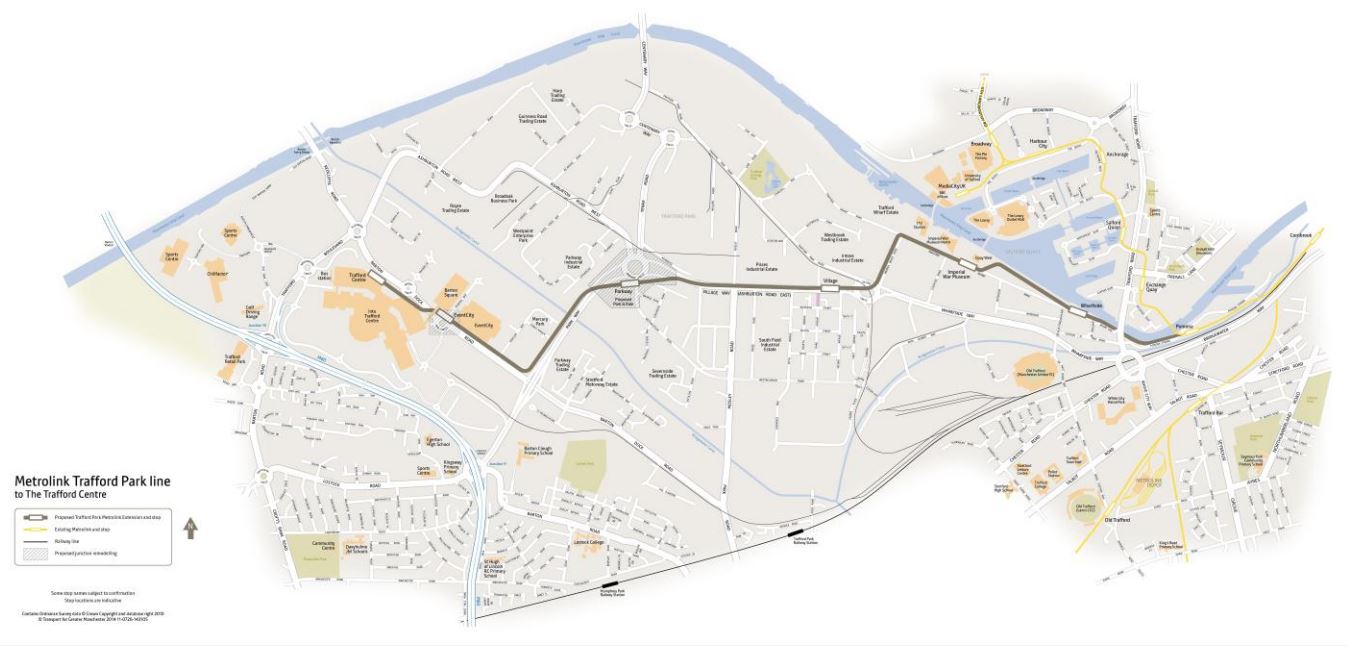
Trafford Park Line
It calls at these stops.
Pomona
This Google Map shows Pomona tram stop.
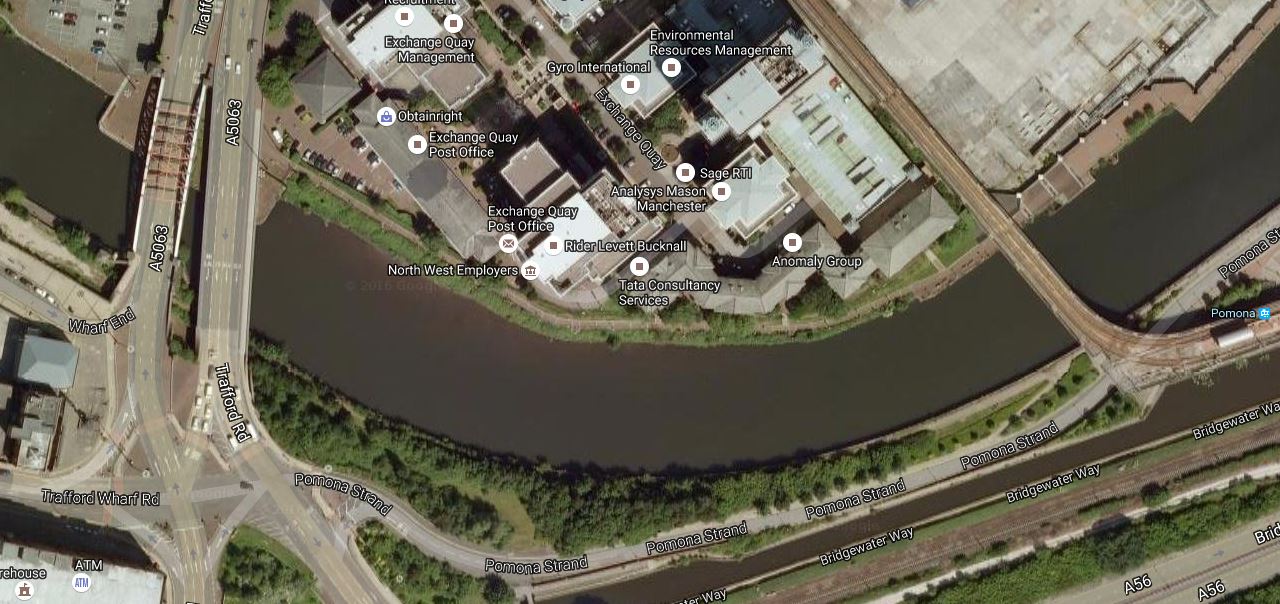
Pmona Tram Stop
The stop is at the far right and the rightmost bridge carries the tram over the water.
This second Google Map shows Note how the stop has been built to allow a junction with the Trafford Park Line.
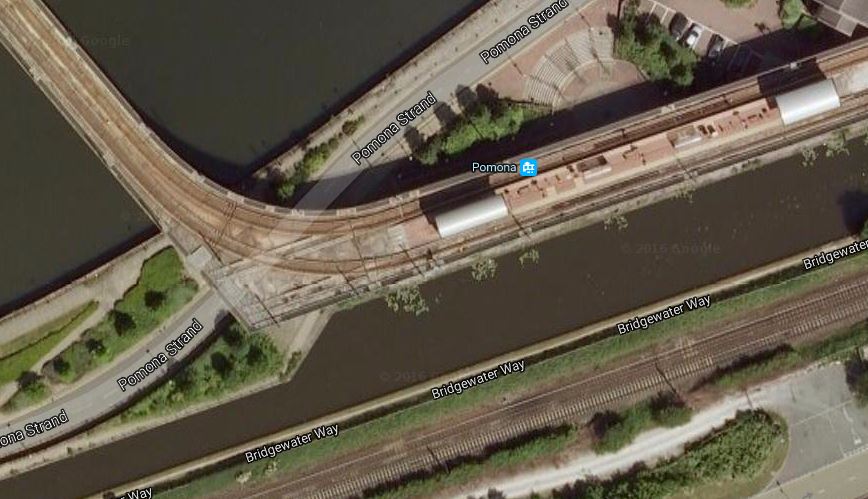
Pomona Tram Stop In Detail
The Trafford Park Line appears to continue along the edge of the water.
Wharfside
This Google Map shopws the location of the Wharfside tram stop close to Old Trafford.
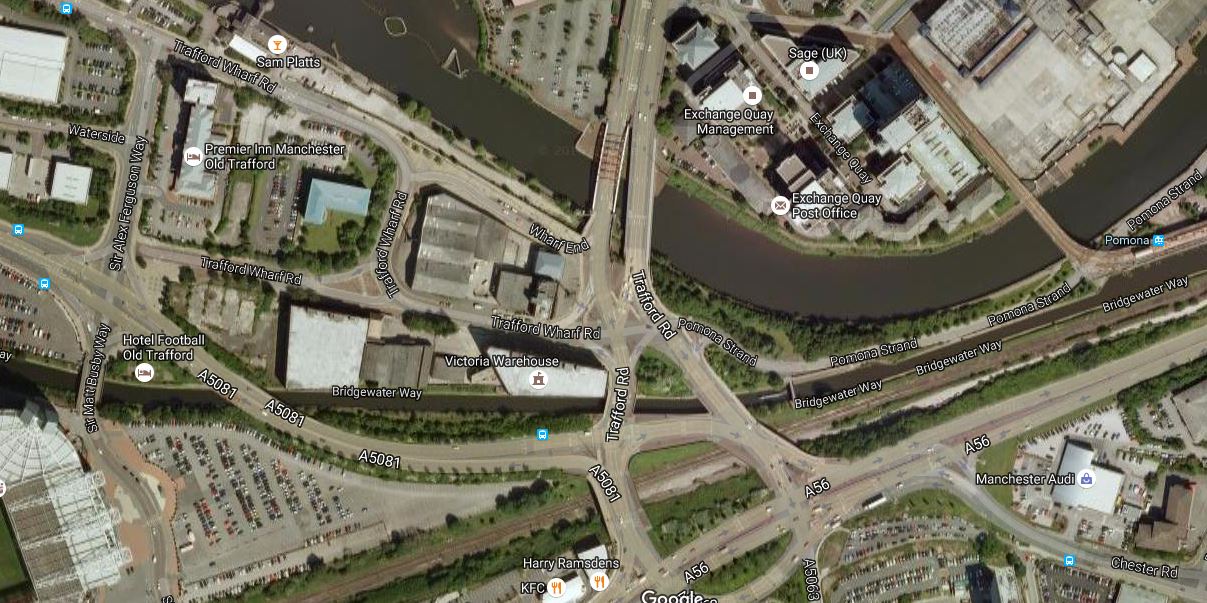
Wharfside Tram Stop
It is on Trafford Park Road, probably between the water and the Premier Inn.
Note Old Trafford in the bottom-left corner.
Imperial War Museum
ThisGoogle Map shows the route between Wharfside and the Imperial War Museum tram stop.
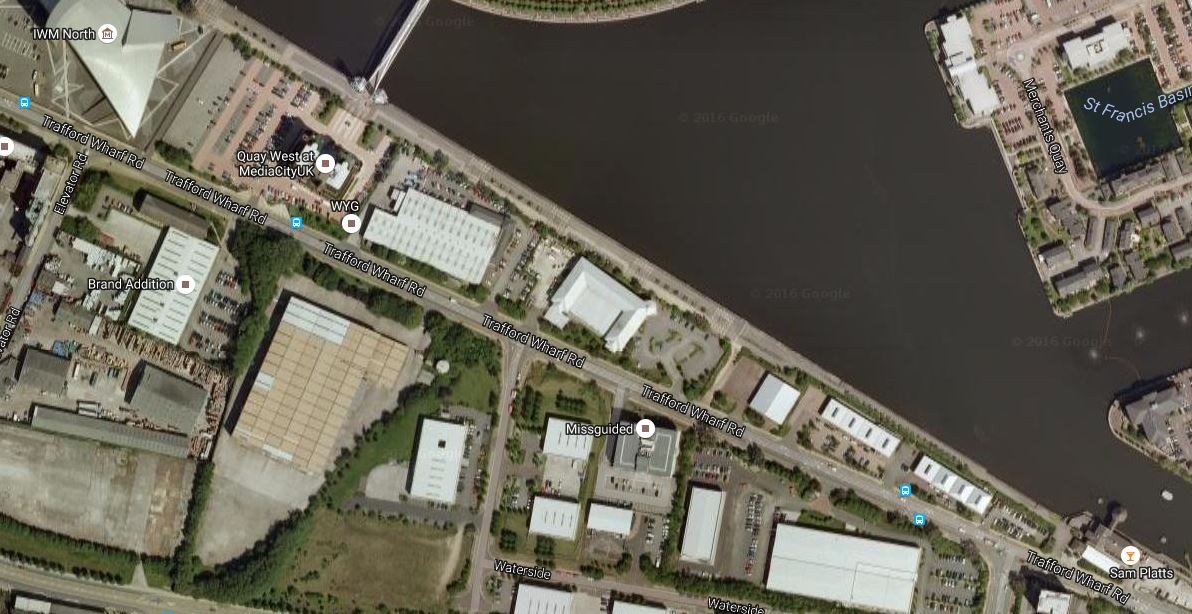
Imperial War Museum Tram Stop
The stop appears to be on Trafford Park Road, by the footbridge at the top of the map..
Village
This Google Map shows the route between the Imperial War Museum and the Village tram stop.
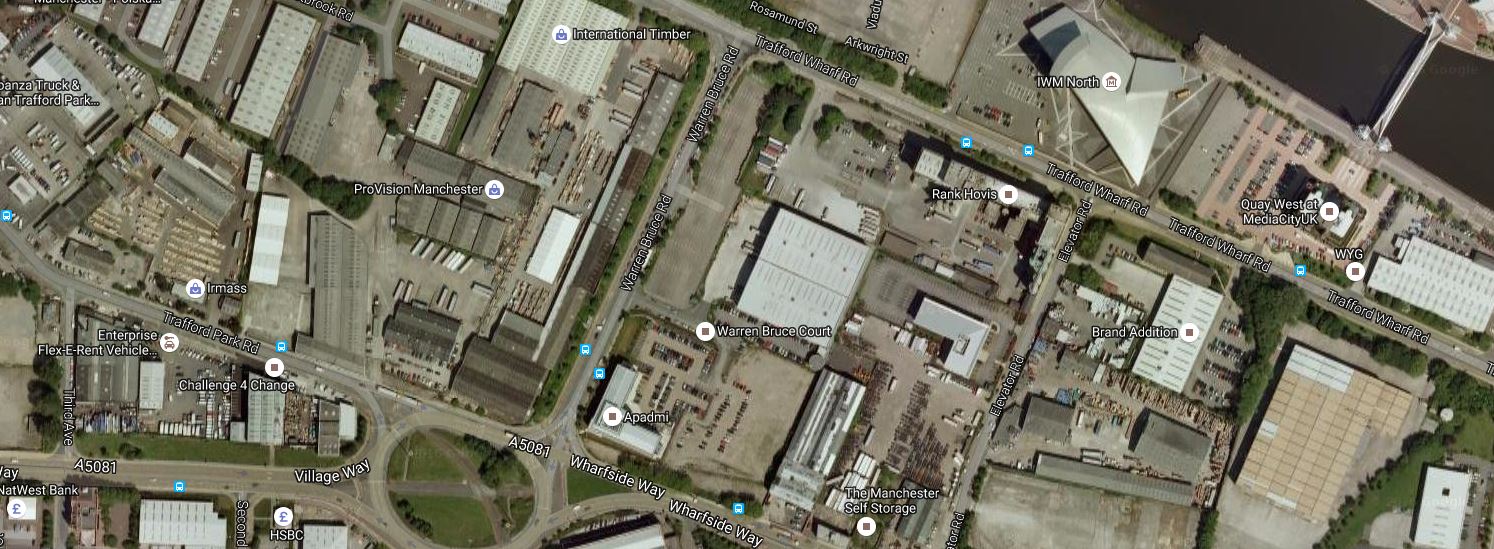
Village Tram Stop
The Imperial War Museum is at the top of the map and the Village tram stop will be on the road leading .West from the rpundabout at the bottom.
Parkway
This Google Map shows the route between Village and the Parkway tram stop.
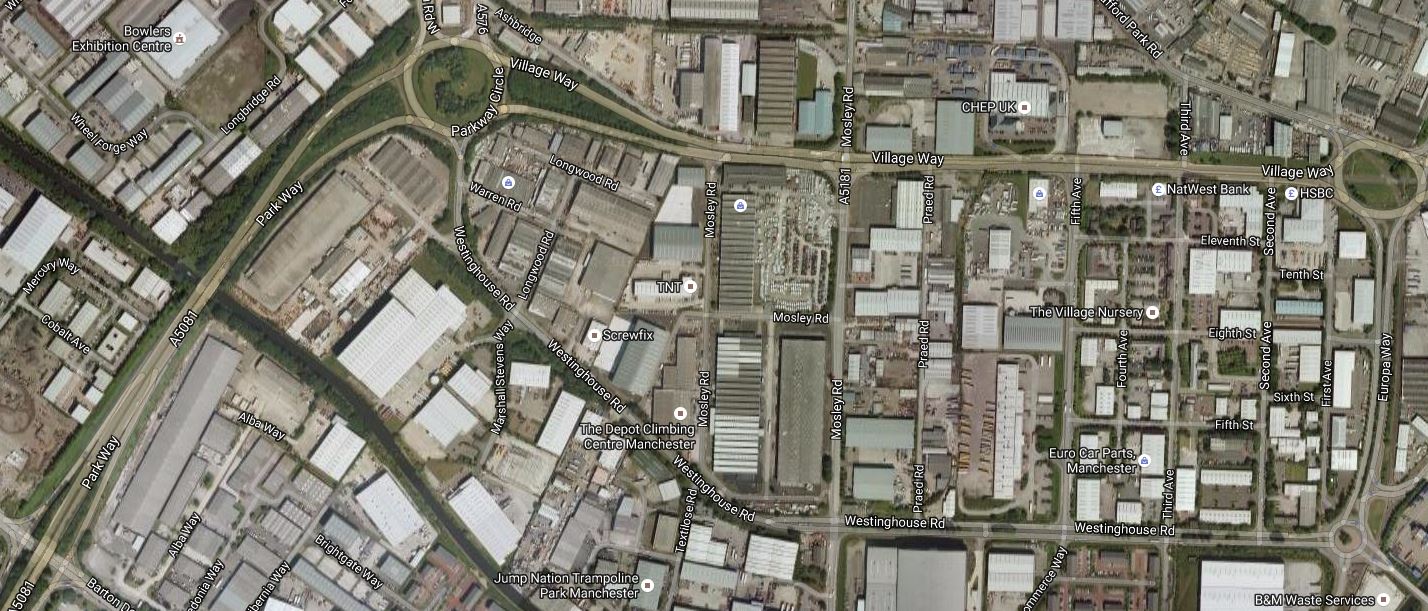
Parkway Tram Stop
The Parkway stop is in towards the Southern side of Parkway Circle, which is the circle at the top towards the left.
Village tram stop is to the West of the other circle and the tram line goes along Village Way to Parkway Circle before going South West.
A Park-and-Ride could be built at this stop.
EventCity
This Google Map shows the route from Parkway to the Trafford Centre.
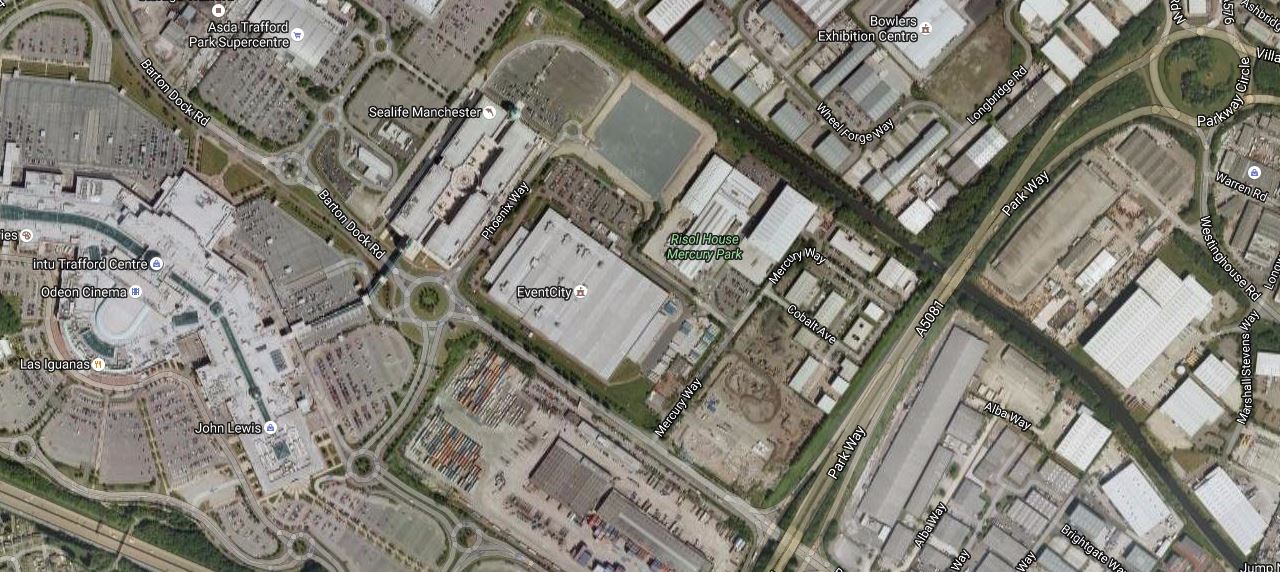
From Parkway To The Trafford Centre
The EventCity tram stop is I suspect by EventCity, which is the big building in the centre of the map.
Trafford Centre
Finally, according to current plans the tram goes on to the Trafford Centre stop.
On To Trafford Waters
This article in the Manchester Evening News is entitled Huge £1bn Trafford Waters development on banks of Manchester Ship Canal given go-ahead.
This Google Map includes Trafford Waters, which is between the Trafford Centre and Manchester Ship Canal.

Trafford Waters
According to Wikipedia there will be a Trafford quays tram stop, to serve the new development.
Finally To Salford Reds And Port Salford
These two final tram stops; Salford Reds and Port Salford are named on Wikipedia..
This Google Map shows the location of these two stops.
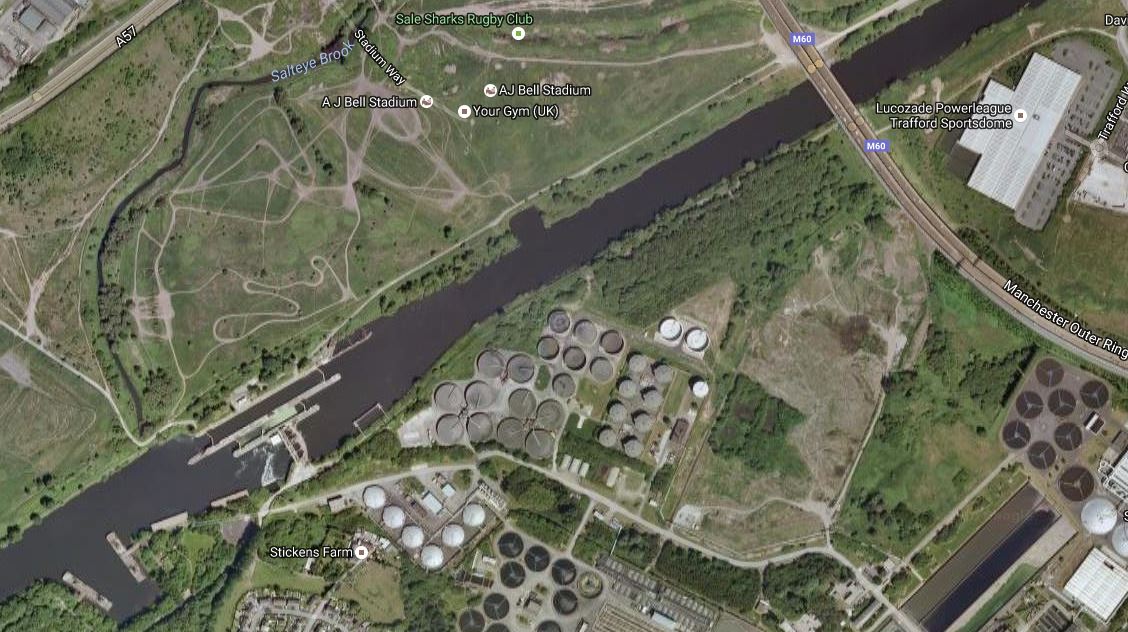
Salford Reds And Port Salford Tram Stops
Salford Reds is on the North Bank of the Manchester Ship Canal, to the West of the M6 Motorway.
Fort Salford is a freight terminal on the banks of the canal.
This is said on the FAQ page of Port Salford web site in answer to the question What are the plans to bring Metrolink to Port Salford?
Transport for Greater Manchester (TfGM) who manage the Metrolink infrastructure, aspire to build a new Metrolink line to the AJ Bell stadium and potentially beyond to Port Salford, via Trafford Park and Trafford Centre. Therefore, the new dual carriageway and lift-bridge have been future proofed to eventually accommodate a Metrolink tram line.
That certainly gives one way for the Trafford Park Line to cross the Manchester Ship Canal.
Western Gateway Infrastructure Scheme
The Western Gateway Infrastructure Scheme is designed to bring better connectivity between Port Salford on the North side of the Manchester Ship Canal and Trafford and Trafford Park on the other side. Wikpedia says this.
As part of the Western Gateway Infrastructure Scheme (WGIS), a new link road was constructed in connection with the Port. The existing A57 road was redirected closer to the Salford City Stadium, and a mile-long new dual carriageway link to Trafford Way and a new lift bridge over the Manchester Ship Canal was constructed to the east of the M60 bridge.
This video shows more.
But all is not going well as this report from the Manchester Evening News shows.
Conclusions
These are my thoughts on what has been published.
- There is a lot of development going on along the Manchester Ship Canal.
- There will probably have to be at least one tram crossing of the Manchester Ship Canal between Trafford Centre and Port Salford.
- The design of the tram route hasn’t be finalised yet and changes can be expected.
I am also surprised that the rail link from the North into Port Salford doesn’t include a rail station.
This would allow travellers from the West to have access to the Trafford Park Line, without going all the way to Manchester Piccadilly.
If you look around the UK and Europe, it is probably important that there is a good interface between the tram network and trains, cars and bicycles.
Manchester Metrolink has some good interchanges to rail, but it needs more.
For completeness this Google Map shows Trafford Park from Port Salford in the West to Pomona in the East.

The waterway curving across the map is the Manchester Ship Canal.
Both Port Salford and Pomona are at the edges of the map.
It’ll be interesting to see how this project develops.
Developments on the Trafford Park Line can now be followed on the line’s own Wikipedia entry.
Something Must Be Done About Cambridge Station
Cambridge station used to be an easy station to use, in that, when you arrived, you either got a taxi from outside the station or walked across the road to get a bus to the centre.
Since the dreaded busway has been built, the buses are about as well-organised as the Labour Party, with information designed to confuse visitors.
Yesterday, it was particularly bad, when I decided to pop in to the City to have a coffee with a friend, on my way to football at Ipswich. There wasn’t a bus in sight and the queue for the taxis was totally blocking pedestrians wanting to get out of the station.
In fact, I took about five minutes to actually get off the platform as it was so busy.
In the end, I walked into the City Centre.
Getting back, I was running late, so I decided to take a bus. But could I find one? No!
So in the end, I took a taxi, which had to take a very roundabout route. Getting into the station was just as bad as getting out had been, but I caught my train with a couple of minutes to spare.
The train is the big improvement on the line between Cambridge and Ipswich.
In 2010, this was a typical train on the route.

Gerald Fiennes and Delia Smith at Dullingham
At least that day, it was two Class 153 trains, when often it was just one crowded carriage.
Yesterday, the train was a comfortable three-car Class 170 train.

The First Ipswich-Cambridge Class 170 at Cambridge
This is a lot better and with the new franchise in October, I think it could be signalled, as getting better again.
But all of this increase in capacity, is straining Cambridge station even further.
At present, the problems at Cambridge seem to be caused by too many people going in different directions, whose routes seem to conflict with each other. Many of these are first time visitors and foreign topurists, who just wander aimlessly around, causing even more conflict.
Cambridge North station, when it eventually opens, might help, as many will cycle and drive to the new station. It will also make it a lot easy to get to the North of the City.
I think, that if most Cambridge trains serve both stations in the future, I’ll go to Cambridge North and get a bus into the City Centre to avoid the scrum at Cambridge station, which I’m sure will get worse, as more and more trains are scheduled between London and Cambridge. At least Thameslink have decided to go to Cambridge North.
One of the problems is that Cambridge station is on a cramped site, which is not an easy walk to the City Centre for the average visitor.

Cambridge Station
The walking route to the centre is along Station Road and then Hills Road, where the payments are crowded and not very wide.
It is my view that something radical needs to be done.
But Cambridge’s problem is not unique and getting from the station to the town or city centre is a problem in many places like Bristol, Leicester, Norwich and Oxford to name just four. Nottingham and Sheffield have used trams to solve the problem, but I don’t think that would work for everyone, as the disruption of building would be just too much.
So what would I do at Cambridge?
It must be a nightmare living on the South-East side of the station opposite to the main station buildings. An entrance on the other side of the station would surely help.
If you take Euston, Kings Cross, Liverpool Lime Street, Sheffield and a few other stations, the area in front of the station has been turned into a public space, so that people can gather their thoughts and plan their next move. It would appear from the amount of building at Cambridge station, that this is now impossible.
A decent walking and cycling route to the centre must be created.
In the future, I feel that Cambridge probably needs an innovative Street Tram, as do many other places.
It would have the following characteristics.
- It would be battery-powered and charged at each end of the route.
- It would be double-ended, so it would just reverse at the end of the route.
- It could be on rails or rubber tyres on a single-line segregated track.
- The vehicle would have three or four segments to give a high capacity.
- It doesn’t have to be single-deck vehicles.
- Why not double-deck vehicles with panoramic windows for tourists?
- It would be free.
If a passing loop could be built at half-way then the route could be run by two vehicles. Or in Cambridge’s case perhaps a different route could be used in each direction.
The nearest thing to what I have described is the 1.4 km long MetroCentro in Seville.
I would feel that a track-less solution based on bus-technology might be better, as in a congested City Centre ;like Cambridge the route could be flexible.
When Is A Train Not A Train?
Take a modern train, say something like a Class 172 DMU or a two-car version of say a Class 710 EMU.
The size and weight of these are very similar to that of one of Sheffield’s trams.
Many, if not all, trams in the UK run to a set of rules, which allow the following.
- Running at up to 50 mph on a dedicated track, which can be either single or double track.
- Running at slower speeds through City Centres and amongst pedestrians, as they do through Birmingham, Blackpool, Croydon, Edinburgh, Manchester, Nottingham and Sheffield
- Trams are driven, by a trained driver, who takes notice of everything and everybody around the tram.
- Passengers can cross the track in designated places provided they keep a good look-out.
- Passengers can only board a tram at a designated stop.
- All rail vehicles run to the same rules.
The rules must work, as you don’t often hear of trams having accidents with pedestrians. In fact fourteen people have died in accidents with modern trams in the UK since 2000. The rate seems to have dropped in recent years, so are drivers getting better and pedestrians learning how to live with the trams?
I believe that in Zwickau in Germany, local trains, run on the tram tracks in the City Centre. There’s more on it under Vogtlandbahn in Wikipedia.
So could some branch lines be run according to tram rules, but using standard modern trains, like Class 172 or Class 710 trains?
In A First Visit To Clacton, I said this about the Walton-on-the-Naze branch of the Sunshine Coast Line.
I do wonder whether some branches like the short one to Walton-on-the Naze could be run to tram rules using on-board energy storage. It might enable stations to be built step-free without electrification, lifts and bridges, provided trains kept to a safe slow speed.
In an ideal system, the rules could be.
- No electrification. Zwickau uses diesel vehicles, but ones using on-board energy storage would be ideal.
- Trains do not exceed an appropriate slow speed. Zwickau uses 80 kph.
- Step free access from platform to train.
- All trains on the line run to the same rules.
- No freight trains.
The advantages would be.
- There is no electrification.
- Signalling is standard railway signals and rules. Often routes would run under One Train Working, which is very safe and well proven.
- Many routes could be built as single-track without points and like the Sudbury branch trains would go out and back.
- DMUs would be exactly, the same as others of their type.
- EMUs would be too, but would have on-board energy storage.
- Extra stations could be added to the line, by just building platforms.
- The line could perhaps be extended past its current terminus.
I must get to Zwickau and see how the Germans do it.
A few examples of lines that could run to these rules include.
- Sudbury Branch
- St. Ives Branch
- Walton-on-the-Naze Branch of the Sunshine Coast Line
- Windermere Branch
Whether some of these would need it, is doubtful. Some though, like Sudbury and St.Ives, terminate as a single platform in a car park.
The Felixstowe Branch certainly couldn’t as it has lots of freight trains, although the final section, from where it branches off the line to Felixstowe Port could.
I said that no freight trains could run on the routes, but those devilish Germans have designed a freight tram that runs in Dresden to supply the Volswagen factory in the city. It’s called a Cargo Tram.
Could this be a way of bringing freight into a City Centre? as I said in The LaMiLo Project, this type of thinking is in the minds of planners.
Edinburgh Tram’s Elaborate Catenary
When I’m in Edinburgh, I always think that the overhead wires for the trams are over-elaborate and intrusive.

The picture was taken as I arrived. Compare that picture, with this one in the centre of Birmingham.
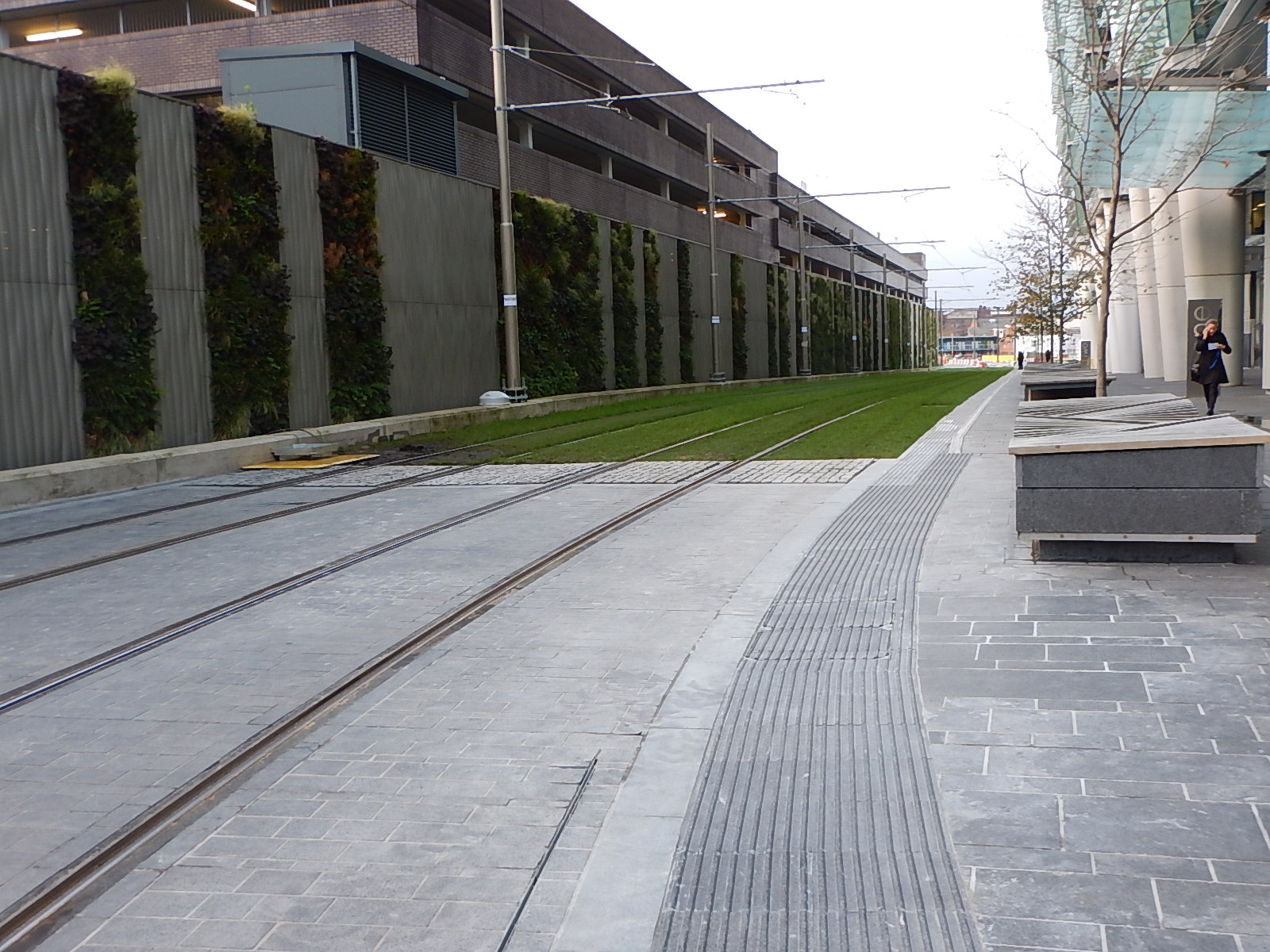
The Birmingham design is a lot simpler and as the trams are both from the same builder, you can’t say that the Midland Metro is designed to easier rules. This system could surely have been used on Princes Street, where I took this picture.
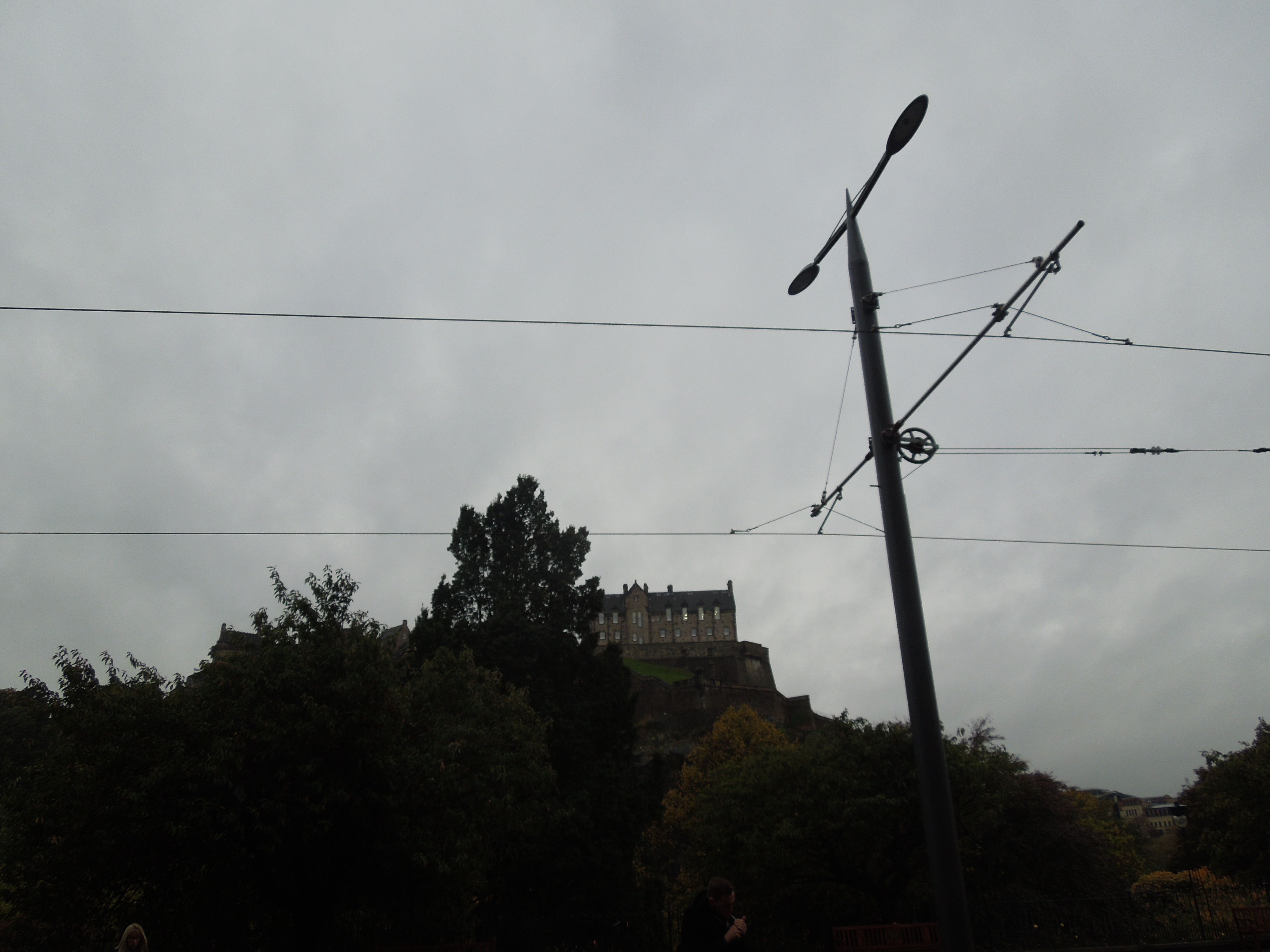
There is no excuse for bad design.
The Midland Metro is also showing the way for its extension, by using battery power through the historic centre.
Midland Metro Arrives In New Street
These pictures show the Midland Metro and its new extension to Birmingham
New Street station.
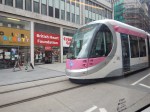
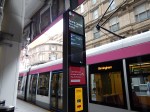

I’d taken a train to Birmingham Snow Hill station and my only criticism, is that the signage at Snow Hill didn’t indicate how to get to the new tram stop.
Could Tramlink Use The Heavy Rail Lines In South London?
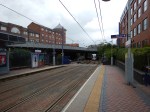
Look at these pictures, I took at Birkbeck station, where one track is for heavy rail and the other is for London Tramlink.
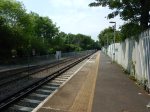
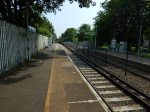


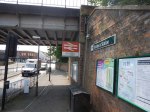
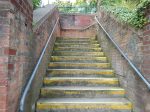
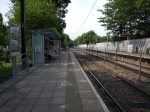

When I took these pictures, I wondered, if it would ease the expansion of the Tramlink network, if trains and trams could share lines.
I am not talking about tram-trains, but more a useful approach to benefit both types of transport.
So lets list the problems.
Rail And Wheel Profile
One of the problems in Sheffield with the introduction of tram-trains is that the rail profile needs to be changed to one that is compatible with the existing trams and the new Class 399 tram-trains.
But to be fair it is a trial and problems will be thrown up.
Platform Height
As someone, who has travelled all over Europe on trams, trains and tram-trains, one of the biggest problem is getting the platform height right, so that everybody including those in wheel-chairs can get on and off easily.
On a scale of five, we generally score about four, but we mustn’t be complacent and I think it will get better.
Some continental countries have problems as their trains have a low step and you step up into the train. This is because traditionally, they had low platforms, whereas for some time, we’ve been aiming for step across.
Karlsruhe has been running tram-trains on their Stadtbahn for over twenty years and are putting in a tunnel to take the tram-trains under the city.
This is said about platform height.
In addition, the platforms of the station’s tunnel will have pedestals that are about 15 metres long with a height of 55 cm above the rail so that the first two doors of Stadtbahn trains will have step-less entry. This will make possible stepless entrance on lines S 4 / S 41 and S 5 / S 51 / S 52 in Karlsruhe for the first time, reflecting a trend that has long been standard elsewhere. The platforms cannot consistently have a height of 55 cm, because the tunnel will be used by trams and DC services of the Stadtbahn, which have an entry level on the modern lines of 34 cm.
If the Germans have to go to that sort of solution, with all their experience, then platform height must be difficult to get right.
I have not heard anything about the platform design at Rotherham Central station, where the platforms must accept trains as different as Pacers and Class 399 tram-trains.
Power Supply
The current trams need overhead power, which with most tram systems is 750 VDC.
So if you want to run Tramlink trams on third-rail lines in South London, you’ll need to put up overhead wires or fit the trams with contact shoes.
It is my view, that for Health and Safety reasons and some design ones too, that running trams using third-rail power will not be practical.
Remember, passengers know they can walk across the tram lines and frequently do, so whatever happens, you don’t want live rails under the trams.
So any rail route, that will be running trams will have to have the 750 VDC overhead supply.
In the Sheffield trial, to extend the Sheffield Supertram, a freight route to Rotherham is being electrified at 750 VDC, rather than the main line standard of 25 KVAC.
Signalling Systems
Rail and tram signalling are different. But after a successful tram-trial in Sheffield, the problems of trams and train sharing the same track, should have risen to the surface.
Rules Of The Tracks
Trams and trains run under different rules.
One main difference is that trams have a maximum speed of 25 mph, whereas trains run at whatever speed the line permits.
So for safety and other reasons, if trams and trains were sharing a length of track, they would have to run under the same set of rules.
I suspect this would mean that the maximum speed would be 25 mph.
In some ways the problems are the equivalent of managing traffic at an airport like Southend, where light aircraft share the runways and airspace with Airbus-319s.
I don’t think it is an insurmountable problem, as two-car diesel multiple units have shared tracks with 125 mph expresses and hevy freight trains for years.
An Ideal Mix Of Trains
So is an ideal solution to use 750 VDC overhead wires for the trams and diesel trains?
Possibly!
But you could always use IPEMUs or EMUs with an on-board battery.
Supposing there is a chord or link line, that would be ideal to be used by trams and say the ubiquitous Electrostars that are popular in South London.
Wires would be put up and all Electrostars using the line, would have to have enough battery capacity to bridge the gap in the track with no electrification.
West Croydon Station
A possible application might be at somewhere like West Croydon station.
The map from carto.metro.free.fr, shows the heavy rail lines through the station and the tram lines around it.
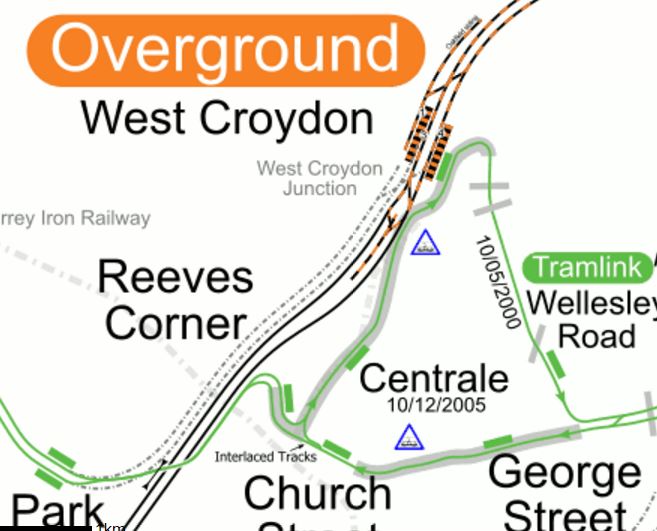
Lines Around West Croydon Station
I’m sure that the engineers in Karlsruhe would have had the trams going through the station to give same-platform interchange to and from trains.
Conclusion
Network Rail has a lot of tools in the box and I think that as technology develops, we’ll see some interesting ideas.
Tram Safety At Augsburg
One of the problems with trams, is that pedestrians cross in front of trams, more intent on their mobile phone, than their safety.
At Augsburg Haunstetterstraße station, they are trialling a warning system.



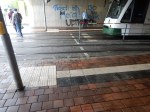

Note how the lights turn red as the tram approsaches and clear, when it is safe to cross.
It was very simple. But it wasn’t always obeyed.
Leicester City Centre
This Google Map shows the relationship between Leicester station and the City Centre.
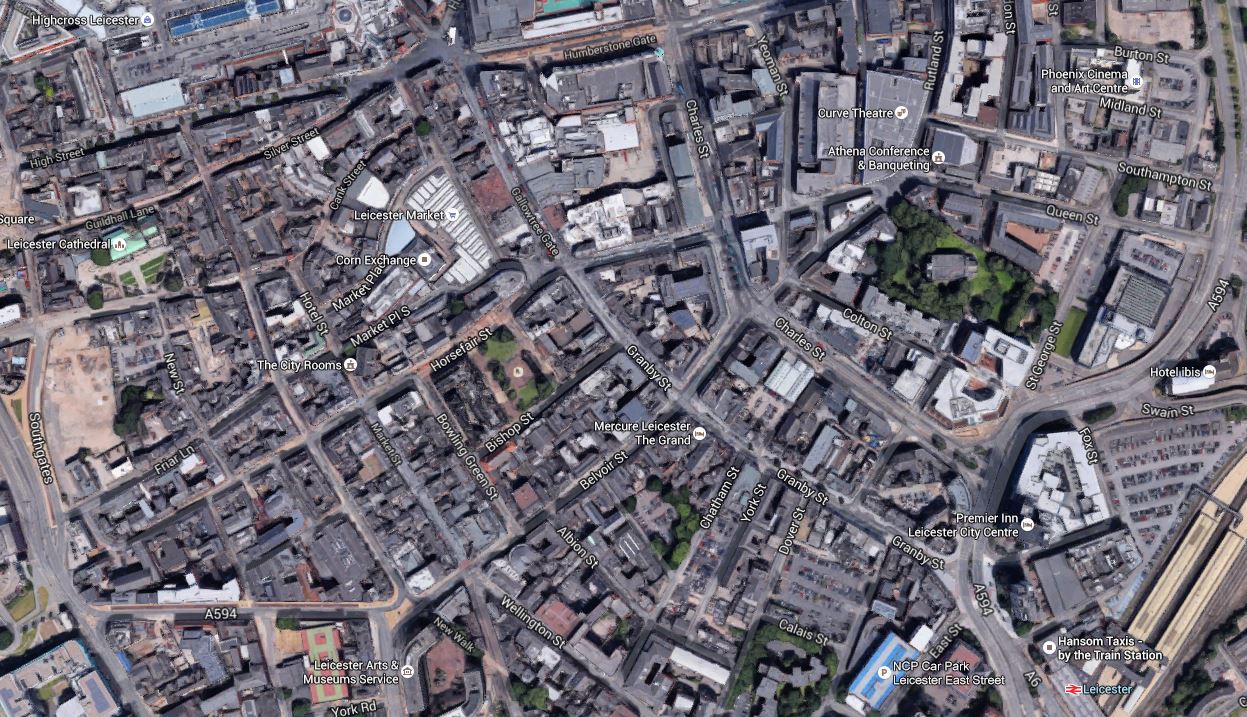
Leicester Station And The City Centre
The station is in the South-East corner and the big High Cross Shopping Centre and the cathedral are in the North-West corner.
Leicester City’s stadium is off the map to the South-West.
I could just about walk it to the Shopping Centre from the station, but it was at the limit of my range with the faciitis in my right foot.
I took these pictures as I walked between the station and the centre.

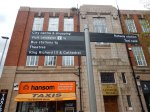

















If there was a city, that needs a people mover of some sort between the two locations, it is Leicester.
All European cities would run a tram and with the latest technological developments, the tram would now be battery powered as in Seville and soon to be seen in Birmingham. On such a short distance, it doesn’t even have to have rails, but could be a rubber-tyred, double-ended articulated bus. I once saw a concept like this is in a Wrightbus presentation.
I made one big mistake on my visit to Leicester.
I was intending to go to the cathedral and have some lunch, which I did in Carluccio’s in the High Cross Shopping Centre.
As I was hungry, I had the lunch first and found that the shopping centre has been designed, so you have to go back through it to get anywhere.
As I didn’t want to buy anything except lunch, that would have been a pointless exercise.
So after wasting twenty minutes walking in the wrong way, I was running too late to visit the cathedral.
So on your visit to Leicester visit the cathedral first and if you’re in a hurry and want something to eat afterwards, don’t go in the shopping centre.
A properly-designed people mover going from the station to the pedestriansed central are and on to the cathedral would not only solve my problem, but it would surely attract a lot more visitors to the city to visit the cathedral and Kind Richard.
The one thing that a people-mover in Leicester, doesn’t have to be, is a fully-fledged tram with overhead wires. That is so nineteenth century for short routes in city centres.
Get it right in Leicester and I can think of several other towns and cities, that could use such a system.
 The Anonymous Widower