How Will Virgin Trains East Coast Use Class 800/801 Trains?
The following two sections give Virgin Trains East Coast (VTEC) current and future fleets.
Current Fleet
VTEC have a current fleet comprising the following locomotives and coaches.
- 32 – Class 43 locomotives
- 117 – Mark 3 coaches
- 31 – Class 91 locomotives
- 302 – Mark 4 coaches
- 31 – Driving van trailers
The Class 43 locomotives and the Mark 3 coaches are formed into InterCity 125 trains.
- Two locomotives and nine coaches per set.
- 125 mph capability
- Diesel-powered
Which gives thirteen diesel trains.
The Class 91 locomotives and Mark 4 coaches are formed into InterCity 225 trains.
- One locomotive, one driving van trailer and nine coaches per set.
- 140 mph capability
- Electric-powered.
- Ability to run London to Edinburgh in under four hours.
Which gives thirty-one electric trains.
Adding the two figures together gives a total of forty-four nine-car trains.
Future Fleet
VTEC’s future fleet will include.
- 10 – Five-car Class 800 electro-diesel trains.
- 13 – Nine-car Class 800 electro-diesel trains.
- 12 – Five-car Class 801 electric trains.
- 30 – Nine-car Class 801 electric trains.
Adding these together counting the five-car trains as half gives fifty-four nine-car trains.
Or ten more nine-car trains!
In addition six to eight InterCity225 trains could be retained in service to run limited stop trains between London and Edinburgh.
This increase in capacity can only me good for passengers, with more services and destinations.
Questions About Class 800/801 Trains
What is the capacity of a nine-car Class 800/801 train?
I can’t find this on the Internet and I suspect it hasn’t been decided.
Wikipedia gives the capacity of an InterCity 225 train as 406 Standard and 129 First Class seats.
It should also be noted that the car length in a Class 800/801 is twenty-six metres, as opposed to the twenty-three metres of the InterCity 225.
I would hope good design can make excellent use of this space.
Will two Class 800/801 trains be able to work as a pair?
I suspect the answer to this is yes, as the closely-related Class 395 trains regularly do this.
The most common use would be to run two five-car trains as a ten-car set.
This would be a 260 metre long train, which is perhaps fifteen metres longer than an InterCity 225 train.
Some lengthening of platforms may be necessary, but it probably isn’t a major problem.
Will coupling and uncoupling of a pair of Class 800/801 trains be automatic?
In The Impressive Coupling And Uncoupling Of Class 395 Trains, I linked to videos of the closely-related Class 395 trains, doing just this in under a minute.
I would be very surprised if two Class 800/801 trains couldn’t do the same.
Will a Class 800 train and a Class 801 train be able to work as a pair?
There may be circumstances, where this is needed on electrified lines, so I would be very surprised if this is not possible.
At what station will a Class 800/801 train be able to call?
The nine-car trains are 234 metres long and a pair of five car trains will be 260 metres long, so platform length will mean they can’t call at a lot of smaller stations.
But a five-car train will be only 130 metres long, which will be shorter than a pair of four-car multiple-units working together, which are regularly seen on the UK’s rail network.
So the five-car trains will probably be able to serve a surprising number of stations.
Will Class 800/801 trains have a faster turn-round time?
If you look at the times of trains between London and Leeds, this things happen.
- A few minutes after a train leaves the platform at Leeds and Kings Cross, the next incoming service arrives.
- It then waits in the station for nearly half-an-hour before going back.
Effectively, an hour must be added to each Out and Back journey between London and Leeds.
This time will enable.
- Passengers to unload and load.
- Train to be prepared.
- Crew to be changed if required.
Any delay of a few minutes can hopefully be recovered.
Train preparation time will probably be better with the Class 800/801 trains, as hopefully automation and better design will speed the process.
But cutting this thirty minutes substantially would probably require passengers to be marched around like the Brigade of Guards, which is of course not possible.
Hopefully, the new trains will be designed, so that ingress and egress for all passengers will be easier and faster but at some stations like Leeds, the station layout is more of a bottleneck than the train.
A few minutes reduction in turn-round time might be possible, but nothing that would mean a train doesn’t occupy a platform for half-an-hour.
How long will A Class 801 train take between London and Edinburgh?
Currently the fastest journey time using an InterCity 225 is around four hours and twenty minutes, but they have done it in under four hours in test runs.
For marketing reasons, I suspect that VTEC would like to dip under four hours with the fastest trains.
As the Class 800/801 trains have a similar 140 mph performance to the InterCity 225, I suspect that four hours will also be possible.
But the big difference will be that the Class 800/801 trains will probably have faster stop times at any intermediate stations.
So I suspect that the average journey time between London and Edinburgh will drop.
How Will VTEC Use Class 800/801 Trains?
Returning to my original question, I’ll now attempt to answer it in the next few sections.
London-Edinburgh Services
I think we can assume the following.
- There will be at least two trains per hour (tph)
- Trains will usually be nine-car trains.
- Class 800 trains will not normally use diesel power on the route.
- Some trains could be two five-car trains running as a pair.
- A proportion of trains will do the trip in under four hours.
- Intermediate stops as now will be optimised to the passenger traffic.
- Intermediate stops will be faster.
I also think, that the InterCity 225 sets will be improved, so they can match the times of the Class 800/801 trains.
I think that once improved signalling on the East Coast Main Line is working and allowing running faster than 125 mph, we could be seeing trains being able to go from London to Edinburgh and back in under nine hours, assuming a thirty minute turn-round at both ends of the route.
This would mean that a dedicated London to Edinburgh fleet of just eighteen trains would be required to run a two tph service. Three tph would need another nine trains.
Speed up the trains so, that a round trip can be done in eight hours and sixteen trains are needed for the two tph service, with eight more trains needed to up the service to three tph.
Under Future in the Wikipedia entry for Virgin Trains East Coast, this is said.
If VTEC’s application to operate extra limited stops services to Edinburgh is successful, it is proposing to operate these by retaining six to eight InterCity 225 sets.
Interesting! So will some or all hours see a third train between London and Edinburgh.
Are the thirty-year-old InterCity 225 trains, showing the same survival instincts of their ten-year-older predecessors; the InterCity 125s?
London-Aberdeen And London-Inverness Services
Currently times on these routes from London are as follows.
- London-Aberdeen – seven hours and four minutes – three trains per day
- London-Inverness- eight hours and four minutes – one train per day
So what times could a Class 800 achieve on these routes?
Times North of Edinburgh with an InterCity 125 are as follows.
- Edinburgh to Aberdeen takes two hours and thirty-six minutes – Fastest ScotRail takes two hours sixteen minutes.
- Edinburgh to Inverness takes three hours and thirty-one minutes – Fastest ScotRail takes three hours nineteen minutes.
I suspect that a Class 800 train running on diesel power could match the InterCity 125 times and approach the ScotRail times.
But as they would be running on electric power to and from London in four hours, times could be as follows.
- London-Aberdeen – six hours and sixteen minutes
- London-Inverness – seven hours and nineteen minutes
So over half-an-hour could be saved on both routes.
Currently trains leave London at these times.
- 10:00 – Aberdeen
- 12:00 – Inverness
- 14:00 – Aberdeen
- 16:00 – Aberdeen
Note that there is probably no 18:00 train, as that would arrive in Aberdeen at 0110.
That is probably too late, but a well-driven Class 800 train, might get to Aberdeen around 00:30, which could be acceptable.
There is also the possibility of running a pair of five-car Class 800 trains to |Edinburgh, where they split with one train going to Aberdeen and the other to Inverness.
If the 16:00 train were to split, the Inverness portion would finish its journey before midnight.
A schedule like this from London could be possible.
- 10:00 – Aberdeen and Inverness
- 12:00 – Inverness
- 14:00 – Aberdeen and Inverness
- 16:00 – Aberdeen and Inverness
- 18:00 – Aberdeen
Both Northern cities would get four trains per day from London, because of two factors.
- The ability to run on electric power between London and Edinburgh, which knocks time off that section of the route.
- The ability to split and join trains at Edinburgh, which saves paths on the East Coast Main Line.
It should be noted that any electrification North from Edinburgh will help.
Stirling to Edinburgh and Glasgow could be electrified by 2019 or 2020.
- Trains would run to the South of Stirling on electric power.
- Any splitting going North and joining going South would take place at Stirling.
- Trains would still stop at Edinburgh to load and unload passengers.
- Crew change currently takes place at Edinburgh, but that could happen at Stirling.
With a well-executed stop at Stirling, electric power between Stirling and Edinburgh and a few other improvements could we see the following?
- London-Aberdeen – six hours
- London-Inverness – seven hours
It would certainly please VTEC’s Marketing Department.
Services To St. Andrews
The Open Championship was last held at St. Andrews in 2015, so by the next time it is held at the Home of Golf, it is likely that a station will have been built for the town.
This new station must be able to accept Class 800/801 trains, which during a major event might need to run to the area.
This reasoning must apply to lots of places either on or within fifty miles of the East Coast Main Line.
London-Leeds Services
Leeds is generally served by 2 tph from London in around two hours ten minutes.
These are usually nine-car InterCity 225 trains, with a couple of InterCity 125 trains, that go to places like Harrogate, which are not electrified.
As the speed limits on the East Coast Main Line are increased as trains are fitted with in-can signalling, I suspect that VTEC’s Marketing Department will be pushing for times between London and Leeds to be under two hours.
I can’t believe that VTEC will not extend services from Leeds by making use of five-car trains running to Leeds as a pair, where they would divide and join.
I am assuming that Class 800/801 trains can join as well as the closely-related Class 395 trains, which do so it in under a minute.
Places that could be served include.
- Bradford
- Harrogate
- Horsforth
- Huddersfield
- Ilkley
- Keighley
- Shipley
- Skipton
Note.
- Some stations like Harrogate and Horsforth are not electrified, so would need Class 800 electro-diesel trains.
- Five-car trains could serve a lot of stations on the Leeds-Bradford Metro network, thus opening up the possibility of services to places like Headingley for the cricket and rugby and Saltaire for the culture.
- Could a five-car Class 800 electro-diesel train run over the Settle and Carlisle Line to Carlisle and Scotland?
- Extending some services from Leeds may mean that platform space is released at the station.
I think that the possibilities to extend services from Leeds using the five-car Class 800/801 trains are large.
London-Edinburgh Via Leeds
On the West Coast Main Line, some Scottish services from London, go via Birmingham and Wolverhampton.
So if there was a fully electrified route from Leeds to York, then some Scottish trains could go via Leeds.
At present, I don’t think this is possible with an electric train, as part of the route from Leeds to York is not electrified.
The electrification should be well underway by now, but there is no sign of it.
Other Extended Services
What can be done at Leeds can surely be done at other places.
If the two trains can couple and uncouple within a minute, that means that a pair of trains can arrive in a station and go through the following sequence.
- 00:00 -A joined pair of Class 800/801 trains arrive in the station and load and unload passengers.
- 00:03 – Close the train doors
- 00:04 – Start the automatic decoupling process.
- 00:05 – The first train leaves the platform.
- 00:08 – After three minutes the second train leaves the platform.
I believe that the stop could be under ten minutes and the trains would be a safe three minutes apart, as they left the station.
So where could trains be split?
- Newark or Peterborough for Lincoln and Nottingham
- Doncaster for Hull and Sheffield
- York for Scarborough and Harrogate
- York for Middlesbrough and Sunderland
- Newcastle for Ashington and Sunderland
Note.
- Trains could go in a loop to serve several stations.
- Sunderland could be on such a loop.
- As trains would only be five cars, they could stop at most stations in need of a service.
- Stations like Peterborough, Doncaster, York and Newcastle with more than one through platform in each direction would probably be preferred stations for split and join.
- No electrification is needed away from the East Coast Main Line.
Obviously, passenger needs and traffic patterns will decide, where the trains split and join.
Conclusions
The big conclusion will be that more places will receive long distance services to London and the places in between.
But these trains will really put the squeeze on smaller operators like Hull Trains and Grand Central Trains, as VTEC will be serving their station.
A High Speed Brew
I took this picture, as my train to Newark for Lincoln was somewhere around New |Southgate. We were just twelve minutes out of Kings Cross

A High Speed Brew
The steward had served it almost before we moved off at Kings Cross, with a very full train of passengers.
Virgin’s New Train On Test
I took this picture near to Stevenage.
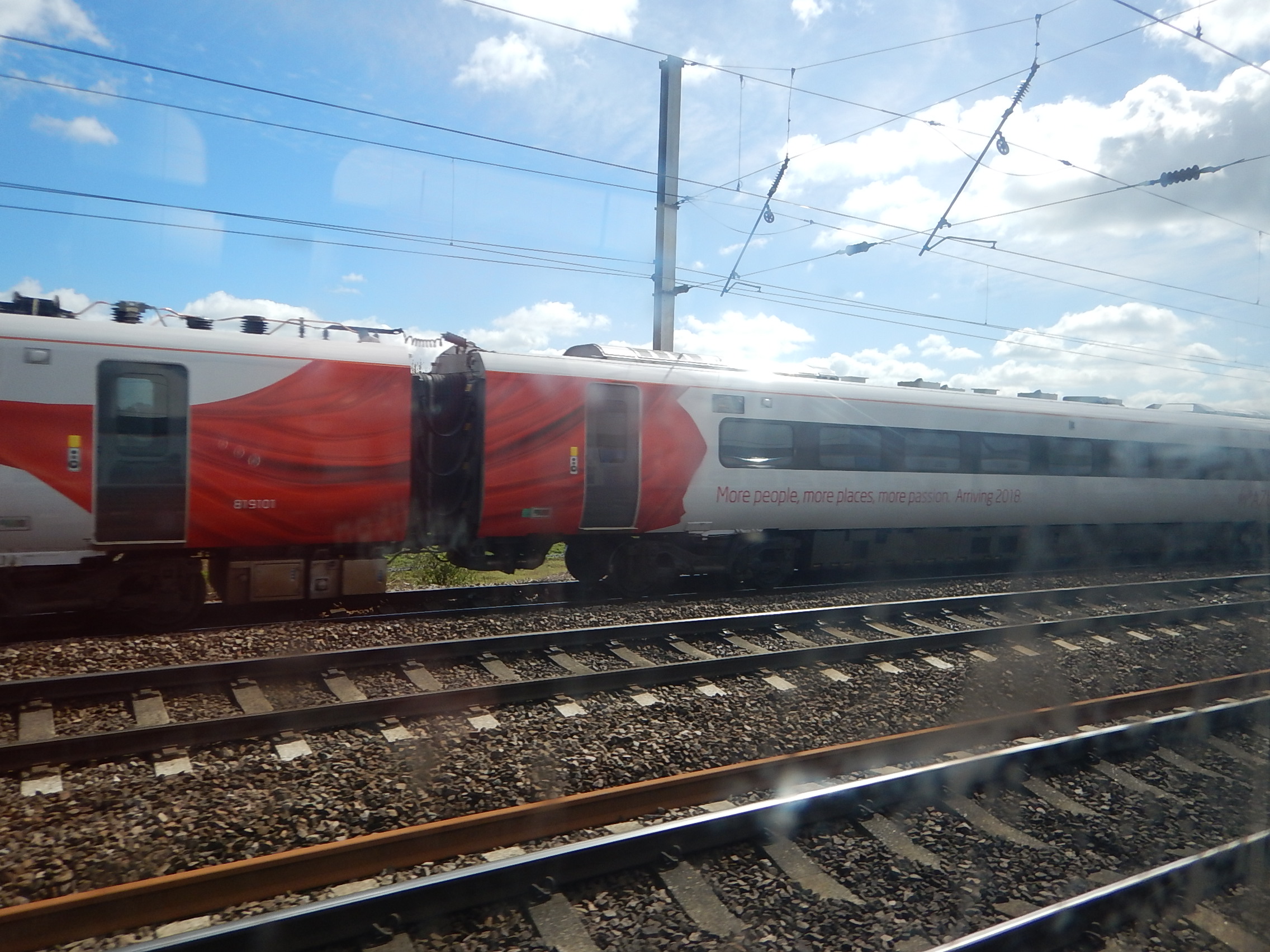
Virgin’s New Train On Test
Virgin’s new Class 800 train is under test.
Where Are The Battery Trains?
I was asked this question last week and it is just as much a puzzle to me, as it is to the person, who asked the question.
There doesn’t appear to be much hard news and in the May 2016 Edition of Modern Railways, IPEMUs to give them Network Rail’s preferred name or battery trains, as some will call them, there was only one reference to trains powered by the technology.
There was an article entitled Bi-Modes To Bexhill?, which contained the sentence.
Also under consideration is replacement of Class 170 DMUs by bi-mode or battery trains on the Marshlink route.
In several posts here, I believe I have shown how IPEMU technology can improve the UK rail network and from numerous on-line sources, I have come to the conclusion that the mathematical and operational reasons behind the trains are sound.
But I come to the following possible reasons, for the non-appearance of the battery trains.
The Technology Doesn’t Work
Although, this could be the reason, I find it unlikely, given that the IPEMU is just a slightly bigger application, than say a hybrid bus or a plug-in electric car.
There have been some problems with buses and cars, but nothing so serious to prompt wholesale withdrawal from service.
It should also be pointed out, that because of the physics of steel-wheel-on-steel-rail, IPEMUs have an advantage over their rubber-tyred cousins.
The Batteries Don’t Work
Some might question the batteries, but battery technology is moving on apace and Bombardier are reportedly testing four different battery systems in Mannheim.
Installing IPEMU Technology On A Class 387 Train Has Issues
The most likely train to be given an IPEMU capability is a Class 387 train.
It is closely related to the Class 379 train, that was used successfully as a public test train.
As two of the possible applications of an IPEMU; Uckfield Branch and the Marshlink Line, are in the territory of Southern, who are an operator of Class 387 trains, I don’t think obtaining a train for a prototype should be a problem.
But one problem that might have arisen is that all of the Class 387 trains in service can’t be given an IPEMU capability, as there is a major modification needed to install the on-board energy storage.
In which case, are we waiting for the first of Porterbrook’s new build of twenty to be manufactured?
There could of course be other technical issues that must be solved.
- I have seen nothing about how two or three IPEMUs would be coupled together to make longer trains. This will be very important to some operators.
- Control of the pantograph, so if possible it deploys automatically.
- The choice of battery.
I think it could be the last, as the one thing Bombardier, don’t want is a train with not quite enough range and unreliable energy storage.
Are Bombardier Going For KERS?
I think we could see something truly mind-blowing in train on-board energy storage in the future.
My money would be on a flywheel-based system similar to KERS, as is used in Formula One and that has been successfully tested in hybrid buses.
The company behind all this technology is called Torotrak. who are based in Leyland in Lancashire. I wrote about the company recently in Low Emission Buses On Hold. In the post I quote, the company as saying this.
Beyond this, Torotrak said its KERS off-highway technology has gained significant traction and said it has seen strong interest in its V-Charge technology from carmakers.
What do they mean by off-highway technology?
So will we be seeing the Formula One train?
I have no idea, but I have made a small investment in Torotrak shares. So at least, I’ve put my money where my mouth is!
Certainly, waiting for train-based KERS, would explain the delay!
The Trains Are Too Expensive
This must always be a possibility and there might be a problem, in that using IPEMUs may be more expensive for the operator, but produce a large saving for the owner of the infrastructure.
So places, where there is a strong connection between the tracks and trains, like London, Merseyside and perhaps Chiltern, may be more enthusiastic about IPEMUs. Merseyrail have been quoted, that they are thinking about IPEMUs!
There Are Issues With Class 700 Trains
Class 700 trains certainly haven’t started running on Thameslink and the May 2016 Edition of Modern Railways reported that although, there are issues, they are nearing resolution.
Once these trains are starting to be delivered, the current electric trains on the route Class 319, 377 and 387 trains can start to be released.
Only the two Electrostars; 377 and 387 trains could be converted to IPEMUs.
So is the knock-on from the non-introduction of the Class 700 trains, meaning that operators are fighting over the Class 387 trains, as I pointed out in Are The TOCs Auguing Over The Class 387 Trains?
Once a supply of Class 387 trains are available, will we see some given an IPEMU capability?
Southern’s Labour Relations Problems Are Getting In The Way
Southern seem to be going to have a summer of discontent, with all sorts of labour relations problems.
So could this be another factor holding up the release of the Class 387 trains?
Is Everybody Waiting For Sir Richard?
If you have a Class 387 IPEMU, that could run at 110 mph on main lines and then could perhaps do sixty miles on batteries, the routes that might be possible include.
- Euston to Blackpool
- Euston to Chester
- Euston to Huddersfield
- Kings Cross to Harrogate
- Kings Cross to Hull
- Kings Cross to Lincoln
- Kings Cross to Middlesbrough
In A High Speed Train With An IPEMU-Capability, I showed that extensions to fast routes might have applications for a fast IPEMU.
All the routes named come into the category of high speed routes with extensions and all are in Virgin Territory, so are we waiting for the Great Publicist to unveil the Green Formula One Train?
At least he would solve the problem of what to call the trains. Batteries are something in a mobile device not a train!
Conclusion
I think that probably the non-appearance is down to a mixture of issues, with technical ones and a shortage of Class 387 trains most prominent.
I do think though, that we shall be seeing IPEMUs working on the UK rail network within a year.
Consider.
- Network Rail are doing extensive work to create a fast double-track railway line between St. Pancras and Corby.
- The Uckfield Branch has been upgraded for twelve-car trains. Would they do that, just to run strings of Class 170 DMUs?
- The Marshlink Line is being upgraded.
- The new East Anglian franchise specified extra points would be given to those who used new technology.
- IPEMUs could run Euston to Blackpool, Euston to Chester, Birmingham New Street to Rugeley and many other routes tomorrow.
I think we’re waiting for a technical issue to be solved.
It’s either batteries or multiple running of trains, which would certainly be needed for some services.
Azuma Has Arrived
This article on Global Rail News is entitled Richard Branson unveils Virgin East Coast’s ‘Azuma’ Class 800/1.
You wouldn’t expect Branson to play second-fiddle to Great Western Railway on new trains.
Azuma means East, so will GWR give them a name that means West in Japanese?
Could Virgin Run A Double Shuttle?
Coming back from Manchester today, I didn’t book a ticket, but then I never do when returning to London.
Suppose I’m going to a football match or a meting at a place like Huddersfield, which is a single change at Manchester Piccadilly or Liverpool Lime treet station.
Going North, I’ll choose a train that gives me about an extra hour to get me to the stadium in time for the match. This means that if the trains are running to time, I will have time to buy a gluten-free lunch at Carluccio’s in Piccadilly station or Liverpool before doing the second leg to the destination.
I might book a First Class Advance, but usually on a Saturday, I’ll book an Off Peak ticket in Standard Class and pay the Upgrade on the train.
Coming home, I’ll always use an Off Peak ticket, as from many places, you can never guarantee to be able to get to the station to catch a booked train. Especially, if it’s a wekend and there are Rail Replacement Buses.
I use similar booking tactics to places like Birmingham, Cardiff, Leeds, Liverpool, Sheffield and York.
It is a tactic that works well and I’ve never needed to buy a new ticket to get home, because I’ve missed a booked train.
Today got me thinking, as I came home from Manchester.
Would it be more profitable, if Virgin ran the service between London and Manchester as a turn-up-and-go Shuttle?
- Passengers would be able to book the trains in the normal manner.
- It would also be possible to turn up at Euston or Manchester and just by touching in and touching out with contactless technology at your destination to get on the train.
- Perhaps it could all be done on a simple terminal where you choose your class and destination, paying for the ticket with contactless technology using ApplePay, AndroidPay or a bank card.
- At Manchester Piccadilly, I had plenty of time today, so taking ten minutes to buy a ticket wasn’t a problem.
- Surely, the quicker you can buy a ticket, the more passengers will travel.
- Three trains an hour would run in both directions always starting from the same platforms.
It could get very interesting, if it was made into a double shuttle, with Euston to Liverpool services.
I suspect there’s a pattern, that perhaps has six trains an hour to Crewe, with some trains going to Manchester and others to Liverpool.
Good News For Blackpool
Blackpool hasn’t had much good news over the last few years, but could this news article in the Guardian, be the start of better times for the town.
The article describes how Great North Western Railway has been given permission to run six return trains a day between Queen’s Park in North London and Blackpool. This is an extract from the article.
GNWR has been granted firm rights to run services from Blackpool North to Queen’s Park in north-west London, calling at Crewe, Preston and Poulton-le-Fylde. GNWR intends to run its services beyond Queen’s Park into the mainline terminus at Euston, but this is contingent on Network Rail agreeing to grant the slots when the scale of disruption of work to construct the new HS2 line becomes clear.
It also intends to call at Milton Keynes, Nuneaton, Tamworth, Lichfield Trent Valley and Kirkham and Wesham, depending on the conclusion of other works by Network Rail.
The services will be run using new Class 390 Pendolino trains.
I think there are two possible outcomes.
The trains are delivered and six services a day are run between Blackpool and London.
But Virgin Trains already operate trains two services a day between Blackpool and London, so I would assume they will use every trick in the book to see that GNWR don’t get a successful service running on the route.
The only way to probably fight off the interloper, would be to run a comparable service.
So in either way it is good news for Blackpool.
To me, the interesting idea, is to use Queen’s Park as a London terminal, if Network Rail can’t find paths to get access to Euston.
It would appear that Queen’s Park station has plenty of space and platforms. Also because of the Bakerloo Line it has good connections to Central London.
So could it be a station that is used to take pressure from Euston during the building of HS2, by perhaps being the London terminus for some London Midland services, even if it is not used for GNWR’s services to Blackpool and other places.
It’s certainly not a problem, I would want to solve, as many won’t want there services moved from Euston.
On a personal note, the Queen’s Park to Blackpool services will be something I will use, as it is proposed they will stop at Milton Keynes, Nuneaton, Tamworth, Lichfield Trent Valley, Crewe, Preston, Poulton-le-Fylde and Kirkham and Wesham.
Also for me, Queen’s Park is not a difficult station to get to from where I live in Dalston.
I shall watch GNWR’s plans unfold with interest, as just as they will have a positive effect on Blackpool, they should benefit me too!
Racing Trains To Scotland
As a child, I was never a great reader of books, except for encyclopaedias and other factual books. In an effort to get me to read more, my mother got me a book from the library about how the various train companies in the late 1800s tried to outperform each other to Edinburgh in 1888 and Aberdeen in 1895.
All of this has come back to me, as this month’s edition of Modern Railways is talking about developments in the services to Scotland, that could happen over the next few years.
The Press of the time, dubbed this Victorian rivalry as the Race To The North and in the section in the Wikipedia entry about the rivalry to Aberdeen in 1895, this is said.
In his 1958 book about the series of races, Oswald Nock wrote of the 22/23 August journey, “And at that astonishing average speed of 63.3 mph made sixty-three years ago the London–Aberdeen record still stands today”
The time was even more astounding, when you consider it wasn’t beaten until the 1970s by an InterCity125, which still work the route today.
The time on the night of the 22nd/23rd of August 1895 was eight hours forty-two minutes with Victorian steam locomotives and today the 200 kph diesel train takes just a few minutes over seven hours. But the modern train takes the shorter East Coast route!
The East and West Coast routes obviously don’t race each other these days, but according to Modern Railways, it looks like travel between London and Edinburgh is going to get faster and more interesting, as Virgin are aiming for quite a few four-hour trains throughout the day and two new companies are applying to run direct services between the two capitals.
If I understand the article correctly, by 2020 Virgin will be running three trains an hour between London and Edinburgh. The train from London on the hour will stop at Newcastle with York in alternate hours. The one stoppers will do the journey in four hours with the others just a few minutes slower.. Hopefully by 2020, the new Class 800 and Class 801 trains will be running the semi-fast services in four hours twenty-three minutes. The fastest trains now take four hours and twenty minutes.
Two new operators are applying to run trains on the route.
GNER which is ultimately a subsidiary of Deutsche Bahn is planning to use 12×9-car Pendelinos to provide an hourly ‘fast’ service in three hours forty-three minutes from December 2018. They have said, that they are aiming to tempt passengers to switch from plane to train.
The article quotes that rail has a 30% share of the London-Edinburgh market, where there are 42 flights a day. They want to push rail’s share up to 50%.
In Edinburgh – Train or Plane? I compared a journey up by easyJet from Stansted with a return in First on East Coast. Both journeys cost and took about the same time from Hackney to the centre of Edinburgh.
FirstGroup is aiming to run five trains each way between London and Edinburgh in four hours from December 2018, using new Hitachi AT300 electric trains with three stops en route at Morpeth, Newcastle and Stevenage. First has said it will be targeting passengers from the low-cost airlines.
I’ve only talked about Edinburgh in this piece, but a lot of the analysis will also apply to the West Coast Main Line, which has already hsad a dose of a competing service, in the share of First TransPennine to Manchester.
If these plans come to fruition, it would look like the slowest trains on the Edinburgh route will be the Virgin semi-fasts, which will take just a few minutes longer than the fastest trains today.
Out of curiosity, I looked at trains and flights for tomorrow (today is a Monday). I could get the 08:00 out of Kings Cross, which gets me into Edinburgh at 12:20, just in time for lunch, for a Second Class cost of £33.95 and a First Class cost of £65.95 (both costs third-off with Railcard), whereas the easyJet flight from Gatwick or Stansted costs around £60, but would probably mean leaving home well before five in the morning.
This leads me to think, that if all these train services to Edinburgh come to fruition, that the only losers will be the airlines, especially if the large increase in capacity on the route brings down train fares.
Alliance Rail Are Thinking Big
In the UK, there is provision for allowing what are called open access operators on UK railways. This is Wikipedia’s definition.
An open access operator is a train operating company that is not subject to franchising, instead purchasing individual slots on the mainline from a railway infrastructure company.
The three most well-known open access operators in the UK are Eurostar, First Hull Trains and Grand Central Railway.
A new company called Alliance Rail, who incidentally are the parent company of Grand Central is trying to join them.
They are proposing to have two train companies Great North Western Railway and Great North Eastern Railway running on the West and East Coast Main Lines respectively.
Services which would be run using six-car Class 390 Pendolinos are proposed as follows.
GNWR
London Euston – Blackpool North (six daily)
London Euston – Leeds (six daily)
GNER
London King’s Cross – Edinburgh – (hourly)
London King’s Cross – Bradford/Ilkley – (two hourly)
London – Cleethorpes – (up to four daily)
In addition towns and cities like Dewsbury, Eccles, Grimsby, Huddersfield, Newton-le-Willows, Scunthorpe and Stalybridge will get direct services to London.
It is an ambitious plan and I suspect that Virgin and Stagecoach will use everything in their power to strangle this upstart before it starts.
A Dreadful, But Totally Avoidable Train Journey
As a coeliac who avoids gluten and also because I’ve had a stroke and am on Warfarin, I have to be very careful about my diet. For this reason I plan my pit-stops well when I travel by train. If I do change trains, I usually arrange this at a station like Birmingham New Street, Cambridge or Leeds, where I know there is a good M & S Simply Food or a selection of restaurants that I trust.
The last couple of days, I have been in Scotland and on the way back I saw Ipswich Town play at Middlesbrough.
As Middlesbrough is a particularly difficult town for suitable food, I decided to come south as soon as possible after the lunchtime match. I did get lunch of sorts from the M & S in the town.

Quiche And Lemonade On A Bitterly Cold Day
It was bitterly cold and I ate it in the gardens in from of the Crown Court. But hey, two of my family’s bloodlines are Jewish and Huguenot and I reckon at times, they’d have found my simple lunch a veritable feast.
A couple of weeks before, I’d tried to book a First Class ticket from Middlesbrough to Kings Cross, but found the prices rather stratospheric, so in the end I bought a reasonably priced First Class ticket from Middlesbrough to Peterborough changing at York, from where I could get a Great Northern train into London.
I had assumed that the difficult availability of tickets was because of the England-Scotland match at Twickenham and at no time did the on-line booking process on East Coast inform me of the real reason for a ticket shortage.
It was only, when I caught the Virgin Trains East Coast train at York, did the staff inform me of the reason. The East Coast Main Line was subject to engineering work and we’d be using a diversion.
Unlike some other companies, East Coast’s gluten-free offering is non-existent, so I was getting hungrier by the hour, as we were shown the delights of the GNGE in the dark.
As the train was going on to Kings Cross and there were plenty of empty seats, I asked the conductor if I could buy a ticket to complete the journey on the train, rather than decamping at Peterborough to purchase a ticket for another train.
Astronomic prices were mentioned, which bore no relation to the twenty pounds or so, my phone said I would need to spend on-line for a Standard Class ticket. So I got off and bought a ticket in the Booking Office for around ten pounds for Great Northern. Incidentally, the Off-Park Single with a Railcard for East Coast is £14.75. So where did a price of three times that come from?
I finally arrived in London six hours after I left Middlesbrough. To cap it all, the only gluten-free food left in M & S at Kings Cross was one packet of sandwiches.
I could say the sandwiches were stale to add colour to this tale! But they were excellent!
If the works on the line had been flagged up when I tried to book the ticket, I would have only used East Coast as a last resort. After all, I could have gone via Sheffield or Manchester, where I can at least get something to eat. The Booking Office clerk at Peterborough had told me that they have to tell personal callers that there are problems! So why not on the web?
The conductor on the train, said it was all my fault, as I should have gone to Kings Cross, to read all the information about engineering works. Doesn’t that remove one of the advantages of booking on-line?
If you say you want to collect a ticket from a station that is not the starting point of your journey, the train purchase web sites ask you if this is what you want to do. Surely, a warning if there are works or likely delays on your route could be similarly indicated.
The real losers in this tale are Virgin Trains East Coast, as they had an empty seat between Peterborough and Kings Cross, for which I would probably have paid a reasonable amount. Next time I go to York or Doncaster where there is an alternative, I will also probably use it.
 The Anonymous Widower