FLXdrive ‘Electrifies’ Pittsburgh
The title of this post, is the same as that of this article on Railway Age.
The article describes Wabtec’s FLXdrive locomotive, as “the world’s first 100% battery, heavy-haul locomotive”
It is well worth a read, as it describes some of the design philosophy.
In addition, this page on the Wabtec web site gives some details of the locomotive.
It is powered by lithium-ion batteries.
- There are around 20,000 battery cells
- The batteries have their own air-conditioning
- There is a sophisticated battery-management system.
- The total battery size is 2.4 MWh
- Power output is 4400 HP or 3.24 MW
- Locomotive will run for 30-40 minutes at full power.
- The locomotive has regenerative braking.
- Operating speed is 75 mph
Note that running at 75 mph for 40 minutes would cover fifty miles.
The Railway age article has this paragraph, which describes a partnership between Carnegie-Mellon University (CMU), Genesee & Wyoming and Wabtec to create the Freight Rail Innovation Institute.
CMU, Genesee & Wyoming and Wabtec also hope to create the Freight Rail Innovation Institute, described as “the first-of-its-kind effort to create zero-emission locomotives, develop technology that increases freight rail utilization and improve safety by 50%, and create 250,000 jobs by 2030.” G&W’s Buffalo & Pittsburgh Railroad will pilot technologies developed by the Freight Rail Innovation Institute, including a zero-emissions battery and hydrogen-powered train that is planned for revenue operation on 200 miles of track between Pittsburgh and Buffalo, N.Y. within the next three years.
Note.
- The paragraph is very much a mission statement.
- Genesee & Wyoming are the parent of Freightliner in the UK, who are developing a dual-fuel locomotive, that I wrote about in Freightliner Secures Government Funding For Dual-Fuel Project.
It strikes me CMU, Genesee & Wyoming and Wabtec are on the right track.
Iron Ore Miner Orders Heavy-Haul Battery Locomotive
The title of this post, is the same as that of this article on Railway Gazette.
This is the first two paragraphs.
Mining company Roy Hill has ordered a Wabtec FLXdrive battery-electric heavy-haul freight locomotive. This will replace one the four ES44ACi diesel-electric locos used to haul its 2 700 m long iron ore trains, and is expected to reduce fuel costs and emissions by ‘double digit’ percentages while also cutting maintenance costs.
The locomotive is scheduled to be delivered in 2023. It will have a capacity of 7 MWh, an upgrade from the 2·4 MWh prototype which Wabtec and BNSF tested in revenue service in California earlier this year.
Note.
- It will have a 7 MWh battery.
- 2700 metres is 1.6 miles.
It looks to me, that the three diesel locomotives and one battery locomotive are arranged as a massive hybrid locomotive and I suspect that with sophisticated control systems, those double digit cuts in fuel costs and emissions would be possible.
A couple of years ago, I took this picture near Shenfield.
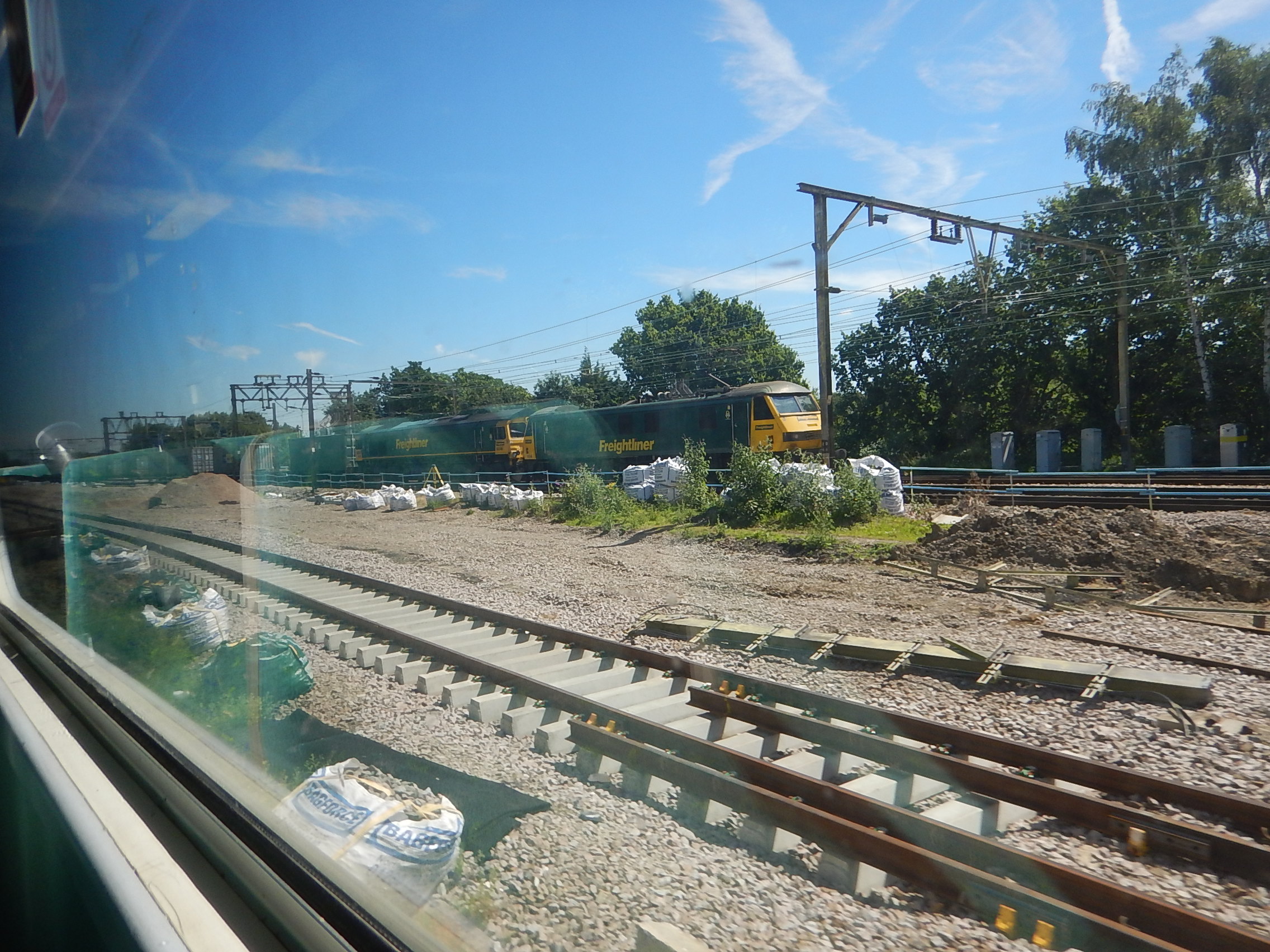
This double-headed train has a Class 90 electric locomotive and a Class 66 diesel locomotive at the front of a long freight train.
- The Class 90 locomotive has an TDM system for multiple working.
- The Class 66 locomotive has an AAR system for multiple working.
So does this mean that the two locomotives can’t work together, which if it does begs the question of what is happening.
- Had the Class 66 locomotive failed and Class 90 was acting as a Thunderbird?
- Was the Class 66 locomotive being moved from one depot to another for maintenance or repair?
- Was it an experiment to see if the two locomotives could work together?
I sometimes think that I didn’t see this unusual formation, but then the camera doesn’t lie.
But could we learn from what Wabtec are doing for Roy Hill in Australia?
The Class 93 Locomotive
Rail Operations Group have already ordered thirty Class 93 tri-mode locomotives from Stadler, which have following power ratings.
- Electric – 4000 kW
- Diesel – 900 kW
- Hybrid – 1300 kW
If this locomotive is capable of hauling the heaviest intermodal freight trains out of Felixstowe, Southampton and other ports and freight terminals, it could contribute to substantial reductions in the diesel fuel used and emissions.
As an example, I will use a freight train between Felixstowe North Terminal and Trafford Park Euro Terminal.
- It is a route of 280 miles.
- I will ignore that it goes along the North London Line through North London and along the Castlefield Corridor through Manchester Piccadilly station.
- There is fifteen miles without electrification at the Felixstowe end.
- There is under three miles without electrification at the Manchester end.
On this service , it could be as much as 94 % of diesel and emissions are saved, if the Class 93 locomotive can haul a heavy freight train out of Felixstowe. A few miles of strategically-placed electrification at the Ipswich end would help, if required.
It must also be born in mind, that the Class 93 locomotive is a 110 mph locomotive on electric power and could probably do the following.
- Run at 100 mph on the busy Great Eastern Main Line.
- Run at faster speeds on the West Coast Main Line.
- Fit in well with the 100 mph passenger trains, that run on both routes.
So not only does it save diesel and carbon emissions, but it will save time and make the freight train easier to timetable on a route with lots of 100 mph passenger trains.
The Class 93 locomotive looks like it could be a game-changer for long-distance intermodal freight, especially, if there were short sections of strategically-placed electrification, added to the electrified network.
Emissions could also be reduced further by using some for of sustainable fuel.

The picture shows a Class 66 locomotive, which is powered by Hydrotreated Vegetable Oil or HVO.
I can see that all diesel-powered trains and locomotives will be powered by sustainable fuels by the end of this decade.
A Wabtec Battery-Electric Locomotive
Wabtec is building a battery-electric locomotive for Roy Hill in Australia.
This article on Railway Age talks about Wabtec’s FLXdrive battery locomotives and describes some features of the locomotive for Roy Hill in Australia.
It mentions pantographs and overhead wires to charge the batteries.
- Wabtec’s prototype battery locomotive has a power output of 3.24 MW and a battery size of 2.4 MWh
- The Roy Hill battery locomotive has a power output of 3.24 MW and a battery size of 7 MWh
I could envisage Wabtec designing a UK-sized battery-electric locomotive with these characteristics.
- 2.5 MW power output, which is similar to a Class 66 locomotive.
- A battery size of perhaps 1.8 MWh based on Wabtec’s FLXdrive technology.
- A pantograph to charge the batteries and also power the locomotive where electrification exists.
- 75 mph operating speed.
- Ability to work in tandem with a Class 66 locomotive.
All technology is under Wabtec’s control.
This locomotive could have a range of at least fifty miles on battery power.
I think this locomotive could handle these routes.
- Peterborough and Doncaster via the Great Northern and Great Eastern Joint Line via Lincoln, with some form of charging at halfway.
- Felixstowe and Nuneaton, with some extra electrification at some point between Peterborough and Leicester.
- Oxford and Birmingham, with possibly some extra electrification in the middle.
One option for charging electrification, would surely be to electrify passing loops.
I think a battery-electric locomtive based on Wabtec’s FLXdrive technology could be a very useful locomotive.
Could Wabtec’s Battery-Electric Locomotive Pair-Up With A Class 66 Locomotive?
Roy Hill will use their locomotive to form a consist of three diesel locomotives and one battery locomotive to obtain double-digit savings of fuel and emissions, when hauling iron-ore trains that are 1.6 miles long on a route of 214 miles.
We don’t have massive iron-ore trains like this, but we do move huge quantities of segregates and stone around the country in trains generally hauled by Class 66 locomotives.
So could a Class 66 or another suitable locomotive be paired-up with a battery-electric locomotive to make savings of fuel and emissions?
I would suggest that if it works in Australia, the technology will probably work in the UK.
The biggest problem for Wabtec is that the heavy end of the market may well be a good one for hydrogen-powered locomotives. But Wabtec are going down that route too!
Conclusion
I am convinced that the two decarbonisation routes I have outlined here are viable for the UK.
But I also feel that locomotive manufacturers will produce hydrogen-powered locomotives.
Other companies like Alstom, Siemens and Talgo will also offer innovative solutions.
Wabtec Breathes New Life Into Older Locomotives
This title of this post, is the same as that of this article on Railway Gazette.
This is the introductory paragraph.
This month Wabtec completed the 1 000th locomotive it has remanufactured for customers in the Americas under a programme launched in 2015. Norfolk Southern has taken delivery of 500 of the locos, with other customers including Canadian Pacific, BNSF, Union Pacific and Brazilian operator Rumo.
This second paragraph gives Wabtec’s aims of the remanufacturing.
Wabtec said locomotive modernisation is a key element of its sustainability efforts, with revitalised locos offering fuel efficiency improvements of up to 25%, reliability increases of more than 40%, up to a 55% increase in haulage capability and reductions in maintenance, repair, and overhaul costs of up to 20%.
This ongoing program, which although it only offers a 25 % reduction in carbon emissions, shows the size of the diesel locomotive market in North America.
- A lot of these locomotives were built by GE Transportation Systems, which is now owned by Wabtec.
- It is obviously, a market that is commercially rewarding.
In Freightliner Secures Government Funding For Dual-Fuel Project, I talked about s UK project to decarbonise one of our North American-built Class 66 locomotives.
I do wonder how long it will be before Cummins or one of the other big diesel engine manufacturers like Caterpillar offers a hydrogen conversion for these big beasts.
The numbers shown in the article, show it could be a very large and profitable market.
In the future, a lot of decarbonisation will be driven by commercial interests.
BNSF and Wabtec Commence Battery-Electric Locomotive Pilot Test In California
The title of this post, is the same as that of this press release from BNSF.
This is the introductory paragraph.
BNSF Railway Company (BNSF) and Wabtec’s (NYSE: WAB) exploration of the future potential of battery-electric locomotives crosses another significant milestone this week as they begin testing the technology in revenue service between Barstow and Stockton, California. As BNSF seeks ways to further reduce its environmental impact, the advancement of battery technology offers some possible solutions.
“We’ve got everything in place and we’re ready to see how this next-generation locomotive performs in revenue service,” said John Lovenburg, BNSF vice president, Environmental. “BNSF is focused on continuing to reduce our environmental impact, and we’re committed to doing our part to test and assess the commercial viability of emerging technologies that reduce emissions.”
They have also released this video.
It certainly seems to work.
 The Anonymous Widower