Centrica And European Energy Sign Agreement On Måde Green Hydrogen Facility
The title of this post, is the same as that of this press release from Centrica.
This is the sub-heading.
Centrica Energy and European Energy have signed a balancing and optimisation agreement for the Måde green hydrogen facility located at Port Esbjerg. Under the agreement, Centrica Energy will manage power production from co-located wind turbines, designating excess power production to green hydrogen production.
These two introductory paragraphs give more details.
Powering the 12MW green hydrogen facility are two wind turbines, part of the Måde Wind Turbine Test Center, developed by European Energy with a total installed capacity of 16MW. The turbines will provide renewable electricity, which is used to produce green hydrogen through electrolysis with demineralised water.
Expected to produce approximately 1,500 tonnes of green hydrogen every year, European Energy has secured an agreement with Port Esbjerg and a world-class industrial gases company for the offtake from the facility. As the production of hydrogen is a heat-intensive process, the excess heat from production will be fed into the local district heating network, demonstrating sector coupling across the electricity, fuel, and heating domains.
These are my thoughts,
Hydrogen Production
The hydrogen production uses a standard electrolysis method, but excess heat will be fed into the local district heating network.
AquaVentus And Denmark
I introduced AquaVentus in this post called AquaVentus.
This video shows the structure of AquaVentus.
I clipped this map from the video.

Note.
- The thick white line running North-West/South-East is the spine of AquaVentus, that delivers hydrogen to Germany.
- There is a link to Esbjerg in Denmark.
- There appears to be an undeveloped link to Norway.
- There appears to be an undeveloped link to Peterhead in Scotland.
- There appears to be a link to just North of the Humber in England.
- Just North of the Humber are the two massive gas storage sites of Aldbrough owned by SSE and Brough owned by Centrica.
- There appear to be small ships sailing up and down the East Coast of the UK. Are these small coastal tankers, that are distributing the hydrogen to where it is needed?
In the last century, the oil industry, built a substantial oil and gas network in the North Sea.
It appears now the Germans are leading the building of a substantial hydrogen network in the North Sea, that will bring the hydrogen they need to their country.
I also suspect that any spare hydrogen produced in Esbjerg can be added to the AquaVentus network.
- Hydrogen could be sent to Brough and Aldbrough in the UK for storage.
- Hydrogen could be sent to any country in the network that needs it.
Countries will pay for the hydrogen they use.
Optimising AquaVentus
AquaVentus is a complex network.
- Hydrogen could be produced offshore in British, Danish, Dutch, English, German, Norwegian, Orcadian, Scottish and Shetland waters.
- Hydrogen could be sent to Brough and Aldbrough in the UK for storage.
- Hydrogen can be sent to Belgium, Denmark, Germany, Norway, The Netherlands and the UK.
A company like Centrica has the expertise and the software to control the various hydrogen flows to the best advantage of hydrogen producers and users.
Could Liverpool Develop A Massive Zero-Carbon Data Centre?
There is an article in The Sunday Times today, which is entitled Google Signs Nuclear Deal To Power AI Data Centres.
These are the first three paragraphs of the article.
Google has struck a deal with a nuclear power start-up to provide low-carbon energy for its data centres and AI operations, marking a world-first in the tech industry.
The California-based company said the agreement to buy energy from multiple small modular reactors developed by Kairos Power could help spur a nuclear revival in America.
The first reactor is scheduled to come online in America by 2030, followed by additional deployments through 2035.
I am not against nuclear-powered data centres, but could Liverpool build a massive zero-carbon data centre?
This Google Map shows Liverpool Bay, which is a vast expanse of water that stretches along the North Wales coast to Anglesey and all the way to the Isle of Man.
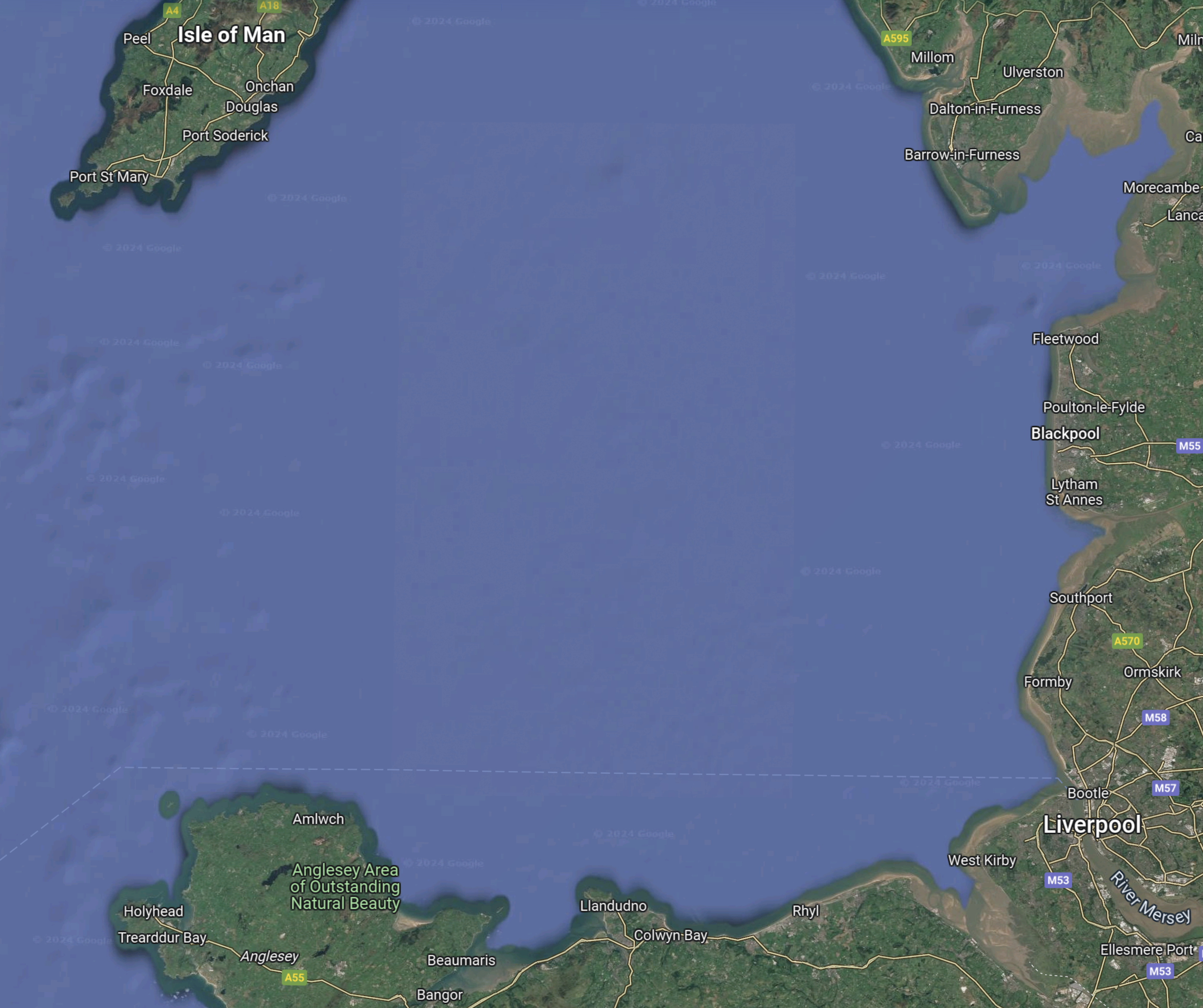
Note.
- The Isle of Man in the North-West corner.
- Liverpool, Birkenhead and the River Mersey in the South-East corner.
- Anglesey in the South-West corner.
- Blackpool with Morecambe Bay to its North in the North-East corner.
Liverpool Bay could be one of Europe’s zero-carbon energy powerhouses.
Wind Farms In Liverpool Bay
At the present time, these wind farms are producing electricity or planned in Liverpool Bay.
- Barrow – 90 MW – Commissioned in 2006
- Burbo Bank – 90 MW – Commissioned in 2007
- Burbo Bank Extension – 258 MW – Commissioned in 2017
- Gwynt y Môr – 576 MW – Commissioned in 2015
- North Hoyle – 60 MW – Commissioned in 2003
- Ormonde – 150 MW – Commissioned in 2012
- Rhyl Flats – 90 MW – Commissioned in 2009
- Walney – 367 MW – Commissioned in 2010
- Walney Extension – 659 MW – Commissioned in 2018
- West if Duddon Sands – 389 MW – Commissioned in 2014
- Awel y Môr – 500 MW – Planned
- Morecambe – 480 MW – Planned
- Mona – 1500 MW – Planned
- Morgan – 1500 MW – Planned
Note.
- 2509 MW has been commissioned.
- 3980 MW is being planned.
- That is a total of 6489 MW
I suspect more space in Liverpool Bay could be developed with wind farms.
Mersey Tidal Power
The Mersey Tidal Power project has a web site.
If it is built, it will probably be built by the South Korean company; K-Water and use some of the design principles of the Sihwa Lake Tidal Power Station.
It will likely have an output of around 1 GW and take ten years to build.
In the 1970s, I did some project management consultancy for Frederick Snow and Partners, and they showed me their plans for a Severn Barrage.
Their futuristic vision for the Severn Estuary was never built, as the Prime Minister of the time; Harold Wilson, felt coal was the future. See Last Of The Many!
I suspect that the Mersey Tidal Power project will be another variation on a proven theme.
Morecambe Bay Bridge And Tidal Barrage Proposal
In the Wikipedia entry for Morecambe Bay, there is a proposal for a bridge and tidal barrage across the bay, where this is said.
In 2004, a proposal was made to build a bridge across the bay flanked by wind turbines and using tidal power. Proposals from Northern Tidal Power Gateways in 2019 outlined a tidal barrage with a road running along on top.
If the Mersey Tidal Power project is a success, then why wouldn’t one across Morecambe Bay, be one too?
500 MW of zero-carbon tidal power would do nicely!
Nuclear Sites At Calder Hall, Heysham And Wylfa
These three nuclear stations have supplied electricity to the North-West of England.
- Calder Hall was the original Magnox site, which the Wikipedia entry says had a nameplate capacity of 240 MW and was decommissioned in 2003, after running for 47 years.
- Heysham is a powerful site which the Wikipedia entry says has a nameplate capacity of 2452 MW and will be decommissioned in 2028.
- Wylfa is an older, smaller Magnox site which the Wikipedia entry says had a nameplate capacity of 1190MW and was decommissioned in 2015.
As the sites are cleared, I am sure that we’ll see more nuclear power stations built on the sites.
How Much Electricity Does A Data Centre Use?
I found this paragraph in an NESO document.
Regardless of this, if we were to use existing market data and modelling projections, this could point to annual data centre electricity consumptions of between 3.6 TWh in 2020 to as much as 35 TWh by 2050.
Dividing by the hours in a year, indicates that an individual data centre could use between 0.4 and 4 GW of electricity.
Using my rough figures here from wind, tidal and nuclear, I suspect that the power on the Mersey will generate enough power for at least one data centre.
Liverpool Is On The Right Side Of The Country For Cables To North America
Cables will go straight out of Liverpool Bay, pass to the North of Ireland and across the Atlantic to somewhere like Puget Sound.
Liverpool has a superb location for a Transatlantic data centre, that connects to networks on both sides of the pond.
Could Underwater Data Centres Be Developed In Liverpool Bay?
This page on the Microsoft web site is entitled Microsoft Finds Underwater Datacenters Are Reliable, Practical And Use Energy Sustainably
These three paragraphs detail the research.
Earlier this summer, marine specialists reeled up a shipping-container-size datacenter coated in algae, barnacles and sea anemones from the seafloor off Scotland’s Orkney Islands.
The retrieval launched the final phase of a years-long effort that proved the concept of underwater datacenters is feasible, as well as logistically, environmentally and economically practical.
Microsoft’s Project Natick team deployed the Northern Isles datacenter 117 feet deep to the seafloor in spring 2018. For the next two years, team members tested and monitored the performance and reliability of the datacenter’s servers.
I would assume that Microsoft have continued the research, as with something like this you can’t be too careful.
But it would appear, that data centres and their servers could be submerged under the waters of Liverpool Bay.
London And Liverpool Will Be Under Two Hours By Train Within A Year
New Class 807 trains, which will be delivered within a year, will improve the train service between the two cities.
- Train times will be brought to around or even below two hours.
- , The extra trains will allow a second hourly service to be added.
- The extra service will additionally stop at Liverpool South Parkway station, for the airport.
- High Speed Two is claiming one hour and fifty minutes, between London and Liverpool.
Liverpool already has one of the best rail terminals in the North of England, as these pictures show.









































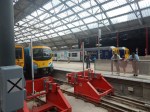



















With these service improvements, it will have a service to London and the South, that will be second to no other Northern station.
Liverpool Has A Refurbished Partly-Underground Suburban Railway With New Trains
Liverpool’s Metro is one of the best in Europe for a medium-sized city.
The Metro is also expanding with new routes and stations.

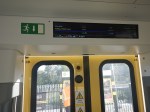




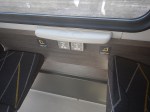









These pictures show the new Headbolt Lane station, which is swerved by the UK’s first battery-electric trains.
Liverpool Has Easy Access To Two International Airports
There are two international airports close by; Liverpool John Lennon and Manchester International.
- For Liverpool Airport, it’s a bus from Liverpool South Parkway station or an express bus from Liverpool city centre.
- For Manchester Airport, it’s a train from Lime Street station.
I am fairly sure, that a hydrofoil could connect Liverpool’s Waterfront and the Tidal Barrier to the airport.
North-West England Has A Rich University Tradition
Liverpool, Manchester and the surrounding area has several world-class universities and research establishments.
Some like The Pandemic Institute would be able to find uses for all the computing power and artificial intelligence on offer at a powerful data centre.
Liverpool Is A World City
Liverpool is a World City, where there is plenty of sport, entertainment and things to do.
Conclusion
Liverpool is installing the power infrastructure for a very large data centre, that will be able to handle the world’s largest and most difficult problems.
15+ MW Floating Wind Turbines to Be Tested At Norway’s METCentre
The title of this post, is the same as that of this article on offshoreWIND.biz.
This is the sub-heading.
Three companies have signed contracts with Norway’s Marine Energy Test Centre (METCentre) to test new technology aimed at reducing the costs of floating offshore wind by demonstrating floaters equipped with 15+ MW turbines.
These are the first two paragraphs.
According to Norwegian Offshore Wind, this is the turbine size that will be relevant for future floating offshore wind farms.
The test area is located just a few kilometres away from the Utsira Nord zone, where Norway’s first commercial floating offshore wind farm will be located.
This sounds like the sort of sensible test philosophy, that you’d expect from the Norwegians.
Norway Plans EUR 3 Billion Subsidy For Floating Offshore Wind
The title of this post, is the same as that of this article on offshoreWIND.biz.
This is the sub-heading.
The Norwegian government has proposed NOK 35 billion (approximately EUR 3 billion) for a support scheme dedicated towards the first commercial floating offshore wind tender within the Vestavind F and Vestavind B areas.
These are the first two paragraphs.
According to the press release, the government is making progress in following up on its ambitious plan to allocate project areas for 30 GW of offshore wind by 2040.
Norway plans to conduct the next tendering round for offshore wind in 2025. After that, the government intends to hold regularly scheduled tendering rounds and state aid competitions leading up to 2040.
The original press release is called A Responsible Approach To Floating Offshore Wind.
Some politicians and green sceptics might not call three billion euros responsible.
I do suspect that Great British Energy will have to deal in this size of numbers to be able to compete with the Norwegians.
We’ll have to work hard to meet our target of 100 GW by 2040.
But at least as the UK’s target is higher, does that mean that the target should be easier. Or do we have more suitable sea?
Principle Power Unveils New Floating Wind Foundations For 15 MW+ Turbines
The title of this post, is the same as that of this article on offshoreWIND.biz.
This is the sub-heading.
Principle Power has expanded its WindFloat portfolio by introducing two new semisubmersible floating wind foundation designs, called WindFloat TC and WindFloat FC, which are said to be optimised for 15 MW+ wind turbines.
A large picture and these two paragraphs introduce the new designs.
According to the company, the new designs are natural evolutions of the existing WindFloat technologies that support a wind turbine located on a column in the centre of the platform.
Designed to complement the existing perimeter column designs WindFloat T and WindFloat F, the new solutions share the same 4th generation design heritage and benefits.
Smart Hull Trim System
The article also mentions a Smart Hull Trim System in this sentence.
Some of these include a Smart Hull Trim system to maximise annual energy production and reduce loads.
I would assume that the Smart Hull Trim System, works very much like the control surfaces of an aeroplane or submarine to keep the craft straight and level.
On the Principle Power web site, the various WindFloats are described as follows.
- WindFloat T – Proven WindFloat® design, suitable for tubular construction.
- WindFloat F – A pontoon-based design suitable for flat panel construction.
- WindFloat TC & FC – Center column design solutions, optimized for 15MW+ turbines with stiff-stiff towers.
From work, I did in the 1970s, with two Cambridge University engineering professors, I reckon that the TC and FC designs will be the best.
Conclusion
Whatever way you look at it, a 15 MW+ floating wind turbine, when you consider they can have capacity factors in excess of 50 %, could be a very powerful electricity generator.
Ireland Joins Forces With EIB For Offshore Wind Port Upgrades
The title of this post, is the same as that of this article on offshoreWIND.biz.
This is the sub-heading.
The European Investment Bank (EIB) and the Irish Department of Transport have established an advisory cooperation to assess capacity, demand and financing strategies for the development of port infrastructure for offshore wind projects in Irish waters.
These are the first two paragraphs.
Signed by the Irish Minister for the Environment, Climate, Communications and Transport, Eamon Ryan, and EIB Vice President Ioannis, the advisory cooperation aims to evaluate the scale and nature of investment needed to upgrade Irish ports.
The initiative is said to unlock an estimated EUR 30 billion in investment in offshore wind projects in the country which plans to have 20 GW of capacity installed by 2040 and 37 GW by 2050.
It looks to me, that the Republic of Ireland will become a big player in the production of electricity from offshore wind.
I also suspect that Northern Ireland will play its part too!
SSE Announces Construction Of Aberarder Wind Farm
The title of this post, is the same as that as an advert on my online edition of The Times.
Click the advert and you get this page, with the title of this post.
This is the sub-heading.
Aberarder secured 15-year CfD in UK Allocation Round 5
These three paragraphs give more details of the wind farm.
SSE has taken a final investment decision to proceed with Aberarder Wind Farm in the Scottish Highlands, in a circa £100m investment boost for its onshore wind portfolio.
Construction of the 12 turbine, 50MW wind farm, which is wholly owned by SSE Renewables, will begin before the end of the year with completion scheduled for the end of 2026. The Aberarder project was successful in September 2023 in the UK’s fifth Contract for Difference (CfD) Allocation round, securing a 15-year contract for low-carbon power generation.
Located at Strathnairn near Inverness, on a natural plateau at an average of 700m above sea level, the Aberarder project site sits directly adjacent to the operational 94MW Dunmaglass Wind Farm, which is jointly owned by SSE Renewables and Greencoat UK Wind.
It would appear that a £100m investment in the Scottish Highlands will get you a fully-operational 50 MW wind farm.
These are my observations and thoughts.
SSE’s Project Overview Of Aberarder Wind Farm
These four paragraphs are SSE’s project overview from this page on the SSE Renewables web site.
The Aberarder Wind Farm project is located in Strathnairn near Inverness, on a natural plateau at an average of 700m above sea level. It will sit directly adjacent to the operational 94MW Dunmaglass Wind Farm, which is jointly owned by SSE Renewables and Greencoat UK Wind.
The project was developed by RES and consented by The Highland Council in April 2017. The consent allows for the construction of a 12-turbine onshore wind farm, with each turbine having a maximum tip height of up to 130m and is expected to have an export capacity of 49.9MW. SSE Renewables reached an agreement with RES to acquire Aberarder in October 2022.
In September 2023 Aberarder was successful in the UK’s fifth Contract for Difference (CfD) Allocation Round and was awarded a 15-year contract for low carbon power generation. SSE took a final investment decision to proceed with Aberarder Wind Farm, in a circa £100m investment in May 2024, construction is scheduled to begin before the end of 2024 with completion scheduled for the end of 2026.
Our focus is now on building strong and meaningful relationships with the local community surrounding the Aberarder Wind Farm. As a responsible developer and operator, we are looking forward to working closely with the community in surrounding area to fully realise the benefits of this exciting project.
Construction has now started and it would appear that in two years, the twelve-turbine wind farm will be producing power.
SSE’s Description Of Dunmaglass Wind Farm
These four paragraphs are SSE’s description from this page on the SSE Renewables web site.
Located to the south east of Inverness, on a natural plateau at an average of 700m above sea level, Dunmaglass is SSE’s highest wind farm to be constructed.
SSE acquired the project from RES in May 2013 and initial enabling works began in the summer of 2013 which included the upgrading of 11km of tracks and the construction of two timber deck bridges.
Highland contractor RJ McLeod was awarded the £16m main civil works contract in summer 2014.
Dunmaglass became fully operational in 2017.
This paragraph also illustrates the challeges of the It looks like the construction of the larger Dunmaglass wind farm.
The height at which Dunmaglass is located presented its challenges during construction and the winter months brought high winds and plenty of snow. The site was fully completed and handed to the operations team in 2017.
Surprisingly, the legendary Highland midges didn’t get a mention.
The Sale Of 49.9 % Of Dunmaglass Wind Farm To Greencoat UK Wind
This sub-heading outlines the sale.
In February 2019, SSE sold 49.9% of Dunmaglass to Greencoat UK Wind PLC as part of a deal in which Greencoat acquired a 49.9% stake in both Dunmaglass and the nearby Stronelairg wind farm.
This paragraph gives more details of the sale.
In February 2019, SSE signed agreements for the sale of 49.9% of Dunmaglass wind farm to Greencoat UK Wind Plc (“UKW”). This sale was part of a £635m deal in which Greencoat acquired a 49.9% stake in both Stronelairg and Dunmaglass wind farms. The stakes equate to 160.6MW (megawatts) of capacity, with an average valuation for the two wind farms of around £4m per MW. This valuation demonstrates SSE’s ability develop quality, low carbon assets and infrastructure vital to the GB energy market.
The interesting figure is that SSE was paid £4m per MW for the interest of 160.6 MW, that they sold.
Aberarder wind farm is a 50 MW wind farm and it appears that it will cost £100 million to build.
If after a couple of years of operation, the wind farm is worth £4 million per MW, then SSE have doubled their money.
Does this illustrate, why the professionals like SSE and Greencoat UK Wind invest in wind farms?
- SSE would have taken the risk, that they could build the wind farm.
- SSE have the engineering skillsto do an excellent job.
- Greencoat UK Wind are buying into a producing asset, with a known cash flow.
SSE also get more money to build more wind farms.
Where Are Aberarder And Dunmaglass?
This Google Map shows the site of Aberarder wind farm with respect to Inverness.
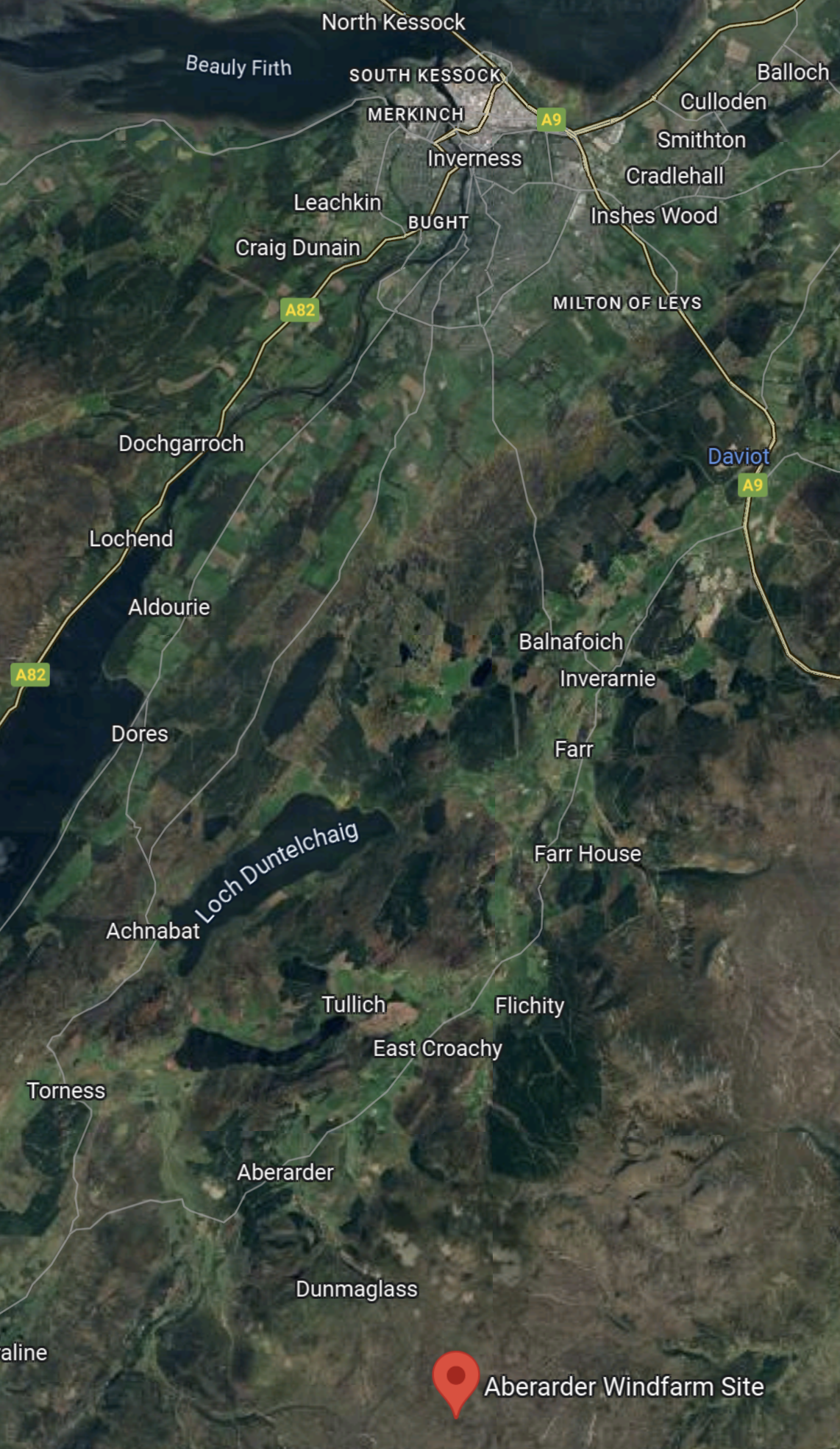
Note.
- Inverness is at the top of the map on the waters of the Solway Firth.
- Aberarder wind farm is marked by the red arrow.
- Aberarder is a hamlet to the North-West of the wind farm.
- Drumnaglass is a shooting estate to the North-West of the wind farm.
- Loch Duntelchaig is the main reservoir for Inverness.
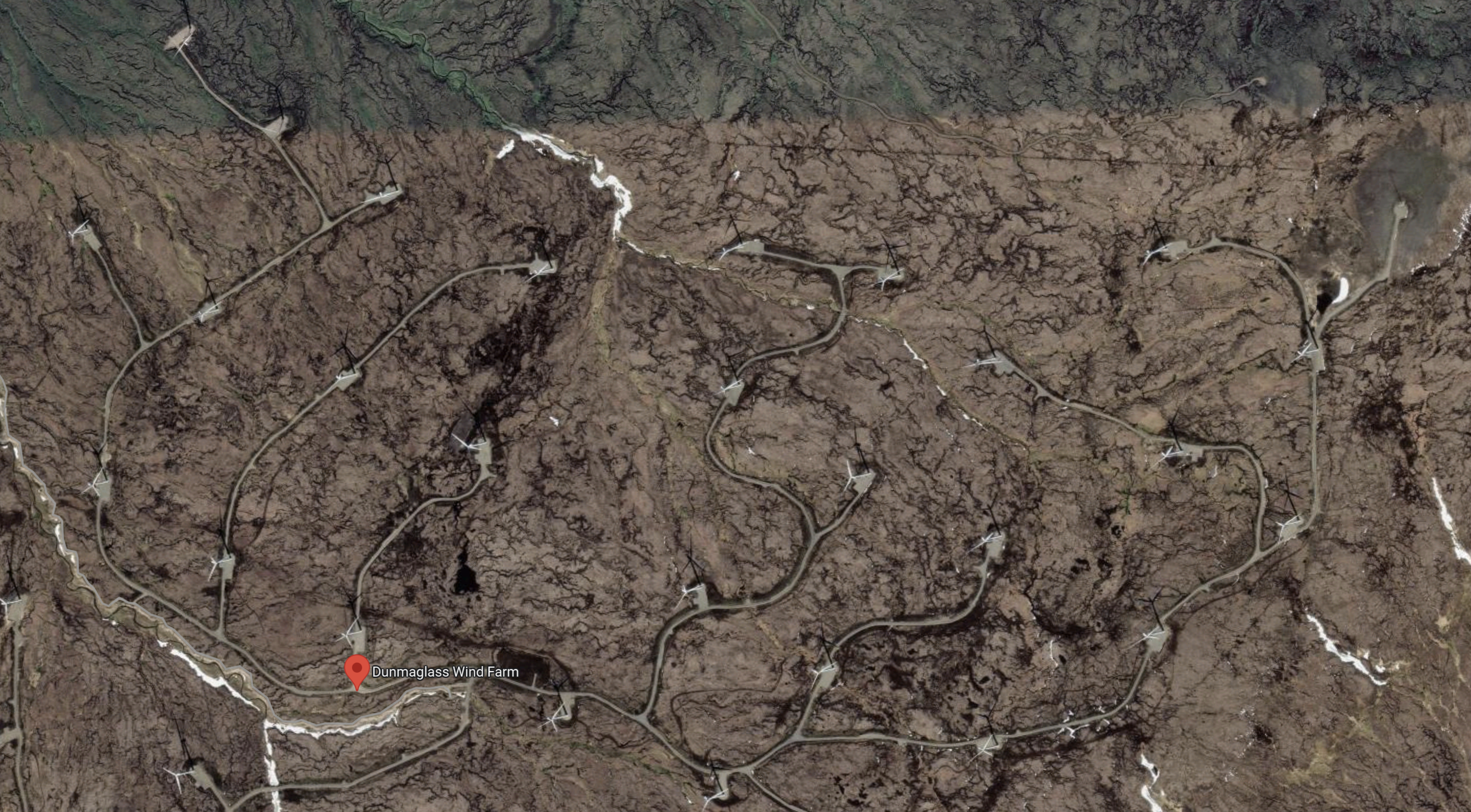
This second Google Map shows the Drumnaglass wind farm.
Note.
- Drumnaglass wind farm has 33 turbines and a capacity of 94.05 MW.
- There is a track network of 11 km. linking all the turbines.
- A good proportion of the turbines can be picked out on the map.
It would appear that Aberarder wind farm will lie to the South-East of this wind farm.
Aberarder Wind Farm To Fort Augustus
In Cloiche Onshore Wind Farm, I talked about the 130.5 MW Cloiche wind farm and its future construction to the East of Fort Augustus and Stronelairg wind farm.
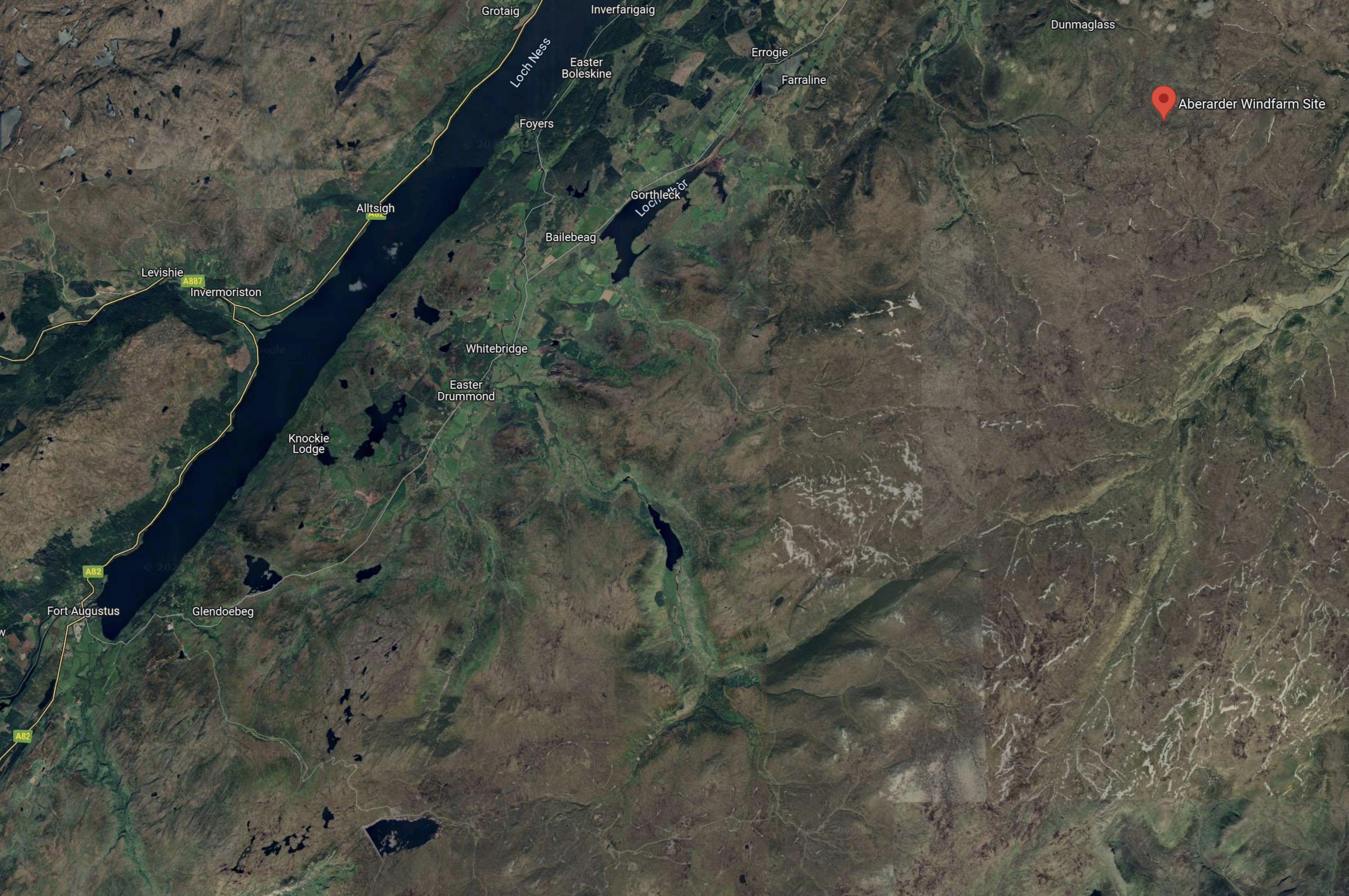
This Google Map shows the position of Aberarder wind farm with respect to Ford Augustus.
Note.
- Loch Ness runs across the North-West corner of the map.
- Fort Augustus and Stronelairg wind farm, are at the Southern end of the loch.
- The red arrow shows Aberarder wind farm.
- Foyers pumped hydro is on the Eastern bank of Loch Ness, at about the same latitude as the Aberarder wind farm.
- The lake at the bottom of the map, to the South-East of Ford Augustus, is the Glendoe Reservoir, that powers the Glendoe hydroelectric scheme.
There are certainly, a lot of SSE-owned and/or SSE-controlled assets in the area and I wouldn’t be surprised, if SSE integrated them more closely, or added a few more wind farms.
Why Are SSE Advertising The Start Of Construction?
SSE have been advertising for some time on The Times web site.
As they are not a retail energy company anymore, as they sold their retail business to OVO, the advertising, is probably about spreading a good corporate message and getting their strategy broadcast.
Cloiche Onshore Wind Farm
This document from the Department of Business, Industry and Industrial Strategy lists all the Contracts for Difference Allocation Round 6 results for the supply of zero-carbon electricity.
The largest onshore wind farm in the Allocation Round, is the Cloiche wind farm, which has this web page,which is entitled Onshore Wind Projects , on the SSE Renewables web site.
It is the only project on the page and these two paragraphs describe its location and capacity.
The proposed 29 turbine Cloiche Wind Farm is located on the Glendoe and Garrogie Estates, adjacent to the operational Stronelairg Wind Farm and Glendoe Hydroelectric Scheme and approximately 11 kilometres (km) to the south-east of Fort Augustus in the Great Glen, in the Monadhliath mountain range.
It is anticipated that the wind farm will generate approximately 130.5MW.
This Google Map shows the location.
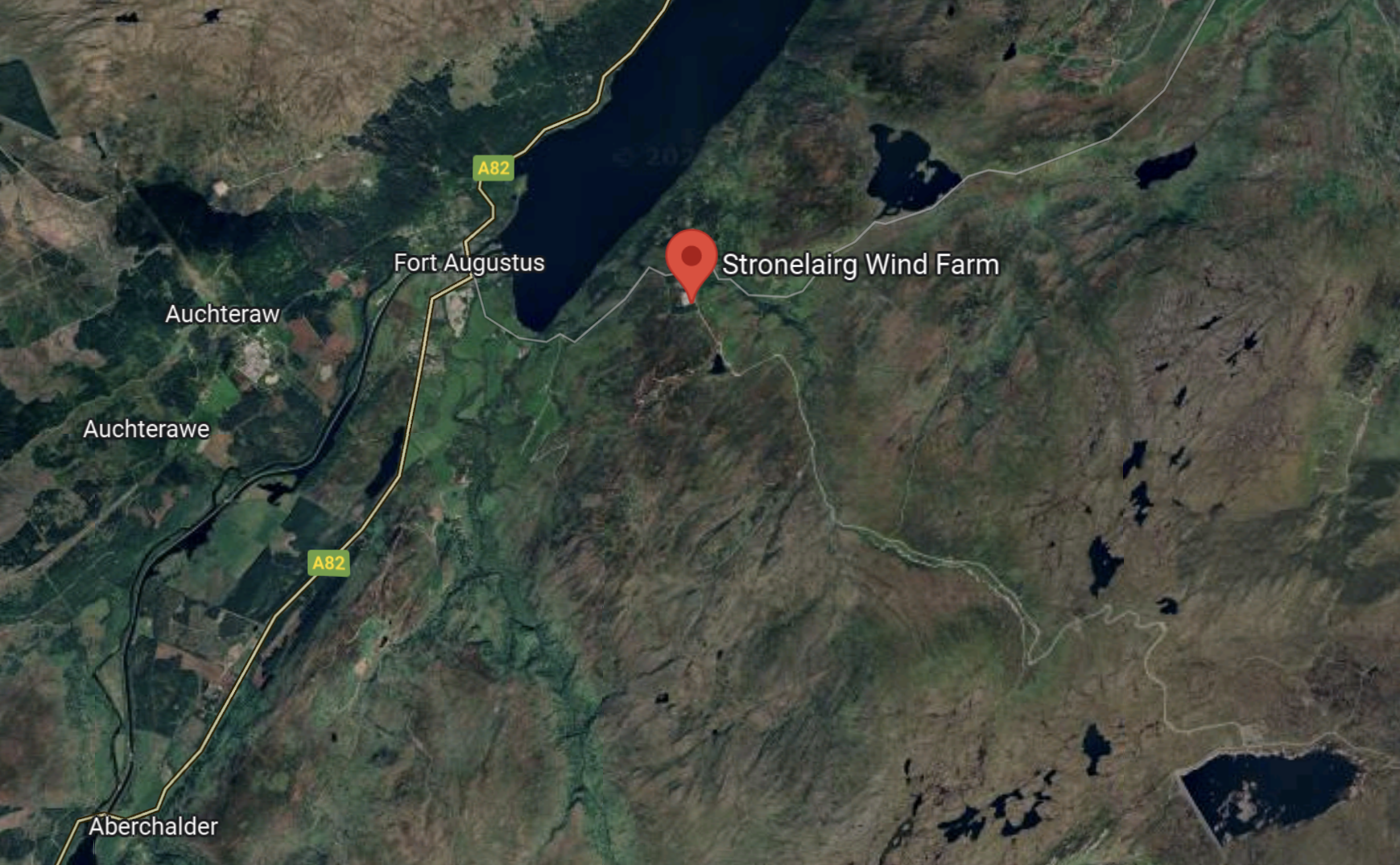
Between the village of Fort Augustus and the Stronelairg wind farm, lies the Southern end of Loch Ness.
In the South-East corner of the map, there is a large lake, which is shown in more detail in this Google Map.
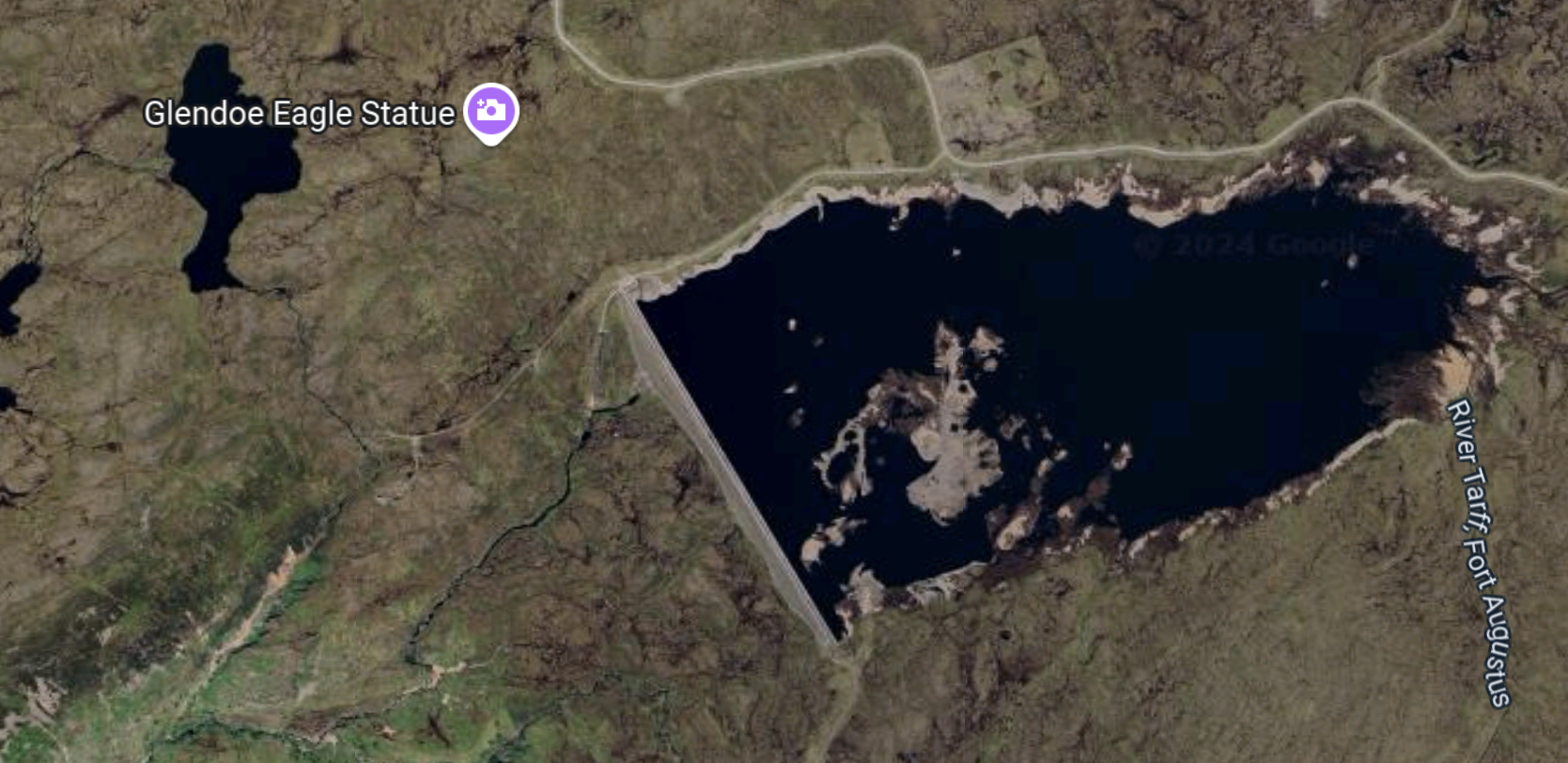
This is the Glendoe Reservoir for the Glendoe Hydro Scheme, that was built in the early years of this century, by damming the River Tarff.
The dam is clearly visible at the Western end of the Reservoir.
The Glendoe Hydro Scheme was opened in 2009 and has a generation capacity of 106.5 MW.
The planning and building of the scheme are described in this Wikipedia entry and the entry is well worth a read.
Stronelairg Wind Farm
Stronelairg wind farm, Cloiche wind farm and the Glendoe Hydro Scheme are all projects, that were or will be developed by SSE Renewables.
Stronelairg wind farm has 66 turbines and a total installed capacity of 228 MW.
It has a web page on the SSE Renewables web site.
These two paragraphs describe the location of Stronelairg wind farm.
Stronelairg sits at an elevation of around 600m above sea level in the Moadhliath Mountain range making it one of our windiest wind farms.
It sits within a natural bowl on a plateau, set well back from Loch Ness meaning that no turbines are visible from the main tourist routes in the area. Stronelairg is also located adjacent to our 100MW Glendoe hydro scheme and so the construction teams were able to use the hydro infrastructure as do our operational teams now.
Stronelairg wind farm appears tobe a powerful asset, hidden in the mountains.
Three Co-located Assets
As Cloche wind farm, will be adjacent to the operational Stronelairg Wind Farm and Glendoe Hydroelectric Scheme, these three energy producing assets, will be close together.
- Cloiche wind farm – 130.5 MW
- Stronelairg wind farm – 228 MW
- Glendoe Hydroelectric Scheme – 106.5 MW
Note.
- This is a total power of 465 MW.
- This would be equivalent to a medium-sized gas-fired power station.
- All three assets could use the same grid grid connection and other facilities.
It could be considered a 358.5 MW wind farm, backed by a 106.5 MW hydro power station.
When there is a shortage of wind, the Glendoe Hydroelectric Scheme could step in, if required.
Conclusion
Onshore wind, backed up by hydroelectric schemes would appear to be a good way to create reliable hybrid power stations.
Do any other schemes in Allocation Round 6, involve combining onshore wind with existing hydro schemes?
 The Anonymous Widower