UK ESO Unveils GBP 58 Billion Grid Investment Plan To Reach 86 GW of Offshore Wind By 2035
The title of this post, is the same as that of this article on offshoreWIND.biz.
This is the sub-heading.
Great Britain’s electricity system operator (ESO) has proposed a GBP 58 billion (approximately EUR 68 billion) investment in the electricity grid. The proposal outlines a vision for incorporating an additional 21 GW of offshore wind into the grid by 2035, which would bring the country’s total offshore wind capacity to a potential 86 GW.
These three paragraphs add more details to what the investment in the grid means for offshore wind.
The ESO released on 19 March the first Beyond 2030 report. The plan sets up the necessary infrastructure to transfer power to and from future industries, as electricity demand is expected to rise by 64 per cent by 2035, according to the ESO.
The grid operator said that the plan connects a further 21 GW of offshore wind in development off the coast of Scotland to the grid in an efficient and coordinated way which would bring the country’s total offshore wind capacity to a potential 86 GW.
The proposals could assist the UK government in meeting the sixth Carbon Budget and allow for the connection of Crown Estate Scotland’s ScotWind leasing round.
These are my thoughts.
How Much Offshore Wind Is In The Pipeline?
This Wikipedia entry is a List Of Offshore Wind Farms In The United Kingdom.
It gives these figures for wind farms in various operational an development states.
- Operational – 14,703 MW
- Under Construction – 5,202 MW
- Pre-Construction – 6,522 MW
- Contracts for Difference – Round 3 – 12 MW
- Contracts for Difference – Round 4 – 1,428 MW
- Early Planning – England – 18,423 MW
- Early Planning – Wales – 700 MW
- Early Planning – Scotland – 30,326 MW
Note.
- These add up to a total of 77,316 MW.
- If all the wind farms in the Wikipedia entry are commissioned, the UK will be short of the 86,000 MW total by 8,664 MW.
- Some wind farms like Ossian could be increased in size by a few GW, as I reported in Ossian Floating Wind Farm Could Have Capacity Of 3.6 GW.
It looks like only another 7,164 MW of offshore wind needs to be proposed to meet the required total.
This article on offshoreWIND.biz is entitled The Crown Estate Opens 4.5 GW Celtic Sea Floating Wind Seabed Leasing Round, will add another 4,500 MW to the total, which will raise the total to 81,816 MW.
The article also finishes with this paragraph.
Round 5 is expected to be the first phase of development in the Celtic Sea. In November 2023, the UK Government confirmed its intention to unlock space for up to a further 12 GW of capacity in the Celtic Sea.
A further 12 GW of capacity will take the total to 93,816 MW.
In Three Shetland ScotWind Projects Announced, I talked about three extra Scotwind wind farms, that were to be developed to the East of Shetland.
These will add 2.8 GW, bringing the total to 96,616 MW.
I don’t think the UK has a problem with installing 86 GW of offshore wind by 2035, so we must create the electricity network to support it.
The Electricity Network In 2024
I clipped this map from this article in The Telegraph, which is entitled Britain’s Energy System Will Not Hit Net Zero Until 2035, National Grid Tells Labour.
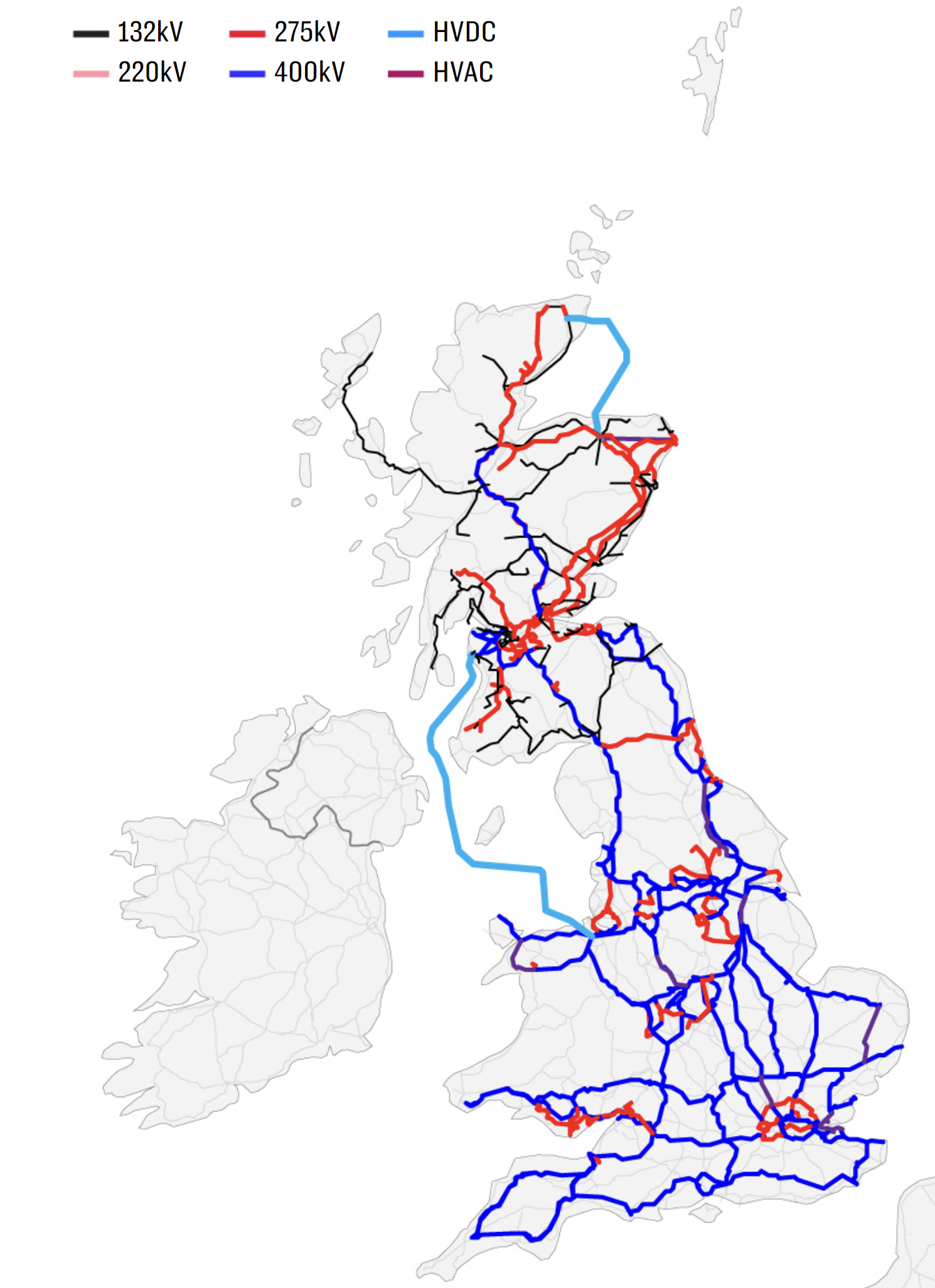
The dark blue lines are the 400 kV transmission lines.
- The one furthest East in East Anglia serves the Sizewell site, which hosts the Sizewell B nuclear power station and will be the home of Sizewell C nuclear power station, unless the Green or LibDem Parties are a member of a coalition government.
- Kent and Sussex seem to be encircled by 400 kV lines, with small spurs to the interconnectors to Europe.
- Two 400 kV lines appear to serve the South-West peninsular, with one going along the South Coast and the other further North. I suspect these two motorways for electricity explain, why the Morocco-UK Power Project terminates in Devon.
- London seems to have its own M25 for electricity.
- There also appears to be an East-West link to the North of London linking Sizewell in the East and Pembroke in the West. Both ends have large power stations.
- There also appear to be two 400 kV lines from Keadby by the Humber Estuary to North Wales with the pumped storage hydro power station at Dinorwig.
- Two more 400 kV lines link Yorkshire to the South of Scotland.
- A lonely Northern cable connects Edinburgh and the North of Scotland.
The red lines, like the one encircling central London are the 275 kV transmission lines.
- Think of these as the A roads of the electricity network.
- They encircle London often deep underground or under canal towpaths.
- They reinforce the electricity network in South Wales.
- Liverpool appears to have its own local network.
- They also seem to provide most of the capacity North of and between Edinburgh and Glasgow.
Newer cables are starting to appear on this map.
There are two light blue cables and these are HVDC cables that run underwater.
- The 1.2 GW Caithness – Moray Link does what it says in the name and it connects the far North of Scotland direct towards Aberdeen.
- The much larger 2.25 GW Western HVDC Link connects Hunterston near Glasgow to Flintshire Bridge near Liverpool. Note how it passes to the West of the Isle of Man.
Not shown on the map are the smaller 500 MW Moyle Interconnector and the recently-opened 600 MW Shetland HVDC Connection.
The Electricity Network In 2050
This second map shows how the network will look in 2050.

Note.
- The colours are the same, as the previous map.
- Although, I do think there are some errors in which have been used.
- There are a lot more cables.
There are several more light blue cables and these are HVDC cables that run underwater.
- Shetland is now linked to the North of Scotland by the Shetland HVDC Connection.
- There appears to be a cluster of HVDC interconnectors at Caithness HVDC switching station, near Wick, including a new one to Orkney, to go with the others to Moray and Shetland.
- The 2 GW Scotland England Green Link 1 will run from Torness in Southeast Scotland to Hawthorn Pit substation in Northeast England.
- The 2 GW Eastern Green Link 2 will run from Sandford Bay, at Peterhead in Scotland, to the Drax Power Station in Yorkshire, England.
- There also appear to be two or possibly three other offshore cables linking the East Coast of Scotland with the East Coast of England.
- If the Eastern cables are all 2 GW, that means there is a trunk route for at least 8 GW between Scotland’s wind farms in the North-East and Eastern England, which has the high capacity wind farms of Dogger Bank, Hornsea and around the Lincolnshire and East Angliam coasts.
- Turning to the Western side of Scotland, there appears to be a HVDC connection between the Scottish mainland and the Outer Hebrides.
- South-West of Glasgow, the Western HVDC Link appears to have been duplicated, with a second branch connecting Anglesey and North-West Wales to Scotland.
- The Moyle Interconnector must be in there somewhere.
- Finally, in the South a link is shown between Sizewell and Kent. It’s shown as 400 kV link but surely it would be a HVDC underwater cable.
There are also seven stubs reaching out into the sea, which are probably the power cables to the wind farms.
- The red one leading from South Wales could connect the wind farms of the Celtic Sea.
- The blue link North of Northern Ireland could link the MachairWind wind farm to the grid.
- The other two red links on the West Coast of Scotland could link to other ScotWind wind farms.
- The red link to the North of East Anglia could link RWE’s Norfolk wind farms to the grid.
- The other stubs in the East could either connect wind farms to the grid or be multi-purpose interconnectors linking to Germany and the Netherlands.
It looks to me, that National Grid ESO will be taking tight control of the grid and the connected wind farms, as an integrated entity.
As a Graduate Control Engineer, I can’t disagree with that philosophy.
Hydrogen Production
In How Germany Is Dominating Hydrogen Market, I talked about how Germany’s plans to use a lot of hydrogen, will create a large world-wide demand, that the UK because of geography and large amounts of renewable energy is in an ideal place to fulfil.
I can see several large electrolysers being built around the UK coastline and I would expect that National Grid ESO have made provision to ensure that the electrolysers have enough electricity.
Would I Do Anything Different?
Consider.
- If it is built the Morocco-UK Power Project will terminates in Devon.
- There could be more wind farms in the Celtic Sea.
- It is likely, that the wind farms in the Celtic Sea will connect to both Pembroke and Devon.
- Kent has interconnectors to the Continent.
Would a Southern HVDC link along the South Coast between Devon and Kent be a good idea?
Conclusion
Looking at the proposed list of wind farms, a total in excess of 96 GW could be possible, which is ten GW more than needed.
The network not only serves the UK in a comprehensive manner, but also tees up electricity for export to Europe.
Bidders Circle ‘Elvis Airport’ A Decade After The SNP Bought It For £1
The title of this post, is the same as that of this article in The Times.
This is the sub-heading.
Prestwick has cost taxpayers millions since it was nationalised by the SNP in 2013. A consortium plans a bid, but can the Nats let go of Sturgeon-era stateism?
These are the first two paragraphs.
It was always going to be difficult keeping a lid on the arrival of Elvis Presley at a US military base in Prestwick, Ayrshire. “Where am I?” he asked as he stepped off the plane and into the biting wind that whipped off the Firth of Clyde.
March 3, 1960 was a momentous day for the screaming youngsters who engulfed the American singer as he set foot on British soil for the first and only time. For Presley, it was his last stop on his return from Germany after two years of military service. For Prestwick, it meant being immortalised in British trivia for its brief flirtation with The King.
But now it appears that a consortium has a plan for the airport and has made a bid.
These are my thoughts.
Prestwick Airport
Prestwick Airport, which is 32 miles SouthWest of Glasgow, is an airport that has seen busier times.
This OpenRailwayMap shows the Airport.

Note.
- The airport has two runways at right angles.
- The longer runway is 3,000 metres long.
- The red line is the electrified Ayrshire Coast Line, which runs between Glasgow Central and Ayr.
- There is a station at the airport.
- The black line going across the map is an unelectrified railway line, which eventually leads to the West Coast Main Line.
The airport does have four very useful assets.
- A very long runway capable of handling the largest and heaviest aircraft.
- A railway station.
- Plenty of space.
- The airport has plenty of available landing and take-off slots.
I also suspect that a rail connection could be developed to the West Coast Main Line.
Prestwick As A Cargo Airport
Someone commenting in The Times, suggested that Prestwick could become a cargo airport.
- The main runway could accommodate the largest and heaviest cargo aircraft.
- There is space for stands for large aircraft and warehouses.
- A rail link to the electrified West Coast Main Line could be built.
The airport could have a very high capacity.
A Rail Connection To The West Coast Main Line
This could be very beneficial for air-cargo at Prestwick.
- It would be less than ninety miles to the West Coast Main Line.
- It is only single-track as British Rail removed the second track.
- Cargo Services could be run all over the UK mainland.
- There could even be an airport service from Carlisle.
A zero-carbon rail service for freight, passengers and staff from both Glasgow and Carlisle would enhance the green credentials of the airport.
Where Would Planes Fly?
It looks like a modern freighter aircraft like a Boeing 747-8F could fly at maximum weight to nearly all the USA.
But because Prestwick Airport is further North, It does possibly have a wider range of airports, it can reach.
What Is The Closest Airport In North America?
The two airports on Newfoundland; Gander and St. John’s are probably the two closest being about 2,000 miles from Prestwick.
- Both airports have long runways.
- I suspect a rail terminal could be arranged at the airport to take cargo through the Chunnel to Europe.
- Could USAF Galaxies even be used to bring over American tanks and guns for Ukraine? The range of a Galaxy at maximum weight is 2,600 miles.
- They could be delivered by rail to Ukraine.
I suspect there will be times, where the shorter routes could be useful.
Could Cargo Change Planes At Prestwick?
On some routes like perhaps New York and India, might it be more efficient to change planes at Prestwick.
Could Cargo Planes Refuel At Prestwick?
Planes can only fly so far and is Prestwick in the right place to refuel a long flight?
Prestwick Could Be A Viable Cargo Airport For North America?
I am convinced that Prestwick and North American could be a viable air cargo route.
Zero-Carbon Air Cargo
In the next few years, Scotland will have much more electricity, than it needs, due to all the wind farms in the seas around the country and much of the spare electricity could be converted into hydrogen.
So does a cargo operator plan to run zero-carbon aircraft powered by hydrogen between North America and Prestwick?
- Remember it’s only 2,000 miles between St. John’s or Gander and Prestwick.
- The ideal aircraft to convert to hydrogen, must surely be an Airbus A 380, as there’s a lot of space in the fuselage for a hydrogen tank.
- Cargo could be brought to Prestwick in zero-carbon trains from all over the UK.
Amazon might like the idea of zero-carbon parcels across the pond!
Could An Airbus A380 Be Converted To Hydrogen?
This article on Simple Flying is entitled Airbus Plans A380 Hydrogen Flights In 2026 After Successful Power On Of ZEROe Engine.
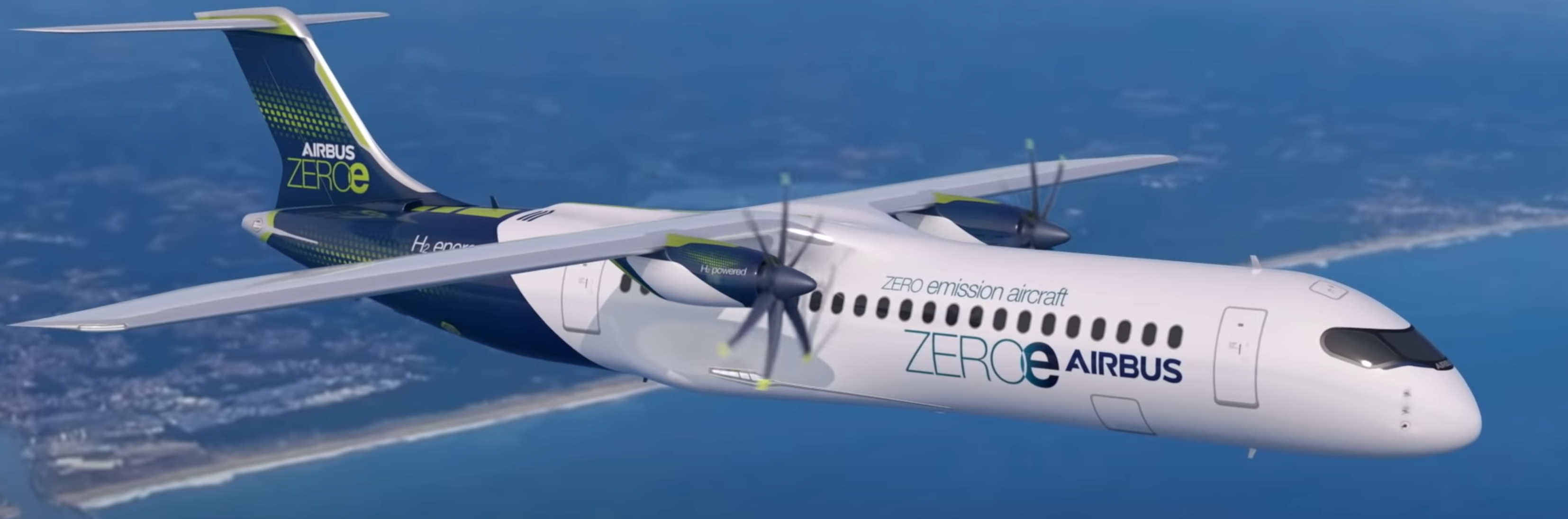
The header picture shows a visualisation of an Airbus A 380, with a fifth engine with a propeller mounted on the top of the fuselage. The A 380 will be testing this electric engine, so that it can be fitted in the ZEROe Turboprop sometime around 2030.
This is a visualisation of the ZEROe Turboprop.
Note,
- The hydrogen tank will probably be behind the passenger compartment.
- The A 380, that will be testing the engine is no ordinary A 380. It is the very first and Airbus use it as a flying laboratory for new technology.
- I wouldn’t bet against one of its next jobs, is to test turbofan engines running on hydrogen.
I wouldn’t be surprised that in a few years, Airbus demonstrate an A 380 flying between Europe and North America on hydrogen.
A Zero-Carbon Air Bridge Between Europe And North America
Or does Westjet fancy a zero-carbon shuttle service, which would appeal to the Gretas of this world?
It has been rumoured, that the possible buyers of Prestwick are linked to Westjet.
As soon, as someone announces, a flight like this across the Atlantic, I’ll be signing up!
If the worse should happen, which I think would be unlikely, it would surely be a less painful death, than that of my wife’s from a rare cancer.
Conclusion
There are certainly, possibilities at Prestwick.
Dogger Bank D Welcomes Confirmation Of Grid Connection Location
The title of this post, is the same as that of this press release from SSE Renewables.
This is the sub-heading.
Project team now focusing full attention on electrical transmission system connection.
These four paragraphs describe the proposed connection to the National Grid.
SSE Renewables and Equinor have welcomed confirmation of a grid connection location from the Electricity System Operator (ESO) for a proposed fourth phase of the world’s largest offshore wind farm.
Dogger Bank D will now connect into Birkhill Wood, a proposed new 400kV substation located in the East Riding of Yorkshire which will be built as part of National Grid’s Great Grid Upgrade.
The announcement follows the publication of an impact assessment for the South Cluster by ESO, relating to energy projects which are due to be electrically connected off the east coast of England.
With the location of a grid connection confirmed, Dogger Bank D will now focus its full attention on connecting to the electrical transmission system.
This is a big change from December 2023, when I wrote Plans for Hydrogen Development At Dogger Bank D Gain Ground, which indicated that Dogger Bank D would be used to produce hydrogen, so the grid connection wouldn’t be needed.
Using A Offshore Hybrid Asset Between the UK And Another European Country
This is the next paragraph on the SSE Renewables press release.
The project is also exploring the future possibility of the development of Dogger Bank D to be coordinated with an Offshore Hybrid Asset between the UK and another European country’s electricity market to form a multi-purpose interconnector. This option would increase energy security for the UK and reduce the need to curtail offshore wind output in times of oversupply on the GB network.
Note that just over the boundary of the UK’s Exclusive Economic Zone are the Dutch and German Exclusive Economic Zones.
It is not unreasonable to believe that UK, Dutch and German grid could all be connected on the Dogger Bank.
Connecting Everything Up At Birkhill Wood
This is the next paragraph on the SSE Renewables press release.
The project team are undertaking a site selection process to identify potential cable corridors and where other onshore infrastructure associated with the grid connection at Birkhill Wood may be sited. Consultation will be held later this year to introduce the connection proposals to the local community.
At least now, with the connection to Birkhill Wood confirmed, SSE and Equinor will be able to supply any electricity generated at Dogger Bank D to the UK grid, up to limit of the connection.
The Value Of Electricity That Could Be Generated At Dogger Bank D
Consider.
- The wind farm has a capacity of 2 GW or 2,000 MW.
- There are 365 days in most years.
- There are 24 hours in the day.
- This means that 17, 520,000 MWh could be generated in a year.
- A large wind farm like Hornsea One has a twelve month rolling capacity factor of 46.6%.
- Applying this capacity factor says that 8,164,320 MWh will be generated in a year.
- The Contract for Difference Round 6 for this electricity will be £73/MWh.
Applying that figure gives a yearly turnover of £ 595,995,360 or £ 297,997,680 per installed GW.
It is not unreasonable to assume that half of this electricity were to be exported to power Germany industry.
It could be a nice little earner for the Treasury.
Ørsted Secures Exclusive Access To Lower-Emission Steel From Dillinger
The title of this post, is the same as that of this article on offshoreWIND.biz.
This is the sub-heading.
Ørsted will be offered the first production of lower-emission steel from German-based Dillinger, subject to availability and commercial terms and conditions. The steel plates are intended to be used for offshore wind monopile foundations in future projects.
These three paragraphs outline the deal.
Under a large-scale supply agreement entered into in 2022, Ørsted will procure significant volumes of regular heavy plate steel from 2024, giving the company access at scale to and visibility of the most crucial raw material in offshore wind while supporting Dillinger to accelerate investments in new lower-emission steel production, according to Ørsted.
The Danish renewable energy giant expects to be able to procure lower-emission steel produced at Dillinger’s facility in Dillingen, Germany, from 2027-2028.
Taking the current technology outlook into account, the reduction of the process-related carbon emissions from production is expected to be around 55-60 per cent compared to conventional heavy plate steel production, Ørsted said.
Increasingly, we’ll see lower emission steel and concrete used for wind turbine foundations.
This press release on the Dillinger web site is entitled Historic Investment For Greater Climate Protection: Supervisory Boards Approve Investment Of EUR 3.5 billion For Green Steel From Saarland.
These are two paragraphs from the press release.
Over the next few years leading up to 2027, in addition to the established blast furnace route, the new production line with an electric arc furnace (EAF) will be built at the Völklingen site and an EAF and direct reduced iron (DRI) plant for the production of sponge iron will be built at the Dillinger plant site. Transformation branding has also been developed to visually represent the transformation: “Pure Steel+”. The message of “Pure Steel+” is that Saarland’s steel industry will retain its long-established global product quality, ability to innovate, and culture, even in the transformation. The “+” refers to the carbon-neutrality of the products.
The availability of green hydrogen at competitive prices is a basic precondition for this ambitious project to succeed, along with prompt funding commitments from Berlin and Brussels. Local production of hydrogen will therefore be established as a first step together with the local energy suppliers, before connecting to the European hydrogen network to enable use of hydrogen to be increased to approx. 80 percent. The Saarland steel industry is thus laying the foundation for a new hydrogen-based value chain in the Saarland, in addition to decarbonizing its own production. In this way, SHS – Stahl-Holding-Saar is supporting Saarland on its path to becoming a model region for transformation.
It sounds to me, that Tata Steel could be doing something similar at Port Talbot.
- Tata want to build an electric arc furnace to replace the blast furnaces.
- There will be plenty of green electricity from the Celtic Sea.
- RWE are planning a very large hydrogen electrolyser in Pembroke.
- Celtic Sea offshore wind developments would probably like a supply of lower emission steel on their door-step.
I would suspect, that Welsh steel produced by an electric arc furnace will match the quality of the German steel, that is made the same way.
Japan Expands Offshore Wind Development Into Exclusive Economic Zone
The title of this post, is the same as that of this article on offshoreWIND.biz.
This is the sub-heading.
The Japanese Government has passed an amendment to the “Act on Promoting the Utilization of Sea Areas”, expanding the area for setting up offshore wind to the Exclusive Economic Zone (EEZ).
These two paragraphs give more details.
The Japanese government aims to deploy 10 GW of offshore wind capacity by 2030 and 30-45 GW by 2040, including floating wind, as part of its target to reach net-zero emissions by 2050.
The new legislation would allow wind farms to be installed further out to sea from current territorial and internal waters, according to a joint statement by the government, the Ministry of Economy, Trade and Industry and the Ministry of Land, Infrastructure, Transport and Tourism.
The Japanese seem to have devised a simple bid process, that gives rights to generate electricity for thirty years.
But then as a Director of Lockheed told me thirty years ago, the Japanese don’t have the same high levels of lawyers that the US, UK and other countries have, so they can move a lot faster and are easier to do business with.
This Wikipedia entry is entitled Wind Power in Japan.
This is the opening paragraph.
In Japan’s electricity sector, wind power generates a small proportion of the country’s electricity. It has been estimated that Japan has the potential for 144 gigawatts (GW) for onshore wind and 608 GW of offshore wind capacity. As of 2020, the country had a total installed capacity of 4.2 GW.
From the potential of 608 GW of offshore wind capacity, it looks like Japan is in a very similar position to the UK and the Japanese can also reap the wind.
UK Onshore Wind Capacity Hits 15GW
The title of this post, is the same as that of this article on reNEWS.BIZ.
This is the sub-heading.
Milestone reached after 30MW West Benhar project entered operations.
These are the first three paragraphs.
RenewableUK has revealed the UK has installed 15,000MW of operational onshore wind capacity.
The project which enabled the UK to cross the threshold was EDF Renewables UK’s 30.1MW West Benhar onshore wind farm in North Lanarkshire, consisting of seven turbines.
The UK now has 2631 operating onshore wind schemes.
These are my thoughts.
I Am Surprised At The Total Of Onshore Wind
The title says it all.
But 15 GW is almost the same power as five big nuclear power stations, the size of the running-late Hinckley Point C.
Should Some Strategically-Placed Battery Energy Storage Systems (BESS) Be Added?
Some wind farms have been built with wind farms and I very much feel, that with some mathematical modelling some excellent BESS sites could be found.
We should also use batteries, so that no wind farm is ever shut down, because too much wind is being generated.
Where Is West Benhar?
West Benhar wind farm has a web site, where this is the sub-heading.
West Benhar is a 7 turbine wind farm capable of powering up to 18,000 homes located near Shotts in North Lanarkshire.
It was opened on 28 February 2024.
This Google Map shows the location of West Benhar between Edinburgh and Glasgow.
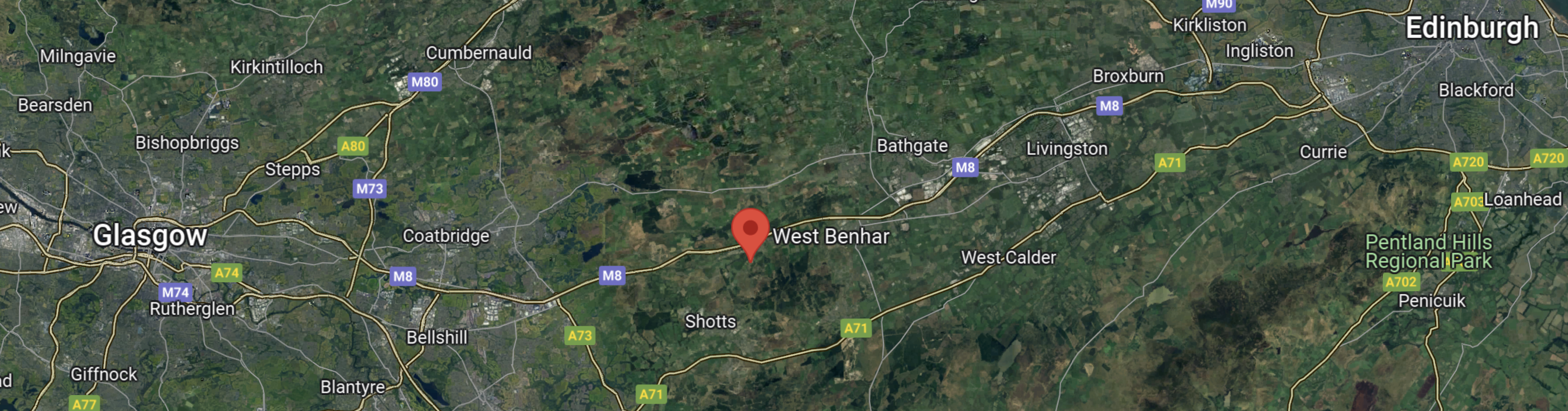
West Benhar is North-East of Shotts and just South of the M8.
There’s More Onshore Wind To Come
These onshore wind farms appear to have Contracts for Difference, but have not been completed.
- Arecleoch Wind Farm Extension – 72.8 MW – Completion 2024/25
- Broken Cross – 48 MW – Completion 2024/25
- Chirmorie – 81.6 MW – Completion 2024/25
- Cumberhead West – 126 MW – + 40 MW BESS – Completion 2024/25
- Douglas West Extension – 78 MW – Completion 2024/25
- High Constellation – 50 MW – Completion 2024/25
- Kilgallioch Windfarm Extension – 51.3 MW – Completion 2024/25
- North Kyle – 206 MW – Completion 2024/25
- Stornoway – 200 MW – Completion 2024/25
- Stranoch – 84 MW – Completion 2024/25
- Viking – 443 MW – Completion 2024
All of these are in Scotland.
But that’s another 1,440.7 MW of onshore wind.
Community Wind Funds
Scotland seems to be continuing to build onshore wind farms.
Could it be that communities have seen the benefits of Community Wind Funds?
This is said about the fund at Stronach.
When operational, EDF Renewables will provide a community benefit fund in line with the Scottish Government Good Practice Principles for Community Benefits from Onshore Renewable Energy Developments. The fund value for the community benefit fund would be £5,000 per megawatt for the lifetime of the wind farm. In the coming months we will begin to form a Community Liaison Group with local interested parties to decide how the funds will be disseminated once the wind farm becomes operational.
If the fund is yearly, then £420,000 is not money to be sneezed at!
Conclusion
It looks like in Scotland that Community Wind Funds promote the building of onshore wind.
UK Set To Provide Record GBP 800 Million Support For Offshore Wind Projects
The title of this post, is the same as that of this article on offshoreWIND.biz.
This is the sub-heading.
The UK government has revealed the budget of over GBP 1 billion (approximately EUR 1.2 billion) for this year’s Contracts for Difference (CfD) Allocation Round 6 (AR6) with the majority of it, GBP 800 million (around EUR 936 million), earmarked for offshore wind.
These three paragraphs explain the three pots.
The Department for Energy Security and Net Zero (DESNZ) confirmed that over GBP 1 billion will be set aside for the budget, divided into three pots.
Within the overall budget, GBP 120 million is designated for established technologies like solar and onshore wind in Pot 1, while GBP 105 million is set aside for emerging technologies such as floating offshore wind and geothermal in Pot 2.
According to DESNZ, following an extensive review of the latest evidence, including the impact of global events on supply chains, the government has allocated a record GBP 800 million for offshore wind, making this the largest round yet, with four times more budget available to offshore wind than in the previous round.
I am glad to see the support for geothermal energy.
Whilst, these three paragraphs explain the pricing.
This follows the increase in the maximum price for offshore wind and floating offshore wind in November and will help to deliver the UK’s ambition of up to 50 GW of offshore wind by 2030, including up to 5 GW of floating offshore wind, according to the government.
Last year, CfD Round 5 attracted no investors with the former maximum strike prices set at GBP 44/MWh for offshore wind with fixed-bottom foundations, which was too low for the developers who were facing the consequences of inflation and supply chain challenges. The maximum bid price for floating wind was GBP 114/MWh.
Now, the maximum price available for offshore wind projects with fixed-bottom foundations has risen by 66 per cent, from GBP 44/MWh to GBP 73/MWh. The maximum strike price for floating offshore wind projects increased by 52 per cent, from GBP 116/MWh to GBP 176/MWh ahead of AR6 which will open on 27 March.
Prices have certainly risen, but this paragraph explains a limiting mechanism, which is straight out of the Control Engineer’s Toolbox.
The funding for the support will be sourced from energy bills rather than taxation. However, if the price of electricity surpasses the predetermined rate, additional charges will be applied to wind power, with the excess funds returned to consumers.
I would hope that extensive mathematical modelling has been applied to test the new pricing structure.
SolarDuck, Green Arrow Capital And New Developments S.R.L. Sign Collaboration Agreement For A Grid-Scale Offshore Hybrid Wind-Solar Project In Italy
The title of this post, is the same as that of this press release from SolarDuck.
These three bullet points, act as sub-headings.
- 540 MW hybrid offshore wind-solar farm offshore Corigliano, Calabria
- Milestone project to accelerate scaling of Offshore Floating Solar Photovoltaic (OFPV)
- Strategic collaboration proves the potential of the technology in Italy and the wider
Mediterranean region
These three paragraphs outline the project.
SolarDuck, leader in OFPV technology, Green Arrow Capital, leading Italian Independent Asset
Manager in the alternative investment world, and New Developments s.r.l., one of Italy’s
most experienced developers, have agreed to collaborate on the development of a landmark
120MWp OFPV farm integrated with 420MW Floating Offshore Wind (FOW).The project will install SolarDuck’s unique elevated platform technology that allows PV panels
to be deployed in significant wave heights whilst maintaining a safe working environment for
access and maintenance and minimizing environmental impact. In addition, the collaboration
will also allow the harnessing of the complementarity of wind and solar energy resources.“With the current momentum, we believe this is a unique opportunity for the offshore
renewable energy industry to help shape a favorable regulatory framework and facilitate the
scaling of OFPV. This is not just important for Italy, but also for other countries in the
Mediterranean. Our collaboration with New Developments and Green Arrow Capital can also
serve as a catalyst for OFPV in Italy”, says SolarDuck CEO, Koen Burgers.
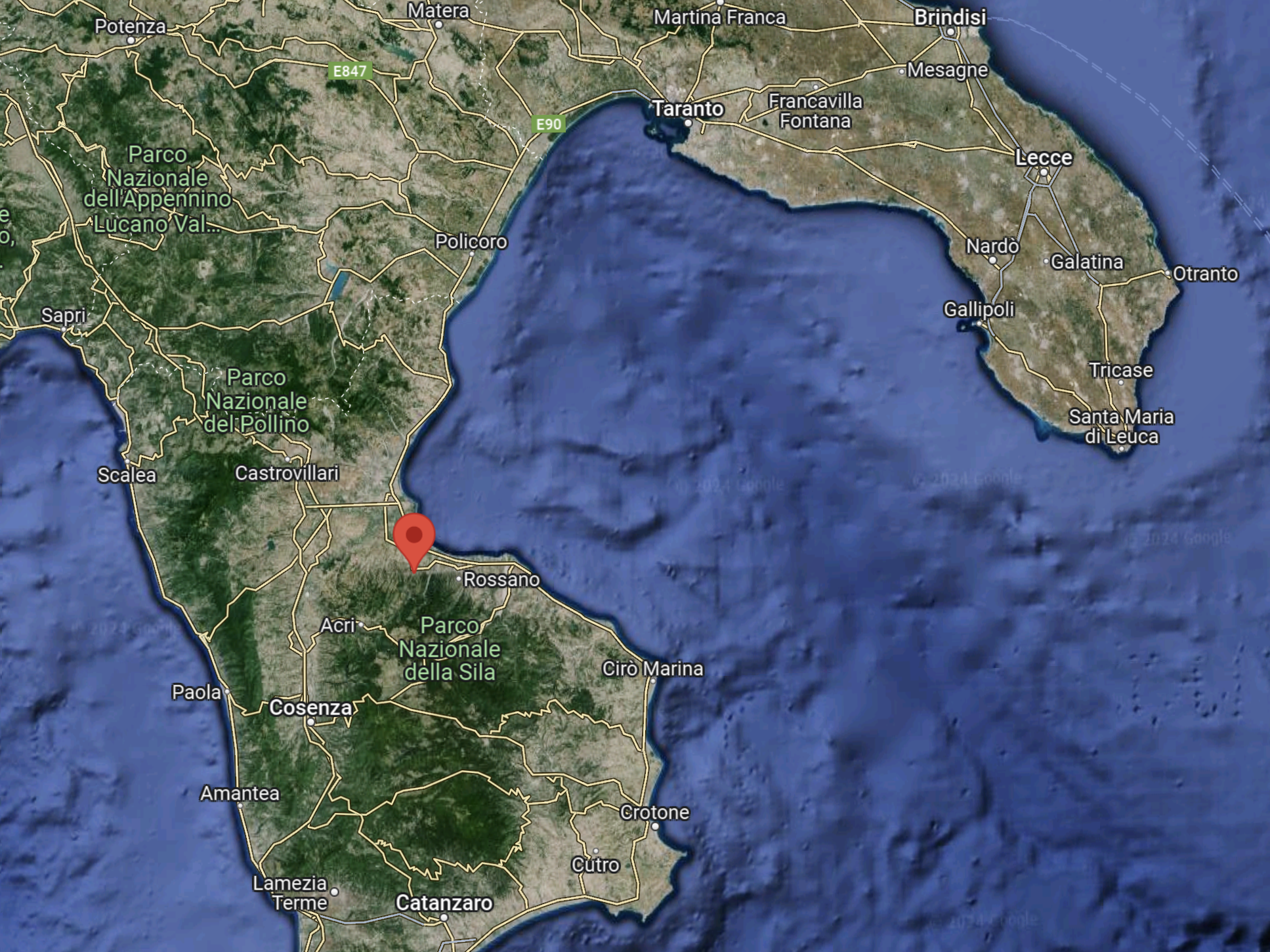
This Google Map shows the location of Corigliano at the foot of Italy.
Note.
- Corigliano is indicated by the red arrow.
- There is an explanatory video of their technology on SolarDuck’s web site.
Opposite Corigliano on the other side of the can be seen the Italian Naval Base of Taranto, which was the scene of the Battle of Taranto, which was one of the most significant naval battles of Second World War, if not the most significant.
- This web page has the Fleet Air Arm’s account of the battle.
- I have a book, that shows the Japanese visiting Taranto after the battle.
- Did the Japanese use what they learned to plan their successful raid on Pearl Harbor?
- Without Pearl Harbor, would the Americans have stayed out of the Second World War?
I visited Taranto in the 1980s and stood on the Dockside. Perhaps, it is time to go again?
Conclusion
I have a feeling that a hybrid offshore wind-solar farm can generate more electricity in a given area, by making better use of the space available.
It will be interesting to see how this hybrid wind farm performs.
In an area with plenty of sun and wind, it could be a better solution.
Only the mathematics will tell.
Why Firms Are Racing To Produce Green Ammonia
The title of this post, is the same as that of this article on the BBC.
This is the sub-heading.
In the 19th Century, Europeans realised what the Inca had known long before. Bird droppings, or guano, made a fantastic fertiliser.
These are the first three paragraphs.
And so sprang up a gigantic industry dedicated to the harvesting of guano from Latin American bird colonies, where there were huge piles of the stuff.
It was so rich in ammonia, the key ingredient, that a mere whiff could induce coughing and sneezing. Not exactly a pleasant cargo to ferry across the world.
As demand for fertiliser rose in the early 1900s, someone began to think, “Perhaps there’s another way?” That someone was Fritz Haber, a German chemist who, along with Carl Bosch, developed the Haber-Bosch process for synthesising ammonia.
This Wikipedia entry describes the Haber-Bosch process.
This is the first paragraph.
The Haber process, also called the Haber–Bosch process, is the main industrial procedure for the production of ammonia. The German chemists Fritz Haber and Carl Bosch developed it in the first decade of the 20th century. The process converts atmospheric nitrogen (N2) to ammonia (NH3) by a reaction with hydrogen (H2) using an iron metal catalyst under high temperatures and pressures. This reaction is slightly exothermic (i.e. it releases energy), meaning that the reaction is favoured at lower temperatures and higher pressures. It decreases entropy, complicating the process. Hydrogen is produced via steam reforming, followed by an iterative closed cycle to react hydrogen with nitrogen to produce ammonia.
These companies are mentioned in the BBC article.
Starfire Energy
This is their web site.
Their home page has a title of Modular, Variable-Rate Ammonia (NH3) Production and this description of their technology.
We are scaling up technologies to make and use carbon-free ammonia fuel. Rapid Ramp is a variable-rate ammonia production process engineered into a modular plant design. Prometheus Fire is a lower temperature, high flow ammonia cracking process that allows ammonia to be used like natural gas, but with no CO2 emissions.
According to the co-founder of the company, Starfire’s process can use intermittent power, like wind and solar.
Could a farmer make their own fertiliser with a containerised system and say a 5MW wind turbine or a small solar farm?
Atmonia
This is their web site.
This description of their process is on their home page.
Atmonia is developing a nitrogen electrolyser with our patented catalyst. The technology uses only air, water and electricity for direct ammonia production. This enables zero carbon ammonia production, when applying renewable electricity.
Could a farmer make their own fertiliser with a containerised system and say a 5MW wind turbine or a small solar farm?
Jupiter Ionics
This is their web site.
Their home page has an endless video and this statement.
We’re commercialising carbon-neutral, electrochemical technology for sustainable agriculture, ammonia-fuelled transport and renewable energy exports.
These three paragraphs in the BBC article, say more about the process used by Jupiter Ionics.
Jupiter Ionics is currently planning to build an ammonia production module on the megawatt scale, which could produce a tonne per day.
Jupiter Ionics’ technology differs from Starfire Energy and Atmonia’s in that it uses lithium as a mediator to break apart nitrogen molecules, which naturally exist as strongly bonded pairs of nitrogen atoms, to form lithium nitride. This then reacts with hydrogen to make the ammonia.
Within the next 12-18 months, Jupiter Ionics aims to scale up its equipment so that it can produce a kilogram of ammonia per day. A grape farmer in the state of Victoria who has solar panels on his land is hoping to trial the system, says Prof MacFarlane.
It appears that Starfire Energy, Atmonia and Jupiter have containerised systems, that can take air, water and electricity and can create sizeable quantities of ammonia for fertiliser or a fuel.
This page on the Ammonia Energy Association web site is entitled Amogy: Ammonia-Powered Tractor, where this is said, alongside a picture of a standard John Deere tractor.
Earlier this month, Amogy demonstrated a new ammonia-powered tractor in Stony Brook, New York. A 100 kW ammonia-to-power system was successfully integrated into a John Deere mid-size standard tractor, which can operate on liquid ammonia fuel for a period of several hours. The tractor conversion demonstration was made possible by significant seed funding secured in late 2021.
The unique system is comprised of a standard liquid-storage tank and highly efficient ammonia-cracking modules integrated into a hybrid fuel cell system, which can provide consistent primary power for several hours per refueling. Therefore, the pioneering vehicle maintains the functionality and duration requirements operators rely on to support farming tasks, which has never been offered with other alternative energy solutions. The ammonia-powered tractor was driven for separate periods, with a refueling session in between. Refueling a tractor with liquid ammonia is fast and simple, similar to gas or diesel refueling.
This is Amogy’s web site.
I can also see a problem, if every farmer of a certain size wants to make their own ammonia for both fertiliser and fuel.
The NIMBYs will have a field day, but at least the countryside’s low-life won’t be nicking your diesel.
Nitricity
The BBC article also talks about Nitricity.
As Josh McEnaney, president and chief executive of Nitricity in the US, explains, spreading ammonia on fields results in greenhouse gas emissions that could be avoided if we took a more direct approach to applying nitrogen, the crucial element that promotes plant growth, to the soil.
His company is developing a system that uses solar-powered plasma cells to fix nitrogen from the air. This is then used to make nitric acid, which can be applied to the soil. Early experiments with tomato plants yielded success and the company is now trialling its technology with suppliers for the US fast food chain Chipotle.
“We don’t require any hydrogen production,” says Dr McEnaney. “We go straight for the fertiliser.”
This is the Nitricity web site.
Two Experts Give Their Views
The BBC article finishes with the views of two experts.
Bill David at the University of Oxford points out that, around the world, there is already lots of infrastructure designed to store and transport ammonia.
He praises large projects for manufacturing ammonia using renewable energy, such as the one in Uzbekistan that will reportedly spew out 454,000 tonnes of ammonia per year with the help of 2.4 gigawatts of wind energy.
While ammonia can be used as a fuel, it can also be cracked to release hydrogen, which may itself be burned as a fuel, points out Lindsey Motlow, senior research associate at Darcy Partners, a technology firm that works with the oil and gas industry.
“We’re seeing real progress in [the] development of ammonia cracking technology,” she says.
Conclusion
According to the BBC article, two percent of the carbon dioxide emitted on the planet comes from the creation of fertiliser.
So it looks like we can either fry or starve, if we don’t address the problem of zero-carbon fertiliser.
But the downside could be every farm having its own wind turbine.
The BBC article and the related web sites are a must-read.
UK Can Secure Record Number Of Offshore Wind Farms In This Year’s Auction For New Projects
The title of this post, is the same as that of this press release from RenewableUK.
The first five paragraphs, should be read as a whole and are a good summary of, where the UK is with offshore wind.
A new report published today by RenewableUK shows that the Government has an opportunity to secure a record number of new offshore wind farms, and record amount of new capacity, in this year’s summer’s auction for contracts to generate clean power (Contracts for Difference). In a huge boost to the UK’s energy security, the Government has the potential to double the country’s offshore wind capacity in this year’s auction alone.
RenewableUK’s latest EnergyPulse Insights Offshore Wind report reveals that 14 wind farms are already eligible to bid into this year’s CfD auction (Allocation Round 6), providing nearly 10.3 gigawatts (GW) of new capacity. The previous records were set in 2022 when 8.5GW was eligible across 7 projects.
In addition to this, a further 4.7GW of new offshore wind capacity (out of 8.7GW in the planning system) could become eligible before applications open for AR6 at the end of March. If these projects were to receive consent from the Government, 14.9GW of offshore wind capacity would be eligible for this year’s auction. The report notes that being eligible does not mean that projects will choose to bid in – but they have the potential to do so.
To put this 14.9GW of potential new capacity into context, we currently have 14.7GW of fully operational offshore wind which generates 14% of the UK’s entire electricity needs. Just one gigawatt of offshore wind generates enough electricity to power over a million British homes for a year.
The report also shows that a further 5.2GW are already under construction in UK waters, and it forecasts that nearly 45GW could be fully operational by the end of 2030.
It is certainly worth reading through to the last paragraph.
The press release also lists the projects eligible to bid into AR6.
- Norfolk Vanguard West and Norfolk Vanguard East (2,760MW) – RWE
- Hornsea Four (2,600MW) – Ørsted
- Awel y Môr (1,100MW) – RWE
- East Anglia Two (900MW) – Iberdrola
- East Anglia One North (800MW) – Iberdrola
- Hornsea Three (753.1MW) – Ørsted
- Seagreen 1A (500MW) – SSE Renewables, TotalEnergies
- East Anglia Three (318MW) – Iberdrola
- Inch Cape (270MW) – Inch Cape Offshore
- Pentland (floating project) (100MW) – Highland Wind Limited
- Erebus (floating project) (100MW)
- Blyth 2 (floating project) (58MW)
- Forthwind (test and demonstration site) (8MW) – Forthwind Limited
These make a total of 10,267MW
Currently, as I write this the UK is generating 29 GW, so 45 GW with a lot of energy storage, should be enough to power the country.
 The Anonymous Widower