Reading And Oxford – 10th June 2023
Yesterday, after breakfast on Moorgate, I went for an explore at the Western end of the Elizabeth Line.
My aim was to change at Reading for Oxford and then have a bit of an explore in the University City.
These are my observations and thoughts.
Changing Trains At Reading
There are two trains per hour between Liverpool Street and Reading station, but at the Moorgate end of Liverpool Street station, there is no way of buying a ticket, that would get me between Reading and Oxford. To make things more complicated, I needed to be quick with my change at Reading, as I only had a few minutes before the next Oxford train left Reading.
In the end I had to leave Reading station and walk across the concourse in front of the station.

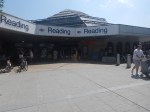


O then bought a ticket in a machine and then re-entered the station.
Great Western Railway can do better.
In Germany, there would be a ticket machine inside the barriers for those changing trains. But we never do that!
In the end, I missed my train and had to wait thirty minutes for a very crowded London Paddington to Oxford train.
Electrification At Oxford
This map from OpenRailwayMap shows the planned electrification at Oxford station.
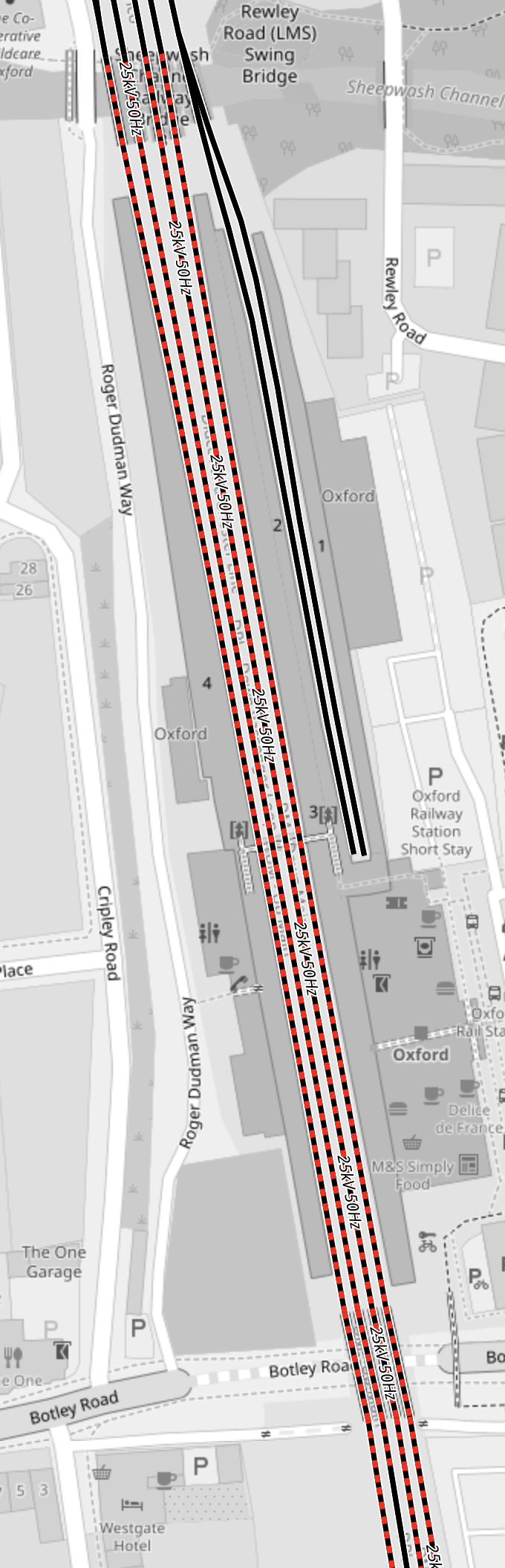
Note.
- The four through lines are shown in dotted red-and-black, which indicates, that they will be electrified with 25 KVAC overhead electrification.
- The proposed electrification continues all the way to Didcot Parkway station on the map.
- The two black tracks are the unelectrified platforms for Chiltern and East West Railway services.
But the proposed electrification stops just outside the station. Why?
Great Western Railway Services Beyond Oxford
Great Western Railway run an hourly service to Great Malvern, which according to Wikipedia terminates as follows.
- 4 trains per day continue to Hereford calling at Colwall and Ledbury.
- 1 train per day terminates at Worcester Shrub Hill.
- 4 trains per day terminate at Worcester Foregate Street.
So what are the distances of these stations from Oxford?
- Great Malvern – 65.6 miles
- Hereford – 86.3 miles
- Worcester Foregate Street – 57.6 miles
- Worcester Shrub Hill – 57.2 miles
I suspect that one version of the Hitachi Intercity Tri-Mode Battery Train, which is shown in the infographic below
could handle all these distances.

After the Oxford and Didcot Parkway electrification is complete, trains will arrive at Oxford station with a full battery.
But how would the batteries be recharged for the journey back to Oxford?
This map from OpenRailwayMap shows the tracks at Worcester.
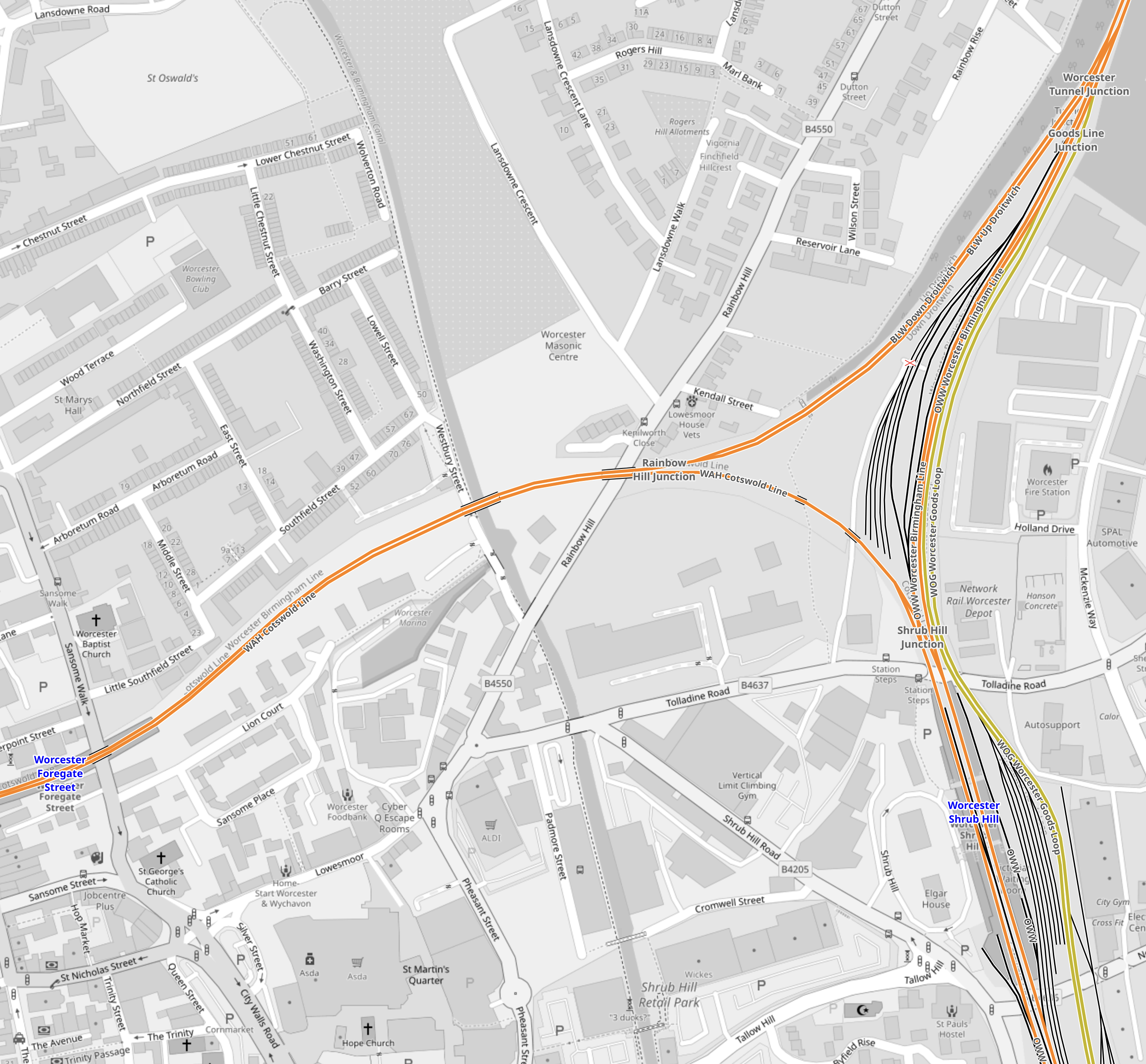
Note.
- Trains to and from Oxford, use the tracks in the South-East corner of the map.
- Trains to and from Birmingham, use the tracks in the North -East corner of the map.
- Trains to and from Great Malvern and Hereford, use the tracks in the South-West corner of the map.
I suspect that some selective electrification would be able to charge the trains.
Trains take around twenty minutes to go between Great Malvern and Worcester Shrub Hill via Worcester Foregate Street.
Electrifying this 8.5 mile section would surely enable the following.
- Trains to leave Worcester Shrub Hill for Oxford with a full battery.
- Trains to leave Great Malvern for Hereford with a full battery.
- As Hereford and Great Malvern are only 20.7 miles apart, I suspect a return trip without a recharge is possible.
- Trains terminating at Worcester Shrub Hill and Worcester Foregate Street to be fully recharged before travelling back to Oxford.
Other services to and from the Worcester stations could also be run by battery-electric trains.
As Worcester Shrub Hill and Oxford stations are only 57.2 miles and well within the capabilities of most battery-electric trains, there would be no need to electrify the route.
I may of course, be wrong about the length and position of the electrification at Worcester, but this could be just one of many solutions using partial electrification.
Does this explain the stopping of the proposed electrification at Oxford?
In addition, there must be marketing opportunities in running a battery-electric service to Hereford and Worcester.
The Bay Platforms At Oxford Station
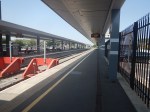
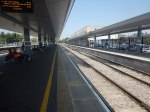
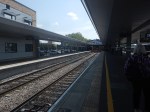
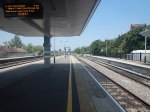
These pictures show the two North facing bay platforms 1 and 2 at Oxford station.
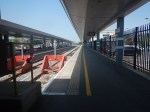

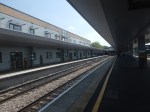
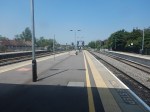
Note.
- The platforms are not electrified.
- They appear to be easily updated with electrification to be able to charge Chiltern and East West Railway trains.
- Marylebone is only 66.7 miles from Oxford.
- Milton Keynes Central is just over 40 miles from Oxford.
- Bedford is just under 60 miles from Oxford.
I suspect that services from Oxford to Bedford, Marylebone and Milton Keynes can all be run by battery-electric trains.
Improving The Cross Country Route
The Cross Country Route is one of the UK’s forgotten railway lines.
- It runs between York and Bristol Temple Meads.
- Intermediate stations include Leeds, Wakefield Westgate, Rotherham Central, Meadowhall, Sheffield, Chesterfield, Derby, Burton-on-Trent, Tamworth, Birmingham New Street, University, Bromsgrove, Worcestershire Parkway, Cheltenham Spa and Bristol Parkway.
- At the Northern end trains can swap to the electrified East Coast Main Line and can extend services to Edinburgh and Aberdeen.
- At the Southern end trains can swap to the Great Western Main Line and extend services to Taunton, Exeter, Plymouth and Penzance.
- Trains can also swap to the South Wales Main Line in the Bristol area, to serve Cardiff and South Wales.
- Operating speeds are generally around 100 mph, but there are sections of 125 mph running.
- Some sections of the route have 25 KVAC overhead electrification.
I very much believe that it is a route that is ripe for improvement.
These are my thoughts.
Extra And Rebuilt Stations
Recently, Worcestershire Parkway station has been opened on the route.
Bromsgrove station was rebuilt and reopened in 2016.
Derby station was remodelled in 2018.
In addition, there are aspirations for other mew stations and station improvements on the route.
- University station is being rebuilt for the 2022 Commonwealth Games.
- Sheffield Region are proposing a station at Barnsley Dearne Valley. I wrote about this in Sheffield Region Transport Plan 2019 – A New Station At Barnsley Dearne Valley.
- Sheffield Region may be creating a new station in Rotherham.
I can see more station improvements and additions on the Cross Country Route.
New Trains
Most services are run by CrossCountry, who only use diesel trains.
Their core services are as follows.
Plymouth And Edinburgh uses the route between York and Bristol Temple Meads. The service runs under wires North of Leeds and at Bristol Parkway and at Birmingham New Street.
Southampton Central And Newcastle uses the route between York and Birmingham New Street. The service runs under wires North of Leeds and at Reading and at Birmingham New Street.
Bournemouth and Manchester Piccadilly uses the route at Birmingham New Street. The service runs under wires North of Birmingham New Street.
Bristol Temple Meads and Manchester Piccadilly uses the route between Bristol Temple Meads and Birmingham New Street. The service runs under wires at Bristol Parkway and North of Birmingham New Street.
Cardiff Central and Nottingham uses the route between Gloucester and Derby. The service runs under the wires West of Bristol Parkway and at Birmingham New Street.
Birmingham New Street and Nottingham uses the route between Birmingham New Street and Derby. The service runs under the wires at Birmingham New Street.
Birmingham New Street and Stansted Airport does not use the route. The service runs under the wires at Birmingham New Street and around Cambridge and Peterborough.
Birmingham New Street and Leicester does not use the route. The service runs under the wires at Birmingham New Street.
Note.
- Several services run under wires for sufficient time to charge a battery-electric train.
- Several services turn in stations for sufficient time to charge a battery-electric train.
- At least six or possibly seven of the services run for at least fifty miles on tracks that can handle 125 mph running. Some of this track will be upgraded to 140 mph with digital signalling.
This Hitachi infographic shows the Hitachi Intercity Tri-Mode Battery Train.
I believe that Hitachi could produce a version of this train, that would partially meet CrossCountry’s need for a new fleet to reduce their carbon footprint.
For the purpose of this analysis, I will assume this about the trains.
- Battery power will always be used in stations.
- The trains have a battery range of around forty miles at 100 mph.
- Running at 125 mph will need 25 KVAC overhead electrification.
This table shows the current electrification status of the Cross Country Route.
- York and South Kirby junction- 45.4 miles – Electrified
- South Kirby junction and Birmingham New Street – 96.6 miles – Not Electrified
- Birmingham New Street and Bromsgrove – 16 miles – Electrified
- Bromsgrove and Bristol Parkway – 69.8 miles – Not Electrified
- Bristol Parkway and Bristol Temple Meads – 4.8 miles- Not Electrified
The trains would appear to still need to use diesel on some parts of the route.
Or Hitachi ABB Power Grids could install short lengths of 25 KVAC overhead electrification to top up the trains’ batteries in appropriate places.
I believe CrossCountry could decarbonise this route using battery-electric trains and discontinuous electrification.
This would surely refresh the line and attract passengers, but would the trains speed up the service?
- Birmingham New Street and Leeds is 116.4 miles and currently takes just under two hours at an average speed of 59.3 mph in a Class 221 train.
- Several sections of line between Birmingham New Street and Leeds can sustain 125 mph running.
- London Liverpool Street and Norwich is 114.5 miles and has regularly been achieved by British Rail-era electric trains in ninety minutes on a 100 mph line, which is an average speed of 76 mph.
- Averaging 76 mph between Birmingham New Street and Leeds would give a time of 92 minutes.
For these and other reasons, I am fairly sure that a battery-electric train capable of running at 125 mph with fast acceleration could run between Birmingham New Street and Leeds in under ninety minutes, with the addition of some discontinuous electrification.
- There is currently one tph between Birmingham New Street and Leeds, which also serves Sheffield.
- There is also one tph between Birmingham New Street and Sheffield by a different route.
- There is two tph between Birmingham New Street and Nottingham.
- My calculations indicate that the Nottingham and Sheffield services would take under an hour to and from Birmingham New Street, with the Leeds service taking thirty minutes longer.
In normal circumstances no diesel would be used.
Track Improvements And Discontinuous Electrification
This table shows the current electrification status of the Cross Country Route.
- York and South Kirby junction- 45.4 miles – Electrified
- South Kirby junction and Birmingham New Street – 96.6 miles – Not Electrified
- Birmingham New Street and Bromsgrove – 16 miles – Electrified
- Bromsgrove and Bristol Parkway – 69.8 miles – Not Electrified
- Bristol Parkway and Bristol Temple Meads – 4.8 miles – Not Electrified
Solutions will have to be found to decarbonise a lot of the route.
I have flown my virtual helicopter from Tamworth to Sheffield and this part of the route seems to the sort of route that could be upgraded to a full 125 mph line, as it is fairly straight and some sections already allow trains to travel at this speed.
As the 15.5 miles between Clay Cross North Junction and Sheffield will be updated and electrified for High Speed Two’s spur into Sheffield sometime in the future, I would feel that as updating this section benefits High Speed Two, the Midland Main Line, the Cross Country Route and the Hope Valley Line, that this section should be rebuilt as necessary and electrified, as soon as is practically possible.
I believe that Clay Cross North Junction and Sheffield is one of the most important routes in the country to be electrified, if not the most important.
This table shows the electrification status of the Cross Country Route after electrification of Clay Cross North Junction and Sheffield.
- York and South Kirby junction- 45.4 miles – Electrified
- South Kirby junction and Sheffield – 18.8 miles – Not Electrified
- Sheffield and Clay Cross North junction – 15.5 miles – Electrified
- Clay Cross North junction and Birmingham New Street – 62.1 miles – Not Electrified
- Birmingham New Street and Bromsgrove – 16 miles – Electrified
- Bromsgrove and Bristol Parkway – 69.8 miles – Not Electrified
- Bristol Parkway and Bristol Temple Meads – 4.8 miles – Not Electrified
It looks that by electrifying the 15.5 miles between Sheffield and Clay Cross North junction, the gap of 18.8 miles between South Kirby junction and Sheffield could be easily bridged by a battery-electric train.
The section between Clay Cross North junction and Birmingham New Street can be split into three.
- Clay Cross North junction and Derby – 20.9 miles
- Derby and Tamworth – 23.9 miles
- Tamworth and Birmingham New Street – 17.3 miles
If Hitachi ABB Power Grids installed discontinuous electrification at Derby and Tamworth, this should bridge the gap to the electrification at Birmingham.
As some of this section can sustain 125 mph running, it may be better to fully electrify part of the route.
This table shows the electrification status of the route would become
- York and South Kirby junction- 45.4 miles – Electrified
- South Kirby junction and Sheffield – 18.8 miles – Not Electrified
- Sheffield and Clay Cross North junction – 15.5 miles – Electrified
- Clay Cross North junction and Derby – 20.9 miles – Not Electrified
- Derby and Tamworth – 23.9 miles – Not Electrified
- Tamworth and Birmingham New Street – 17.3 miles – Not Electrified
- Birmingham New Street and Bromsgrove – 16 miles – Electrified
- Bromsgrove and Bristol Parkway – 69.8 miles – Not Electrified
- Bristol Parkway and Bristol Temple Meads – 4.8 miles – Not Electrified
I have also flown my virtual helicopter from Bromsgrove to Westerleigh junction, where the Cross Country Route joins the electrified Great Western Main Line, about 4.5 miles East of Bristol Parkway station.
It looks to me that this Southern short section of electrified line would be able to charge a battery-electric train so that it could reach Bristol Temple Meads station.
But the sixty-plus miles of route without electrification between Bromsgrove and Westerleigh junction would be too far to travel without some electrification.
This could either be full electrification or discontinuous using the methods proposed by Hitachi ABB Power Grids.
It certainly looks to me, that Hitachi’s technology or similar, that I talked about in Solving The Electrification Conundrum could be used to run battery-electric trains between York and Bristol Temple Meads on the Cross Country Route.
Digital Signalling
I would assume this will be installed on the route, to give more precise control of trains on the more complicated sections of the route.
East Coast Main Line Improvements
There are several improvements to the North of York, that will reduce journey times on all services using the East Coast Main Line.
These could contribute time saving of up to ten minutes, according to High Speed Two’s Journey Planner and current timetables.
Comparison With The Proposed Eastern Leg Of High Speed Two
With all the talk about possible cancellation of the Eastern Leg of High Speed Two could an improved Cross Country Route be used in the interim?
I will look at a few timings from Birmingham.
Birmingham And Leeds
A fully-developed High Speed Two is claiming forty-nine minutes, as against the one hour and fifty-eight minutes today.
I have stated that ninety minutes is an attainable time on a 116.4 mile journey, where a good proportion of 125 mph running will be possible, sustained by electrification.
But with full electrification, more 125 mph running and even some 140 mph running under the control of digital signalling, I suspect that ninety minutes is only an upper limit to the journey time between Birmingham and Leeds.
High Speed Two are saying they will run two tph between Birmingham and Leeds, which is twice the current frequency.
I could see that an improved frequency on the Cross Country Route could be very convenient, if it increased the frequency between the two cities to four tph.
Is it going to annoy passengers, that services will leave from two different stations in Birmingham and if you go to the wrong one, you’ll have to wait thirty minutes for the next train?
Birmingham And Middlesbrough
Times between Birmingham and Middlesbrough will be determined by adding a Leeds and Middlesbrough time to the Birmingham and Leeds times.
The best time between Leeds and Middlesbrough today is one hour and 23 minutes, which I suspect will lose a few minutes due to East Coast Main Line improvements North of York.
This gives using High Speed Two to Leeds a time of two hours and eight minutes, as against two hours and forty-nine minutes using an improved Cross Country Route.
Birmingham And Newcastle
A fully-developed High Speed Two is claiming one hour and fifty-seven minutes, as against the three hours and twenty-six minutes today.
Based on the current and possible times between Birmingham at Leeds using CrossCountry, I feel times to stations North of Leeds will be reduced by at least twenty-eight minutes, putting the Birmingham and Newcastle time a few minutes under three hours.
Birmingham And Nottingham
A fully-developed High Speed Two is claiming twenty minutes to East Midlands Hub, which when adding in the tram to Nottingham City Centre will be thirty-five minutes..
,Current services are one hour and ten minutes today.
On an improved Cross Country Route, with with battery-electric trains and some 125 mph running, I can see this time shrink to under an hour, even with the reverse at Derby.
Midlands Connect are also proposing a high speed service between Birmingham Curzon Street and Nottingham station, which will take thirty-three minutes.
High Speed Two are saying they will run three tph between Birmingham and East Midlands Hub, which compares with two tph using the Cross Country Route.
Birmingham And Sheffield
A fully-developed High Speed Two is claiming fifty-seven minutes, as against the one hour and fifteen minutes today.
I have stated that an hour is an attainable time on this route, with battery-electric trains and some 125 mph running.
A time of an hour would be very competitive with the Eastern Leg of High Speed Two.
High Speed Two are saying they will run two tph between Birmingham and Sheffield with a change at East Midlands Hub, which compares with two tph using the Cross Country Route.
Conclusion
A fully developed East Coast Main Line will give High Speed Two a good run for its money on services between London and Yorkshire, North East England and Scotland. I indicated my thoughts and conclusions in What Is Possible On The East Coast Main Line?.
I also believe that an improved Cross Country Route could give the Eastern Leg of High Speed Two a very good run for its money.
Perhaps, we should safeguard the route of Eastern Leg of High Speed Two for building later to increase capacity when it is needed, but in the interim we should upgrade the following routes.
- Cross Country Route
- East Coast Main Line
- Midland Main Line
- Northern Powerhouse Rail
- West Coast Main Line
These routes should have at least these minimum standards.
- All passenger trains electric or battery-electric.
- All freight locomotives electric, battery-electric or hydrogen-electric.
- Where possible all lines should allow 125 mph running.
- Universal in-cab digital signalling
- There should be sections of 140 mph running, where possible.
We will need the Eastern Leg of High Speed Two in the future, but we don’t need it in the next few years.
Beeching Reversal Fund Bids
The title of this post, is the same as that of an article in the May 2020 Edition of Modern Railways.
This is the introductory paragraph.
Bids have been submitted to Government for a share of the £500 million ‘Restoring your railway’ fund launched by the Department for Transport in January. The fund is to be used to support proposals to reinstate axed local services, to accelerate schemes already being considered for restoration and also to promote new and restored stations.
Some of the bids are detailed.
Okehampton And Tavistock
If you were deciding what lines shouldn’t have been closed by British Rail in the 1960s, by hindsight, the Exeter to Plymouth railway of the LSWR, would be a railway that you wouldn’t close.
- The Northern route would be a valuable diversion, when the sea and the weather decide to attack Dawlish again. as they did in 2014.
- When COVID-19 is over, there will be more people going to Devon and Cornwall. A second rail route would be invaluable to get traffic off the roads.
- Attitudes are changing about zero-carbon travel and this will also nudge passengers towards rail.
- Four tracks between Exeter and Plymouth would allow more freight services to take trucks off the road.
- There may be new developments along the Northern route.
- It may be even be possible to electrify the Northern route.
At least, British Rail left the viaducts and bridges intact.
The Modern Railways article says this.
In the West Country, a new Northern Route Working Group has submitted a bid to the fund to develop a Strategic Outline Business Case for reopeing the former London and South Western Railway Main Line between Exeter and Plymouth via Okehampton and Tavistock. The proposal is backed by four local MPs and the working group of industry personnel.
These points are also made.
- The reopening is crucial to the resilience of the network.
- Reopening is complimentary to the ongoing work at Dawlish.
- Devon County Council is leading plans to reopen the 5.5 miles between Bere Alston and Tavistock.
- Devon County Council is pushing for a daily service between Exeter and Okehampton.
- The previous two developments, would leave the 16 miles between Tavistock and Okehampton to be restored.
- Much of the route is intact and structures survive, but some track has been sold off.
- The route will be useful during closure of the coastal route through Dawlish.
- Journey times might be only six minutes longer.
- It might be an easier route for freight trains.
As I said earlier, the proposers of the scheme think electrification could be possible.
Stratford And Honeybourne
The Modern Railways article says this.
A bid has been submitted for £75,000 to carry out an Economic Impact Assessment regarding reopening of the Stratford-upon-Avon to Honeybourne route.
These points are also made.
- The Honeybourne station and Long Marston section is in use to connect the Cotswold Line and the rail facility at Long Marston.
- The Long Marston and Stratford-upon-Avon station section has been safeguarded for reopening.
- Reopening is estimated at £110million.
- The assessment would enable benefits to be quantified.
Nothing is said about whether the route will be single or double track or what services will be run on the line.
There’s more on the Shakespeare Line web site.
This is said about train services.
- A reopened railway could provide the ability to operate orbital train services in both directions between Birmingham-Stratford-Evesham-Worcester-Birmingham providing connections for South Wales and South West at the new Worcestershire Parkway station.
- The reopened line would provide the ability to operate direct train services with a 12 mile shorter route between Stratford upon Avon, the Cotswolds, Oxford, Reading, Heathrow Airport and London Paddington.
I also think, I’ve read that the line could be used by freight services and heritage services on the Gloucestershire Warwickshire Railway, which could link Birmingham and Cheltenham.
It does appear to be a rail link with potential.
Rawtenstall Line
The Modern Railways article says this.
Meanwhile, Rossendale Council has submitted an application to the fund seeking to propose reinstatement of passenger services on the Rawstenstall Line, now part of the East Lancashire Railway.
A study published in 2018 determined that reinstating services along the ELR and then joining the Manchester to Rochdale Line would be feasible.
These points are also made.
- Rossendale is the only council in Lancashire without a rail link.
- 60 % of residents leave the borough each day for work.
Tram-trains have also been proposed for this route, as I wrote about in Could A Class 399 Tram-Train With Batteries Go Between Manchester Victoria And Rochdale/Bury Bolton Street/Rawtenstall Stations?
Conclusion
This is the closing paragraph of the article.
In addition to those mentioned, it is likely that other bids will have been submitted to the fund.
It certainly looks like the money in the fund, will be bid for, by worthwhile projects.
Worcestershire Parkway Station Is Now On The Map
This article on the BBC is entitled Worcester’s New Railway Station’s Set To Open In December.
This Google Map showsWorcestershire Parkway station, at the place, where the Cotswold and Cross Country lines cross.
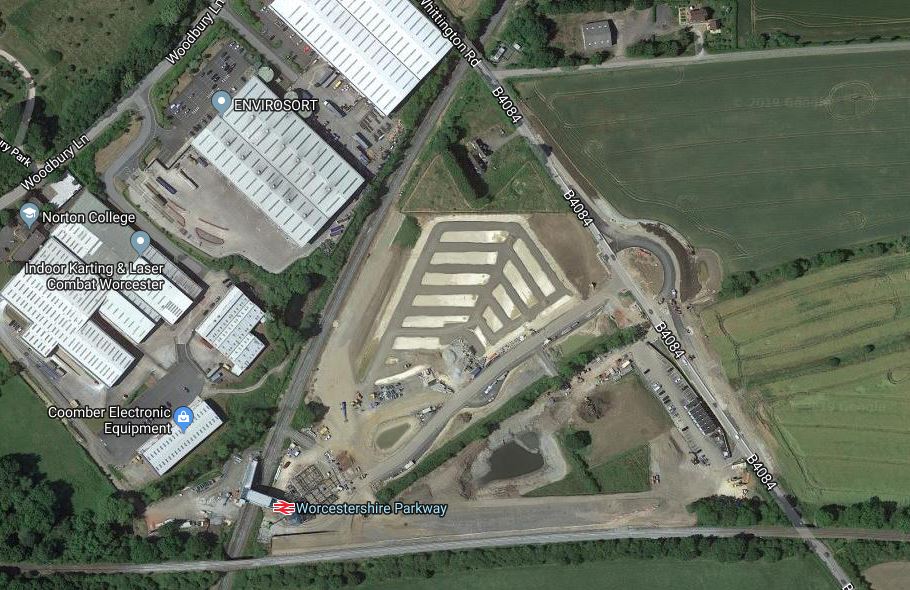
Services will probably start to call at the timetable change of December 15th, 2019
Judging by the bands of car parking shown in this map, they are expecting a sizeable number of passengers.
I just tried to book a ticket to the station and it is not in the on-line ticketing system yet as a destination, although it does show up as a stop on these journeys.
- CrossCountry – Nottingham and Cardiff – Hourly
- GWR – Paddington and Worcestor, Great Malvern and Hereford.- Hourly
Two other hourly CrossCountry services also pass through.
Worcestershire Parkway Station Under Way
This article in the Worcester News is entitled PICTURES: Lift off! Clearance work underway for Worcestershire Parkway.
Enough said! Especially as the pictures are informative!
But with similar signs of a new station at Meridian Water, it seems to be good news for those who want new stations.
Worcester Parkway Station Given The Green Light
According to this article in the Worcester News, Worcester Parkway station has been given the green light by the Government.
Clearing of the site will start this winter.
This is another station project to be given the go-ahead, since I wrote Government Focuses On New Stations And Trains. So it could be that Chris Grayling has changed direction at the Department of Transport.
The Worcester News article gives more details of the station.
- New Class 800 trains will go direct on the Cotswold Line to Oxford and Paddington.
- Services between Gloucester and Birmingham will also stop.
- The station is close to Junction 7 of the M5.
- The station will have 500 parking spaces.
It should be noted that Worcester Foregate Street station is on a restricted site and has no parking and Worcester Shrub Hill station has only 121 spaces. I suspect that the two current stations don’t probably encourage mode shift from car to train by travellers.
The article says this about funding.
The majority of the budget for the scheme will be self-funded through station car park fees and access charges levied on the Train Operating Companies, along with £8.3 million from the Worcestershire Local Enterprise Partnership through the Government’s Growth Deal.
Worcestershire Local Enterprise Partnership is very hopeful that the new station will be good for the local economy and employment.
It certainly looks like it will improve the journey of commuters and travellers from the Worcester area to Birmingham and London.
I also wonder, if once the station is built, there will be opportunities for the train companies to use trains more efficiently and add extra services to and from Worcester. Could some of these inefficiencies release valuable development land in the centre of Worcester?
Worcester Parkway is not a normal station project reliant on a lot of local and central government funding, but one with several different ways of raising the finance.
Knicker Twisting In Worcestershire
This article on Worcester News is entitled Worcestershire Parkway public inquiry shelved after pay-out.
It describes the latest round in the saga of getting Worcestershire Parkway station built.
Wikipedia says this.
On 21 February 2015 Worcestershire County Council advertised for contractors for the construction of the railway station to include platforms, station building, passenger footbridge and lifts with a commencement date of late September 2015 with completion in May 2017. On 25 August 2015 planning permission was granted, with work expected to have started in 2016.
A potential legal battle between Worcester County Council and Norton Parkway Developments, who currently own the land, started in 2016. Norton Parkway Developments has refused to hand over the land to the council as they feel that they are in a position to complete the development themselves.
So it seems like another row between a Council and developers over a station, to follow the one at Battersea.
 The Anonymous Widower