Waxing Lyrical About The Overground
My Internet trawler found this article on a web site called The Quietus. It’s an interview with veteran writer and filmmaker; Iain Sinclair.
He says this about the London Overgroiund, when asked about the effect of the lines on his life.
It’s changed mine enormously, in a sense. It’s so convenient that I tend to make journeys that reflect on the railway rather than journeys that I need to make. I wouldn’t have thought of going to Clapham Junction if I couldn’t just jump on this train and get to Clapham Junction. I wouldn’t have gone to Willesden Junction, which proved to be very useful, because I got a better sense of Leon Kossoff as a painter. He’d done some fantastic paintings of Willesden Junction but I didn’t really know Willesden Junction.
I think the Overground railway is a bit like the cinema project in that it curates. It curates a London of disparate elements. What relates Denmark Hill to Finchley and Frognal or Camden Town to Shadwell? They are now an organic identity. And sitting on this train is like sitting in a cinema. You’ve got this screen, and the landscape changes. Patrick Keiller writes that as being the view from the train; that is, really, a form of cinema. I really believe that walking is a form of cinema, and being on a train is a form of cinema, and having the excuse to stop and go to these venues and see some wonderful movie enhances that experience.
Read the full article.
I can see my own behaviour in what he says.
Every city deserves its own Overground network, designed and run to the same principles.
In the UK, Birmingham, Bristol, Cardiff, Glasgow, Leeds and Liverpool seem to be going or starting to go in this direction. Manchester is going a slightly different direction by integrating its trams and trains in the Northern Hub.
As somebody once said in the past – “The Future’s Bright – The Future’s Orange!”
Improving Walking Routes To Football Stadia
I’m using football stadia as an example, but it could equally be any other important building, like a hospital or a museum, or any number of sporting venues.
The problem was brilliantly illustrated yesterday at Bournemouth, where I walked the obvious route to Dean Court, that I’d used twice before. But after seeing Bournemouth fans at Pokesdown station turning the other way, I thought there must be a better route. Stewards gave me directions to one, that was the other two sides of a quadrilateral, that was five minutes shorter.
A few signs are all that are needed, with perhaps a few metres of asphalt to make the walking easier.
At Ipswich, you come out of the station and you can see the ground. But there are also maps everywhere for the lost, although for visiting fans there isn’t any indication of where they should go. In this map, away fans go to the bottom right corner of the ground, which is the area of the ground you get to first as you walk up Portman Road.
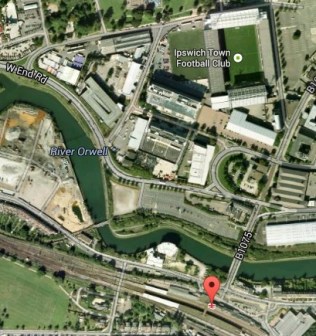
Ipswich Station And Portman Road
Since this map was produced, the biggest improvement has been putting the Sir Bobby Robson Bridge across the river. This provides an important walking route between the south western parts of the town and the centre and the football ground.
Note that in this map, the station is indicated by the red arrow symbol, as they are in all the other maps.
There are a few groups in the Premier League and Championship that have their own stops or are less than fifteen minutes from a rail, tube, tram or metro stop.
Arsenal – This has three stations at Arsenal, Finsbury Park and Highbury and Islington.
Aston Villa – The stations are Aston and Witton
Chelsea – Take your pick from Fulham Broadway, Imperial Wharf and West Brompton
Crystal Palace – Norwood Junction is five minutes away.
Everton – Sandhills station and then the Soccerbus.
Hull City – There is a walking route from Hull station.
Liverpool – Sandhills station and then the Soccerbus.
Manchester City – Take the Metrolink to Etihad Campus.
So could the walking routes to other grounds in the top two divisions, particularly from the nearest rail station, be improved?
Birmingham City
The walking route from Bordesley station isn’t very long or difficult, as this map shows.
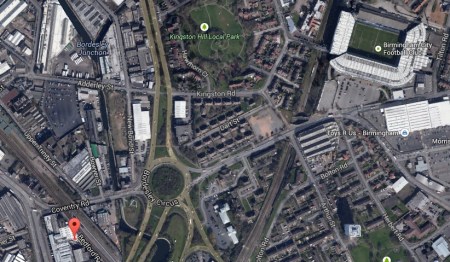
Bordesley Station And Birmingham City
But it’s just downright dangerous, as there is no pedestrian route around Bordesley Circus. I wrote about it in this post; A Pedestrian Crossing From Hell.
I have heard from Birmingham City Council, who say that something is being done.
If you look at the map, you’ll see the Camp Hill Line passing at the side of the ground. If Birmingham City are ever successful and need to rebuild the ground, if feasible planning permission should include a station at the new stadium.
It is a long term aspiration of Birmingham City Council to open this line to passenger traffic. The way the tide is turning in favour of rail, I wouldn’t bet against this happening.
Blackburn
Ewood Park is a tricky ground to get to, as you have two stations in the town; Blackburn and Mill Hill.
I usually go to the ground by Blackburn, as I usually change trains for the area in Manchester, so that I can get a meal if I need one.
To get between the station and the ground, I normally use a bus, which isn’t as easy as it could be, as the information is rudimentary.
Mill Hill is nearer to the ground and walk-able, as this map shows.
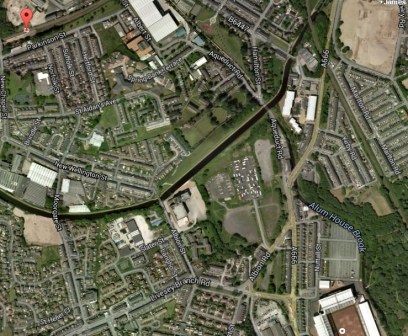
Mill Hill Station And Ewood Park
But I think there are two problems with using Mill Hill.
To return to the station would be a walk up the hill.
But the main reason, I would not go to Mill Hill, is that I can’t get a direct train to that station from Manchester. As you have to change trains in Blackburn, I might. just as well get out there and catch a bus.
Cardiff
The preferred route to get to the ground is to take a train to Grangetown station, but Ninian Park station is nearer, but the trains aren’t so good.
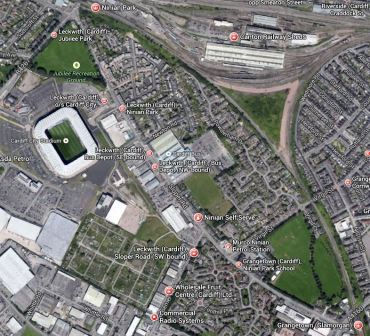
Grangetown And Ninian Park Stations, And Cardiff City Stadium
All this might change when the local lines around Cardiff are electrified, as they seem to be improving stations.
Derby
Derby is an easy walk between Derby station and Pride Park, as the map shows.

Derby Station And Pride Park
I did get lost though, so I think a few more signposts would help, as would another light-controlled crossing on Derwent Parade.
Leicester
I wasn’t sorry when Leicester City got promoted, as the walk to get to the stadium is not a short one.
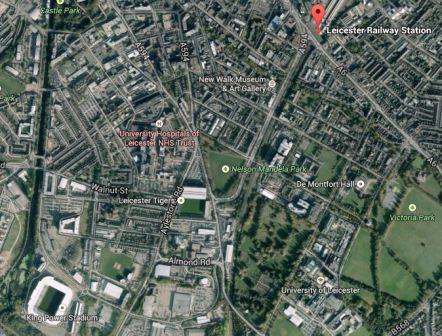
Leicester Station And Stadia
I think it would be helped with some better signs. I generally take the road opposite the station and aim for Welford Road, I pass the rugby ground and you can see the King Power stadium.
Nottingham
This map shows Nottingham station and the two Nottingham football grounds; Meadow Lane and the City Ground.
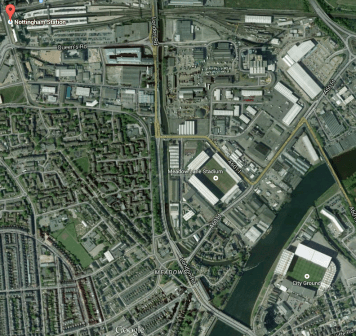
Nottingham Station And The Football Grounds
I have walked between the station and the City Ground probably a dozen times and it’s flat and not a route that has many opportunities to get lost. But as the map shows, you walk alongside a waterway and surely access to this would make the walk more pleasant. It would also help if some improvements could be implemented at both ends of the route.
One thing that I’ve never had explained to me, is why are there no plans to serve the two football grounds and the cricket ground using the Nottingham tram.
Wigan
I’ve always thought that getting from Wigan North Western station to the DW Stadium was very difficult, so I generally take a taxi. I’ve just looked at the map.
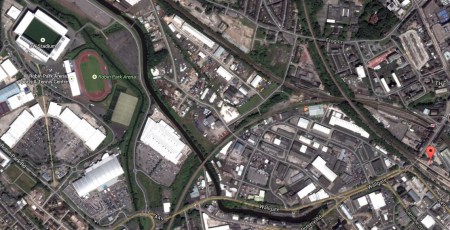
Wigan North Western And The DW Stadium
The distance isn’t great but it doesn’t appear to be signposted at all. Note that there is a canal and Wigan Pier, that could be on the route,so it could bring visitors to an area that the council is developing, into the Wigan Pier Quarter.
The Power Of Check-Lists
The most interesting article in The Times yesterday was entitled How A Checklist Saved A Little Girls Life. It starts like this.
A simple procedure borrowed from the airline industry and a bit of humility has ensured many more patients survive
It is powerful stuff and I hope every doctor and health administrator reads it. But I doubt they will, as what does the aviation industry know about medicine?
The author of the article Atul Gawande is giving the Reith Lectures this year. I shall be listening.
Match Eighteen – Bournemouth 2 – Ipswich 2
Bournemouth would have been a long way to go and come back with nothing!
I wasn’t optimistic as I sat having brunch in Carluccio’s in Waterloo station and nothing on the way down did anything to convince me that we wouldn’t lose.
But lose we didn’t and I was one of a group of fellow Ipswich supporters, who took the train back to London.
I won’t talk about the two Bournemouth goals, but I will say that our first equaliser was surprising and the second was well-taken.
Teddy Bishop‘s first goal for Ipswich was surprising, in that instead of being from a long range effort, he appeared in the box to side foot a low Tyrone Mings cross past the keeper.
On the other hand, Daryl Murphy’s goal was typical of what he has been scoring in the last twelve months. It is best described as a well-taken looping header from a superbly taken free kick from Paul Anderson.
As to Bournemouth, they were the best team we’ve faced at season and I think that pundits underrate them at their peril. Make sure you get your ticket for the return match at Portman Road on Friday, April 3rd, early.
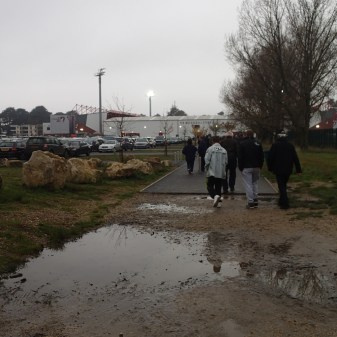
Walking To Dean Court
Dean Court is not too far away from Pokesdown station. But the route between the two does need to be better signposted and it isn’t all tarmac
The shortest route through the park was not easy in the dark for someone with dodgy eyesight. Luckily, I was guided by a group of Bournemouth fans. This map shows the area.
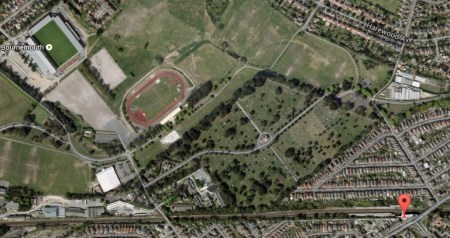
Pokesdown And AFC Bournemouth
Come out of the station, turn left and then left again into Clarence Park Road. When you get to the park and the cemetery, you should be able to see the ground. There are paths through the park to the ground.
The great advantage of this route is that it brings you to the corner of the ground, where the away fans enter to take their seats. It also avoids having to walk past the Ukip shop.
It took me about seventeen minutes to walk back to the station after the match. Ipswich station takes about ten minutes from the ground.
A Surprise For Bournemouth
I have always believed a story once told me by a hairdresser who used to work there, that Bournemouth does more blue rinses than any town in England.
So I was surprised to see this shop as I walked from Pokesdown station to Dean Court, down the rather less than salubrious shopping street, with its collection of shops which are not the best.
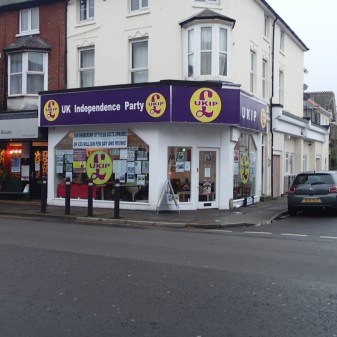
A Ukip Shop In Bournemouth
Who’d have thought that Bournemouth would be a hot-bed for kippers.
South West Trains Messy Tea
The picture says it all.

South West Trains Messy Tea
If I was the boss of ATOC, I’d offer a prize for the design of a tea system that was simple for the staff and customers alike, but didn’t leave any mess.
Serial Cooking – Cinty’s French Fish Pie
This fish pie is another Lindsey Bareham recipe, that is an ideal two portion dish.








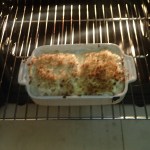

It is easy to do and I suspect that the completed dish could be prepared earlier and left in the fridge for most of the day.
The one here, gives me two portions for two suppers or a meal with a friend.
A friend of mine does this recipe a lot. She says it is easy to modify for however many are turning up for supper. She also says she doesn’t get complaints.
Could Parry People Movers Replace The Class 153s?
On the Stourbridge Town Branch Line, Parry People Movers or Class 139 trains, have replaced a Class 153 train on the short route.
As there are seventy of the Class 153s, how many of these could be replaced by the smaller Class 139s.
I feel that a line like the Felixstowe branch could probably just be covered adequately, by two Class 139s working together. They would start simultaneously at Ipswich and Felixstowe, every thirty minutes. The current Class 153 is scheduled to take twenty-six minutes, which means it would be tight and would probably need a train with a bit higher performance than the current Class 139.
But if you look at this line in a few years, it is likely that it will be electrified for freight reasons and I suspect that passenger trains on the branch will be reorganised and run by a suitable electric train. I do wonder if the Ipswich Cambridge line were to be electrified and given an increased service frequency, that some of these trains should be extended to Felixstowe or Harwich. Extra stations might also be added on the Felixstowe line to both serve the port and new housing developments. The area has lived on scraps and hand-me-down trains for years, but now that the Beccles Loop and the Bacon Factory Curve have been built, the trains are at last generating traffic and running more frequently and reliably.
Looking at where the seventy single coach Class 153 trains are used, quite a few are used on lines a lot longer than the Felixstowe branch. When I took a trip around Wiltshire, a lot of the journey was in a Class 153, but probably the route is too long, fast and busy for the smaller Class 139.
So I would think that some Class 153s and possibly some Class 150s or 156s might be able to be replaced on services by Class 139s or a bigger version, but not many. A specialist version with lots of space for bicycles, wheelchairs and luggage might also have applications in tourist areas like the St. Ives branch.
Another likely source of replacement is some new Class 172s. This has been hinted at by a rail minister and we do have a General Election coming up. If money was no object, all of those rural lines that will probably never be electrified like those in the North of Scotland, Lincolnshire, East Anglia, Wales and the West Country, would be equipped with a new standard train like a Class 172, built to last for the next forty years. Class 172s also have the advantage that they can be lengthened by adding extra coaches in the middle and coupled together to make longer sets. I suspect too, they could also be updated in a decade or so, with an energy-efficient, quieter hybrid power train.
In my view an order for some Class 172s would solve a lot of problems for a long time.
A start has also been made on refurbishing some of the Class 156s and these will probably all be retained for many years. As some of these Class 156s are used on lines that will be electrified, they could be a replacement for Class 153s and 150s, where something better and/or bigger is needed.
The Class 15x trains may all be getting on for thirty years old, but many could linger a good few years. Especially, if engineers keep finding ways of updating them, like these new toilets.
So to answer my original question. Parry People Movers or their larger successors might have a place in some places in the UK, but I can’t see too many running in say ten years time, except under special circumstances like Stourbridge, where a high frequency service is needed over a short distance.
Perhaps some might be used on new services, where a small town or attraction needs to be connected to a main line. One place for example might be to link Yeovil Junction to Yeovil Pen Mill and then possibly to the town centre. The track exists between the two stations, which don’t have any connections and are served by totally different companies and services
Projects Are On The Way – W/E 22nd November
This week there have been several projects or investment in UK railways announced.
21st November – Crossrail Work At Shenfield Starts Early – Are they wanting to build Crossrail faster?
21st November – Welsh Valley Lines Go-Ahead Given – This is very much needed.
20th November – Wisbech Reopening Proposed – Nothing concrete yet, but needed if Wisbech is going to develop as a satellite of Silicon Fen
19th November – Electrostars For Gatwick Express – Something like this was expected and Derby will be pleased.
18th November – Crossrail Accessibility Boost – Probably best done before opening
It will be interesting to see how many get announced each week, as we build up to the General Election.
Using The Strange Property Of Water To Advantage
Most people, except perhaps those, who live in hot climates, know from their personal experience that ice floats on water. But most people don’t know that water is at its densest at 4°C. So water at this temperature sinks, but it rises at all others.
I once heard somebody use the existence of this property as a reason why God exists. He argued that if it didn’t, then life would have been impossible in water. It was all a bit contrived, but it is still as a strange property.
This morning, I was listening to Wake Up To Money, when a company called SureChill was mentioned. So I looked them up and found that they are using this property to create a new type of refrigerator. This page explains it all. This section describes the solution.
Sure Chill is a brand new kind of cooling system. It doesn’t need a constant power source. In an on-grid situation with intermittent power, it works perfectly well. In an off-grid situation, where a solar panel may be used, a Sure Chill powered refrigerator doesn’t even need a rechargeable battery. It shouldn’t work but it does. And it works beautifully.
Water surrounds a Sure Chill refrigeration compartment. When it has power, the water cools and forms ice above the compartment leaving only water at four degrees cooling the contents. When the power is switched off, the water warms and rises while the ice begins to melt, keeping only four-degree water cooling the contents of the compartment. So it has its own internal and entirely natural energy store that maintains a completely steady temperature. The system can operate like this, without power, for days and weeks.
People think physics is boring. Outside of Metier, I’ve done well in my career and made quite a bit of money by understanding the laws of physics that govern our lives.
My surprise at this idea, is that the technique could have been implemented in a refrigeration system decades ago. Artificial refrigeration was first performed by William Cullen in 1755. My bible; Nelkon amd Parker says that the maximum density of water was first measured by Thomas Charles Hope in 1804.
That is a long time from experimental proof to reality!
 The Anonymous Widower