Some Trains Never Know When To Retire
This article in the Railway Gazette, which is entitled Southampton – London open access service proposed, caught my eye.
I like disruptive innovation in all its forms. When you consider that my pension is paid by the money I made from two examples of disruptive innovation, I would be a hypocrite to think otherwise.
To me, an open access operator on the railway, is just another form of disruptive innovation.
Although not open access operators, some of the smaller rail companies like Chiltern, c2c and London Overground are very much disruptive innovators.
If they get the product right they succeed, if they don’t they fail.
These train companies also bring much needed competition to a route.
I use them, when they are convenient to me and in the last couple of months, I’ve used several of them.
These points gleaned from the article describes the proposed Southampton London service.
- Alliance Rail Holdings hope to start a new Southampton – London Waterloo route in December 2017.
- Alliance envisages that there would be seven off-peak services a day, with two Peak services from 2018.
- They will be offering a high class service.
- They are proposing to use Class 442 trains for the route.
It is a proposal, I shall watch with interest.
I have never had many rides in a Class 442 train, but they are interesting beasts.
- They started to be introduced in 1988, so are nearly thirty years old.
- In some ways they are the ultimate development of the Mark 3 coach, with air-conditioning and plug as opposed to slam doors.
- They hold the speed record for a third-rail electric train.
- When first delivered, their reliability was questionable, but over time, they seem to have become a dependable electric multiple unit.
Recently, they have been working the Gatwick Express, but now that route has brand new Class 387 /2 trains, they are in storage.
It may seem strange to start a new train company with thirty-year-old trains, but then Mark 3 carriages still feel they have another few years yet. Certainly, companies like Chiltern and Abellio Scotrail are still recruiting them at the scrapyard’s door and giving them a treatment worthy of Joan Collins or Roger Moore.
In addition, there is this article from Rail Magazine, is entitled Refurbished Mk 3s for Tornado.
It describes how, a rake of Greater Anglia’s Mark 3 coaches, will be acquired to be used with the new-build steam locomotive 60163 Tornado.
I’ll be long dead, when the last Mark 3 coach is finally retired from revenue-earning service on the UK’s railways.
Bourne End Station And Improving The Marlow Branch Line
Bourne End station is an intermediate station on the Marlow Branch Line, where trains reverse on their way between Maidenhead and Marlow stations.
It also is a terminus of trains to and from Paddington station in the Peak.
This Google Map shows the station and its location.
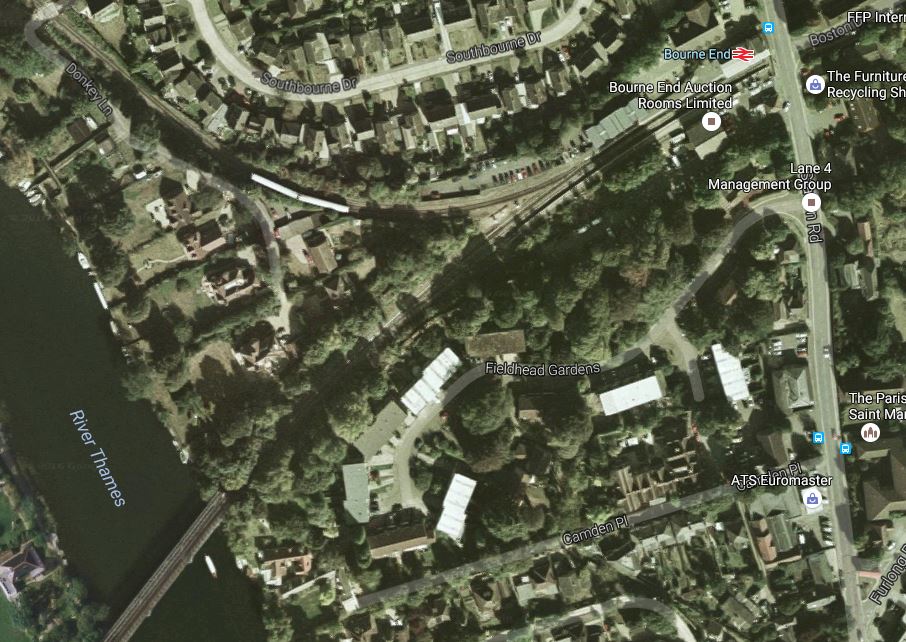
Note.
- The Bourne End Railway Bridge takes the railway over the Thames to and from Maidenhead.
- The two-car Class 165 train on its way to or from Marlow.
- The station has a short Northern platform, where trains reverse and a longer Southern one, that can only be used by trains going to Maidenhead.
- There is a step-free interchange between platforms
- All lines are single-track.
These pictures show the station and the surrounding area.
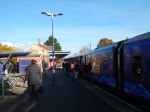


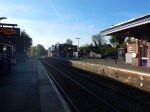
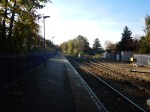


These are some thoughts on various ideas and issues on Bourne End station and the Marlow Branch Line.
Longer Trains To Marlow
Currently, because of the layout of the junction, where trains take the left-hand fork to Maidenhead and the right hand route to Marlow., all trains to Marlow must be only two cars.
I don’t know if modern trains can take sharper curves than the 1990s-built Class 165 trains on the route, but if it was the case, it might be possible to configure the junction to allow the Northern platform to be lengthened to take a longer train.
There are also other features of modern trains like a Class 387 train, that might help.
- Selective door opening.
- Walk-through design.
- 20 metre as opposed to a near-23 metre car-length of the older diesel train.
It would be a tight fit, but I suspect that fitting a three or even four-car train in Bourne End station might be possible, if the passenger traffic needed that capacity.
Passing Loops On The Line
There used to be a passing loop at Cookham station, but this was removed in the 1960s.
This Google Map shows Cookham station.
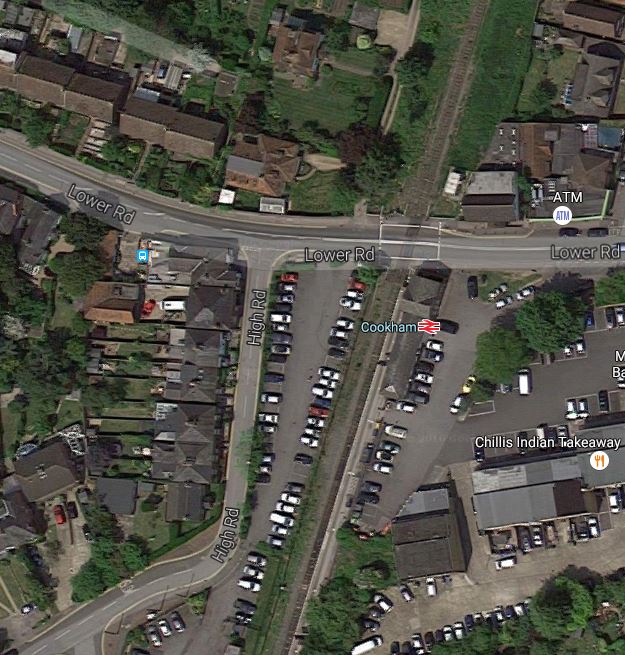
Cookham Station
It is probably one of those things that is possible, but would actually be a difficult project to implement.
- The users of the line wouldn’t accept a long closure.
- The level crossing would add a large degree of complication and opposition.
I suspect that unless there were really pressing reasons, that a passing loop will never be rebuilt at Cookham.
Increased Frequency
In the Peak, the service between Marlow and Maidenhead is effectively two trains per hour (tph). The method is described in Train Services under the Wikipedia entry for the Marlow Branch Line. This is said.
The off-peak service is one train per hour in each direction between Maidenhead and Marlow. During morning and evening peak times a two trains per hour service is achieved by using two trains: one shuttling between Marlow and Bourne End, and another between Bourne End and Maidenhead/London Paddington. This is possible because Bourne End station has two platforms that may be used simultaneously.
I suspect, that some devious train scheduler has a method for improving on this in the Peak and perhaps providing 2 tph in the Off Peak all day.
Certain facts might help.
- It only takes seven minutes to travel between Bourne End and Marlow stations.
- It only takes eleven minutes to travel between Bourne End and Maidenhead stations.
- Track improvements and modern faster trains might improve these times.
- Modern trains probably mean that the driver can change ends in a shorter time.
- Modern trains have various driver assistance systems to help timekeeping.
- . Running two tph as a shuttle shouldn’t be a problem, as it is currently in the Peak.
- Currently, four tph run to both Paddington and Reading from Maidenhead, with extra trains in the Peak.
- Crossrail will add four tph to Paddington and two tph to Reading.
- If all trains are modern, with floor heights compatible with Crossrail’s Class 345 trains and GWR’s Class 387 trains, then all train entry and exit, will just be a step or wheel across.
It probably all adds up to having at least two tph on the branch all day.
One problem that will limit frequency to two tph, is the lack of a passing loop on the line.
Two tph is only attainable, by using Bourne End station as a virtual passing loop, where the trains don’t actually pass. but the passengers do.
I suspect that train arrivals and departures at Bourne End station, are timed, to minimise conflicting passenger movements between platforms.
This is the current times of some movements at Bourne End station in the morning Peak.
- 7:21 – Train arrives from Maidenhead
- 7:24 – Train arrives from Marlow
- 7:27 – Train leaves to Maidenhead
- 7:28 – Train leaves to Marlow
These times give seven minutes for Maidenhead to Marlow passengers to change trains and three minutes for passengers going the other way.
They obviously give plenty of time for the driver to change ends of the train.
If we take the current timings of Maidenhead to Bourne End and Bourne End to Marlow, we get timings for a complete shuttle of two journeys.
- Maidenhead and Bourne End – 6+2*11 +4 = 32 minutes
- Marlow and Bourne End – 4 + 2*7 + 4 = 22 minutes
The extra four minutes has been added as that is how long it takes to reverse the train at Marlow.
So if a minute or two could be shaved on the Maidenhead shuttle, two tph is possible.
Three tph are probably possible between Bourne End and Marlow, but using one train to run three tph between Maidenhead and Bourne End is certainly not possible unless, one or more of the following are done.
- A passing loop is built between Maidenhead and Bourne End.
- A better sequence of trains is used at Bourne End.
- Trains run faster and call in minimum times at intermediate stations.
- Some trains don’t terminate at Maidenhead, but go on to Paddington or another station.
I am left with the conclusion, that with modern trains two tph is possible all day, but with minor adjustments three tph may be possible, especially in the Peaks.
Restoring The Line To High Wycombe
From the images in this post, I think it would be unlikely that the line to High Wycombe would ever be restored.
It would probably need a level crossing and I doubt Network Rail or the locals would like that idea.
I think that the increased frequency of trains between Bourne End and Maidenhead would need a passing loop.
Electrification
It has been planned to electrify Bourne End station and the Marlow Branch Line.
As I said in Is It Bi-Modes And Battery Trains To The Rescue?, nothing has been said by the Rail Minister about any plans for the electrification of the Marlow Branch.
But I did take these pictures at Maidenhead station today.
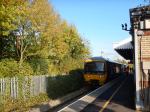
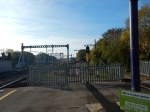
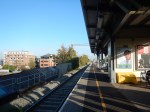
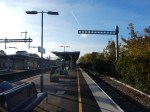
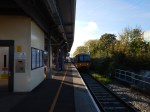
Why would the platform for the Marlow Branch and the first couple of hundred metres of the branch be electrified?
Especially, as there appeared to be no sign of work on the rest of the line between Maindenhead and Bourne End!
Given what I saw and wrote about increased frequencies, I think there are four possibilities.
- The Marlow Branch continues to be run as now..
- It receives traditional electrification later.
- The line is electrified just enough to charge trains with an IPEMU-capability or batteries.
- It has something to do with reversing Crossrail trains.
Option 1 and 2 are possibilities, but Crossrail are reversing trains to the West of the station.
It would also appear that sufficient work is being done for option 3.
Consider.
- There appears to be no work going on to lower the track in the numerous bridges.
- The clearances, are enough for a battery-powered train or IPEMU, which would be those needed for a Class 165 train.
- The line is only just over seven miles long, which would be within battery range.
- The line has at least two level crossings, which can be difficult to electrify.
- Putting overhead wiring on Bourne End Railway Bridge could rightly meet with objections.
Perhaps the best way to run the branch would be to run it almost as two separate services, as it is currently done in the Peak.
- A newer two-car diesel, like say a Class 172 train, runs the shuttle between Marlow and Bourne End.
- A four-car electric multiple unit with an IPEMU-capability, runs the Bourne End to Maidenhead service, under battery power charging at Maidenhead station, using the 200 metres or so of overhead wires.
- The trains are timed to meet at Bourne End, where passengers change between the trains.
- Certain Bourne End to Maidenhead trains could be extended to Paddington, as they are now in the Peak. I think they would take two hours for the round trip.
- In some ways the biggest advantage is that the only new infrastructure, would be the electrification at Maidenhead station, that is currently in progress.
I feel it is all feasible.
Conclusions
On current timings, two tph is very feasible and three tph may be a possibility and a certainty in the Peak.
What benefits would passengers get from this level of service?
- They get a turn-up-and-go service of at least two tph.
- They get newer trains with more capacity.
- Some of the trains would be electric-powered.
And the train operator?
- They get newer trains with more capacity.
- They would only need to allocate a small number of trains to provide the service.
- They get an easy-to-deliver service.
Hopefully, the quality service would attract more passengers and generate profits.
Surely though, Network Rail are the biggest winner, as they would only need to get the infrastructure into tip-top condition, add a small amount of electrification and give it a thorough testing.
Will it happen?
I have no idea, but it certainly looks like something innovative is being assembled.
If whatever Network Rail and GWR are planning, should involve the use of IPEMUs or battery-powered trains and it proved to be a success, then it would open up the possibility of several branch and other lines receiving the same electrification by stealth.
- Barking Riverside Extension
- Didcot Parkway to Oxford
- Felixstowe Branch
- Greenford Branch
- Henley Branch
- Marshlink Line
- Sudbury to Marks Tey and Colchester
- Uckfield Branch
- Windsor Branch
It is certainly easier to electrify a line using modified electric trains with batteries, built in a new clean and warm factory in Derby, rather than by traditional methods, which seem to be Network Rail’s money pit.
Reflections On My Journey From Gatwick
After a good night’s sleep, it is perhaps worth taking a look at my experience yesterday in getting through and home from Gatwick Airport.
The train problems were hopefully exceptional, but having seen the new plans for Thameslink’s services, which make it difficult for anybody in East London to go South, I suspect that these problems will go on for some time.
The trouble with the new Thameslink is that it has no step-free interchange with any of the main North South routes through East London.
East London Line
Currently, you can change at New Cross Gate for Gatwick services, but after Thameslink fully opens, this connectivity will be lost under current plans.
It looks like the best route will be to go to West Croydon station and take the tram to East Croydon.
Bank Branch Of The Northern Line
Currently, the interchange at London Bridge between Northern Line and National Rail is not good, although it is step-free.
Hopefully, it will get better.
But the problem with the Northern Line is that many of the stations need reconstruction for full step-free access.
If the London Bridge interchange is improved and the excessive walking is cut, I could use this route a lot to get to Thameslink from Angel station.
But Angel is not a station for a large case, a wheelchair or a baby in a buggy.
Victoria Line
Many on the Victoria Line go direct to Victoria and get a direct train.
Victroria Line access to Thameslink is currently terrible with the only interchange at Kings Cross being step-free and a very tortuous and long walk.
After Thameslink is fully open, there will be a much easier change at Finsbury Park station.
Conclusions
I’m still not sure that the new fully-open Thameslink will not be without controversy.
There is also a need for a solution to the Freedom Pass problem.
I suspect that savvy passengers will just buy an extension ticket between East bCroydon and Gatwick Airport.
On the other hand, I wouldn’t put it past Gatwick Airport to fund the moving of Gatwick Airport into Travel Zone 6, if Heathrow does something unfriendly with Crossrail ticketing. After all, each return ticket costs just £6.
Is It Bi-Modes And Battery Trains To The Rescue?
This article in Rail Technology Magazine is entitled Further delays to GWML electrification as schemes deferred indefinitely.
The delayed schemes include.
- Bristol Parkway to Bristol Temple Meads
- Bath Spa to Bristol Temple Meads
- Oxford to Didcot Parkway
- Henley Branch
- Windsor Branch
There is no mention of the Marlow Branch or the Greenford Branch.
The article also quotes the Rail Minister; Paul Maynard, as saying.
Introducing newer trains with more capacity in these areas could be done without costly and disruptive electrification,
Is this a meaningless platitude or is there substance behind it?
A mix of Class 801 electric trains and Class 800 bi-mode electro-diesel trains were originally ordered for GWR.
But this is said in the Wikipedia entry for the Class 800 train.
In July 2016, it was announced that GWR’s intended fleet of Class 801s were to be converted from pure EMUs to bi-mode units. Subsequently these were reclassified as Class 800s.
So will we see bi-mode trains working the Bristol Temple Meads routes, which are numbered 1 and 2 above?
That would certainly allow the Minister to bathe in the glory of a run to Bristol via Bath and back via Bristol Parkway.
Five-car Class 800 trains could also work route 3, thus giving Oxford trains, that would increase capacity and run on electric power between Didcot and Paddington.
But what about the four branch lines; Greenford, Henley, Marlow and Windsor?
Note.
- The Minister used the word newer not new.
- He also said capacity would be greater.
- When I passed the Marlow branch a few weeks ago, it appeared electrification had started.
- All branches are short, with the Marlow Branch the longest at 7.25 miles.
- The Henley Branch has a 50 mph speed limit.
It should also be noted that the Mayflower Line, where the battery train trial was conducted in 2015 is just over eleven miles long.
So would it be possible to fit batteries to the Class 387 trains to fulfil the Minister’s statement?
- The Class 387 trains are very similar to the Class 379 trains used in the trial on the Mayflower Line.
- They are newer with greater capacity, than the current trains on the branch lines.
The answer could be yes! I reported on Rumours Of Battery-Powered Trains in August 2015. At that time Network Rail were calling the trains Independently Powered Electric Multiple Units or IPEMUs.
The possibility also exists that Class 387 trains with batteries could also work the lines between Didcot Parkway and Oxford, Reading and Basingstoke and Reading and Bedwyn.
Network Rail needs to convert a serious loss of face into at least a score-draw!
If the Great Western does use this approach, they’ll only be taking a similar route to the Germans, as I wrote about in German Trains With Batteries.
Crawling Home From Gatwick
Getting home from Gatwick for me, should be an easy process.
- Touch in with my American Express card at Gatwick Airport station.
- Train to East Croydon station.
- Touch out to close the transaction.
- Train to London Bridge.
- 141 bus to home.
But there was trouble in this simple plan.
- Thameslink services appeared to have problems.
- The tragic Croydon tram accident.
- There appeared to be a shortage pf trains to East Croydon.
- Staff weren’t very numerous.
- The closure of ower Bridge.
I eventually got to East Croydon and touched out without going through the barrier, so I was now in Freedom Pass territory. The train from Gatwick was a Class 377 train, which although brilliant for commuters, is not designed for anybody with a suitcase.
There needs to be a reader on the platform at East Croydon, so that passengers with Freedom Passes can touch in and out, without going to the barrier. But sorting this minor irritation, is probably the least of Southern’s worries.
After a wait of about thirty minutes, I got on a trainto London Bridge and although, I’d intended to get the Overground from Brockley, I missed the stop as in the dark, I missed the stop, so I went to London Bridge, which should be quicker anyway.
But it wasn’t, as on arrival at the station, there were no buses and only a couple of taxis.
I took the taxi and the amiable driver immediately turned off the meter.
It was all due to the total gridlock created by works on both Tower and London bridges.
After crossing the river, it was more or less plain sailing.
It could be argued that my journey would have been easier, if I hadn’t wanted to go via East Croydon, so that I could save a few pounds.
I don’t need the money but other travellers do! The system certainly doesn’t cope well with those, who want to change from using their Freedom Pass to a ticket at East Croydon station.
If I’m going out and back through Gatwick, the problem can also be solved by buying a return ticket from East Croydon to Gatwick Airport from a ticket machine from certain companies like the Overground and Thameslink.
I
Nightmare At Gatwick
I few out to Las Palmas from Southend and the experience coming back through Gatwick couldn’t have been more different.
I arrived in the North Terminal and this terminal is now very poor compared to modern standards.
- The walk to Passport Control is long and tortuous compared to many other similar-sized European airports.
- Passport Control was solid and was only half open.
- The baggage took an age to arrive, but luckily my bag was off first.
- I had to get the shuttle to the main terminal for the train, but it wasn’t a well-signposted route.
- I of course just missed the shuttle.
The North Terminal is basically a 1970s design and it shows.
The terminal is a disgrace and doesn’t fit with any notion of Britain being open for business.
Did the Government plump for Heathrow, as they have all had very bad experiences of Gatwick.
To be fair to the Airport, their plans for the future look good.
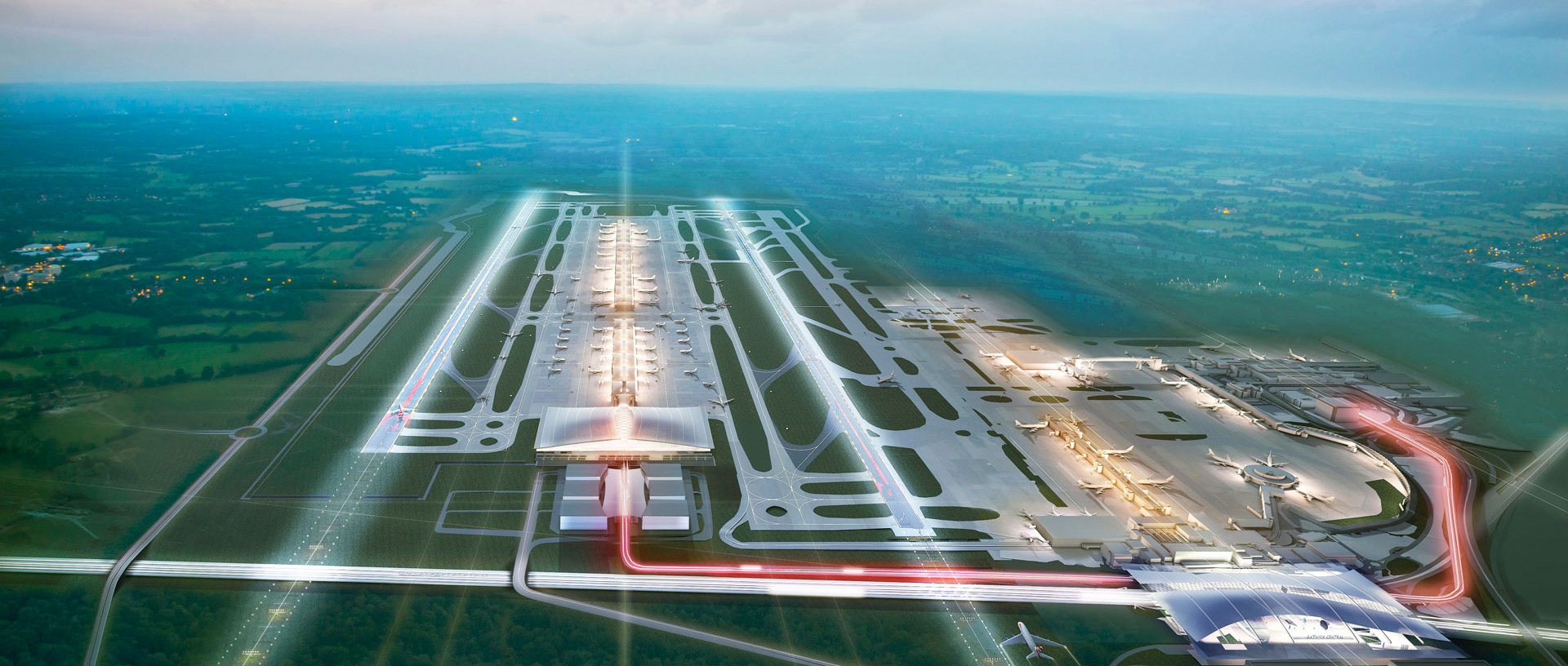
Gatwick In The Future
But will we actually see it?
Leaving Las Palmas
I took these pictures, as I rode to the airport at Las Palmas.








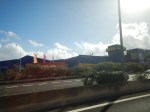


I was in a free shuttle from the hotel.
Wikipedia has a section in their entry for Las Palmas, which is entitled Train Under Construction.
This is said.
Tren de Gran Canaria (TG) is a rail project initially proposed as an alternative way to get from Las Palmas to Maspalomas[44] but was later raised to Agaete extension.
Another project is the Tramway Palmas (Gran Canaria), which would cover the same journey as the bus line 1, with an average frequency of 5 minutes and a journey time of 35 minutes.
As the pictures indicate a train will be more interesting.
Las Palmas Wakes Up
I rose early and took these pictures along the the promenade by Las Canteras Beach.

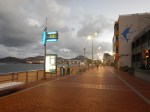

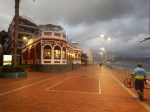

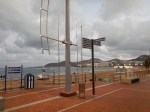




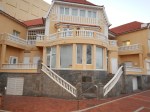

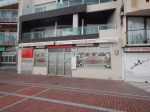



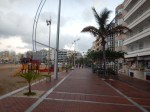
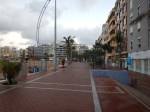
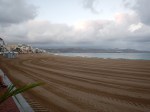

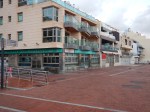
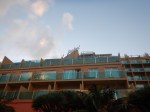
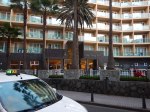
I always get up early and it was good to walk along the promenade.
Note the three restaurants where I had a good gluten–free meal.
- Kitchen Lovers
- Balalaika
- Restaurante Molinet
I also had a good tuna salad at Max Bread, so if you’re coeliac or gluten-free, you shouldn’t starve, unless you’re exceedimgly fussy.
Other points to note.
- The Hotel Reina Isabel looked to be a good place to stay because of its location.
- The beach was very clean.
- The promenade was a good place to walk, with no pavement problems.
- There were plenty of places serving good coffee and ices.
I would certainly return, but try the Hotel Reina Isabel next time.
Gluten-Free Eating In Las Palmas
Spain is not a difficult place to be gluten-free.
The Hotel
In the hotel, I only are breakfast, which usually consisted of fruit juice, eggs, ham, cheese and coffee.
There was no gluten-free bread, as you can get in most three or four stars hotels these days.
But that I can do without.
Snacks
I did take about ten EatNakd bars and M&S Honeycomb Crisps, but Ialso found some Spanish bars, that were labelled Gluten-Free in large letters.
They would have done at a pinch.
I also had a couple of good salads.
Balalaika
I ate in this restaurant on Monday night.


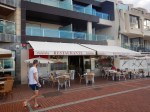


The restaurant had the best allergy-friendly menu, I’ve ever found. Not from a point of the food, but from the way the information was presented.
For gluten-free food, I just avoided any item with a large red dot, with a gluten sign in the middle.
Kitchen Lovers
I ate here on the Tuesday night.
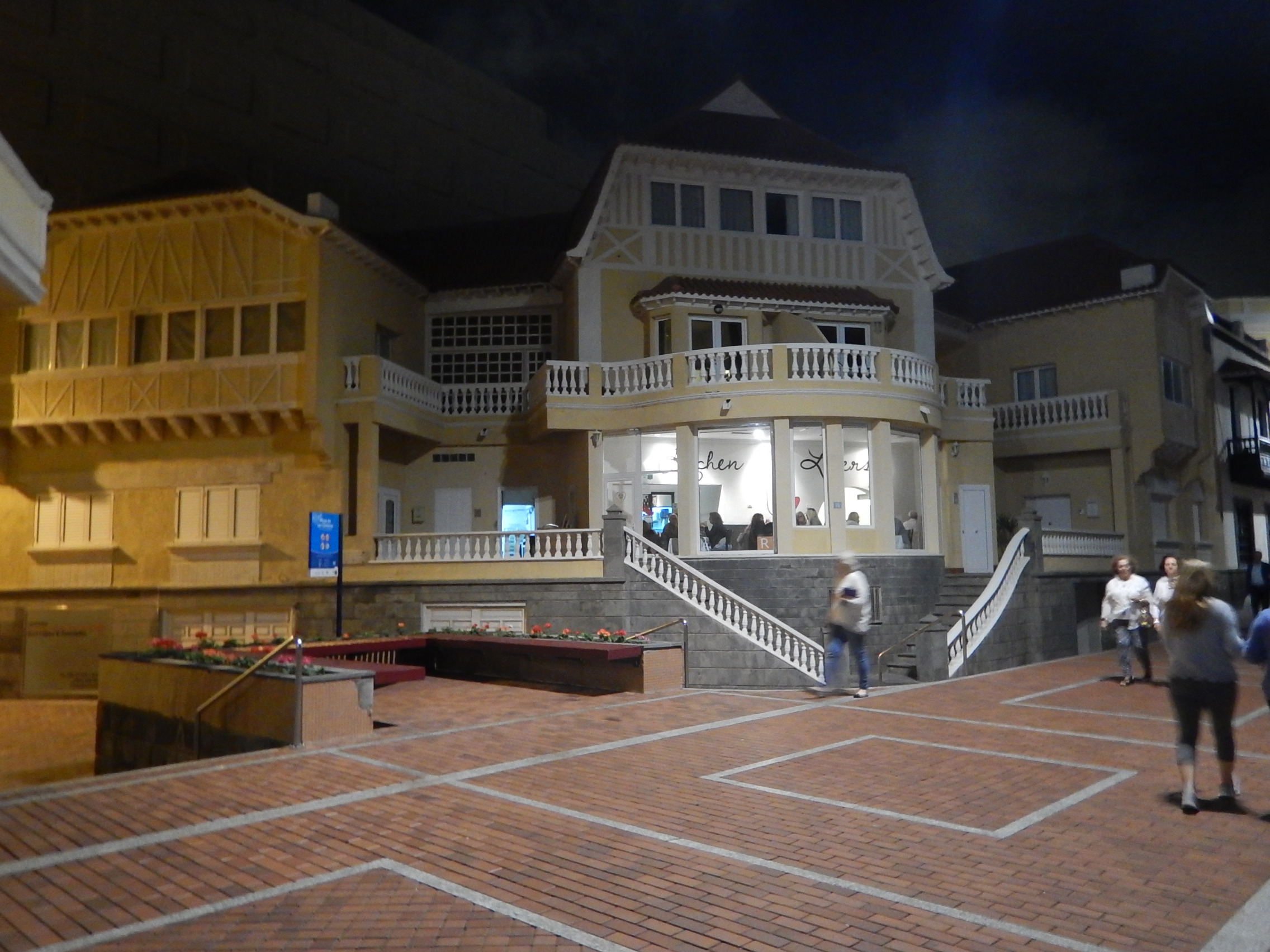
Kitchen Lovers
I’d been pointed to the restaurant by Lonely Planet’s guide to the Canary Islands (p 74)
It’s all, they say it is.
I didn’t book, but then November wasn’t busy in Las Palmas.
It was one of the best restaurants, I’ve eaten at in Spain. You have to remember that C and myself tried quite a few.
I paid 33 euros for two courses and a glass of wine.
I could spend that in say Carluccios in Leeds!
Restaurante Molinet
I ate here on Wednesday night after seeing the gluten-free sign on the facia.





It is a restaurant to watch, as it had mixed reviews, so it could go either way.
But at least it serves gluten-free San Miguel lager.
I wish them lots of success.
Tailpiece
If you have to be gluten-free like me, you won’t starve in Las Palmas.
A Tour Of Gran Canaria
I don’t usually take tours, but I took this one around the island of Gran Canaria.



















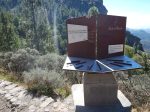










Note.
- It was a good tour, even if a bit cold.
- But then we were 2,000 metres up.
- We all visited a restaurant on the way down. I think, I was mildly glutened.
Next time, I go, I’ll go with someone who can drive and a quality road map, as there are lots of worhwhile places to visit.
 The Anonymous Widower