Tottenham Hale Station – 30th April 2018
These pictures show the space to the East of the third platform space, where the third track will go through.


It looks like there isn’t much space for the fourth track, if they want to squeeze one in. Or will the piles for the electrification have to be moved?
Good Advice About The May 2018 Rail Timetable Changes
Several of the train operating companies don’t seem to have published their timetables, that will become current on May 20th, 2018.
I found this page on the Settle-Carlisle web site, which is entitled May 2018 Timetable.
This is said.
The current timetable for daily services on the Leeds-Settle-Appleby-Carlisle route ends on Saturday, 19 May.
To help you plan your journeys post 19 May, we have put train times on the timetable page.
This is the first major change to train times for many years with extra services and new train departure times. Please check the new times applicable from 20 May carefully.
Printed timetables are not yet available. We are working hard to get the Settle-Carlisle line guide and timetable ready so it is available before the timetable change.
Northern’s printed timetable may not be available until 1 June but we anticipate the Settle-Carlisle lineguide and timetable will be in stations, tourist information centres etc before the start of the new timetable.
This would appear to be good advice, that applies to all train operating companies.
It does seem that what is said on nationalrail.co.uk seems sensible.
Best of luck with your journeys on the 21st of May.
The Resignation Of Amber Rudd
In the almost forty-six years from 18th October 1964 to the 11th May 2010, there have been several Governments of both sides and twenty Home Secretaries.
Which means the average tenure is under two and a half years.
Incidentally, how many of the twenty can you name?
So Amber Rudd‘s tenure is just under the average.
The remarkable thing about the list of Home Secretaries is how few last more than four years, so Theresa May‘s tenure of six years, must show a certain something.
In the same period, there have only been twelve Chancellors of the Exchequer.
I have seen it said by respectable commentators, that if a company has a large turnover of CEOs, then there is something fundamentally wrong with the company.
So is there something fundamentally wrong with the Home Office?
It is a large department with a budget of nearly £9billion and around 30,000 employees.
The Home Office web site, these are the department’s responsibilities.
- working on the problems caused by illegal drug use
- shaping the alcohol strategy, policy and licensing conditions
- keeping the United Kingdom safe from the threat of terrorism
- reducing and preventing crime, and ensuring people feel safe in their homes and communities
- securing the UK border and controlling immigration
- considering applications to enter and stay in the UK
- issuing passports and visas
- supporting visible, responsible and accountable policing by empowering the public and freeing up the police to fight crime
- fire prevention and rescue
Would Sainsburys put such diverse responsibilities together?
I’m certain, that some of these responsibilities need to be reorganised.
Perhaps, then Home Secretaries will find it easier to stay in the job.
Direct Trains Between Liverpool Lime Street And Norwich
In my wanderings around the UK, I very often come across this service and use it for short trips between two major towns or cities many miles from both Liverpool and Norwich.
The Current Service
Currently, the service is run by East Midlands Trains and is usually a two-car Class 158 train. Although, I have seen the service worked by a pair of these trains.
The route is very comprehensive with calls at Liverpool South Parkway, Widnes, Warrington Central, Manchester Oxford Road, Manchester Piccadilly, Stockport, Sheffield, Chesterfield, Alfreton, Ilkeston, Nottingham, Grantham, Peterborough, Ely and Thetford.
The service always seems to be full and I suspect that in addition to offering useful routes like Manchester-Sheffield, Liverpool-Nottingham and Nottingham-East Anglia, it is often a convenient route for some long distance business and family travellers.
The major problem for a train operator is that it needs a lot of rolling stock to provide a service.
Liverpool to Norwich takes five and a half hours, so to provide the hourly service probably needs as many as a dozen trains.
This extract comes from the East Midlands Trains section in Wikipedia entry for the Class 158 train.
The hourly Norwich to Liverpool service has been criticised for overcrowding, especially between Liverpool and Nottingham. This resulted from the Department for Transport specifying two-coach units in the EMT franchise starting in November 2007. In the light of persistent and excessive overcrowding, with some passengers being left behind on occasions, the DfT eventually admitted that it had made a mistake. Various cascades of other units enabled more Class 158 stock to be released for this route, and from the December 2011 timetable change the busiest services have been lengthened to four-coach trains between Liverpool and Nottingham, with units splitting and joining at Nottingham as necessary, two-coach trains being regarded as adequate between Nottingham and Norwich. Further services on this route were strengthened from December 2012.
Running a pair of Class 158 trains on the route between Liverpool and Nottingham, does seem to ease problems there, but I’ve encountered bad over-crowding at the Eastern end too.
Improvements On The Route
Several improvements or changes of rolling stock have or are taking place in the next few years.
Increased Capacity At Liverpool Lime Street
This is detailed in the 2017-2018 Station Remodelling section of the Wikipedia entry for Liverpool Lime Street station.
- Two new platforms are being added.
- Platforms are being lengthened.
In addition there are improvements on the approaches to the station.
Ordsall Chord And Related Improvements In Manchester
The Liverpool-Norwich service calls at both Manchester Oxford Road and Manchester Piccadilly stations, although it doesn’t use the new Ordsall Chord.
But I can’t believe that the Liverpool-Norwich service won’t be affected by all the works in Manchester.
Hope Valley Line Improvements
This article on Rail Technology Magazine is entitled Long-Awaited Hope Valley Line Plans Given The Green Light.
Improvements to the Hope Valley Line between Manchester and Sheffield include.
- A loop to allow passenger trains to overtake slow freight trains.
- Removal of a foot crossing.
- Improvements around Dore and Totley station.
This is said on this document on the Transport for the North web site, which announces the Hope Valley improvements.
The new passing loops will mean three fast trains can run per hour between Sheffield and Manchester, one every 20 minutes, freight and stopping trains every hour, and a fast Manchester-Nottingham and East of England service every hour.
If nothing else, the extra capacity between Manchester and Sheffield, will reduce reliance on the Liverpool-Norwich service.
Improvements To The Midland Main Line
The Midland Main Line is not being electrified between Nottingham and Sheffield, but other improvements have taken place over the last few years.
- In particular, the Erewash Valley Line has been improved and a new station at Ilkeston has been added.
- The Liverpool-Norwich service calls at stations on this by-pass.
- The line has been resignalled.
Would a train with a 125 mph capability, as opposed to the 90 mph operating speed of the Class 158 train, allow a faster service?
East Coast Main Line Running
The 90 mph Class 158 trains must present pathing problems on the East Coast Main Line, whereas a 125 mph train could mix it easier with the high speed trains.
Greater Anglia’s Plans
Greater Anglia have ordered a fleet of Class 755 trains.
- The trains are bi-mode.
- The trains have a 100 mph operating speed.
- Greater Anglia have ordered fourteen three-car and twenty-four four-car trains.
Greater Anglia will be replacing 27 diesel trains, that consists of 58 carriages, with 38 bi-mode trains, that consist of 138 carriages.
- There are forty percent more trains.
- There are a hundred and thirty-eight percent more carriages.
- Average train length of the diesels is 2.1 carriages, wheres that of the bi-modes is 3.6.
There are two possible reasons for these large number of trains.
- Abellio have decided to buy a few bi-modes for their other franchises.
- There is going to be a massive expansion of train services in East Anglia.
Two of the new bi-mode services interact with the Liverpool-Norwich service.
- Colchester to Peterborough via Ipswich, Bury St. Edmunds and Ely
- Norwich to Stansted Airport via Ely and Cambridge.
Both services are thought to be hourly.
Consider the Colchester to Peterborough service.
- I estimate that trains will take around two hours.
- The round trip could be under five hours, even with a generous turn-round at both ends and perhaps a wait at Ipswich.
- The waits would allow connecting passengers to join the train.
- A five hour round trip would need five Class 755 trains.
- I would choose four-car trains, as the route can get crowded.
Could the Colchester to Peterborough service be considered as an extension of the Liverpool-Norwich service, that serves Bury St. Edmunds, Ipswich and Colchester?
I think it could if the trains were timed appropriately.
- Passengers from Liverpool to Ipswich, would change at Peterborough or Ely to the Peterborough to Colchester train, which would arrive a few minutes after the Liverpool to Norwich train.
- Passengers from Ipswich to Liverpool, would change at Ely or Peterborough to the Liverpool train, which would arrive a few minutes after Colchester to Peterborough train.
Hopefully, the change would not require a platform change.
Consider the Norwich to Stansted Airport service.
- I estimate trains will take about one hour and fifty minutes.
- The round trip would be four hours and would need four Class 755 trains.
- I would choose four-car trains, as the route can get crowded.
Could the Norwich to Stansted Airport service be equally spaced with the Liverpool-Norwich service between Ely and Norwich to give a clock-face two trains per hour (tph)?
These services call at Ely
- CrossCountry -Birmingham to Stansted Airport
- East Midlands Trains – Liverpool to Norwich
- Greater Anglia – Peterborough to Colchester
- Greater Anglia – Norwich to Stansted Airport
- Great Northern – Kings Lynn to Kings Cross
Totalling them up gives the following frequencies to various stations.
- Bury St. Edmunds/Ipswich/Colchester – 1 tph
- Cambridge North/Cambridge – 3 tph
- Kings Lynn – 1 tph
- Norwich – 2 tph
- Peterborough – 3 tph
- Stansted Airport – 2 tph
I suspect that the services will be arranged so there are convenient interchanges. No-one wants to spend an hour on a draughty Ely station waiting for the next train.
I also suspect that Greater Anglia will use some of their extra trains to improve connectivity at Ely.
Speed Limits On The Route
Speed limits on the route are rather variable.
- Liverpool to Manchester via Warrington is limited to 85 mph
- The Hope Valley Line between Manchester and Sheffield is 90 mph
- The proportion of the Midland Main Line, where 125 mph running is possible, is being increased.
- Grantham to Peterborough on the East Coast Main Line allows 125 mph running.
- The Peterborough to Ely Line is limited to 75 mph.
- The Breckland Line between Ely and Norwich is limited to 75- 90 mph.
I feel that increasing speed limits on some parts of the line would help the Liverpool to Norwich service.
But surely, a train with a 125 mph-capability would help with journey times and train timetabling between Sheffield and Peterborough.
But on the rest of the route, trains with this speed capability, wouldn’t be needed.
Rolling Stock Choices For Liverpool Lime Street And Norwich
Various choices include.
Class 158 Trains
Everything could carry on as now using Class 158 trains
- Two two-car trains working ass a pair would go from Liverpool Lime Street to Nottingham.
- The trains would divide at Nottingham.
- One train would go on its way to Norwich, and the other would wait at Nottingham to join with the train returning from Norwich.
With all the new diesel multiple units arriving in the next few years, I think it is likely that more Class 158 trains could be made available to strengthen the service.
The trouble with the Class 158 trains, is that with only a 90 mph operating speed, they can’t take advantage of the sections of the route where 125 mph running is possible.
Class 170 Trains
These trains were built as successors to the Class 158 trains.
- They are more modern.
- They are 10 mph faster.
- Most are three cars.
But they are still not fast enough for the 125 mph sections of the route.
A Second Service Between Liverpool And Nottingham
Improvements on the Hope Valley Line and in Liverpool and Manchester, might make it possible to run a much-needed second service between Liverpool and Nottingham via Manchester, Stockport and Sheffield..
This extra service could use the same trains as the full service.
Currently, the direct service between Liverpool Lime Street and Nottingham takes two hours thirty five minutes. In some ways, this is a problem, as if the timing was say two hours twenty minutes, a five hour round trip would be possible.
This would mean that the second service would need just five trains.
I doubt that Class 158 trains could meet this schedule, so more would be needed.
Class 800 Trains
Class 800 trains are 125 mph bi-mode trains, but are they fast enough on diesel to make real differences to the timetable by running fast on the Midland Main Line?
I think not!
So more trains would be needed to run the service.
Bombardier’s Proposed 125 mph Bi-Mode
A genuine 125-mph bi-mode, with that performance on both electricity and diesel, would be a totally different matter.
- Timings between Liverpool and Nottingham would drop to perhaps two hours twenty, thus allowing a five hour round trip.
- Timings between Liverpool and Norwich would drop to perhaps four hours fifty, thus allowing a ten hour round trip.
Even so a full service would require fifteen trains.
Bombardier have proposed a train of this type and I wrote about it in Bombardier Bi-Mode Aventra To Feature Battery Power.
In my view, this small exercise shows why some routes in the UK need a 125 mph bi-mode.
If the train can’t do 125 mph, where it is possible on the Midland and East Coast Main Line, the time savings on the route won’t be possible and more trains will be needed to run the service.
One great advantage is that the trains working this route could be the same as those working the main routes of the East Midlands franchise to and from London.
Short Formation InterCity 125 Trains
The forty-year-old InterCity 125 trains have the power and the speed to match the 125 mph bi-mode trains.
Short formation with four or five passenger cars between the two Class 43 locomotives are being used by Scotrail and Great Western Railway, but to use them on Liverpool to Norwich would require another fifteen trains to be updated, which is probably not as cost effective as new 125 mph bi-modes.
Conclusion
If service between the Liverpool Lime Street and Norwich is to continue in its present form, it needs 125 mph bi-more trains.
Direct Fast Train To Bordeaux Opens Up Grape Expectations
The title of this post is the same as that as an article on Page 11 of today’s Sunday Times.
Points from the article.
- SNCF and Eurostar are talking seriously about the route.
- The journey would be less than five hours.
- The service would go through Lille.
- Preferably, customs would be in Bordeaux.
- Markets include lovers of fine wines, those with holiday homes in the Dordogne and the 1.4m passengers, who fly.
- Servies could be launched by 2022.
- Fares could be as low as £90 return.
- Eurostar would probably run the service.
Points from the Internet and myself.
- SNCF already run a direct service between Lille and Bordeaux, that takes four hours thirty-two minutes with eleven stops.
- It skirts to the East and South of Paris.
- London to Lille can be achieved in one hour and twenty-two minutes.
- All of the other possible intermediate stops like Charles de Gaulle Airport and Marne-la-Vallée–Chessy for Eurodisney are covered by other services
- Under five hours is a necessity for sales and marketing purposes.
On the face of it, it would appear that under five hours is challenging, but what would happen to the times, if the journey was non-stop?
It must be under five hours!
I can’t wait for it to start.
Where Next?
Eurostar currently runs regularly to the following places.
- Amsterdam
- Avignon
- Brussels
- Lille
- Lyon
- Marne-la-Vallée–Chessy
- Marseilles
- Paris
- Rotterdam
In addition, various ski resorts are served in winter.
Frontrunners for services must be Cologne, Frankfurt and Geneva, but then Eurostar will be tracking ticket sales to make sure they add the right destinations.
Cologne is my preference for another destination.
- Cologne is an hour and fifty minutes from Brussels.
- It is well-connected to the rest of Germany.
- Frankfurt is only 62 minutes away on the Cologne-Frankfurt High Speed Line.
- Eurostar’s Class 374 trains, would appear to have sufficient power for inclines of the Cologne-Frankfurt High Speed Line.
I estimate that the time from London to Cologne will be something like three hours and forty minutes.
But if the service were to be extended to Frankfurt along the Cologne-Frankfurt High Speed Line, London to Frankfurt should be under five hours.
More Details On 30th April 2018
There is an article on Global Rail News, which gives more details.
This is the first two paragraphs.
The owner and operator of the UK’s first high-speed line has revealed it is in advanced discussions with three international operators to launch a direct high-speed train from London to Bordeaux.
HS1 Ltd, Lisea, Eurotunnel and SNCF Réseau are working on agreed timetable slots and train routes and hope that a new international train operator will be able to get the route up and running “in a couple of years”.
Who is Lisea?
Lisea is the joint venture, that built the LGV Sud Europe Atlantique to Bordeaux and now operate the line. This is all explained in this extract from the Wikipedia entry for the line.
The line was built by consortium LISEA consisting of Vinci Concessions (fr) (Vinci SA subsidiary) – 33.4%, Caisse des dépôts et consignations – 25.4%, Meridiam – 22.0% and Ardian – 19.2%. The consortium will operate and maintain the line until 2061, and will charge tolls to train companies. The consortium invested €3.8 billion, French government, local authorities and the European Union paid €3 billion and €1 billion was contributed by SNCF Réseau (fr) (subsidiary of SNCF. Another €1.2 billion was spent by SNCF Réseau on the construction of interconnecting lines, control centres, capacity enhancements at Bordeaux and remodelling the track layout at Gare Montparnasse.
It looks very much like a French PFI.
Who Are SNCF Réseau?
This definition of SNCF Réseau is from Wikipedia.
SNCF Réseau is the infrastructure division of SNCF, and carries out track and other infrastructure maintenance, design and construction. Subsidiaries in the group include Systra, Inexia and SNCF International.
I have read that SNCF Réseau can be thought of as a French Network Rail.
More On Where Next?
The Global Rail News article also says this.
HS1 is also in discussions with operators to launch routes to Frankfurt and Geneva and has appointed a new market development lead, Edmund Butcher, to develop these plans.
As I said earlier, London-Frankfurt times would appear to be under five hours.
I can’t find a definitive time between London and Geneva, but I suspect it’s under six hours.
Other places and times could be.
- Barcelona – Under ten hours – But gorgeous views through the Camargue.
- Nice – Under nine hours – I did it once, as I wrote in Cambridge to Nice by Train.
It should also be noted, that as the French and German high speed networks grow, there will be large numbers of places accessible within a day, with a single change at places like Amsterdam, Bordeaux, Brussels, Cologne, Frankfurt, Geneva, Lille, Lyon and Marseille.
I haven’t mentioned Paris, as changing at Paris often involved a trek across the city!
Nova 3 On The Test Track
The title of this post is the same as that of an article in the May 2018 Edition of Modern Railways.
Nova 3 is the name that TransPennine Express (TPE) have given to their thirteen new rakes of Mark 5A coaches, that are being built by CAF in Spain and will be hauled by Class 68 locomotives.
These are my thoughts on what we know about the trains.
The Test Phase
Testing is being performed on the Velim test track in the Czech Republic.
Increasingly, it seems that a lot of testing of trains is done on this track and I do wonder if one of the problems al our trains seeming to be late, is a lack of the suitable testing facilities in the UK.
Spanish train manufacturer; Talgo, seem to have noticed this gap and I wrote about their plans for a UK test track in Talgo Explores Options For Building UK Test Track.
Modern Railways, states that there was trouble getting the two test locomotives to Velim, because of industrial action in France.
Perhaps in parallel with the ordering of large numbers of trains, we should have built a test track!
Buying New CAF carriages Enabled Faster Deployment, Than Converting Spare Mark 3 carriages
I think that the main problem of converting Mark 3 carriages, which Chiltern have shown is very possible, is that until Greater Anglia release their carriages, after receiving their new Class 745 trains, the fifty-two coaches needed by TPE could be difficult to find. There are plenty of driving van trailers in store, that just need refurbishing.
The Modern Railways article says that most if not all, of the new Mark 5A coaches will be in service by early 2019.
I suspect that Greater Anglia won’t release their Mark 3 carriages until late 2019.
So to get the required number of Mark 3 coaches could be difficult!
I also suspect that going the CAF route means that if any extra sets re needed or the current ones need lengthening, that CAF would oblige. Whereas starching around for spare Mark 3 coaches might be more difficult.
Transpennine’s New Fleet Of Coaches
TPE have ordered the following.
- Fifty-two coaches, of which thirteen are First Class and the rest Second Class
- Fourteen driving van trailers (DVT). A spare seems prudent, as surely train ends are more likely to hit something.
- Fourteen Class 68 locomotives, two of which are spare.
- These are formed into thirteen fixed rakes of four coaches and DVT, which are hauled by a single Class 68 locomotive.
The Modern Railways article says that the idea is to have twelve sets in service and one in maintenance.
Flexible Length
The rakes appear to have been designed, so they can be lengthened to six or seven coaches.
The article also says that extension beyond six would need infrastructure work at some stations.
Changing The Power Unit
These twelve rakes are powered by a Class 68 diesel locomotive.
But I suspect, they could be powered by any suitable locomotive for the route.
I would be interesting to find out how an electro-diesel locomotive live a Class 88 locomotive, performed with a rake of five Mark 5A coaches.
What is probably needed in the future is an electroc-diesel locomotive with the following characteristics.
- Ability to haul a rake of five coaches at 125 mph on electricity.
- Ability to haul a rake of five coaches at 90 mph on diesel.
In a few years time, such a locomotive could handle some of TPE’s routes as electrification progresses.
Wheelchair Users Travel First Class
The First Class vehicle is next to the engine.
- A small kitvhen is provided.
- It seats thirty passengers.
- It has the only accessible toilet on the train.
Because of the last feature, TPE have taken the pragmatic decision, that all wheelchair users will be able to travel in First.
I’m not disabled or a wheelchair user, but that is probably down to luck more than anything else. So there but for luck, go I!
I travel on trains a lot and it is very rare for me to see more than one wheelchair user on a train.
Obviously TPE have statistics and adding everything up, they find that one accessible toilet is enough provided those needing it can sit close.
By not providing a second accessible toilet, but three ordinary toilets, they probably get another six seats they can sell to passengers.
I do wonder, if other train operating comp will adopt a similar philosophy.
Other Orders
The fleet appears to have been designed, so it can be adjusted to a train operating company’s needs.
I would suspect, that after two orders for their Mark 5 coaches, CAF are expecting more, from the next round of franchise renewals.
I also think, that TPE’s concept of a rake of five coaches with a locomotive could appeal to Open Access Operators like Grand Central Trains, especially if a 125 mph electro-diesel locomotive can be built.
One great advantage that CAF have is that once the TPE fleet is operating successfully, there would not be a large testing phase for a new operator.
Conclusion
It appears that CAF and TransPennine Express have thought long and hard about these trains and I’m looking forward to riding in one.
First ‘717’ In UK In June
The title of this post is the same as that of a short article in the May 2018 Edition of Modern Railways.
This is the first paragraph.
The first Class 717 EMU, built by Siemens for Govia Thameslink Railway’s Great Northern suburban services into Moorgate, is due to arrive in the UK in June.
The article also makes these statements, about the new Class 717 trains.
- The first unit is planned to enter service in September.
- The full fleet of 25 x 6-car units will be deployed in Winter 2018.
- The current Class 313 trains will be replaced.
- The new trains will have no toilets or First Class.
- The new trains will have power points and wi-fi.
By virtue of the cross-platform connection between the Northern City Line and Victoria Line, these trains will improve a valuable link between North East London and the City of London.
When Crossrail opens in December 2018 at Moorgate station, the Northern City Line will have a step-free below-ground connection to Liverpool Street station and all the Underground lines serving the two stations.
Ducking and diving will move to a whole new level.
What Will The New Trains Do For Me?
For my own part, if the frequency on the Northern City Line is increased, I shall use the line from Essex Road station to get to Moorgate for Crossrail and the Central Line.
I suspect my house will go up in value!
How Will The New Trains Affect The Service?
The New Trains Are Faster
The current Class 313 trains are 75 mph trains, whereas the new Class 717 trains are 100 mph trains.
This increased operating speed will have two effects, when running on the East Coast Main Line and to Letchworth Garden City.
- Time might be saved.
- As their operating speed is the same as Thameslink’s closely-related Class 700 trains, they might make keeping to time easier.
Time savings on the Hertford Loop Line, will be more difficult, as the line only has a 75 mph operating speed.
However, speed improvements on the Hertford Loop Line would surely result in faster trains to Hertford, Letchworth Garden City and Stevenage.
The New Trains Could Change Voltage Faster
Trains on the Northern City Line need to change voltage at Drayton Park station. I have observed Class 700 trains, do this on Thameslink and they do it without fuss and very reliably.
The Class 717 trains will probably use the same pantograph, so we could be seeing a smoother and faster changeover.
The New Trains Will Probably Be Ready For ERTMS
The Class 700 trains are fitted for ERTMS, so they can work the Thameslink tunnel under Automatic Train Operation.
As this method of signalling and control will be fitted to the East Coast Main Line to improve caacity, the new Class 717 trains will probably be ERTMS-ready.
It should be noted that the Hertford Loop Line has been used as an ERTMS test track and I suspect engineers know the performance improvement ERTMS would bring to the line.
I suspect in a few years, the Northern City Line and services out of Moorgate will be run automatically, with the driver monitoring the system.
The New Trains Will Stop In A Shorter Time At Stations
The new Class 717 trains will have the these advantages of modern trains over the current ones.
- They will be able to accelerate to line speed in a shorter time.
- They will be able to brake faster.
- Wider doors and larger lobbies will enable shorter loading and unloading times.
- The trains will have better systems to help the driver.
These will all result in time savings at each stops.
Currently, the four destinations have the number of stops to Moorgate.
- Hertford North – 49-53 minutes – 12 stops
- Letchworth Garden City – 75 minutes – 19 stops
- Stevenage – 68-72 minutes – 14 stops
- Welwyn Garden City – 47-48 minutes – 16 stops
Because of the high number of stops, saving a minute at each stop would speed up the train service.
Less Trains Could Be Needed For The Current Service
As an example, take the Moorgate to Letchworth service.
The current service is one train per hour (tph), which takes 75 minutes. In its simplest form, allowing for turnround at both ends, trains take up to three hours for the round trip, so three trains are needed for the service.
But if the faster Class 717 trains can save a minute at each stop and run faster on the East Coast Main Line, it might be possible to reduce the round trip to several minutes under two hours. If that is possible, then only two trains would be needed for the route.
Improve The Hertford Loop Line
With its low operating speed of 75 mph, the new Class 717 trains can’t take full sadvantage of their increased speed.
There are already plans for new bay platforms at Gordon Hill and Stevenage stations, so what other plans are being progressed to improve the Hertford Loop Line?
The New Trains Could Have Less Seats And More Capacity
I can only give a rough estimate for this as I can’t find the capacity of a Class 717 train.
These are cars, car length and capacity for various trains.
- Class 707 trains -five x 20 m. – 275 seats + 533 standing
- Class 717 trains – six x 20.2 m. – No figures.
- Class 313 trains – three x 20.2 m. – 232 seats
- 2 x Class 313 trains – six x 20.2 m. 464 seats
A rough calculation for the Class 717 train using the figures for a similar Class 707 train and adjusting for another ytailer carriage gives the following.
339 seats + 657 standing = 996 total
Incidemtally, I’ve stood on a crowded Class 707 train, and it was not an unpleasant experience, as there were plenty of handholds.
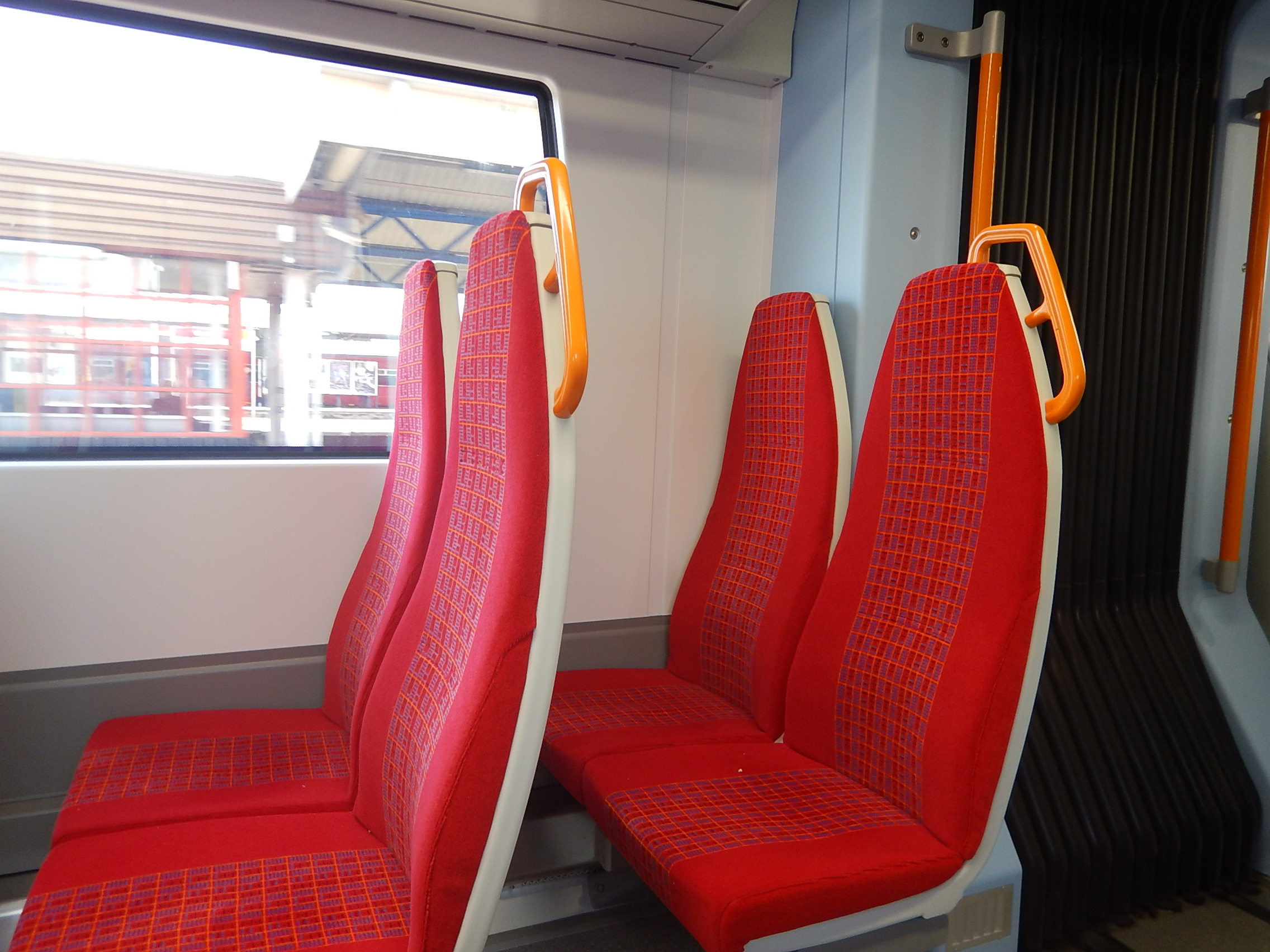
This picture shows handholds on the seats and between carriages.
I hope the Class 717 trains have 2 + 2 seating, like the Class 707 trains.
Improved Services To And From Moorgate
Current services to and from Moorgate station are as follows.
- Three tph to Welwyn Garden City
- Three tph to Hertford North, with one tph extended to Letchworth Gsrden City.
This means that there are six tph between Alexandra Palace and Moorgate stations.
From the May 2018 timetable change, the service levels will become.
- Four tph to Welwyn Garden City
- Five tph to Hertford North, with two tph extended to Stevenage or Watton-at-Stone.
- No direct services will run to Letchworth Garden City. Change seems to be a cross-platform interchange at Finsbury Park.
The service termination at Watton-at-Stone station is only temporary until Network Rail build a new bay platform at Stevenage station.
These changes mean that there will be nine tph between Alexandra Palace and Moorgate stations.
This frequency is already achieved in the Peak, from Monday to Friday. But it now appears, it will be running all day from the May 2018 timetable change.
I found this document on the Rail Delivery Group web site, which is entitled 6,400 Extra Trains A Week To Run To More Places, More Often.
It says these services will be added in 2019.
- An increase of 2 Hertford Loop trains per hour, Moorgate-Hertford
- An increase of 1 Hertford Loop train per hour, Moorgate-Stevenage
- An increase of 1 train per hour, Moorgate-Welwyn Garden City
In the May 2018 edition of Modern Railways, this is said.
New Class 717 EMUs will eplace the current Class 313s on these services from the autumn, with a further frequency boost planned in May 2019.
Adding this all together gives the following.
- Five tph to Welwyn Garden City
- Seven tph to Hertford North, with three tph extended to Stevenage.
This means that there will be twelve tph between Alexandra Palace and Moorgate stations. Or a train every five minutes.
It would appear that the overall effect of what Govia Thameslink Railway is doing is as follows.
- Restricting the running of Moorgate services on the East Coast Main Line.
- Provide a five tph Turn-Up-And-Go service from Welwyn Garden City.
- Provide a seven tph Turn-Up-And-Go service from Hertford North.
- Provide a six tph Turn-Up-And-Go Thameslink service from Stevenage.
- Provide a three tph service to Moorgate from Stevenage and Watton-at-Stone. Could it be expanded to a Turn-Up-And-Go four tph.
- Stations North of Stevenage will be served by Thameslink services to Cambridge and Peterborough.
- Thameslink services will stop at Stevenage and Finsbury Park for interchange with Moorgate services.
Will all of of this, downgrade Welwyn North station, by offering better services at Knebworth, Stevenage, Watton-at-Stone and Welwyn Garden City stations?
Consider.
- Welwyn North station handles about 600.000 passengers a year.
- Welwyn North station only has a service of two tph.
- Welwyn North station lies on the double-track section of the East Coast Main Line over the Digswell Viaduct.
- Knebworth station handles 600,000 passengers a year, but is on a four-track section of the line.
- Watton-at-Stone station, which is perhaps four kilometres to the East handles 100,000 passengers a year, but appears to be short of car parking.
I’m pretty certain, that if Welwyn North station could be closed, then the notorious bottleneck of the Digswell Viaduct could be eased.
So are Network Rail and Govia Thameslink Railway working towards a situation, where this will be able to happen.
They could do the following.
- Provide more car parking at Knebworth, Stevenage, Watton-at-Stone and Welwyn Garden City stations.
- Build a new Park-And-Ride station in South Stevenage on the Hertford Loop Line.
- Improve timings between Stevenage and Moorgate.
- Extend more Hertford North services to Stevenage. Six tph would probably be the limit for a single bay platform at Stevenage.
Shutting Welwyn North station would be controversial and heavily resisted.
How Many Trains Will Be Needed?
In May 2019, I think the service will be as follows.
- Five tph to Moorgate to Welwyn Garden City
- Four tph to Moorgate to Hertford North,
- Three tph Moorgate to Stevenage.
I’ll now look at each separately.
Moorgate To Welwyn Garden City
Trains take just under around 47-48 minutes and there are sixteen intermediate stops.
Currently, I suspect a train takes two hours to do a round trip, which would allow up to 12-13 minutes to turn round at each end.
- Three tph would need six trains.
- Four tph would need eight trains.
- Five tph would need ten trains.
But supposing the Class 717 trains, with faster running on the East Coast Main Line and faster stops could reduce this to under thirty minutes with a round trip of an hour.
- Four tph would need four trains.
- Five tph would need five trains.
Note.
- Currently, all trains are turned in Platform 4.
- Will Platform 4 be able to handle four tph after the May 2018 timetable change?
- Will Platform 4 be able to handle five tph after the May 2019 timetable change?
- There are sidings easily accessible to the North of Platform 4.
- Trains leaving Welwyn Garden City for Moorgate use a flyover to cross to the Up Slow line.
If five tph with just five trains is possible, it’s well worth achieving. But it could be a hard ask!
Moorgate To Hertford North
Trains take around 49-53 minutes and there are twelve intermediate stops.
This service would be another two hour round trip.
- Three tph would need six trains.
- Four tph would need eight trains.
- Five tph would need ten trains.
The new Class 717 trains couldn’t probably do the trip in thirty minutes, but a ninety minute round-trip would surely be possible.
- The proposed four tph would need six trains.
Note.
- Four tph is the frequency that will be running from May 2019.
- Four tph could also be easily handled in the bay platform at Hertford North station.
Any track improvement would help.
Moorgate To Stevenage
Trains take around 68-72 minutes and there are fourteen intermediate stops.
The new Class 717 trains with their faster running and faster stops, should be able to do this trip under the hour, with a possible two-hour round trip.
If this could be achieved the service would need the following trains.
- The proposed three tph would need six trains.
- Four tph would need eight trains.
Improving the Hertford Loop Line, so that the Class 717 trains could fully use their 100 mph operating speed could be key.
Summarising The Trains Needed
Summarising gives.
- Three tph between Moorgate and Stevenage would need six trains.
- Four tph between Moorgate and Hertford North would need eight trains with a two hour round trip.
- Cut that to a ninety-minute round trip and six trains could be needed.
- Five tph between Moorgate and Welwyn Garden City could possibly be run with five trains or need as many as ten.
A pessimistic answer for the number of trains could be as high as 24, which fits well with a fleet of twenty five trains.
But an optimistic solution might need.
- Six trains for Stevenage
- Six trains for Hertford North
- Five trains for Welwyn Garden City
This would leave several trains for increasing frequency.
Increasing The Service After May 2019
Improving The Hertford Loop Line
If the Class 717 trains could use their speed, this would enable faster journeys and could allow extra paths for more trains.
ERTMS On The Moorgate Lines
It is already used by Thameslink and is scheduled to be used on the East Coast Main Line.
Will it be added to the Hertford Loop Line and on the Northern City Line?
ERTMS and a degree of Automatic Train Control, could be a game changer.
Fitting the necessary equipment to the Class 717 trains, shouldn’t be the most difficult of jobs, as the system is already fitted to Thameslink’s Class 700 trains.
Increased Frequency Into Moorgate
Consider.
- Currently, in the Peak, the Class 313 trains running under control of conventional signalling manage 11 tph at times.
- From May 2019, Gover Thameslink Railway will be running 12 tph into Moorgate all day.
- Thameslink and Crossrail should be handling 24 tph, by the end of 2019.
- Brixton station on the Victoria Line handles upwards of thirty tph with two platforms.
- Transport for London and Londoners have a lot of experience about loading and unloading trains.
Look at this schematic of the vast Crossrail complex linking Liverpool Street and Moorgate stations.
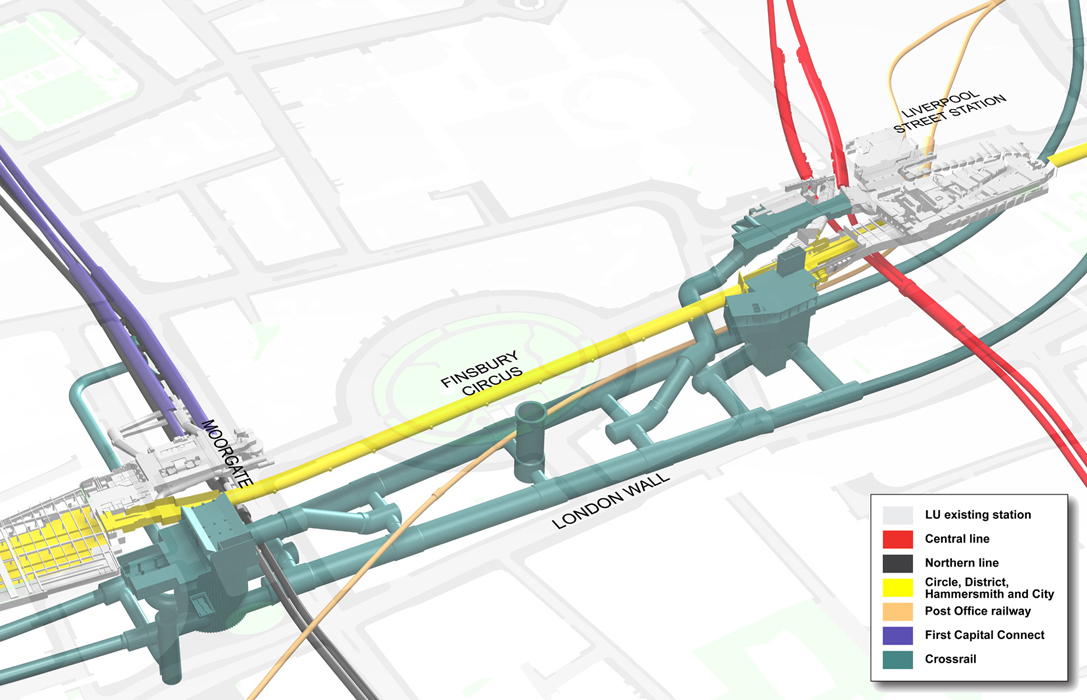
Note the Northern City Line in dark blue at the left, with a new pedestrian tunnel linking to Crossrail. This will help handle the passenger flows between Crossrail and the Northern City Line.
With ERTMS and Automatic Train Control, I wonder what, is the maximum number of trains that can be handled at Moorgate?
Twelve is obviously possible with the current infrastructure, as it is only one more than what is currently achieved in the Peak.
My experience says that with good electronic and organisational systems, that fifteen tph should be possible in both directions between Moorgate and Finsbury Park stations.
An Extra Train To Stevenage
Current plans envisage three tph between Moorgate and Stevenage.
The new bay platform at Stevenage would easily handle four tph and if the sufficient trains are available, I could see this extra service implemented.
The following frequencies would be achieved.
- Four tph – Stevenage and Watton-at-Stone.
- Eight tph – Hertford North.
The Northern City Line would obviously need to be able to handle the extra train.
Gordon Hill Station As An Extra Terminus
Gordon Hill station is sometimes used as an extra terminus to turn trains from Moorgate in the Peak.
I can see this continuing, as surely it increases the capacity at the Moorgate end of the line.
Conclusion
It will be interesting to swee how this line develops in the future.
Oxford’s Nimbys Are Getting Angry!
I keep finding articles on the web, like this article on the Oxford Times, which is entitled First Person: The Campaign To Keep Oxfordshire As It Is Now.
The title says it all.
It is all about opposition to the Oxford to Cambridge Expressway, which everybody wants in someone else’s back-yard.
My feelings are as follows.
- A fully-electrified freight route should be built between Southampton and the West Coast Main Line, preferably with 25 KVAC overhead wiring.
- The East West Railway should provide at least two fast trains per hour between Heathrow and Cambridge, via Reading, Oxford, Milton Keynes and Bedford.
- I would accelerate the construction of the East West Railway.
Only as a last project, would I build the Oxford to Cambridge Expressway.
L&G To Build 3,000 Affordable Homes By 2022
The title of this post, is the same as that of this article on Construction News.
This is said.
Legal & General is to start building affordable homes with the aim of delivering 3,000 a year by 2022.
The firm said it will target affordable housing due to underinvestment in the sector.
L&G is aiming to become the “leading affordable housing provider in the UK” by drawing on its £15bn investment programme, according to chief executive Nigel Wilson.
It looks like the story could be better than the headline.
Re-Use Rather Than Re-Cycle
I remember in the 1970s or 1980s hearing the Research Director of Pilkington on Radio 4, giving a defence of using glass as packaging.
He argued that one of the problems with glass coffee jars and sauce bottles was that after use and a quick wash, they looked like they could be refilled with new product. In those days, coffee jars were often used for the storage of small items like screws, clips and dry foods like rice and pasta.
Now we’ll buy a designer jars, like these from IKEA.
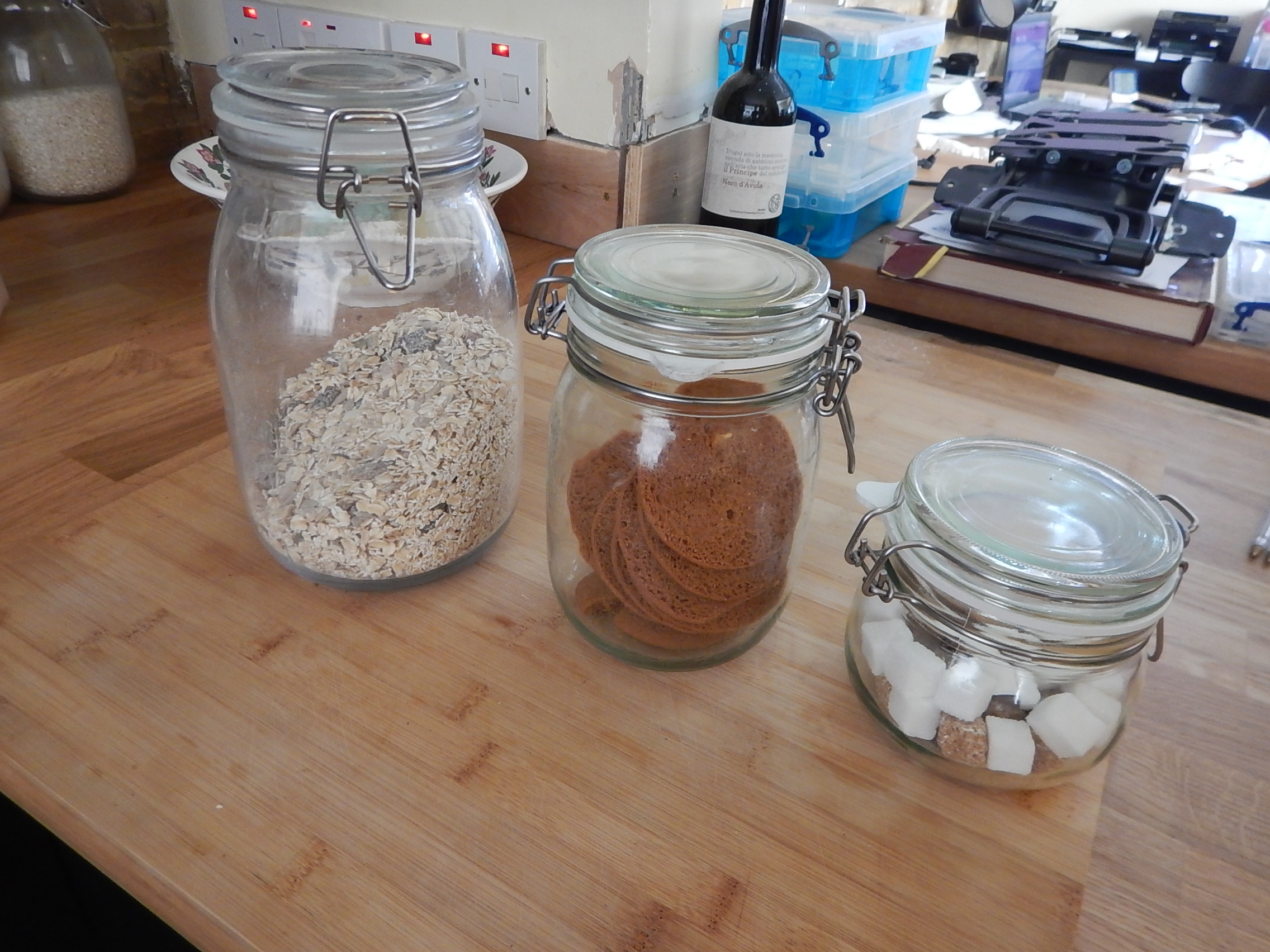
In those days a lot of milk and beer bottles were returned to the dairy or brewery, but are we going to send empty beer bottles back to some of the exotic places from where they came.
The Research Director argued, that the best thing to do with glass bottles was to smash them up and re-use for other purposes.
One of the uses he discussed was to use broken glass as an aggregate substitute in road construction. This does happen and I’ve read of by-passes being constructed on a bed of broken glass and seen broken glass being used under paving slabs.
Glass came from materials dug out of the ground and it’s going back under.
He also said that to create new bottles was cheaper, than reusing bottles, unless there was a direct link, like milk rounds from a dairy.
This morning on wake Wake Up To Money, they were discussing cutting the use of plastics. So I sent in the following text.
I wonder if black-plastic ready-meal trays could be replaced with a light-weight glass variant. Along with bottles, they would just be washed and crushed after use for aggregate. Several roads have been built on broken bottles.
It was read out.
Consider.
- We drink a lot of beer that comes in glass bottles. One of my beer bottles from Marks and Spencer weughs 280 grams.
- They would be oven-proof, microwave-safe and freezable.
- You could eat your meal out of the dish!
- They might save on washing-up time.
- They could go in the dry-recycling after a quick rinse.
But above all, they may have other uses.
I also suspect that the other pakaging could be similar.

Could a piece of plastic be glued to the tray in the same way?
My idea is probably total rubbish!
But some of Marks and Spencer’s pies already come in just an aluminium tray and a cardboard box.
They need to be cooked in an oven and are not microwavable.
The pie goes down the gullet and the aluminium tray and the cardboard box, go into the dry recycling.
One thing I will be right about, is to say that there are some clever packaging scientists and designers out there, trying to create a freezable ready-meal, that can be cooked in a microwave, that isn’t protected in anything that can’t go direct in the dry recycling.
 The Anonymous Widower