The Crystal Palace Bus Charger – 19th September 2023
I went to see the new charger at Crystal Palace for the new Irizar ie trams that will be introduced on route 358.
I took these pictures.

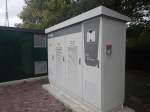




Note.
- It is not finished yet or someone has nicked the pantograph.
- Irizar seem to make their own chargers.
- It looks a well-designed installation.
This Spanish video shows the bus inside and outside.
I have a few thoughts.
The Specification Of The Bus
This document on the Irizar web site is the specification of the ie trams, that London are buying.
Passenger Capacity
According to the specification, these twelve metre long buses have a capacity of 97-99 passengers, with 21-28 seated, depending on layout.
Is that a bit tight? Especially, if people are carrying large cases.
Climbing Anerley Hill
I wonder how these buses will manage to climb Anerley Hill.
- This page on a cycling blog, rates the hill as the fourth stiffest in London.
- A typical Wrightbus or AlexanderDennis single-decker diesel bus has a kerb weight of 13-14 tonnes.
- The ie tram gives maximum front and rear axle loadings which total 21.2 tonnes. But that includes the passengers, which at 60 Kg each account for a lot of the difference in weight with the diesel buses.
- Anerley Hill has a rise of upwards of 30 metres.
Using Omni’s Potential Energy Calculator gives a figure of less than 2 KWh of energy needed to get up the hill.
That should be possible!
News Of The Bus
But there has been very little news on the Internet of these buses and their chargers, with the last story dated a year ago. Given Sadiq Khan’s love of publicity, does that mean anything?
Conclusion
It seems that Irizar have pulled out all the stops in the design of this bus.
Do Thunderstorms Cause Strokes?
On Saturday evening, we had a severe thunderstorm in North London.
All day long, I’d been drinking heavily, but as it was only tea and low-alcohol Adnams Ghost Ship 0.5 %, the worst that could happen is an accident on an extra visit to the toilet.
I came to the conclusion though, that most of the fluids was leaving my body through my skin.
Does this lower my INR? I do know that in hot and humid weather, I have difficulty raising it. In the last week or so, it has been hovering around 2.2, but yesterday, it was a very safe 2.7.
But as I test regularly, this may well help to protect me from another stroke.
Typing “Thunderstorms and Strokes” into Google, I found this paper on the National Library of Medicine, which is entitled Relationship Between Weather Conditions And Admissions For Ischemic Stroke And Subarachnoid Hemorrhage.
It is an interesting read.
This was the aim of the study.
To assess impacts of different weather conditions on hospitalizations of patients with ischemic strokes and subarachnoid hemorrhages (SAH) in South Florida.
And this was the conclusion.
Higher number of ischemic stroke and SAH cases can be expected with the daily lowest and highest air pressure, highest air temperature. Presence of hurricanes or tropical storms increased the risk of ischemic stroke but not the SAH. These findings can help to develop preventive health plans for cerebrovascular diseases.
From my own observations on INR for nearly ten years, I certainly believe that INR moves up and down with the weather because of the laws of physics.
Next time a severe thunderstorm is forecast, I will track my INR throughout the day.
Is Sizewell C Needed?
I am generally pro-nuclear, but I am not sure if building a large nuke at Sizewell is the right action.
Consider.
- East Anglia has 3114 MW of offshore wind in operation.
- East Anglia has 6772 MW of offshore wind under construction, with Contracts for Difference or proposed.
- Vattenfall are considering abandoning development of their large wind farms off the Norfolk coast, which are proposed to have a capacity of 3196 MW.
- If the two Vattenfall wind farms don’t get built, it is likely that East Anglia will have around 6700 MW of offshore wind capacity.
- Sizewell C has a proposed nameplate capacity of 3260 MW. Some might argue, that to back up East Anglia’s offshore wind power, it needs to be larger!
- Norfolk and Suffolk no large electricity users, so are Vattenfall finding they have a product no one wants to buy.
- National Grid is developing four interconnectors to bring power from Scotland to the Eastern side of England, which will back up wind power in the East with the massive Scottish pumped storage, that is being developed.
- National Grid and their Dutch equivalent; TenneT are developing LionLink to connect the UK and the Netherlands to clusters of wind farms between our countries in the North Sea.
- Kent and East Anglia have several gas and electric interconnectors to Europe.
- Sizewell is well-connected to England’s grid.
These are my thoughts.
Energy Storage At Sizewell
Consider.
- Sizewell is well connected to the grid.
- It has the sea on one side.
- It could easily be connected to the large offshore wind farms, thirty miles out to sea.
If large energy storage could be built on the Sizewell site or perhaps under the sea, then this energy could be recovered and used in times of low wind.
Perhaps the technology of the STORE Consortium, which I discussed in UK Cleantech Consortium Awarded Funding For Energy Storage Technology Integrated With Floating Wind, could be used.
In this system, energy is stored in 3D-printed concrete hemispheres under the sea.
A Small Nuclear Reactor Cluster At Sizewell
Rolls-Royce are proposing that their small modular reactors will have a capacity of 470 MW.
Perhaps a cluster of seven small modular reactors at Sizewell, with a building schedule matched to the need to back up wind farms would be better and easier to finance.
I also feel a cluster of SMRs would have less risk and would be less likely to be delayed.
Where Is Generating Capacity Needed In The UK?
These areas already have large amounts of offshore wind in operation or proposed to be built before 2030.
- Celtic Sea
- North Wales
- Liverpool Bay
- Cumbria
- Scotland
- Scotland’s Offshore Islands
- North East England
- Humberside
- Lincolnshire
- East Anglia
- Thames Estuary
- Kent
- Sussex
Amongst the back up for these wind farms, there are only two modern nuclear stations; Sizewell B and the still-to-open Hinckley Point C.
If you look at a map of England and its power generation, there is a tremendous gap of capacity South of a line between Hinckley Point and Brighton, with little or no offshore wind and no nuclear.
There is probably a need for a large nuke near Weymouth.
Alternatively, perhaps several SMRs could be built underneath places like Salisbury Plain, Dartmoor and Exmoor!
Conclusion
We probably need the nuclear electricity from another Hinckley Point C-sized nuclear power station, so that we have adequate back-up for offshore wind.
But I am not sure that Sizewell is the right place to build it.
 The Anonymous Widower