Consultation On Plans For Keadby Hydrogen Power Station To Begin
The title of this post, is the same as that of this press release from SSE.
These four paragraphs outline the project
SSE and Equinor will consult on plans for a new hydrogen-fired power station in North Lincolnshire which would provide vital new reliable and flexible capacity to the electricity system.
Keadby Hydrogen Power Station is a proposed 900MW plant which could be operational from 2030 – bolstering security of supply and supporting the UK’s long-term decarbonisation by providing back-up low-carbon power to variable renewable generation.
The project will enter environmental scoping in April before SSE and Equinor launch a public consultation ahead of a full planning application being made in due course.
Under plans, the new power station will be designed to run on 100% hydrogen. The ambition is that this would be the case from inception, with Government already committed to deploying low-carbon infrastructure in the Humber – the UK’s most carbon intensive cluster.
Note.
- The hydrogen for this power station will be produced by electrolysis or one of the new turquoise methods.
- It will be stored in Aldborough or Rough gas storage.
- This will be the fourth power station at Keadby after Keadby 1 (734 MW), Keadby 2 (893 MW) and Keadby 3 (910 MW)
- Keadby 3 will be fitted with carbon capture.
- These total up to 3.4 GW.
The Keadby cluster of power stations will make good backup to the wind farms in the North Sea.
UK Has Almost 7GW Of Shovel-Ready Pumped Hydro, Says IHA
The title of this post, is the same as that of this article on Solar Power Portal.
This paragraph fills out the headline.
Former Australian Prime Minister and current president of the International Hydropower Association (IHA) Malcolm Turnbull has penned an open letter to Rishi Sunak stating that the UK has “almost 7GW of shovel-ready pumped storage hydropower projects with over 135GWh storage capacity”.
Note.
- At 7 GW, it would take 19.2 hours to run out of water.
- Currently, we have about 3GW/24GWh of pumped storage hydro.
- At the end of 2022, we had just 2.4GW/2.6GWh of connected battery storage sites.
It looks like we should start digging.
Is Alstom’s Proposal For A Service Between London Euston And Wrexham Part Of A Cunning Plan?
Alstom have built and introduced into service between Buxtehude and Cuxhaven in Germany, the Coradia iLint hydrogen-powered train. The prototype has performed demonstrations in Austria, Canada, The Netherlands and Saudi Arabia.
This picture shows a Coradia iLint in Germany.

In the UK, Alstom had a plan to convert redundant Class 321 trains into a fleet of hydrogen-powered trains called Breeze, which I wrote about in Hydrogen Trains Ready To Steam Ahead, in January 2019.
This visualisation is from Alstom.
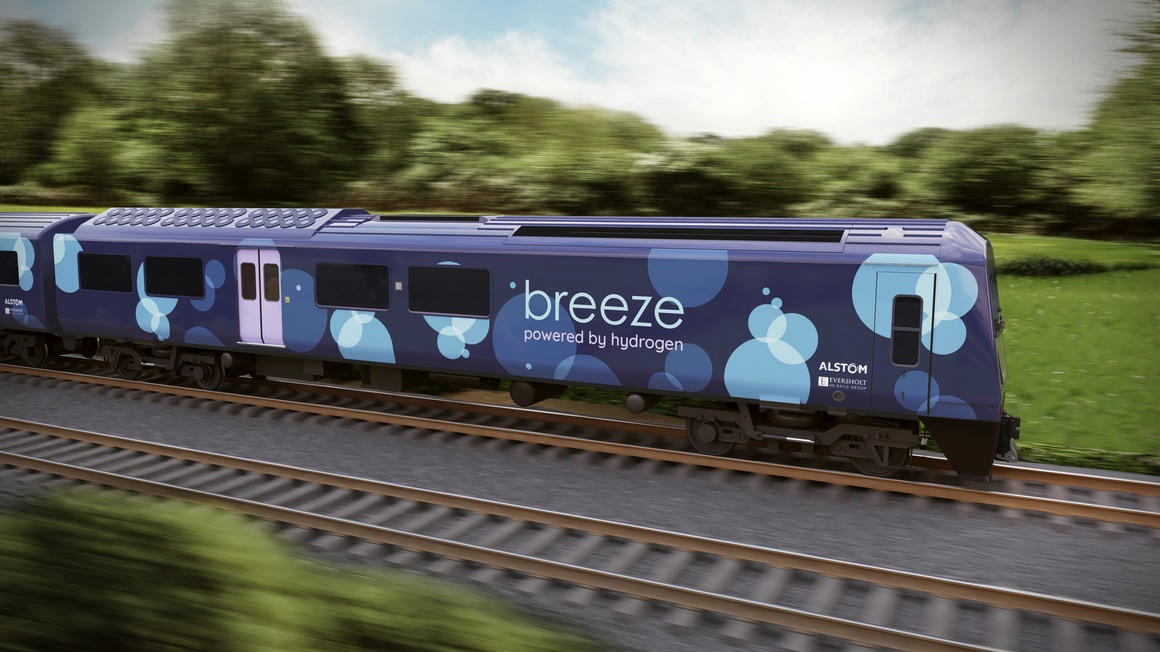
I suspect it didn’t appeal to train companies, as no orders appear to have been received.
But you can’t criticise Alstom for not trying, as in November 2021, they signed an agreement with Eversholt Rail Group to develop a hydrogen-powered Aventra, which I wrote about in Alstom And Eversholt Rail Sign An Agreement For The UK’s First Ever Brand-New Hydrogen Train Fleet.
This visualisation is from Alstom.
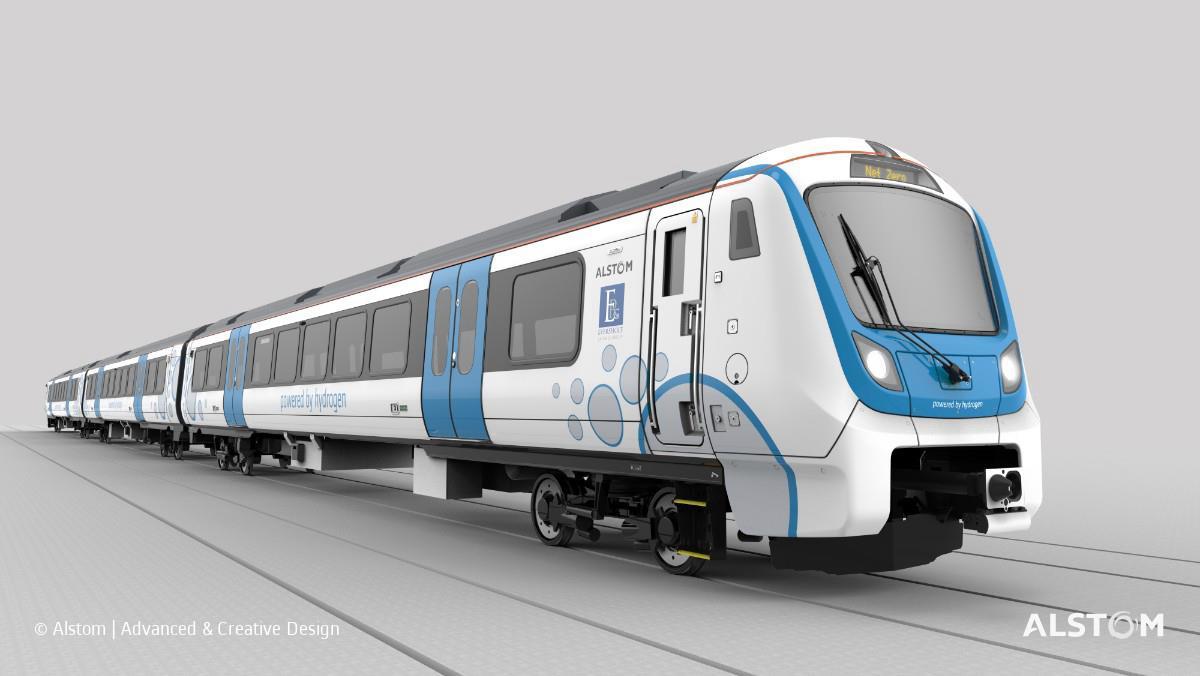
Visually, it looks just like any other Aventra and much better than the previous Breeze design.
In March 2018, I wrote Bombardier Bi-Mode Aventra To Feature Battery Power, which was based on this article in Rail Magazine.
These are a few points from the article.
- Development has already started.
- Battery power could be used for Last-Mile applications.
- The bi-mode would have a maximum speed of 125 mph under both electric and diesel power.
- The trains will be built at Derby.
- Bombardier’s spokesman said that the ambience will be better, than other bi-modes.
- Export of trains is a possibility.
- Bombardier’s spokesman also said, that they have offered the train to three new franchises. East Midlands, West Coast Partnership and CrossCountry.
Have Alstom looked at what they bought from Bombardier and decided the following train is possible, if they add some of their technology?
- A train the size needed by the customer, up to a length of at least ten cars.
- 125 mph under 25 KVAC overhead electrification.
- 100 mph with 750 VDC third rail electrification.
- Running on hydrogen away from electrification.
- 100 mph maximum speed running on hydrogen.
- A range of perhaps 500 miles, if it can emulate the hydrogen-powered Coradia iLint.
A train with this specification would have several applications in the UK.
- Fully-electric routes.
- Electric routes with perhaps a hundred miles of unelectrified track.
- Scenic routes, where the Nimbies wouldn’t like electrification.
These points should also be born in mind.
- There are now 110 mph Aventras in service with West Midland Trains on the West Coast Main Line.
- I recently came back from Cardiff to London in a twelve-car Class 387 train and there wasn’t too many unhappy passengers. It was certainly better than a rail replacement bus. I wrote about the trip in Cardiff To Reading In A Class 387 Train.
- Alstom believe you can certainly fit their hydrogen gubbins in an Aventra.
- The hydrogen gubbins appear to be from Cummins, who have a worldwide support network.
- Cummins can also supply complete hydrogen support systems. A truck can refuel the train, at one end of the route?
- Alstom have been doing the market research with the hydrogen-powered Coradia iLint, so I suppose they know what the market needs.
Could Alstom, with help from Cummins, have a zero-carbon 200 kph train and support systems, which has a hydrogen range of up to a thousand kms for export markets like the United States, Africa, Australia, India and South America?
Two big world-leading companies are surely better than one!
But Alstom has one big problem!
How do you fully test a 125 mph hydrogen-powered train?
- I know with aircraft, if you change the engine type on an existing aircraft, you only have to certify the engine and this is done on a Supplementary Type Certificate.
- Is it the same with trains, so a 110 mph Class 730 train, which is in service with West Midlands Trains, could be the basis of certifying a hydrogen-powered Aventra?
- The Coradia iLint was only a change from diesel to a hybrid hydrogen-electric engine, so was it certified this way?
- With the Coradia iLint, it seemed to go into service quite quickly, so did it do much of the testing in service?
I looks to me, that London Euston and Wrexham is an ideal route for a hydrogen bi-mode 125 mph train.
- The route has electrified sections, some of which have high operating speeds.
- The route has a convenient hydrogen supply from INEOS at Runcorn at the Northern end.
- Change between hydrogen and electric power would always take place in a station.
- A round trip needs less than 200 miles of running on hydrogen.
- South of Nuneaton, no hydrogen is used, so the train will be like a Class 730 train, that already uses the route.
- There are depots that can service Aventras on the route.
It is certainly a possibility, that the London Euston and Wrexham service will be used to test and showcase Alstom’s new Hydrogen Aventra.
 The Anonymous Widower