Could Anglia Railways’ London Crosslink Be Recreated As Part Of The London Overground?
This is the first paragraph of the Wikipedia entry for the original London Crosslink.
London Crosslink was a passenger train service operated by Anglia Railways between Norwich and Basingstoke, using the North London Line to bypass central London. Class 170 Turbostar diesel multiple units were used, and the service operated between 22 May 2000 and 28 September 2002, supported by funding from the Strategic Rail Authority through its Rail Passenger Partnership fund.
Note.
- The service called at Diss, Stowmarket, Ipswich, Colchester, Whitham, Chelmsford, Ingatestone, Romford, Stratford, Highbury & Islington, Camden Road, Willesden Junction, West Hampstead Thameslink, Brentford, Feltham, Staines, Woking, and Farnborough (Main)
- It ran six times on Monday to Friday and five times on Sunday.
- Feltham and Woking stations have a coach link to Heathrow.
- Journeys took around 3 hours and 44 minutes.
Over the years, attractions and other rail lines and stations served by the route have changed. improved and been added.
- In 2006, the Arsenal’s Emirates Stadium opened within walking distance of Highbury & Islington station.
- In 2012, the Olympic Stadium opened at Stratford and is now used by West Ham United.
- In 2020, Brentford Stadium opened within walking distance of Brentford station.
- There are long-term plans for a station at Brentford stadium.
- In 2022, Romford and Stratford stations were connected to the Elizabeth Line.
- In 2025, Beaulieu Park station was added to the Greater Anglia Main Line.
- In 2026, both ends of the route came under the control of Great British Railways.
At some point in the future, Old Oak Common Lane station will open to link the route to High Speed Two, the Great Western Main Line and the Elizabeth Line.
In Can The Signalling Of The London Overground Be Improved?, I looked in detail at the signalling of the London Overground and if it could handle more trains.
My conclusion was that on the East and North London Lines, another three trains per hour (tph) could probably be accommodated, which over an average day was probably around sixty trains.
As a restored London Crosslink would need just six paths per day, I would suspect the service could be restored, if it were thought to be a good idea.
I certainly feel that capacity would not be a problem.
These are a few other thoughts.
Will There Be Political Problems?
Providing the London Mayor approves, I can’s see any problem with Labour and I can’t see other parties objecting if passengers like it.
Would It Be Sensible To Use Lumo Branding And Trains?
Consider.
- Lumo is trusted branding.
- A five-car Lumo Class 803 train is 132 metres long and a pair of four-car London Overground Class 710 trains is 166 metres long, so I suspect platform length problems will be minimal.
- I doubt there will be problems on the Greater Anglia network.
- Stratford and Norwich is mainly a 100 mph network.
- Not all parts of the route have 25 KVAC overhead electrification, but batteries can be fitted to the Class 803 trains, that will cover any gaps.
- My calculations show that the modern trains will be twenty-two minutes quicker, than Anglia Railways Class 170 diesel trains.
- At one point Anglia Railways was owned by First Group, so FirstGroup may have knowledge of the problems of the route.
I believe it would be sensible to use Lumo branding and trains.
Could The Route Be Extended?
Consider.
- It could probably be extended to Winchester, Southampton and Bournemouth in the South.
- If offshore hydrogen takes off at Great Yarmouth, it might be worth extending with a reverse to Yarmouth in the North.
- Yarmouth has had a direct service from London in the past.
The service could also develop days out by the sea.
The Liquid Air Alternative To Fossil Fuels
The title of this post, is the same as that of this article on the BBC.
This is the sub-heading.
An overlooked technology for nearly 50 years, the first liquid air energy storage facility is finally set to power up in 2026. It’s hoping to compete with grid-scale lithium batteries and hydro to store clean power, and reduce the need to fall back on fossil fuels.
These three introductory paragraphs add more details.
s the world’s use of renewable electricity soars, surpassing coal for the first time, the need to store that energy when the Sun isn’t shining and the wind isn’t blowing is growing in step. While some turn to grid-scale lithium batteries and others to pumped hydro, a small but growing industry is convinced there’s a better solution still: batteries that rely on air.
Near the village of Carrington in north-west England, the foundations are being laid for the world’s first commercial-scale liquid air energy storage facility. The site will eventually become an array of industrial machinery and a number of large storage tanks, filled with air that has been compressed and cooled so much it has become a liquid, using renewable energy surplus to demand. The stored energy can be discharged later when demand exceeds supply.
If the project succeeds, more will follow. The site’s developers Highview Power are confident that liquid air energy storage will make it easier for countries to replace fossil fuels with clean renewable energy – though at present, the technology is expensive. But as the need for clean energy storage surges, they’re betting the balance will tip in favour of liquid air.
Where this article about Highview Power is different, as it gives various details on the efficiency, return and of liquid air energy storage systems.
How Will The New London Number 10 Bus Turn Round At Mildmay Park?
The new London Bus 10 is going to terminate near my house at probably the four-way junction of the Balls Pond Road/Mildmay Park/Southgate Road.
This Google Map shows the area.
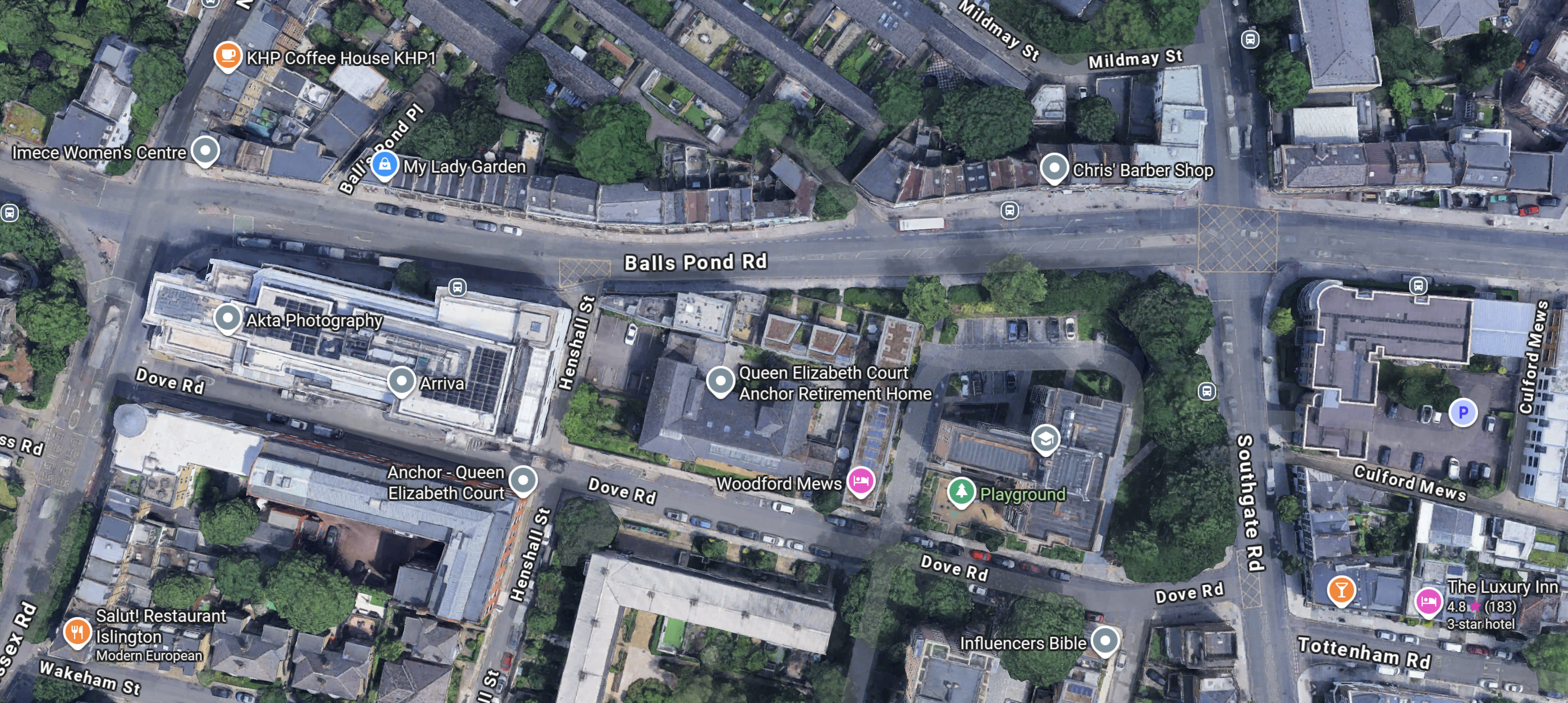
Note.
- The road about a third of the way down the map, that goes across the map is the Balls Pond Road of 1950s and 1960s fame on the BBC radio shows Beyond our Ken and Round the Horn.
- If you like your comedy with lashings of double entendres, then check out the shows. They have Wikipedia entries.
- At the West end oof the map, is the Essex Road, which takes buses to and from the Angel and Central London.
- Southgate Road and Mildmay Park form a North-South route towards the East of the map.
- Southgate Road leads South to Old Street and the City of London.
- Mildmay Park leads North to Newington Green, Clissold Park and Manor House.
Sometimes, buses from Central London turn-back in this area, by taking this route.
- The bus comes North up the Essex Road and turns right into the Balls Pond Road.
- It stops in the Balls Pond Road and drops off any remaining passengers.
- At the set of traffic lights, the bus will turn into Southgate Road.
- The bus, then turns into Dove Road and proceeds to its Western end.
- The bus company has an office in the block at the end, so drivers can also take a comfort break before returning to Central London.
I have seen buses taking this route several times in the last month, so it could be likely that it will be used in future to turn the buses.
Will New Routemasters Continue To Be Used?
At least initially, I suspect, but London will replace them with zero-carbon buses. Hopefully, they won’t be the inadequate BYD electric-buses on route 141?
How Will Buses Be Recharged?
At some point, the buses will probably be charged in this area.
There doesn’t seem to be a suitable place, so will the buses be charged at the other end of the route, which is Battersea Bridge.
Perhaps, the solution is to convert the Routemasters to zero-carbon?
CIP’s UK Offshore Wind Project Granted Development Consent
The title of this post, is the same as that of this article on offshoreWIND.biz.
This is the sub-heading.
The UK Secretary of State for Energy Security and Net Zero has approved the Development Consent Order (DCO) for the Morecambe offshore wind farm in the Irish Sea, owned by Copenhagen Infrastructure Partners (CIP).
The article also shows this map from Copenhagen Infrastructure Partners.
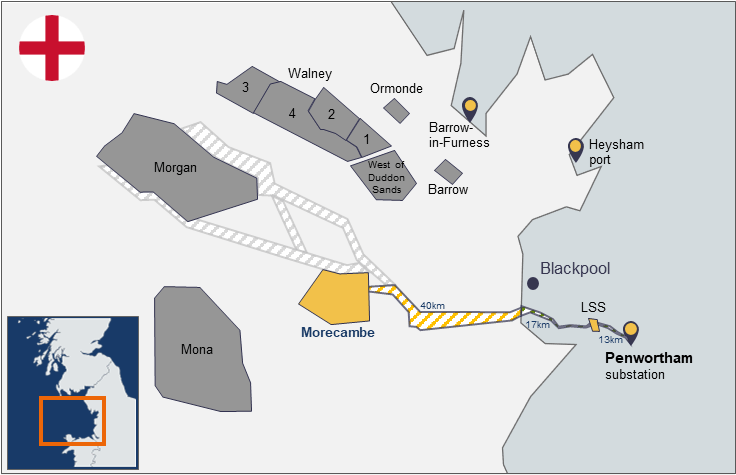
Note.
- The 480 MW Morecambe wind farm is shown in yellow.
- The 1.5 GW Morgan wind farm received its DCO in August 2025.
- The 1.5 GW Mona wind farm received its DCO in July 2025.
- Both Morgan and Mona wind farms are being developed by a consortium of EnBW and JERA Nex bp.
- Morgan and Morecambe wind farms will connect to the grid at Penwortham substation.
- Mona wind farm will connect to the grid at Bodelwyddan National Grid substation in Denbighshire, North Wales.
- Morgan and Morecambe wind farms appear to be being developed jointly.
I must admit, I’m a bit surprised that Mona doesn’t connect to Penwortham substation.
Major Revamp Of Wales’ Busiest Station Gets Go-Ahead
The title of this post, is the same as that of this article on the BBC.
This is the sub-heading.
Plans for a major revamp of Wales’ busiest railway station have received final approval.
These three paragraphs add more details.
The £140m upgrades to Cardiff Central – including a new brick arch rear entrance, larger concourse and improved waiting areas – aim to support passenger growth and reduce overcrowding.
Better accessibility for people with reduced mobility and additional retail and cycle facilities are also among the changes.
Work is due to start in the middle of next year with the aim of completing most of it within three years.
Note.
- The new entrance on the south side of the station, was opened in September 2015.
- A new Platform 8 was added in 2017, which allows sixteen local trains per hour to run between Cardiff Central and Cardiff Queen Street stations, to serve the twenty railway stations in the city.
- All platforms are bi-directional, which surely improves the flexibility of the rail network in Cardiff City centre.
- Access from the station to the Principality Stadium has improved greatly in recent years.
- The station will remain open during the works.
Cardiff’s railways are a comprehensive mix of local and inter-city trains.
I have some thoughts on Cardiff Station.
The Cardiff & Valleys Day Ranger
This very useful ticket, is the ideal way to explore the Cardiff and Valleys area and I’ve used it several times.
- I usually buy it from one of the two ticket offices in Cardiff Central station, but in one case, I did buy it in Paddington to save time.
- According to Transport for Wales, you can buy it on a local train from the conductor.
- It costs about £16 for an adult, but railcard apply.
I actually find taking a train up the valleys, is a good way to clean out my lungs.
Sights To See On The Cardiff & Valleys Lines
Google AI makes these suggestions.
The Cardiff & Valleys Lines offer historic castles (Cardiff, Caerphilly, Castell Coch), world-class museums (St Fagans, National Museum Cardiff, Big Pit), industrial heritage (Rhondda Heritage Park, Royal Mint Experience), and stunning nature in Bannau Brycheiniog National Park, with scenic railway journeys connecting these sites for history, culture, and outdoor adventure.
Hopefully, when the new Stadler trains and tram-trains are fully operational on the Cardiff & Valleys Lines, someone will write a full guide.
French Companies Unite On Superconducting Cable Project For Distant Offshore Wind Farms
The title of this post, is the same as that of this article on offshoreWIND.biz.
This is the sub-heading.
Air Liquide, CentraleSupélec, ITP Interpipe, Nexans, and RTE have joined forces to develop a project that connects distant offshore wind farms to shore via a High Voltage Alternating Current (HVAC) superconducting transmission system.
This introductory paragraph adds some detail.
The SupraMarine demonstrator project will study the electrical connection between offshore wind farms and the coastline using High-Temperature Superconducting (HTS) cables. Cooled by liquid nitrogen, the cables are said to transport electricity with near-zero energy loss.
Note.
- No details of the target distances are indicated.
- There is a detailed exploratory diagram.
It is certainly an ambitious project, but I feel it could have substantial uses.
I have a few thoughts and questions.
Can Sodium Metal Be Used For High Voltage Electrical Underground Cables?
Google AI answers this question as follows.
Yes, sodium metal was investigated and used in trial runs for high-voltage underground electrical cables in the late 1960s and early 1970s, as a potentially cheaper and more flexible alternative to copper and aluminum. However, it is not in common use today due to safety concerns and unfavorable lifecycle economics compared to aluminum.
When I was at ICI around 1970, they were researching the use of sodium for high voltage power cables.
- ICI had access to large amount of sodium chloride in Cheshire.
- The sodium metal can be obtained by electrolysis.
- Renewable electricity for electrolysis will be plentiful.
- Someone told me that their prototype cable was a polythene pipe with Sodium metal in the middle.
- I’ve read somewhere that sodium cables have interesting safe overload properties.
- I can understand the safety concerns and unfavorable lifecycle economics, especially where water is concerned.
Perhaps, French technology has improved in the sixty years?
Will Sodium Metal Be Used In The French Superconducting Cable?
Nothing has been disclosed!
But the office chat at ICI from those, who knew their sodium and their polythene, as they’d been working at ICI Mond Division for decades, was of the opinion that sodium/polythene cables were possible!
From The Diagram, It Looks Like Power Is Needed At Both Ends Of The Superconducting Cable
The diagram shows wind turbines at one end and the grid at the other end of the cable.
So will a battery or some other form of stabilisation be needed for when the wind isn’t blowing?
Will The French Superconducting Cable Have A High Capacity?
The basic capacity of a cable depends on three properties.
- The resistance of the cable.
- The cross-section area of the cable.
- The design of the cable must also be able too conduct away the heat generated by electricity flowing through.
Will The Technology Work For Interconnectors?
I don’t see why not!
 The Anonymous Widower