Spain v France – I’m Looking Forward To The Match, But Not The Inane Adverts!
I have just watched the most inane, irrelevant and time-wasting adverts on ITV before the 2026 World Cup semi-final between France and Spain.
They’ve even started up again.
I want to watch football not adverts.
- I do hope some clever geek is devising a TV, that automatically cuts out adverts, using Artificial Intelligence!
- I would even pay extra to watch an advert-free feed.
If the second option made more money for FIFA, we might see that.
UAE Building New Port To Bypass The Strait Of Hormuz
The title of this post, is the same as that of this article on The Times.
This is the sub-heading.
New facility on the Emirates’ east coast is past the tip of the strait but would still be vulnerable to Iranian drone and missile attacks.
These three paragraphs add more details.
The United Arab Emirates is building another port in an attempt to bypass the Strait of Hormuz, having already expedited the construction of a new oil pipeline.
The new port would join an existing facility in Fujairah along the country’s eastern coastline and past the tip of the strait that Iran closed to shipping during the war with the United States.
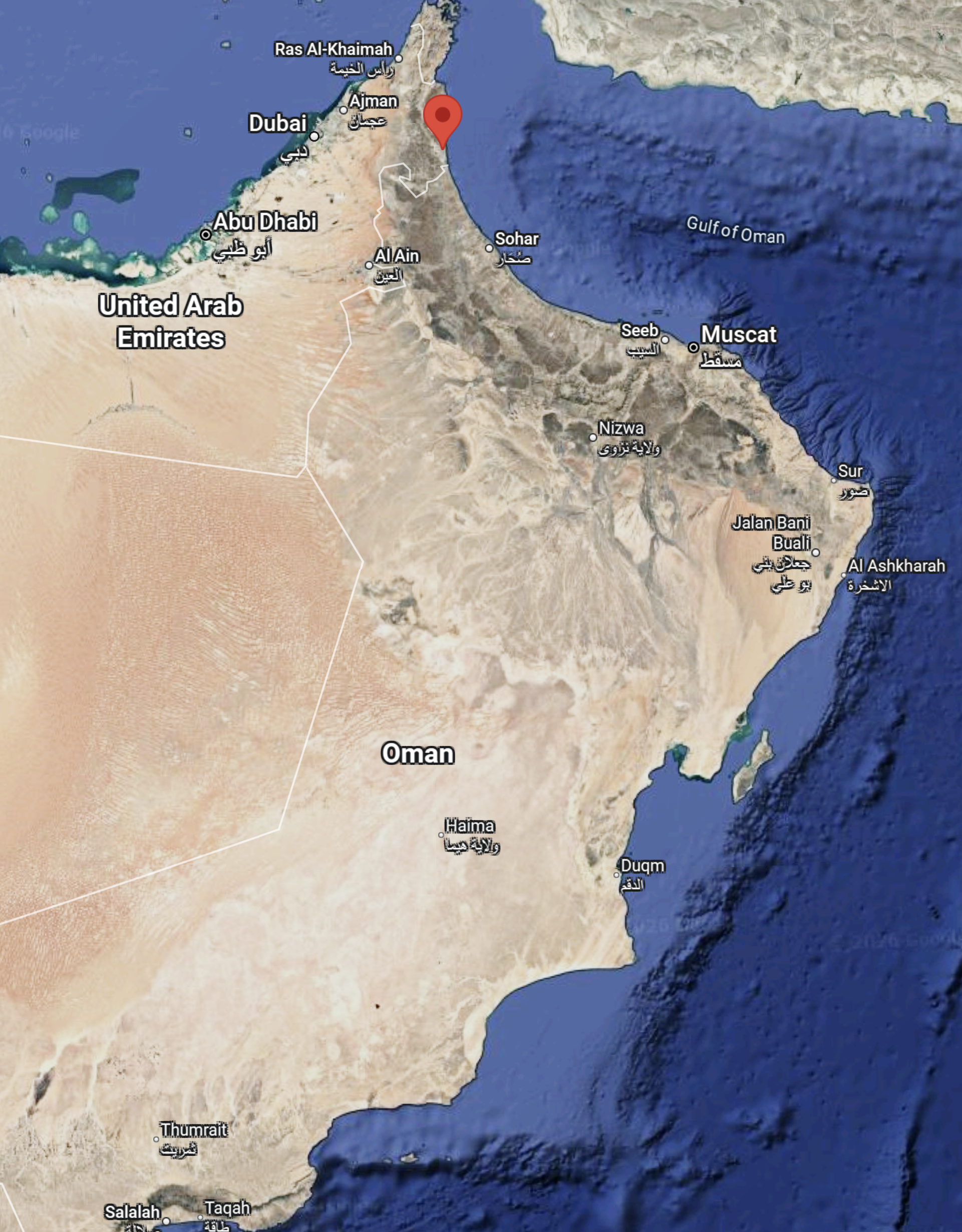
This Google Map shows the Eastern side of the Arabian Peninsular.
Note.
Fujairah is indicated by the red arrow.
Iran is the land mass in the North-East corner of the map.
The Strait of Hormuz is between the Arabian Peninsular and Iran.
As you come South from Fujairah, you pass through Muscat and then Iran.
Oman has two deep water ports at Duqm and Salalah.
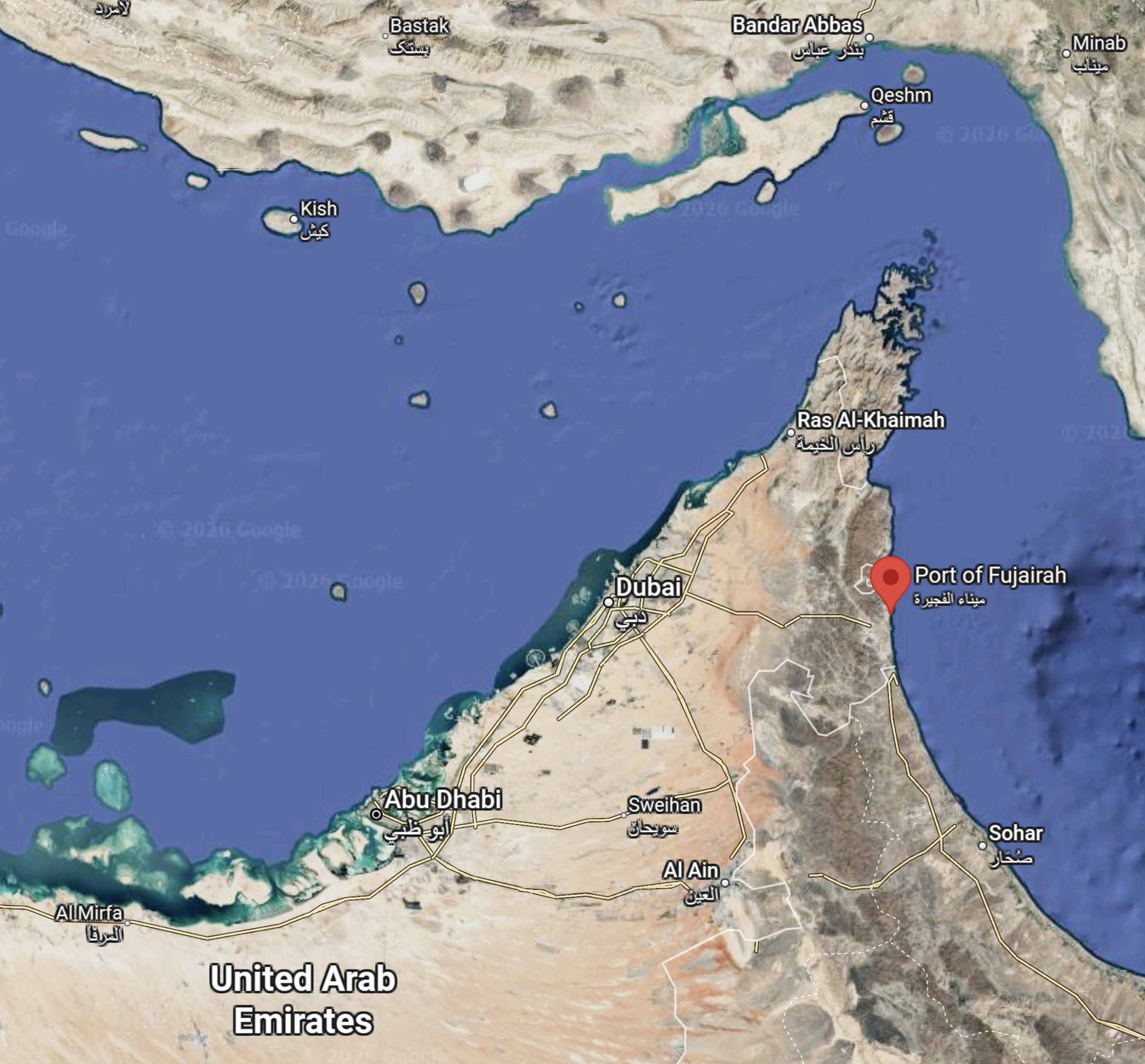
This second Google Map shows the Port of Fujairah and the Strait of Hormuz.
Note.
- The Port Of Fujairah is indicated by the red arrow.
- Dubai and Abu Dhabi are indicated on the map.
- The Strait of Hormuz is between the United Arab Emirates and Iran.
- There is a passenger train between Fujairah and Abu Dhabi that opened recently and takes an hour and 45 minutes.
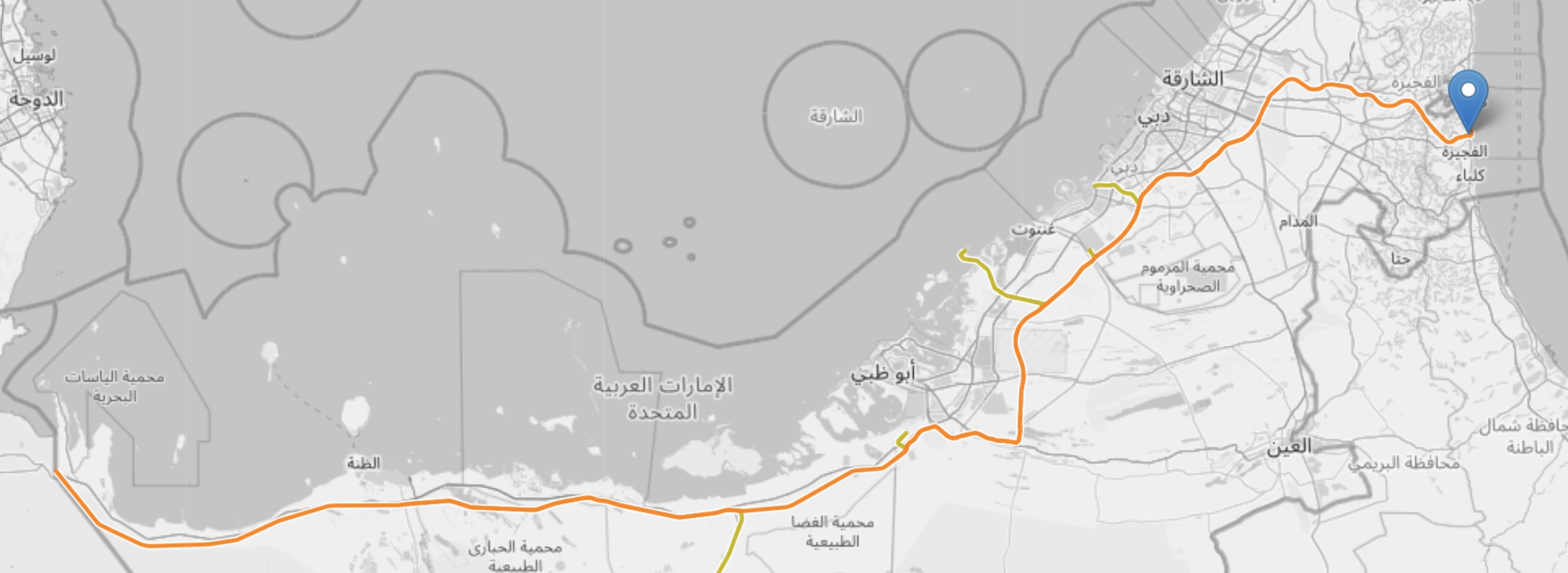
This OpenRailwayMap shows the route of Etihad Rail.
Note.
- The Port Of Fujairah is indicated by the blue arrow.
- Dubai and Abu Dhabi are on the Western coast.
- Etihad Rail has a Wikipedia entry.
- Etihad Rail has a web site.
- It is both a passenger and freight railway.
- It is 559 miles long.
It is planned to be extended to Saudi Arabia.
I can see Etihad Rail being very successful.
Could Duqm And/Or Salalah In Oman Be Developed As Oil And Gas Ports To Bypass Hormuz?
This REPEATED Google Map shows the Eastern side of the Arabian Peninsular.
The deep-water ports of Duqm and Salalah are shown on this map.
When I put the question in the title of this section to Google AI, I received this answer.
Yes, the Port of Duqm and the Port of Salalah are uniquely positioned to serve as critical oil and gas export hubs that bypass the Strait of Hormuz. Both deep-water ports are located on Oman’s open Arabian Sea coast, entirely avoiding the narrow maritime chokepoint.
Developing these ports into massive oil and gas export hubs is highly feasible but presents logistical and financial challenges:
Pipeline Corridors: Bypassing Hormuz would require constructing extensive, multi-billion dollar cross-border pipeline networks spanning over 1,800 kilometers from oil-producing hubs in Iraq, Kuwait, Saudi Arabia, and the UAE to the Omani coast.
Cost & Timeline: Estimates suggest a twin-pipeline project terminating in Duqm and Salalah—capable of moving 10 million barrels per day—would cost upwards of $50 billion and take up to seven years to complete.
Liquefied Natural Gas (LNG): Qatar and other nations could also route gas to the Omani coast, though doing so would require building multibillion-dollar liquefaction and export terminals on the Arabian Sea.
Regional Alliances: Projects at this scale require deep cross-border energy integration and substantial political consensus among the Gulf states.
Although, this route would be expensive, it would keep oil and gas for countries like China, India, Japan and Korea well away from Iran and their partners in crime the Houthis.
The Times article finished with this paragraph.
Plans now include pipelines that could run through Israel, Turkey and Syria to the Mediterranean and Europe, securing supplies to western countries but creating longer shipping times to China and India — both major consumers of Middle East oil.
Conclusion
The one common factor in all these plans is that Iran is sidelined.
And also alternative infrastructure must be better than the destructive US-Iran War.
European Commission Greenlights France’s EUR 63 Billion Aid Scheme To Build 11 Offshore Wind Farms
The title of this post, is the same as that of this article on offshoreWIND.biz.
This is the sub-heading.
The European Commission has approved a EUR 63 billion French scheme to support the construction and operation of eleven offshore wind farms, in line with the objectives of the Clean Industrial Deal.
These three paragraphs add more detail.
The scheme was approved under the Clean Industrial Deal State Aid Framework (CISAF) adopted by the Commission on 25 June 2025.
France notified the Commission, under the CISAF, a scheme to support offshore wind energy to contribute to the objectives of the Clean Industrial Deal. The scheme will run for 25 years and has a maximum budget of EUR 63 billion.
The wind farms, located in the North Sea, the Atlantic and the Mediterranean, are expected to have a combined capacity of up to 11.1 GW and to generate up to 47.8 TWh of renewable electricity per year, or around 10.6 per cent of France’s annual electricity consumption.
I have highlighted this article, as it gives a lot of true figures about the cost of offshore wind farms in France.
The scheme costs in subsidy € 227027/GW/year.
 The Anonymous Widower