UAE Building New Port To Bypass The Strait Of Hormuz
The title of this post, is the same as that of this article on The Times.
This is the sub-heading.
New facility on the Emirates’ east coast is past the tip of the strait but would still be vulnerable to Iranian drone and missile attacks.
These three paragraphs add more details.
The United Arab Emirates is building another port in an attempt to bypass the Strait of Hormuz, having already expedited the construction of a new oil pipeline.
The new port would join an existing facility in Fujairah along the country’s eastern coastline and past the tip of the strait that Iran closed to shipping during the war with the United States.
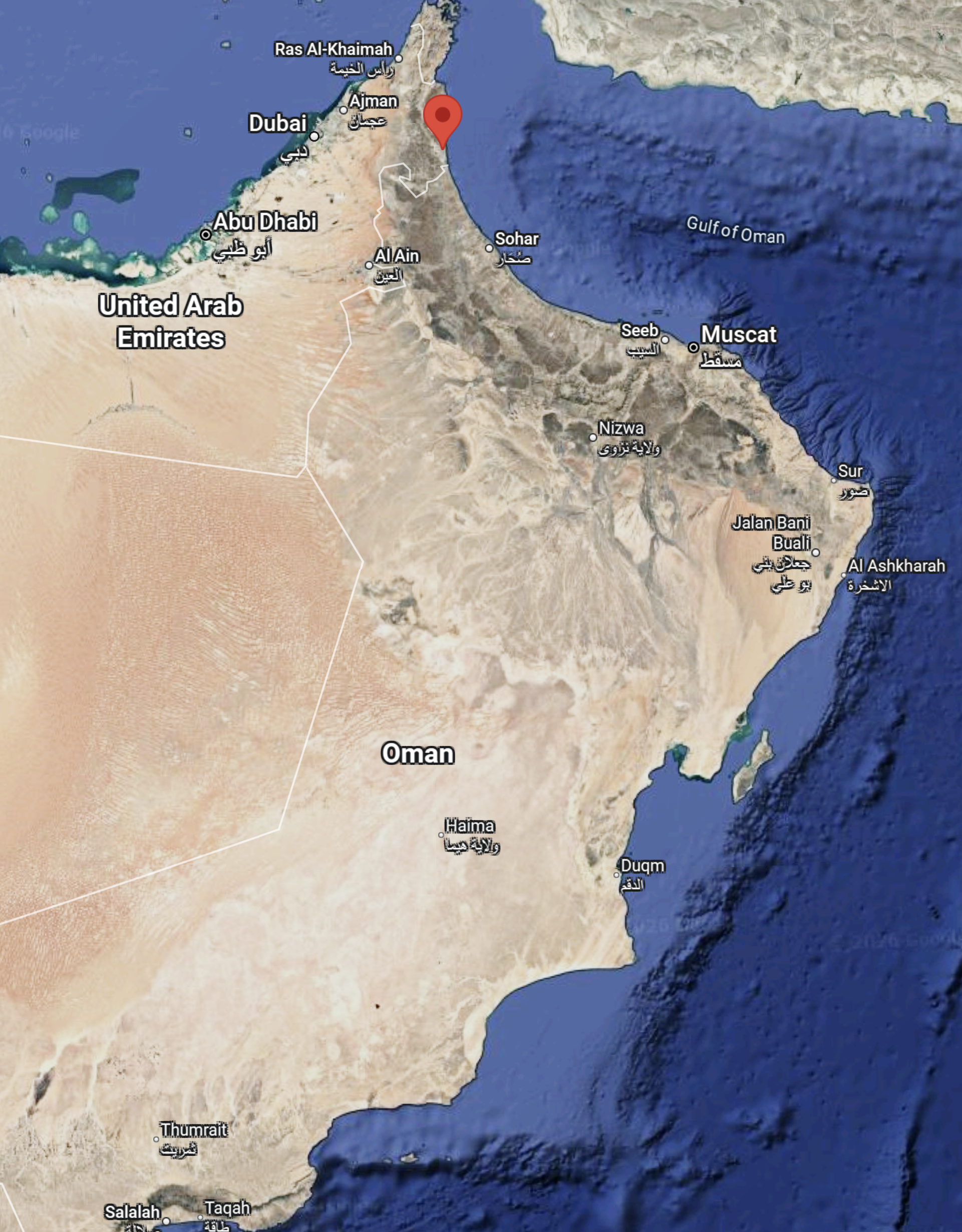
This Google Map shows the Eastern side of the Arabian Peninsular.
Note.
Fujairah is indicated by the red arrow.
Iran is the land mass in the North-East corner of the map.
The Strait of Hormuz is between the Arabian Peninsular and Iran.
As you come South from Fujairah, you pass through Muscat and then Iran.
Oman has two deep water ports at Duqm and Salalah.
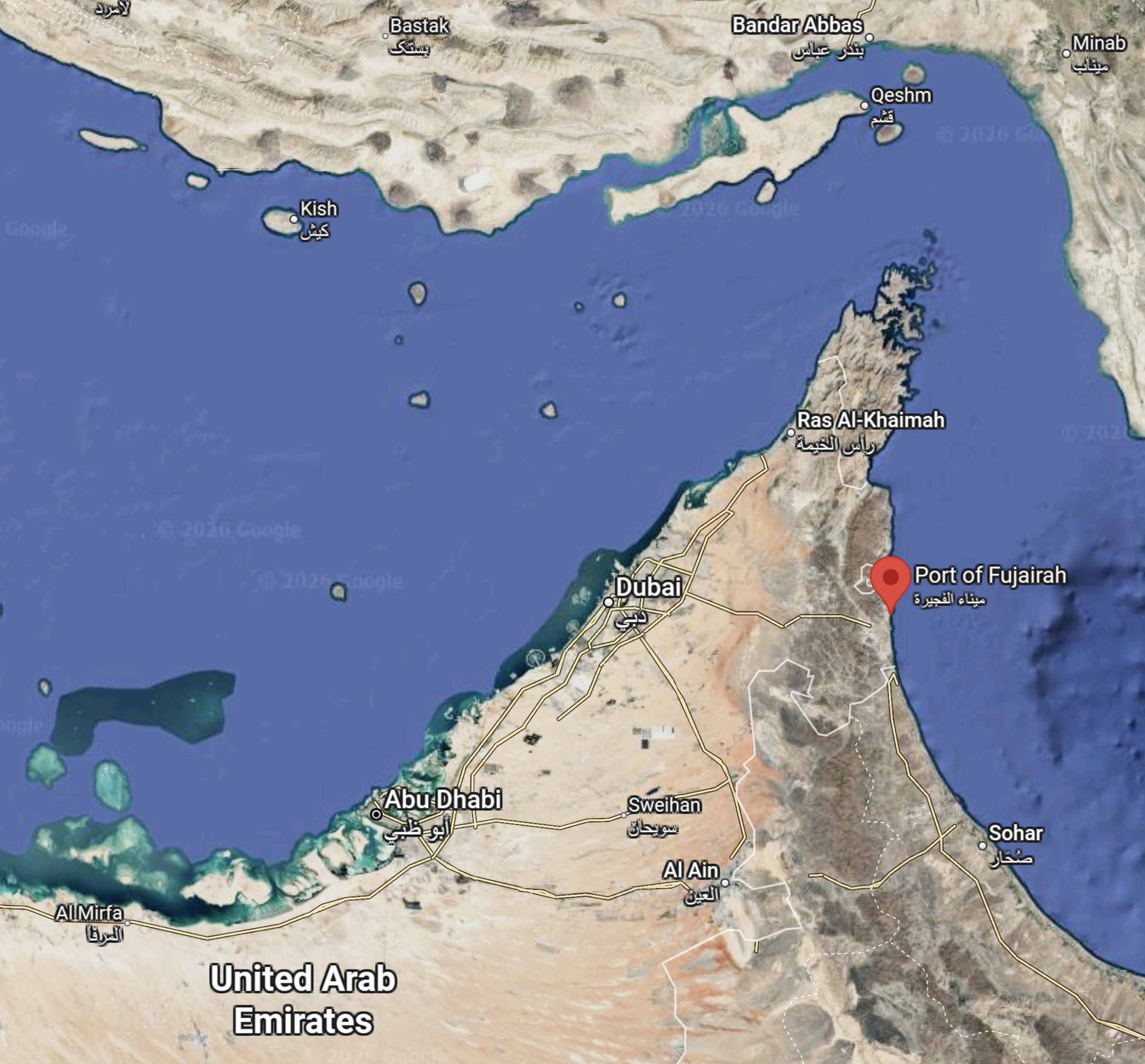
This second Google Map shows the Port of Fujairah and the Strait of Hormuz.
Note.
- The Port Of Fujairah is indicated by the red arrow.
- Dubai and Abu Dhabi are indicated on the map.
- The Strait of Hormuz is between the United Arab Emirates and Iran.
- There is a passenger train between Fujairah and Abu Dhabi that opened recently and takes an hour and 45 minutes.
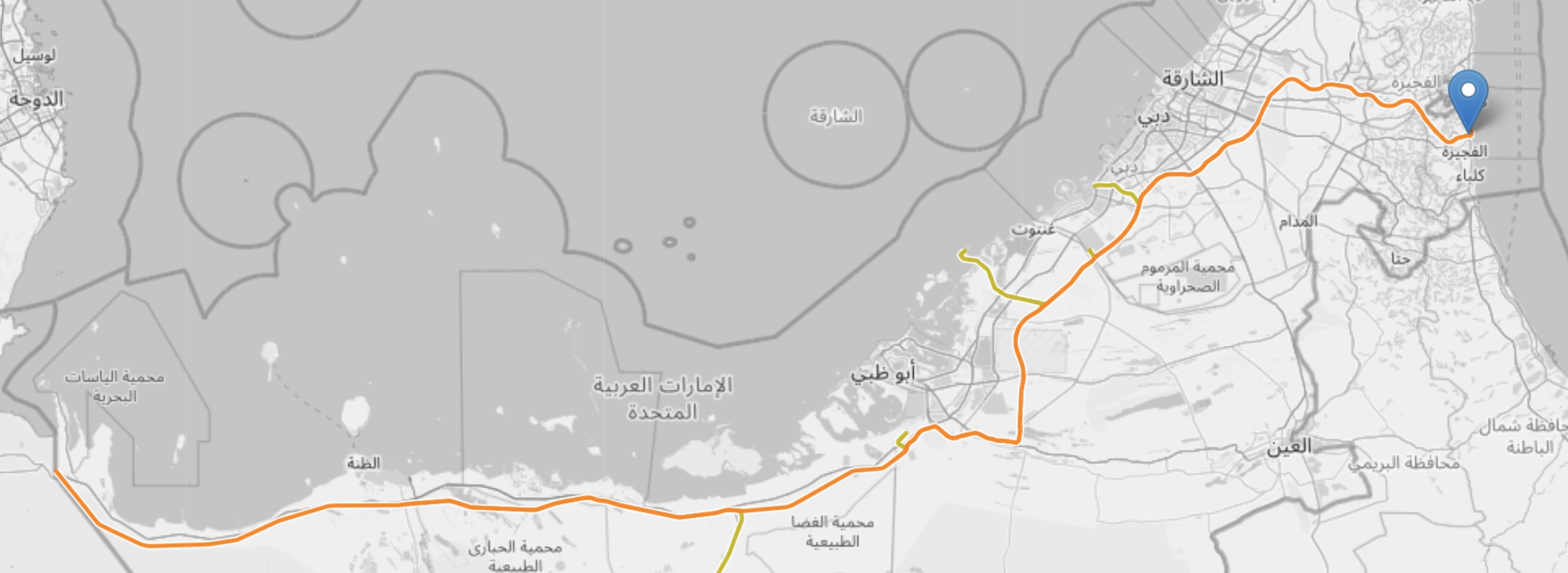
This OpenRailwayMap shows the route of Etihad Rail.
Note.
- The Port Of Fujairah is indicated by the blue arrow.
- Dubai and Abu Dhabi are on the Western coast.
- Etihad Rail has a Wikipedia entry.
- Etihad Rail has a web site.
- It is both a passenger and freight railway.
- It is 559 miles long.
It is planned to be extended to Saudi Arabia.
I can see Etihad Rail being very successful.
Could Duqm And/Or Salalah In Oman Be Developed As Oil And Gas Ports To Bypass Hormuz?
This REPEATED Google Map shows the Eastern side of the Arabian Peninsular.
The deep-water ports of Duqm and Salalah are shown on this map.
When I put the question in the title of this section to Google AI, I received this answer.
Yes, the Port of Duqm and the Port of Salalah are uniquely positioned to serve as critical oil and gas export hubs that bypass the Strait of Hormuz. Both deep-water ports are located on Oman’s open Arabian Sea coast, entirely avoiding the narrow maritime chokepoint.
Developing these ports into massive oil and gas export hubs is highly feasible but presents logistical and financial challenges:
Pipeline Corridors: Bypassing Hormuz would require constructing extensive, multi-billion dollar cross-border pipeline networks spanning over 1,800 kilometers from oil-producing hubs in Iraq, Kuwait, Saudi Arabia, and the UAE to the Omani coast.
Cost & Timeline: Estimates suggest a twin-pipeline project terminating in Duqm and Salalah—capable of moving 10 million barrels per day—would cost upwards of $50 billion and take up to seven years to complete.
Liquefied Natural Gas (LNG): Qatar and other nations could also route gas to the Omani coast, though doing so would require building multibillion-dollar liquefaction and export terminals on the Arabian Sea.
Regional Alliances: Projects at this scale require deep cross-border energy integration and substantial political consensus among the Gulf states.
Although, this route would be expensive, it would keep oil and gas for countries like China, India, Japan and Korea well away from Iran and their partners in crime the Houthis.
The Times article finished with this paragraph.
Plans now include pipelines that could run through Israel, Turkey and Syria to the Mediterranean and Europe, securing supplies to western countries but creating longer shipping times to China and India — both major consumers of Middle East oil.
Conclusion
The one common factor in all these plans is that Iran is sidelined.
And also alternative infrastructure must be better than the destructive US-Iran War.
Oman Set For Next Frontier In Energy Storage
The title of this post is the same as that of this article on the Times of Oman.
This first paragraph introduces the story.
Oman’s solar story is already being written. Manah, Ibri II, and the next wave of solar IPPs moving through procurement have placed the Sultanate firmly among the region’s renewable leaders. The next chapter, the one every solar-rich nation is racing to author, is about the long-duration energy storage technology that powers the grid after sunset. Lithium-ion batteries handle the first few hours effectively. What comes after is the harder problem, and it is increasingly being solved by a technology called Liquid Air Energy Storage, or LAES: a technology that aligns naturally with Oman’s industrial base.
The article then describes how the technology to handle LAES technology aligns with all their expertise in handling liquified natural gas.
This paragraph outlines Oman’s expertise in cryogenic engineering.
Oman’s natural advantage in this race deserves far more attention than it has received. Cryogenic engineering, the discipline of holding substances at extraordinarily low temperatures without losing them, is the most demanding part of any LAES plant. It is also the foundation of the LNG export business that has run out of Qalhat for a quarter of a century. The workforce that liquefies natural gas at minus 162 degrees Celsius is the same workforce that can liquefy air. The insulation expertise, the compressor specifications, and the maintenance discipline are all already here, refined over decades and built locally. Few nations possess this depth of capability as a domestic resource. Oman does.
If Oman have called this one right, then any nation with plentiful renewable resources, of solar, hydro, offshore wind or geothermal, should be looking at Liquid Air Energy Storage.
This is not the first time, that Liquid Air Energy Storage has been paired with LNG.
Highview Power are the UK pioneers of Liquid Air Energy Storage and on the Projects page of their web site, there is this section on Japan.
Our investment partner Sumitomo Heavy Industries (SHI), together with Hiroshima Gas, is developing a grid‑scale LAES demonstration plant in Hatsukaichi, Hiroshima. The 5 MW, four‑hour facility will use waste cold from an adjacent LNG terminal to enhance efficiency and sustainability, showcasing the flexibility of Highview’s modular LAES technology. The plant is scheduled to be operational in 2025.
In Is Sumitomo Heavy Industries Highview Power Energy Storage System On Line At Hiroshima?, I describe how the Hiroshima plant held a completion ceremony on the 9th December, 2025.
Liquid Air Energy Storage and LNG may seem unlikely bedfellows, but when engineers share a few beers, joint projects seem to emerge.
Green Hydrogen – Meranti Green Steel Launches Green Iron Project In Oman
The title of this post is the same as that of this article on Hydrogen Central.
The title shows how if you have plenty of energy, you can produce green steel.
Surely, if the Omanis can do it, we can attract a company to make green steel in the UK, as we have lots of renewable energy around our shores.
All the current steelmakers do is blackmail the UK Government into paying them subsidies.
Oman And BP Sign Renewable Hydrogen Partnership On Mega-Gigawatt Scale
The title of this post, is the same as that of this article on Hydrogen Fuel News.
This is the introductory paragraph.
Oman has announced that it has entered into an agreement with BP, in which the energy giant will support the country’s development of mega-gigawatts of renewable hydrogen and energy by 2030.
Wind and solar power will be developed on 8,000 square kilometres of land.

