Newtonian Politics
Isaac Newton was a great man of many facets. To me though as an Control Engineer, his most important work is his three laws of motion.
The First Law states that every body continues in its state of rest or uniform motion in a straight line unless acted on by an external force.
In real life it is Newton’s version of the old maxim – If it ain’t broke, don’t fix it.
The Second Law states that the rate of change of mass times velocity in a body is proportional to the force applied.
Basically, in real life this means that the harder you push something the more it moves the way you want it to.
The Third Law states every action on a body has an equal and opposite reaction.
Newton wrote his laws as they applied to mechanical systems, but they also can be applied to people systems in a philosophical way.
If you look at the British economy for the last fifty years, two of the worst times were the Oil Crisis of 1973 and the Banking Crisis of 2008. Massive external forces distorted a British economic system, that was sitting reasonably happily in a state of rest as defined by the First Law. The application of the external force was a superb example of Newton’s Second Law, which caused the economy to move fast in the wrong direction.
In recent years too, the attacks of September 11th, 2001, the Boxing Day tsunami in 2004 and the Japanese earthquake and tsunami of 2011
In some cases the reaction of politicians the world over to these and other crises only made things worse. If we take September 11th, the United States had the moral high-ground after the atrocities and could have applied sensible policies to make sure that such attacks never happened again. Instead they illustrated Newton’s Third Law brilliantly, by in revenge invading Afghanistan and Iraq, which of course provoked the opposite reaction of Islamic terrorism we now see all over the world. If you poke a hornets nest, you get stung. Or in the case of the September 11th attacks, the rest of the world does.
So how do Newton’s Laws affect British politics and in particular this coming election?
I’ll use two simple examples from London.
The London Fire Brigade has closed ten fire stations in order to save money to help the city recover from the recession of 2008. There have been protests and local objections, but there has not been one story in the past year, of destruction or even death caused by the cuts.
Transport for London over the last couple of years, have swiftly moved totally away from cash-based ticketing to one that relies on contactless cards of one sort or another with the closure of lots of ticket offices. Politicians protested loudly at the announcement but there have not been any stories since about passengers protesting because they couldn’t get home or something similar. In fact the only comment, I’ve had from staff, is one off-duty bus driver, who said he’s convinced attacks on staff have reduced significantly.
I think that Londoners, staff and eventually politicians have realised that although the changes are massive, most have only been affected in a small way, so their reaction to the changes has been proportionately small. Probably the worst affected group are firemen, who’ve been made redundant and I suspect, that London’s booming economy has allowed those who need a new job to get one, as protests have been surprising by their absence.
I think that these two examples illustrate a facet of the British people. We may moan a bit about something we don’t like, but when the new system beds in and it doesn’t effect us too much, we accept it as a sensible policy. On the other hand, if something is manifestly wrong, like the Second Gulf War, we protest until the end.
People may complain about the parties being too similar, but as most politicians are decent reasonable people, who see the bigger picture, the middle way is often chosen by everybody.
In this current election there has been a defining theme, that could determine who is the next Prime Minister.
In the seven-party television debate, Nicola Sturgeon, showed the English a face of Scots, that they don’t like. All of the thoughts from north of the border is worrying the English that any Labour dog, will be wagged by a Scottish Nationalist tail. So will this cause a drop in Labour’s vote in England?
The poll today in The Sunday Times shows that Tory support is hardening. So has Newton’s Third Law taken control?
If Labour is to get the most seats they have got to convince a large number of house-owning working middle-class voters to switch allegiance.
But will these floating votes go for a party that is saying it will use their ISAs and other measures to fund and ease more house building, which will depress the value of their own properties?
Labour policy makers obviously don’t know that every action has an equal and opposite reaction, as many of their policies, as do those of UKIP and the Nationalists, only appeal to a very committed majority. Tony Blair’s strength in the polls, was that he mobilised the non-Labour voters to vote for Nulabor.
David Cameron on the other hand, generally kept out of the squabbles in the seven-party debate, which was a classic stance to give a message compatible with Newton’s First Law.
It is an interesting problem, which will only be solved in the very British way at the ballot box in a few weeks time.
Trouble For Crossrail At Shenfield
In my piece on Crossrail 2 through East London, when discussing how Crossrail 2 will be built, I said this.
Crossrail 1 was built rather traditionally, in that the tunnels have been bored first and then the stations have been created. One thing that surprised me was that the surface sections, which have nothing to do with the tunnels were not prepared for Crossrail 1 a lot earlier.
So now because they didn’t sort out Shenfield station years ago, the adding of the required additional platform at the station has caused problems, with the parking. This report on the Brentwood Gazette explains it all.
I do wonder, if those inconvenienced and loudly complaining about the lack of a place to park the 4×4, belong to a faction, that think Crossrail is a total waste of money and will never use the line when it opens.
The Station Now Arriving Is Running Late
Network Rail is creating several new stations in the UK. But not every one seems to be going to the original schedule.
In the following, which lists current new station projects in Wikipedia, I have not included any Crossrail or Borders Railway stations.
Appleby Bridge
The station at Appleby Bridge would appear to be progressing according to the latest plan and could open on time in August 2015. I went past the site recently but didn’t manage to see much.
Bermuda Park
Bermuda Park station is a small station in Nuneaton, but according to this story in the Nuneaton News, construction appears to be going well for an opening this year.
Cambridge Science Park
Cambridge Science Park station was originally approved in December 2013 scheduled to open in December 2015. This has now slipped to December 2016.
When I last went past the area in March 2015, there appeared to be little happening.
Cassiobridge And Watford Vicarage Road
Cassiobridge and Watford Vicarage Road are two new tube stations being built on the Croxley Link of the Metropolitan Line linking it to Watford Junction. The link and the new and updated stations were due to open in 2016, but after the takeover of the project responsibility and management by Transport for London, the completion date is now a more realistic 2018.
Coventry Arena
Like Bermuda Park, Coventry Arena is a new station on the Coventry to Nuneaton Line. Like Bermuda Park, things seem to be going well for a scheduled opening in May 2015.
Cranbrook
Cranbrook station is a small single-platform being built in Devon, perhaps using ideas borrowing from James Cook. Progress is summed up by this story in the Exeter Express and Echo.
Ebbw Vale Town
Ebbw Vale Town is a new terminus station for the Ebbw Vale Railway, being built for the town and various reports say it will open this year.
Ilkeston
If ever a station was delayed by great crested newts on the line, it is the new Ilkeston station. This story on the BBC details the problems, which mean that this important station will be delivered over two years late.
Would the Germans, French and Italians allow this sort of construction delay? The Chinese would probably serve them with ginger, pak choi and noodles.
Kenilworth
Kenilworth station has had a protracted gestation period, with an original planned opening of 2013, which is now scheduled for December 2016, with this report in the Leamington Observer saying work will start this year. It looks impressive and it is one I’m looking forward to use.
Kirkstall Forge
Thje builders must be confident of the schedule for Kirkstall Forge station, as the Wikipedia entry gives a completion date of the station is given as October 2015, which is confirmed on this page on the Leeds Metro web site. When I passed recently, there certainly seemed to be an embryonic station at the site.
Lea Bridge
It was hoped that Lea Bridge station would reopen in late 2014, but despite one sighting of the orange army, nothing seems to be happening. and the new hoped-for opening date of December 2015 would appear to be optimistic.
Oxford Parkway
Oxford Parkway station is not only a new station, but one at the interim end of a new privately-funded railway route from London. As it is key to the opening of the line, I would suspect that the planned opening date of September 2015 will be achieved.
Wixams
Wixams railway station was originally promised to be completed this year. This report on Bedfordshire on Sunday takes about broken promises and a much-delayed station. In other words, it is an aspiration, that has not been planned.
The lateness with some of these stations is a trend that is worrying, but in many cases it seems that you can’t blame the politicians but bad planning and the not getting everything sorted before announcing start and finish dates.
And of course there are the newts at Ilkeston!
Word Of The Day
The Times today has a picture on page 4 of what they describe as a coalition of cheetahs.
Now there’s a word!
How Did They Do That?
Normally, the new five-coach trains have their new car inserted next to the end car at the northern end. So how did this train have its extra car inserted at the southern end?

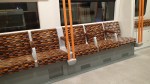
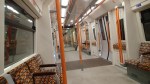
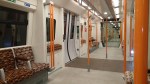
Note how the interior of the new cars are brighter. The dull seats are those reserved for the elderly, disabled and pregnant.
As I don’t think there is a turning loop on the East London Line, the train was either modified this way or it was sent on a jolly somewhere, perhaps to test out compatibility with a new route or back to Bombardier for some special maintenance.
Since most of the trains on the East London Line are now five-car, it does seem that the trains are less crowded.
On the whole, this train lengthening would appear to passengers to have been a pretty painless exercise, although I’ve heard rumours of a few teething troubles with the trains.
According to some Transport for London documents, the trains will go to six-cars some time before 2030, so if that is as painless as the two previous extensions, it is a validation of the quality of Bombardier’s cut-and-shut design for the trains.
When Crossrail opens and is joined to the East London Line at Whitechapel, I have a feeling, that many more passengers will use the East London Line to access the new line to places like Heathrow and Paddington, so the extra capacity will be fully used.
When I grew up in London just after the war, you’d see a short line on the tube map that was the East London Line. Mo-one thought, that this line would become the expanding East London Line we have today.
Where will it go by say 2030?
It will probably be joined to the Central Line at Shoreditch High Street and there will be extra branches in both North and South to handle the twenty-four trains in each hour for which the infrastructure of the line is capable.
It all goes to show how you can sometimes create new rail lines without spending billions of pounds.
Crossrail and Thameslink may get all the publicity, but London Overground’s policy of continuous improvement on the East London Line, is a philosophy that could be copied on many railway lines in the UK, Europe and the wider world.
You Can Always Rely On Boris For a Good Quote
This article in The Guardian has this quote from Boris Johnson.
Vote Tory and get broadband. Vote Ukip and get Miliband!
Is there another UK politician, who is as good with words as Boris?
Dancing With Cranes And A Bridge With Help From Lego
I just had to put a link to this article on Rail Engineer, which is entitled Scarborough Bridge – Monte Carlo Or Bust.
It describes how the bridge that takes the York Scarborough railway line over the River Ouse in the medieval heart of York, was replaced over the half-term weekend in February, at a cost of six million pounds. This Google Earth image shows the centre of York.

York
The bridge is the one at the left of the image, with the station below it.
It was choreographed to an amazing degree and used three enormous mobile cranes squeezed into the car park by the bridge on the north bank of the river. Luckily the wind and the weather were kind and the project was completed on time. Perhaps, the most strange aspect of the project is told in this paragraph.
And then we should take our hats off to team member Eamon McAuley who literally built the bridge single-handed…albeit in Lego. It was remarkably detailed – including the track layout and little orange men with chainsaws – and could be deconstructed and rebuilt to follow the lifting sequence. Sitting as a centrepiece in the conference room, it proved more useful than a PowerPoint when explaining the challenges to visitors and stakeholders.
Anybody who said engineering isn’t fun, should hang their head in shame.
Humour On The Overground
This story from the Standard has gone viral around London.
London Overground and Underground staff are increasingly posting humorous messages at several stations.
Does this happen on any other metro or tram system?
Thinking Big In Essex
I found this report in the Southend Echo from 2008 interesting.
It is a plan to link Canvey Island with the Hoo Peninsular in Kent using an immersed tube road and rail tunnel. This is an extract from the report.
Metrotidal’s blueprint seeks to combine the tunnel with new flood defences protecting London and a tidal power plant in the middle of the Thames Estuary.
This could support a new eco-town or generate enough power to operate a rail service through the tunnel, the consortium said.
This is a Google Earth image of the Thames south of Canvey Island.
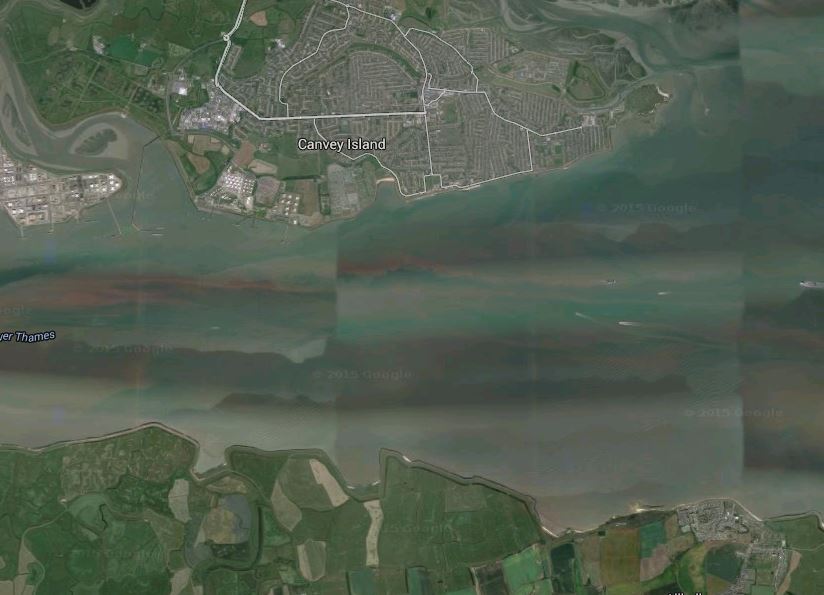
The Thames South Of Canvey Island
The surprising thing is that the river isn’t that wide and is probably about a couple of kilometres.
There hasn’t been anything on the news in recent years, so I suspect that the plan is very much on the back burner.
But one day, a project like this will be built!
Could London Benefit From Fosteritos?
How many times a day, does a passenger on the London Underground, go down or up a short set of uncovered stairs to access a ticket hall with machines, ticket barriers and escalators and lifts to the trains? Stations, I use regularly with this layout include Kings Cross, Oxford Circus, Bank and Euston Square. Many of these staircases can be slippery in the wet, but some are covered.




These pictures show the covered staircase at the front of Kings Cross station. This is better than uncovered, but it is probably an expensive solution, although it does incorporate a lift.
Norman Foster faced a similar problem in Spain of how to protect staircases and escalators emerging from the Bilbao Metro. These pictures show his elegant solution.




The Spaniards obviously liked them, as they called them fosteritos.
Perhaps, Transport for London needs to have a design contest to create a distinctive shelter for those slippery-when-wet staircases.
 The Anonymous Widower