The Crossrail Portal At Pudding Mill Lane
You can get a good view of the portal, where Crossrail trains from and to the East enter and leave the tunnel under London, from Pudding Mill Lane station and the DLR line that passes through it.


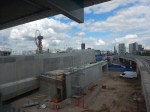



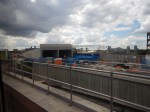

I think in years to come, this will be the station, where parents take their children to see the Crossrail trains.
The Class 700 Train Launch At Blackfriars Station
I took these pictures when Thameslink launched the new Class 700 train this morning, at Blackfriars station.
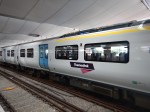
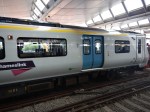

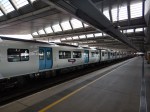
I’ll be very pleased, when I get to have a ride and take a look inside. I suspect six on a Sunday morning at St. Pancras Thameslink, will be a good place to start.
Vitamin D Deficiency And Atrial Fibrillation
I’ve just found a paper in the International Journal of Cardiology with this title.
As according to two cardiologists in Cambridge, the reason I had my stroke was atrial fibrillation, I should discuss this with a cardiologist.
I think my story goes something like this.
- For some reason, I didn’t like the sun and kept out of it.
- When I was diagnosed as a coeliac, I went gluten-free and didn’t get added Vitamin D in my food.
- But C dragged me off to the sunnier climes, where now I can stay in the sun without problem.
- When she died, I retreated into myself and didn’t go to the sun.
- So did I get low vitamin D?
- My GP thought so and I decided to drive around in my Lotus with the top down.
- I eventually, had the stroke, I’d probably been just missing since C died.
- Atrial fibrillation was diagnosed and it was said to have caused the stroke.
- Warfarin has been prescribed to protect me!
I’ve added sun and vitamin D for good measure.
Until I can prove otherwise, my father who gave me coeliac disease, wasn’t so lucky and died of a stroke.
Did he have atrial fibrillation and low vitamin D?
Boom In Cycle-Rail Journeys
The title of this post is the title of this article in Rail Magazine.
These two statistics are given.
- Cycle-rail journeys have increased by 40% since 2010.
- The number of journeys where a bike was parked at the station increased by 75% in the same period.
You certainly see a lot more bikes on trains.
I think in the next few years will see more restrictions on bike usage on trains. Sometimes, there are just too many bikes, pushchairs and enormous cases on trains and there’ll come a point, when train companies try to cut the numbers.
I was talking to one of the driver managers of a company introducing the new Class 800 trains. He felt that the designers had not incorporated enough cycle places.
We shall see if he’s right, when the trains are serving their first summer.
As passengers have the space in the locomotive at present, if they turn up with a bike in the future and are told there there is no room, it will be an unholy row!
Are Train Coaches Making A Comeback In The UK?
There were two stories yesterday, where new coaches to be built by Spanish company CAF.
- In TransPennine Express Buys Spanish Trains, I wrote about the new trains for TransPennine Express, which include thirteen five-car rakes of coaches pulled by Class 68 locomotives.
- In Expanding The Scottish Sleeper, I wrote about how new coaches could transform the Caledonian Sleeper.
Both sets of coaches probably use the same basic bodyshell, running gear and electrical and heating services, so once CAF designed the sleeper trains, they probably have developed a vehicle that could be used for any profitable purpose.
At present the Caledonian Sleeper uses two types of coach; a sleeping car and a lounge/seated sleeper car and these are being replaced with an identical number of coaches.
But little has been said about the design and make-up of the new coaches.
I suspect, that we will see lounge cars with large windows, so that the Scottish countryside can be enjoyed in style, if the weather permits.
The new coaches will be compared to British Rail’s legendary Mark 3 coach.
- I’m also sure that CAF have set out to design a coach, that rides better.
- The new coach must also be capable of running at 200 kph., as Mark 3s do every day in large numbers.
- Will the coaches pass the cement lorry test, as a Mark 3-derived multiple unit did at Oxshott?
The 1960s design of the Mark 3 has set a very high bar.
Even less has been said about the five car rakes of coaches for TransPennine Express.
But in common with the other rakes of coaches in mainline service in the UK on Chiltern and the East Coast Main Line, and in East Anglia, they would need some means of driving the train from the other end, which is currently done with a driving van trailer.
A DVT is very much a solution of the 1970s, although it does have advantages in that the empty space can be used for bicycles, surfboards and other large luggage. Hence, the van in the name.
If you look at CAF’s Civity train, it is very much a stylish modular design and I’m sure CAF, have the expertise to build a stylish driving cab into some of the new coaches they are building.
I therefore think we will be seeing these five-car rakes of coaches for TransPennine Express, with a driving cab at one end.
One of the big advantages of this approach is that trains can be pulled and pushed by any suitable and available locomotive.
- Class 68 diesel locomotives could provide reliable go-anywhere diesel power.
- Class 88 electro-diesel locomotives could provide electrical power from overhead lines and diesel power elsewhere.
- Class 73 electro-diesel locomotives could provide electrical power from third rail and diesel power elsewhere.
- Class 90 electric locomotives could be used with overhead lines
- A 200 kph-capable electric locomotive could be used on high-speed electrified lines.
Operators wouldn’t be tied to one particular power unit, so as more electrification is installed, they could change to something more suitable.
You also have the possibility of designing the coach with the driving cab as perhaps a buffet/observation car or using it for First Class, so that the other coaches are very much a standard interior.
The approach also has the advantage that if you need a longer train, you just couple another coach into the rake.
I’m sure that CAF have designed a rake of coaches that has impressed TransPennine Express, otherwise they wouldn’t have ordered the coaches.
Some people might think that going back to coaches is a retrograde step.
Consider.
- Chiltern run an excellent service with coaches.
- Deutsche Bahn still uses lots of rakes of coaches.
- Rakes of coaches are more flexible than fixed-length multiple units.
- The most appropriate locomotive can be used.
- Some passengers might think, that coaches give a better ride than multiple units.
But I suspect the biggest factor in the revival of coaches, is that a rake of stylish new coaches and a Class 68 locomotive are more affordable than a new Class 800 train. They are also available earlier.
Imagine going across the Pennines from Liverpool to York in the buffet/restaurant/observation/driving car of one of these new trains, enjoying a Great Western Pullman Dining experience, as the countryside goes by.
If it is done, it would set a high standard for other train operators.
Expanding The Scottish Sleeper
There is an article in Rail Magazine entitled New Destinations For Scottish Sleeper Trains?.
Oban and the Far North of Scotland are mentioned, as new destinations for the Caledonian Sleeper.
Oban
Oban station is on a branch of the West Highland Line to Fort William.
One of the attractions of Oban for the operator, is that it is a port.
- Four ferries go to the offshore islands.
- It would be so convenient to get off the Sleeper and then get on a ferry to your ultimate destination.
- The Scottish diaspora would love it.
I suspect that Serco’s Marketing Department have the link to the ferries in mind.
Currently, Euston to Fort William takes twelve hours and forty minutes, with the train dividing into three portions at Edinburgh Waverley station.
To serve Oban, it would probably need the train to spin off an extra section which went to Oban.
At present it would appear, that you would get off the Caledonian Sleeper at Crianlarich at 0745, and wait until 1015 to catch the train to Oban.
If that is actually what happens, it’s not very passenger-friendly.
You can also get to Oban at the same time, by taking the sleeper to Glasgow and changing trains there.
As I suspect that the train operator; Serco are serious about getting more passengers to the Caledonian Sleeper, there would seem to be some ways to get passengers to Oban earlier in the morning, perhaps by timetabling an earlier train to Oban that meets the two sleeper trains better.
Once they knew that sufficient passengers were travelling between London and Oban, Serco could start to think about running a direct service.
But would it be a further split of the Highland service at Edinburgh or a split of the Lowland service at Glasgow?
The current frmation of the Highland Sleeper, is given in this section inWikipedia.
This is said in Wikipedia about the splitting off the train in Edinburgh.
The front two sleeping carriages are for Fort William, being combined at Edinburgh with a further two sitting carriages to make a four-vehicle formation. The middle portion of either six carriages is for Aberdeen, and the rear portion of eight carriages is for Inverness. Both the Aberdeen and Inverness portions usually convey one sitting and one lounge carriage each, with the rest being sleeping cars, all working through to/from London.
It might just be too complicated, to split the train for Oban at Edinburgh
The Far North
Serving the Far North Line to Wick and the intermediate stops may well be an ambition, but running a profitable service will surely have problems.
The sleeper takes eleven and a half hours to Inverness and the current local train takes four and a half hours between Inverness and Wick, which makes sixteen hours for the journey. That is just too long, when you can fly it in four hours.
The New Rolling Stock
The new rolling stock from CAF must be the key to improving the service for both the operator and passengers.
- The current sleeper trains are not the fastest and are generally limited to 40 mph in the Highlands.
- But even on the West Coast Main Line, the trains don’t go very quick, taking seven and a half hours for the journey, as opposed to four and a half for the fastest Virgins.
- I would suspect that the new coaches will probably go faster and still give a good night’s sleep. Not that I have any complaints about the current sleepers.
- Modern technology would probably improve the time to couple and uncouple the various sections of the trains.
- The mix of carriages will give the operator more flexibility, with respect to the formation of trains.
- Wikipedia has section on the new Mark 5 Coaches, which says there are 75 coaches of four types, arranged into four sixteen coach trains, with eleven spares.
- As new trains and coaches attract interest in a train service, I would not be surprised to see the new coaches attracting more passengers to the Caledonian Sleeper.
Four trains is an interesting figure, as at present they only use two; one to the Lowland and one to the Highlands.
But for the first time in the thirty years since the original Mark 3 coaches were built, if the Caledonian Sleeper needs to increase their number of coaches, there will be a manufacturer, who will probably be happy to oblige.
Ladbrokes wouldn’t give me odds on CAF building new coarches for the Night Riviera.
European Services
The first two Eurostars to Paris leave at 0540 and 0701 and the first to Brussels at 0650. At present the sleeper from Glasgow gets in at 0707, but surely better timings between the two services would attract more passengers, who wanted to have a good night’s sleep and be in Paris or Brussels early.
I doubt there is any great demand for a direct sleeper service between Scotland and Paris or Brussels and the cost of the trains would be prohibitive.
But by interfacing the two services properly, there could be a market to be developed.
The new rolling stock with there more generous performance might mean that this is a lot easier.
Kings Cross
This article in Rail Magazine is entitled Sleeper MD Considers King’s Cross Potential.
Apparently, passenger feedback from when King’s Cross is used is very positive because of the station’s better connectivity.
I have this feeling that if they moved the Caledonian Sleeper to King’s Cross. during the rebuilding of Euston, that it would never go back.
Onward From The Sleeper Destinations
If you are coming south and arrive in London around seven in the morning, you have lots of modern, comfortable trains to go onward to your ultimate destination.
When I looked at Oban, it struck me that the connections to the sleeper, weren’t as good as say those in London to Bath, Bournemouth, Cardiff or Paris.
So perhaps one of the things that would help the current service is good onward connections in comfortable trains. Abellio Scotrail are committed to improving train services in Scotland, so they may be doing this.
Cnclusion
There is no doubt that the current Caledonian Sleeper is a valuable and much-loved service. The fact that Serco are buying new carriages from CAF, is not an act of charity and must be because the company believes that they can improve the profitability of the service.
I believe that although eventually, there may be services to other destinations in Scotland, that in the meantime better onward connections may be a more cost-effective solution.
It also has to be said, if improved services work to Scotland, then they’d surely work between London and Cornwall.
TransPennine Express Buys Spanish Trains
After Arriva Rail North bought 98 Civity trains from CAF, which I wroye about in Arriva Rail North’s New Trains, it probably wasn’t much of a surprise that TransPennine Express have gone to the same source for twenty-five new trains, as is detailed in this article in Global Rail News. This is said.
The new fleet, which will be maintained by Alstom at Longsight depot, will consist of 12 five-car Civity EMUs from CAF – financed by Eversholt Rail – and 13 five-car loco-hauled intercity trains.
The announcement follows an order placed earlier this year with Hitachi for 19 bi-mode train sets. Both fleets of new trains are due to be delivered between 2018 and 2019.
If there is a surprise, it is that they are going for locomotive-hauled sets or rakes of coaches.
The 12 five-car Civity EMUs will be running between Liverpool/Manchester and Edinburgh/Glasgow. According to the CAF data sheet, there will be a 200 kph version available, so these could mix it with other operators’ Class 800 trains.
The article also says this about the locomotive-hauled rake of Mark 5 coaches.
In addition to the new CAF trains and carriages, Beacon Rail-owned Class 68 locomotives will be leased from Direct Rail Services to operate intercity services between Liverpool and Newcastle.
So it would appear that the Class 68 locomotives could work Liverpool to Newcastle before the line is fully electrified. They would also be ideal for routes to Hull and Scarborough.
I would also suspect, that as the Class 88 electro-diesel locomotive is very similar to a Class 68, that these locomotives could also work some of the services, once the route is partially electrified.
The Mark 5 coaches, are probably similar to those being built for the Caledonian Sleeper. One question that has to be asked, is why haven’t TPE opted to bring some of the legendary Mark 3 coaches up to a modern standard.
- The concept of a quality set of coaches with a locomotive at one end has been proven to work in East Anglia, on Chiltern and on Deutsche Bahn.
- The conversion of doors, toilets and other issues, might mean that new coaches are better value for money.
- New coaches are probably good for at least thirty years.
- All the basic design has been paid for in the Caledonian Sleeper order.
- One of the five coaches in each set, could have a driving cab integrated into one end, so there would be no need for a separate driving van trailer.
- Have CAF applied all their designs for the modular Civity train to build a train, where you just plug a suitable locomotive into one end?
- New coaches sell seats, especially if they are designed for a good passenger experience.
- If you want six, seven or more coaches, you could probably just slot them into the rake.
I suspect that CAF have seen a gap in the market and have produced a design for a rake of coaches, that will appeal to the UK. I think we could be seeing these coaches appearing elsewhere.
At the end of the day, it all comes down to cost, reliability, flexibility and the quality of the passenger experience.
It does look to me, that by virtue of good design and manufacturing capacity, that CAF seem to have nicked a nice order from under the noses of the big companies.
- CAF could probably deliver coaches in 2018.
- Suitable locomotives are already in the UK and Stadler/Vossloh would probably oblige with a few more.
- The Class 68 locomotive doesn’t seem to generate bad reports in the media.
- The three previous points, might mean that TPE could be running new reliable trains earlier than anybody thinks.
- The Civity family is proven and is being built for Arriva Rail North.
- Hitachi haven’t probably got the capacity to build more Class 800 trains early enough.
- Bombardier haven’t built a high-speed Aventra, although they might have the capacity, but not a diesel variant.
I certainly think that TPE have got a good replacement at an affordable price for the overcrowded Class 185 trains.
My Endoscopy
This is an old post from an earlier blog, which is dated October the third, 2003, but I’ve been asked about it a couple of times lately, so I thought I’d copy it over.
Introduction
I have written this in quite a lot of detail so that it can help others who are undergoing the procedure.
The only thing I might say, is that I am a reasonably fit, fifty-six year old, who has a strong scientific training. So on the one hand, my body should be able take most things and on the other I do have a basic understanding of what’s going on!
Before
I wasn’t that sure to expect when I went for a endoscopy.
I am also not the bravest where hospitals or operations are concerned!
I had the instructions, which said that there was a 1-in-10,000 chance of something going wrong, that I was to wear comfortable easily washed clothes and that I wasn’t to eat or drink anything for six hours before.
It also said that there was the choice of a sedative or a throat spray and if I had the first I wouldn’t be able to drive, use machinery or drink alcohol for 24 hours.
Hmm!
Would I be brave enough to have the throat spray, as it would also mean I wouldn’t have to find someone to go with me? Not easy when your wife works full time and your children live miles away!
It said phone if you wanted any help. So I did!
I was given a direct line by the receptionist and after a couple of tries, I got through to a helpful nurse who said that most people are alright with the throat spray.
So it was to be the throat spray!
I also remembered the advice given to me by a scientist who created some of the world’s best anaesthetics. He said to avoid them at all costs!
I didn’t sleep too badly the night before, but I did get up about six.
Nothing unusual here, as Celia is often out by half past on her way to all Courts east, west, north and occassionally south. I also find that the early morning is the best time to work!
But I did want to have a last drink of a cup of tea before the requisite six hours of abstinance arrived at half past six.
It was a long wait, as I am one of those who just like others have a thinking cigarette, when I work I have a thinking drink, or a snack. I did bite my fingers a bit, until I realised that could count as food!
In the end I gave up on work about twelve and disappeared off on a series of useful, but on the whole rather time-wasting errands.
I had tried to arrange a game of tennis before, but that all came to nothing. I was dressed for the game though, as the clothes fitted the requirements.
I drove all the way to Bury St. Edmunds to collect my spare car keys from last night and then wasted a good fifteen minutes talking to the salesman about the new higher powered MG-ZT-T-230. (I would have bought one a few years ago, but now cars are just a means of getting around. Well not quite, but they aren’t so important!)
I then picked up the enlargements of the family photo taken at Imogen’s christening. I think I paid a cheque into the bank!
All things that needed to be done, but they could have waited until the Saturday!
Finally, about two I parked the car in the lane that leads to Addenbrookes.
When I visit the hospital I tend to do that, as on a sunny day (It was!) it is a nice walk and you avoid all the hassle of finding a car parking space.
Procedure
If you don’t know Addenbrokes it is not the most attractive of buildings, being a 60’s, brutal construction designed by an architect, who probably designed down to a cost, rather than up to a standard.
It’s also rather a maze, so when I entered the Out-Patients I looked around for someone to give me directions. As when I came for my first appointment, I was given proper directions to Endoscopy, which seemed to be rather an afterthought for the building, reached up what looked to be a fire-escape!
As I had forgotten to bring some suitable reading, I bought a magazine. I think it was Autocar.
Often when I go to the doctors, I’ll take a rather academic book, so that I don’t get treated like an idiot. Also something with substance and length as that seems to ensure I get seen quickly!
I waited for perhaps half an hour until twenty minutes after my appointment before I was seen by a nurse, who then asked whether I was taking the sedative. I said not, but I got the impression that most of the others were taking one.
She also said that as I have a crown on a front tooth, I was less likely to break that if I had a spray, as I wouldn’t bite so hard on the mouth piece through which the probe would pass.
Then at about a quarter past three, I was called in by the doctor.
The doctor, a Mr. Hardwick, again asked about the sedative and then outlined the procedure.
I did question him, as to why the consent form asked so many silly questions! I really don’t care at all about what happens to my body after I die, so long as it gets the respect it deserves. If it deserves any that is!
A few minutes later and he walked me through to the room where it was to be carried out.
Now I realised that except for the facts that a camera was being passed down my throat, through the stomach and into the duodenum, before a biopsy was to be taken, I didn’t know much else.
Would I be standing, sitting or lying? How big was the camera tube? After all I did know that sword swallowers appeared to take something substantial!
It’s funny, but whether because I was apprehensive or whether I didn’t want to interfere with the procedure, I didn’t take a look at the equipment out of my normal rather excessive curiosity. All I can remember is that it was made by Olympus. I hoped it gave better pictures than the last camera I bought of that make!
I was told that the throat spray was rather unpleasant and tasted of bananas. Why should bananas be unpleasant? I’ve always eaten at least one a day since I first saw one at the age of about five! (There weren’t any in London for several years after the war!)
The spray was fine and after a couple of sprays, I could feel my throat going numbish. But I still had full control and could swallow as required.
I was then asked to lie on the trolley and then I was turned onto my side.
Other instructions were given to try and swallow the probe and also to breathe normally. He also said that it was easier as I had not had the sedation and could co-operate with him. That sounded very reasonable!
I now had the mouth piece between my teeth and the doctor started to pass the probe down into my stomach. The probe was perhaps three to four millimetres in diameter. In other words considerably smaller than the occassional mint imperial, that I have swallowed by accident.
At this point, I should say that I am predominately a mouth breather and even with the mouth piece in, I was still breathing almost normally through my mouth, rather than the nose. Although I was trying to use it! I don’t think I was very successful!
As the tube progressed, I was asked to swallow and after a few attempts was able to progress it down my throat. I didn’t swallow more than about six to eight times.
I had also been worried because dentists have told me I have a strong gag reaction. It didn’t seem to be a problem!
Obviously, I was quiet and couldn’t talk. However, I did have a rather macabre thought as to whether they used the same probe if they were looking from the other end! I never asked the question!
It wasn’t that unpleasant and was no worse that having teeth drilled! It was a lot quieter and I only dribbled a very small amount.
It was also certainly better than the day in a dentist’s surgery in Smithdown Road in Liverpool, when I had the first crown fitted on my front tooth. I can still remember the smell of burning teeth!
I had been warned to expect wind as the probe entered my stomach, but really didn’t notice much and after perhaps two to three minutes the probe was in the duodenum. I hadn’t felt anything inside as the probe progressed. Was this due to the spray? I suspect it was.
So the first part was over and it wasn’t too bad at all! I hadn’t broken out in a sweat or anything like that, but it did find a bruise later on my knee, where the other one had been pushing into it, whilst I was trying to lie still!
They then took two biopsies by passing a tool down the probe. I thought I might have felt a slight prick as each was taken, but it may be that I was looking for something!
And that really was that!
A couple of minutes later, the probe had been removed and I was sitting on the trolley.
I was told that everything appeared normal and that they had got a couple of good biopsies. What constitutes a good one?
I was then told not to drink or eat anything before twenty to four and after a few minutes sitting on a chair, I walked out of the department, out of the hospital and back to my car.
My throat seemed slightly sore, but after a drink and some crisps as I filled up with petrol at the garage, everything seemed fine!
I ate a hearty meal that evening.
Conclusions
I think the first thing I should say, is that everything at Addenbrookes was very professional and I would have no complaint as to care.
Or any complaint about anything else for that matter!
Take the case of phoning before the procedure for advice about the throat spray!
This should always be available and I certainly found it very helpful as looking back, I think I made the right decision to have the spray rather than the sedative :-
1. The very fact that I was awake and fully conscious during the procedure must be a help to the staff, as they could tell me to do things and at least I could try to carry them out!
2. This must make the procedure quicker and more efficient, especially as there is no need for a recovery bed.
3. The nurse also told me that as I have full control of my jaw, which I wouldn’t have with the sedative, that there is less chance of dental damage.
Now having crowns fitted is definitely not pleasant!
4. But the biggest advantage to me of the throat spray, is that I walked out a few minutes later, drove home and within half an hour I was almost back to normal.
There is only one thing I would do to improve the system and that is to give more information to the patient.
If I had known more before I went to the hospital and had perhaps read an experience like this, I would have been less apprehensive.
It probably didn’t make any difference to me in the end, but someone of a more nervous disposition than myself, might just decide to be sedated rather than choose the spray.
So looking back about a week later as I write this, it doesn’t seem terrifying at all and I would recommend anybody who is asked to have a endoscopy, to have one without worrying too much!
And have the throat spray rather than the sedative!
Just relax and let the doctors and nurses get on with the job!
America Is A Sick Country
There is no other title for a post about this story on the BBC entitled Gun that killed Trayvon Martin ‘makes $250,000 for Zimmerman’.
In my view anybody who wants to own a gun other than for genuine sporting purposes, needs his head examined.
Until the United States has a sensible gun policy and abolishes the death penalty, I shall not be visiting.
Serial Cooking – Asparagus, Prosciutto And Poached Egg
This is another recipe from Lyndsey Bareham from The Times.





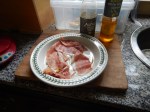
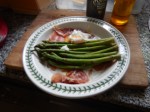
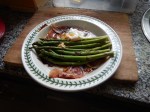
It was exceedig simple and so delicious I did it two days running.
 The Anonymous Widower