Japan A ‘Very Interesting Market’ For Gore Street As It Becomes An ‘Enabler’ Of JXTG’s Transition
The title of this post, is the same as that of this article on the Solar Power Portal.
This is the introductory paragraph.
London Stock Exchange-listed energy storage fund Gore Street has outlined how it sees Japan as a “very interesting market” following its investment from JXTG Nippon Oil & Energy Corporation.
I like Gore Street’s philosophy and its execution.
I am not an investor and probably never will be, but they seem to be based on sound principles and do their modelling well. I’ve built enough large financial models to know a good one from its results.
Gore Street is normally investing in lithium-ion batteries.
- These batteries now have a predictable reliability profile and I suspect cash-flow from owning a battery is fairly predictable.
- The control and monitoring software will get better as time goes by and these batteries will probably update themselves automatically.
- They probably aren’t that affected by COVID-19, as lockdown still needs energy to be balanced and these batteries are probably performing as normal.
- The heat of the last few weeks probably caused more grief than COVID-19.
- If a site visit is necessary, they can probably be done with one man in a van with a key to the security system. So maintenance is probably easy to do, whilst maintaining social distance.
I also liked this paragraph from the article.
, Gore Street Capital CEO, Alex O’Cinneide, said that the fact that the deregulation of the Japanese market over the next few years makes it of interest to the company, alongside it having the same characteristics of the UK in terms of the decommissioning of coal, nuclear and gas and increasing levels of renewables.
Could Gore Street Energy Fund, be a safe investment for today’s difficult times?
How Do You Save Clean Energy? This Company Plans To Pump It Underground
The title of this post is the same as that of this article on Grist.
This sentence, introduces a company called Quidnet Energy.
Last week, Quidnet, a Houston, Texas-based company, announced that it lined up a contract with the New York State Energy and Research Development Authority to construct a pilot project for its “Geomechanical Pumped Storage” technology.
Reading the article, the following points can be made.
- Quidnet is a new take on pumped storage.
- Instead of using expensive land to store water, the water is pumped underground from a supply pond into a well.
- It uses pumped storage supply chains and expertise.
- Quidnet is backed by a Bill Gates energy fund.
- About sixty percent of US power markets have the right type of rock.
The article finishes by comparing these systems with lithium-ion batteries, which double in cost every time you want to double the capacity.
But technology like from Form Energy, Highview Power and Quidnet might be a lot simpler.
This is very much a must-read article.
Think Zinc: Another Metal That Can Transform The Energy Storage Sector
The title of this post, is the same as that of this article on Stockhouse.
This is the introductory paragraph.
Mines worldwide extract more than 11.9 million metric tons of zinc annually. There are zinc mines in over 50 countries around the world, and while the metal plays a key role in the steel industry, few people understand its transformative role in the energy storage sector. When most people think of the metals that power today’s energy storage systems, vanadium and lithium are at front of mind.
Wikipedia has an entry called Zinc Mining. This extract, sums up the availability of zinc from mining.
Global zinc mine production in 2019 was estimated to be 12.9 million tonnes. The largest producers were China (34%), Peru (11%), Australia (10%), United States (6.1%), India (5.5%), and Mexico (5.4%), with Australia having the largest reserves.
The world’s largest zinc mine is the Red Dog open-pit zinc-lead-silver mine in Alaska, with 4.2% of world production. Major zinc mine operators include Vedanta Resources, Glencore, BHP, Teck Resources, Sumitomo, Nexa Resources, Boliden AB, and China Minmetals.
The paragraph is accompanied by a photograph from the Zinkgruvan mine in Sweden.
Closer to home, in 2009, Ireland mined 385,670 tonnes of zinc and was the tenth largest producer in the world. Tara Mine is at Navan in County Meath.
This Google Map shows its location to the West of Navan.
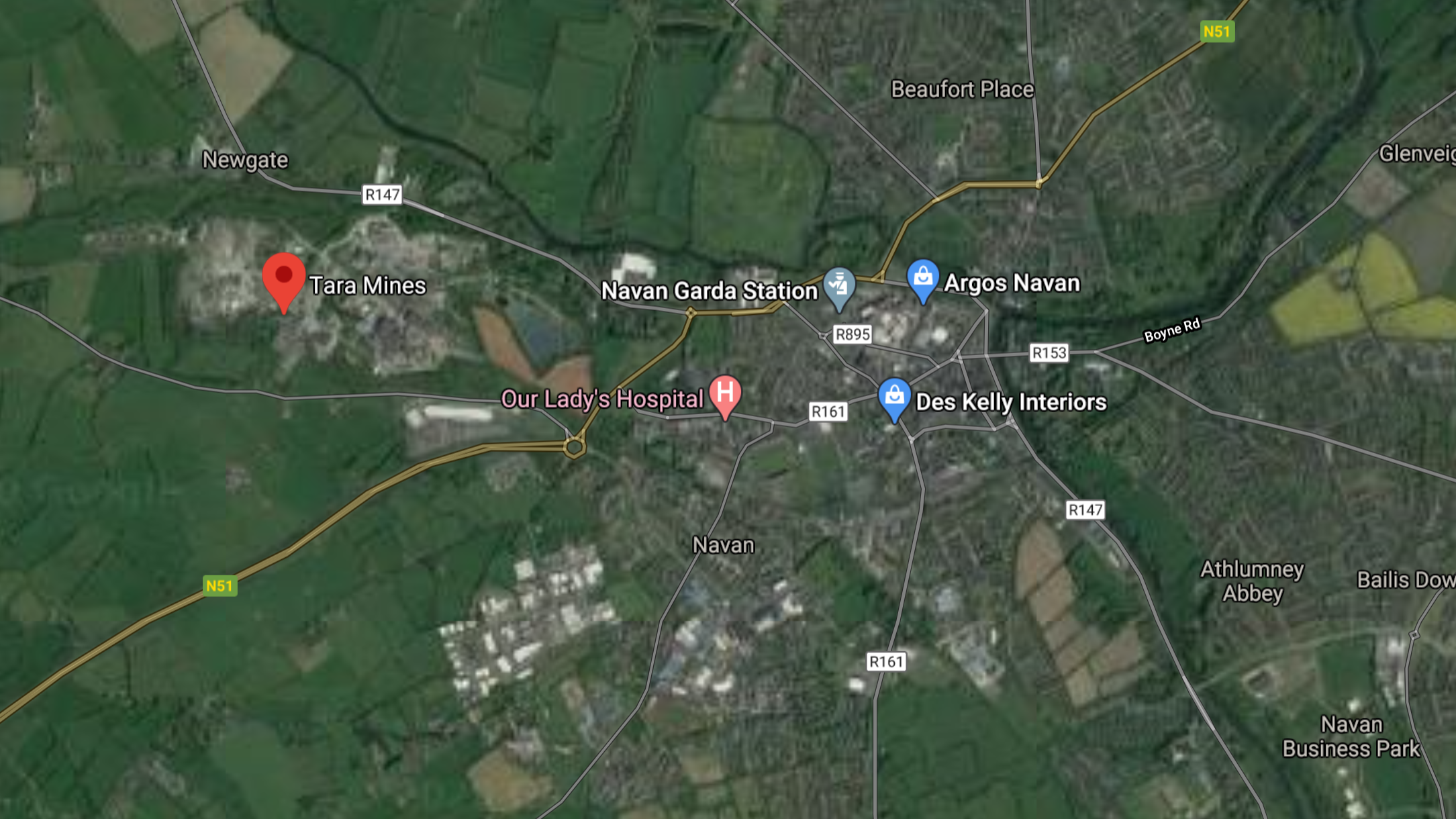
So if the Irish build more wind turbines, they have the zinc for their own zinc-air batteries.
The Stockhouse article is written by Ron MacDonald, who is President and CEO of Zinc8 Energy Solutions. He says this.
To give one example: Our company Zinc8 Energy Solutions has won a recent contract award and project collaboration with the New York Power Authority (NYPA) and private sector deployment agreement with Digital Energy supported by New York State Energy Research and Development Authority (Nyserda). We will deploy a 100kW/1.5MWh zinc-air system capable of storing energy for 15 hours.
Everybody, who worries about our future energy supplies should read the full article.
Highview Power On The Good News Network
If the Good News Network, is what it says on the tin, then I’m pleased that they’ve written this article, which is entitled World’s Biggest Liquid-Air Battery – ‘The Climate-Emission Killer’ – Is Now Under Construction In England.
The article, appears to be a rehash of what appeared in the Guardian, slanted for American readers.
It has the usual American fault of mixing up England with the UK, but surely the fact that it’s on the site, is good news for Highview Power.
UK’s Pivot Power Sees First Battery On Line By 2021
The title of this post, is the same as that of this article on Argus Media.
The article is a review of what is happening in the UK and this is the introductory paragraph.
UK firm Pivot Power is now targeting a 2021 start for its first two 50MW lithium-ion battery storage projects, while a 50MW liquid air energy storage project and another 50MW battery recently announced they were targeting completion by 2022.
The article gives several pieces of information about Pivot Power.
- Their two batteries are at Kemsley and Cowley.
- The two batteries appear to be running late.
- The company has a portfolio of forty projects with s total size of 2 GW.
- The Cowley battery will be co-located with a 2MW/5MWh Vanadium flow battery operated by storage firm redT.
- Pivot Power is owned by EdF.
Good to see redT involved, although they seemed to have merged with Avalon Battery to form Invinity Energy Systems. The new web site describes them as the world’s leading vanadian-flow battery company.
This page on the web site is the Press Release about the merger.
This paragraph from the Press Release, describes where vanadium flow batteries fit in the market.
Vanadium flow batteries are a form of heavy-duty, stationary energy storage, used primarily in high-utilisation applications such as being coupled with industrial scale solar generation for distributed, low-carbon energy projects. This sort of application requires daily, heavy use and is well suited to flow battery technology, which is expected to become a £3.5bn market by 2028.
I don’t know much about vanadium-flow technology, but this company could probably be added to a list of companies, who might make it.
Proposed Merger Will Make Zinc Battery Developer Eos Energy A Public Company
The title of this post, is the same as that of this article on pv magazine.
This is the introductory paragraph.
EOS has executed a letter of intent for a merger with a SPAC — which would result in EOS becoming a publicly listed company. Investors seem fascinated by energy storage this year, the long-duration variety in particular.
The two companies are described like this.
EOS Energy Storage
EOS Energy Storage is a private zinc battery developer with the chance to go public via a merger with a special purpose acquisition company.
The company has a comprehensive web site.
Riley Principal Merger Corp II
B. Riley Principal Merger Corp II (BMRG), a special purpose acquisition company listed on the New York Stock Exchange, and Eos have executed a letter of intent for a merger which would result in Eos becoming a publicly listed company.
The article, then states that energy storage is the big thing with investors this year.
The article makes some interesting points and anybody thinking about investing in these technology stocks should read it.
Conclusion
With this activity around EOS, it could be they are a company to watch, but we’ve had share bubbles before.
Do We Need A UK Lithium-Ion Battery Factory?
My post, Gore Street Acquires 50MW Ferrymuir Battery Project, Eyes More In Scotland and the article on the Energyst with the same name, got me thinking.
It was this statement about Gore Street Energy Fund, that really started the thought.
The fund said the addition takes its portfolio built or under development to 293MW and added that is has options for a further 900MW.
Gore Street obviously have the money to build all of this energy storage.
- I have also looked at some of their projects on Google Maps and there are still plenty of sites on green- or brown-field land close to electricity sub-stations, where energy storage would be easy to connect.
- I suspect, they have some good engineers or electricity marketing specialists available.
- My worry, would be, with many countries going the energy storage route, is there enough capacity to build all the batteries we need.
We have three routes, we could easily take in this country.
- Convert suplus energy to hydrogen using electrolysers from ITM Power in Rotherham.
- Develop some BALDIES (Build Anywhere Long Duration Intermittent Energy Storage). British technology is available as the CRYObatteryfrom Highview Power, who signed to build their first full-size plant in the UK, last week.
- Build a lithium-ion battery factory. Preferably of the next generation, so that battery vehicles will go further on a charge.
It is my view, that we should do all three!
Will Gore Street, add a BALDIES to their portfolio of lithium-ion energy storage.
- In World First As Liquid-Air Energy Storage Makes Commercial Debut Near Manchester United Ground, I gave costs of £110/MWh for a CRYObattery and £231-470/MWh for lithium-ion batteries.
- Nothing exotic like lithium is needed to build a CRYObattery.
- Highview claim they can build bigger batteries than Elon Musk.
- They wouldn’t be the first substantial order.
I think the decision makers at Gore Street would sleep comfortably in their beds if they bought a CRYObattery for a location, that needed a larger battery.
Conclusion
As to the answer to my question, the answer is yes, as mobile application will need more and better batteries and on balance, we should have our own supply.
Gore Street Acquires 50MW Ferrymuir Battery Project, Eyes More In Scotland
The title of this post, is the same as this article on The Energyst.
This is a paragraph.
The Ferrymuir project in Fife, Scotland, has all connections and consents in place. Gore Street hopes to commission it in 2022.
It looks like it just needs the money to fit it out.
Judging by the numbers quoted for Gore Street in the article, it looks like a lot of fund managers and people with money, are putting money into energy storage.
Air-Powered Energy Storage Knocks Out Coal & Gas — Wait, What?
The title of this post, is the same as that of this article on CleanTechnica.
After reading, this must read article, it could have had a title with Knocks Out Coal, Gas and Nuclear.
It makes a passionate article for Highview Power’s long term air-powered energy storage and other systems with a similar energy profile like Form Energy.
It also showed this good graphic from Highview Power, which shows how their system works.
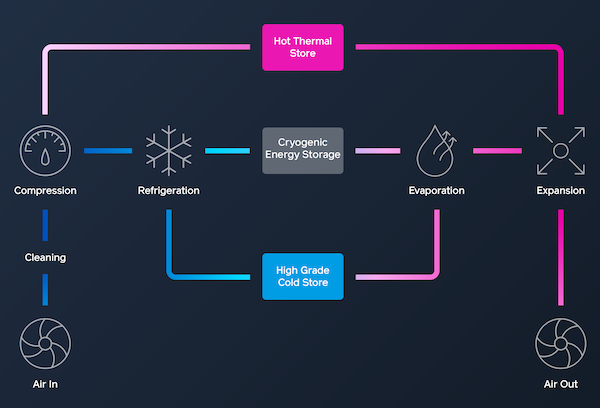
This paragraph gives Highview’s view on what their CRYObatteries will do.
Grid operators are turning to long-duration energy storage to improve power generation economics, balance the grid, and increase reliability. At giga-scale, CRYOBatteries paired with renewables are equivalent in performance to – and could replace – thermal and nuclear baseload power in addition to supporting electricity transmission and distribution systems while providing additional security of supply,” enthuses Highview.
The author then chips in with the attitude of the US Department of Energy.
Don’t just take their word for it. The US Department of Energy is eyeballing long duration energy storage for the sparkling green grid of the future despite all the hot air blowing out of 1600 Pennsylvania Avenue.
In an interesting twist, the Energy Department’s interest in long duration storage was initially connected to its interest in at least preserving, if not growing, the nation’s aging fleet of nuclear power plants.
Will renewables be able to see off nuclear in a country with plenty of sun and/or wind like the United States?
Conclusion
With a lot of help from their friends in the long term energy storage business, the answer must be yes!
World First As Liquid-Air Energy Storage Makes Commercial Debut Near Manchester United Ground
The title of this post is the same as that of this article on Recharge.
I can add some extra information starting with this picture from Highview Power, which shows a visualisation of the CRYObattery.
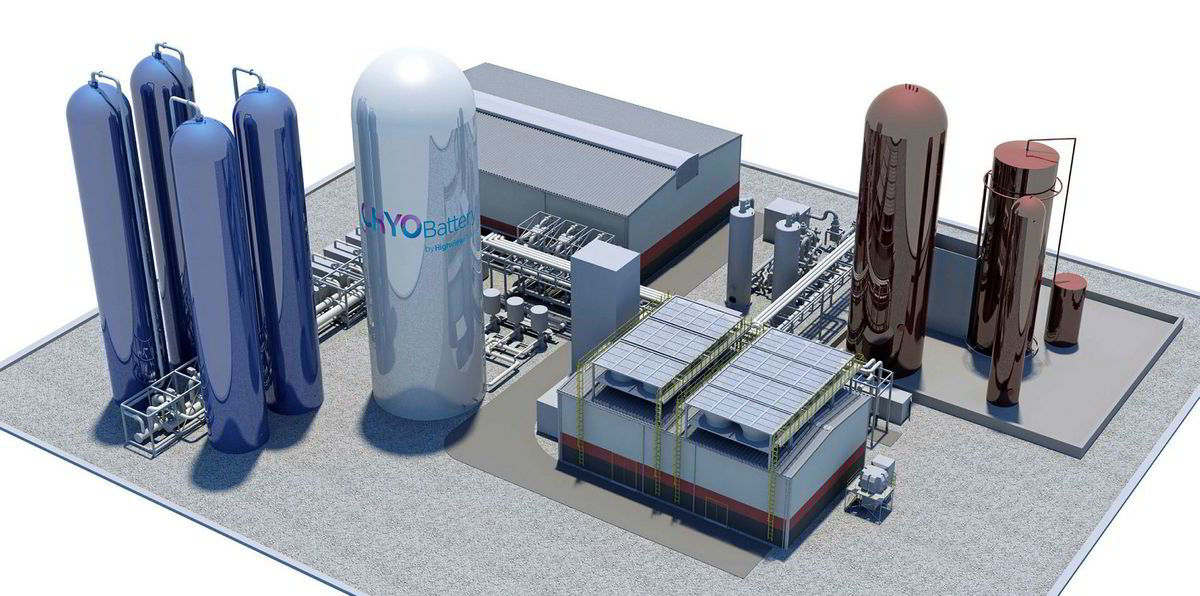
Unfortunately, it doesn’t show any objects, which can give an idea of the size of the plant.
Levelised Cost Of Energy
LCOE or Levelised Cost Of Energy will be a term, that will be increasing used, when electricity generation is discussed. This is Wikipedia’s definition of the term.
The levelized cost of energy (LCOE), or levelized cost of electricity, is a measure of the average net present cost of electricity generation for a generating plant over its lifetime. The LCOE is calculated as the ratio between all the discounted costs over the lifetime of an electricity generating plant divided by a discounted sum of the actual energy amounts delivered. The LCOE is used to compare different methods of electricity generation on a consistent basis. The LCOE “represents the average revenue per unit of electricity generated that would be required to recover the costs of building and operating a generating plant during an assumed financial life and duty cycle.” Inputs to LCOE are chosen by the estimator. They can include cost of capital, “fuel costs, fixed and variable operations and maintenance costs, financing costs, and an assumed utilization rate.
Make sure, when comparing different LCOE values for different methods of energy generation, that the same method was used to calculate LCOE.
Comparative Costs
The article quotes the following costs on an LCOS or Levelised Cost Of Storage basis, which enables comparison to be made according to the same rules.
- A 200 MW/2 GWh CRYObattery will cost £110/MWh
- Pumped storage/hydro will cost £123-150/MWh
- Lithium-ion will cost £231-470/MWh
I have converted some from dollars.
I do think that a 2 GWh CRYObattery could be very good value!
Income
The article says this about how the CRYObattery will earn us keep.
Income will come through grid balancing, ancillary services such as frequency response and voltage support, and arbitrage — buying electricity when wholesale prices are low and selling it when prices are high.
I suspect that if a company like Carlton Highview Power had several large batteries around the country, this would be an advantage to the company.

