Are Rolls-Royce Converting The World To Sussainable Fuels?
Rolls-Royce are certainly up to something.
- Versions of all their diesel and aero engines appear to be able to or will be able to run on hydrogen, SAF, HVO and other exotic zero or low-carbon fuels.
- They are replacing the engines on the USAF B 52s with new American-built Rolls-Royce engines, that can run on hydrogen.
- They are working with easyJet on zero-carbon engines.
- They are developing the UltraFan, which promises to be the most frugal turbofan engine ever. Will all long-distance wide-bodies end up Rolls-Royce powered?
- They have developed a frugal engine for business jets that can run on any fuel.
- Rolls-Royce have also developed a 2.5 MW electric generator based on the engine of a Super Hercules. This level of power is what you need for a railway locomotive.
- Are they building a retrofit for all the diesel-electric railway locomotives of the world, which runs on hydrogen?
Some of these developments could be moving from diesel, jet-fuel and SAF to hydrogen. Others will just reduce the amount of fuel needed.
I just can’t get the image of an iconic B 52, with RR on the side of the engines out of my mind.
But all of these developments seem to have one aim in mind. – To reduce the amount of aircraft and other large vehicles that have to run on standard jet fuel, diesel, SAF or HVO.
This will mean that long-distance air travel, which will be the most difficult to decarbonise will be able to use SAF and other exotic fuels made from renewable sources.
UK Wind Risks ‘Exponentially Rising’ Curtailment Without Energy Storage
The title of this post, is the same as that of this article on Recharge.
This is the sub-heading.
UK liquid battery pioneer Highview Power is working with renewable energy giant Orsted on plan to store excess power from its Hornsea offshore wind projects
This is the introductory paragraph.
The UK wind sector faces “exponentially” increasing curtailment of assets without a rapid rollout of energy storage, says the chief of liquid battery pioneer Highview Power, which is working with Orsted on a project to store excess offshore wind power.
The article also states that according to Octopus Energy, this cost could have been as high as a billion pounds last year.
In Grid Powers Up With One Of Europe’s Biggest Battery Storage Sites, I described how Ørsted were planning to build a large BESS near the Swardeston substation in Norfolk, where the Hornsea 3 wind farm will connect to the grid.
Have Ørsted decided to put a Highview Power battery on the Swardeston site, as it can be a bigger battery, as Highview Power talk about 200MW/2.5GWh capacity batteries on the projects page of the web site?
Highview also say this about co-operation with Ørsted on that page.
Highview Power and Ørsted’s joint study shows that the co-location of LAES with Ørsted’s offshore wind offers a step forward in reducing wind curtailment, and helping to move to a more flexible, resilient zero carbon grid.
The words are accompanied by pictures of a smart gas storage site, which shows four of the largest tanks, that might be used to store LNG.
In Could A Highview Power CRYOBattery Use A LNG Tank For Liquid Air Storage?, I estimated that one of the largest LNG tanks could hold about a GWh of energy.
So Highview Power’s visualisation on their project page would be a 4 GWh battery.
.
I’ve Just Come Across Avnos
I feel we should take into account any possibilities of second use of oil or gas structures, that once held hydrocarbons.
An article in a magazine called Carbon Herald pointed me to a company called Avnos, who are developing Direct Air Capture of carbon dioxide out of the atmosphere. If systems like that of Avnos do work, we may need somewhere to put the carbon dioxide.
Centrica are storing the hydrogen in the Rough gas field, which was previously used for storing natural gas and now some depleted gas fields are being used to store captured carbon dioxide.
On the subject of carbon capture, Avnos do it differently, in that for every tonne of CO2, they capture from the air, they capture five tonnes of distilled water. And they do it without using any heat.
This is their web site.
This is their mission statement on the front page of the web site. There is also a video.
Carbon Negative. Water Positive
Avnos is commercializing the most advanced technology in the Direct Air Capture of CO2
Our proprietary Hybrid Direct Air Capture (HDAC) solution inverts the water paradigm in DAC, producing water, eliminating heat consumption and reducing costs compared to other forms of DAC.
It sounds too good to be true!
But I have experience of the positive financial results of fluid dynamics in this area.
Thirty years ago, two guys approached me with an idea for an aerosol valve that used nitrogen as a propellant.
At the time, I lived in the house, where Osborne Reynolds, the great Victorian fluid dynamicist of Reynold’s number fame had been brought up.
The guys succeeded and the device was sold on to J & J.
They were then asked to develop a metered dose inhaler for asthma drugs, which is now sold as Respimat, which is sold by Boehringer Ingelheim.
Afterwards, I researched Reynolds at Manchester University, where he was the first Professor of Engineering and I found that he had done some marvelous things with fluids. He was a true genius and undergraduates are still taught on his Victorian apparatus.
I suspect that Avnos may have been exploring in the same area and are using another of Reynold’s useful properties.
MP Pushes For Tidal Lagoon In Bristol Channel
The title of this post, is the same as that of this article on the BBC.
This is the sub-heading.
Building a tidal lagoon in the Bristol Channel could provide clean energy for 120 years, an MP has said.
These three paragraphs give more details.
The proposed West Somerset Lagoon, which would cost £10bn to build, would run nine miles (14km) from Minehead to Watchet in Somerset.
Its lifespan would be twice that of a nuclear power plant, said Tiverton and Minehead MP Rachel Gilmour.
Mrs Gilmour said she will soon be discussing the proposal with ministers. If the project is pursued, it could be up and running by 2038 – bringing jobs and financial benefits to the area.
The project already has a web site, with this mission statement.
The West Somerset Tidal Lagoon is a proposed Tidal Range power scheme, that aims to harness the energy of the tides to provide zero carbon renewable energy. It is strategically located on the southern coast of the Bristol Channel Basin between Minehead and Watchet to take advantage of the world’s second highest tidal range and will become the UK’s largest sustainable energy project.
This map from OpenRailwayMap shows the coast between Minehead and Watchet.
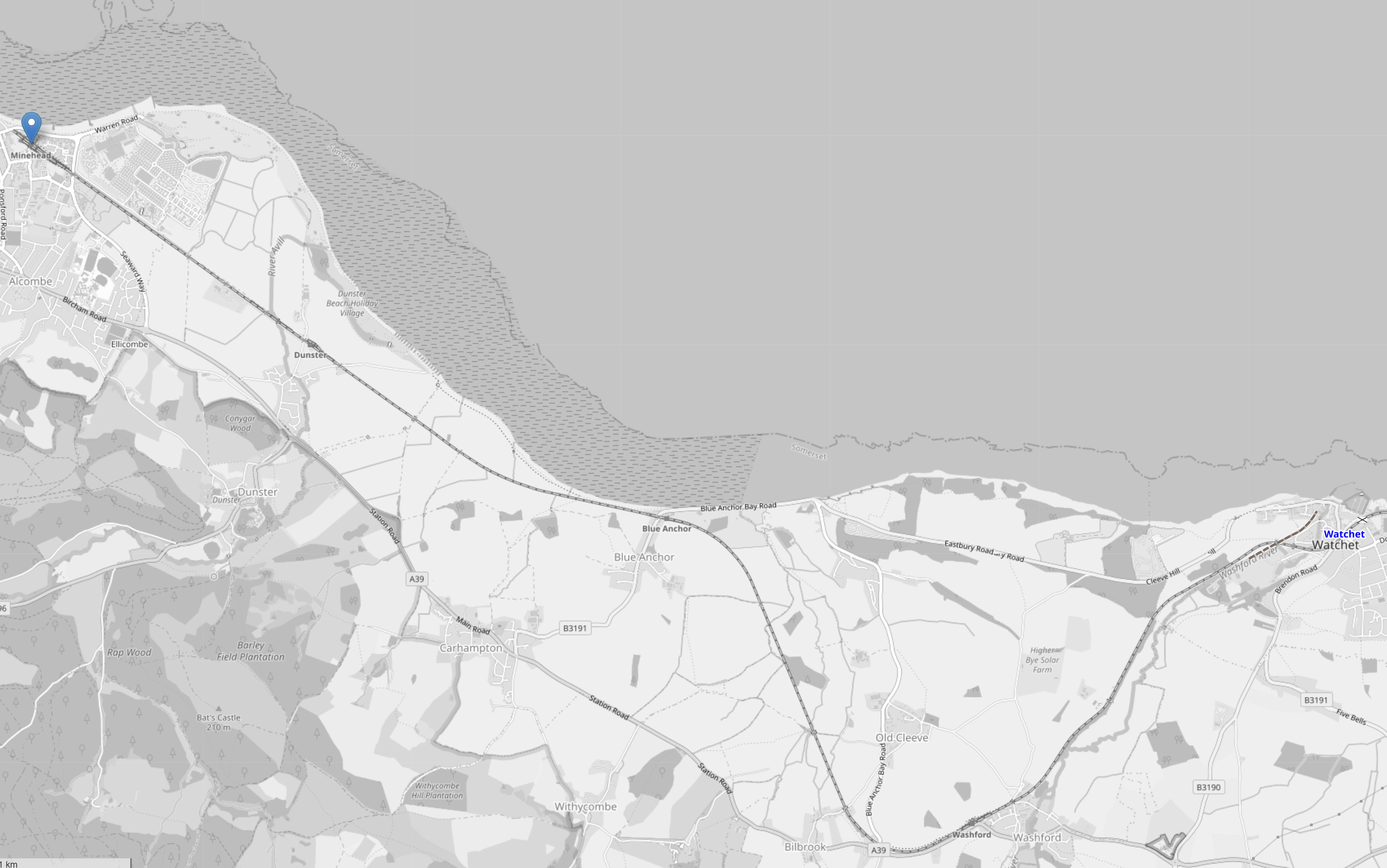
Note.
- Minehead station is indicated by the blue arrow in the North-West of the map.
- Watchet station is indicated by the blue lettering on the Eastern edge of the map.
- The West Somerset Railway links the two stations and connects them to the Bristol and Exeter Line at Norton Fitzwarren station.
It looks like the sea wall of the lagoon will curve between Minehead and Watchet.
The West Somerset Railway
This OpenRailwayMap shows the whole West Somerset Railway.
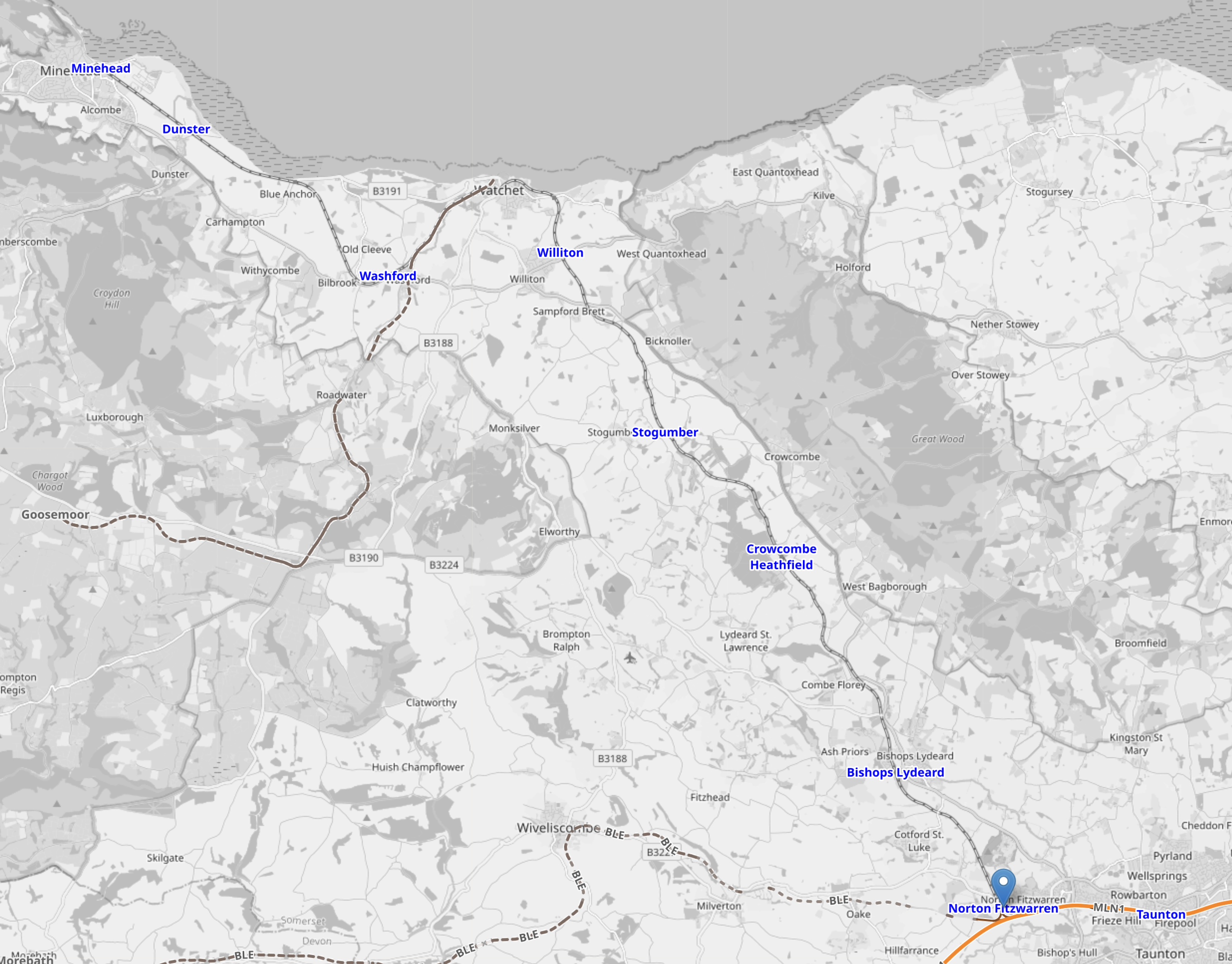
Note.
- Minehead station is in the North-West corner of the map.
- Norton Fitzwarren station is indicated by the blue arrow in the South-East corner of the map, where the West Somerset Railway joins the main line between Exeter and Bristol.
- Taunton station on the main line with trains all over the country is a few miles to the East of Norton Fitzwarren station.
I believe that for the lagoon project to be completed, the West Somerset Railway needs to be turned into a fully-operational branch line from Taunton to improve access for residents, visitors and workers to Minehead and other places in West Somerset.
Large projects like these need large numbers of workers to be completed.
Less disruption to local residents and businesses is caused if a park and ride site is set up. Sizewell C is setting up two from the nearby East Suffolk Line, using hydrogen-powered buses.
Sizewell C also intends to bring in heavy equipment and construction materials by rail from Ipswich and Lowestoft.
The West Somerset Tidal Lagoon could use the railway to bring in heavy loads.
If the West Somerset Railway is going to be used to ease the construction of the lagoon , then this should be properly to connected to Taunton first.
UK Unveils Measures To Fast-Track 16 GW Of Offshore Wind
The title of this post, is the same as that of this article on offshoreWIND.biz.
This is the sub-heading.
The UK government has unveiled measures to unlock up to 13 offshore wind projects, which could generate up to 16 GW of electricity and potentially bring GBP 20 billion (approximately EUR 23.9 billion) to GBP 30 billion (about EUR 35.8 billion) of investment in homegrown clean power.
These paragraphs illustrate how thw the government propose to do it.
According to the UK government, ministers are streamlining the consenting process to accelerate the construction of offshore wind projects. As set out in Chancellor Rachel Reeves’ growth speech, this will hasten the delivery of vital infrastructure projects and unlock growth as part of the government’s Plan for Change while protecting nature and the environment.
The government plans to eliminate obstacles that have delayed or blocked the development of offshore wind projects by designating new Marine Protected Areas (MPAs) or extending existing MPAs to compensate for impacts to the seabed.
This should prevent delays that have previously resulted from insufficient environmental compensation being agreed upon while protecting the marine environment and contributing to the government’s commitment to protect 30 per cent of its seas for nature by 2030.
- The Government will be streamlining the consanting process.
- But will this streamlining just give more ammunition to the Nimbies?
- Will more compensation be paid and has Rachel from Accounts go it to spend?
- Designating new or redefining existing Marine Protected Areas (MPA).
- The wind farm developers developers will pay for the MPAs.
- Any new designations of MPAs will follow the existing process required under legislation and will include consulting other affected industries and communities.
Surely, if the developers pay for the MPAs, then the price of the energy produced will rise. But then I’m only following Sir Isaac!
We’ve seen streamlining and acceleration before and I can’t remember all of these actions producing positive results.
My feelings are the following should be done.
Fully back the development of the Port of Ardersier, as a floating wind farm production facility.
I discussed this in Redevelopment Of Scottish Port Begins As Owner Secures GBP 400 Million For Offshore Wid Upgrade.
Will 2025 Be A Bumper Year For Solar?
The title of this post, is the same as that of a sub title of this this article on Solar Power Portal, which is entitled Two Solar NSIPs Granted Development Consent.
This is the sub heading of the main article.
The Department for Energy Security and Net Zero (DESNZ) has granted development consent orders (DCOs) to the Heckington Fen Solar and West Burton Solar solar PV power plants.
This paragraph, gives a brief description of the two projects.
The two developments, both located in Lincolnshire, England, are classified as Nationally Significant Infrastructure Developments (NSIPs) as their proposed generation capacity is over 50MW. Combined, the Heckington Fen Solar and West Burton Solar projects will have a generation capacity of almost 1GW.
But it was the prominent sub-title in the article, that prompted me to write this post.
These were the three paragraphs, the author used to answer their question.
This year so far has already seen significant movement on several large-scale solar projects, with more to come throughout 2025.
Last week, international renewable energy developer Ørsted announced proposals for a 320MW solar PV power plant in East Yorkshire, the Kingfisher Solar Farm, for which public consultations are set to begin on 3 February. Meanwhile, Elements Green has opened the second phase of statutory consultations for its 800MW Great North Road Solar and Biodiversity Park, which will run until 20 February.
Plans for another proposed 800MW development, EDF Renewables UK’s Springwell Solar Farm, will be examined by the planning inspectorate following the successful submission of a DCO application for the project.
I also wrote UK Solar Deployment Poised To Increase 50% YoY, Following Rapid Growth In The Second Half Of 2024, just over a week ago, where I predicted a large growth in steel aolar panels on industrial and architect-designed buildings.
Conclusion
There may be a lot of new solar power generated in the UK in 2025, but because some of it will be roof-mounted and structural, we won’t see as much as we have in the past.
How To Keep The Lights On When The Wind Doesn’t Blow
The title of this post, is the same as that of this article in The Times.
This is the sub-heading.
Britain came close to a blackout this month. Gas is being phased out and renewables are intermittent, so can energy storage stop us going dark?
These are the first two paragraphs.
It was 8.29pm on the first Tuesday in January when the alert was issued by the electricity control room. Freezing temperatures had coincided with unusually low wind speeds, and it was making the National Energy System Operator (Neso) jittery.
Engineers forecast a 1.6GW shortfall — the requirement for about 1.5 million homes — for a three-hour period from 4pm the following afternoon. “System operators are requested to notify Neso of any additional megawatt capacity,” the message said.
Luckily, the plea worked.
The article then goes on to describe the various technologies that are being deployed.
The article starts by talking about pumped storage hydroelectricity.
This paragraph gives a superb illustration about how things have changed in energy and energy storage in the UK in the last few decades.
In the past, when coal provided the bulk of British power, this system was used to meet fluctuating demand levels. But now it is also required to meet fluctuating supply levels from renewable sources. Martin Pibworth, chief commercial officer at SSE, started with the company as a trainee in 1998. “Back then, at our Foyers pumped storage plant [at Loch Ness] we would switch modes, from pumping to not pumping and back again, maybe 600 to 700 times a year. Last year we switched modes there 6,500 times. It’s an insight into how the market has changed and how much more flexibility is needed, and how responsive that has to be.”
We have to be more agile, with our handling of storage to back up the various methods of generation.
1.1 GW Inch Cape Wind Farm Entering Offshore Construction Phase
The title of this post, is the same as that of this article on offshoreWIND.biz.
This is the sub-heading.
ESB and Red Rock Renewables have reached a financial close on the 1,080 MW Inch Cape offshore wind farm in Scotland, and the project will now progress into its offshore construction phase.
Inch Cape will be a 1.1 GW wind farm, which as this web site/data sheet shows could be capable of generating enough green energy to power more than half of Scotland’s homes.
Highlights from the data sheet include.
- Represents an around £3 billion investment in the UK’s electrical infrastructure
- Will contribute significantly to the UK Government’s target of 50 gigawatts (GW) of offshore wind installed capacity by 2030
- Constitutes 10% of the Scottish Government’s ambition of 11 GW of offshore wind installed by 2030
- As at Q1 2025, has already invested almost £300 million with 300 UK companies (more than £100 million in Scotland with 120 Scottish companies)
- Is set to spend a further (approx.) £700 million with UK supply chain (and create associated direct and indirect jobs)
- Efficient re-use of a brownfield site in East Lothian (of former coal-fired power station) including existing grid capacity and established transmission infrastructure
- The offshore substation is being built by Siemnens and Smulders at Wallsend on Tyneside.
- On track to deliver at least 50% UK content over life cycle of the project
- Will mean large investment in a new facility in the Port of Montrose and more than 50 long-term skilled local jobs
- Once operational the wind farm will reduce carbon emissions by 2.5 million tonnes per year compared to using fossil-fuels.
I like this project.
- It has a capacity of 1.1 GW.
- The turbines are 15 MW Vestas units.
- The connection to the grid is at the site of the demolished Cockenzie coal-fired power station.
- 50 % of the content of the £ 3 million project is British, spread among three hundred companies. That is certainly spreading the money around.
- I calculate that, when the turbines are fully turning, the Inch Cape wind farm will generate £ 44, 201.38 per hour or just over a million pounds per day.
I suspect we will be seeing lots more wind farms like this in the next thirty or forty years.
These are currently under construction.
- Neart Na Gaoithe – Scotland – 450 MW
- Sofia – England – 1400 MW
- Dogger Bank A – England – 1235 MW
- Dogger Bank B – England – 1235 MW
- Dogger Bank C – England – 1218 MW
- Moray West – Scotland – 882 MW
- East Anglia 3 – England – 1372 MW
- Total – 7792 MW
These are pre-construction.
- Hornsea 3 – England – 2852 vMW
- Inch Cape – Scotland – 1080 MW
- Total – 3932 MW
These are proposed wind farms – Contracts for difference Round 4
- Norfolk Boreas – Round 1 – 1380 MW
- Total – 1380 MW
These are proposed wind farms – Contracts for difference Round 6
- Hornsea 4 – England – 2400 MW
- East Anglia 2 – England – 963 MW
- Greeen Volt – Scotland – 400 MW
- Total – 3763 MW
These are proposed wind farms – Early Planning
- East Anglia 1 North – England – 800 MW
- Rampion 2 Extension – England – 1200 MW
- Norfolk Vanguard East – 1380 MW
- Norfolk Vanguard West – 1380 MW
- Dogger Bank South – England – 3000 MW
- Awel y Môr – Wales – 500 MW
- Five Estuaries – England – 353 MW
- North Falls – England – 504 MW
- Dogger Bank D – England – 1320 MW
- Berwick Bank – Scotland – 4100 MW
- Seagreen Phase 1A – Scotland – 500 MW
- Outer Dowsing – England – 1500 MW
- Morecambe – England – 480 MW
- Mona – England – 1500 MW
- Morgan – England – 1500 MW
- Morven – England – 2907 MW
- Ossian – Scotland – 3610 MW
- Bellrock – Scotland – 1200 MW
- CampionWind – Scotland – 2000 MW
- Muir Mhòr – Scotland – 798 MW
- Bowdun – Scotland – 1008 MW
- Ayre – Scotland – 1008 MW
- Broadshore – Scotland – 900 MW
- Caledonia – Scotland – 2000 MW
- Stromar – Scotland – 1000 MW
- MarramWind – Scotland – 3000 MW
- Buchan – Scotland – 960 MW
- West of Orkney – Scotland – 2000 MW
- Havbredey – Scotland – 1500 MW
- N3 Project – Scotland – 495 MW
- Spiorad na Mara – Scotland – 840 MW
- MachairWind – Scotland – 2000 MW
- Sheringham Shoal and Dudgeon Extensions – England – 719 MW
- Llŷr 1 – Wales – 100 MW
- Llŷr 2 – Wales – 100 MW
- Whitecross – England – 100 MW
- Total – 48262 MW
- Grand Total – 57337 MW
57337 MW would have enough electricity left over to replace Germany’s gas.
Could Highview Power’s Batteries Be Used Offshore?
When I first saw Highview Power’s Liquid Air batteries or Long Duration Energy Storage (LDES), I liked them.
This was partly because I’d investigated large tanks for chemical reactions and I like their mathematics.
But it was mainly because the concept had been developed by a lone inventor in Bishops Stortford.
In Could A Highview Power CRYOBattery Use A LNG Tank For Liquid Air Storage?, I bcalculated, that a 5,000 cubic metre tank could hold about a GWh of electricity as liquid air.
So just as steel and concrete tanks were placed on the sea floor to hold oil and gas, could they be placed on the sea floor to hold compressed air?
I don’t see why not!
I suspect, that it’s all fairly standard offshore engineering.
If you want more storage, you would just add more tanks.
Could They Be Combined With Electrical Substations?
I don’t see why not!
There may be advantages with respect to safety and noise.
Haventus Chosen To Accelerate Opportunities For Floating Offshore Wind In Scotland
The title of this post, is the same as that of this press release from Cerulean Winds.
These three bullet points, act as sub-headings.
- The under-construction Ardersier Energy Transition Facility owned by Haventus, is selected by Cerulean, the floating wind company with 3GW under development in the Central North Sea
- Announcement marks major boost to future of offshore floating wind in Scotland, as UK floating offshore wind supply chain takes shape
- Cerulean Winds to leverage its unique experience in floating infrastructure from oil and gas sector, in particular, Alliance Contracting
These four paragraphs add detail to the post.
Haventus, owner of the under-construction Ardersier Energy Transition Facility, located near Inverness, Scotland, has been selected by Cerulean Winds, the lead developer of 3GW+ UK floating offshore wind, as its chosen deployment port.
Ardersier Energy Transition Facility, which has secured £400 million of funding, including a £100 million credit facility from the UK National Wealth Fund & Scottish National Investment Bank, will be Scotland’s largest offshore wind facility on the North Sea coast. Cerulean’s commitment to using the facility marks a major step toward realising the UK and Scottish governments’ vision of creating a world-leading floating offshore wind (FLOW) industrial base.
By 2050, FLOW could contribute more than £47 billion to the UK economy and employ 100,000 people. Ardersier will support achieving these targets by deploying and servicing offshore wind installations, providing green jobs and establishing a UK supply chain to rival international competitors.
The Cerulean alliance’s first project will be the Aspen development, a 1 GW wind farm in the Central North Sea approximately 100km from shore, that is targeting first power between 2028-29. The project is designed to enable Scotland’s supply chain and direct more than £1 billion of investment in FLOW manufacturing and service support in the country, with the Ardersier Energy Transition Facility acting as a strategic hub. This early investment will help establish the industrial foundation needed to maximise domestic economic benefits from ScotWind’s planned buildout from 2030.
The numbers are huge and hopefully the initial returns will provide the capital to develop the later wind farms.
In some ways, I’m disappointed, as this is the sort of project, I’d love to be writing the software for.
I also these days have no family responsibilities and only need to look after myself.
 The Anonymous Widower