On The Bonnie, Bonnie Banks o’ Loch Lomon’
I couldn’t resist using the first line of one of the most famous Scottish traditional songs, as the title of this post.
But a very significant power station project, is to be undertaken in the area.
These are the opening few sentences of the Wikipedia entry for the Loch Sloy Hydro-Electric Scheme.
The Loch Sloy Hydro-Electric Scheme is a hydro-electric facility situated between Loch Sloy and Inveruglas on the west bank of Loch Lomond in Scotland. It is also within the Arrochar Alps. The site was originally suggested as the location of a huge pumped-storage scheme in 1936 by Edward MacColl, but this was rejected as being uneconomic. After the North of Scotland Hydro-Electric Board was created in 1943, it became the first of their proposed schemes.
This Google Map shows Loch Lomond and Loch Sloy.
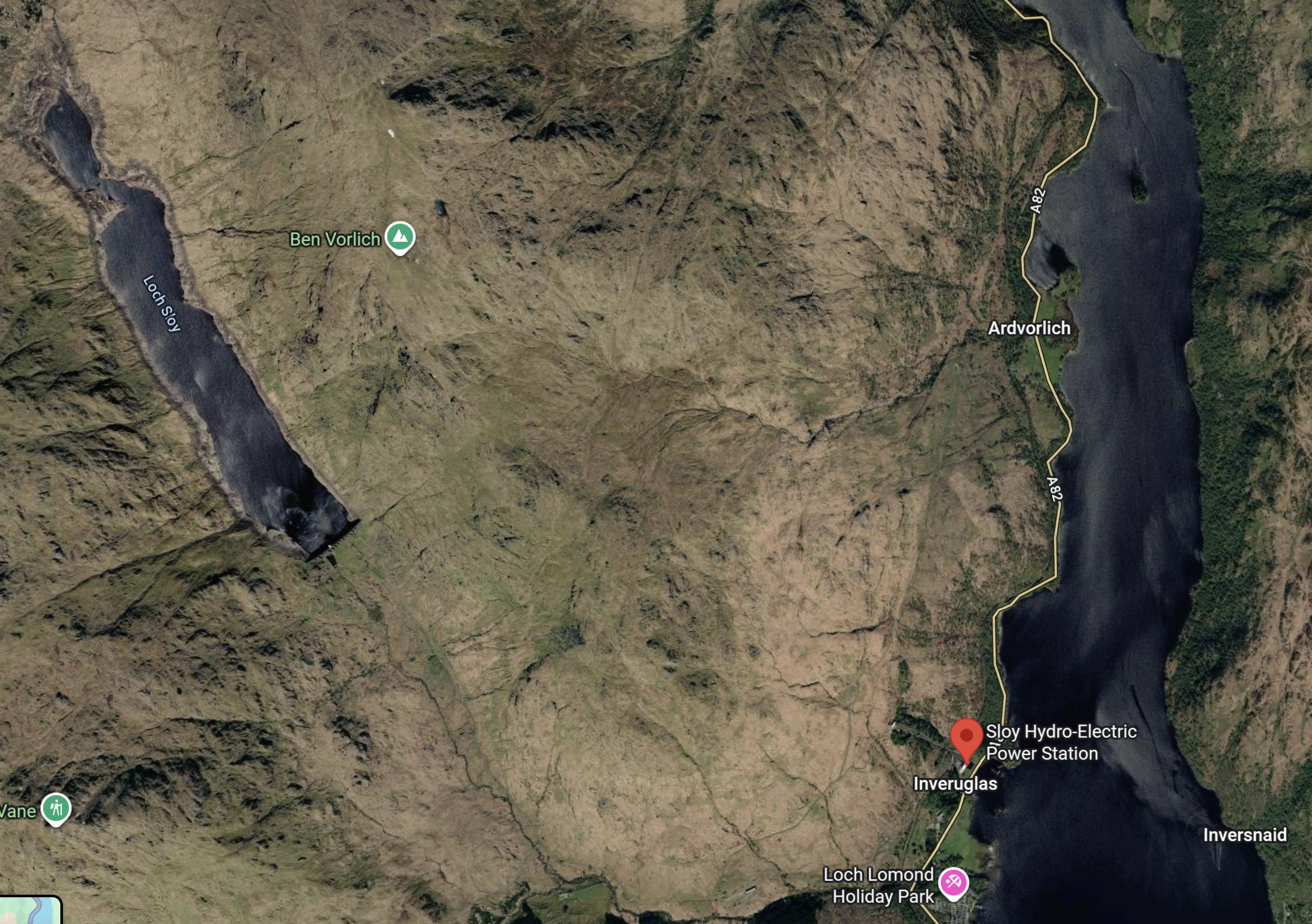
Note.
- Loch Sloy is in the North-West corner of the map.
- Loch Lomond is on the Eastern side of the map.
- The red arrow indicates the main buildings of the LochSloy Hydro-Electric Power Station.
- Loch Sloy is eight-hundred feet above Loch Lomond.
- The total generating capacity of the power station is 152.5 MW.
The facility is operated by Scottish and Southern Energy, and is normally in standby mode, ready to generate electricity to meet sudden peaks in demand. It can reach full capacity within 5 minutes from a standing start.
This second Google Map shows the power station to a larger scale.
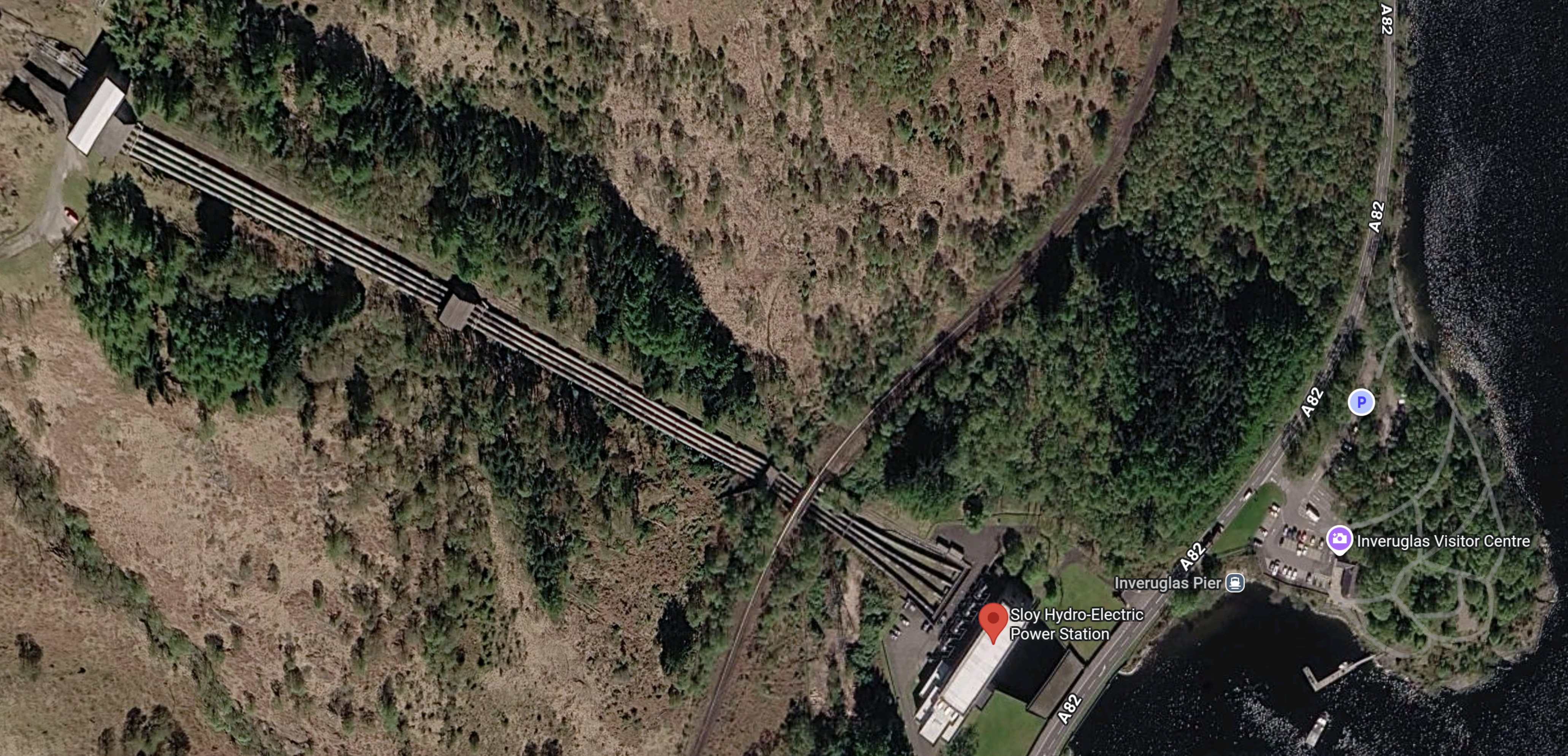
Note.
- Loch Sloy is to the North-West of the North-West corner of the map.
- Loch Lomond is on the Eastern side of the map.
- The red arrow indicates the main buildings of the Loch Sloy Hydro-Electric Power Station.
- The four pipes carry water from Loch Sloy to the actual power station.
- The single-track West Highland Line crosses over the four pipes at their South-Eastern end.
The design of Loch Sloy Hydro-Electric Power Station is typical of many hydro-electric stations all over the world.
This third map is an OpenRailwayMap of the area.
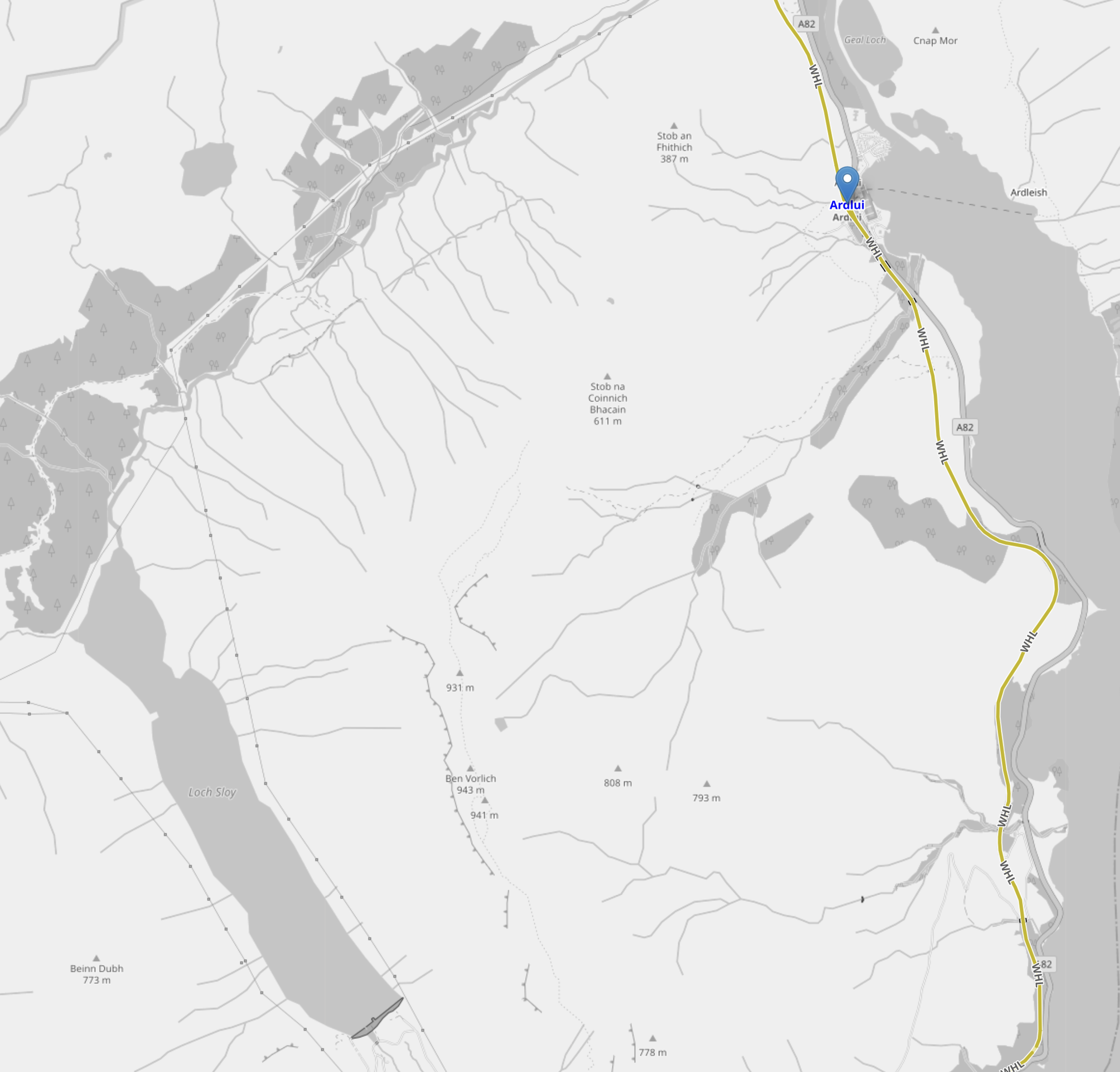
Note.
- Loch Sloy is on the Western side of the map.
- Loch Lomond is on the Eastern side of the map.
- The yellow track is the single-track West Highland Line between Glasgow and Mallaig via Fort William
- The blue arrow indicates Ardlui station.
The railway goes close to the power station.
A Platinum Celebration for Sloy Power Station!
The title of this section is the same as this must-read web page on the SSE web site, which dates from 2020.
Sloy Power Station Development Plans
This second must read web page on the SSE web site is entitled Sloy Power Station.
This is the sub-heading.
We’re Proposing To Convert Our Iconic 1950s Hydro Station To Pumped Storage Hydro
This is the introduction to the development.
In April 2025, we submitted a planning application to the Scottish Government to convert the iconic Sloy Power Station into a pumped storage hydro scheme.
Our proposals would bolster energy security and help provide the large-scale and flexible renewable energy back-up needed in a future UK net zero power system, helping meet the UK Government’s ambition of Clean Power by 2030.
If approved for delivery, the converted Sloy scheme would be capable of delivering up to 16GWh of long-duration electricity storage capacity.
It could provide firm, flexible renewable energy for up to 100 hours non-stop.
It appears that the upgraded power station will effectively become a 160 MW/16 GWh long duration energy store.
Currently, the UK’s largest pumped storage power station is the 1727 MW/9.1 GWh Electric Mountain in North Wales.
The updated Sloy power station will have less output, but more storage capacity, than Electric Mountain.
Should There Be A Railway Station At Loch Sloy Power Station?
Google AI gives this answer in reply to “Loch Sloy Railway Station”.
There was never a permanent public railway station called Loch Sloy, but temporary private platforms like Inveruglas railway station and Faslane Platform railway station served the area. These stops were built in 1945 by the London and North Eastern Railway (LNER) to haul materials and workers—including prisoners of war—for the construction of the Loch Sloy Hydro-Electric Scheme.
Note.
- Surely, similar reasons to those in 1945 could apply to the development of the power station. Materials and workers could be brought in by rail.
- Given, the power station’s historic significance, I believe that it could become a tourist attraction and/or education centre.It could be a stop for the Caledonian Sleeper.
I believe that as time passes, the power station’s historic significance will increase.
Are There Any Other Hydro Power Stations, That Can Be Upgraded To Pumped Storage Hydro?
Google AI can’t find anything at present.
Four Of The Largest Grid Batteries From Fidra
Fidra have made a big splash as they enter the UK’s Long Duration Energy Storage market, with three grid batteries.
Bicker Fen 1 and 2
Capacity – 1.20 GW/2.40 GWh
Web site
Commission Date – BF1-2028, BF2-2029
Thorpe Marsh
Capacity – 1.45 GW/2.90 GWh
Commission Date – Q1-2027
West Burton C
Capacity – 500 MW/1 GWh
Commission Date – Q4-2027
Note.
- All are two-hour batteries.
- Each battery has some drone footage of the site.
How Much Pumped Storage Hydro Will Be Operational In The UK By 2030?
Pumped Storage Hydro is the Bank of England-standard for energy storage.
I asked Google AI, the question in the title of this post and received this answer.
The UK currently has approximately 3 GW (roughly 26-28 GWh) of operational pumped storage hydro (PSH) capacity. By 2030, this capacity is expected to increase, driven by new projects in the pipeline that aim to meet a government goal of up to 8 GW of long-duration energy storage by that year.
Key Projects Expected Online by 2030-2031:
Coire Glas (SSE): A major project in Scotland with a planned capacity of 1.3 GW / 30 GWh, expected to be operational around 2030–31.
Cruachan Expansion (Drax): A 600MW plant in Scotland that has received approval, with construction expected to contribute to the 2030 goal.
Glenmuckloch: Projected to be operational by 2029. In
Other Developments:
Total Pipeline: Developers have identified up to 10 GW of potential projects in the Scottish Highlands and Wales, though not all will be operational by 2030.
Future Growth: The total installed capacity of PSH is expected to grow significantly, with one projection suggesting a rise from 26.7 GWh currently to over 122 GWh by 2034.
To support these projects, the UK government has confirmed a “cap and floor” investment framework to stimulate development of long-duration energy storage (LDES).
For a relatively small island we do seem to be an ideal place to develop pumped storage hydro!
The Coire Glas Pumped Storage Scheme
In The Coire Glas Pumped Storage Scheme, I give more details of this scheme.
The Glenmuckloch Pumped Storage Scheme
In The Glenmuckloch Pumped Storage Scheme, I give more details of this scheme, which is based on a disused open cast coal mine.
Addition Of Pumped Storage Hydro By 2030
This looks to be around 5 GW, but it is just a foretaste of the shape of things to come!
Could A Highview Power CRYOBattery Provide Backup Power For A Large Data Centre?
I asked Google AI how much power does a data centre need and got this answer.
The power requirements for an average data center vary greatly depending on its size and purpose, ranging from 1-5 MW for small facilities to 20-100 MW or more for large hyperscale centers. Small data centers, typically with 500-2,000 servers, might need 1-5 MW of power, while large or hyperscale data centers, housing tens of thousands of servers, can consume 20-100 MW or even more.
As Highview Power are currently building four 200 MW/2.5 GWh CRYOBatteries for the UK, I am fairly sure the answer is in the affirmative.
Another Headache For Fossil Fuels: Liquid Air Energy Storage
The title of this post, is the same as that of this article on Clean Technica.
This article is an honest American look at Highview Power’s liquid air batteries and a must-read.
This is the first paragraph.
Whatever happened to liquid air energy storage? The UK startup Highview Power was going to bring its new liquid air system to the US back in 2019, providing the kind of scaled-up and long duration energy storage needed to support more wind and solar power on the grid. Highview switched gears and headed back home where the grass is greener. Our loss is the UK’s gain…
They first wrote about Highview Power in 2011, which shows how long some of these projects take to come to fruition.
The article also has this view on the state of offshore wind in the United States today.
Perhaps it’s just as well that Highview dropped its US plans when it did. Offshore wind stakeholders in the US were just beginning to find their footing along the Atlantic coast when President Trump took office on January 20 and promptly sent the offshore industry into a death spiral.
If I lived in the US today, I’d thinking about leaving given Trump’s barmy energy policies.
This paragraph from Highview Power’s web site, discloses their backers.
The £300 million funding round was led by the UK Infrastructure Bank (UKIB) and the British multinational energy and services company Centrica, alongside a syndicate of investors including Rio Tinto, Goldman Sachs, KIRKBI and Mosaic Capital.
So at least some American companies believe in Highview Power. KIRKBI is the investment vehicle of the family, that invented Lego.
UK Government Sets 8-Hour Minimum For LDES Cap-And-Floor Scheme
The title of this post, is the same as that of this article on Energy Storage News.
This is the sub-heading.
The UK government has published a Technical Decision Document confirming crucial aspects of its long duration electricity storage (LDES) cap-and-floor scheme, which includes increasing the minimum duration required from six hours to eight.
These three paragraphs give more details.
The document, released by regulator Ofgem on 11 March, details the final overarching rules and requirements for the scheme as well as how it will be implemented, though significant detail still remains to be worked out.
The scheme will provide a cap-and-floor revenue protection for 20-25 years that will allow all capital costs to be recoverable, and is effectively a subsidy for LDES projects that may not be commercially viable without it. Most energy storage projects being deployed in the UK today are lithium-ion battery energy storage systems (BESS) of somewhere between 1-hour and 3-hour in duration (very occasionally higher).
One of the most significant new details of the scheme is that, following industry feedback, the minimum duration for projects to qualify has been increased from six hours to eight hours of continuous rated power.
As a control engineer, I believe this is all good stuff and is a good improvement on the previous regime.
The whole article is a must read and I believe that more investors, will invest heavily in energy storage.
But then the UK, with its massive potential for offshore wind, has the resources to create and fill many GW of energy storage.
Boris once said, that we would become the Saudi Arabia of wind!
Could Highview Power’s Batteries Be Used Offshore?
When I first saw Highview Power’s Liquid Air batteries or Long Duration Energy Storage (LDES), I liked them.
This was partly because I’d investigated large tanks for chemical reactions and I like their mathematics.
But it was mainly because the concept had been developed by a lone inventor in Bishops Stortford.
In Could A Highview Power CRYOBattery Use A LNG Tank For Liquid Air Storage?, I bcalculated, that a 5,000 cubic metre tank could hold about a GWh of electricity as liquid air.
So just as steel and concrete tanks were placed on the sea floor to hold oil and gas, could they be placed on the sea floor to hold compressed air?
I don’t see why not!
I suspect, that it’s all fairly standard offshore engineering.
If you want more storage, you would just add more tanks.
Could They Be Combined With Electrical Substations?
I don’t see why not!
There may be advantages with respect to safety and noise.
Highview Power Releases More Details Of The Hunterston LDES
In a long and detailed press release, these are the first two paragraphs.
London, 15 October 2024: The First Minister for Scotland, John Swinney MSP, welcomed Highview Power Executives to Scotland House in London today as the company announced its intention to develop its Hunterston project in Scotland as part of its multi-billion-pound LDES programme. Hunterston will deliver five times Scotland’s current operational battery storage capacity and is strategically placed in the grid transmission network to maximise the use of Scottish-produced renewable electricity. This follows Highview Power’s funding round in June where it secured a £300 million investment for its 300MWh proprietary Liquid Air Energy Storage (LAES) technology at Carrington, near Manchester.
Supported by the Scottish Government, Hunterston is the first project in Highview Power’s second phase, which comprises four projects across Scotland and Northern England. The 2.5GWh LAES plant at Hunterston will deliver an 8-fold increase in storage capacity on Carrington – to deliver enough power 650,000 homes for 12.5 hours.
Note these important points.
- The Hunterston battery will be the first of four 200 MW/2.5 GWh batteries.
- Together, these four batteries will have a distributed 1600 MW/10 GWh capability.
- For comparison, Dinorwig pumped storage hydroelectric power station, in Snowdonia, which opened in 1984, has a 1600 MW/9.1 GWh capability.
- The second battery will be in Aberdeenshire.
- The Hunterston project will support 1,000 jobs onsite during construction and 650 jobs in the supply chain.
John Swinney, who is First Minister for Scotland, summed the project up like this.
The creation of the largest liquid air energy facility in the world, in Ayrshire, demonstrates just how valuable Scotland is in delivering a low carbon future as well as supporting the global transition to net zero.
Highview Power Plans To Develop 2.5GWh LDES Project In Scotland
The title of this post is the same as that of this article on Power Technology.
This is the sub-heading.
The liquid air energy storage plant at Hunterston is set to deliver a substantial increase in storage capacity
These first three paragraphs add a few more details.
Highview Power has announced plans to develop a long-duration energy storage (LDES) project in Ayrshire, Scotland, with a capacity of 2.5 gigawatt hours (GWh).
The project will be built at Peel Ports’ property at Hunterston, North Ayrshire and will provide five times the existing battery storage capacity of Scotland.
It is supported by the Scottish government and its strategic location optimises the use of renewable electricity produced in the country.
Note.
- Highview Power talks of 200MW/2.5GWh capacity batteries in Scotland on its web site, so I suspect this battery is one of those.
- This battery is as large as some pumped storage hydro systems.
- In UK Infrastructure Bank, Centrica & Partners Invest £300M in Highview Power Clean Energy Storage Programme To Boost UK’s Energy Security, I described the funding now behind Highview Power. The funding appears to be solid, as it includes the UK Infrastructure Bank, Centrica, Goldman Sachs and Rio Tinto.
This is a good start for Highview Power.

