15+ MW Floating Wind Turbines to Be Tested At Norway’s METCentre
The title of this post, is the same as that of this article on offshoreWIND.biz.
This is the sub-heading.
Three companies have signed contracts with Norway’s Marine Energy Test Centre (METCentre) to test new technology aimed at reducing the costs of floating offshore wind by demonstrating floaters equipped with 15+ MW turbines.
These are the first two paragraphs.
According to Norwegian Offshore Wind, this is the turbine size that will be relevant for future floating offshore wind farms.
The test area is located just a few kilometres away from the Utsira Nord zone, where Norway’s first commercial floating offshore wind farm will be located.
This sounds like the sort of sensible test philosophy, that you’d expect from the Norwegians.
Equinor Acquires Minority Stake In Ørsted, Becomes Second-Largest Shareholder
The title of this post, is the same as that of this article on offshoreWIND.biz.
This is the sub-heading.
Norway-headquartered Equinor has acquired a 9.8 per cent minority stake in Denmark’s Ørsted, making it the second-largest shareholder behind the Danish state, which holds a controlling stake in the company.
These are the first two paragraphs.
According to Equinor, the company is supportive of Ørsted’s strategy and management and is not seeking board representation.
“Equinor has a long-term perspective and will be a supportive owner in Ørsted. This is a counter-cyclical investment in a leading developer, and a premium portfolio of operating offshore wind assets”, said Anders Opedal, CEO of Equinor.
Could it also be two Scandinavian companies getting together to put up a stronger front to outside interests?
Are they frightened of the actions that might be taken by Great British Energy and by the Germans with their massive thirst for hydrogen?
Norway Plans EUR 3 Billion Subsidy For Floating Offshore Wind
The title of this post, is the same as that of this article on offshoreWIND.biz.
This is the sub-heading.
The Norwegian government has proposed NOK 35 billion (approximately EUR 3 billion) for a support scheme dedicated towards the first commercial floating offshore wind tender within the Vestavind F and Vestavind B areas.
These are the first two paragraphs.
According to the press release, the government is making progress in following up on its ambitious plan to allocate project areas for 30 GW of offshore wind by 2040.
Norway plans to conduct the next tendering round for offshore wind in 2025. After that, the government intends to hold regularly scheduled tendering rounds and state aid competitions leading up to 2040.
The original press release is called A Responsible Approach To Floating Offshore Wind.
Some politicians and green sceptics might not call three billion euros responsible.
I do suspect that Great British Energy will have to deal in this size of numbers to be able to compete with the Norwegians.
We’ll have to work hard to meet our target of 100 GW by 2040.
But at least as the UK’s target is higher, does that mean that the target should be easier. Or do we have more suitable sea?
Public Views Sought Over Mersey Tidal Barrier Plan
The title of this post, is the same as that of this article on the BBC.
This is the sub-heading.
More details have been revealed about plans to build the world’s largest tidal barrier in the River Mersey.
These two paragraphs outline the project.
A dam-like structure would be constructed between Wirral and Liverpool, with the possibility of cyclists and pedestrians being able to walk across it.
Liverpool City Region Combined Authority believes the project could generate enough clean, predictable energy to power hundreds of thousands of homes for 120 years.
Note.
- A six-week public consultation on the scheme will begin on 1 October, offering local people and organisations the chance to comment on the plans.
- Steve Rotherham, who is the Mayor, has said it will be within ten years.
As Rotherham has called in the Korean experts, he could likely be right.
This is a flythrough of the barrage.
Nuclear Deal Gives Rolls-Royce £2.5bn Boost
The title of this post, is the same as that of this article on The Times.
This is the sub-heading.
UK engineers selected to build a fleet of mini-nuclear power plants in the Czech Republic
These are the first two introductory paragraphs.
Almost £2.5 billion was added to the market value of Rolls-Royce after it was selected to build a fleet of mini-nuclear power plants in the Czech Republic, the first deal of its kind in Europe.
Rolls was selected as the preferred supplier for the development and construction of a number of small modular reactors by the Czech government from a shortlist of seven companies. The exact number of SMRs due to be delivered will be announced in the next few weeks.
Strangely, despite the announcement having a positive movement on the company’s share price, there was no corporate press release. but the Rolls-Royce subsidiary; Rolls Royce SMR did publish this press release, which is entitled Rolls-Royce SMR Named As Preferred Supplier To Build In Czechia.
These four paragraphs are the complete release.
Rolls-Royce SMR CEO, Chris Cholerton, said: “We welcome today’s landmark announcement by the Government of the Czech Republic and the Czech State utility, ČEZ Group, naming Rolls-Royce SMR as their preferred supplier for the development and construction of Small Modular Reactors (SMRs).
“This decision, to select Rolls-Royce SMR from a list of seven potential SMR technology providers, follows a rigorous evaluation process by ČEZ Group. Discussions are ongoing to finalise contract terms and the final agreements are subject to customary regulatory clearances. Details of the agreement will be published at signing.
“This important strategic partnership further strengthens Rolls-Royce SMR’s position as Europe’s leading SMR technology, and will put CEZ, Rolls-Royce SMR and its existing shareholders at the forefront of SMR deployment.
“Rolls-Royce SMRs will be a source of clean, affordable, reliable electricity for Czechia – creating jobs, enabling decarbonisation, reducing the reliance on imported energy and supporting the global effort to reach net zero.”
These are my thoughts.
Rolls-Royce And Small Nuclear Reactors
The Wikipedia entry for Rolls-Royce Submarines, who build the nuclear engines for submarines, indicates that the subsidiary was formed in 1954.
The first nuclear submarine with a Rolls-Royce engine was HMS Valiant, which was commissioned in 1966, according to its Wikipedia entry.
Valiant was powered, until it was decommissioned in 1994, by a Rolls-Royce PWR or Pressurised Water Reactor, that is described in this Wikipedia entry.
Since Valiant, the UK has built nearly forty nuclear submarines for the Royal Navy, and all have been or will be powered by that original Rolls-Royce PWR or derivatives of the design.
The next nuclear submarine project for Rolls-Royce Submarines, will be the nuclear power unit for the SSN-AUKUS, which is described in this Wikipedia entry, which describes the submarine like this in the first paragraph.
The SSN-AUKUS, also known as the SSN-A, is a planned class of nuclear-powered fleet submarine (SSN) intended to enter service with the United Kingdom’s Royal Navy in the late 2030s and Royal Australian Navy in the early 2040s. The class will replace the UK’s Astute-class and Australia’s Collins-class submarines.
The Wikipedia entry for the Rolls-Royce PWR, says this about the power unit for the SSN-AUKUS.
Rolls Royce is building the reactor for SSN-AUKUS, which may be the PWR3, or a derivative.
The PWR3 is the latest version of the original 1966 design.
If you fly on the latest Airbus A350, the aircraft is powered by Rolls-Royce Trent XWB engines, which are the most powerful engines in the Trent family of turbofan engines.
The Trent engine was developed from the RB-211 engine of the 1960s. The RB-211 may have bankrupted the company, but it later provided the cash-flow for the world-class company we see today.
I don’t think Rolls-Royce need have any fears about using sixty years of nuclear reactor technology to build the Rolls-Royce SMR.
Rolls-Royce And The US Department Of Defense Nuclear Microreactor Program
I discuss this in Rolls-Royce To Play Key Role In US Department Of Defense Nuclear Microreactor Program.
Surely to be involved in a key US program, Rolls-Royce’s offering must be tip-top.
Will The Czechs Play Any Part In The Manufacture?
This article in the Financial Times, is entitled Rolls-Royce Wins Pioneering Deal To Build Mini Nuclear pPlants In Czech Republic.
A paragraph sounds very much like active participation to me.
Between the Two World Wars, Skoda Works in Czechoslovakia, was according to its Wikipedia entry, was one of the largest European industrial conglomerates of the 20th century.
This paragraph from the Wikipedia entry describes their history after the First World War.
By World War I, Škoda Works had become the largest arms manufacturer in Austria-Hungary, supplying the Austro-Hungarian army with mountain guns, mortars and machine guns, including the Škoda M1909, and the ships of the Austro-Hungarian navy with heavy guns. After the end of the war and the creation of the First Czechoslovak Republic, the company, previously focused on manufacturing of armaments, diversified and became a major manufacturer of locomotives, aircraft, ships, machine tools, steam turbines, equipment for power utilities, among other industrial products.
The company sounded just like a Czechoslovakian version of Vickers.
I believe that as a teenager, I heard a story, that the armour plate for the British battleship; Duke of York, was smuggled out of Czechoslovakia, under the noses of the Nazis. I can’t find the story on the Internet, but Czech armour seemed to be of high quality, between the two wars.
This paragraph from the Wikipedia entry describes the history of Skoda Works after World War II.
After World War II, Škoda Works was nationalized and split into several companies by the newly communist government in Czechoslovakia. Important products during the Communist era include nuclear reactors and trolley buses.
I don’t think they made nuclear trolley buses, but they might have had the capability.
What happened to the knowledge about all the steelworking needed to make nuclear reactors?
This further paragraph gives an indication. that lack of modern designs killed the business.
The factory concentrated on markets in the Soviet Union and the Eastern Bloc. The company produced a wide range of heavy machinery such as nuclear reactors and locomotives. A lack of updates to its product designs and infrastructure considerably weakened the company’s competitive position and its brand.
Note.
- Can Rolls-Royce and their partner; The Welding Institute (TWI), provide modern designs and techniques to build the parts of reactors for modern SMRs in Czechia?
- The Welding Institute, which is based just outside of Cambridge, describes themselves as the leading engineering institution supporting welding and joining professionals with welding, joining and allied technologies.
- Czechia is also in the heart of Europe and components would be easily shipped by rail or road to European construction sites.
- Wikipedia also says that a lot of post-Soviet trams and trolley busses, were made by Skoda, so the same must count for something.
There will be much worse places to build components for SMRs than Czechia.
Will The Czechs Help With The Soviet Reactors?
If the Czechs built the reactors, they will have a lot of answers about things like.
- Where the Soviet reactors are?
- When will the Soviet reactors need replacing?
- How were they transported?
- How were they assembled?
- What will be the difficult parts to take apart?
Choosing the Czechs for their knowledge as partners seems a good idea.
Conclusion
The Czechs would appear to be good partners for Rolls-Royce.
The Potential For Floating Solar In The UK
The title of this post, is the same as that of this article on Solar Power Portal.
I like the concept and I have written a few posts on the topic, which can be viewed from this link.
The application, I particularly like, is the use of floating solar on reservoirs, which in addition to producing energy, can reduce water evapotation and reduce the forming of algal blooms.
This Google Map shows the farm in the Queen Elizabeth II Reservoir, near Walton-on-Thames.
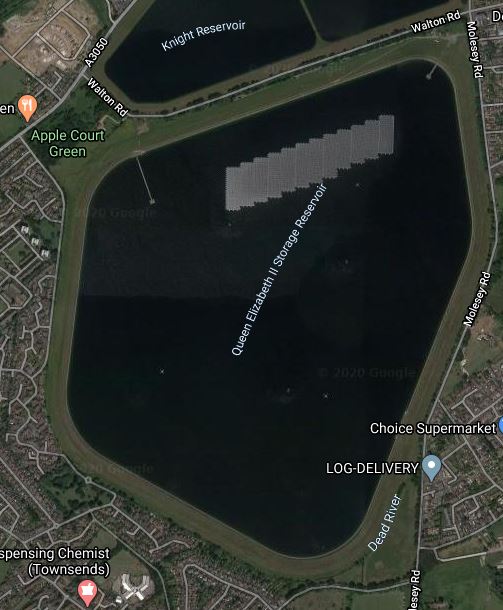
There is also this article in the Guardian, which is entitled World’s Biggest Floating Solar Farm Powers Up Outside London. It gives a good description of the project.
Conclusion
The article is a must-read and we need more floating solar in the UK, especially on reservoirs.
Principle Power Unveils New Floating Wind Foundations For 15 MW+ Turbines
The title of this post, is the same as that of this article on offshoreWIND.biz.
This is the sub-heading.
Principle Power has expanded its WindFloat portfolio by introducing two new semisubmersible floating wind foundation designs, called WindFloat TC and WindFloat FC, which are said to be optimised for 15 MW+ wind turbines.
A large picture and these two paragraphs introduce the new designs.
According to the company, the new designs are natural evolutions of the existing WindFloat technologies that support a wind turbine located on a column in the centre of the platform.
Designed to complement the existing perimeter column designs WindFloat T and WindFloat F, the new solutions share the same 4th generation design heritage and benefits.
Smart Hull Trim System
The article also mentions a Smart Hull Trim System in this sentence.
Some of these include a Smart Hull Trim system to maximise annual energy production and reduce loads.
I would assume that the Smart Hull Trim System, works very much like the control surfaces of an aeroplane or submarine to keep the craft straight and level.
On the Principle Power web site, the various WindFloats are described as follows.
- WindFloat T – Proven WindFloat® design, suitable for tubular construction.
- WindFloat F – A pontoon-based design suitable for flat panel construction.
- WindFloat TC & FC – Center column design solutions, optimized for 15MW+ turbines with stiff-stiff towers.
From work, I did in the 1970s, with two Cambridge University engineering professors, I reckon that the TC and FC designs will be the best.
Conclusion
Whatever way you look at it, a 15 MW+ floating wind turbine, when you consider they can have capacity factors in excess of 50 %, could be a very powerful electricity generator.
1.4GW Of BESS Capacity Could Be Co-Located With AR6 Winners
The title of this post, is the same as that of this article on Solar Power Portal.
These are the first two introductory paragraphs of the article.
Analysis from Modo Energy has revealed that renewable energy projects awarded contracts under the Contracts for Difference (CfD) Allocation Round 6 (AR6) could facilitate 1.4GW of co-located battery energy storage systems (BESS).
While BESS projects themselves cannot directly participate in the CfD auction, projects awarded contracts are able to co-locate with a battery. Following changes to the rules following Allocation Round 4, BESS co-location is now a far easier prospect for generators, and AR6 saw record high levels of awards for solar projects.
Modo Energy have used two rules to decide which projects will have a battery.
Modo Energy analysis suggests that 5GW of the 9.6GW of renewable energy capacity awarded contracts in AR6 could be suitable for, or has already revealed plans for, co-located battery storage. As a result, as much as 1.4GW of BESS capacity could be created as part of new renewable projects resulting from the AR6.
Using an average ratio of 60MW of BESS capacity for every 100MW of solar generation capacity, Modo Energy has calculated that 1GW of this potential BESS capacity could come from solar projects alone.
Longfield Solar Energy Farm
The article and related documents also say this about Longfield Solar Energy farm.
- This could be the largest battery to co-locate with renewables from this allocation round.
- The project does have a web site.
- The farm has a 399 MW solar array.
- The web site says that the project will store or export up to 500 MW to and from the grid.
- The project is being developed by EDF Renewables.
- The solar farm appears to be North-East of Chelmsford.
The project should be completed by 2027/28.
Conclusion
As time goes on, we’lll see more and more batteries of all kinds co-located with renewable resources.
Ireland Joins Forces With EIB For Offshore Wind Port Upgrades
The title of this post, is the same as that of this article on offshoreWIND.biz.
This is the sub-heading.
The European Investment Bank (EIB) and the Irish Department of Transport have established an advisory cooperation to assess capacity, demand and financing strategies for the development of port infrastructure for offshore wind projects in Irish waters.
These are the first two paragraphs.
Signed by the Irish Minister for the Environment, Climate, Communications and Transport, Eamon Ryan, and EIB Vice President Ioannis, the advisory cooperation aims to evaluate the scale and nature of investment needed to upgrade Irish ports.
The initiative is said to unlock an estimated EUR 30 billion in investment in offshore wind projects in the country which plans to have 20 GW of capacity installed by 2040 and 37 GW by 2050.
It looks to me, that the Republic of Ireland will become a big player in the production of electricity from offshore wind.
I also suspect that Northern Ireland will play its part too!
 The Anonymous Widower