London Mayor Sadiq Khan Plans TfL ‘Junk Food’ Advert Ban
The title of this post, is the same as that of this article on the BBC.
I don’t buy junk food, except for the odd bag of gluten-free chips from McDonalds, where there is nothing else I can find.
The move is to cut obesity in the capital.
I think a relately problem is the steadily-growing numbers of fast food shops in places like Kingsland High Street, near where I live?
- They offer unhealthy food.
- Few offer food for those like me, who have special needs.
- They contribute largely to litter all over the place.
- They are always dropping junk mail through my door.
Walk past these shops, just after school has finished and they are full of kids, stuffing themselves.
So what is Sadiq Khan doing to curb the numbers of the unhealthy places? Precisely, nothing!
In the BBC article, Karl Mercer the BBC corespondent says this.
It seems the mayor is trying to have his (low-calorie) cake and eat it.
Perhaps aware that high sugar, fat and salt ads bring in around £13m for TfL he says his new ban will not apply to companies – just to their less healthy products.
I think it is unworkable policy, that if it results in reduced advertising spend for TfL, could result in higher fares or Council Tax.
Scotland’s New Alcohol Pricing Laws
Scotland now has new alcohol pricing laws, as is detailed in this article on the BBC, which is entitled Scotland Ends Cheap Booze As Minimum Price Starts.
A minimum price on alcohol of fifty pence will certainly have effects, although my preferred drink of Suffolk-brewed low-alcohol gluten-free real ale from Marks and Spencer, which is just 0.25 units for a half-litre bottle at £2.60, would not be affected. I don’t think it’s even sold in Scotland, as it’s a very soft Sassenach drink.
I feel that the minimum pricing will either work very well or be a disastrous failure.
I think it depends on how law-abiding, the average Scot is!
The article in the Guardian is entitled Smoking Rate In UK Falls To Second-Lowest In Europe .
This is said.
In 2016, 15.8% of adults in the UK smoked, down from 17.2% in 2015, according to data from the Office for National Statistics (ONS).
Some 15.5% of adults currently smoke in England, rising to 18.1% in Northern Ireland, 17.7% in Scotland and 16.9% in Wales.
I suspect the Scottish government hope to see similar falls in the sales of alcohol, that the various smoking bans have brought.
If I walk into all the local shops round here, cheap booze is prominent, but I rarely see anybody drunk on the street and never on the buses.
On the other hand, I can’t help feeling that the higher booze prices will be just another tax on those, who can’t afford it.
Re-Use Rather Than Re-Cycle
I remember in the 1970s or 1980s hearing the Research Director of Pilkington on Radio 4, giving a defence of using glass as packaging.
He argued that one of the problems with glass coffee jars and sauce bottles was that after use and a quick wash, they looked like they could be refilled with new product. In those days, coffee jars were often used for the storage of small items like screws, clips and dry foods like rice and pasta.
Now we’ll buy a designer jars, like these from IKEA.
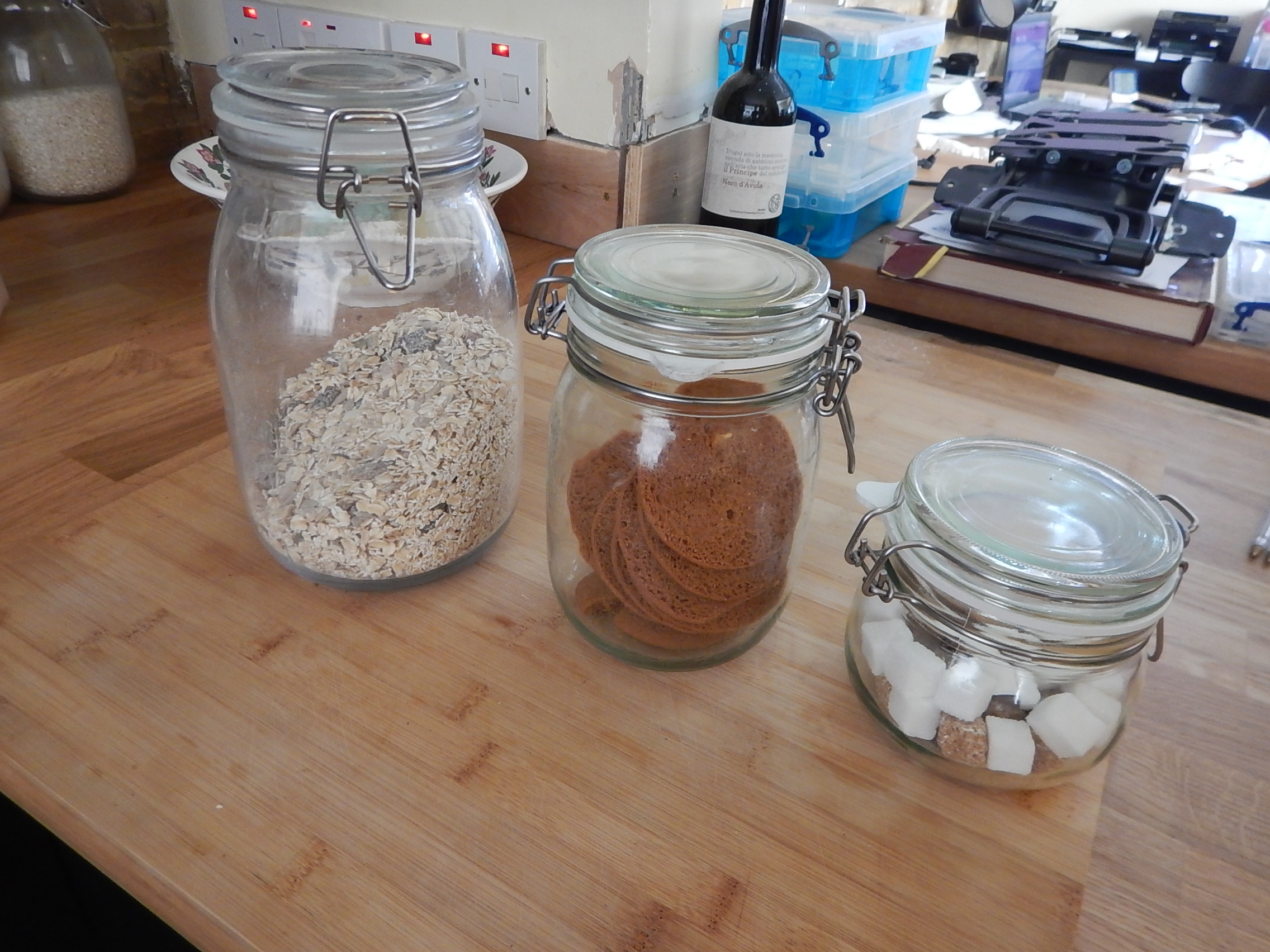
In those days a lot of milk and beer bottles were returned to the dairy or brewery, but are we going to send empty beer bottles back to some of the exotic places from where they came.
The Research Director argued, that the best thing to do with glass bottles was to smash them up and re-use for other purposes.
One of the uses he discussed was to use broken glass as an aggregate substitute in road construction. This does happen and I’ve read of by-passes being constructed on a bed of broken glass and seen broken glass being used under paving slabs.
Glass came from materials dug out of the ground and it’s going back under.
He also said that to create new bottles was cheaper, than reusing bottles, unless there was a direct link, like milk rounds from a dairy.
This morning on wake Wake Up To Money, they were discussing cutting the use of plastics. So I sent in the following text.
I wonder if black-plastic ready-meal trays could be replaced with a light-weight glass variant. Along with bottles, they would just be washed and crushed after use for aggregate. Several roads have been built on broken bottles.
It was read out.
Consider.
- We drink a lot of beer that comes in glass bottles. One of my beer bottles from Marks and Spencer weughs 280 grams.
- They would be oven-proof, microwave-safe and freezable.
- You could eat your meal out of the dish!
- They might save on washing-up time.
- They could go in the dry-recycling after a quick rinse.
But above all, they may have other uses.
I also suspect that the other pakaging could be similar.

Could a piece of plastic be glued to the tray in the same way?
My idea is probably total rubbish!
But some of Marks and Spencer’s pies already come in just an aluminium tray and a cardboard box.
They need to be cooked in an oven and are not microwavable.
The pie goes down the gullet and the aluminium tray and the cardboard box, go into the dry recycling.
One thing I will be right about, is to say that there are some clever packaging scientists and designers out there, trying to create a freezable ready-meal, that can be cooked in a microwave, that isn’t protected in anything that can’t go direct in the dry recycling.
Charging For Single Use Plastic. Aluminium And Glass Drinks Containers
I’m all for this, but I feel we should look at how the empties are returned and refunds are obtained.
The Norwegians seem to have solved this by means of expensive machines, which give vouchers back.
But there must be something simpler.
A few of my thoughts.
Marking Chargeable Containers
All containers for which a deposit is made, should be clearly marked with symbol, which says that it is worth something to return.
Returning To Shops
Obviously, people will want to do this, but I suspect a lot of smaller shops will ask shoppers to take the empties elsewhere.
They might install a machine, but many shops couldn’t afford the expense.
Collecting For Charity Or Local Causes
Suppose, you had a simple steel bin with holes in the top, like those we had in Suffolk for bottles.
Anything that had the correct symbol could be put in the bin.
These bins would then be collected and sorted automatically at a large plant.
By weighing each bin and knowing its location and owner, it would be possible to apportion the refunds to the charity.
National charities might put recycling bins in car parks or prominent places.
But supposing, your area has a run down children’s playground, that everybody wants to improve.
A recycling bin is placed by the playground and everybody is asked to use it for bottles and other containers. All proceeds would go to the playground fund, with a collateral benefit, that the area of the playground wasn’t strewn with empty bottles.
Automatic Sorting Of Containers
If you have a large plant sorting the containers, it can do a better job, than the most expensive machine on the street.
- It would be able to sort plastic, glass and aluminium containers.
- I suspect technology exists to remove labels
- Glass would probably be washed and crushed.
- It could also sort out ordinary rubbish like fast food wrapping and boxes, newspapers and disposable nappies.
- Any washing water would be collected and reused.
The plant would calculate the various combination of materials and if the weight of the rubbish would known, could calculate the return.
Extending The System
There must be other containers, that are also recyclable. In my cupboard, I have a large glass mayonnaise jar, which would probably be recyclable if washed and the top is removed.
So perhaps the system could accept this bottle without its top. It would be washed and crushed, so it could be used instead of quarried aggregate.
Conclusion
There are much better ways to handle the charge on a drink container.
I would reckon, that some of the biggest recycling organisations in the UK are working on a solution, that benefits us all and is as widespread as possible.
Thoughts On Alcoholism
In the last month or so, I’ve done something that I’ve never done before in my life.
I’ve drunk perhaps half a bottle of beer when I’ve got up. Admittedly, I’d left the bottle half finished by my computer.
It was good.
In the 1960s, I could drink a lot of beer. I just seemed to need it.
About that time, I decided I needed to drink large amounts of fluids and swapped to tea and Coke.
My doctor understands my needs for fluids and the practice nurse has the same problem. The nurse puts it down to leaky skin, which he has.
I actually love walking in the rain, so that might help explain it. We all live by the laws of physics.
My father warned me off alcohol in a practical way, by giving me halves of Adnams down at Felixstowe Conservative Club, whilst we played snooker, when I was about fourteen.
My father drank a lot of fluids, but I never saw him drunk and most doctors would say he was a sensible drinker. Like me, he also drank a lot of tea!
He had a reason to control his drinking! His father had died from complications of being an alcoholic at 40, when my father was about twenty.
My grandfather had lived just around the corner from where I live now and my father had once told me, he had drunk large amounts of beer and had moved on to whisky.
Around 1900, there was very little to drink except beer, so did my grandfather’s need for fluids mean that he turned to what was available?
Now I like a good beer and know of its properties to slake a thirst when you’re dry. I’ve worked in foundries in the 1960s and beer was always available.
So is there a type of person, who needs a lot of fluids and if beer is available they turn to it. In some cases does this lead to alcoholism.
As to myself, I must have gluten-free beer and because I’m on Warfarin, I must keep my alcohol consumption down.
So I now drink a gluten-free beer, that is just 0.25 of a unit and tastes like real beer from Marks and Spencer.
But then it is real beer, as it is brewed in Southwold by Adnams.
My life has come full circle.
A Quick Fish Pie Supper
I like fish pies and there are several entries for fish pie. If I have time, I will cook my version of Jamie Oliver’s Fish Pie.
But today, I found a new gluten-free fish pie in Marks and Spencer, so I had to try it.



I cooked it in the microwave and it was of a very different type to Jamie’s, being creamy rather than having a good proportion of vegetables. Although, both have a potato topping, rather than a pastry pie-crust.
It was well-worth buying, cooking and eating, at a cost of £3.80 for one.
Note the tomato sauce in the pictures. I’ve found some very dodgy fish pies and cooked some of my own, in my time, that needed it.
This one certainly did not!
Next time, I’ll cook it in the oven, although I think both methods will work, but you may get a different texture of pie.
A New Curvy Path At Highbury Corner
The results of the consultation on Highbury Corner are on this page on the TfL web site.
Two options are presented for the arboretum in the middle of the roundabout.
- 14 per cent chose Option 1 (keep the arboretum closed to the public)
- 56 per cent chose Option 2 (open up the arboretum for public use)
I voted for Option 2, as it will be a more pleasant walk from bus to train station, on a new path through the trees.

Note.
- The station is in the top-left with a large pedestrian area in front.
- I would walk to the station along the leading through the trees
Both options include a new curvy path between the original arboretum and the pedestrian area in front of the pub and McDonalds.
One picture shows a possible cafe on the curvy path.

I like that idea! But no anonymous foreign-registered unhealthy tax-avoiding chain! Please!
Why I’m Not Sorry About Kentucky Fried Chicken
The troubles of Kentucky Fried Chicken don’t bother me one smallest of an iota.
In fact as a coeliac, I think it is huge laugh.
This page on their web site is the allergy and nutrition list of their menu.
It is probably the most coeliac-unfriendly list, I’ve ever seen from a restaurant chain and treats our gluten-free dietary needs with contempt.
It says to me that KFC believe, that anybody who doesn’t eat gluten is a Grade A Pain-In-The-Arse, and deserves to be poisoned.
The people I feel sorry for are kids, who are coeliac, who probably miss out on a few parties.
I’ve never knowingly eaten any Kenchucky Fried Chicken products in the past and never will in the future, unless the chicken-free problems brought about by DHL, result in a menu that doesn’t try to kill me!
Gluten Not Optional
I spent last night in the Ibis hotel at Karlsruhe and had a very good supper in Baden-Baden.
This morning, I’m on my way to Stuttgart, so I thought I’d pick up something at the station.
Usually, on German stations, I can find something like fruit, but here there were nothing gluten-free except a bag of McDonald’s fries, coffee etc and water.
I assume all German coeliacs are stick-thib, as they aren’t allowed to collect snacks on the run!
Pizza Again Last Night
It’s not often, I’ve ate pizza two nights running, but last night I went to Pizzesco after Cielo di Berlino in Berlin.
Both were gluten-free and washed done with Lammsbrau gluten-free beer.
If you give Pizza Express 7 out of 10, then Berlin would be 8 and Munich 9 or 10.
The only trouble with Pizzesco is that it gets busier every time I go.
 The Anonymous Widower