The NHS And Disruptive Innovation
I’m a great fan of disruptive innovation. It summed up in Wikipedia as follows.
A disruptive innovation is an innovation that helps create a new market and value network, and eventually goes on to disrupt an existing market and value network (over a few years or decades), displacing an earlier technology.
In some ways the classic disruptive innovation is iTunes, where Apple changed the music industry totally.
I, of course, would be a fan, because my first great success was Artemis, which took the project management industry out of the domain of large mainframe computers and cumbersome management structures into a computer that fitted under a desk.
But I have given this post, the title I have, as the NHS and other health systems is coming under pressure from disruptive innovation.
My other big innvation success was also disruptive innovation.
I was one of the backers of the technology that led to Respimat, a metered-dose inhaler.
That device seems to be too disruptive, as despite many years of development, I don’t think it is in general use.
It doesn’t use any batteries, compressed gases, nasty chemicals and is affordable to be throwaway. But despite their HCFC propellants, the incumbents in the healthcare industry, have not given market share.
But I have the satisfaction, that because of my scientific knowledge and practical experience, I spotted that the guys I backed could do something special. At least too, when I sold my share, I was well rewarded.
I do feel though that the NHS doesn’t do things in the same way as perhaps John Lewis would, when it comes to handling new methods of working.
As an example I was talking to my excellent GP about how having my cholesterol results on my blog, helped the doctors in Hong Kong when I had my stroke. I said it would be great if all our medical records were searchable on line. We were also discussing a small operation I had on my nose ten years ago and wondering if it should be done again to stop the nose bleeds I sometimes get.
We then both said that computerisation had been an expensive farce, but we were both agreed it would be a good thing, especially if like me you travel a lot. He did say Google launched something called Google Health, but that has now been discontinued. Read about it here.
So did the general conservatism of health professionals and a lot of the general public kill the project. Google don’t have many failures.
Reading about it, it seems that it would have been something I would have used.
If I look too at my Coaguchek, that is classic disruptive innovation. I don’t know how many use the device in the UK, but I suspect it’s not a large proportion of those who could benefit from such a device.
I suspect though that in a few years this device and its probably simpler successors will be as accepted as the monitors used by diabetics.
Small personal patient used technology like this will become more common. After all, we now have a population, who love their gadgets and what better gadget is there, than one that helps you improve your health.
The NHS is going to have to get used to new technology and especially where that technology shows substantial cost savings. But a lot of it, will mean changes in methods and management structures.
Disruptive innovation will improve the NHS, but it will be an NHS with a different number and type of hospitals, and staff not always deployed as they are now.
My Non-Existent Trickle Vents
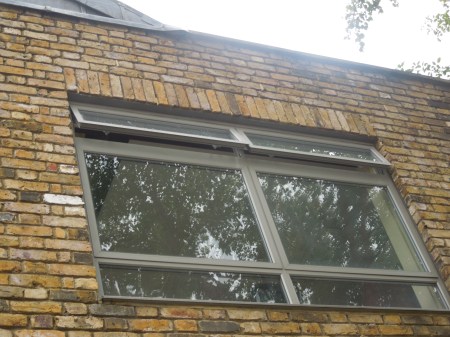
All windows in a house are supposed to have trickle vents. My windows don’t! Wikipedia says this about the effect of trickle vents on the indoor environment.
Trickle vents will help avoid problems associated with poor ventilation in naturally ventilated spaces, including, reduced risk of condensation, avoided over ventilation (minimizing energy consumption), improved comfort through draft avoidance.
So I’ve now opened the top windows to see if this makes the house healthier for me.
My Non-Existent Trickle Vents
it looks like I could have just scored another victory over the dreaded Jerry
What Doctors Won’t Tell You
The Guardian puts the boot in to a publication, some think should be banned, in this article.
It gave me a good laugh.
I’ve had several people say that if I eat bread made from organic wheat, it won’t harm me. But not for some years, as now the organic freaks are often on a wheat-free kick as well.
My INR For September 2013
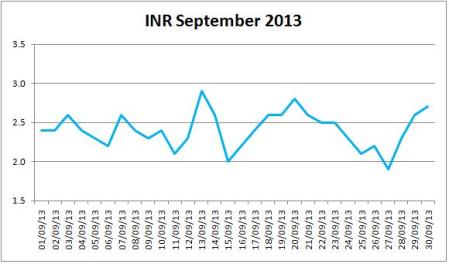
As September is now finished, I can show a graph of my daily INR tests for September 2013.
My INR For September 2013
The average INR for the month was 2.4 with a standard deviation of 0.2. This is well within the range of 2 to 3 and just below the target of 2.5.
Note the drop in INR starting at the 19th. This was when the weather started to get colder and fresher. The lowest value of 1.9 on the 27th was after a particularly cold night.
Compare this graph with previous results for August 2013.
The Hospital Test
As I travel around the country, I like to apply the hospital test to all of the places I visit.
Imagine, that a friend or relative has been taken ill or had an accident and is in the local hospital!
By going to the local main station or airport, can you get to that hospital easily using information available there?
Some hospitals are easy to do the last link, but for others, the information is sadly lacking.
I’ve just looked up Barnet Hospital, where both my in-laws died. I did find the nearest station and bus information on the web site, but it wasn’t on a front page link, as it seemed to assume most will drive. On the Transport for London web site, I did find a spider map for the buses to and from the hospital. But not in every case, will I have such good local knowledge!
Incidentally, it seems that most London hospitals have their own spider maps showing all buses around the hospital. The only one I can’t find is one for University College Hospital.
How does your local hospital stack up?
Remember a high proportion of visitors will not be in the first flush of youth and many will have mobility and eyesight problems.
Labour Has A Good Idea
Jon Cruddas is reported as saying in several papers, like here in the Mail, that parents will lose benefits if their children don’t have the MMR vaccination.
I’m all for this, as I know a few people, who were born before vaccination was possible, who after measles have developed problems.
It’ll also help to generate a lot of jobs in the PR and legal areas, as the legislation is fought. So it could be very good for the economy!
A Rubbish Bag Failure
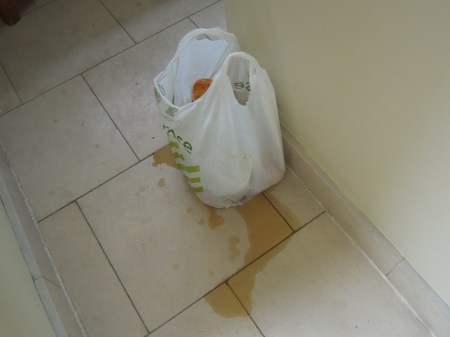
I had a rare rubbish bag failure this morning.
A Rubbish Bag Failure
Despite my stroke, I seem to drop things rarely, but this was caused by a carton of chicken stock, that wasn’t fit for purpose.
Do We Put Our Heating On At The Right Time?
I have been puzzled, why after C died, I started to develop hay fever like symptoms. I blogged about it first here in April 2010, which was before I had the serious stroke.
I have just read this thoughtful article on the BBC entitled “Is It Too Early To Put The Central Heating On?”.
i asked someone who knew us well, and they said that the house was always very cold.
Now both C and myself, were brought up in cold houses, with perhaps hers a little bit warmer than mine because she was down in the valley at East Barnet and I was on top of the hill at Cockfosters.
When I met her, she had the worst chilblains I’ve ever seen. They disappeared fairly soon afterwards and she always put it down to wearing Scholl sandals. She incidentally wore those virtually until the day she died. I suspect there was not one day in the forty years we were together she didn’t put a pair on. She even drove in them. She always said, I should, as they would keep my feet warm.
But could the death of her chilblains be put down to her not living in her parents’ house any more? She was in a warm Hall of Residence in Liverpool and afterwards we lived generally in warmer housing, until we moved to Suffolk.
My house as a child was very cold and I was always having time off with a hat fever like runny nose. In fact one of my memories is my mother boiling up handkerchiefs on the gas stove for my father and I. He suffered terrible catarrh and was always sucking on dreadful menthol sweets. I remember, he used to keep his garage very warm and I would often go there to talk to him and listen to football on the Light Programme. Did I go because it was warm?
But everything changed when my grandmother died, as my parents could now afford more electric fires and perhaps more importantly, I got the big sunny bedroom at the back of the house. I was also about twelve and could spend more time in the fresh air, when it wasn’t cold.
Over the years in Suffolk, C and I developed our own ways of living with cold weather.
She always wrapped up well, did a lot of exercise and I usually had a fan heater playing on my feet.
I did keep my car hotter than she did. I seem to remember, she adjusted her Porsche to 22.5°C. I liked it warmer.
I can also remember staying in hotels in London several times when C complained very much about the high temperature.
When she died in 2007, I did a lot of things to warm the house up, like putting in extra radiators and buying the thickest duvet I could find. I have since bought a thinner one.
It does seem strange that my rhinitis started about that time.
So it does seem that temperature and humidity, has a lot of effect on my rhinitis.
One thing I’m going to do, is make sure my heating and ventilation is completely and precisely controllable.
A Coaguchek Failure
I get on well with my Coaguchek, but I did have a failure in Sweden.
The batteries chose to run out and I then had to reset the device.
Unfortunately, it is not an easy process to do without the manual, which I deliberately had not taken.
An ideal device would have a quick setup, where it took defaults for everything. After all, you always write down all your results and don’t rely on things like the date set into the device.
Everything should be simple and intuitive. It isn’t and the manual is needed too often. It also just gives you error numbers, rather than a proper error message.
The outcome was that I missed one of daily tests. Not important for me, as I just took the average Warfarin dose of 4 mg.
 The Anonymous Widower