Vere Promises East Midlands Bi-Modes In 2022
The title of this post is the saqme as that of this article on Rail Magazine.
This is the first paragraph.
East Midlands Railway will have its entire bi-mode fleet in traffic by December 2022, according to Baroness Vere, the Government’s transport spokesman in the House of Lords.
This statement means that whoever manufactures the trains has just over three years from today to design, build and test the trains.
This paragraph from the article talks about how Bombardier and Hitachi would design the trains.
It’s known that Bombardier and Hitachi are interested in the contract, but both will be supplying new designs, with the former offering a bi-mode Aventra while the latter will offer an AT300 (the Intercity Express Programme platform) but with shorter vehicles.
What do we know about these two trains?
Bombardier Bi-Mode Aventra
In the July 2018 Edition of Modern Railways, there is an article entitled Bi-Mode Aventra Details Revealed.
As is typical with Bombardier interviews, they give their objectives, rather than how they aim to achieve them.
In Bombardier Bi-Mode Aventra To Feature Battery Power, I said this.
The title of this post is the same as this article in Rail Magazine.
A few points from the article.
- Development has already started.
- Battery power could be used for Last-Mile applications.
- The bi-mode would have a maximum speed of 125 mph under both electric and diesel power.
- The trains will be built at Derby.
- Bombardier’s spokesman said that the ambience will be better, than other bi-modes.
- Export of trains is a possibility.
Bombardier’s spokesman also said, that they have offered the train to three new franchises. East Midlands, West Coast Partnership and CrossCountry.
Very little more can be gleaned from the later Modern Railways article.
Consider.
- Aventras are designed to a modular concept.
- Bombardier have finally got the software for the train working to a high standard.
- The trains are designed for ease of manufacture, at a high rate.
- Development of the bi-mode train must have started before June 2018.
- Christian Wolmar disclosed the objective of a 125 mph Aventra in February 2017.
- I have seem references to Aventras, being tested at 110 mph.
On the balance of probabilities, I think it is very possible that Bombardier can deliver a full fleet of 125 mph bi-mode trains with batteries before the end of 2022.
Hitachi AT-300
Consider.
- Class 802 trains are a version of the AT-300 train, which in turn are a member of Hitachi’s A-Train family.
- Class 802 trains are successfully in service on the Great Western Railway.
- Class 385, 395, 800 and 801 are all members of the A-train family and are closely related to the Class 802 train.
- The A-Train is a modular family.and different numbers of cars and car length, shouldn’t be a problem.
- Hull Trains ordered their fleet of five Class 802 trains in November 2016 and they will enter service around December 2019 or early in 2020.
- First Group ordered five AT-300 trains in March 2019 and they will enter service in Autumn 2021.
If the order has been placed in the last few months, there is every chance that Hitachi could deliver a fleet of new bi-mode trains for service in December 2022.
Stadler Flirt
These aren’t mentioned in the Rail Magazine article, but they were mentioned as a possibility for the order in an article by Roger Ford, which was entitled East Midlands IC125 Dilemma, in the June 2019 Edition of Modern Railways.
This is an extract from Roger’s article.
In theory, Stadler should be in pole position. Itis also supplying Abellio’s Greater Anglia franchise, where Flirt bi-modes are running on test.
As they haven’t had any serious problems yet, and they are Swiss, everyone thinks they are amazingly efficient and wonderful. Whjich may turn out to be the case.
In the end, Roger rates their chances as slim.
But Stadler certainly has the technical capability to produce a 125 mph bi-mode train.
Electric Trains To Corby
When the electrified St. Pancras and Corby service opens in December 2020, a round trip will take three hours.
This means that as few as three trains would be needed to provide the service.
The specification would be.
- Electric traction
- Twelve cars and 240 metres long.
- 125 mph capability.
- Three trains and a spare would probably be needed by December 2020, with a further three trains by December 2021.
Abellio would also probably like the trains to be very similar for drivers and staff.
Currently, it appears that the electric services to Corby, will be run initially by cascaded Class 360 trains.
- But with a bit of juggling of production, Bombardier, Hitachi and Stadler might be able to manufacture, the four trains needed to start the service in December 2020.
- Abellio also have Class 360 and Class 379 trains working on Greater Anglia, that are likely to be replaced before December 2020.
So they have a sensible back-stop.
How Many Trains Will Abellio Need?
The current service is two trains per hour to both Nottingham and Sheffield.
These are fastest times.
- London and Nottingham is one hour forty minutes
- London and Sheffield is two hours
Even if there is a bit of a speed increase, it looks like at least eight trains will be needed for both services.
As to train length, I doubt five cars will be enough on all trains.
- Some services are currently run by six and eight-car HSTs.
- Have Abellio promised more seats?
- Abellio will be extending some Sheffield services to Rotherham, Barnsley and Leeds.
- It has already been stated that the Corby trains will be 240 metres long
- So will we see a uniform fleet of longer trains?
There are some short platforms, so I suspect Abellio will buy a mixture of full-length 240 metre-long trains and half-length 120 metre-long trains, as several train companies have done.
I feel we could see something like eight full length trains and perhaps twelve half-length trains.
I have calculated that seven full-length trains are needed for Corby.
Adding this up gives the following.
- Eight full-length bi-mode trains of ten-cars.
- Seven full-length electric trains of ten-cars.
- Twelve half-length bi-mode trains of five-cars
This gives a total of 27 trains of a total of 210 cars, of which 140 are bi-mode and 70 are electric.
All of this is based on running the current service with new trains.
abellio Greater Anglia have not not just done this in East Anglia, but have purchsed extra trains to add new services and increase frequencies.
So I would feel, that these trains are a minimum order, if Abellio are not doing any expansion.
Daily Telegraph Report – 19th July 2019
A report in the Daily Telegraph on the 19th July 2019, which is entitled Blow For Bombardier’s Derby Plant As £600m Train Contract Goes To Hitachi, says the order has gone to Hitachi.
- Value is quoted at £600million.
- A formal announcement is expected next week.
Has next week already passed without an announcement from Abellio?
I do find it strange, that there has been no reference to the Telegraph report in local sources around Derby.
This article on Railway Gazette is entitled Trains Ordered For 2021 Launch Of ‘High-Quality, Low Fare’ London – Edinburgh Service.
FirstGroup have ordered AT-300 trains.
- All-electric.
- Five trains of five-cars.
- A total order value of £100 million.
- Order placed in March 2019
- Service starting in Autumn 2021
This works out at four million pounds per car.
Earlier, I calculated that Abellio needed to buy 140 bi-mode cars and seventy electric ones.
Assuming that Abellio run the Corby services with refurbished Class 360 trains, then 140 carriages will cost £560 million.
But this would mean the following.
- Abellio would be running two separate fleets on the Midland Main Line.
- The Corby services would run below the operating speed of the route.
- Expansion would mean the purchase of more trains.
This is very different to their philosophy in Abellio Greater Anglia.
- Class 745 and Class 755 trains are very similar to drivers and other staff.
- Both trains can operate at 100 mph on the Great Eastern Main Line.
- Abellio Greater Anglia have significantly increased the size of their train fleet.
I believe that Bombardier, Hitachi and Stadler can all met this schedule.
- Deliver four 125 mph electric trains by a date early enough for a December 2020 start for Corby services.
- Deliver another three 125 mph electric trains by December 2021 for two trains per hour to Corby.
- Deliver the fleet of 125 mph bi-mode electric trains by December 2022 for Derby,Nottingham, Sheffield and beyond.
At four million pounds for a car for a Hitachi train, this works out at £840 million.
So could it be, that Hitachi have thrown in a good discount to make sure of the order.
It will be very interesting, when Abellio announce their order.
Interim Trains
Baroness Vere also discussed the other trains on the Midland Main Line.
This was the final two paragraph from the article.
As it stands, the 12 High Speed Trains cannot operate in passenger traffic beyond December 31 2019 this year, as they will not meet new accessibility regulations.
When announcing the Abellio contract win in April, Government confirmed that four Class 180s would transfer from Hull Trains to EMR. There was also the possibility that the LNER HSTs could also transfer to the MML, although these do not meet the disability requirements either.
So what is going to happen?
It appears that the four Class 180 trains and the twenty-seven Class 222 trains of various lengths will have to manage.
But I do think, that Baroness Vere’s statement.
East Midlands Railway will have its entire bi-mode fleet in traffic by December 2022.
Is very welcome, as the HSTs will retire on the 31st December 2019 and there will be less than three years of a reduced fleet.
These points should also be noted.
- In December 2020, when the electrification goes live and new electric trains start running between London and Corby, there will be a few more Class 222 trains available.
- The Corby electric trains, will also add capacity between London and Kettering.
- I don’t think it unlikely, that some other trains are rustled up to fill the gaps using perhaps Mark 4 coaches and Class 43 locomotives.
I hope for Abellio’s and their passengers sake, that what Baroness Vere said, comes true!
Could Abellio Go For A Safety-First Solution?
Consider.
- Abellio Greater Anglia’s new Class 745, Class 755 and Class 720 trains are all running, if not years, but a few months late.
- There has been nothing serious and Greater Anglia only has one fleet that is not PRM-compliant; the London and Norwich expresses.
- Providing all goes reasonably well with the introduction of the new Class 745 trains, Greater Anglia’s fleet will be fully PRM-compliant, by the end of the year.
But if they had opted for off-the-shelf Hitachi Class 801 trains for London and Norwich, there might have been less worry. On the other hand, Hitachi way of making trains, by shipping the bodies from Japan probably doesn’t lead itself to high productio rates.
But for Midland Main Line services, Abellio East Midlands Railway aren’t looking at a large fleet of trains.
I estimate they could need.
- Eight full-length bi-mode trains of ten-cars.
- Seven full-length electric trains of ten-cars.
- Twelve half-length bi-mode trains of five-cars
Now that Hitachi’s big orders are coming to an end, Abellio can probably be sure, they will get the main line trains on time and with the minimum of fuss.
Going the safety-first route of buying a fleet of Hitachi trains could deliver the trains that are needed urgently.
- Four 125 mph electric trains by a date early enough for a December 2020 start for Corby services.
- Another three 125 mph electric trains by December 2021 for two trains per hour to Corby.
- A fleet of 125 mph bi-mode electric trains by December 2022 for Derby,Nottingham, Sheffield and beyond.
It might be a bit tight for the Corby electrics, but other trains that could work the route in the interim are available.
Abellio could do a lot worse than give Hitahi the order, if they could deliver early!
Conclusion
If any of the three train manufacturers can supply new trains for the St. Pancras and Corby service to the tight timetable, Abellio would surely be very pleased, as they would only have one train type to introduce on the route.
But I do think, that there is a possibility, that a good discount has won it for Hitachi!
£82m, 30m High Aerial Tramway Vision Would Link Eden Project North To Lancaster University And M6
The title of this post, is the same as that of this article on the Lancaster Guardian.
This is the first two paragraphs.
Proposals for an £82m aerial tramway project linking Lancaster, Morecambe and the university have been drawn up by the man behind the initial plans for Eden Project North.
Standing at more than 30m high, the Aerial Tramway System would link the proposed Eden Project North, the Bay Gateway, Lancaster Railway Station, the University of Cumbria’s Lancaster campus, Lancaster University and junction 33 of the M6 motorway.
Iy is an interesting suggestion.
But I do question the cost.
The Emirates Air Line in London has the following characteristics.
- I kilometre in length
- 2 stations
- 34 gondolas in use at one time.
- ten-seat gondolas
- 90 metres maximum height.
The proposed Lancaster and Morecambe aerial tramway has the following characteristics.
- I0 kilometres in length
- 5 stations
- 30 gondolas in use at one time.
- thirty-five-seat gondolas
- 30 metres maximum height.
As the cost of the Emirate Air Line is reported at £60million, I’m afraid that £82million for the Lancaster and Morecambe aerial tramway are slightly ambitious.
In Getting To The Proposed Morecambe Eden Project By Train, I laid out how a large zero-carbon rail system could develop around Morecambe.
I also concluded that journeys to and from Birmingham, Edinburgh, Glasgow, Liverpool, London and Manchester, could be made zero-carbon.
Conclusion
There could be better ways to acgieve the same local objectives.
Getting To The Proposed Morecambe Eden Project By Train
I originally wrote this post as part of Thoughts On The Morecambe Bay Eden Project, in August 2018, but I now feel it is better as a standalone post!
Current Train SAervices To Morecambe
Morecambe is served by the Morecambe Branch Line, This diagram from Wikipedia, shows how Morecambe is well-connected to Lancaster and the West Coast Main Line.

Note.
- The line has two stations in the town at Bare Lane and Morecambe and another at the nearby Heysham Port.
- Service between Morecambe and Lancaster seems to have a frequency of two trains per hour (tph) and a journey time of around ten minutes.
- There are also upwards of three services a day to and from Skipton and Leeds, which reverse at Lancaster.
I don’t think that a train every half-hour, is sufficient to serve a major attraction.
Possible Expansion Of The Train Service
As both Bare Lane and Morecambe stations have two platforms and there used to be extra tracks along the route, I think it would be possible to create a railway system to Morecambe that could include.
- Two tph to and from Lancaster.
- Trains to and from Leeds via Lancaster, Carnforth, Hellifield for the Settle & Carlisle Railway and Skipton
- Trains to and from Windermere via Lancaster, Carnforth and Oxenholme Lake District.
- Trains to and from Carlisle via Lancaster, Carnforth, Barrow and the Cumbrian Coast Line.
There is tremendous scope to expand rail services in an area of scenic beauty, that includes the Lake District and the Pennines.
Creating an iconic attraction at Morecambe could be a catalyst to develop the rail services in the wider area.
A decent rail service with good provision for bicycles and wheelchairs, might also encourage more tourism without the need for cars.
The West Coast Main Line And High Speed Two
The West Coast Main Line, which will also be used by High Speed Two trains in the future goes between Lancaster and Carlisle.
- Trains to and from Morecambe, Windermere and Barrow will have to share with the 125 mph trains on the West Coast Main Line.
For this reason, I feel that the specification for local trains must be written with care.
Battery Trains Between Morecambe And Lancaster
In my view, the short Morecambe and Windermere Branch Lines are ideal for services that use battery trains, which would charge the batteries on the electrified West Coast Main Line.
- All trains between Lancaster and Morecambe could use battery power.
- Morecambe to Windermere could even be a 125 mph electric train on the West Coast Main Line, that used batteries on the short branch lines at either end.
Consider
- Bombardier are talking about a 125 mph bi-mode Aventra with batteries. Diesel power would not be needed, so add more batteries.
- Battery trains are talking about ranges of thirty miles, in a few years.
- Batteries would be charged on the West Coast Main Line.
- The trains would not be slow enough to interfere with the expresses on the West Coast Main Line.
How cool is that?
The battery-powered trains would surely fit in well with the message of the Eden Project.
Hydrogen-Powered Trains Between Morecambe And Leeds
In my view these routes would be ideal for environmentally-friendly hydrogen-powered trains.
- Morecambe and Leeds
- Lancaster and Carlisle via Barrow and Workington
- Carlisle and Newcastle
- Carlisle and Leeds via the Settle and Carlisle Line.
All passenger trains in Cumbria would be zero-carbon.
Conclusion
Morecambe and the Eden Project could be at the centre of an extensive zero-carbon rail network.
These major cities would have direct electric trains to Lancaster, which would be a short local train ride away.
- Birmingham
- Edinburgh
- Glasgow
- Liverpool
- London
- Manchester
All journeys could be zero-carbon.
The Coolest Trains In London
It was hot in London today, so I thought I’d investigate how well the New Class 710 trains on the Gospel Oak to Barking Line.
I did the following journeys.
- A 141 bus from my house to Harringay Green Lanes station.
- A Class 710 train between Harringay Green Lanes and Gospel Oak stations.
- A Class 710 train between Gospel Oak and Blackhorse Road stations.
- A Victoria Line train between Blackhorse Road and Highbury & Islington stations.
- A Class 707 train between Highbury & Islington and Moorgate stations.
- After doing some shopping, I took a 141 bus to my home.
I took these pictures on the route.
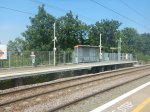
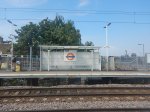
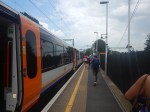
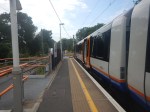

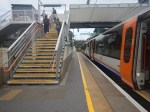
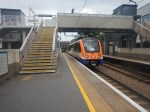
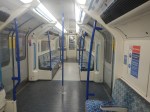
Some observations.
Passengers Towards Gospel Oak Weren’t Numerous
The train going to Gospel Oak station wasn’t very full, wil only about half the seats taken.
The Train From Gospel Oak Was Packed
It was rather different going back, as every seat on the train was taken and there were passengers standing.
The Seats And Air In The Train Were Comfortable
I would certainly recommend a trip in a Class 710 train on a hot day, as a means to cool off.
Let’s hope that all the other classes of Aventras have the same quality of air-conditioning.
The Victoria Line Wasn’t Busy
The air and temperature ion the Victoria Line wasn’t bad, but it wasn’t of the same quality as the Class 710 train.
But the trip made me think that passengers avoid the deep tube in hot weather.
Class 707 Train To Moorgate
I used the cross-platform interchange at Highbury & Islington station to switch to a Class 707 train, running a Great Northern service to Moorgate station.
The air-conditioning was working well and the two other passengers remarked that it was good in this hot weather.
It’s a pity that these trains have ironing-board seats.
Will These Trains Cut Crime?
When I moved to Dalston in 2010, the service along the North London Line was just being launched and wasn’t fully running until May 2011.
Dalston was the haunt of aimless youth and it wasn’t the best place to live.
Nine years on and it has all changed.
The youths have disappeared and the perceived threat of crime seems down. So where have they all gone?
From stories I have heard, public transport has improved so much, that a large proportion of the youths, have discovered something better to do! It’s called work.
- New Class 378 trains
- North London Line trains have gone from four trains per hour (tph) to eight.
- East London Line trains didn’t exist in 2010 and are now sixteen tph.
- There are several fleets of new buses.
- Increases in train frequencies are planned.
Dalston is now a much better place to live.
The new Class 710 trains will soon be running on the following routes.
- Gospel Oak to Barking Line
- Liverpool Street to Cheshunt
- Liverpool Street to Chingford
- Liverpool Street to Enfield Town
And the new Class 707 trains will soon be running on the following routes.
- Moorgate to Hertford East
- Moorgate to Stevenage
- Moorgate to Welwyn Garden City
Most new trains will be in service by the end of this year.
The following will be delivered.
- More capacity
- Increased frequencies
- Better comfort
- Wi-fi and power sockets
- On-train CCTV
A lot of the previous ancient trains will be scrapped.
Will the new trains cut crime and the perception of crime in the areas of North-East London, that they serve.
It is too early to tell, but good public transport has had a remarkable affect on Dalston.
So will the same thing happen in Enfield, Hasringey and Wathamstow?
Conclusion
I wonder how many people with a Freedom Pass like me are cooling off in this weather by using these and other trains.
Steaming Up To Treforest In A Class 143 Train
On my trip to Treforest, I was in a Class 143 train or one of the dreaded Pacers.
It was performing well on the challenging route and I wondered how the power compared with that of the proposed tram-trains, that will be used in a couple of years.
Class 143 Train
- Speed – 75 mph
- Sections – 2
- Weight – 48.5 tonnes
- Length 31 metres
- Power – 336 kW
- Capacity – 122 seats
- Gross Weight (90 Kg per passenger) – 49.6 tonnes
- Kinetic Energy At Operating Speed – 7.7 kWh
- Time to Operating Speed At Full Power – 1.5 minutes
The train I was on was pretty smooth! Or for a Pacer anyway!
Class 399 Tram-Train
- Speed – 62 mph
- Sections – 3
- Weight -66.15 tonnes
- Length – 37.2 metres
- Power – 870 kW
- Capacity – 88 seats and 150 standing.
- Gross Weight (90 Kg per passenger) – 87.6 tonnes
- Kinetic Energy At Operating Speed – 9.3 kWh
- Time to Operating Speed At Full Power – 6 minutes
These figures are taken from details of the tram-trains in Sheffield.
The two trains are very similar in some respects, but the tram-train is heavier with a full load of passengers.
I certainly can see no reason, why the Class 399 tram-train won’t perform as well as the lass 143 train, but with a bigger and heavier load of passengers.
But one important factor should be born in mind.
The German cousins of the Class 399 tram-trains are used in Karlsruhe, where they easily climb out of the city into the surrounding hills.
A trip up the valleys to Aberdate, Merthyr Tydfil or Treherbert could be no more difficult, once the electrification is in place.
Conclusion
I can see other cities and tram networks around the UK, Europe and the wider world developing urban transport networks around these Stadler tram-trains.
UK cities for their deployment must include Manchester and Sheffield.
Nissan Refuses To Improve Qashqai’s Toxic Emissions
The title of this post is the same as that of this article on Tuesday’s copy of The Times.
This is the first paragraph.
Nissan has refused a government request to carry out adjustments to thousands of highly polluting diesel cars to make them less toxic.
The car is called the Nissan Qashqai, which I wouldn’t recognise, unless it reversed into me on the street and I could see the name badge on the boot.
Today, there is this article on the BBC, which is entitled Nissan Workers Braced For Job Cuts.
As they say in Private Eye, could the two stories be related?
Especially, as Nissan seem to have had problems with a CEO recently, who seemed to find enhancing his lifestyle more important, than good stewardship of the company.
Cadoxton Station Is Going Step-Free
This article on Rail Advent is rntitled MP Visits Cadoxton station to see upgrade work.
This is the first paragraph.
Vale of Glamorgan MP, Alun Cairns, met the Network Rail team upgrading Cadoxton station to see first-hand the work being delivered to make the station accessible for all passengers.
So as I was in South Wales, I had to go and have a look at Cadoxton station.
I took these pictures.
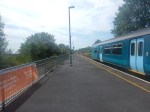

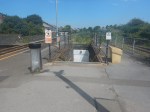

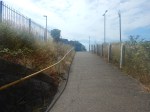
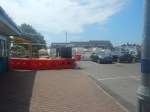
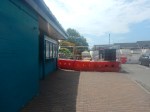
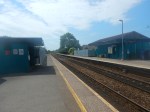
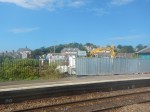
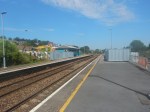
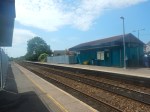
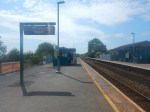
It appears to be a traditional step-free installation and will take about a year to complete.
Barry Station To Go Step-Free
This document on the Government web site is entitled Access for All: 73 Stations Set To Benefit From Additional Funding.
Barry station is on the list.
These pictures show the station and the current bridge,

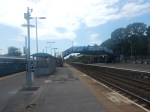

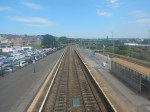


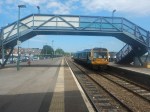
Note.
- The trains were very crowded.
- The bridge is approaching its rust-by date.
- I think it is true to say, that the station buildings need a thorough refurbishment.
I have been sent a map of the proposed works and facilities for the South Wales Metro. This snippet shows the lines around Barry station.
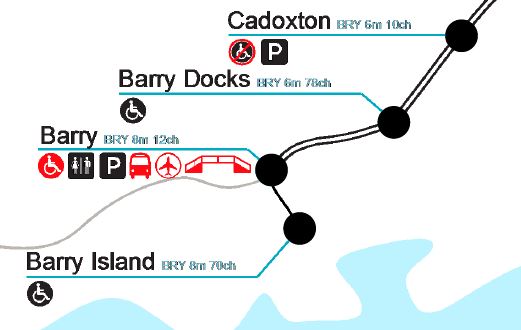
Note.
- The lines are not planned to be electrified.
- Barry station will get a new PRM-compliant bridge with step-free access between street and train.
- There will be an airport connection at the station.
I would assume that the station buildings will get the much-needed refurbishment.
Services To Barry, Barry Island, Bridgend and Penarth
The South Wales Metro services through Barry will be as follows.
- Services will terminate in the South and West at Barry Island, Bridgend and Penarth
- Services will terminate in the North at Coryton and Rhymney.
- There will be increased train frequencies.
Trains will be tri-mode Stadler Flirts with three or four cars, which will be similar to Greater Anglia’s Class 755 trains.
Judging by yesterday this capacity increase will be welcome.
Installing The Step-Free Access
It would appear there is plenty of space for a step-free footbridge with lifts.
In Winner Announced In The Network Rail Footbridge Design Ideas Competition, I wrote how the competition was won by this bridge.
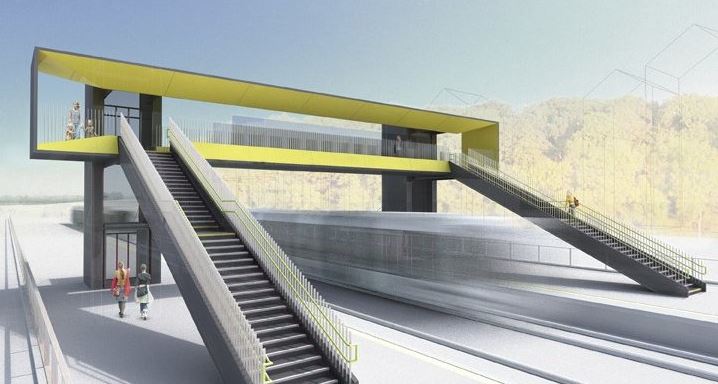
A bridge like this could be built at the other end of the station.
It would also be able to built it, without disrupting the train services or the passengers.
Once complete, the old bridge could be demolished or left as required.
Electrification West Of Cardiff Central Station
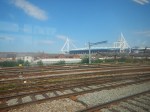
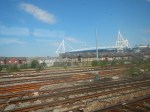
These pictures show erected gantries for the electrification to the West of Cardiff Central station.

I have been sent a map of the proposed works and facilities for the South Wales Metro. This snippet shows the lines to the West of Cardiff Central station.
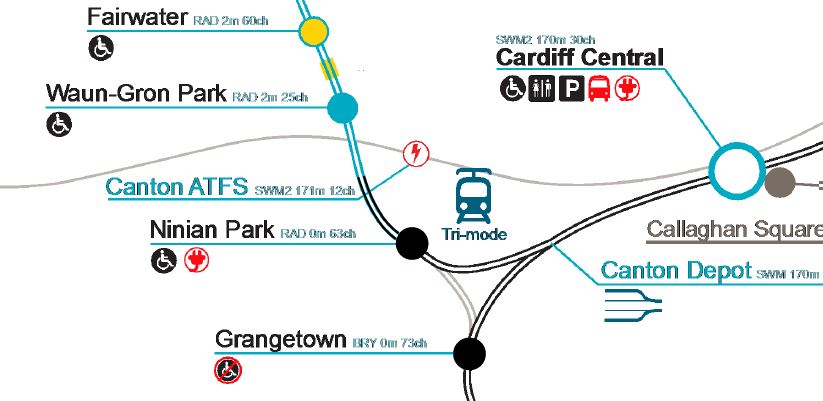
Note.
- Electrified lines are shown in blue and unelectrified ones in black.
- The South Wales Main Line is shown as a feint line going East-West to the North of Ninian Park station.
- Trains for Barry Island, Bridgend, Cardiff Airport, Maesteg and Penarth go via Grangetown station.
- Tram-trains for Radyr will go via Ninian Park station.
It looks like tram-trains emerging out of Canton Depot will have immediate access to 25 KVAC overhead electrification.
 The Anonymous Widower