Stairs And A Lift At Cannon Street Station
These pictures show stairs and a lift at Cannon Street station, that provide access between the National Rail and Underground stations.
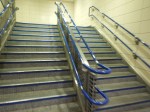
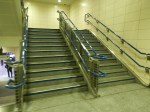
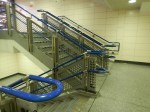
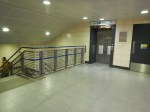
In my view this is one of the best installations, that I’ve seen.
- There is a lift for those who need one.
- The stairs are wide with an additional central hand-rail.
- The hand-rails are double and covered in comfy blue plastic.
This may be impressive, but as yet, there is only a full step-free connection to the Eastbound platform.Underground.
Obviously, all railway stations should be step-free, but to do all stations in the UK in a short time would be expensive and probably disruptive too!
But one thing that can be done at many stations, is to improve the hand-rails.
One of the worst stations near me, is Dalston Kingsland station, which was rebuilt a few years ago with a narrow staircase to each platform.
There has already been an incident at the busy station, where four people were hurt, as reported in this article on City AM.
Were the narrow stairs partly to blame?
Nervous Operators Force Network Rail To Defer King’s Cross Plan
The title of this post is the same as that of this article on Rail Magazine.
King’s Cross station has to be closed for three months, so that tracks, electrification and signalling can be replaced and modernised for about 1.5 miles from the buffer stops at the station.
The original dates of the closure were to have been between December 2019 and March 2020, but now it looks like it could be delayed by up to a year.
The article on the web site, is a shortened version of the article in the magazine, where this is said.
Closure dates have yet to be announced, and NR is still developing a passenger handling strategy which could include long-distance services at Finsbury Park or some services terminating at Peterborough. Some trains could even be rerouted into London Liverpool Street.
I wonder, if Network Rail’s planners are cursing that the around thirty miles between Peterborough and Ely is not electrified.
If it were electrified, it would allow electric trains as well as diesel and bi-mode trains to access Liverpool Street station via the West Anglia Main Line.
What Benefits Would There Be From Electrifying Peterborough To Ely?
I can imagine Oxford-educated civil servants in the Department of Transport and The Treasury dismissing calls for more electrification in the backwater of East Anglia, after the successful electrification to Norwich in the 1980s.
But now Cambridge is powering ahead and East Anglia is on the rise, with the massive Port of Felixstowe needing large numbers of freight trains to other parts of mainland UK.
This East Anglian success gives reasons for the electrification of the Peterborough-Ely Line.
Direct Electric Trains Between Peterborough And Cambridge
I have met Cambridge thinkers, who believe that Peterborough is the ideal place for businesses, who need to expand from Cambridge.
Peterborough has the space that Cambridge lacks.
But the transport links between the two cities are abysmal.
- The A14 is only a two-lane dual-carriageway, although a motorway-standard section is being added around Huntingdon.
- Peterborough station has been improved in recent years.
- The direct train service is an hourly three-car diesel service between Birmingham and Stansted Airport, which doesn’t stop at the increasingly-important Cambridge North station.
The road will get better, but the rail service needs improvement.
- There needs to be at least two direct trains per hour (tph) between Cambridge and Peterborough.
- They would stop at Cambridge North, Waterbeach, Ely and March.
- End-to-end timing would be under an hour.
- Greater Anglia will have the four-car bi-mode Class 755 trains, which would be ideal for the route from next year.
If the Peterborough- Ely Line was electrified, Greater Anglia could use five-car Class 720 trains.
An Electric Diversion Route For The East Coast Main Line
The works at Kings Cross station, and the possible proposal to run some trains into Liverpool Street station, show that an electric diversion route would be useful, when there are closures or problems on the East Coast Main Line.
In the case of the Kings Cross closure, if Peterborough were to be used as the terminal for some trains from the North, then I suspect some high-capacity Class 800 trains could shuttle passengers to Liverpool Street.
If the date of the Kings Cross closure is 2020, then certain things may help.
- Crossrail will be running.
- Extra trains will be running from Finsbury Park to Moorgate.
- Hull Trains will be running bi-mode Class 802 trains.
- There could be more capacity on the West Anglia Main Line.
- There could be more capacity and some longer platforms at Liverpool Street.
What would really help, is the proposed four-tracking of the West Anglia Main Line.
The latter could prove extremely useful, when Network Rail decide to bite the bullet and four-track the Digswell Viaduct.
Extending Greater Anglia’s Network
Greater Anglia have bought new bi-mode Class 755 trains.
This would appear to be more than enough to covering the current services, as they are replacing twenty-six trains with a total of fifty-eight coaches with thirty-eight trains with a total of one hundred and thirty-eight coaches.
That is 46 % more trains and 137 % more coaches.
The new trains are also genuine 100 mph trains on both electricity and diesel.
Obviously, Greater Anglia will be running extra services, but with the explosive growth around Cambridge, coupled with the new Cambridge North station, I feel they will be running extra services on the Peterborough to Cambridge route and perhaps further.
The new Werrington Grade Separation will make a difference.
- It will open in a couple of years.
- Trains between Peterborough and Lincoln won’t block the East Coast Main Line.
- The Leicester route could also be improved.
So services to and from Lincoln and Leicester would probably be easier to run from Cambridge and Stansted Airport.
CrossCountry run a service between Birmingham New Street and Stansted Airport stations.
- The service stops at Coleshill Parlway, Nuneaton, Leicester, Melton Mowbray, Oakham, Stamford, Peterborough, March, Ely and.Cambridge and Audley End stations.
- The service doesn’t stop at Cambridge North station.
- The service is run by an inadequate Class 170 train, which sometimes is only two coaches and totally full.
- Trains take just over three hours ten minutes for the journey.
Will Greater Anglia take over this route? Or possibly run a second train as far as Leicester?
Their Class 755 trains with better performance and specification would offer the following.
- Electric running between Ely and Stansted Airport stations.
- Greater passenger capacity.
- wi-fi, plugs and USB sockets.
- A three hour journey both ways.
- The extra performance would probably allow an extra important stop at Cambridge North station.
The new trains would certainly offer what passengers want.
CrossCountry run an extra train between Birmingham New Street and Leicester, so perhaps at the Western end, the Greater Anglia service need only go as far as Leicester.
At the Stansted end of the route, there will be an hourly train between Stansted Airport and Norwich, so there could be scope for perhaps cutting one the services back to Cambridge.
Obviously, time-tabling would sort it out to the benefit of the train operators and passengers, but I can envisage a set of services like this.
- Norwich and Stansted Airport – Greater Anglia – 1 tph
- Birmingham New Street and Stansted Airport – CrossCountry – 1 tph
- Leicester and Cambridge – Greater Anglia – 1 tph
- Colchester and Peterborough – 1 tph
- Norwich and Nottingham (Currently Liverpool Lime Street) – 1 tph
Adding these up you get.
- Stansted Airport and Cambridge – 2 tph – As now!
- Stansted Airport and Cambridge North – 2 tph – New service!
- Cambridge and Ely – 4 tph – At least!
- Ely and Peterborough – 4 tph – At least!
- Cambridge and Peterborough – 2 tph – Up from 1 tph
- Stansted Airport and Peterbough – 1 tph – As now!
- Cambridge and Leicester – 2 tph = Up from 1 tph.
This pattern or something like it would be much better for all.
If the Ely-Peterborough section of the were to be electrified then it would enable the following.
- A reduced journey time for electric or bi-mode trains.
- If required Greater Anglia could run an extra electric service using Class 720 trains between Stansted Airport and Peterbough.
I said earlier that the Werrington Grade Separation will make it easier to run services between Peterborough and Lincoln.
So why not add an hourly service between Cambridge and Lincoln?
I can envisage, when the West Anglia Main Line is four-tracked at the southern end, that there might be enough capacity for a Liverpool Street to Lincoln service via Cambridge, Cambridge North, Ely, Peterborough, Spalding and Sleaford.
But whatever happens Greater Anglia’s choice of bi-mode Class 755 trains, seems to give them the flexibility to match services to passengers needs.
Electro-Diesel and Battery-Electric Freight Locomotives
The Class 88 locomotive is an electro-diesel freight locomotive, that can use either power from overhead electrification or an pnboard diesel engine.
I believe that locomotives like this will become more common and that eventually, we’ll see a battery-electric heavy freight locomotive.
I wrote about the latter in Thoughts On A Battery/Electric Replacement For A Class 66 Locomotive.
The Peterborough-Ely Line will see increasing numbers of trains hauled by these powerful electric locomotives, with either diesel or battery power to propel them over the gaps in the electrification.
Electrifying the line would speed these hybrid trains through and increase the capacity of the route.
Conclusion
Network Rail have annoyed the train operators with their planning and timing of the upgrade at Kings Cross station.
It looks to me, that the part of the problem, is that there is no viable electrified secondary route to London.
Bi-mode trains can use the Peterborough-Ely Line to go to Liverpool Street via Cambridge.
This line is one of those routes that sits in a sea of electrification, which carries a lot of traffic, that would bring several benefits if it were to be electrified.
- Direct electric trains between Cambridge and Peterborough, would greatly improve the spasmodic service between the two cities, with large economic benefits to the county.
- An electric diversion route would be created from Peterborough to Liverpool Street via Ely and Cambridge.
- It would allow Greater Anglia to develop routes West of Cambridge to places like Lincoln and Leicester using their future fleet of Class 755 trains.
- It would also make it easier for battery-electric freight locomotives to cover the busy freight route between Felixstowe and Peterborough.
I also feel that it wouldn’t be the most difficult route to electrify.
The Fens are flat.
There is no history of mining.
The track is fairly straight and simple.
I suspect that it could become a high-quality 90-100 mph, electrified line.
With
Thoughts On A Battery/Electric Replacement For A Class 66 Locomotive
Many of the long freight routes from Felixstowe and Southampton are hauled by diesel locomotives like the environmentally-unfriendly Class 66 locomotive.
Electric haulage can’t be used because of significant gaps in the 25 KVAC overhead electrification. Gaps and a typical transit time of a Class 66-hauled heavy freight train include.
- Didcot and Birmingham – Around two-and-a-half hours
- Didcot and Coventry – Just under two hours
- Felixstowe and Ipswich – Around an hour
- Haughley Junction and Peterborough – Around two hours
- Southampton and Reading – Around one-and-a-half hours
- Werrington Junction and Doncaster via Lincoln – Around two hours
- Werrington Junction and Nuneaton – Just under two hours
Would it be possible to design a battery/electric hravy locomotive, that could bridge these gaps?
Consider the following.
- A Class 66 locomotive has a power output of around 2500 kW.
- To run for two hours on battery would require a battery of 5000 kWh.
- A 5000 kWh battery would weigh around fifty tonnes. But battery energy densities are getting higher, which would reduce the weight.
- A Class 70 locomotive is a heavy freight diesel Co-Co locomotive with a weight of 134 tonnes with a full tank of diesel.
- A Class 88 locomotive is an electro-diesel locomotive, that without the diesel engine weighs about 80 tonnes.
- A Class 88 locomotive has a power output of 4,000 kW on 25 KVAC overhead electrification
Putting this information together and I think it would be possible to design a battery/electric locomotive with the following specification.
- 4000 kW on 25 KVAC overhead electrification
- Ability to use 750 VDC third-rail electrification
- Ability to change between running on electrification and battery in under a minute and at line speed.
- A 5000 kWh battery.
- Ability to charge the battery, when connected to electrification.
- Ability to use a rapid charging system.
- Two hour range with 2500 kW on battery power.
- Regenerative braking to the battery.
- Co-Co configuration
- Dimensions, weight and axle loading similar to a Class 70 locomotive.
These are a few other thoughts.
Passing Loops With Charging Stations
Passing loops are often provided for freight trains, so that passenger trains can pass a slow freight train. So why not fit these loops with a charging station, so that trains can stop for say twenty minutes to charge or top up the batteries?
Electrification Islands
There are places, where it would be easy to create, what is best described as an electrification island.
I describe electrification islands in The Concept Of Electrification Islands.
Last Mile Applications
Ports and Container Terminals are often without electrification.
The proposed locomotive would be able to work in these environments.
A couple of yeas ago, I had a long talk with a crane operator at the Port of Felixstowe, who I met on a train going to football. He was of the opinion, that Health and Safety is paramount and he would not like 25 KVAC overhead electrification all over the place. Containers do get dropped!
So if freight locomotives used battery power inside the port, most would be pleased.
The only cost for ports and freight terminals would be installing some form of charging.
Maximum Power On Batteries
I suspect that the maximum power on battery would also be the same as the 4,000 kW using 25 KVAC overhead electrification, as the locomotive may have applications, where very heavy trains are moved on partially electrified lines.
Diesel-Free Operation
The proposed locomotive will not use any diesel and will essentially be an electric locomotive, with the ability to use stored onboard power.
Environmentally-Friendly Operation
Freight routes often pass through areas, where heavy diesel locomotives are not appreciated.
- The proposed locomotive will not be emitting any exhaust or noxious gases.
- Noise would be similar to an electric locomotive.
- They would be quieter using battery-power on lines without overhead electrification, as there would be no pantograph noise.
I think on balance, those living by freight routes will welcome the proposed locomotive.
Would Services Be Faster?
This would depend on the route, but consider a heavy freight train going from Felixstowe to Leeds.
- On the electrified East Coast Main Line, the proposed battery-electric locomotive would have a power of 4,000 kW, as opposed to the 2,500 kW of the Class 66 locomotive.
- On sections without electrification, the locomotive would have more power if required, although it would probably be used sparingly.
- The locomotive would have a Driver Assistance System to optimise power use to the train weight and other conditions.
I feel on balance, that services could be faster, as more power could be applied without lots of pollution and noise.
Creeping With Very Heavy Loads
I suspect they would be able to creep with very heavy loads, as does the Class 59 locomotive.
Class 59 Locomotive Replacement
The proposed locomotive may well be able to replace Class 59 locomotives in some applications.
Any Extra Electrification Will Be Greatly Appreciated
Some gaps in electrification are quite long.
For example, Didcot and Birmingham takes about two and a half hours.
- Didcot is on the electrified Great Western Main Line.
- Birmingham has a lot of electrified lines.
So perhaps there could be some extra electrification at both ends of busy freight routes.
Electrification between Didcot and Wolvercote Junction would be a possibility.
- It would be about twelve miles
- It is very busy with heavy freight trains.
- The natives complain about the railway.
- It would allow Great Western Railway to run electric trains to and from London.
- If Chiltern Railways were to run battery-electric trains to Oxford, it would provide electrification for charging at Oxford.
- Electrification could be extended to Oxford Parkway station to make sure battery-electric trains would get a good send-off to Cambridge
This simple example shows, why bi-mode and battery/electric trains don’t mean the end of electrification.
All vehicles; rail or road and especially electric ones, need to take on fuel!
I also think, that there is scope to electrify some passing loops, so that locomotives can top-up en route.
Conclusion
It would be a heavyweight locomotive with a performance to match.
I believe that such a locomotive would be a very useful addition to the UK’s fleet of freight locomotives.
Thoughts On A Battery Electric Class 88 Locomotive On TransPennine Routes
In Issue 864 of Rail Magazine, there is an article, which is entitled Johnson Targets A Bi-Mode Future.
As someone, who has examined the mathematics of battery-powered trains for several years, I wonder if the Age of the Hybrid Battery/Electric Locomotive is closer than we think.
A Battery/Electric Class 88 Locomotive
After reading Dual Mode Delight (RM Issue 863), it would appear that a Class 88 locomotive is a powerful and reliable locomotive.
- It is a Bo-Bo locomotive with a weight of 86.1 tonnes and an axle load of 21.5 tonnes.
- It has a rating on electricity of 4,000 kW.
- It is a genuine 100 mph locomotive when working from 25 KVAC overhead electrification.
- The locomotive has regenerative braking, when working using electrification.
- It would appear the weight of the diesel engine is around seven tonnes
- The closely-related Class 68 locomotive has a 5,600 litre fuel tank and full of diesel would weight nearly five tonnes.
The locomotive would appear to be carrying between 7 and 12 tonnes of diesel-related gubbins.
It is worth looking at the kinetic energy of a Class 88 locomotive hauling five forty-three tonne CAF Mark 5A coaches containing a full load of 340 passengers, who each weigh 90 Kg with baggage, bikes and buggies. This gives a total weight would be 331.7 tonnes.
The kinetic energy of the train would be as follows for various speeds.
- 90 mph – 75 kWh
- 100 mph – 92 kWh
- 110 mph – 111 kWh
- 125 mph – 144 kWh
The increase in energy is because kinetic energy is proportional to the square of the speed.
Supposing the seven tonne diesel engine of the Class 88 locomotive were to be replaced by a battery of a similar total weight.
Traction batteries seem to have an energy/weight ratio of about 0.1kWh/Kg, which is increasing with time, as battery technology improves.
A crude estimate based on this energy/weight ratio would mean that at least a 700 kWh battery could be fitted into a Class 88 train and not make the locomotive any heavier. Given that lots of equipment like the alternator and the fuel tank would not be needed, I suspect that a 1,000 kWh battery could be fitted into a Class 88 locomotive, provided it just wasn’t too big.
A short length of electrification could be installed at terminal stations without electrification to charge the batteries during turnround.
This size of battery would be more than large enough to handle the braking energy of the train from full speed, so would improve the energy efficiency of the train on both electrified and non-electrified lines.
It would also contain more than enough energy to accelerate the train to line speeds that are typical of non-electrified routes.
TransPennine Express will soon run similar rakes of coaches hauled by Class 68 diesel locomotives between Liverpool and Manchester Airport and the North East.
The following sections of the Northern TransPennine route, are not electrified.
- Stalybridge and Leeds – 35 miles taking 46 minutes
- Leeds and Colton Junction – 20 miles taking 18 minutes
- Northallerton and Middlesbrough – 21 miles taking 29 minutes
- York and Scarborough – 42 miles taking 56 minutes
When running on these sections without electrification, consider the following.
- The train consists of modern coaches, which must be energy efficient.
- The train would enter the sections with a full battery, that had been charged using the 25 KVAC electrification on part of the route.
- Scarborough and possibly Middlesbrough stations, would have means to charge the battery.
- The train would enter the sections as close to line speed as possible, after accelerating using electrification.
- Regenerative braking would help conserve energy at any planned or unplanned stops.
- The driver will be assisted by a modern in-cab signaling and a very capable Driver Assistance System.
- Stadler and Direct Rail Services must have extensive theoretical and measured data of the performance of Class 88 locomotives and the related Class 68 locomotive, when they are hauling trains across the Pennines, which will enable extensive mathematical models to be built of the route.
For these reasons and especially the last about mathematical modelling, I believe that Stadler could create a battery/electric locomotive based on the Class 88 locomotive, that would be able to bridge the electrification gaps on battery power and haul a five-coach train on the Northern routes across the Pennines.
A Quick Look At The Mathematics
As I said earlier, the weight of a Class 88 locomotive and five Mark 5A coaches, full of passengers is 331.7 tonnes.
There would appear to be little weight difference between a diesel Class 68 locomotive and an electro-diesel Class 88 locomotive, so in this rough exercise, I will assume the train weight is the same.
The current Class 185 trains, that run across the Pennines have the following characteristics.
- Three-cars
- A weight of 168.5 tonnes.
- A passenger capacity of 169.
- Installed power of 560 kW in each coach, which means there is 1560 kW in total.
If each passengers weighs 90 Kg, with all their extras, a full train will weigh 183.7 tonnes.
So a full train has a power-weight ratio of nine kW/tonne, which must be sufficient to maintain the timetable across the Pennines.
The diesel Class 68 locomotive, which will be hauling trains on the route in the New Year, has an installed power of 2,800 kW, which gives a power/weight ratio of 8.4 kW/tonne.
I would be interested to know, if a Class 88 locomotive running in diesel mode with a power output of only 700 kW, could take one of the new trains across the Pennines. I suspect Stadler and/or DRS know the answer to this question.
But it would be a power/weight ratio of only 2.1 kW/tonne!
The challenging route is between Stalybridge and Leeds via Huddersfield, where the Pennines has to be crossed. I’m pretty certain, that all the other sections lack the gradients of the section between Stalybridge and Leeds.
So would a Class 88 locomotive with a 1,000 kWh battery be able to cross the Pennines with a full train?
Theoretically, up and down routes are good for battery/electric trains with regenerative braking, as energy used going uphill can be recovered on the other side.
The thirty-five miles between Stalybridge and Leeds take forty-six minutes, so for how long on this journey will the locomotive be applying full power? Perhaps for twenty minutes. If the locomotive applied an average of 2,000 kW for twenty minutes or a third of an hour, that would be 667 kWh.
With an electric multiple unit like an Aventra, where most if not all axles are driven and they can also contribute to regenerative braking, reasonably high rates of braking energy can be recycled.
But what proportion can be recycled, when the locomotive is doing all the regenerative braking. Any braking done by disc brakes on the coaches will result in lost energy.
As an aside, I wouldn’t be surprised to find out that train manufacturers simulate train braking in order to develop braking systems, that turn less energy into wasted heat.
I’d also love to see a simulation using Stadler’s real data of a Class 88 locomotive with batteries attempting to cross the Pennines, with a rake of Mark 5A coaches!
- What size of battery will be needed?
- Can this battery be fitted in the locomotive?
- Would distributing the batteries along the train increase performance?
- Would short lengths of electrification on the route, increase performance?
I was doing problems of similar complexity to attempt to design efficient chemical plants nearly fifty years ago. We had our successes, but not as great as we hoped. But we certainly eliminated several blind alleys.
My figures don’t show conclusively, that a Class 88 locomotive with a 1,000 kWh battery instead of a diesel engine and all the related gubbings, would be able to perform services across the Pennines.
But.
- Battery technology is improving at a fast pace.
- Train manufacturers are finding surprising ways to use batteries to improve performance.
- I don’t have access to Stadler’s real performance figures of their diesel locomotives.
- Finding a way to make it work, has a very high cost benefit.
Who knows what will happen?
125 Mph Running
The Class 88 locomotive, has a similar power output to the 125 mph Class 91 locomotive of the InterCity 225 and I believe that the locomotive might have enough power, when running on 25 KVAC overhead wires to be able to haul the train at 125 mph on the East Coast Main Line.
Conclusion
I believe that it is possible to create a battery/electric version of the Class 88 locomotive, that should be able to take a rake of five Mark 5A coaches across the Pennines.
Timings across the Pennines would benefit substantially, without any new infrastructure, other than that already planned and the charging system at Scarborough.
The Design And Development Of Crossrail’s Unique Luminaires
The title of this post is the same as that of this article on Global Railway Review.
It is a very informative article and the lights look well-designed.
The lights were developed by a company called Future Designs.
New Lifts At Newbury Park Station
Newbury Park station now has lifts.
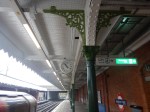
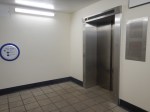
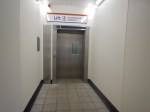
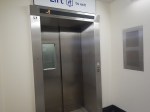
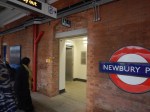
It also looks like the station has had a bit of upsprucing, as well!
The two clocks looked superb, alongside what is a top quality lift installation.
Two mothers with babies in prams were especially pleased, as neither knew that the station now had lifts, as they didn’t live in the area.
Transport for London are putting in several step-free installations at the outer reaches of the Central Line and like a thousand American lawyers at the bottom of the sea, it’s a good start!
Can Abandoned Mines Heat Our Future?
The title of this post, is same as that of the title of a public lecture I attended at The Geological Society this afternoon.
This page on the Geological Society web site, gives a summary of the lecture and details of the speaker; Charlotte Adams of Durham University.
The Concept
The basic concept is simple.
- Abandoned coal mines had their pumps turned off when they are closed and the worked areas have flooded with water, that is now at temperatures of around 12 to 20°C.
- As fifteen billion tonnes of coal have been extracted from UK coalfields, that is a lot of space to flood. An estimate of around two billion cubic metres is given.
- This means that the water holds somewhere between 27.9 and 46.5 GWH of energy in the form of heat.
- Heat pumps would be used to upgrade the temperature of this water, to provide hot water at useful temperatures for space heating.
For those unfamiliar with the concept of a heat pump, Wikipedia gives a good explanation, of which this is the first paragraph.
A heat pump is a device that transfers heat energy from a source of heat to what is called a heat sink. Heat pumps move thermal energy in the opposite direction of spontaneous heat transfer, by absorbing heat from a cold space and releasing it to a warmer one. A heat pump uses a small amount of external power to accomplish the work of transferring energy from the heat source to the heat sink.
In connection with this project, the heat source is the warm water in the mines and the heat sink is the water that is circulated to heat the buildings.
Wikipedia goes on to say this.
In heating mode, heat pumps are three to four times more effective at heating than simple electrical resistance heaters using the same amount of electricity. However, the typical cost of installing a heat pump is also higher than that of a resistance heater.
Wikipedia also has a section, which descries the use of heat pumps in district heating.
It should also be noted, that as with lots of technology, heat pumps are much improved, from the one I installed in a swimming pool in the 1980s.
Gas Is Replaced By Renewable Energy
The electricity to drive the heat pumps could be derived from renewable sources such as hydroelectric, solar, wave or wind.
Effectively, the system is using intermittent sources of electricity to create a constant source of heat suitable for space heating.
Would The Mines Run Out Of Heat Or Water?
As I understand it, the water in the mine will continue to be heated by the heat in the mines. The father of a friend, who came with me to the lecture was a coal miner and my friend confirmed it was hot in a coal mine.
The water will of course continue to flood the mine and the water pumped to the surface will probably be returned.
So the system will continue to supply heat for space heating.
How Long Will The System Supply Heat?
The system has the following characteristics.
- It is electro-mechanical.
- It is powered by electricity.
- Water is the heat transfer medium.
- Additives like anti-freeze will probably be applied to the water used for heat transfer.
There is no reason the system can’t be designed, so that it supplies heat for many years with regular maintenance and updating.
How Does The System Compare To Bunhill 2 Energy Centre?
In Bunhill 2 Energy Centre, I described Islington’s Bunhill 2 Energy Centre which uses heat generated in the Northern Line of the London Underground to provide district heating.
I am fairly sure that a lot of similar technology will be used in both applications.
This page on Wikipedia is entitled London Underground Cooling.
There is a section, which is entitled Source Of The Heat, where this is said.
The heat in the tunnels is largely generated by the trains, with a small amount coming from station equipment and passengers. Around 79% is absorbed by the tunnels walls, 10% is removed by ventilation and the other 11% remains in the tunnels.
Temperatures on the Underground have slowly increased as the clay around the tunnels has warmed up; in the early days of the Underground it was advertised as a place to keep cool on hot days. However, over time the temperature has slowly risen as the heat sink formed by the clay has filled up. When the tunnels were built the clay temperature was around 14ºC; this has now risen to 19–26ºC and air temperatures in the tunnels now reach as high as 30ºC.
So one big difference is that the Underground is warmer than the mine and this should make it a better heat source.
I feel that engineers on both projects will benefit from the ideas and experience of the others.
Would Infrastructure Funds Back This Technology?
In the UK, there are several infrastructure funds set up by companies like Aberdeen Standard, Aviva, Gresham House and L & G.
In World’s Largest Wind Farm Attracts Huge Backing From Insurance Giant, I explained why Aviva had invested nearly a billion pounds in wind farms to support pensioners and holders of their insurance policies.
Comparing the risk of using abandoned mines to heat buildings and that of offshore wind turbines generating electricity, my engineering knowledge would assign a greater risk to the turbines, providing both were built to the highest possible standards.
It’s just the onshore and offshore locations and the vagaries of the weather!
I think it is true to say, that infrastructure funds will back anything, where there is an acceptable long-term income to be made, commensurate with the costs and risk involved.
But then Government or any public or private company or organisation should not pay over the odds for the energy delivered.
Conclusion
Charlotte Adams in her lecture, asked if abandoned mines can heat our future.
The answer could well be yes, but there are other sources of heat like the London Underground, that can also be used.
Should Railways Have A Pop-Up Service Capability?
Most of us will be familiar with the concept of Pop-Up Retail.
This is the first paragraph of the Wikipedia entry.
Pop-up retail, also known as pop-up store (pop-up shop in the UK, Australia and Ireland) or flash retailing, is a trend of opening short-term sales spaces that started in Los Angeles and now pop up all over the United States, Canada, China,Japan, Mexico, France, Germany, the United Kingdom and Australia. The pop-up industry is now estimated to be a $50 billion industry. Pop-up retail has been an increasing factor during the retail apocalypse of the 2010s, including seasonal Halloween retailer Spirit Halloween, who has operated stores in vacant spaces during the season.
Two of the units are scheduled for export to the United States, to demonstrate for the potential for ‘pop-up’ commuter services; the cost of a one-year period are said to be equivalent to the consultancy costs for opening a new route. Should such an approach be considered in this country too? The gestation period for new services on freight-only routes is probably the best part of 10 years, but it doesn’t have to be like that.
When floods swept away the road bridge at Workington in 2009; Network Rail and Northern constructed a pop-up station and introduced additional trains in less than two weeks.

I can envisage three types of simple stations.
- A one-platform station on a single-track line.
- A two-platform station on a double-track line.
- A one-platform station on a double-track line.
Note
- Type One, would be the simplest and would be worked bidirectionally.
- Type Two, would probably require a bridge across the tracks.
- Type Three, would need crossovers at both ends of the station, to allow the single platform to be worked bidirectionally.
Obviously, Type 1 would be the most affordable and probably easiest to install.


- It would certainly bridge the gap between two platforms with a double-track railway in between.
- In a rail application, the bridge would be interlocked with the signalling and controlled by the signaller.
- Signals and lights could be added to the bridge to ensure complete safety.
- Wikipedia says the original at the Paddington Basin cost £500,000, which could probably be reduced if more were built.
- This page on the Merchant Square web site, shows the bridge in action.
- I suspect this bridge would work on single- or double-track lines, without electrification, or with third-rail or with overhead electrification.
- At many stations it could just be dropped in place from a rail-mounted crane, after preparing the existing platforms.
- I suspect though, that there would be a limit to the number of trains per hour it could handle.
- The ability to execute a fast stop at a station.
- Level access will be possible between train and platform.
- On-board CCTV systems to ensure safe loading and unloading of passengers.
- Modern in-cab digital signalling.
This will enable the trains to make a station stop without causing problems to the existing timetable.
So if Network Rail, had the ability to quickly install a pop-up station, modern trains would allow a service to be tested at a reasonable cost.
The Practicalities Of Installing A Pop-Up Station
Suppose a station were to be installed at Soham or any other suitable place.
I would expect Network Rail to produce standard designs for the foundations of their pop-up stations.
Network Rail periodically close a line to replace track or do various other work. When a line is closed for this work and a pop-up station might be needed on the route, the standard foundations would be installed.
Then, when the budget for the station had been obtained, the station would be installed and commissioned in a suitable possession.
Conclusion
I believe a pop-up station is a feasible proposition.
If a pop-up station is a feasible proposition, then it follows that to install perhaps five stations on a freight-only line to create a totally new passenger service is also a feasible proposition.
London Taxi Protest Against Safety Rules Brings Gridlock to City
The title of this post is the same as this article on Bloomberg.
I had heard there was a protest about something last night and this explains what it was.
I should declare an interest, in that I use black cabs about five or six times a month, when I am in a hurry or am coming home late at night from say a station.
I have used Uber once, when my son paid for a cab from Walthamstow. The driver had come all the way from Ealing and got lost twice getting to my house.
Never again!
London Needs Clean Air
I am affected by London’s dirty air and feel strongly that as many vehicles in Central London should be zero emission.
So I very much agree with the Mayor’s strategy of making all London’s new black cabs electric.
But surely, this policy should also apply to Uber, mini-cabs and local delivery vehicles inside the Central area.
It will in the future and it can’t happen soon enough.
Black Cab Drivers Think Sadiq Khan Doesn’t Like Them!
Black cab drivers never have a good word for Sadiq Khan, but then they didn’t Boris either. I didn’t live in London, when Ken was Mayor, so I can’t comment on that!
But then I always say, that because we have a South London Mayor, we are getting a higher proportion of bus cuts.
I don’t think, I’ve ever been driven by a South Asian black can driver, although, I’ve been driven by many Africans and Caribbeans. Go to Birmingham, and you’ll find lots of South Asian black cab drivers.
On the other hand, I’ve been driven by several South Asian mini-cab drivers, from the firm round the corner.
So is the Mayor playing to his constituency and ignoring the views of black cab drivers?
Hence the protests!
Should The Drain Get The First New Tubes For London?
Introducing new trains onto a rail route can be a difficult process, where all sorts of problems occur.
Testing And Introducing Class 710 Trains
Currently, London Overground are introducing Class 710 trains on the Gospel Oak to Barking Line.
As the trains are about eighteen months late, I think that there must have been problems.
I’ve never tested a train, but the modern train must require lots of systems to be tested and Aventras and other recent trains could best be described as computers-on-wheels.
So I must admit, I was a bit surprised, when I heard that first route to receive the new Class 710 trains was the Gospel Oak to Barking Line.
- The line had only been recently electrified.
- Both diesel and electric freight trains use the route.
- Eight trains are needed to run a complete service.
As this will be the first time the trains are used, there would appear to be a lot of things that could go wrong.
The simplest route, where the new Class 710 trains are to be used is the Romford-Upminster Line.
- It is 5.4 km long.
- It is single-track
- It has a 30 mph speed limit.
- There is only three stations, each of which are a single platform.
- The journey takes nine minutes.
- The service operates every thirty minutes.
- There is only one signal.
- Only one train is needed for the service.
It must be one of the simplest electrified railways in the world.
My instincts would have been to put a single train on this line and constantly shuttle it backwards and forwards.
This was exactly how Bombardier tested the Class 379 BEMU train on the Mayflower Line.
- Only the train is being tested.
- Passenger systems can be tested.
- Drivers can be trained.
- Passengers can be asked their opinions.
If the train fails, there is a regular bus service between the two stations and service engineers are not far away at Ilford Depot.
There must be good reasons, why this approach hasn’t been used.
Perhaps, it’s just that London Overground are not going to use a Class 710 train on this route. There have been rumours of this, that I talked about in A Heritage Class 315 Train For The Romford-Upminster Line.
The New Tubes For London
London Underground are buying New Tubes For London from Siemens for four lines.
- Piccadilly – 100 trains
- Bakerloo – 40 trains
- Central – 100 trains
- Waterloo & City – 10 trains
First trains are to run on the Piccadilly Line in 2023.
I think that it will not be a simple case of replacing one fleet of old trains, with another fleet of new trains, as has been done in the past.
It was managed successfully in recent times on the Victoria Line, when 2009 Stock trains replaced 1967 Stock trains.
But Siemens design is more radical and may need track and platform work to be performed before the trains can be run.
My research in The Train-Platform Interface In London, showed that the interface seemed fairly consistent on the Piccadilly Line, so it may be easy to design trains to run the line efficiently with step-free access between train and platform.
But what about the section of the line, where the trains share track with the S8 Stock trains of the Metropolitan Line.
If the Piccadilly Line has to be closed to make it fit for the New Tubes for London, then it will be a major undertaking, even if it is done in sections.
It would be a high-risk undertaking.
A Test Line For New Tubes for London
I believe there would be advantages in creating a test line for the following purposes.
- Test the engineering for track and platforms.
- Test the train performance and reliability.
- Test the Automated Train Control
- Test the passenger systems.
One of the suburban sections could be used, but there could be problems.
The Waterloo & City Line As A Test Track
On the other hand the Waterloo & City Line could be an ideal test track.
- It has only two stations.
- It is step-free
- It is only 2.4 km. long.
- Journeys take four minutes.
- It is integrated with a depot.
The only problem is that trains have to be moved in and out by the use of a crane.
Using the Waterloo & City Line as a test track does have other advantages.
Alternative Routes During Closure
If the line had to be closed for any period of time for track or platform work, then in 2023, there will be some excellent alternative routes.
- Northern Line to Tottenham Court Road and then the Central Line to Bank.
- Northern Line to Tottenham Court Road and then Crossrail to Moorgate.
- Bakerloo Line to Embankment and then the Circle/District Lines to Monument.
- Jubilee Line to London Bridge and then the Northern Line to Bank.
- Southeastern From Waterloo East to London Bridge and then bus or walk.
There is also the direct 76 bus and possibly others.
It should be noted that from late 2021, the Northern Line platforms at Bank station will be much improved.
So, if the Waterloo & City Line was used to test the trains, this in itself would not present any problems during closure or unreliable service.
Improved Capacity For The Line
According to an article in the November 2017 Edition of Modern Railways, which is entitled Deep Tube Upgrade, new trains for the Waterloo & City Line will give a capacity increase of twenty-five percent.
This is much-needed.
Automatic Train Control Testing
Testing of any automatic control system must be very rigorous and the short double-track route of the Waterloo & City Line would be ideal for testing automatic control of the new trains.
Trains could test twenty-four hours per day and every day of the year and not annoy anybody.
Driver Training
It could a valuable resource in training new drivers and converting others to the new trains.
Ongoing Train Development
It is London Underground’s and Seimen’s objective to have the same trains on as many lines of the London Underground as possible.
Siemens might get it right first time, but each line has its own quirks and design features and having a short line in London, where the next version of the trains could be tested by the public could be an advantage.
Conclusion
I believe that introducing the New Tubes for London on the Waterloo & City Line before the other lines could give advantages in the testing and designing of the trains and for the passengers of this short route.
 The Anonymous Widower