Reopening The Anglesey Central Railway
Note that this post was updated in October 2021.
The Anglesey Central Railway is a disused branch railway, where the track-bed is intact although overgrown, that runs across the Island of Anglesey from the North Wales Coast Line to the port town of Amlwch.
It carried freight until 1993 and is one of those remote lines, where a case can be made for reopening., using simple station designs and affordable trains.
On its route it serves the County Town of Llangefni and these stations are proposed, either on the branch or the island
With the existing stations on the North Wales Coast Line, a useful local railway could be created.
But would it be value for money?
These are a few of my thoughts.
Bangor Station
Bangor station looks like the ideal place to terminate the service from the Anglesey Central Railway.
This Google Map shows Bangor station.
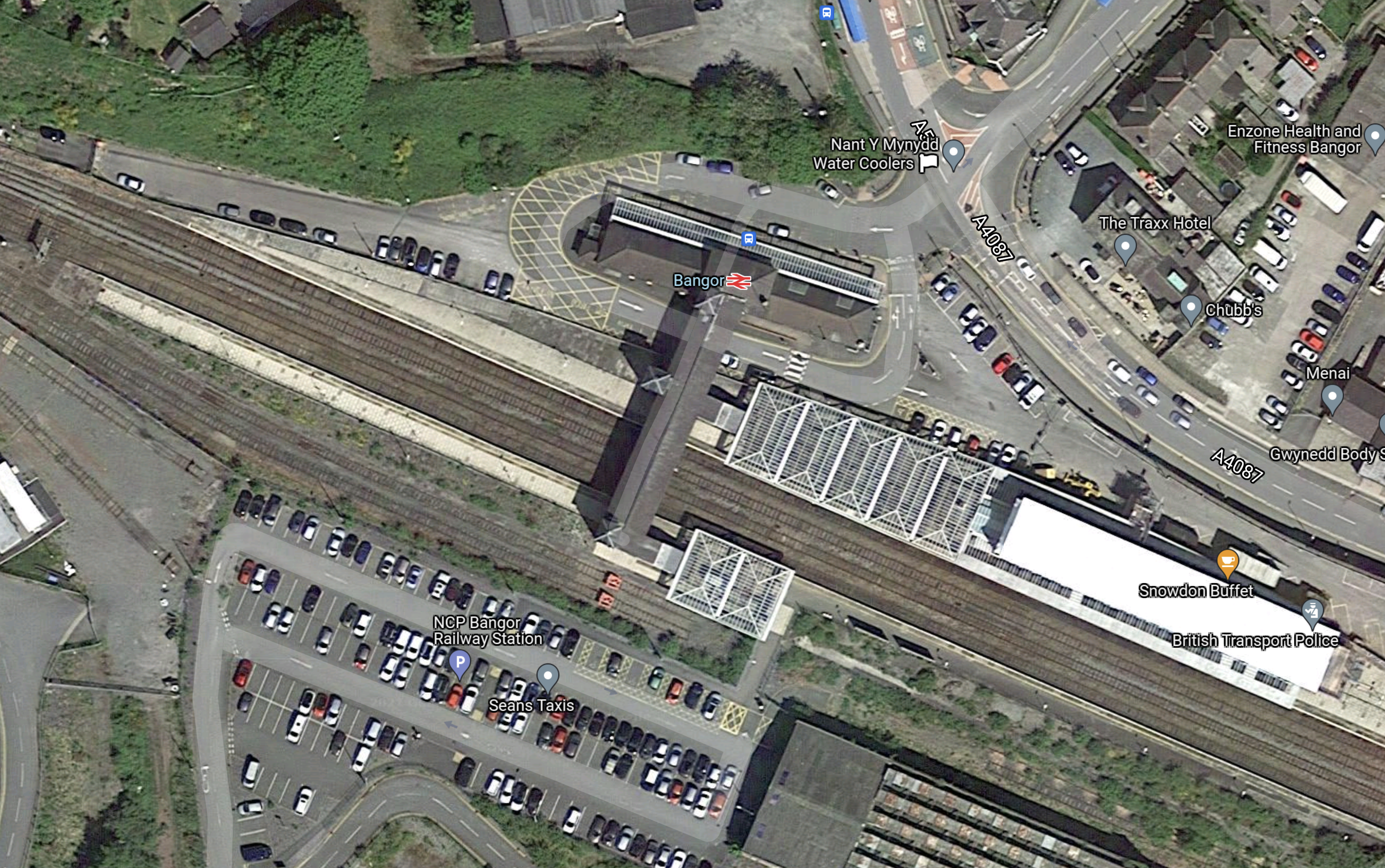
Note.
- Anglesey is to the West.
- There are four tracks through the station. This will allow trains to overtake.
- Only the outside two tracks have platforms.
- The platforms are long enough to handle at least a two-hundred metre long train. They could even be long enough to handle a pair of Aventi West Coast’s new Class 805 trains, which would be 260 metres long.
- There are a couple of Anglesey-facing sidings, which probably could be converted into at least one bay platform.
- I suspect in a city like Bangor, there is probably enough electric power to provide charging facilities in an Anglesey-facing bay platform.
I can’t see any problems with terminating Anglesey Central Railway services at Bangor.
Battery-Electric Trains Between Bangor And Amlwch
Consider.
- Bangor and Amlwch would be around 25 miles.
- Modern battery-electric trains have a range of up to 80 miles.
- Battery-electric trains can fully recharge in 15 minutes.
This means that with charging facilities at Bangor, modern battery-electric trains could handle a return journey between Bangor and Amlwch.
I suspect that a very acceptable two trains per hour (tph) should be possible.
Hydrogen Trains Between Bangor And Amlwch
These would also be possible, once a refuelling strategy has been decided.
Developing The Ebbw Valley Railway
There are various developments proposed for the Ebbw Valley Railway.
A Second Hourly Service To Newport
In Proposed Additional Services in the Wikipedia entry for the line, this is said.
A second hourly service to Newport is proposed for the line. A South East Wales Transport Alliance (Sewta) report in 2006 noted that additional infrastructure work would be required to enable the service to become half-hourly (one train running to Cardiff and another to Newport). An additional seven miles (11 km) of double track would be needed between Aberbeeg Junction and Crosskeys and additional platforms at Newbridge and Llanhilleth stations would be required.
Network Rail says additional work needs to be done, but from various news reports, the service from Ebbw Vale Town to Newport is some years away, but could be completed in 2018.
Possible Stations
In A Look At New Station Projects, I’ve found several.
- Aberbeeg has been proposed for reopening.
- Abercarn has been proposed for reopening.
- Abertillery has been proposed for reopening on a new branch.
- Cwm has been proposed for reopening.
I’m sure there could be others.
Riding In A Clean Class 319/4 Train
The Class 319/4 train is the upmarket version of the Class 319 train with First Class seats, less 2+3 seating and a fully-accessible toilet.
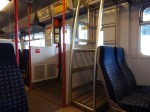
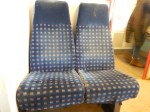
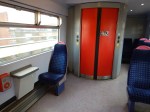
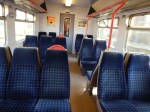

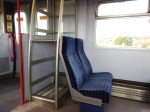
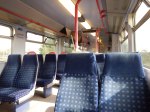

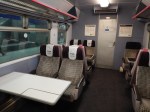


I took the pictures on a particularly neat and tidy Thameslink train.
It is likely that the Class 319 Flex train will use this interior, especially as the prototype is a conversion of a Class 319/4 train.
According to Wikipedia, there are still 23 Class 319/4 trains in service with Thameslink, with a few actually off lease, so there should be quite a few of this variant to convert.
In the article in Rail Magazine, which is entitled Flex… and flexibility, this is said.
One unit has moved to Loughborough (319427), but this is not one of the eight destined for Northern. Instead, it will be deployed for dimensional analysis. Only so much can be planned on paper and computers, and this will enable the various teams to evaluate the train and ensure everything fits.
Sounds like good engineering and as the train was off lease, it probably wasn’t one of best, so if it eventually becomes a spares donor or scrap, no-one is probably bothered, given that there are quite a few Class 319/4 trains available for conversion.
In fact after riding in a couple of Northern’s Class 319 trains last week, I definitely felt that the Class 319/4 train in the pictures, rode a lot better and more like what you’d expect from a train derived from a Mark 3 coach.
Conclusion
The more I read and observe about the Class 319 Flex train, the more I like the project.
I wonder how much a new bi-mode four-car multiple unit would cost? As a rough guide London Overground are paying nearly six million for each of their Class 710 trains.
Class 319/4 trains converted to Class 319 Flex trains will have the following extra and proven features.
- 100 mph as against 75 mph top speed.
- 91-92 mph top speed away from wires on diesel.
- First Class seating
- Fully-accessible toilet.
- The ability to survive a direct hit from a 24 tonne cement mixer truck dropped from a bridge.
But the Class 319 Flex is not a new train.
The Oxshott incident with the cement mixer truck, did happen to a Class 455 train, but this is also Mark 3 coach-based, like the Class 319 train.
DOO – Analysed & Explained
This article in Rail Staff is a must-read about the dispute.
It is a detailed article and if you are short of time, just read the last paragraph entitled Looking Forward.
Could Platform 13 And 14 At Manchester Piccadilly Station Be Improved?
I took this picture on the island platform 13 /14, at Manchester Piccadilly station on my trip to the North last week.
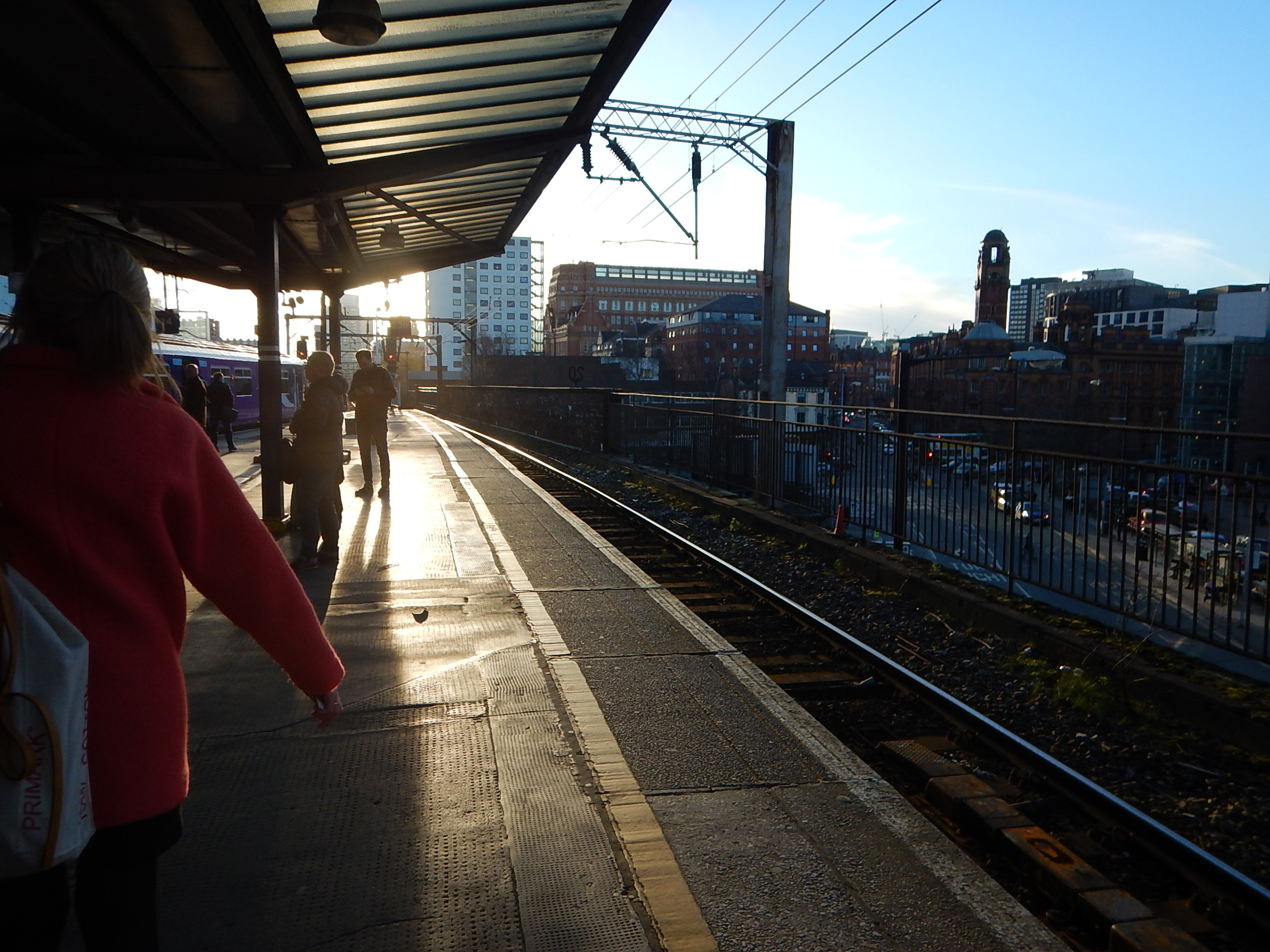
I actually took the picture, as I wanted to check if the lines were electrified, which can be seen.
Services Through Manchester Victoria, Manchester Piccadilly and Salford Crescent Stations
After the current works on the Ordsall Chord has been completed, Manchester Victoria, Manchester Piccadilly and Salford Crescent stations will form a triangle of lines and stations, through which services passing through Manchester will travel. This map from Wikipedia shows the lines in a simplified form.
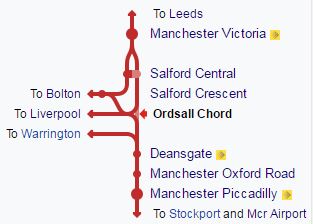
Note the lines to Leeds, Bolton, Liverpool, Warrington, Stockport. It is a real Crossrails of the North.
The only similar intensive set of railway junctions in a city with multiple terminal stations is be the tangle of lines across the South Bank of the Thames in London encompassing London Bridge, Cannon Street, Blackfriars, Waterloo East and Charing Cross stations. This map from Wikipedia shows the lines in a simplified form.
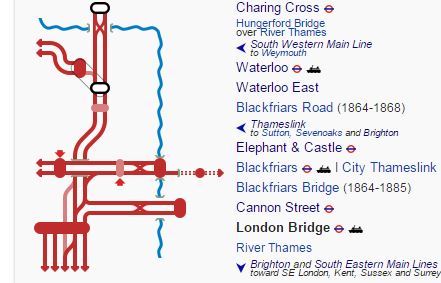
Simple it is not!
As an aside it should be noted that Thameslink is planned to run twenty-four trains per hour (tph), through the central core tunnel, of which sixteen tph stop at both Blackfriars and London Bridge stations. Add in the 14 tph terminating at Charing Cross and the 16 tph terminating at Cannon Street, all of which stop at London Bridge and you get a measure of the capability of modern signalling.
Northern Electric Services To Manchester Airport
As I write this, Northern Electrics trains from Liverpool Lime Street, Edinburgh via Wigan North Western and Blackpool North via Bolton are all scheduled to call in Platforms 13 at Manchester Piccadilly station within the next hour on their way to Manchester Airport. Only the Liverpool service is run by an electric train, which is one of the 100 mph Class 319 trains.
But after the Manchester to Preston Line via Bolton and the Blackpool Branch Lines are electrified and the Ordsall Chord is opened, which will hopefully happen late in 2017, there could be more Northern |Electrics services through these platforms going to Manchester Airport from these and other stations.
- Barrow-in-Furness – Flex
- Blackpool North
- Bolton
- Blackburn – Flex
- Huddersfield – Flex
- Liverpool Lime Street
- Manchester Victoria
- Preston
- Stalybridge – Flex
- Warrington Central – Flex
- Windermere – Flex
Stations marked with Flex will be run by Class 319 Flex trains, but as they will be running on the overhead wires through these platforms to and from the Airport, they can be considered to be the same as the electric Class 319 trains.
If you look at the current service between Manchester Oxford Road and Manchester Airport stations, the frequency is something like eight trains per hour.
So there will be a large number of electric trains going through Platforms 13/14 at Piccadilly! And the trains will be getting longer, with the minimum train size being four-cars and surely eight-cars are possible on some routes.
All of these services will bring passengers to and from Platforms 13 /14 at Piccadilly.
Manchester’s New Urban Link
Across the South Bank of London most people take the Jubilee Line!
But I don’t!
Between say London Bridge and Charing Cross, I will use Southeastern’s 14 tph service between the two stations, as it’s quicker, the views are better and there’s less walking in tunnels underground.
And according to some of their Customer Service people, I’m not the only one.
Manchester will also be getting a new similar high capacity urban link from Manchester Piccadilly station across the city, that will serve.
- Manchester Oxford Road
- Deansgate
Before splitting into two branches.
- Salford Crescent via the Windsor Link
- Salford Central and Manchester Victoria via the new Ordsall Chord
As there is also a line that joins Salford Crescent to Manchester Victoria via Salford Crescent, train planners will have a lot of scope for improving services.
- Liverpool and Manchester services have a choice of Manchester terminals and a variety of routes.
- A service linking Edinburgh, Newcastle, York, Leeds, Huddersfield, Manchester Victoria, Manchester Piccadilly and Manchester Airport would be possible. Current services go via the West Coast Main Line.
- Inwards to Manchester, an improved Salford Crescent station could be a cross-platform interchange with Salford Central/Victoria services on one platform face and Deansgate/Oxford Road/Piccadilly/Airport services on the other.
- Similarly, outwards from Manchester, Salford Crescent station could be a cross platform interchange between services.
I think that this could lead to the Metrolink being connected to one or both of the two Salford stations.
To sum everything up, there will be lots of trains going through the three stations of Manchester Victoria, Manchester Piccadilly and Salford Crescent.
And all those trains using the Windsor Link and the Ordsall Chord will be coming through Platform 13 or Platform 14 at Manchester Piccadlly station.
Overcrowding At Platform 13 and 14 At Manchester Piccadilly Station
Overcrowding at these two platforms is bad enough already and it’s going to get worse if more and longer trains are running through the platforms.
Looking at the picture, the platforms are not overly-wide either.
But at least there are solutions, as I’ll discuss now.
The Alternative Route
Londoners are world-champions at ducking-and diving and will find the route that is quickest after a few weeks of a new rail line or bus route opening. It’s probably one of the reasons that Transport for London, placed the forecast for the passenger usage on the London Overground on the low side.
I don’t know how Mancunians will react to the Ordsall Chord and the new Northern Electrics services, but if they quickly suss-out the best route for their personal journey, this may mean that passengers avoid using Platforms 13/14 at Piccadilly.
There are a quite a few interchange stations on the Piccadilly-Salford Crescent and Piccadilly-Victoria routes through the City.
Better Access To The Island Platform 13/14
Access to the island platform is not good and perhaps more escalators and lifts will help.
Whatever is done to improve the through route, improvement of the access will be on the list of projects to perform.
A Bigger Island Platform 13/14
Looking at the picture in this post, I wonder if the island platform could be made bigger.
If it was wider, this would need the tracks to be moved apart and if this is possible another metre on the platform width would help.
I was on Platform A at St. Pancras Thameslink station this morning and it is very long platform, with the trains stopping vaguely in the middle, thus leaving spare platform space at each end.
So if the platform could be lengthened would this help with the overcrowding?
This Google Map shows the Western end of Platform 13/14.
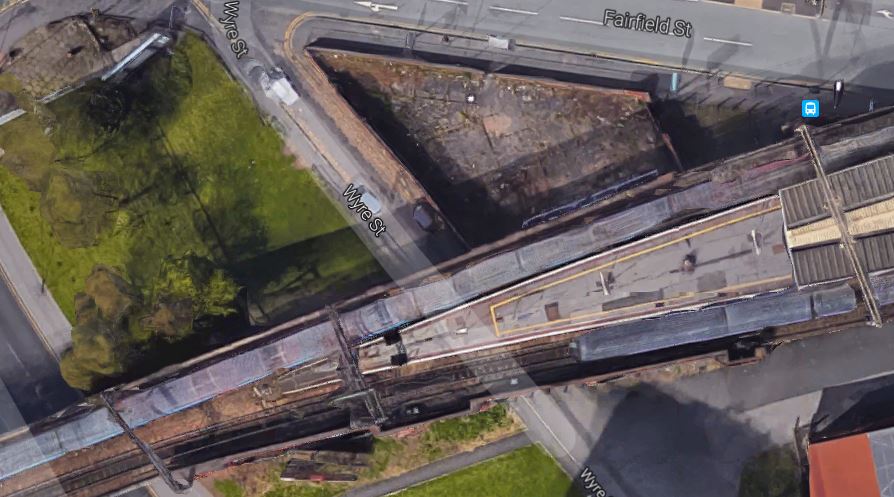
Platform 13/14 is the pointy one in the middle.
And this one the Eastern end.
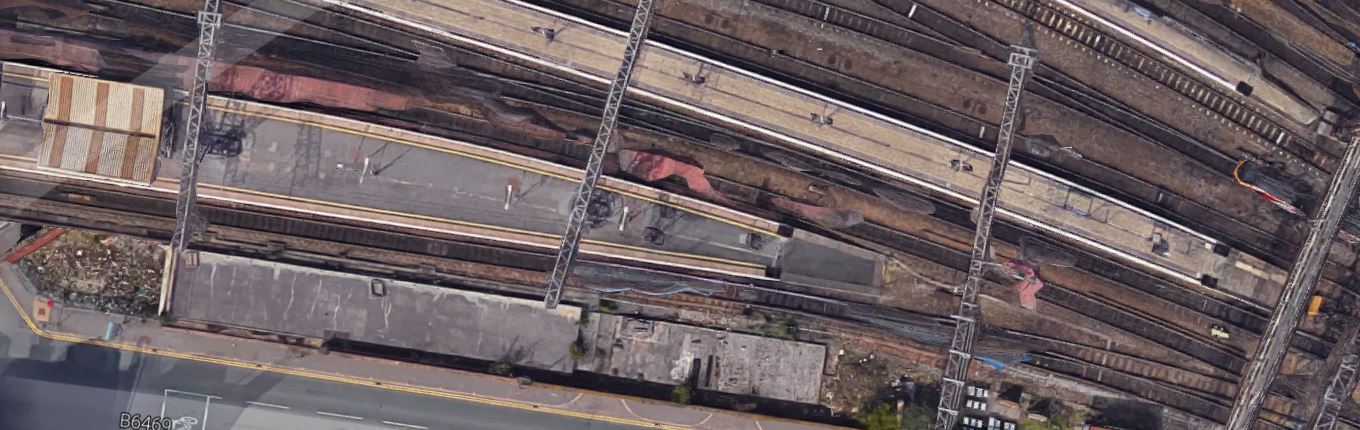
Again Platform 13/14 is the one in the middle.
It’s all very tight and I estimate Platform 13/14 isn’t much more then ten metres wide at any point.
Access to Platforms 13/14 From Below
I don’t know whether this is possible, but the platforms sit on a large viaduct and in many stations like this escalators and lifts are used to access the platforms from below.
This picture shows the Platforms on the viaduct.
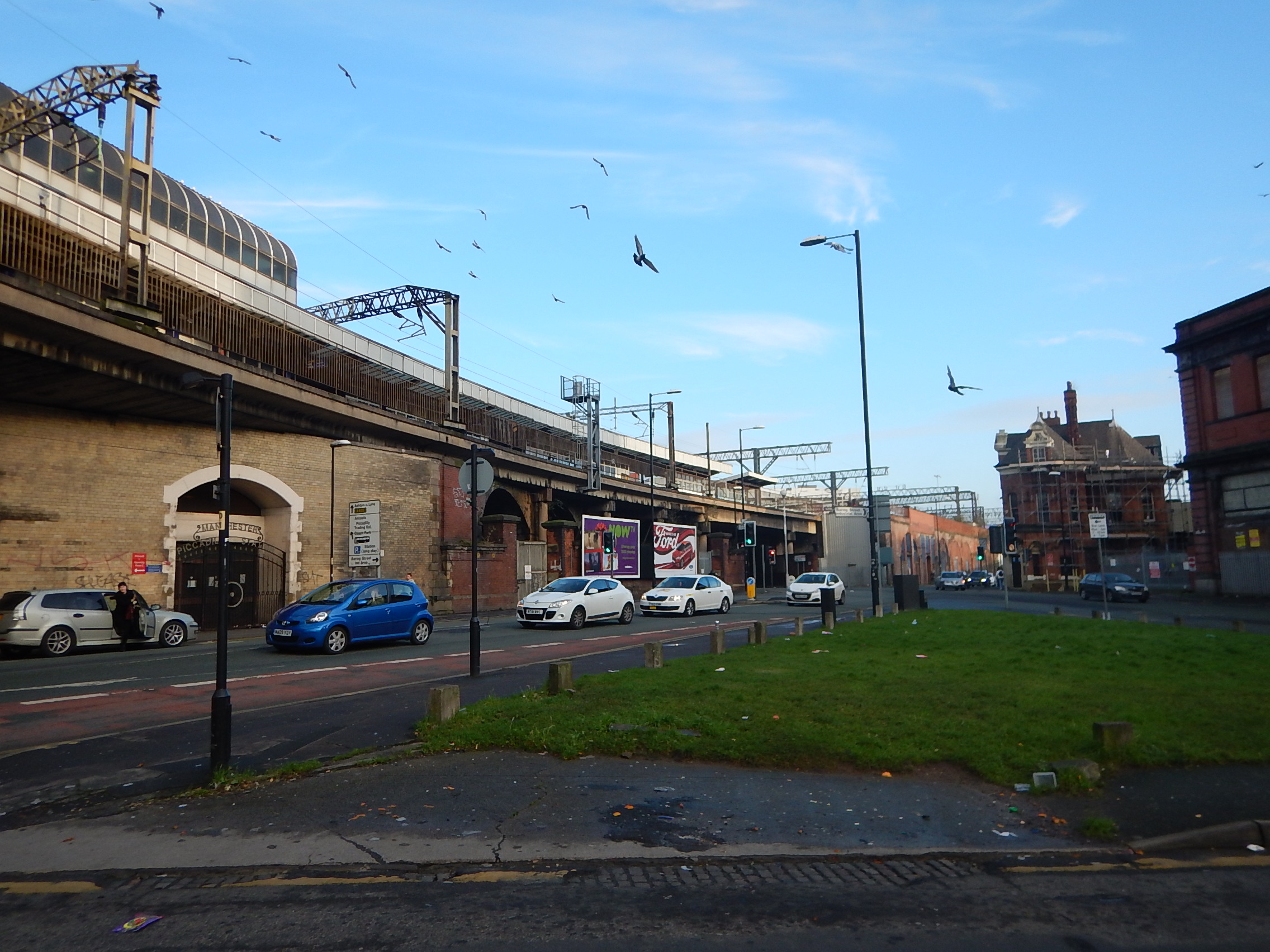
Platform 14 is closest to the camera.
I think that with imagination, access might be possible from this side.
A New Bridge To Platforms 13/14
This Google Map shows the London end of the platforms at Piccadilly.
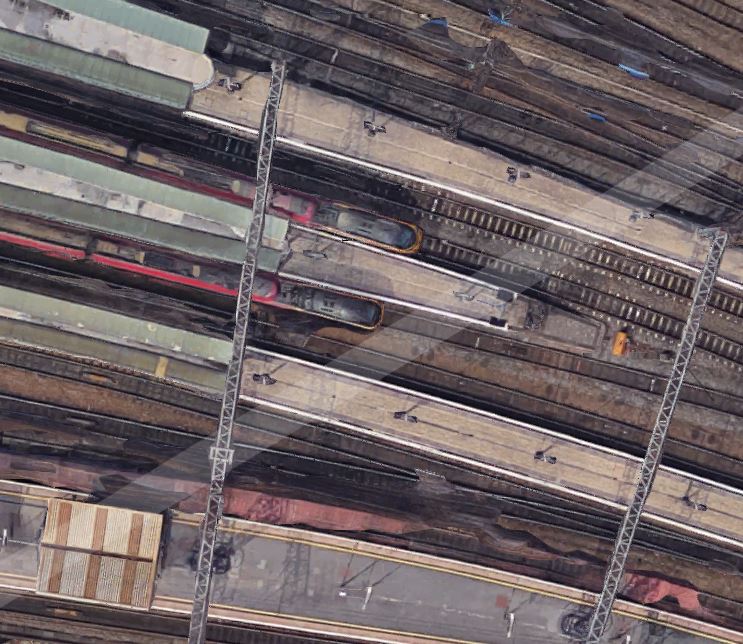
Platform 13/14 is at the bottom of the picture.
I think there is space to put a second bridge over the platforms here and it could reach all the way to the new HS2 platforms on the other side of the station.
Platforms 15 And 16 At Manchester Piccadilly Station
Building two new platforms 15 and 16 has been touted as a solution.
I think that the key to whether four through platforms is needed, is how many trains will be going through.
In a few years time the two track cross-London lines; Crossrail aqnd Thameslink will be handling 24 tph, with a third; the East London Line handling 20 tph.
Also at London Bridge, 54 tph in both directions are handled by nine platforms, which means that an average of 12 tph go through each platform.
If you look at the Y-shaped line through Manchester, Thameslink could be overlaid on the top.
- Blackfriars would be Platforms 13/14 at Piccadilly.
- St. Pancras Thameslink would be Deansgate.
- West Hampstead Thameslink would be Salford Crescent.
- Finsbury Park would be Victoria.
Other conditions would be needed for a throughput approaching that of Thameslink.
- All trains must be modern electric trains, capable of making quick stops.
- All trains must be fitted with modern signalling.
- No trains terminating at Manchester Oxford Road
- Some services from the North linked back-to-back with services to the South to free up platform space at Victoria and Piccadilly.
Thameslink is aiming for 24 tph and currently runs 14 tph.
I can’t see, if everything is done correctly, that Platform 13/14 at Piccadilly can’t handle somewhere between 14-24 tph.
And as Thameslink manages 14 tph with a proportion of Class 319 trains, I would be very surprised if this figure is not attainable.
Under Proposal in the Wikipedia entry for the Ordsall Chord, this is said.
The Ordsall Chord will provide a direct link between Piccadilly and Victoria stations, allowing trains from Manchester Victoria and the east to continue to Piccadilly. On completion the chord will allow four trains per hour to travel between Manchester Airport/Manchester Piccadilly and Manchester Victoria in each direction, eight trains per hour from Manchester Victoria towards the west via Chat Moss, and six trains per hour from Manchester Piccadilly towards either Chat Moss or Bolton and Preston. Other trains will travel from Manchester Piccadilly via Warrington.
This appears to say that only the following trains would use Platform 13/14 at Piccadilly.
- 4 tph Manchester Airport/Piccadilly to Victoria
- 6 tph Piccadilly to Chat Moss or Bolton/Preston
So that is just 10 tph.
Currently, in the Peak, it appears that the frequency of trains between Oxford Road and Piccadilly is 10 tph.
I have a feeling that with a bit of reorganisation of services, the rather difficut problem of building Platforms 15/16 can be delayed for ten years or more, if not for ever.
Manchester Airport From The South
How would people from Birmingham, London and the South get to Manchester Airport?
There are two routes.
- Change at Manchester Picaadilly to any of the several tph to Manchester Airport
- Change at Crewe to the Crewe-Manchester Line.
I would use the second option as it’s fifteen minutes quicker and avoids Platform 13/14 at Piccadilly.
I suspect that the train companies will reorganise their services from Crewe to Manchester via the Airport to take advantage of the Ordsall curve and the new electrification North of Manchester.
HS2 Arrives At Crewe
HS2 will have various effects, when it arrives at Crewe in 2027!
One interesting idea, borrowed from the French, would be to split and join, shorter HS2 trains at Crewe. So perhaps two or even three shorter units would work as a larger unit between London and Crewe.
The advantage of this is that anywhere that is electrified and has a platform long enough could get a high-speed service to London and the South, if the market was there.
According to this page in the Guardian, Crewe will be just 58 minutes from London, instead of the fastest time of 97 minutes today.
Currently Crewe to Manchester Airport takes thirty minutes in a Class 323 train. If as I suspect HS2 trains can run efficiently on classic lines, the following times might be possible using the 110 mph Crewe-Manchester Line to complete the journey.
- Manchester Piccadilly – 88 minutes instead of the current 127 minutes.
- Manchester Airport – possibly 78 minutes instead of 144 minutes.
- Stockport – 76 minutes instead of 115 minutes
No services would need any changes.
But a train might leave London, do a quick stop at Crewe, where it divided with one portion going to Manchester Airport and the other to Stockport and Manchester Piccadilly.
The operator would be able to run short HS2 trains on the classic lines to the North and East of Manchester using the lines now being electrified.
Currently, Huddersfield to Manchester Piccadilly takes 33 minutes, so a modern electric train must be able to do the journey in 20 minutes.
On my estimate of 88 minutes to Piccadilly using HS2, on the electrified existing tracks Huddersfield could be reached without a change in 108 minutes.
The current fastest time is 175 minutes with a change at York.
Running HS2 trains through platforms 13/14 at Piccadilly would have no effect on the design of the platforms, as the HS2 trains will be designed to run to any electrified platform, that is long enough.
The interesting destination of a portion of a train would be Blackburn, if the electrification was extended to the town.
I estimate it could be done in 133 minutes without a change as opposed to 162 minutes today with a change at Preston.
Until 1964, the Ribble Valley Line used to host a Manchester-Glasgow express and now I believe it could have a HS2 service to and from London.
Conclusion
Manchester and its environs will get a much better rail system.
But I suspect it will be some years before Piccadilly gets Platforms 15/16
Thoughts On The Buxton Line
In these four posts.
I describe an enjoyable trip up from Manchester Piccadilly station up and down the Buxton Line to Buxton station.
These are some thoughts.
Rolling Stock
The Buxton Line is very stiff for a railway in England. Wikipedia says this about the rolling stock.
Due to steep gradients on this line, Class 142 and Class 153 DMUs are banned from the section of line between Hazel Grove and Buxton. Therefore, services to Buxton are worked by Class 150 and Class 156 DMUs. Also Class 158 DMUs were once blocked from operating on the line to Buxton due to the possibility of the large roof-mounted air vents striking low bridges on the route.Piccadilly to Hazel Grove services used Class 323 electric multiple units up until 2008.
I went up in a Class 150 train and came down in a Class 156 train.
The Class 150 train definitely found the climb a struggle and it wasn’t even that full.
I dread to think how even two Class 156 trains working together would have coped after a City-United Derby in Manchester.
The trains up and down this line need to have the following characteristics.
- Four-cars or more.
- Lots of power.
- Step-free access from the platform for wheel-chair users and buggy pushers.
- Big windows.
- Lots of space for luggage and bicycles.
As it is a unique tourist line, what about a commentary available through the train’s wi-fi?
The Class 319 Flex train for which this Manchester to Buxton is going to be a test route, should be a lot better, but as tourism by train grows in importance for the rail companies, a need for a specialist tourism-friendly interior will need to be developed.
These are some pictures I took of a Thameslink Cllass 319/4 train, that will be the starting point for the Class 319 Flex train.
The Class 319 Flex trains could be an improvement. They’ve even got a First Class section.
Stations
When the line is run consistently by one type of rolling stock, I would hope that the platform-train step will be minimised, which I think is one of the biggest drawbacks to train travel for perhaps wheel-chair users and buggy pushers in the UK.
Not on this line, but in my recent trip to the North, on one occasion, I nearly saw a child tipped out of a buggy under a Pacer at Wigan Wallgate station. Luckily the child and the buggy was caught by two quick elderly and obviously savvy passengers.
A straight push-across gets rid of this problem. It can surely be pretty much achieved on the Buxton Line, if one one type of train works the regular services on the line.
I didn’t look in detail, but I suspect that only Stockport, Hazel Grove and Buxton are true step-free stations, although I suspect is not difficult at some stations, especially on the line going to Buxton.
The line going to Buxton is probably the most important side and it would be interesting to see how many passengers get out at intermediate stations coming down from Buxton compared to the number going to Buxton.
Some of the stations were very basic and others less so and I suspect that some improvements would be welcome, especially if on a wet day, you had to wait an hour for a train.
I would think too, that some stations have good views from the Buxton-bound platform, so is there scope to create a proper viewing place for the less-mobile.
There is certainly scope to improve the facilities at stations along the line.
Buxton Station
Buxton station has scope to be made into a proper terminus with perhaps a cafe and a comfortable waiting room.
After my experience recently, that I wrote about in A Good Day Out In A Wheelchair, some form of wheelchair or mobility scooter hire at the station might be in order.
I’ve seen mobility scooter hire at one coastal station before, but I can’t remember where. It might not even have been in the UK!
Train Frequency
This line has an hourly service, with extra trains in the Peak.
But as it is at least a double-track all the way from Manchester Piccadilly to Buxton, I’m sure that the line could be run at a frequency of two trains per hour all day. Especially, if the trains were like the Class 319 Flex trains and had enough power to maintain a faster timetable, even when fully-loaded.
Perhaps, with two trains per hour and decent kiosks at some of the intermediate stations, it would even attract more casual walkers to explore the line.
Ticketing
The Buxton Line could be one, where the normal ticketing model will be fine for the locals, but may not be the best for tourists and casual users.
Disability Issues
I haven’t had a proper look and I’m no expert, but I do wonder if selected improvements could be made, the line could be a way for those in wheelchairs or with limited mobility to explore the area.
Conclusions
The Buxton Line is a valuable railway for the residents and visitors to the area.
I do wonder though with a small amount of selective and sympathetic development, that it could be made even more valuable.
In some ways, designing the Class 319 Flex train, so that it can work the line, can only encourage more passengers to use the route.
Flex… and flexibility
This is the title of an article in Rail Magazine, which is an interview with Helen Simpson and Mark Isbern of Porterbrook.
There is a lot of information about why Porterbrook went the hybrid route rather than batteries.
These are some of facts disclosed.
- Manchester Piccadilly to Buxton was chosen as the test route as it uphill all the way with 12 stops.
- They have simulated running on routes on Great Western, London Midland and in Wales.
- The Flex technique could be applied to other EMUs such as Electrostars.
- Top speed is 100 mph under the wires and 91-92 mph when running on diesel.
- Conversion takes between four and six weeks.
- Most of the changes are in the driving vehicles.
- Porterbrook are converting an initial batch of eight trains and that they will be based on the Class 319/4 version of the train.
Above all the air of professionalism, that I felt from the advance brochure they sent me, has been maintained.
I am impressed.
These are my thoughts.
The Conversion Process
The conversion process appears to be designed for simplicity and a fair bit of throughput.
- The starting point appears to be a Class 319 train, updated with the required interior and paintjob by Knorr-Bremse at Wolverton.
- Existing Northern trains could also be converted.
- Engine rafts will be assembled and tested in advance.
- Engine rafts and other equipment are fitted to the driving cars.
My project management knowledge, leads me to feel this is a well-designed production process.
As there are 86 Class 319 trains in total, if the orders roll in, production should run smoothly.
It’s also not as if, everybody’s working on a train they don’t know well.
The Initial Eight Trains
It would appear that four trains are to be delivered by the end of December 2017. After that, at 4-6 weeks a train, the other four should be delivered in time for the May 2018 timetable change.
When I wrote Why Not Buxton To Hellifield?, I calculated that to run an hourly service between Buxton and Clitheroe would need four trains and a half-hourly service would need eight trains.
It’s not that this Buxton to Clitheroe service will be run, but running intensive services on stiff routes needs a lot of trains.
Now, if the trains do what the specification says in practice, as they do on the computer, I can see a situation, where Northern and its drivers will be able to use these trains on more and more of Northern’s numerous partly-electrified routes.
So if it all works out, I can see more trains being converted!
But if the conversion process is well-planned, that won’t be a problem.
The 91-92 mph Speed On Diesel
This surprised me, but it is significant.
My trip from Huddersfield to Blackburn in the Peak on Friday wasn’t the best of trips.
- The Class 156 train was severely asthmatic.
- Half the four-car unit was unserviceable.
- The train was full to bursting.
It gave me the impression that the train needed a major refurbishment.
The Class 156 train is a 75 mph train and if the Class 319 Flex can do over 90 mph on diesel, it would be an obvious train, with which to run services like Huddersfield to Blackburn.
Class 185 Replacement
Northern currently hire four Class 185 trains from TransPennine for the following routes.
- Manchester Airport to Blackpool North
- Manchester Airport to Barrow in Furness
- Oxenholme to Windermere
The sub-lease runs out in December 2017.
If things work out as planned and the Blackpool Branch is electrified, then Manchester Airport to Blackpool North could be worked by an electric Class 319 train.
If the wires don’t get switched on, then like the other two routes, Class 319 Flex trains will be needed.
It will be interesting to see how a Class 319 Flex performs against a Class 185 on these routes, as they are both 100 mph trains, where there is electrification.
From Tottenham Hale To Northumberland Park
I wanted to see if I could see any more of the works to create STAR, so I walked between Tottenham Hale and Northumberland Park stations.


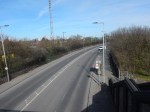
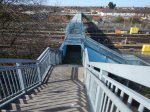

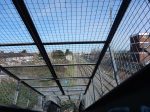
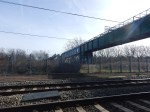
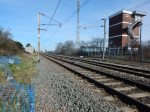

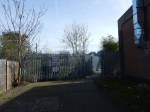
I first crossed the railway on the road bridge and then used a footbridge to cross back again.
The Google Map show the area.
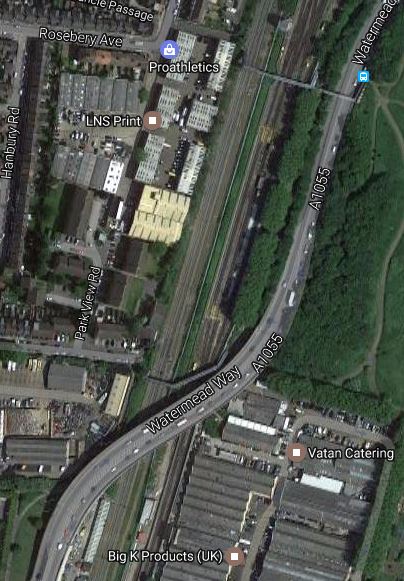
Note.
- The footbridge crosses the road and the various railway lines at the top of the map. The blue dot at its Eastern End is a bus stop.
- STAR will run on the Eastern side of the railway, in the space, which looks green on this map.
- Northumberland Park is the next station to the North
- Tottenham Hale is the next station to the South.
The map shows it is a tight space to thread a railway.
Why Not Buxton To Hellifield?
Hellifield station, which connects to the Settle and Carlisle Line, is the Northernmost station on the Ribble Valley Line from Manchester and Blackburn.
I’ve not been there, as you need to get there from Blackburn on a Sunday, but surely, as a conductor told me, Northern Rail should provide a service seven days a week.
The Track To Hellifield
This is an extract from an e-mail from Ribble Valley Rail.
The line north of Clitheroe to Hellifield is entirely double track (in use) with a double track junction on to the S&C line at Hellifield South Junction at the south end of the station. Approximately 19 sets of points and a large amount of trackwork were renewed at Hellifield a few years ago.
They also said, that there is one small addition, they would make at Hellifield, but if services to Hellifield get a lot more numerous, I’m sure Network Rail would do what is necessary.
As the line is double-track from Blackburn to Hellifield, this would mean that running more trains on the line is determined by the number of passengers and the revenue and profit generated, rather than some quirky passing loop by a level crossing or some of British Rail’s pitiful attempts to save money.
Blackburn to Hellifield is a real railway.
Platform Lengths
The e-mail from Ribble Valley Rail, also said this about platform lengths.
All Ribble Valley intermediate stations were lengthened a few years ago and can now accommodate 4-car class 150s which now operate quite regularly, especially on Sundays. 4-car class 156 do overhang and involve locking some doors out-of-use until Blackburn or Clitheroe.
So how long is a four-car formation of the various trains?
- Class 150 – 80.24 metres – 75 mph
- Class 156 – 92.1 metres – 75 mph
- Class 172 – 94.48 metres – 100 mph
- Class 319 Flex – 79.5 metres – 100 mph
I included the Class 172, as it’s a typical modern diesel multiple unit.
So Porterbrook’s new train has an advantage in that British Rail made the Bedpan Specials, a little bit shorter, to save steel and other materials.
I’ve just received another e-mail where this is said.
Despite the lengthening of the Ribble Valley line intermediate stations, because of various constraints with adjacent bridges they have finished up different lengths. The shortest is the Down platform at Ramsgreave & Wilpshire which I am told is79 m. However a 4-car class 150 does fit on with careful stopping, all doors on the platform and only a slight overhang of the train at each end.
Look at this picture of a Class 319 train.

The end passenger doors would appear to be several metres back, so the train fits a platform, that is a few metres shorter than the train. Was this British Rail’s solution to the non-invention of selective door opening?
Health and safety might want a little fence on the platform, but it looks like the Class 319 trains were designed so that British Rail could get away without lengthening platforms on Thameslink.
Current Timings On The Route
These are timings of the various sections of the whole route from Buxton to Hellifield.
- Buxton to Hazel Grove (up) – 37 minutes
- Hazel Grove to Buxton (down) – 33 minutes
- Hazel Grove to Stockport – 9 minutes
- Stockport to Bolton – 48 minutes
- Stockport to Manchester Piccadilly – 22 minutes for a Hazel Grove to Blackpool North train via Bolton
- Stockport to Manchester Piccadilly (fastest) – 9 minutes
- Bolton to Manchester Piccadilly (fastest) – 22 minutes
- Bolton to Blackburn (up) – 29 minutes
- Blackburn to Bolton (down) – 26 minutes.
- Blackburn to Clitheroe (up) – 26 minutes
- Clitheroe to Blackburn (down) – 23 minutes
- Clitheroe to Hellifield (up) – 25 minutes
- Hellifield to Clitheroe (down) – 11 minutes
Note the differences between up and down times.
Based on these timings, I reckon that these timings are possible now with a Class 150 or Class 156 train.
- Buxton to Blackburn – 102 minutes
- Blackburn to Buxton – 103 minutes
- Buxton to Clitheroe – 128 minutes
- Clitheroe to Buxton – 126 minutes
- Buxton to Hellifield – 153 minutes
- Hellifield to Buxton – 137 minutes
This would give round trip times something like these.
- Buxton to Hellifield – 290 minutes
- Buxton to Clitheroe – 254 minutes
- Buxton to Blackburn – 205 minutes
Obviously, the two turnround times would have to be added.
But various factors would reduce the times, if a Class 319 Flex were to be used from December 2017.
- The route will be fully electrified between Bolton and Hazel Grove stations.
- Two trains per hour will be possible between Bolton and Blackburn from December 2017.
- The Class 319 Flex is a 100 mph train.
- As the Class 319 Flex has been optimised to climb the hills, it must be faster on the uphill sections.
- Drivers have told me, that the Class 319 train has excellent brakes, so they may be faster coming down.
The Bolton to Hazel Grove route is currently timetabled at 48 minutes. But surely a 100 mph electric train can knock quite a few minutes off that, when the route is fully electrified.
If this section could be done in thirty minutes, which I suspect is possible, this brings the round trip times down as follows.
- Buxton to Hellifield – 254 minutes
- Buxton to Clitheroe – 218 minutes
- Buxton to Blackburn – 169 minutes
In some ways the interesting one is the round trip from Buxton to Clitheroe, which allowing ten minutes for each turnround at Clitheroe and Buxton means that the round trip is under four hours.
This means that an hourly Buxton to Clitheroe service would need four trains and two trains per hour would need eight trains.
The Blackburn Service From December 11th 2017
On this day Northern introduced two trains per hour between Manchester Victoria and Blackburn along the Ribble Valley Line, with one train per hour exytending to Clitheroe.
If the service went to Buxton instead of Manchester Victoria, I think this service would require seven trains. If the Clitheroe service was extended to Hellifield, that would need another two trains.
Conclusion
I wonder when the real timings are obtained using Class 319 Flex trains, what cunning plan Northern Rail will come up with, to satisfy their passengers, staff and profits.
Marketing says that running between Hellifield and Buxton on a 24/7 basis, even at one train every two hours could be a very popular route.
The Four-Car Bi-Mode Train
The Class 319 Flex train is an affordable four-car bi-mode or electro-diesel train, promoted by Porterbrook and to be used by Northern.
- The train is affordable, as it is based on a refurbished Class 319 train, which was built thirty years ago.
- The train is a dual-voltage unit and can be powered by either 25 KVAC overhead or 750 VDC third-rail electrification.
- Each unit also has two rail-proven MAN diesel engines, for powering the train on lines without electrification.
If there is a drawback, it is that with their interiors so far, Northern have opted for a no-frills interior with no wi-fi.
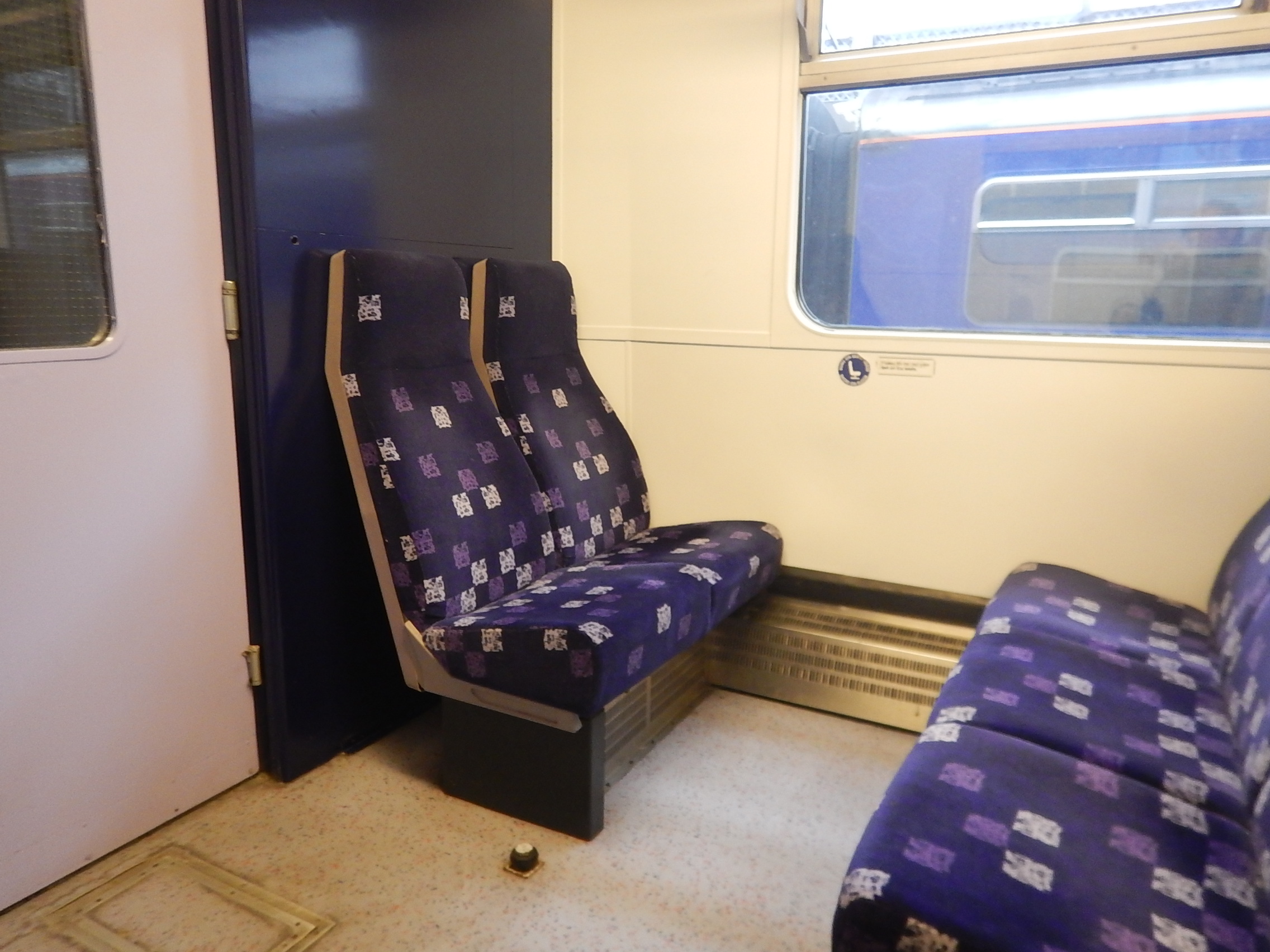
Compare this with the interior of a Class 455 train.
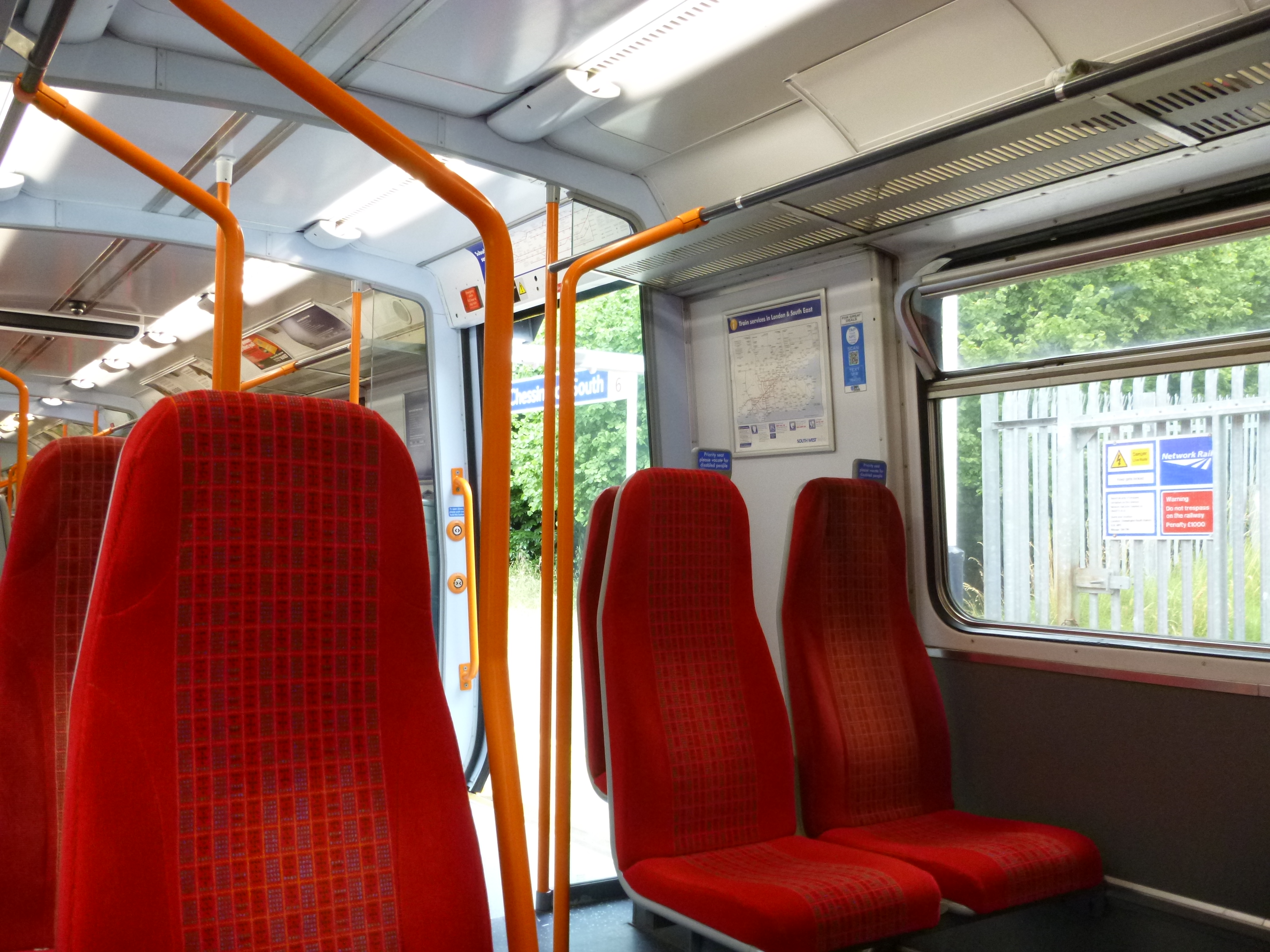
The trains were originally built within a couple of years, but the updated interior specified by South West Trains is much more impressive and passenger-friendly than that used by Northern.
Both trains are four-car units and are based on the Mark 3 coach, so underneath the skin, they probably have a lot in common.
There are a large number of four-car trains on UK railways so it must be a train length that is convenient for operators.
But strangely until now there has not been a four-car bi-mode train.
But then bi-mode trains are not that common, with the only UK train of that type; the Class 800 train, yet to enter service.
But the Class 800 train is for the long distance market and is a five-car or nine-car 125 mph train.
I do wonder, if the reason we have no four-car bi-mode trains, is that no-one has bothered to design one so no-one has wanted one.
But Porterbrook own 86 of these Class 319 trains, which are reliable 100 mph trains, that drivers tell me they like, because of their performance and excellent brakes.
Because of their age, they’re probably not worth a great deal more than scrap value, but because of the depth of knowledge of what can be done with Mark 3 coaches, they can be turned into a useful train by quality engineering.
Porterbrook have seen a gap in the market with Northern for a train specifically designed to be able to handle their toughest route, which is Manchester Piccadilly to Buxtonup the very steep Buxton Line. But the train is no one-trick pony and can run on virtually any of Northern’s routes, whether they are electrified or not.
So Northern can use the train for a variety of purposes.
- Running services on routes, that are not fully electrified.
- New route development.
- Extension of existing electrified routes.
- Replacement of a failed unit, which could be electric or diesel
Northern will have two versions of the Class 319 train; electric and bi-mode, just like other train operating companies will have electric and bi-mode versions of the Class 800 train.
I suspect that to passengers and all train staff except the driver, there will not be many obvious differences between the two versions.
Some routes will probably be able to be served by both versions.
The Bombardier Aventra
I feel very much that the Aventra will have one or more independently-powered versions.
The Aventra has a slightly unusual and innovative electrical layout.
This article in Global Rail News from 2011, which is entitled Bombardier’s AVENTRA – A new era in train performance, gives some details of the Aventra’s electrical systems. This is said.
AVENTRA can run on both 25kV AC and 750V DC power – the high-efficiency transformers being another area where a heavier component was chosen because, in the long term, it’s cheaper to run. Pairs of cars will run off a common power bus with a converter on one car powering both. The other car can be fitted with power storage devices such as super-capacitors or Lithium-Iron batteries if required.
This was published six years ago, so I suspect Bombardier have improved the concept.
Perhaps instead of a power storage device, they could squeeze in a small diesel engine and an alternator.
I’ve believed for a long time, that the Class 710 train being built by Bombardier for the London Overground, has onboard energy storage and that I wouldn’t be surprised if it used the storage to capture energy from regenerative braking, just as a lot of hybrid vehicles, like a London Routemaster and a Toyota Prius.
It won’t be a high-power bi-mode like the Class 319 Flex train, but it could have a useful range on the stored energy.
But it will be an all-electric train and probably more energy-efficient.
Other Four-Car Bi-Modes
I can’t believe that other train manufacturers are not looking at various forms of bi-mode trains.
Hitachi make the Class 800 trains at Newton Aycliffe, where they also make the four-car Class 385 train for ScotRail.
And what about Alstom, CAF, Siemens and Stadler?
What About Five Cars?
Four-car trains mean that operators can run eight and twelve car trains, when they are convenient. But other companies prefer five-car and ten-car trains.
We have the Class 800 trains, which are a 125 mph bi-mode, but we don’t have a five-car bi-mode suburban trundler. A few would surely be useful for Southern to handle Uckfield and the Marshlink Line.
I also believe that Greater Anglia’s five-car Aventras could have the limited independent capacity given by onboard energy storage.
I suspect that what the train operators need, the train operators will get!
Conclusion
We will see a complete spectrum of bi-mode four-car trains. And a few fuve-cars too!
, o
 The Anonymous Widower