Thameslink’s Proposed Service In A Few Years
I’m putting this up for my own help, as I often need to answer my own questions about the services and where they call.
Much of what I am using here has come from the Wikipedia entry for the Thameslink Programme. Imporant sections are.
- Bermondsey Dive-Under
- Provisional Timestable
- Rolling Stock
- The Last Phase Of The Programme (Key Output 2)
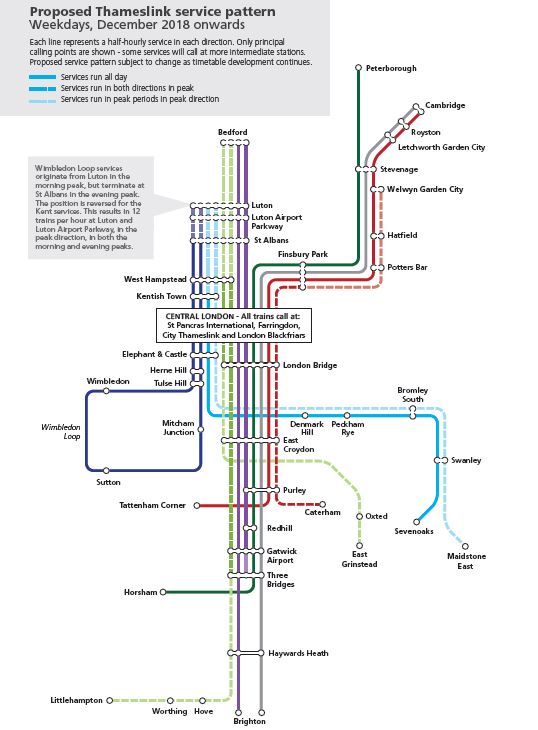
This a map of Thameslink Services.
ThamesLink Programme Map
I shall finish with a section of Questions and Answers..
At Which Stations Will All Thameslink Services Call?
St. Pancras International, Farringdon, City Thameslink and London Blackfriars.
So if you want to change your destination tro another Thameslink branch, you would get off your train at any of these stations and wait for one that serves your destination.
At Which Stations Will Thameslink Call Between London Bridge and East Croydon?
None!
How Will You Get To Thameslink From Dalston Junction And The East London Line?
It would appear that there will be no easy way to do it, as no Thameslink trains will stop anywhere between London Bridge and East Croydon.
Where Is The Journey Time Calculator?
You tell me! I can’t find one!
Why Is The Sutton Loop Still in the Programme?
Under Political Developments, the Wikipedia entry says this.
Network Rail had planned to terminate Sutton Loop Thameslink trains at Blackfriars station, rather than have them continue through central London as at present. This upset many residents in South London and their local politicians, who saw it as a reduction in services rather than an improvement. In response to pressure, government has ordered Network Rail to reverse the decision.
I will add a few more questiuons later.
Changes At Highbury Corner
Transport for London have announced their plans to change the pedestrian, cycling and vehicle routes at Highbury Corner, which are detailed in this document on their web site, which is entitled Have your say on improvements to Highbury Corner for pedestrians and cyclists, and changes to bus services.
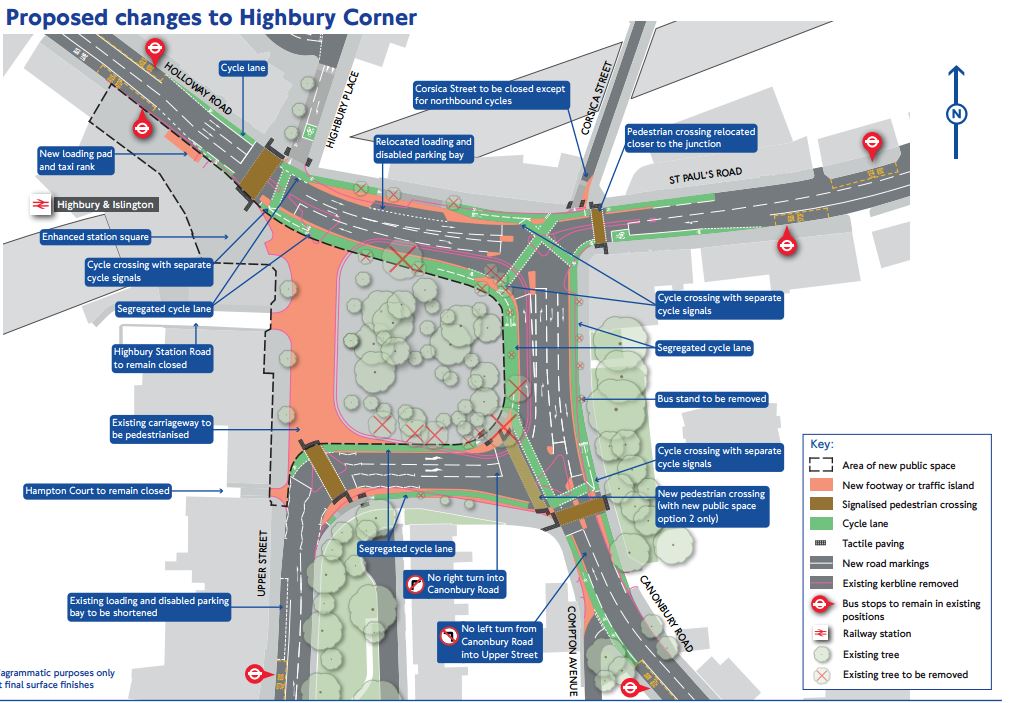
The document contains this map.
Highbury Corner Changes
The map is a good summary of the proposed changes.
- The western side of the roundabout is to be closed and become a pedestrian area.
- The roads around the roundabout will become two-way.
- The area in front of Highbury and Islington station and the Famous Cock public house will become a large pedestrian area.
- Pedestrian routes will be improved.
- There will be new cycling routes.
- There will be provision for a taxi rank by the station.
- The 277 bus route will be cut back to Dalston Junction and more buses will run on route 30.
- There will be a new N277 night bus.
They are also developing two options for the arboretum in the middle of the roundabout.
- Option 1 would keep it closed off from the hoi polloi.
- Option 2 would open it up to create a pleasant walking route to the station.
The first option would see nineteen trees felled and the second twenty-three.
My Problems With The Current Layout
I try to avoid using Highbury Corner as much as possible, despite it being an easy bus ride on a 30 or 277 bus from the stop behind my house.
The reasons are as follows.
- Highbury and Islington station needs a makeover with a wrecking ball. It has no lifts to the Victoria and Northern City Line platforms and at certain times of the year, my feet aren’t up to the stations long and dreary passages.
- To get to the station from the bus stop, you have to walk along a narrow pavement and cross a busy road on a light-controlled crossing at both ends of the walk. To make matters worse, there are two roads, which are used by drivers as rat runs and then there are bikes chained up blocking the pavement.
- Coming home is only one road crossing, but the bus stop is exposed and can be a bleak and polluted place to wait.
- If I’m coming home with heavy shopping, it’s impossible to get a taxi.
- The bus stops are not well-placed if you arrive at the station and want to go South to the Angel.
- Some of the pavements are rather narrow and crowded.
At least when I’m coming home, I can take the North London Line to Dalston Junction station and then get a bus from outside the station.
So how does the new layout affect my points.
1. Highbury And Islington Station
This isn’t covered in the current plans and I hope when TfL get round to sorting the station, they do a good job. I would like to see the following.
- Full step-free access.
- A second entrance in the 1904 entrance on the other side of Holloway Road
- Better laid out walking routes to the Emirates Stadium.
- A decent iconic building on the top of the station.
In Could We Create A Second Entrance To The Overground At Highbury And Islington Station, I proposed an a second entrance at the other end of the Overground plstforms.
It’s probably not feasible, but the station has potential for being a lot better.
2. Walking Between The Station And The Bus Stops On St. Paul’s Road
The walking route is improved a bit.
- Moving the crossing on St. Paul’s Road to the west is good.
- The wider pavement in froint of Marie Curie will help.
- The closure of Corsica Street is good.
- I would like to see more of a closure of Highbury Place.
But the walking route is improved a lot, if Option 2 for the arboretum is implemented.
- It would be much more pleasant and sheltered to walk through the trees.
- I like the option to walk from the St. Paul’s Road stop, to catch a 271 bus to go towards Archway at Stop H.
It will of course seem to be longer.
3. The Eastbound Stop On St. Paul’s Road
There is very little that can be done to improve Stop C, unless it was moved nearer the roundabout and placed on a wider pavement.
It is a stop that gets loaded up with fast food litter and needs a Big Belly.
4. Taxis
I like the provision of a taxi rank, in front of the station.
5. Buses To The Angel
The bus stops seem better positioned.
If possible I would like to see Stops F and G as near to the station as possible, with Stop G on a wider pavement.
Stop G is probably a better option now to go South, as the bus routes 4, 19 and 30 have joined and it should be easier to cross the traffic.
6. Narrow And Crowded Pavements
The places that I don’t like are.
- From the Barclays Bank to Bus Stop C along the North side of the roundabout.
- From the station to Bus Stop G.
- From the station to Bus Stop F.
The first and third will be improved if drivers don’t rush into and out of side roads.
The second may be improved by the better crossing at the roundabout.
But I do feel that bus stops C and G need to be on wider pavements.
These are my comments on other parts of the proposals.
Traffic Routes
As I don’t drive, any more, I won’t comment, other than to say, that if drivers obey the signals, pedestrians will be happy.
Closure Of The Western Side Of The Roundabout
I’m very much in favour, as all stations should welcome you to an area. A pedestrian space half the size of a football pitch does that!
Improved Pedestrian Crossings
No problem! I don’t like double crossings, as I’m getting a bit slow.
Legible London Signage
I have a gammy left hand and use the signs and liths a lot, as I find them easier to use than a book of maps or a smart-phone,
New Cycling Facilities
My days of cycling in areas like Highbury Corner are long gone. So long as cyclists obey the rules and don’t knock me over on the pavement, I’ll leave them alone.
Changes To Trees
A proportion of London’s trees are suffering because of pollution and some others are inappropriate for today’s climate.
All I ask, is that a sensible approach is taken, that in a few years means that Highbury Corner is held up, as the correct way to manage an urban space.
Some people get far too emnotional about trees, when a hard-nosed practical approach can often lead to more trees being planted.
I should also say, that I used to own and live in a property surrounded by beautiful trees, many of which were hundreds of years old.
Over a period of about ten years, I lost about twenty specimen elm trees to Dutch Elm Disease and then the Great Storm of 1987 blew half the rest of my wonderful trees away overnight.
Bus Service Changes
I’m broadly in favour and providing that the extra buses are added to route 30 to make up for the loss of route 277 between Dalston Junction andv Highbury and Islington, I won’t bother too much.
I sometimes feel that there might be scope for a bus to go on a route something like this.
- Shoreditch
- Dalston Junction
- Highbury and Islington
- Holloway Road
- Archway
But I think I’m just being selfish!
Options For A New Public Space
As I want to walk through the arboretum, when I take a bus to Highbury and Islington station, I’m totally in favour of Option 2.
Drop-In Sessions
TfL will be holding three events at which you can view the proposals in detail and speak to representatives of TfL and Islington Council.
Union Chapel, Compton Terrace, London N1 2UN
- Wednesday, 24 February 15:00 – 19:00
- Saturday, 27 February 09:30 – 13:30
- Monday, 29 February 10:00 – 14:00
Conclusion
It’s a good start and I wouldn’t be surprised if the final scheme was better.
An Ideal Oxted Line
This post was suggested by a comment by Ben H on my post called Untangling The Brighton Main Line. He said this about Oxted Line services.
Cease all services between the Oxted lines and Victoria (fast lines). All Oxted line services should go to London Bridge and (excluding diesels) become part of Thameslink.
Oxted services should operate single-line working between Norwood Junction and Sanderstead, with East Croydon’s easternmost platform island acting as the passing loop.
In one way, what he says is a no-no. If Oxted services were switched from Victoria to London Bridge, all the commuters would be up in arms and would challenge the change of London terminal in every way possible. Remember what happened when Network Rail proposed terminating all Sutton Loop services at Blackfriars. This is from Wikipedia in Political Developments under Thameslink Program.
Network Rail had planned to terminate Sutton Loop Thameslink trains at Blackfriars station, rather than have them continue through central London as at present. This upset many residents in South London and their local politicians, who saw it as a reduction in services rather than an improvement. In response to pressure, government has ordered Network Rail to reverse the decision.
So Oxted services will have to go into Victoria, until something so much better comes along, they forget about it. Bribery is a powerful tool.
The Current Oxted Line Service
So what services go down the two branches of the Oxted Line?
In the Off Peak the following services run.
- Two trains per hour go between Victoria and East Grinstead
- One train per hour between London Bridge and Uckfield.
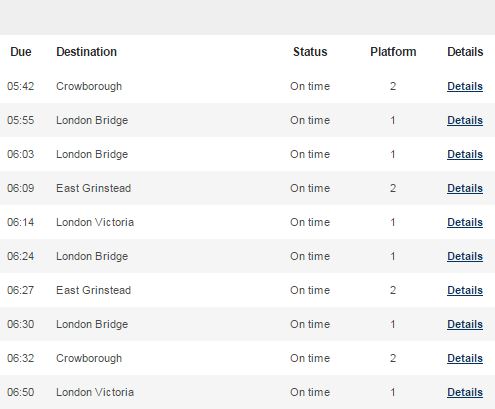
There are extra trains in the peak, as this Departures display at Oxted station shows.
Trains From Oxted
But compared to say the Chingford Branch into Liverpool Street, which has at least four trains per hour all day, it is a very sick joke of a service. And a lot of the Chingford Branch services are eight cars!
Four Trains Per Hour To East Grinstead And Uckfield?
I strongly believe that services need to be four trains an hour, as they are on the East London Line to the four Southern terminals of Clapham Junction, Crystal Palace, New Cross and West Croydon.
So the question has to be asked if East Grinstead and Uckfield should have a four trains per hour service?
My view is that they do, if you want to have a turn-up-and-go service!
Fifteen minutes may seem a long wait, but if you can get a coffee and a paper, it can be quite a short time.
So what frequencies do other places in Sussex have to and from London?
- Bognor Regis – 2 trains per hour.
- Eastbourne – 2 trains per hour.
- Hastings – 3 trains per hour.
- Hove – 2 trains per hour.
- Littlehampton – 2 trains per hour.
- Worthing – 2 trains per hour.
These are better than Uckfield and just about on a par with East Grinstead.
Thameslink Will Be A Game-Changer
The completion of the Thameslink Programme will bring an increase in capacity all the way from Brighton and Gatwick Airport to London and beyond.
This a map of Thameslink Programme.
ThamesLink Programme Map
Brighton and Gatwick Airport after the upgrade will have frequencies of upwards of eight and twenty trains per hour respectively and a choice of destinations including.
- Blackfriars
- Cambridge
- Farringdon for Crossrail
- London Bridge
- Luton
- Peterborough
- St. Pancras
- Victoria
I also think that if passengers were prepared to change at Brighton, Gatwick or East Croydon, there could be substantial increases in faster services to London and beyond from places on the Coastway Lines like Bognor Regis, Eastbourne, Hastings and Worthing etc.
There is possibly an argument to build some south-facing bay platforms at Gatwick, so that additional services can be run from there down the two Coastways. Thus a passenger from Hastings to London say, would have in addition to the direct service perhaps two or three with a step-free change at Gatwick, where they could choose either a Victoria or a Thameslink service.
What happens in the future will depend on how passengers use the improved Thameslink and what Gatwick decides to do to gain more passengers.
It will be interesting to see how the pattern of commuters changes in the next few years.
Have Thameslink Got Their Act Together?
One thing that puzzles me, is that I can’t find anything on the Internet, which talks about speeded up services on Thameslink after improvement. So am I right to assume that they’re spending all this money to provide more trains with larger capacity to more destinations in the same time as now?
There is no journey time calculator on the Thameslink Programme web site like there is on the Crossrail web site.
Obviously, it isn’t provided as the truth may be at odds with how wonderful the PR guys believe Thameslink is going to be.
Thameslink To Uckfield and East Grinstead
It might seem logical to run Thameslink trains down the Oxted Line to Uckfield and East Grinstead.
In fact, it is planned to run an eight-car service between West Hampstead Thameslink and East Grinstead in the Peak.
So why not run two four-car Class 700 trains that join and split at Oxted?
- The trains only come in fixed formations of eight and twelve cars.
- A sixteen-car train would probably be too long for the tunnels and the trains don’t have the end gangways needed for tunnels.
- The Uckfield Branch is not electrified.
- It would probably not be a good decision to build four-car trains for one branch of Thameslink.
Given the chequered history of the birth of Thameslink and the design of the trains, I think that four-car trains that could run in pairs, were discarded from the design of the railway. As it’s also common for trains to be split and joined all over southern England, I wouldn’t be surprised to see some shorter trains in the future on Thameslink.
Services Not Serving Gatwick Airport At East Croydon Station
If consolidation of services can take place at Brighton and Gatwick Airport, would it be possible to do the same at East Croydon station. These are the services south from East Croydon, that don’t terminate at Three Bridges and Brighton or pass through Gatwick Airport.
- 2 trains per hour from Victoria to Caterham
- 2 trains per hour from London Bridge to Caterham
- 2 trains per hour from London Bridge to Tattenham Corner, which when the Thameslink Programme is complete will start from Cambridge.
- 2 trains per our from Victoria to East Grinstead
- 1 train per hour from London Bridge to Uckfield
- 1 train per hour from Victoria to Tonbridge via Redhill
- 1 train per hour from Victoria to Reigate via Redhill
To summarise there are eleven trains an hour of which six go to Victoria and five to London Bridge. I assume it’s all for historic reasons and nothing to do with any serious railway planning.
Thankfully, the Tattenham Corner services are being taken out of the mix and will become part of Thameslink.
Another Gatwick Express Route
An interesting point is that Reigate and Tonbridge are both on the East West Route that connects Reading to Ashford International, via Guildford, Reigate, Redhill, Gatwick Airport and Tonbridge.
I believe that this could be a second Gatwick Express route to link the Airport to Wales and the West, and Continental rail services. So a four trains per hour service from Reading to Ashford international via Gatwick could benefit a lot more than those going to and from the Airport.
Platforms 5 And 6 At East Croydon Station
Intriguingly, all of these non-Gatwick services from London, seem to go south from Platform 6 at East Croydon station and go North from Platform 5.
There are also some other services like London Bridge to Horsham, that also use these platforms.
So do the savvy passengers coming from the South wanting to go to London Bridge, but from a station served by Victoria , change at East Croydon for the alternative destination?
Interestingly, if you use the National Rail’s Journey Planner to look at services from Victoria to Uckfield or London Bridge to East Grinstead, it sends you via a change at East Croydon.
So I would suspect that regular travellers know how to use East Croydon as an optimal interchange to get to their correct destination.
These pictures show Platform 5 and 6 at East Croydon station.
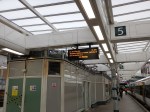
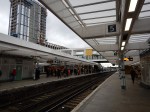
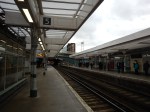
It is a well-equipped island platform, with coffee and food stalls, a waiting room, an information booth and toilets. The bridge at the Northern end and the ramp at the Southern end give step-free access to the two entrances and the other platforms.
Compared to some draughty, unwelcoming and scruffy places, where I’ve changed trains, it is one of the best single-platform interchanges.
The only thing that the island platform lacks is an Oyster reader, so that those like me, who need to touch-out and touch-in again, as they are changing from a Zone 6 ticket to contactless for Gatwick Airport, don’t have to walk up and through the barrier. I wrote about this in Contactless Between East Croydon And Gatwick Airport, which showed that at present contactless cards may be cheaper!
Increasing Capacity on the Oxted Line Is Not That Simple
Various factors come into play when providing extra capacity on the Oxted Line and I’ll discuss them in the next few sections.
Extra Services Through Platforms 5 And 6 At East Croydon
I’ve looked at an hour in the rush hour and a dozen trains have travelled South through platforms 5 and 6, with some gaps between trains being as low as two or three minutes.
Many platforms in London handle upwards of sixteen to twenty trains an hour. Londoners and visitors, also know how to use platforms like these as interchanges, by getting off one train and then getting another one a few minutes later.
When Thameslink is fully upgraded, passengers from Peterborough, Cambridge and Bedford, will change to their ultimate southern Thameslink destination at stations like St.Pancras Thameslink, Farringdon, City Thameslink, Blackfriars and London Bridge.
So on a brief analysis, it would appear that Platforms 5 and 6 at East Croydon are not the limiting factor, provided that signalling, track, trains and staff are all working as they should. The platforms also offer valuable interchange opportunities to set up the journey you need.
It gives a simple rule for getting to any of the stations on the various inner branch lines to Caterham, Uckfield, East Grinstead and others not served by Thameslink.
You get any train on either of these branches to East Croydon and then wait on Platform 5/6 for the next train to your ultimate destination.
Thameslink to Tattenham Corner And Horsham
When I went to Gatwick Airport to write about the contactless ticketing, I arrived on Platform 5 at East Croydon on a Horsham train, that had started from London Bridge, that I’d caught at New Cross Gate. These services run twice every hour, as does a service from London Bridge to Tattenham Corner.
When Thameslink is completed, two services to Horsham and two to Tattenham Corner will become all day twelve-car services as follows.
- Peterborough to Horsham. – Currently this service stops at New Cross Gate and Norwood Junction between London Bridge and East Croydon.
- Cambridge to Tattenham Corner – Currently some services stop at Norwood Junction between London Bridge and East Croydon.
Incidentally, I do wonder if the person, who devised the Thameslink schedule was a horse racing enthusiast. A twelve car train from Cambridge to Tattenham Corner would be ideal for getting between the two important racing centres of Newmarket and Epsom.
Will these four services continue to use Platforms 5/6 at East Croydon?
I think they should as it would give all of those places like East Grinstead, Purley, Uckfield and all the other stations currently connected to Platform 5/6, a same-platform interchange to a four trains per hour Thameslink service to the East Coast Main Line.
If passengers want the other northern branch to Luton and Bedfird, they would change in the core.
Will these Thameslink services still continue to stop between East Croydon and London Bridge?
Judging by some of the chatter on the Internet, it looks like there’s a good chance they won’t!
Extra Northbound Destinations From Platform 5 And 6 At East Croydon
East Croydon station frustrates me, in that to get there from my closest station at Dalston Junction is not simple.
- Change at New Cross Gate or Norwood Junction stations.
- Travel to West Croydon station and get the Tramlink.
So could a third northbound destination be added to platform 5 and 6 at East Croydon?
I believe that the answer is yes, especially as there is spare capacity on the East London Line to the North of Surrey Quays station. Although, I doubt that Southern’s trains could run north of that station.
- Personally, I would find a Dalston Junction service to East Croydon, much more useful than the current one to West Croydon.
- Crystal Palace possibly has the space.
- It would be very handy, if it were possible to have a terminal platform somewhere in the Shoreditch High Street/Whitechapel area.
- Transport for London are also thinking about a station in the Penge area, where the East London Line and the Chatham Main Line cross.
What is done in the end will depend on the travel statistics. I suspect that the new Penge station and swapping the West Croydon service to East Croydon are the most likely options.
Gatwick Express To Old Oak Common And Milton Keynes
Platform 5/6 At East Croydon is the Southern terminus of a service to Milton Keynes that uses the West London Line.
I believe that this service could be upgraded to be part of Gatwick Express.
- It would use the same trains as the other Gatwick Expresses.
- Hopefully, it could run more than once an hour.
- It would create a simple link from Gatwick Airport to the Midlands and the North.
- It would serve the new Old Oak Common station for HS2, the West Coast Main Line and the North London Line.
- It would terminate at Milton Keynes on the East West Rail Link.
I certainly think, that this is a third route for Gatwick Express.
The Tattenham Corner Paths Won’t Always Be Released
After Thameslink is fully open, two of the services from Tattenham Corner to London Bridge, will become Thameslink services to Cambridge.
But as some Caterham and Tattenham Corner services to Victoria join and split at Purley, this might not mean that two extra paths an hour are available to London Bridge.
I have one question about this Thameslink Tatterham Corner to Cambridge service. Which platforms will it use at
Can South Croydon Help Sort Things Out?
South Croydon station could be a key to providing better services through East Croydon. Look at this Google Map of the station and the junction to the South.
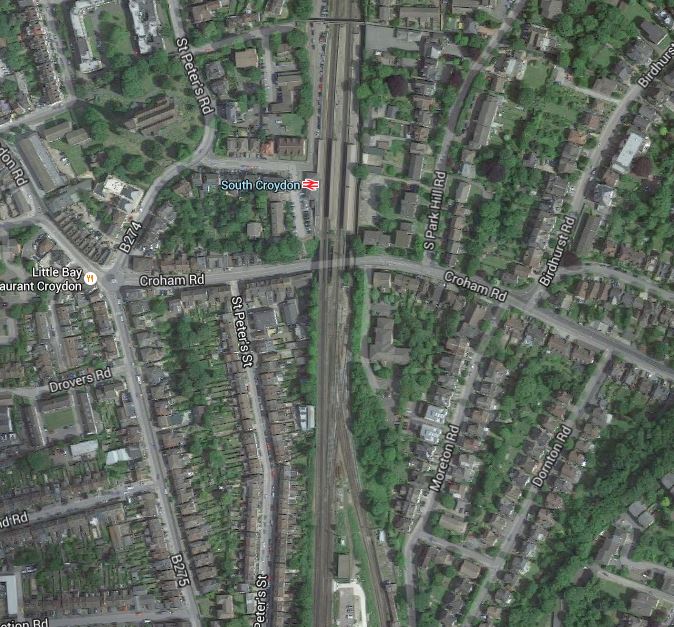
South Croydon Station And Junction
Note.
- The station currently has five platforms, but I don’t think it could be called a modern station in terms of facilities.
- The junction south of the station, is where the Oxted Line for Uckfield and East Grinstead leaves the Brighton Main Line.
- The Southern service from Milton Keynes to East Croydon, used to terminate at South Croydon.
Many of the services that use Plstforms 5 and 6 at East Croydon pass through South Croydon and I feel that a properly remodelled station could be an alternative interchange.
I think that South Croydon could also be an alternative terminus for East London Line services that currently go to West Croydon.
Norwood Junction Station
I also find Norwood Junction station frustrating and judging by the calls for some Thameslink services to call at the station, I suspect others do too.
If I’m going south on the East London Line, I can change to various services to places like East Croydon, Horsham and Tattenham Corner, by just walking across the island platform 5/4.
But going north, you have to dive into a subway to get to platform 1, rather than using the other side of the island platform 2/3.
There will be a lot of Thameslink services passing through the station and if some stopped, it would be possible to have simple cross-platform access between the East London Line and Thameslink.
A New Penge Station
Transport for London have proposed a Penge Interchange station in the Transport Infrastructure Plan for 2050, If it were to be built it would link the East London Line and the \Chatham Main Line, where they crossed just North of Penge West station. I wrote about the station in An Exploration At Penge.
This station could be an interchange between the following services.
- Chatham Main Line
- East London Line
- London Bridge to East Croydon Services
- Thameslink
As the site is quite large, there is also space for some terminal platforms facing South.
Conclusion
I have no idea what will happen, but it would seem to be possible to increase the services on the Oxted Line towards the ultimate aim of one every fifteen minutes to both termini.
The simplest solution would see the Oxted Line relegated to a branch line, where some services terminated at a rebuilt and rejuvenated South Croydon station with cross-platform access to Victoria, London Bridge and Thameslink services.
But I do doubt that four services an hour on both branches can be accommodated in the main London termini.
I do think though that there is so much flexibility, that what happens in the end will be a pleasant surprise. And probably totally acceptable to everybody except Disgusted in Tunbridge Wells!
.
Contactless Between East Croydon and Gatwick Airport
I recently travelled to Gatwick Airport and went via East Croydon station, which is a Zone 6 station and thus Freedom Pass territory for lucky Londoners like me!
I used my Freedom Pass to get to East Croydon, by changing at New Cross Gate from the East London Line.
At East Croydon, I found myself on the well-appointed Platform 5, with its coffee stall, waiting room, information booth and toilets.
The only thing that the platform lacks is an Oyster reader, so that those like me, who need to touch-out and touch-in again, as they are changing from a Zone 6 ticket to contactless for Gatwick Airport, don’t have to walk up and through the barrier.
Incidentally, for those like me who have a Freedom Pass, there is an interesting anomaly. After going through the barrier, I then re-entered the station using my AMEX card, before catching a Bognor Regis/Southampton Central service to Gatwick Airport.
At Gatwick I entered the Airport using my AMEX card and when I checked the statement I found that I’d been charged three pounds for the journey.
Coming back, I bought a ticket in a machine from Gatwick Airport to East Croydon and I was charged three pounds and forty-five pence.
So contactless cards may be cheaper! And the return ticket used my Senior Railcard!
I shall have to travel between East Croydon and Gatwick Airport on a Gatwick Express and see how much I’m charged.
It would seem to me that for Freedom Pass holders, the cheapest way to get to Gatwick, is to use the pass to get to East Croydon, exit the station and then re-enter the station using an Oyster or contactless bank card.
It’s just a pity, there isn’t an Oyster reader on the platform at East Croydon, so that those changing for Gatwick at the station can touch out and touch in again.
But this simple exercise showed that for those wanting to go to Gatwick, using contactless ticketing is the way to go.
Brummies Go For Battery Trams
The Midland Metro has several extensions in the planning stage and this article in Global Rail News is entitled Approval for catenary-free trams in Birmingham.
So the Metro’s Urbos 3 trams will be fitted with batteries to allow them to travel without the need for overhead wires on extensions to the current system.
It is not new unproven technology as the trams’ builder; CAF have buuilt battery-powered Urbos 3 trams for Seville some years ago. They are also used in Cadiz and Zaragoza.
The article in Global Rail News says this.
Birmingham will be the first city in the UK to use the technology. The batteries will be fitted to the roof of the vehicles and recharge when the tram moves back under the wires.
Routes identified for catenary-free operation include the entire Birmingham Centenary Square extension, the Birmingham-Edgbaston extension, the Birmingham Eastside extension, which will stop at the future Curzon Street HS2 station, and the Wolverhampton city centre extension.
Removing the need for overhead lines on these routes will save £650,000, ITA has said. However, the cost of procuring and installing the batteries isn’t yet known.
As Edinburgh Trams also use the same Urbos 3 trams, I wonder if Edinburgh will use similar technology to extend their tram system. The city had a lot of trouble putting up the wires, so surely a system without them may save money and time on the construction.
after the order for Arriva Rail North’s New Trains, CAF seem to be doing well in the UK.
Where will their battery trams be seen next?
It would have to be on a new system, rather than an update to an existing one.
But I do think, that Blackpool’s proposed extension to Blackpool North station could use Bombardier’s version of the battery technology.
This video on YouTube shows Bombardier’s Primove system. It’s probably more advanced than the CAF system.
Untangling The Brighton Main Line
I like difficult problems and getting more capacity out of the Brighton Main Line between London and Brighton is one of the most difficult problems on the UK rail network.
I have just read this document on the Government web site, which is entitled Brighton Main Line – Emerging Capacity Strategy for CP6.
Most of the problems are at the London end of the line and can probably be blamed on the fact that the Brighton Main Line was built by two companoes; the London Brighton and South Coast Railway and the South Eastern Railway.
There is this little history lesson in the document.
The London and South Western Railway, which operated today’s Wessex Route area for example, was able to grade separate almost all of its major junctions between London and Basingstoke in the Victorian era. The London, Brighton and South Coast Railway which operated the Brighton Main Line was unable to fund grade separation at key junctions. Even when further opportunities presented themselves for remodelling with stimulus funds in the 1930s, the by then amalgamated Southern Railway, despite developing plans for several grade separations, chose to prioritise the South West Main Line (delivering the grade separation of slow and fast lines north of Wimbledon).
The only sorting of the line done in recent years, was the creation of the Thameslink opening in the 1980s.
But as with many British Rail projects of the era, it was not done rigorously, with all major junctions, stations and other issues fully sorted.
A section in the document lists some of the bad points on the line and some possible solutions. Going South they are as follows.
Victoria Main Line Platforms
The document talks of a major reorganisation of the operation of the station. This is said.
The terminus of the BML, Victoria has seven terminating platforms available to Fast Line services although two of these are dedicated to the 4tph Gatwick Express service to simplify access for airport passengers. This leaves the remaining platforms to handle a higher volume of traffic. Development either side and above the station means the options for building additional platforms at the terminus are extremely limited.
Could it be that there has been a bit too much development around the station?
Clapham Junction Main Line Platforms
The document says this about Clapham Junction’s affect on services.
Clapham Junction is the key platform-based constraint on the route into Victoria. The station has single Up BML Fast and Down BML Fast platforms, and the majority of Fast Line services call here. The platforms have a booked dwell time of one minute and a platform re-occupation time of two minutes3 . This effectively pegs the maximum theoretical capacity of the BML Fast Lines into Victoria at 20tph – although when combined with constraints elsewhere on the route it is effectively less.
The solutions proposed at Clapham Junction station are complex and would probably be difficult to impl;ement given space and political considerations.
Windmill Bridge Junction
This is a major junction just North of East Croydon station, where one set of lines goes North-West through Selhurst and Clapham junction stations to Victoria and another set of lines goes North-East through Norwood Junction and New Cross Gate stations to London Bridge.
To complicate matters, Selhurst Depot lies in the junction, as this Google Map shows.

Windmill Bridge Junction
Selhurst station is at the top by the depot and East Croydon station is to the South.
The document says this should be done.
Grade separation of remaining flat junction conflicts (Down Victoria Fast with Up London Bridge Fast) and Up London Bridge slow with Down Victoria slow) under development.
Effectively, this means putting a flyover to separate trains going to London Bridge from those coming from Victoria.
At least the map shows that there is some green space between the two sets of lines.
East Croydon Station
This station is another station with not enough capacity. This is said in the document.
East Croydon has three Fast Line platforms but their use is complicated by the track layout at the London end of the station that involves conflicting moves between Up London Bridge fast and Down Victoria fast services at Windmill Bridge (listed above), as well as requiring reversible use of Platform 2.
The solution is mapped out in the document.
Scheme providing an additional 1 Line platforms and or 2 platforms under development. associated track layouts Scheme would also provide additional track East Croydon to Windmill Bridge Junction and track layout and signalling changes in the immediate East Croydon area including to relieve platform 4 and 5.
I think with all the development going on around East Croydon station, that this might help the addition of extra platforms. Wikipedia gives more details about the future development of East Croydon station.
South Croydon Junction
This junction just south of South Croydon station causes conflicts, where Oxted Line services conflict with down slow services.
This Google Map shows South Croydon station and the junction.
South Croydon Station And Junction
The document says this about a solution.
No viable solution currently available. Relief of other constraints may allow current layout to remain, as the flat junction constraint predominantly affects Slow Line services (although potentially constrains the pathing of services that use the Fast Lines north of Croydon).
But it is now probably more complicated as longer trains are proposed for the Uckfield Branch.
Stoat’s Nest Junction
The wonderfully-named Stoat’s Nest Junction is south of Purley station and causes the odd delay. The document talks about a solution.
A grade separation option for Up Slow to Up Fast moves under development.
It is probably a smaller but important project.
Gatwick Airport
There will be twenty trains an hour through the station at Gatwick Airport.
Given the investment being put into the station by Gatwick and the importance of the station as a hub, I feel that a way could be found to use the station to squeeze some more capacity out of the line.
Keymer Junction
Keymer Junction is south of Wivelfield station and causes delays =. The document says this about a solution.
Several options under consideration from grade separation to a third track option – case yet to be proven and would not be required if reliability and capacity uplift was focused on Gatwick inwards only.
This is one solution, that I think will be a bit different, as it could unlock capacity in Brighton and on the two Coastway Lines.
Crossrail 2
You may wonder how Crossrail 2 will affect the Brighton Main Line?
There are three stations in common between the two lines.
- Victoria
- Clapham Junction
- Balham
Will passengers switch between the two lines at stations before Victoria?
If they do, the major effect will be to perhaps free-up Victoria station by a small amnlunt.
Conclusions
There would appear to be several places where capacity improvements can be made.
But don’t be surprised if something radical happens at Gatwick!
If a second runway were to be built at the airport, then this would need more capacity to London, which would have effects on the trains south of the airport.
The Rise Of Gatwick Airport
I used to hate Gatwick Airport, but now on my short flights to Europe, I often find myself using the Sussex airport, as it is usually an easier train ride, than Heathrow or Stansted.
The South East’s Next Runway
I am coming more to the conclusion, that despite the report of the Airports Commission, Heathrow Airport will never have a third runway, but Gatwick may get a second one, as they can start to plan, for when the deal to not build a second runway with Sussex County Council, runs out in 2019.
- No serious candidate for London Mayor would win an election if they proposed a third runway at Heathrow.
- Heathrow is surrounded by housing, whereas Gatwick is surrounded by more much open countryside.
- The protests over another runway at Heathrow would be enormous.
- In a few years time, Gatwick will have the better rail links and fifteen million people will live within an hour’s train journey of the Airport.
But the main reason is that building a second runway at Gatwick will be a lot easier. Just look at this Google Map of Gatwick Airport.
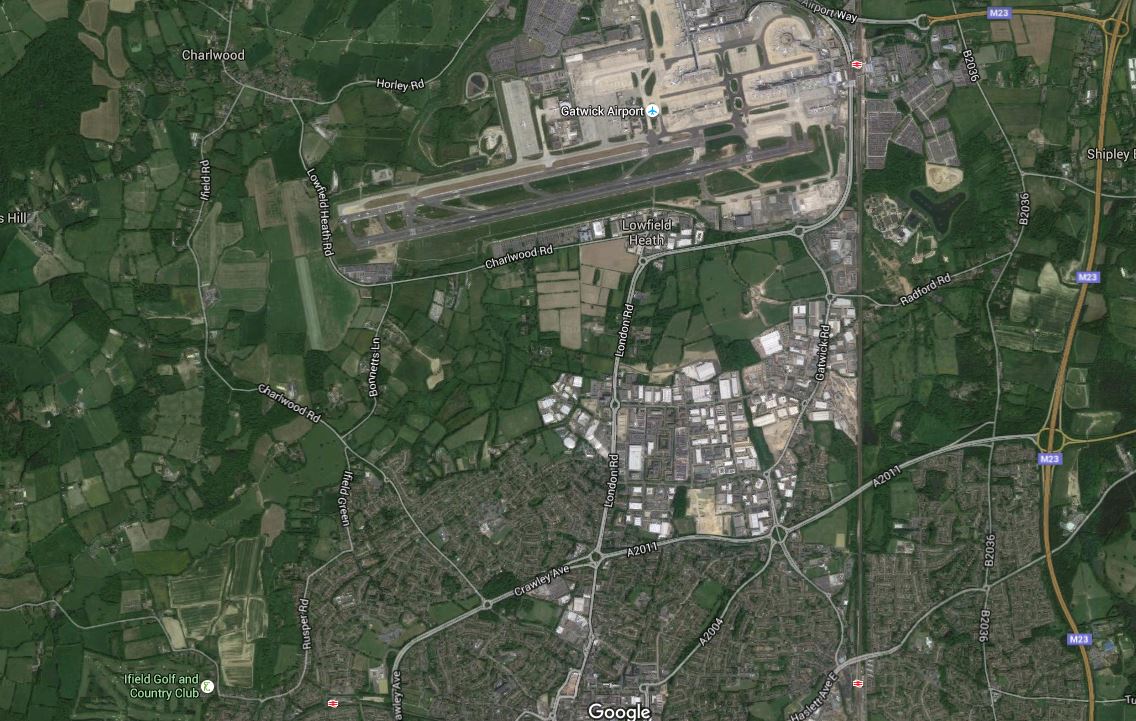
Gatwick Airport
Note the following about the map and the expansion of Gatwick Airport.
- The second runway will be built to the South of the existing runway.
- There doesn’t appear to be much housing in the area of the proposed new runway.
- The M23 Motorway and the Brighton Main Line run North-South to the East of the Airport.
- A third terminal would be built near to the existing railway line.
- Note in the map, that in addition to the single runway, the taxiway can be used as a runway, if say the runway is under repair or blocked.
The second runway would increase the capacity of the Airport to over 80 million passengers a year.
I’ve always believed that Gatwick could also build a North-South runway over the M23. This was proposed in the 1980s by pilots and with the capability of aircraft increasing all the time, I don’t rule it out at some time in the future.
The Biggest Airport Terminal In The World
I have argued in the past, that when Crossrail and Thameslink are completed, then the following airports and international rail stations will be connected together.
- Heathrow Airport
- Gatwick Airport
- Stansted Airport
- Luton Airport
- St. Pancras International station
- Ebbsfleet International station
There will also be an easy link to HS2 for the North and Scotland.
As passengers will be increasingly savvy, in many cases they will organise their travel to what is best for them and not the travel agents, airlines and the airports.
I believe that London will sell itself, as a place to break that long journey, just as Singapore and Dubai have done for years.
As the North of England, Scotland and Wales always say, London always wins!
But then London is the capital of the world!
Rail Links To Heathrow Airport
Crossrail should give Heathrow Airport a world-class link to Central London, if they can sort out Crossrail’s access problems to the airport, that I wrote about in Heathrow Express And Crossrail.
The over-priced joke that is Heathrow Express will be on borrowed time once Crossrail opens in 2019.
But there will still be problems with rail access to Heathrow Airport.
- Terminal 5 will not be connected to Crossrail.
- Changing terminals at Heathrow is a chore.
- Heathrow Express only takes passengers to and from Paddington.
- There is no direct rail access to Reading for the West.
- For some parts of London, the Piccadilly Line will still be the best way to go to and from the Airport.
- Access to Continental rail services from Heathrow will be difficult.
You would never describe Heathrow as fully integrated into the the UK’s rail network.
Heathrow will of course argue, that links to Central London are excellent and that those continuing their journey will just change terminals and be on their way.
Obviously, improvements will come, but nothing important for passengers will happen, until Heathrow puts passengers first and drops it’s arrogant attitude, which thinks it is London’s only airport.
Rail Links To Stansted Airport
Stansted Airport has the Stansted Express from Liverpool Street, which runs about four times an hour.
I believe in the next few years, the following will happen.
- Crossrail will arrive at Liverpool Street in 2019, giving one-change journeys to and from Heathrow.
- The West Anglia Main Line will be four-tracked, allowing faster Stansted Express services.
- An improved rail service will be provided to the increasingly important rail hub at Cambridge.
- An extra Stansted Express service will run to Stratford via the new Lea Bridge station.
- Stansted Express will probably get new air passenger-friendly trains.
But the biggest improvement of rail services to Stansted Airport will come, when and if Crossrail 2 is built, as this will make travel to the airport from all over London a lot easier, with just a single change at Tottenham Hale or Broxbourne.
I also wouldn’t be surprised to see some Crossrail 2 trains extended to Stansted. After all, the tracks exist and if the airport said to Transport for London, here’s a few million from our petty cash to run Crossrail 2 to Stansted, I’m sure TfL would oblige!
This would give Stansted Airport one-change services to Gatwick, Heathrow and Luton airports, Continental Rail Services and HS2.
Rail Links To Luton Airport
Luton Airport has its own Thameslink station at Luton Airport Parkway.
But also it has plans to expand, as is reported in this article in the Daily Mail, entitled Luton Airport reveals plans for direct rail line that would cut train journey from central London to just 20 minutes.
I think that Luton Airport could use something like Class 387/2 trains, as used on Gatwick Express with an IPEMU capability, so that they could use a branch line without any electrification to underneath the airport terminal.
Rail Links To Gatwick Airport
I found this article in TravelWeekly, which is entitled Gatwick outlines plans for a train departure to London every three minutes.
It gives a very good summary of the train services that will run to Gatwick after Thameslink is completed.
The planned hourly timetable would see:
• Four dedicated Gatwick Express trains to Victoria
• Six trains to Victoria – originating from East and West Coastway, Horsham/Littlehampton, and Three Bridges/Haywards Heath
• Four trains to Bedford via London Bridge – originating from Gatwick and Brighton
• Two trains to Cambridge via London Bridge – originating from Brighton
• Two trains to Peterborough via London Bridge – originating from Horsham
• Two trains to London Bridge – originating from Littlehampton/West Coastway, and Haywards Heath/Three Bridges.
That is a total of twenty trains to and from London and beyond and most of the South Coast from Southampton to Hastings.
How many better rail-connected airports are there anywhere in the world?
The article also quotes Guy Stephenson, the Airport’s Chief Commercial Officer as saying.
The new high frequency service that will serve Gatwick will transform rail journeys for our passengers, with capacity doubling and a train to London every three minutes.
Crucially, the new trains will be much more reliable and will be stacked with amenities suited to the needs of air travellers. Combined with robust new track and signalling systems, Gatwick’s passengers will experience a really pleasant and dependable service.
Overall, the improvements to Gatwick’s rail service means that 15 million people will be brought within 60 minutes of Gatwick by rail – the best reach of any UK airport,
Reading the article, you might think that Thameslink should be called Gatwicklink!
According to this Press Release on the Gatwick Airport web site, Gatwick Airport are going to spend £120.5million on updating the rail station. This is an architect’s impression of the new station.

I also think that Gatwick could extend their Gatwick Express services.
I think we can also see development of Airport services to and from Gatwick Airport station based on the following existing services.
- Reading via the North Downs Line.
- Tonbridge and Ashford International via the Redhill to Tonbridge Line.
Will we be seeing a second Gatwick Express route from Ashford or Ebbsfleet to Reading via Gatwick Airport?
Consider.
- It would inevitably get known as the M25-on-rails.
- It gives a large number of passengers a way to get to Gatwick and Continental Rail Services without going through Central London.
- It could serve Heathrow, if they got their act together.
- Surprisingly, I think this route will be quicker to go between Reading and Gatwick, than using Crossrail and Thameslink with a change at Farringdon.
- The trains for such a service could be the same as the new Class 387/2 Gatwick Expresses, but with an IPEMU capability.
But it wouldn’t be just an Airport service, as I suspect that given adequate parking at stations, it would become a valuable cross-country route linking the rail hubs of Ebbsfleet, Gatwick and Reading. After all, North of London, the East West Rail Link is being created from Reading to Cambridge via Oxford, Milton Keynes and Bedford.
Southern also run a service from Milton Keynes to South Croydon via the West London Line. In the future this service will serve Old Oak Common station on Crossrail, HS2, the West Coast Main Line and the North London Line.
So will this service be extended from South Croydon to Gatwick and become a third Gatwick Express service?
These two additional Gatwick Express services would greatly increase or ease the airport’s links across the wider South East and to HS2 services out of Euston.
The only problem, is the overcrowding on the Brighton Main Line.
Conclusion
Gatwick will become the best rail-connected airport in the UK and will get a second runway!
The East London Line Closure Of The Week Of 13th February 2016
Some have raised questions, as to why it is necessary to close the East London Line next week for Crossrail works?
I have found this vaugely-dated document on the Crossrail web site entitled Whitechapel Station closures between 13 and 21 February 2016. It says this.
The programme of activities scheduled to take place between 01:00 on Saturday 13 February and 05:30 on Monday 22 February 2016 includes the following:
- Ground reinforcement (piling) activity in the vicinity of the London Overground and London Underground platforms
- Removing the staircases, walls and canopies in the vicinity of the Whitechapel Station and the former ticket hall.
- Removing cables from the protection deck located over the London Overground, to the north of Durward Street • Removing part of the old pedestrian footbridge at the eastern end of Whitechapel Station
- Station steelwork in the vicinity of London Overground
- Concrete pours in the vicinity of the station.
- There will be concrete lorries in Durward Street and activity on Whitechapel Road to support these concrete pours.
I can certainly understand, that if they have to close the railway for Health and Safety reasons, then so be it.
I can also understand, if they’ve found something unexpected in the old part of the Victorian station. We’ve all found that when we’ve renovated old buildings.
And of course, the closure is when it is, as it is half-term in Swanlea School, which helps with access.
But this whole closure is a puzzle to me, as Crossrail’s project management and also their handling of community relations and the media has been generally good.
According to someone locally to me in Dalston, this is an unexpected closure. If it is, then where is the story in the local press or on the BBC?
These days, with cameras and crews everywhere, why hasn’t there been an honest report on BBC London television?
I think Crossrail have rather mucked up here, as people are annoyed and if they’d given us the truth, people would be more understanding.
But then we’re in the East End, and if there was an Olympic event of ducking and diving, all the medals would be won, by someone from this area.
A Trip To Seaford
This morning, I took a trip to Seaford station on the Seaford Branch in Sussex via Brighton, to see if I could learn more about the East Coastway Line at Brighton.
I took these pictures.


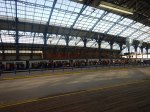


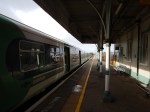

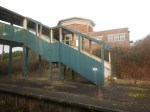




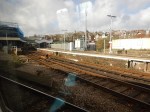

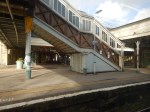

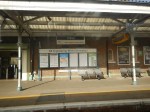
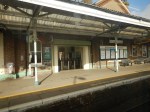

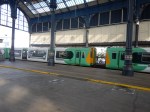
Note.
- The service from Brighton to Seaford is run by 3-car Class 313 trains.
- The Class 313 trains are elderly, but well-maintained and lacking features that passengers expect these days, like wi-fi, information displays, adequate space for bicycles and fully-accessible toilets.
- The train was fairly full on a cold but sunny, Sunday morning around Falmer station, where the University of Sussex and The Amex are located.
- I was surporised at how many people arrived at Brighton on a Thameslink service.
- Lewes station is being given a full upgrade.
- Most other stations are simple affairs, that need some refurbishment.
- It was sad to see the Port of Newhaven so quiet.
- I couldn’t identify the place, where the Wealden Line used to join the East Coastway.
Certainly the route has potential, which will probably be driven by traffic at Falmer station, which has already been upgraded to take 8-car trains.
The trains should be replaced by something like a four-car Class 377 or Class 387, that could run in pairs for busy days at the The Amex.
The question also has to be asked, if the new trains had an IPEMU capability, would it be more affordable to run the Seaford Branch, if the electrification were to be removed.
Will Southern Create A South Coast Express Using IPEMUs?
This post is pure speculation on my part,which I’ve written to illustrate the capabilities of an IPEMU.
What is an IPEMU?
Many rail passengers in the UK, have ridden in one of Bombardier’s fairly ubiquitous Electrostar trains. Here’s a short list of some of the types and the services they run.
- Class 357 trains run services out of Fenchurch Street for c2c.
- Class 375, Class 376 and Class 377 trains running commuter services to the South of London.
- Class 378 trains running on the London Overground.
- Class 379 trains running from Liverpool Street to Stansted Airport and Cambridge.
- Class 387 trains currently running on Thameslink, but perhaps soon on a line near you.
A Class 379 was used to create the IPEMU or Independently Powered Electric Multiple Unit and a year ago, I rode this train in public service between Manningtree and Harwich.
A battery pack had been added to the four-car train, which was charged up, when the train is running on an electrified line; third rail or overhead and the energy can then be used to propel the train on a line without electrification.
I was told by the engineer sitting opposite me,monitoring train performance on a laptop, that this Class 379 IPEMU had the following characteristics.
- A range of upwards of sixty miles on battery power.
- Similar performance on battery or direct power.
- Virtually identical driving experience.
I would also add that the passenger experience was virtually identical.
Network Rail and Bombardier have put a lot of time, effort and money into the IPEMU. They believe, that IPEMUs and their battery power will have the following applications.
- Providing affordable electric services on branch lines or other lines that are difficult to electrify.
- Moving trains around in depots and sidings that have not been electrified.
- Train recovery and diversion, when the power fails.
- Used in conjunction with regenerative braking, IPEMU technology saves electricity.
Obviously, Bombardier very much believe in the technology, as their new train; the Aventra has been designed to use energy storage.
IPEMU is an acronym, that will increasingly be used with trains.
The Class 387 Train
Southern, who operate a lot of services south of London are users of Class 387 trains.
- 29 x Class 387/1 trains running on Thameslink
- 27 x Class 387/2 trains ordered for Gatwick Express.
The Class 387/1 trains will be replaced by Class 700 trains, as they arrive from Germany.
Unfortunately, due to the well-documented problems of Network Rail’s electrification, it looks like a lot of these twenty-nine trains could be put into storage.
I believe that some of these trains will be given an IPEMU capability to be used to provide electric train services on certain lines.
As they are closely related to the Class 379 train used for the prototype, I feel that most of the technical problems have been solved.
Along The South Coast From Southampton to Ashford
The South Coast from Southampton to Ashford is covered by two separate rail routes.
- The East Coastway Line that runs between Brighton and Ashford International stations is only partially electrified and uses two-car diesel Class 171 trains.
- The West Coastway Line that runs between Brighton and Southampton Central stations is fully electrified and uses elderly three-car Class 313 trains, which have a top speed of 75 mph.
If you want to travel between say Hastings and Worthing, you will have to change trains at Brighton.
This usually means a wait of a few minutes and a change of platform.
Any sane person would believe that if a single train could run all the way from Southampton to Ashford, this would be better for many reasons.
- The train company would probably need less trains.
- Passengers wouldn’t have to change trains at Brighton.
- There could probably be a simpler interchange between Coastway and Brighton Main Line services at Brighton station, which might release platform space.
- Both Coastway routes are limited to speeds below 80 mph and are fairly straight, so perhaps with some improvements, faster services could be introduced.
Until recently, the only trains capable of going from Ashford to Southampton would have been diesel multiple units, but as the only part of the route that is not electrified is the Marshlink Line from Ore to Ashford, it would now be possible to run the service using an IPEMU variant of a Class 387 train. The train would charge its on-board batteries between Southampton and Ore and at Ashford and then use battery power to bridge the gap of about thirty miles on the Marshlink Line.
As IPEMUs have a range of sixty miles, then it would seem that there should be few problems in running the trains between Ashford and Ore.
This approach has benefits.
- The Class 387 train is an 110 mph electric train with regenerative braking, so services could be faster.
- GTR has quite a few of the standard Class 387 trains in service, so the company and their drivers probably know them well.
- GTR could say they have removed a number of diesel trains and they are a greener company.
- Network Rail would only have to update the track and signalling of the Marshlink Line for four-car trains and wouldn’t need to electrify any of the route.
Currently, to go from Ashford to Southampton takes three hours forty-five minutes and it is quicker to go via St. Pancras and Waterloo. But with a 110 mph train and no changes, timings must be possible in the region of three hours.
I suspect that with some selected track improvements, a limited-stop service could be a real South Coast Express.
There certainly is some scope and I’ll detail each improvements on the main East and West Coastways separately,
The Marshlink Line
The Marshlink Line is not fully double-tracked, has several level crossings and a low speed limit, which if improved, would probably be welcomed.
The Marshlink Line Action Group web site has an extensive report about improving the line, of which this is an extract, from a report which discusses extending the Class 395 train service from Ashford to Hastings.
The basics of the project are substantially as presented last year with line speeds generally expected to be 60-90 mph from Ashford to Doleham and 40-60 mph onwards to Hastings. But the ongoing big question for NR (and of concern to MLAG from an environmental point of view and compatibility with rolling stock in the surrounding lines) is whether the power source would be third rail (as MLAG would prefer) or overhead. NR acknowledges the difficulty of overhead power along the Marsh with gantries having to be built on (obviously) marsh land and with the strong winds. Whichever, some 30 miles of track would need to be laid but, apparently, only about half a mile of dualled track to the west of Rye.
Incidentally, there has been talk about running Class 395 trains from St. Pancras to Eastbourne via HS1 to Ashford and the Marshlink Line. It would undoubtedly be a fast service, but it has some inherent disadvatages.
- The Marshlink Line would need to be electrified, probably with 25KVAC overhead wires.
- Some people might object to the wires across the marshes?
- Would it need some extra Class 395 trains to be purchased?
- Would it mean that one franchise was encroaching on the territory of another?
On the other hand, using IPEMU trains would simplify the job and mean no electrification would be needed.
However, it would probably be a good idea to make sure that as much dualled track was created, to maintain an efficient service on the line in the future.
The Willingdon Chord And Eastbourne
There has been talk about reinstating the Willingdon Chord, which could shorten the line by making it possible for trains to by-pass Eastbourne, But the locals fear, that Eastbourne would lose services.
However, surely some fast long-distance services along the South Coast could by-pass the town.
A skilled compiler of timetables could probable devise one for Eastbourne, that gave the town, faster and better services to Brighton, Southampton and London.
Lewes And The Wealden Line
It is an aspiration of many to reinstate the Wealden Line, as a new route to London to take pressure off the Brighton Main Line.
In Musical Trains In Sussex, I gave my reasons for believing that the Uckfield Branch could be run using Class 387 IPEMUs.
I also believe that if the Wealden Line is reinsatated that it will use the same type of train.
Obviously, Network Rail and Southern, will make sure that the Wealden Line project doesn’t conflict with a desire to run fast trains along the South Coast.
Hove Station
Hove station is a busy one with up to eight services an hour passing through in both directions, to and from Victoria and Gatwick Airport as well as Brighton.
There were aspirations that in the future to add the London Bridge to Littlehampton via Hove service to Thameslink. The service would use the Cliftonville Curve to access the Brighton Main Line, as it does now.
This would give all stations on the West Coastway Line between Hove and Littlehampton, two trains per hour through to London Bridge and beyond
Except for the Future Developments section in the Wikipedia entry for Hove station, I can’t find any more about this proposal.
The Arundel Chord
One piece of infrastructural that gets mentioned is a chord at Arundel that would connect the West Coastway Line to the Arun Valley Line between Angmering and Ford stations.
If it were to be built, it would create another route between Brighton and Three Bridges using the eastern part of the West Coastway and the Arun Valley Line.
Westward From Littlehampton
My only experience of the western end of the West Coastway line, was missing a train and having to wait an hour on a freezing and deserted Bosham station for the next train.
The service could probably benefit from a rethink.
Brighton
Brighton is the major interchange between the two Coastway services and the Brighton Main Line with its Gatwick Express, Victoria and Thameslink services.
Brighton station certainly needs improvement to cope with the large increase in capacity to the city, that Thameslink and its new Class 700 trains will bring.
Each twelve-car Class 700 train, will have a capacity approaching 1,800 passengers and there will be four of these trains to and from Central London and beyond every hour.
Obviously, the trains won’t be full at Brightpon and not all passengers will be walking to and from the station, so there needs to be better connections to buses and the two Coastway Lines.
At present, it takes a few minutes and a platform change to pass through Brighton if you’re going between services at the station.
- Brighton Main Line, Gatwick Express and Thameslink services.
- East Coastway services
- West Coastway services.
- Great Western Railway services to the West.
The platform layout at Brighton doesn’t look as if it was designed to make train services for passengers and train companies efficient.
So surely, if Coastway services could be linked, so that they came into the station, set down and picked up passengers before going out in the other direction, this would be a more efficient way to organise trains at the station.
It would also make the interchange between Coastway and Brighton Main Line services easier and hopefully, just a walk across a platform.
A reorganised Brighton could probably contribute several minutes to the savings in journey times along the Coastway.
This Google Map shows Brighton station and the two Coastway Lines coming into the station.
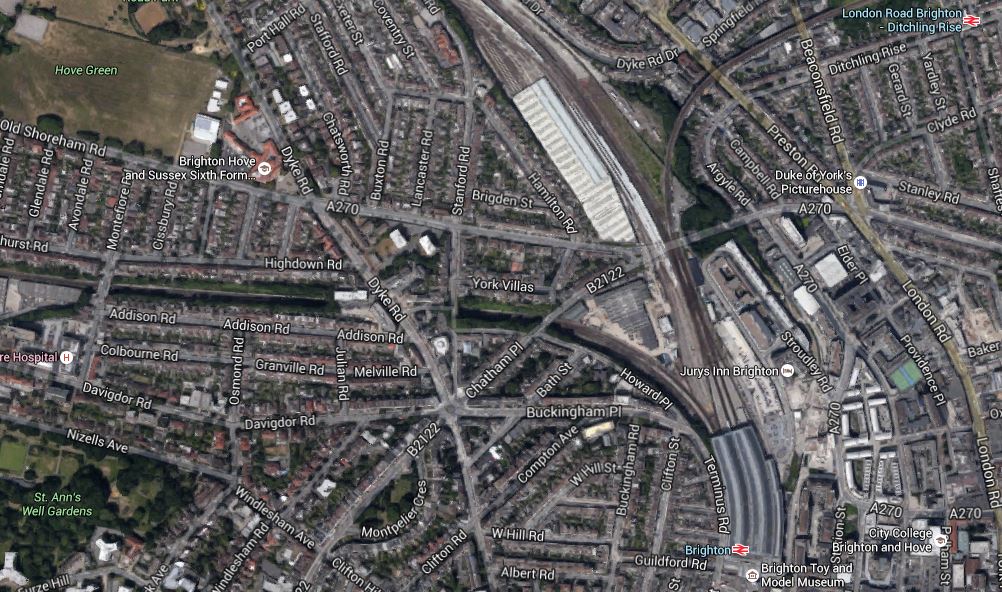
Brighton Station And The Coastways
I don’t think it would be an affordable or even a sensible solution, to combine the two Coastways together north of Brighton station.
The Wivelsfield Alternative
But Network Rail have come up with an alternative solution, so that the two Coastways can be connected together.
Just sixteen kilometres north of Brighton is Wivelsfield station. It is possible to access the East Coastway Line just south of the station at Keymer Junction, which unfortunately is not grade-separated and probably needs to be to improve Eastbourne services from Victoria.
Wikipedia has a section on the future of Wivelsfield station, which says this.
In Autumn 2015 Network Rail released the Sussex Area Route Study, where two options for the proposed grade separation of Keymer Junction are detailed, both of which would transform the station dramatically. Option 1 is the minimal option and creates a new platform 0 on the west side of the station served by a 3rd track from the new flyover line from Lewes. Option 2 is much more ambitious and builds on option 1 by adding an additional 4th platform on the east side of the station as well, served by a 4th track on the line to Lewes. Whilst this would enable each line to the south to have a dedicated platform the primary benefit would be that the existing platforms could be used to turn back trains in either direction as needed without blocking the main lines.
As services can access the West Coastway Line through the Cliftonville Tunnel to Hove, which is a couple of miles north of Brighton station, it would appear that the two Coastways could be connected, with a reverse at Wivelsfield.
The route would be.
- Lewes
- Cooksbridge
- Plumpton
- Wivelsfield
- Burgess Hill
- Preston Park
- Hove
This is not a complete solution, as there would have to be a way to get to Brighton station, by probably changing at Lewes, Wivelsfield or Hove.
A Brighton Metro
In a trip to Brighton, I travelled to Seaford using the East Coastway and the Seaford Branch. Even on a Sunday morning in February, the three-car Class 313 train was pretty full, especially around the University of Sussex at Falmer station.
So could the half-hourly Brighton-Seaford service be extended to the west of the City to perhaps Hove, Littlehampton or even Bognor Regis?
It would surely generate its own traffic across the city, which could help to reduce Brighton’s bad traffic jams. Stations could be.
- Hove
- Brighton
- London Road (Brighton)
- Moulsecoomb
- Falmer
- Lewes
- Southease
- Newhaven Town
- Newhaven Harbour
- Bishopstone
- Seaford
I think if you can sort out Brighton station or create the Wivelsfield alternative, you could run a four trains per hour stopping service across the city for as far as you want.
Perhaps the slower stopping trains would go via Brighton and the semi-fast services would go via Wivelsfield.
It’s a problem, that I suspect Network Rail have thought through fully!
Train Movements At Brighton
The only problem would be that the combined Coastway Line would need to cross the throat of the station, probably in a flat junction.
Say the Joint Coastway Line had the following services at Brighton.
- 2-4 trains per hour between Seaford and Littlehampton/Bognor, that would stop at all stations including Brighton.
- 2-4 trains per hour between Ashford International and Portsmouth Harbour and/or Southampton Central, that would stop at major stations only.
These would come into a platform or platforms on the Eastern side of the station, which would mean any train going to or coming from the West Coastway, would have to cross the Brighton Main Line to London.
The services to and from London after Thameslink is fully opened could be.
- 3 trains per hour to Victoria.
- 4 trains per hour on Thameslink
I’m no signalling expert, but I do feel that much more onerous train movements are coped with in stations like Manchester Piccadilly, Paddington and Waterloo.
Note the four trains per hour frequency on Thameslink (two from Cambridge and two from Bedford) Surely, if Coastway services are four trains per hour, then all services should have a pattern, so journeys like Seaford to Cambridge, involved just a walk across a platform at Brighton.
I’m sure some clever train scheduler can come up with an optimal pattern of changing trains at Brighton, especially if some trains used the alternative route via Wivelsfield.
But my feeling is that as Brighton is such an important station, that all Coastway services must either terminate or stop in the station.
At least there does not appear to be significant freight running on the Coastways.
Capacity At Brighton Station
The Thameslink Program and its Class 700 trains, will probably increase passengers through Brighton station.
Knowing the quality of Network Rail’s passenger transport modelling, I would not bet against Thameslink being so successful between London and Brighton, that additional services have to be added.
As the Thameslink trains will be new and they serve lots of destinations in London and beyond, I think it is a given, that passengers from places like Eastbourne and Worthing, might use Thameslink instead of their local direct route, changing at either Brighton or Gatwick Airport.
Conclusions
Improvement of the Coastways, is just one part of an evolving plan for rail and air services in Kent, Surrey and Sussex.
As there are important lines in the area that are not electrified, I’m certain that IPEMUs will play a part in this development.
After all, the technology works and we will soon have lots of Class 387 trains sitting in sidings.
 The Anonymous Widower