Three New Battery-Only Revolution Very Light Rail Vehicles
This title of this post, is the same as that as this press release from Eversholt Rail Group.
These are the three bullet points.
- Eversholt Rail funding three brand-new Revolution Very Light Rail vehicles for passenger trials and ongoing operation.
- Manufactured in the UK by Transport Design International.
- Battery-only propulsion, providing zero-emissions operation.
These three paragraphs fill out the story.
Innovative new lightweight passenger trains that will help decarbonise Britain’s railways are to be trialled after a new deal was announced this week.
The new Revolution Very Light Rail vehicles will run entirely on battery power and could be carrying passengers within three years. A new system of lineside fast charging will mean the whole operation has zero emissions.
Some of Britain’s major rail operators are already showing interest in the RVLR vehicles as they seek to fulfil promises to make rail ‘cleaner’.
This is also said about looking for routes, to trial the new vehicles.
Eversholt Rail and TDI are working with key stakeholders across the UK rail industry to agree routes and services where operators can run passenger-carrying trials using these new vehicles. These trials will generate actual passenger demand data to support business cases for long-term deployment of RVLR vehicles as well as providing further passenger and operator feedback on their design and capabilities.
I have some thoughts and questions.
What Is The Top Speed?
A lot of questions like this are answered by this article on Rail Engineer, which is entitled Very Light Rail – A Revolution.
These can be ascertained from this comprehensive article.
- Top Speed – 65 mph
- Seats – 56
- Wheelchair space
- PRM TSI accessibility compatible
- Tare Weight – 24.8 tonnes
- USB Charging
For comparison these figures relate to a PRM-compliant Class 153 diesel train.
- Top Speed – 75 mph
- Seats – 59
- Tare Weight – 41.2 tonnes
This picture shows one of the Class 153 trains at Matlock Bath station.
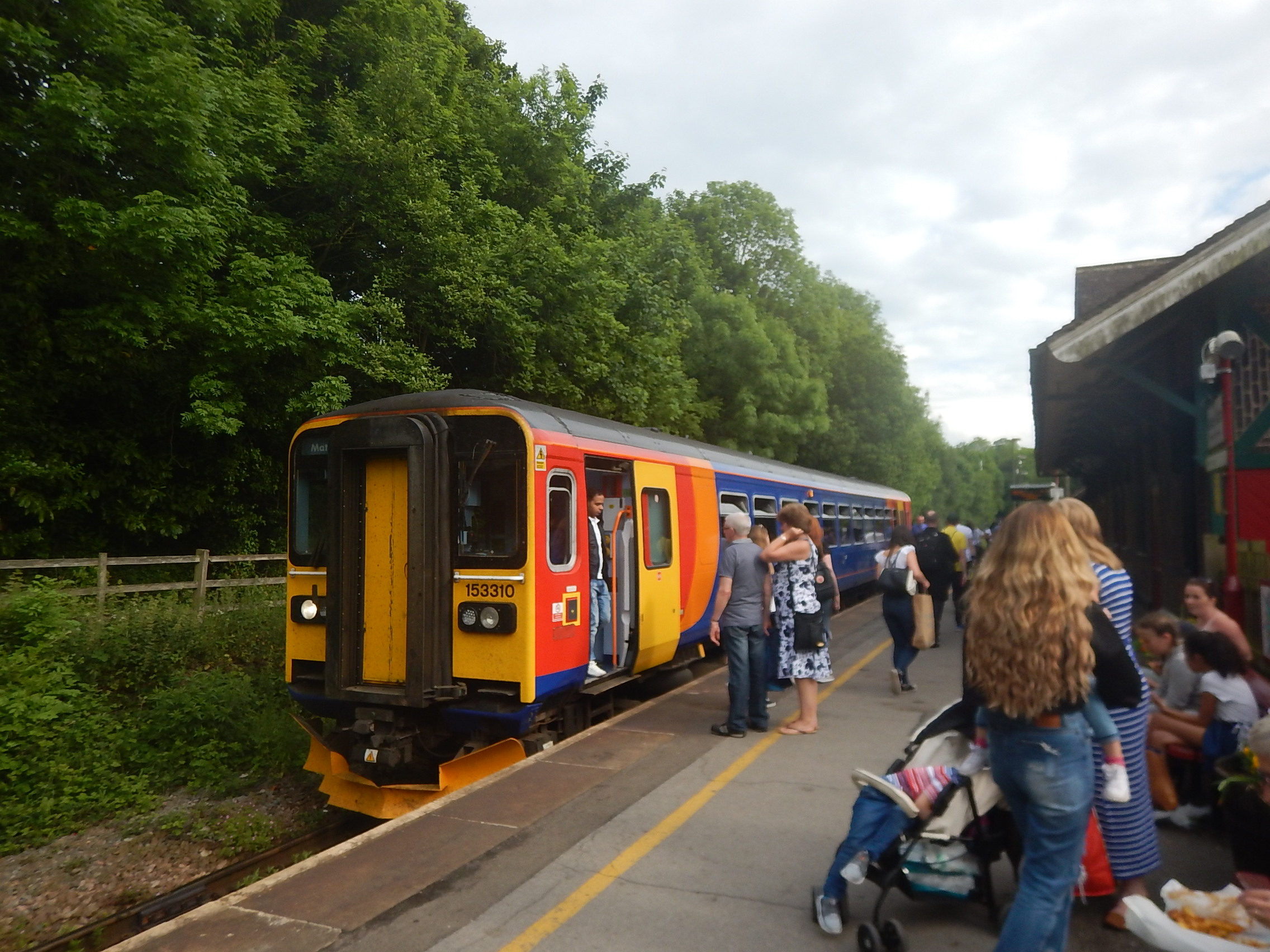
There are still around thirty in service in the UK.
Can Two Revolution VLRs Run As A Two-Car Train?
From the pictures on the web, the trains have buffers and space for a coupler, so until someone says they must always run as single units, I’ll assume they can at least run as a pair.
Can A Revolution VLR Recharge Its Batteries Using Conventional 25 KVAC Overhead Electrification?
One route, that is a possibility for running using Revolution VLR must surely be the Greenford Branch, which connects to the electrified Great Western Main Line at West Ealing station.
In this and at several other places on the network, it could be easier to charge the trains using the existing overhead electrification or an extension of it.
Another possibility; the Marston Vale Line is also electrified at both Bedford and Bletchley.
In New Mobile Rail Charging Facility For Long Marston, I talked about how Siemens are developing a mobile charger, which initially will be deployed at Long Marston.
It could be very useful for efficient operation, if the batteries on a Revolution VLR could be charged in a number of places, which included conventional electrification.
If charging only happened, whilst trains were stationary, a lightweight pantograph and appropriate electrical gubbins might be sufficient.
Can A Revolution VLR Replace A Class 153 Train?
I suspect on some routes this will be possible, but on others, the speed or hill-climbing requirements might be too stiff for the lightweight train.
But, if I was designing a train like the Revolution VLR, I’d make sure it fitted as many markets as possible.
The picture was taken at Matlock Bath station on the Derwent Valley Line, which is a single track with a fifty mph limit and an uphill climb. I suspect that the Revolution VLR would be designed to handle the uphill part of the route, but would the train be able to handle the speed of the Midland Main Line to Derby.
The Revolution VLR would probably attract more passengers, so it might be necessary to double up the service by running a pair.
Can A Pair Of Revolution VLRs Replace A Class 150 Train?
I don’t see why not!
Could The West London Orbital Use Revolution VLRs?
This might be a proposed route that could use Revolution VLRs.
The two routes would be.
- West Hampstead and Hounslow.
- Hendon and Kew Bridge.
Both services would use the Dudding Hill Line and serve Neasden, Harlesden, Old Oak Common and Acton, with a frequency of four trains per hour (tph).
Although this service could be run using conventional multiple units, it might be more affordable to use Revolution VLRs charged on sections of line that are already electrified.
Could the Greenford Branch Use Revolution VLRs?
The Greenford Branch would be a classic application and trains could be charged by fitting a charger in the bay platform at West Ealing station.
In An Automated Shuttle Train On The Greenford Branch Line, I did a rough calculation to see if an automated shuttle could achieve four tph.
Four tph might be too ambitious, but automatic trains shuttling along a branch line might be an affordable way to provide zero-carbon trains with an adequate capacity.
- The driver would drive the train using the sort of remote control used for drones.
- The driver would sit in a convenient place on the train, with CCTV to help them see everything.
- When the train was ready to leave, the driver would push a button to tell the train to move to the next station.
- On arrival at the next station, the doors will open.
- The process would repeat along the line.
If this method of operation sounds vaguely familiar, the Victoria Line has used it since 1067.
Although the Victoria Line drivers always sit in the front.
But on a line with no other trains running at the same time, all they need is a good view of the doors.
Branch lines that could be run in this way could include.
Bodmin Parkway and Bodmin General
Brockenhurst and Lymington Pier
Grove Park and Bromley North
Lancaster and Morecambe
Liskeard and Looe
Lostwithiel and Powey
Maidenhead and Marlow
March and Wisbech
Par and Newquay
Plymouth and Gunnislake
Romford and Upminster
Sittingbourne and Sheerness-on-Sea
Slough and Windsor Central
Southall and Brentford
St. Erth and St. Ives
Truro and Falmouth Docks
Twyford and Henley-on-Thames
Watford Junction and St. Albans Abbey
West Ealing and Greenford
Wickford and Southminster
Wymondham and Dereham
Counter-Terror Officers Investigate Ulez Camera Explosion
The title of this post, is the same as that of this article on the BBC.
This is the sub-heading.
Metropolitan Police counter-terrorism officers are investigating an incident where a Ulez camera was blown up using a “low-sophistication improvised explosive device” (IED).
These two paragraphs introduce the story.
The explosion happened at about 18:45 GMT on Wednesday in Sidcup, south-east London, damaging vehicles and property.
The Met has said it is treating the blast as a “deliberate act”, but not terrorism at this stage.
It also appears that the camera had been cut down earlier and then someone blew it up.
I am 76 and I know several of my generation, who experimented with explosives. One, who was an American, blew his hand off.
But speaking to my children, none said they had experimented.
Is it, that my generation was born closer to World War II?
I don’t drive so ULEZs and Low Traffic Neighborhoods don’t bother me, but if some blow-up cameras and deface the signs, they must bother others.
I can’t help feeling that Sadiq Khan is introducing policies, that some violently object to!
I doubt that is a sensible policy, both practically or politically.
Hertford North Station – 6th December 2023
I went to Hertford North station this morning and took these pictures.
















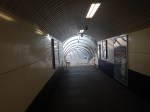
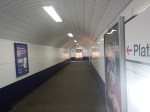
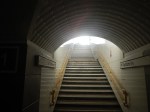
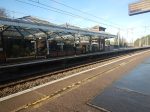

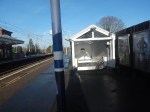
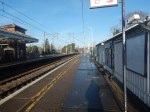
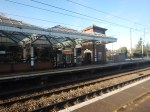
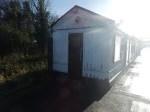
Note.
- Getting to Platform 1 is not easy.
- There would appear to be no obvious place for a lift.
- The traditional signals are still working.
- There is a cafe/shop in the station.
With some sympathetic refurbishment, it could be an excellent station.
I have some thoughts.
Digital Signalling
The digital signalling is currently being rolled out on the Northern City Line.
- The Class 717 train seemed to be running faster than I can remember.
- Had Network Rail been weeding the signals, as there only seemed to be one between each pair of stations?
- Currently, Moorgate and Welwyn Garden City takes around 50-53 minutes.
- Currently, Moorgate and Stevenage takes around 66-67 minutes.
- The average speed between Moorgate and Stevenage is only about 32 mph, which is slow for an 85 mph train.
Could the digital signalling find more time between Hertford North and Stevenage reduce the journey time to something less than an hour?
Trains For Current Schedule
I estimate that the current off-peak schedule of two trains per hour (tph) needs nine trains.
So as there are extra trains in the peak, the fleet of twenty-five Class 717 trains should be enough to be able to run the extra peak trains.
Could Four Trains Per Hour Be Run On Both Routes?
Four tph on both routes, would need something like eighteen trains, which leaves seven spare trains.
New Mobile Rail Charging Facility For Long Marston
The title of this post, is the same as that of this article from Rail Technology Magazine.
This is the sub-heading.
Porterbrook has signed a £1.7 million deal with Siemens Mobility to purchase an innovative Rail Charging Converter (RCC) for its Long Marston Rail Innovation Centre. The cutting-edge technology will make battery charging and 25kV power supply possible in areas of the UK railway where overhead line equipment is not currently available.
This first paragraph describes the system.
The RCC is a modular and containerised system that uses power electronics to provide a fully compliant, standard connection between the modern three-wire electricity grid and the single-wire railway. It essentially reduces the electrification infrastructure needed by being able to plug into existing power cables and deliver the ideal power supply for trains.
These two paragraphs describe how the RCC was designed and funded, and how it will be used in the future.
The original development of the RCC was supported by the Department for Transport through Innovate UK’s First of a Kind programme. The team will install the novel charging solution at Long Marston, enabling the charging of trains with batteries, fed from existing standard local power supply cables.
Compatible with all overhead line equipment powered trains, the small, low-cost design of the RCC enables the removal of diesel passenger train operation on routes without continuous electrification.
I suspect we’ll see other manufacturers like Hitachi ABB Power Grids and Furrer+Frey launch similar products.
This page gives full details of the award to Siemens Mobility.
Project Title: 25kV Battery Train Charging Station Demonstration
Lead Organisation: Siemens Mobility Ltd.
Project Grant: £59,910
Public Description:
The UK rail industry is committed to decarbonisation, including the removal of diesel trains by 2040.
Replacing diesel trains with electric, hydrogen or battery bi-mode rolling stock provides faster, smoother and more reliable journeys, as well as eliminating local pollution and greatly reducing carbon dioxide.
To enable clean, green electric bi-mode operation without continuous electrification requires enhancement of the power supply to existing electrification and novel charging facilities to support bi-mode trains.
No small, low-cost solution is currently available for charging facilities that are compatible with standard UK trains and locally available power supplies and space.
Siemens Mobility, working with ROSCO, TOCs and Network Rail, will deliver a novel AC charging solution enabling simple installation of small, low-cost rapid charging facilities fed from existing standard local power supply cables.
Compatible with all OLE-powered trains, the novel design enables the removal of diesel passenger train operation on non-electrified routes across the UK, while minimising land requirements and modifications required to existing station structures.
£59,910 seems to be good value for the helping with the design of a universal charging system for 25 KVAC battery-electric trains in the UK.
I have a few thoughts.
Will The Rail Charging Converter (RCC) Charge Third Rail Trains?
As new third-rail systems are effectively systems non grata, I suspect that third-rail trains will be charged by fitting a pantograph and the appropriate electrical gubbins.
Most modern third-rail electrical multiple units have a roof that is ready for a pantograph and can be converted into dual-voltage trains.
What Trains Will Be Able To Be Charged Using An RCC?
I suspect it will be any train with a battery, a pantograph and the appropriate electrical gubbins.
Battery-electric trains that could have a pantograph include.
- Alstom Electrostar and Aventra
- CAF Civity
- Hitachi Class 385 train
- Hitachi Class 800 train
- Siemens Desiro and Mireo
- Stadler Class 777 train
- Stadler Flirt and Akku
- Vivarail Class 230 train
I suspect it could charge all trains in the UK, where batteries have been proposed to be added.
What Is Meant By Mobile?
I suspect transportable and temporary would be a better description.
This gallery show Felixstowe station and a Class 755 train, which can be fitted with batteries.
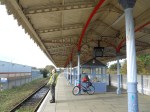
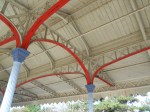
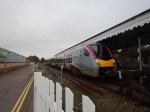

Suppose that testing was to be done at Felixstowe of a battery-electric Class 755 train.
- The containerised electrical system would be placed somewhere convenient.
- A short length of overhead wire would be erected in the platform.
- The system would then be connected together and to the electrical supply.
- After testing, it could be used to charge a train.
It would be very convenient for operation of the railway, if it could be installed and taken out overnight.
Conclusion
It looks a well-designed system.
Wales’ Public Transport Priorities All Wrong, Expert Says
The title of this post, is the same as that if this article on the BBC.
This is the sub-heading.
The Welsh government has got its priorities wrong over public transport, an expert has said.
These five paragraphs outline the story.
Ministers should have improved bus and train services before reducing speeds from 30mph to 20mph on many Welsh roads, said Stuart Cole, Emeritus Professor at University of South Wales.
He said public transport facilities should have been “put in before any other anti-motorist legislation”.
The Welsh government said current arrangements were complex across Wales.
But Prof Cole said the Welsh government had “gone about it the wrong way round” although “what they’ve done is not in itself a bad idea”.
He said he wanted to see Wales emulate the Netherlands, where there’s been massive investment in trains and buses to entice motorists out of their cars.
I agree with Professor Cole and I feel that the Welsh Government’s approach has been all stick and no carrot!
He also criticises the lack of a Welsh travel card.
The article gives a classic example of bad transport planning.
Llanelli, in Carmarthenshire, which happens to be Transport Minister Lee Waters’ constituency, is a good example of how buses and trains are not integrated.
The bus station is a mile away from the train station, and there are no buses linking the two.
In fact there are no buses at all from the railway station.
There must be other examples like this all over the country.
Perhaps we need a UK-wide complaints department for idiocies like this.
British Land Unveils Plans To Transform London’s Euston Tower Into A Life Sciences And Innovation Hub
The title of this post, is the same as that of this press release from British Land.
The Wikipedia entry for the Euston Tower gives this paragraph of history.
The site was developed by Joe Levy who bought properties along the north side of Euston Road to enable him to build a complex of two tower blocks with office shops and apartments. The building, which was designed by Sidney Kaye Eric Firmin & Partners in the International style and built by George Wimpey, was completed in 1970. It is 36-storeys and 124 metres (407 ft) high. Early tenants included Inmarsat and Capital Radio.
When you get to over fifty years old, various parts of your body get tired and I suspect it is the same with buildings.
These are the two bullet points of the press release.
- Euston Tower represents a major retrofit and redevelopment opportunity at the heart of London’s Knowledge Quarter
- Proposals aim to transform the building into a world-class net zero home for world-leading life science and innovation occupiers
These two paragraphs then add a bit more vision.
Leading property company British Land has unveiled plans to redevelop Euston Tower through an innovative combination of retention, re-use and an ultra-low carbon new structure. The plans would transform the building into a pioneering, modern, net zero workspace for cutting-edge businesses of all sizes, including new world-class, lab-enabled spaces at the heart of London’s Knowledge Quarter.
Currently under discussion with Camden Council and other local stakeholders, the vision for Euston Tower will lead the way in low carbon retrofit and construction techniques, using inclusive design which creates high quality workspaces and continues to support the local community and economy. The current proposals will bring forward lab-enabled spaces for start-up and scale-up innovation businesses, as well as spaces for the local community to support education and training opportunities.
These are points from the press release.
- Leading the design are award-winning Danish architecture practice 3XN.
- They are supported by London-based architecture and landscape studio DSDHA who re-designed much of Broadgate’s public realm, including Exchange Square.
- In line with British Land’s longstanding commitment to net zero development, the design’s sustainability strategy is based on retaining, re-using and re-cycling existing material, specifying low carbon and recycled materials where new is required and only using certified carbon offsets as an action of last resort.
- This multi-layered approach to net zero development aims to create a blueprint for the sustainable redevelopment of challenging, inflexible old buildings that can be used in the future.
British Land has owned and operated Regent’s Place for nearly 40 years, which means they must have a lot of knowledge about how best to develop the building and its surroundings.
They certainly seem to be applying a modern net-zero approach to a building that was iconic and modern in the 1970s.
This afternoon I walked down the Euston Road between Euston and Great Portland Street stations and took these pictures.



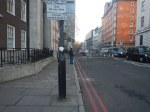










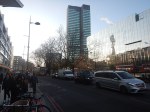


























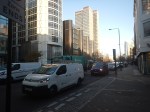


Note.
- Euston Station is a shadow of its former self.
- Euston Tower is the boxy tower on the North side of Euston Road.
- University College London Hospital (UCLH) is the tower on the South side of Euston Road.
- I believe the glass-fronted building opposite the hospital and Euston Tower contains a lot of BT infrastructure.
I have some thoughts.
Traffic Along The Euston Road
I took the pictures around 1400 in a Friday and they show how busy the Euston Road is most of the time.
According to the Wikipedia entry for the Euston Road, there was a plan to remove the underpass.
In the early-21st century, the Greater London Authority commissioned a plan to improve the road from the architectural firm, Terry Farrell and Partners. The original study proposed removing the underpass (which was subsequently cancelled) and providing a pedestrian crossing and removing the gyratory system connecting the Tottenham Court Road and Gower Street. The scheme was approved by the Mayor of London, Ken Livingstone as “the start of changing the Marylebone to Euston road from a highway into a series of linked public spaces.” The pedestrian crossing opened in March 2010. Livingstone’s successor, Boris Johnson, favours keeping the Euston Road underpass and declared it to be a good place to test his nerves when cycling around London.
Nothing is said about, where the traffic would have gone, if the underpass had been closed.
I walked along the South side of the Euston Road past the hospital and the air couldn’t be considered clean. As I write this, this website rates it Hazardous.
If we ignore the pollution for pedestrians and cyclists, is it really a road, that is fit for the purpose of moving traffic between King’s Cross and Baker Street, and vice-versa? I don’t think so!
The UK Needs More Lab Space
Cambridge innovators and developers were always saying they needed more lab space.
I also suspect, they are moaning in Oxford too!
So building high-quality space in London could reduce the pressure.
In Canary Wharf Boosts Its Science Ambitions, I talked about the ambitions of Canary Wharf to be a life sciences hub.
The Euston Tower Is Well-Connected
Consider.
- The Euston Tower is within walking distance of Euston, King’s Cross and St. Pancras stations, with all their long distance connections.
- The Euston Tower is within walking distance of Euston Square, Great Portland Street, King’s Cross St. Pancras and Warren Square stations, with all their Underground connections.
- There are buses everywhere.
But that’s not to say, that these links cannot be improved.
Euston High Speed Two Station Could Be Euston Tower’s Sister?
This Google Map shows the location of Euston Town and the proposed Euston High Speed Two station.
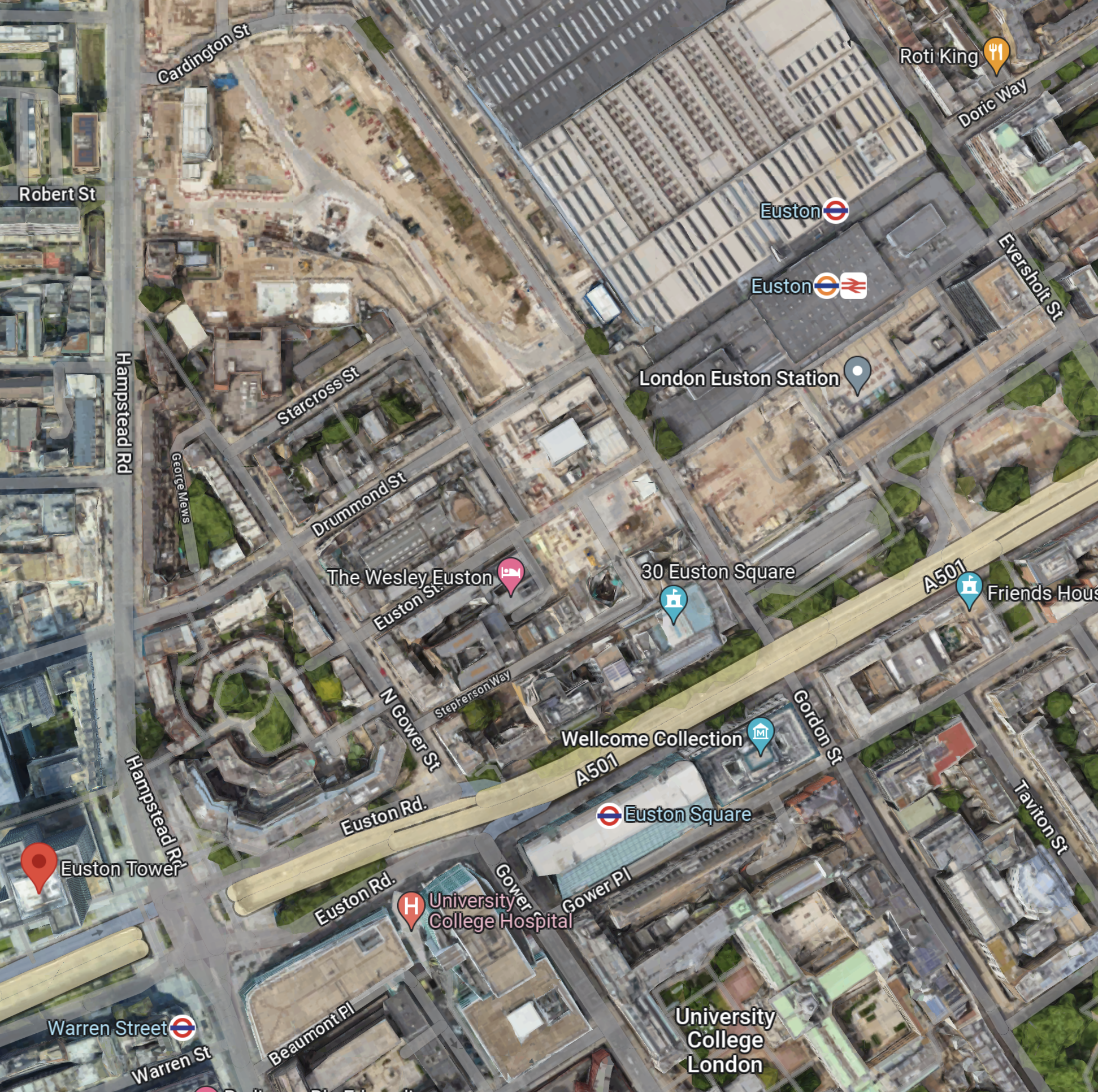
Note.
- Euston Tower is marked by a red arrow in the South-West corner of the map.
- The existing Euston station is in the North-East corner of the map.
- The High Speed Two station will be built along the Western side of the existing station.
With good landscaping, an excellent walking route, and perhaps a people mover Euston Tower could have superb connections to the rest of the UK.
Cycling And Walking Could Be A Possibility!
This Google Map shows the wider area around Euston Tower.
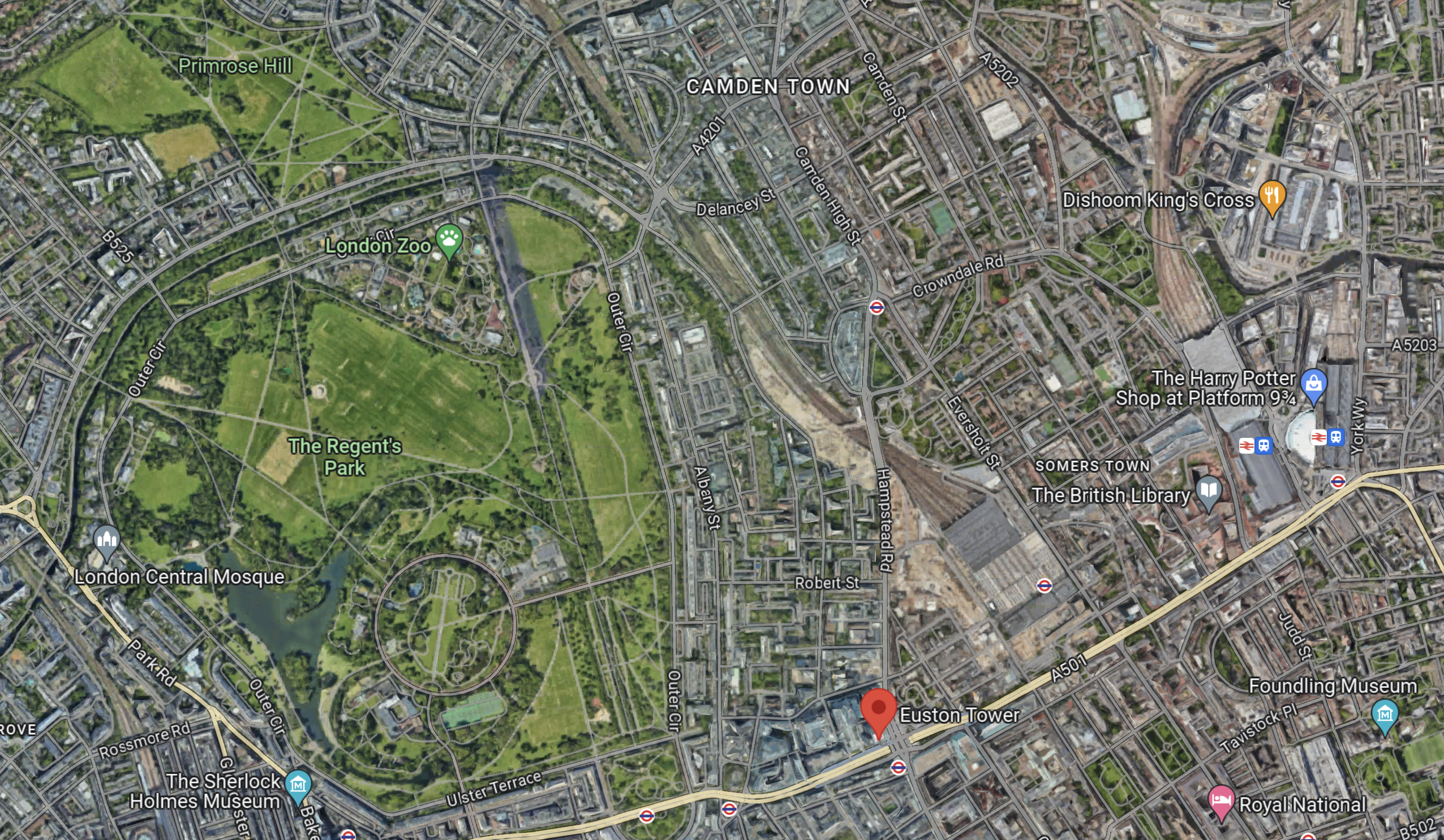
Note.
- Euston Tower is marked by the red arrow towards the bottom of the map.
- To its West lies the cycling- and walking-friendly spaces of Regents Park and Primrose Hill.
In the 1970s, I regularly walked or cycled across the park from where we lived near Primrose Hill to a client in Great Portland Street.
I also suspect other cycling and walking routes could be developed to Euston Tower from Euston, King’s Cross, St. Pancras and other stations.
Crossrail 2
Crossrail 2 would certainly help travelling to the Euston Tower, by linking Euston, King’s Cross and St.Pancras to North-East and South-West suburbs of London, with trains at frequencies of up to 30 thirty trains per hour (tph) in the central tunnel.
But.
- The new line will cost at least £31.2 billion. Who can afford it?
- The Elizabeth Line took sixteen years from approval to full opening.
- Crossrail 2 would still be a walk from Euston Tower.
So Crossrail 2 is unlikely to be any help to the redevelopment of Euston Tower.
Improving The Sub-Surface Lines
The Euston Tower is close to two stations on the sub-surface lines; Euston Square and Great Portland Street.
Services through these stations are currently as follows.
- Circle Line – 6 tph – In both directions all day.
- Hammersmith & City Line – 6 tph – In both directions all day.
- Aldgate and Amersham- 2 tph – In both directions all day.
- Aldgate and Chesham – 2 tph – In both directions all day.
- Aldgate and Uxbridge – 6 tph Peak – 8 tph – Off-Peak
- Aldgate and Watford – 4 tph – Peak
Note.
- In the Peak there are 26 tph through Great Portland Street and Euston Square stations.
- In the Off Peak there are 24 tph through Great Portland Street and Euston Square stations.
- In this article on Modern Railways,it is said that after digital signalling is installed on the sub-surface lines, the capacity on the lines, will be 32 tph in the Peak and 27 tph in the Off-Peak.
These figures give a 33 % capacity increase in the Peak and a 28 % increase in the Off Peak.
Both Great Portland Street and Euston Square stations are cramped and not fully step-free stations and could struggle with a 28 % and upwards increase in passenger numbers.
In The New Step-Free Entrance At Euston Square Station, I detailed TfL’s plans to put a new full step-free entrance South of Euston Road at Euston Square station.
This would not directly help travellers going between Euston Tower and Euston station, but hopefully, it would help to make Euston station less crowded and more passenger-friendly.
It would certainly ease walking between University College and the hospital, and the station.
This map from cartometro shows the Underground lines at Great Portland Street station.
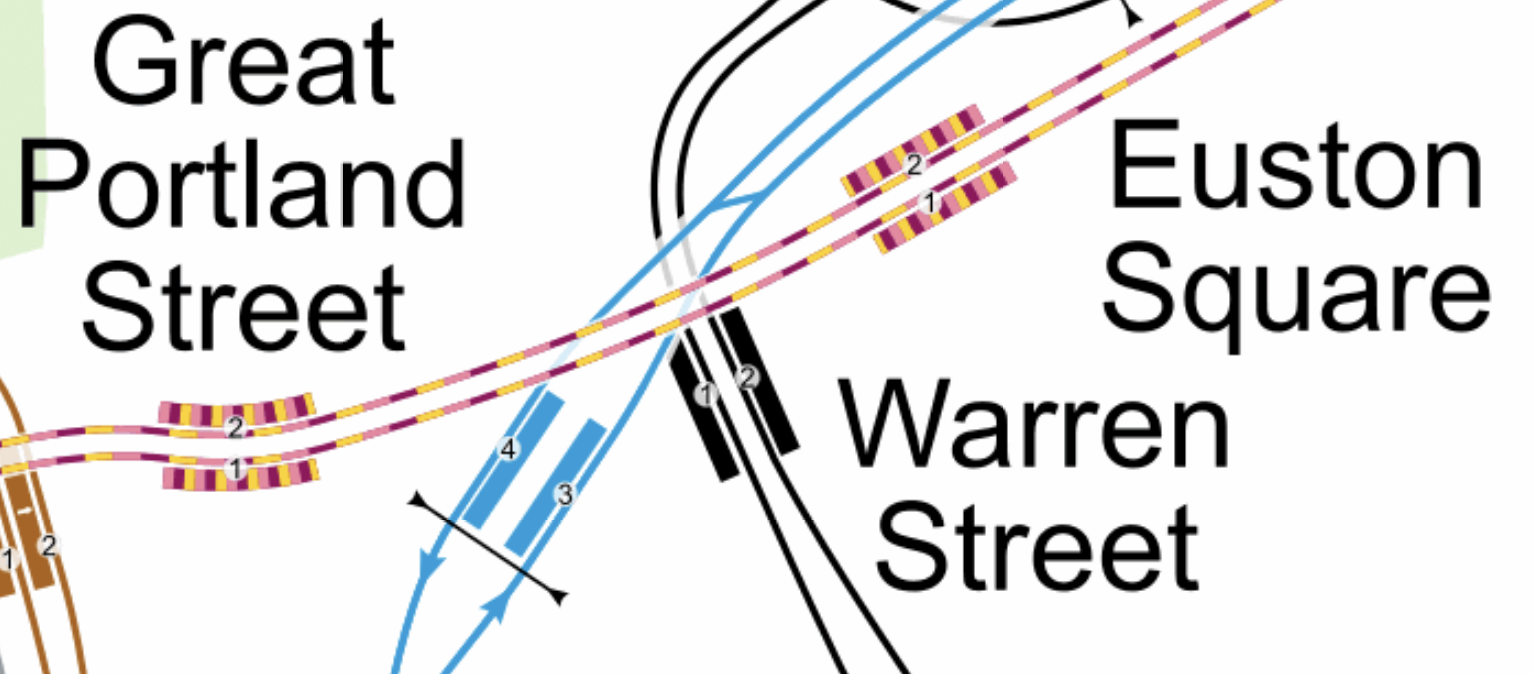
Note.
- The yellow and mauve tracks are the sub-surface lines.
- The black tracks are the Northern Line.
- The blue tracks are the Victoria Line.
This Google Map shows the Euston Tower, Great Portland Street and Warren Street stations.
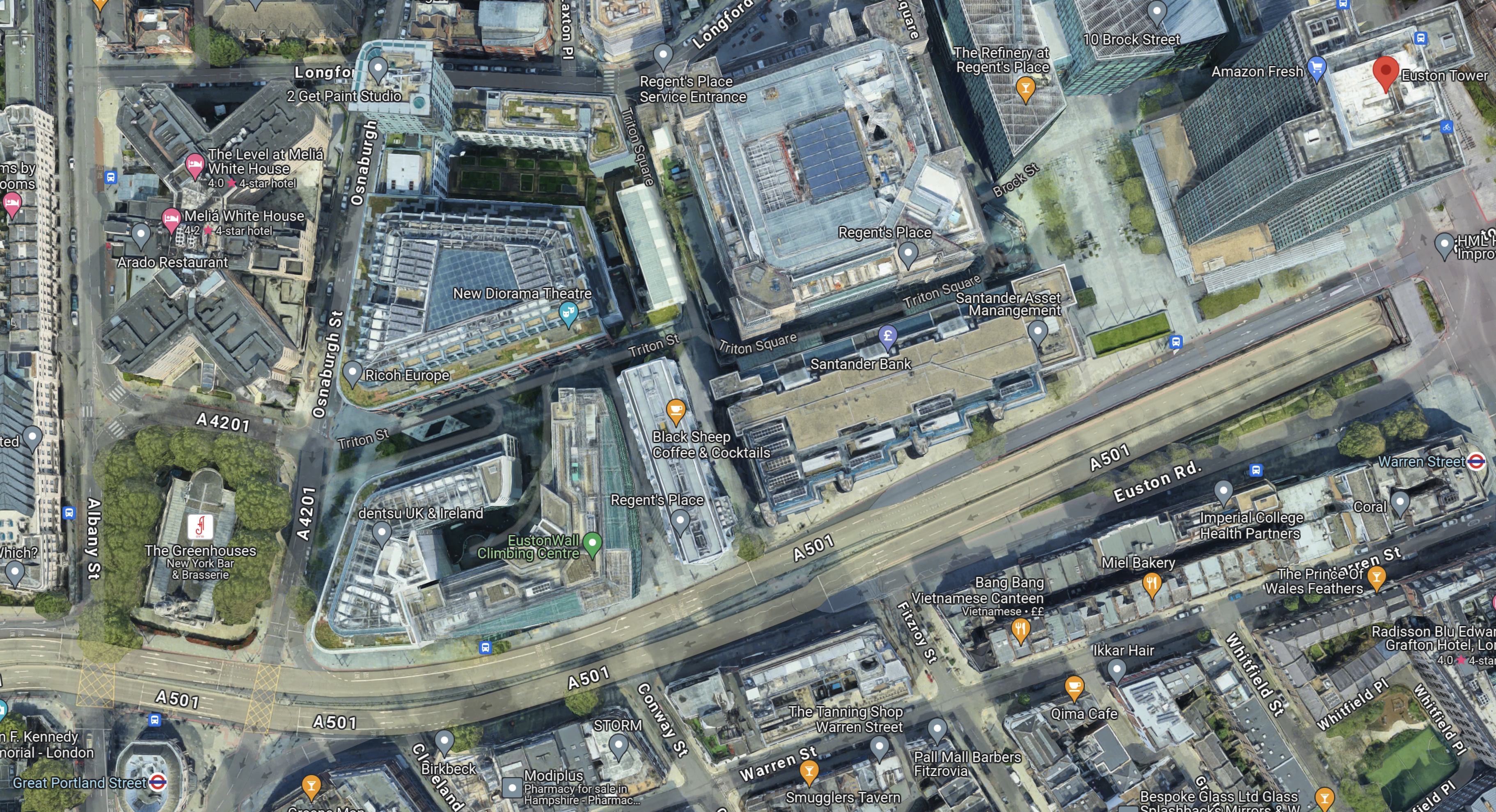
Note.
- The Euston Tower is indicated by a red arrow in the top-right corner of the map.
- Great Portland Street station is in the bottom-left corner of the map.
- Warren Street station is at the left of the map.
I wonder if the platforms were to be extended Eastwards at Great Portland Street station, that a new entrance to the station could be created perhaps fifty metres from Euston Tower.
I am convinced that the extra passenger traffic created by the life sciences and innovation hub can be handled by an augmented transport infrastructure, which would rely mainly on planned improvements to the sub-surface lines, which are approaching their final stages.
Conclusion
Converting Euston Tower into a life sciences and innovation hub is a plan that I believe can work well!
I would recommend the following improvements to public transport.
- The planned extra step-free entrance to Euston Square station on Gordon Street is constructed.
- An extra fully step-free entrance is built at the Eastern ends of the platforms at Great Portland Street station, which would be about halfway between Euston Tower and the station.
As improvements to the signalling of the sub-surface lines will deliver an upwards of 27 % capacity on the sub-surface lines, the life sciences and innovation hub might as well take advantage.
Treforest Estate Station – 28th November 2023
On Tuesday, I went to South Wales to look at the progress of the South Wales Metro.
I took these pictures at Treforest Estate station.
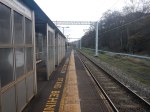
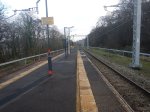
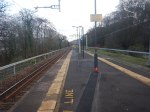
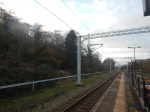
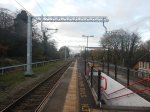
Note.
- The station has a narrow island platform.
- Aberdare, Merthyr Tydfil and Treherbert trains go through here. but on Tuesday not all were stopping.
- It was rather cold and draughty.
- The electrification looks to be of high quality.
This OpenRalwayMap shows the tracks through the station.
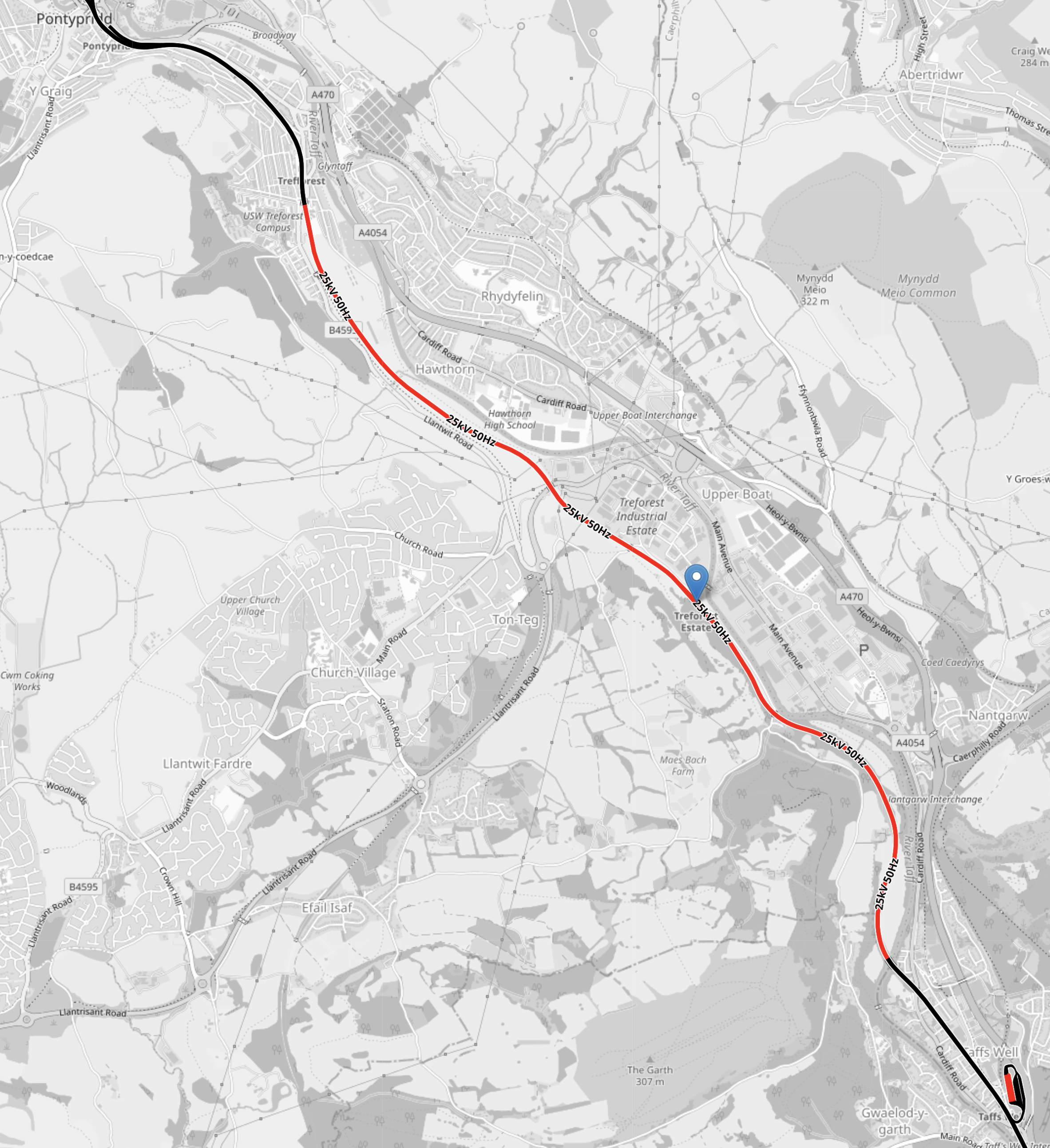
Note.
- Electrified lines are shown in red.
- Unelectrified lines are shown in black.
- Pontypridd, where the tracks are not electrified is at the top of the map.
- The strange squiggle in the South-East corner of the map is Taff’s Well Depot.
- The blue arrow indicates the position of Treforest Estate station.
This OpenRalwayMap shows the station at a larger scale.
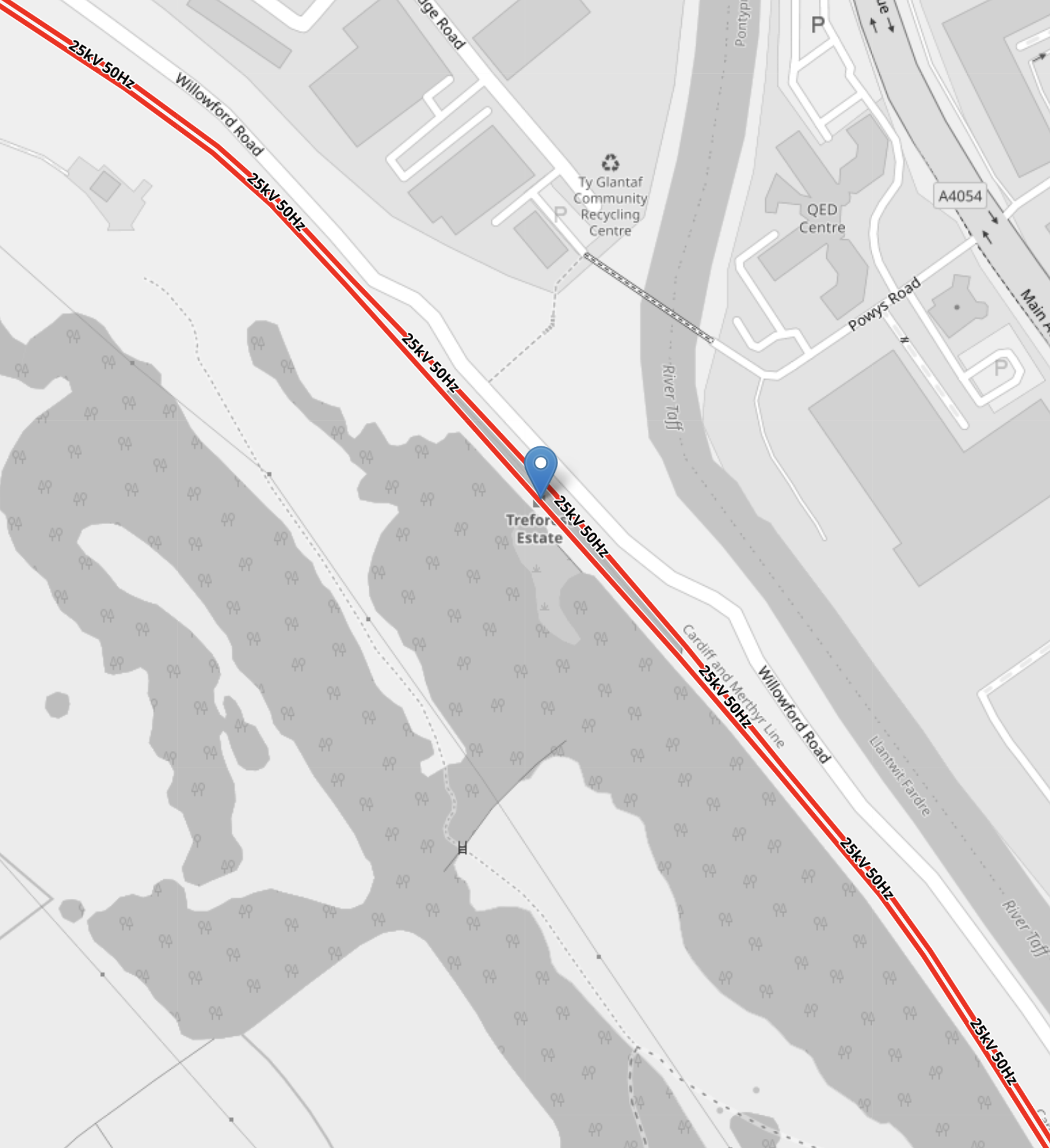
Note.
- Electrified lines are shown in red.
- Unelectrified lines are shown in black.
I wonder if the drivers will raise and lower the pantograph in Treforest Estate station. Or will this be automatic?
Abercynon Station – 28th November 2023
On Tuesday, I went to South Wales to look at the progress of the South Wales Metro.
I took these pictures at Abercynon station.
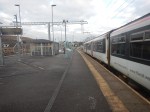
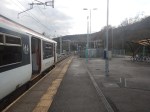

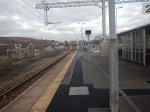
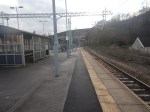
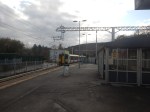
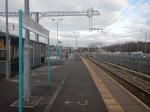
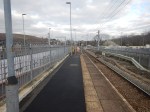
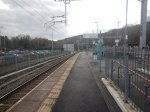

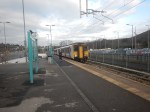
Note.
- The station has a wide island platform.
- The Aberdare and the Merthyr Tydfil branches merge here.
- It was rather draughty.
- The electrification looks to be of high quality.
This OpenRalwayMap shows the tracks through the station.
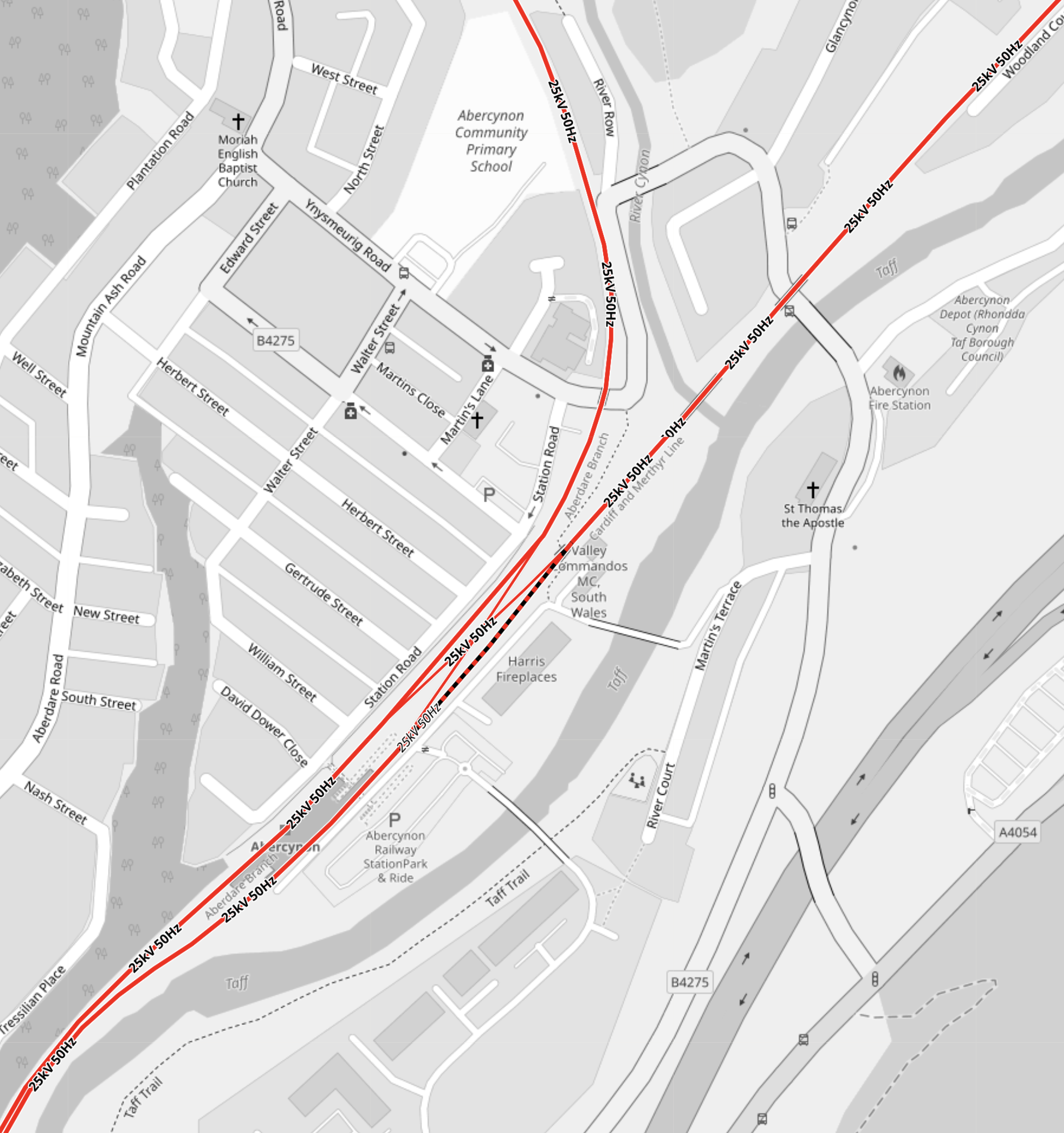
Note.
- Electrified lines are shown in red.
- Unelectrified lines are shown in black.
- The single-track going North is the Aberdare branch.
- The single-track going North-East is the Merthyr Tydfil branch.
- There is a crossover to the North of the station, so that trains can go where they should.
- The single platform is the grey-shaded area between the two tracks.
- The tracks are electrified to the South.
It is a neat simple station, that also allows passengers to travel between stations on different Northern branches.
The Increase In Passenger Capacity
Consider.
- Currently, there are two Class 150/2 tph on both Northern branches.
- This means current capacity is 596 passengers per hour.
- After electrification, there will be four Class 398 tph on both Northern branches.
- This means future capacity is 2016 passengers per hour.
That is an increase of 238 % in the capacity.
Merthyr Tydfil Station – 28th November 2023
Yesterday, I went to South Wales to look at the progress of the South Wales Metro.
I took these pictures at the station and in the town.
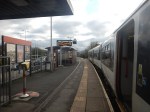
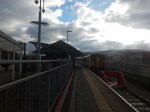






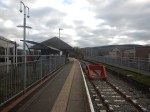
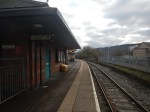
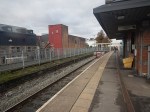
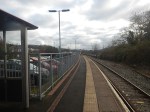
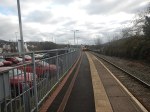
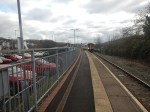
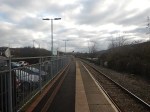
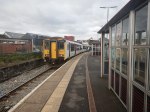
Note.
- It is only a single-platform station.
- The platform and track appear to be reasonably flat.
- Several bay terminal platforms in the UK like four of those at Dalston Junction and Highbury & Islington stations near me are able to handle four trains per hour (tph).
- The Class 150/2 trains in the are 19.74 metres long and have a maximum capacity of 149.
- The new electric Class 398 tram-trains are 40.07 metres long and have a capacity of 252.
The platform appears to be long enough for the new trains.
These are my thoughts.
Capacity To And From Merthyr Tydfil
Consider.
- Currently, there are two Class 150/2 tph.
- This means current capacity is 298 passengers per hour.
- After electrification, there will be four Class 398 tph.
- This means future capacity is 1008 passengers per hour.
That is an increase of 238 % in the capacity.
Where Is The Electrification?
This OpenRailwayMap shows the proposed electrification at Merthyr Tydfil station.
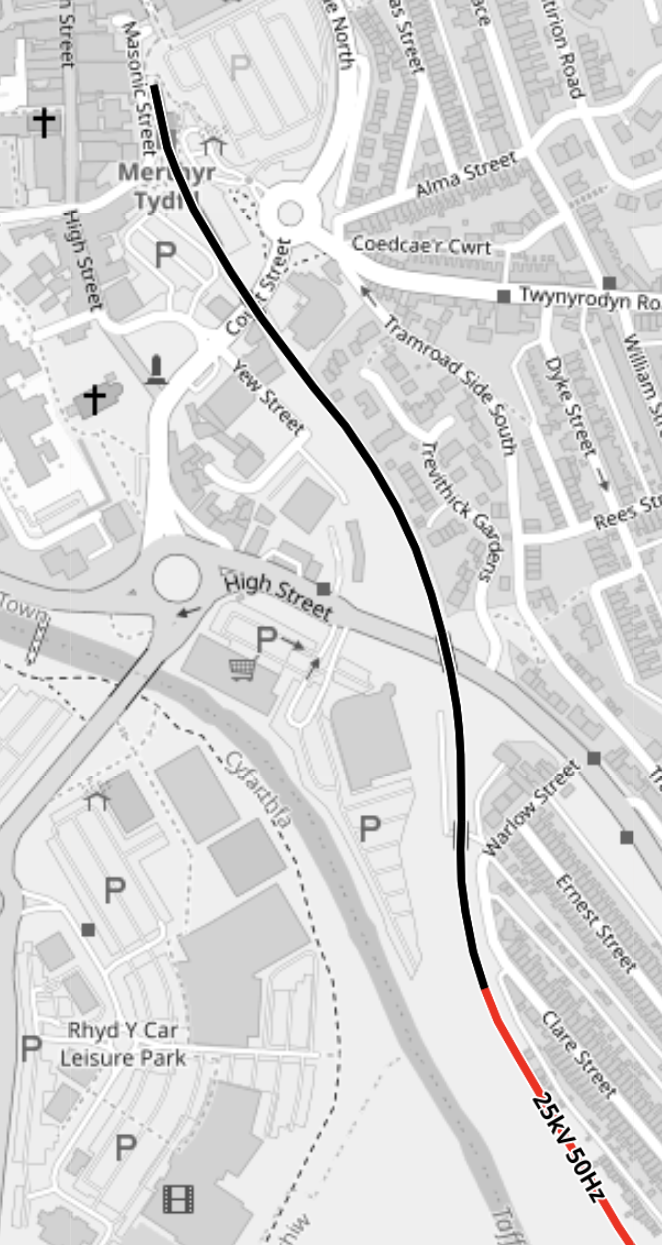
Note.
- Electrified lines are shown in red.
- Unelectrified lines are shown in black.
- The railway is single-track until past Troed-y-Rhiw, after which it is double track to Merthyr Vale station.
- Between Merthyr Vale and Abercynon is single-track, with a short length of unelectrified double-track at Quaker’s Yard station.
It appears that the section of the Merthyr Line at Merthyr Tydfil station will not be electrified.
- The tram-trains’ batteries must be large enough to climb the unelectrified section .
- There must also be enough power to nudge the tram-train back down the hill, after the climb has been completed.
- At least the pictures show, that the track in Merthyr Tydfil station, is reasonably flat.
It looks to be a neat piece of cost-saving design.
Why Did I Feel Better In Merthyr Tydfil?
I have been feeling under the weather lately, but I felt a lot better in Merthyr!
Was it the altitude of 180 metres?
My cardiologist friend, says most people feel worse at altitude. But I seem to be the other way round.
My wife was certainly feeling rough, when I drove a car up to 13,000 feet in the Andes of Ecuador, whereas I was fine.
Incidentally, the car was coughing and wheezing like a good ‘un.
First Digitally Signalled Passenger Train Comes To Northern City Line
The title of this post, is the same as that of this article on Rail Advent.
These two paragraphs introduce the article.
The Northern City Line experienced its first taste of digital signalling, as a passenger train controlled by the in-cab technology ran between Finsbury Park and Moorgate on Monday the 27th of November.
The introduction of this type of signalling – known as the European Train Control System, or ETCS – is a first step towards wider adoption across the rail network and represents an important milestone in the government-backed £1.4bn East Coast Digital Programme (ECDP). The programme is designed to improve journeys between London and north of Peterborough, with reliability and environmental outcomes at the forefront of the project’s deliverables.
I hope that one of the benefits will be more trains between Moorgate and Hertford North, Stevenage and Welwyn Garden City.
 The Anonymous Widower