Under Silicon Roundabout
I had to pass through the maze of passages at Old Street Station underneath Silicon Roundabout this morning.
Someone has been decorating.




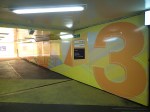



It’s certainly brightened up a dull corner of London.
Could Transport for London Run A Tourist Train On The East London Line?
The East London Line of the London Overground is a railway line with lots of history, that runs through the Thames Tunnel, which was built my the father and son, Marc and Isambard Brunel.
Could it be turned into a tourist attraction for East London, without interfering with its main function as a valuable cross-river railway line?
In Berlin, they used to run a specially-converted panorama train on the S-bahn, but I couldn’t find it on my last visit.
Obviously, to have a non-standard train or two would be expensive, but small modifications might be possible to enhance its value to visitors, when all the other modifications that will happen are taken into account.
For example, I think that in a few years time, a substantial number of London’s buses and trains will have free or more likely sponsored wi-fi. So could a tourist commentary be broadcast through this to passengers? As I detailed in this post, you can already download audio guides for the Docklands Light Railway.
The East London Line is covered by four services to four destinations in the south and two in the north. All go through the Thames Tunnel, but one between Dalston Junction and New Cross stations is a fair bit shorter than the others and the service is scheduled with just two trains, shuttling north and south every fifteen minutes with a wait time at each end of the line of eleven minutes.
So how could these trains and stations be improved to provide a better service for visitors?
1. I don’t know about New Cross, but Dalston Junction doesn’t have a café, although I think at both stations, there is space on the platforms for a quality coffee stall.
2. If the trains were wi-fi enabled, the trains could have video cameras giving forward and backward views as the train progressed.
3. I would also put sideways facing lights on the two trains, so that, when passing through the Thames Tunnel, the Victorian structure could be illuminated. One of the good features on the Class 378 is that they have fairly wide windows, that give a good view.
4. On the Overground, many trains used to have a conductor. But could a trained tourist guide/conductor be provided on these trains? I suspect they could.
The East London Line is a railway line unique in London and probably in the UK and the wider world, as where else do you pass through such an important Victorian tunnel, that is so rich in history and engineering, and is in such a superb state?
Assets should be made to sweat! Especially, where they have the potential to create jobs.
I’m Very Disappointed This Morning
One of my ambitions is to walk under the River Thames through the Thames Tunnel.
This weekend a walk through the tunnel is possible, as work on the line means no trains will be running. But all the tickets have gone!
I am very disappointed that I didn’t see the initial announcement. I suspect it was only displayed on the Brunel Museum website.
Are Small Energy Companies Struggling?
I’ve just read this article on Blue and Green Tomorrow entitle ‘Unprecedented’ growth forces small energy suppliers to battle customer service issues. The first paragraph summarises the article well.
While dissatisfied energy customers are turning their back on the ‘big six’ suppliers, smaller firms are increasing their number of customers, but their exponential growth is also leading to higher complaints.
I have no current customer services issues with Ovo, who I switched to in December. Although earlier, I did have some issues with their login system.
I would expect that just like any new industry, these small energy companies will have customer service issues in their infancy, as more customers join before the staff are recruited and trained to deal with any problems.
It’s Only A Toilet For A Train
Some of the designs that impress me are ones where something is properly redesigned for the twenty-first or even the twenty-second century, often re-using the current outdated infrastructure.
That is why I like some of the architecture in the UK like the British Museum, the Tate Modern and Kings Cross Station have been extended in a modern style.
The UK Rail Industry has several stations on my list of good improvements, but it is also good at updating rolling stock. The stopgap High Speed Trains are still thundering to the extremes of the UK and who would predict, when the last one is retired from active service? If I live to a hundred, I suspect that some of these trains will outlive me! After all they would become a marketing man’s dream on a long tourist route like down to Cornwall, up to the North of Scotland or perhaps across Australia or Argentina, offering unprecedented comfort in a vintage train. We’ve also got the example of the HST’s humble cousins, the Class 455, which scrubbed up so well, some passengers thought they were new trains.
The UK Rail Industry has an expensive road block coming up in 2020, with the Persons of Reduced Mobility (PRM) legislation coming into force. Many older trains like the Class 156 would have to be scrapped and replaced if they couldn’t be updated to meet the new regulations.
But never underestimate the power of good design and engineering and one of the biggest problems of the refurbishment of the Class 156 described here, namely a fully-accessible toilet has been solved.
The new toilet has been designed and built by PCC.eu and they call it a Comfort Zone. I first saw it described in this month’s Modern Railways.
As I travel occasionally on some of the Greater Anglia trains, that have now been updated, I shall be interested to see how it works in practice.
As the floorspace needed is smaller than the traditional PRM toilet and providing decent on-train facilities is not just a UK problem, it looks to me that this is a classic where-there’s-muck-there’s-money design.
It also shows that one of the best ways to make money is to design or invent something.
Train Information To Be Free To Developers
The Rail Industry is going to open up its database, so that all train running and timetabling information will be available free to software developers. It is reported here on the Modern Railways web site.
This may seem quite small and technical, but it is an interesting change of philosophy by a public body.
I’ve always believed in giving access to data in a comprehensive manner, when that data is anonymous and disclosure is in the public interest.
For instance, a programme could be written, that collates and analyses some specific data on the rail network, that might be required by a local politician, who is getting complaints about the rail service.
But that is only a simple example and knowing the skill of software developers, free access to the data, will spawn some very useful applications.
The article doesn’t say if passenger journey statistics will be available, but this might be very useful to develop a system, which helped show a company, which would be the best location for their next coffee shop or office development. Or perhaps it could suggest to a coach company, which might be the best route for a new service.
A lot of these applications are speculative, but because the data is available and free, companies with a need will use it to their advantage to grow, increase profits and create jobs.
Let’s hope that this is a first small step to opening up public data,so that companies and organisations can improve their products and services, and consumers can benefit.
Cooking Salmon The Mary Berry Way
I’m trying to get my B12 levels up and to this end. I decided to cook myself some salmon.
I found this recipe on the BBC web site, that was created by Mary Berry. It’s called baked salmon with parmesan and parsley crust.
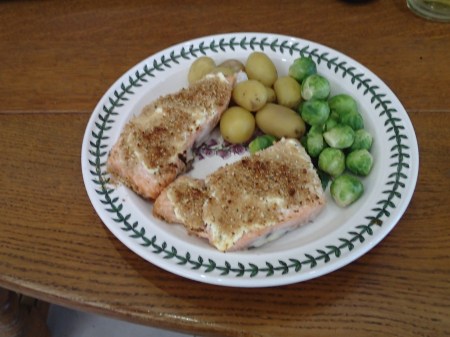
Cooking Salmon The Mary Berry Way
I cooked it using two salmon fillets from a pack and substituting a slice of Genius bread for the breadcrumbs, by pulverising it with the parmesan and parsley in my Little Chopper.
I shall be cooking it again as it was good and very tasty.
The Consequences Of A Yes Vote For Scottish Independence
I don’t care one way or another, if Scotland votes for independence or not, as I don’t think it would affect me much at all, if the decision was made for all time. Nothing would be worse than continuous referenda every two years or so.
But I’ve just read an article in Modern Railways, by their respected columnist; Alan Williams, in which he details some of the problems we might see in the event of Scotland voting for independence.
He suggests that after Sottish Independence, England and Wales might decide to adopt Central European Time, as most of the opposition is in Scotland. So if Scotland was to stay on the current time, we’d have the problem of running connected businesses like trains and power networks. I know we do it successfully with the French, but we’ve not changed our time relationship with the French for some decades.
Now this is just one of several problems he flags up with the railway industry.
How many other problems will arise in splitting other industries and utilities?
It’s not my set of problems, but it would be a rich vein for critics and comedians.
Blackpool Is Finally Going To Link The Tram To The Train
I must admit that I don’t like Blsckpool and this post in my view sums up the seaside resorts attitude to visitors.
As I say in the post, Blackpool doesn’t have many useful maps, but one of the biggest problems is that the newly rebuilt tramway, doesn’t link up to Blackpool North station. Imagine if a main line station like Kings Cross or Paddington didn’t connect to the London Underground.
But Blackpool updated the trams a few years ago spending over £80 million. Surely, this upgrade could have been stretched to connect the trams to the station.
At least now this missing link is being built according to this report on the BBC.
Hopefully next time I go to support Ipswich at Blackpool, I’ll be able to get on a tram at the station to take me to the ground.
Will The Northern Line Extension Open Before Crossrail?
That is what this article in Global Rail News is saying.
It looks to me like some clever project manager has examined the critical path and found a way to build it quicker.
Or could it be, that Crossrail has shown that digging tunnels through London has got a lot easier since they built the Jubilee Line Extension, as tunnel boring machines are now much bigger and faster? Crossrail have also shown how stations can be built independently of the actual railway, as commercial projects, at the same time as the railway is being dug or fitted out.
From Wikipedia too, it would appear that both station sites are not cramped and hemmed in by existing buildings.
So are we going to have a race between the Northern Line Extension and Crossrail, to see which opens first?
I think that Crossrail will open first, as it is a big project that has almost got successfully past the difficult parts and there are still questions to be asked of the Northern Line Extension, before construction can start.
One thing that might delay the Northern Line Extension is to build the line to Clapham Junction station in the first phase, rather than as a second one.
 The Anonymous Widower