Eating Alone In Restaurants
It is usually several times a week, that I eat a meal or have a drink in a pub or restaurant alone. I often do this in places where I’m known and may annoy the staff a bit, by talking to them too much!
But that is a problem of loneliness!
I remembered yesterday a story from my past. I think I’d driven to Bristol to do a presentation in something like 1990, and I’d not eaten particularly well. It was before my diagnosis as a coeliac, and I think lunch had probably been something like an egg salad sandwich and a Coke. Not what I’d eat now!
I was driving back by a cross-country route to Suffolk about seven and I knew that I’d told C that I was going to be home late and not to cook for me.
So somewhere in probably Oxfordshire, I happened to pass was looked to be a village pub with those magic words of Real Ale and Home Cooked Food on a sign. There were a couple of good cars in the car park and it all looked pretty welcoming. So perhaps I could have a pint and meal.
I walked in and approached the bar and ordered a pint of something real and after choosing a ham steak and chips, I asked the landlord where I should sit.
He told me to sit on the large table along the side of the bar, as that table was reserved for people eating and drinking alone, who might want to socialise.
I’m not sure what we talked about, but I did have a pleasant hour or so in that very friendly pub.
I just wonder why, so few pubs and restaurants seem to treat single people in a creative manner.
And The Winner Is!
They announced the winner of the Carbuncle Cup this week and the story is here in the Guardian. Here’s the first paragraph.
Cramped rooms with low ceilings and one small window facing directly on to a brick wall. If you crane your neck, you can just about see the outside world. It could be a description of the cells in Pentonville Prison, but these are the conditions enjoyed just down the road from the Victorian jail in a new student accommodation block for University College London – today announced as winner of the Carbuncle Cup by Building Design magazine, for the worst building of the year.
It might appear to some, that the judges thought the student residence at 465 Caledonian Road was even worse on the inside than the outside.
This is generally unusual, as I think we’ve all stayed in bad looking hotels, where the rooms were excellent.
Do We Have Too Many Site-Seeing Buses In London?
On Friday, I needed to get from Piccadily Circus to the Aldwych, which is a simple one bus journey on a 6, 13 or 23. But the whole area was in chaos because of large numbers of site-seeing buses. This one was even parked so that it blocked the Haymarket.
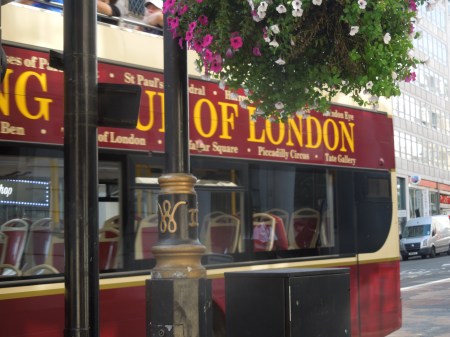
Do We Have Too Many Site-Seeing Buses In London?
Hopefully, when more New Buses for London are delivered and take over routes in the centre, the economics of taking of the annoying tourist-ripping-off site-seeing buses will take a well-deserved nose-dive.
I’m also getting rather fed up in some places in London by the annoying ticket touts for these buses, who I keep telling to Foxtrot Oscar.
An Elegant Design
One problem I have with my gammy left hand, is eating on the move, as salads can be a bit much to manage, as I really need a plate and a knife and fork.
I saw this excellent spoon/fork/knife in Cotswold in Islington this morning.
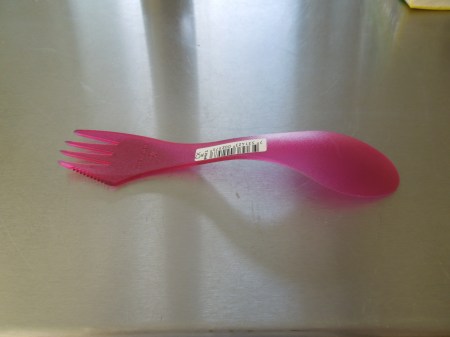
An Elegant Design
At only two pounds, I bought one.
Is This A Legitimate Use Of The Word Cripple?
Cripple is a word that was very common when I was growing up. But it is now one of those words that gets exchanged these days for something more politically correct.
On reading the latest Modern Railways, they talked about a cripple siding at Ipswich. Searching the Internet for the term found this article on the history of railway sidings. It says this about cripple sidings.
The first justification for a siding today is as a “cripple siding”. Basically if a train cannot move at normal speed under its own power, the controller will be desperate to get it off the running lines as soon as possible so that the service can continue. In effect, this is the railway operational equivalent of “any port in a storm”.
The article goes on to give two examples of such a siding in the London Underground.
Paid-For Bank Account Complaints Soar
It is being reported that complaints about paid-for bank accounts are soaring. It’s here in the Guardian. Here’s a flavour.
Complaints about wrongly sold, fee-paying current accounts are rising sharply according to data that suggests this could be the latest mis-selling scandal to hit the financial sector.
Nationwide have been trying to sell me a paid-for account for some time. It gives a whole series of things I don’t want like car breakdown cover and a guaranteed derisory interest rate on a small amount of money. They even tempt me with an Upgrade Now button on my on-line account. I wonder how many people have been fooled by it!
Lost In Translation
This story from the BBC illustrates the perils of translating.
Two years ago I saw a really mixed up sign in Swansea.
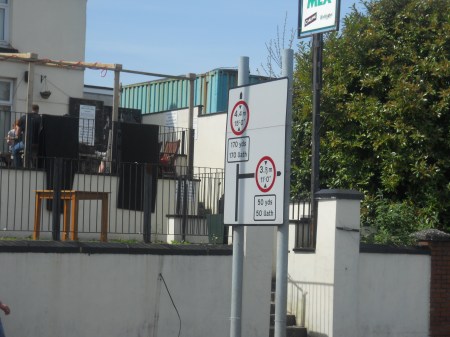
Mixed Up Signage in Swansea
I think road signs should be in one language only and understandable to everybody who drives past them. Obviously in this one, it should only be in metric units.
The Syria Debate on Radio 5 Live
I was invited to be a member of the public at this debate on College Green by the Houses of Parliament today.


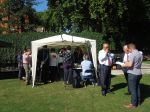
I didn’t say much, but it was an interesting experience. I found it fascinating to see how they set it all up and I think I learned something, if ever I get interviewed by the media again.
I don’t think we contributed much to the debate, but then only time will tell what will happen in Syria.
Boots Marches Into Fast Food
Boots at the Angel have taken over the Burger King next door.

Boots Marches Into Fast Food
Now there’s a way to promote health!
It’s All Dropping Into Place
If I look at my father, he had breathing problems and I suspect so did his father as he suffered from asthma and died of pneumonia and other complications in his forties. Both were pretty heavy smokers and my grandfather was a heavy drinker too. My father used to tell stories of picking his father up late at night from various clubs in a very bad state and that’s probably why my father was a sensible drinker and why he brought me up to be the same. I never for instance ever saw my father drunk. My father’s only addiction other than his pipe, was industrial strength menthol catarrh tablets, which he consumed virtually all day, to try to get his throat clear.
As a child, I suffered similarly with my breathing and throat at times, but then we lived in a cold house, heated by electric fires, which must have made the air exceptionally dry. From about the age of eight, I had a south-facing room with big picture windows, which was very warm at times. I regularly, lost a term, usually the spring one, in my schooling. My doctor had no idea, about what was the problem, so they took my tonsils out, which was an all-purpose remedy in those days.
Things improved when I got to about twelve or so, and my parents just felt, I’d grown out of it. It could be that we were spending increasing time at Felixstowe, where my parents had bought a house to retire to, or it could be that I spent more and more time at my father’s print works in Wood Green. Who knows why? I don’t even have any medical records from that period, as my medical records restarted some time about 1969. So you can see why I’m all in favour of computerised medical records, which the patient can access when and where they want through the Internet!
I can remember my late teens very well and can’t ever remember going to the doctor or feeling unwell, especially at University in Liverpool, whilst working at Enfield Rolling Mills or in The Merryhills, or generally riding about on my bicycle.
I certainly didn’t feel ill, either in the early years of my marriage to C, either in Liverpool or in Melbourn near Cambridge. The first entry on my medical record, is a visit to the doctor in Melbourn about excessive diarrhoea, which looks like a classic glutening.
However things got a lot worse, when we moved to Shannon Place in St. John’s Wood. The flat was damp and cold and I can remember going to the doctor with lots of knee and arm pains. He recommended knee surgery, which I didn’t accept.
But then when we moved to the eleventh floor in Cromwell Tower, everything got better and in the three or four years we lived there, I never saw the doctor on my own behalf. But the flat was comfortably warm and the air was very fresh.
We then lived in Suffolk for forty years and only at odd occasions did my breathing problems come back.
That is until Celia died and I think in certain ways I reverted to my childhood habits; like wrapping myself in the bedclothes, keeping the house as warm as I could and avoiding going out. I started getting what looked like hay fever soon after C died in 2007.
Since my stroke and also since moving to London it has got a lot worse, but I’m now in a particularly airless house with little ventilation.
It might need to have heat recovery ventilation. Wikipedia says these are the benefits.
As building efficiency is improved with insulation and weather stripping, buildings are intentionally made more airtight, and consequently less well ventilated. Since all buildings require a source of fresh air, the need for HRVs has become obvious. While opening a window does provide ventilation, the building’s heat and humidity will then be lost in the winter and gained in the summer, both of which are undesirable for the indoor climate and for energy efficiency, since the building’s HVAC systems must compensate. HRV introduces fresh air to a building and improves climate control, whilst promoting efficient energy use.
Certainly, a proper system will be better than I’ve got now.
 The Anonymous Widower